Buyer Fit Snapshot
| Best fit | branded packaging for customer loyalty decision review for packaging buyers comparing material specs, print proof, MOQ, unit cost, freight, and repeat-order risk where brand print, material, artwork control, and repeat-order consistency matter. |
|---|---|
| Quote inputs | Share finished size, material target, print colors, finish, packing count, annual reorder estimate, and delivery region. |
| Proofing check | Approve dieline scale, logo placement, barcode or warning zones, color tolerance, and any recyclable or compostable wording before bulk production. |
| Main risk | Vague material claims, crowded artwork, or missing packing details can create delays even when the unit price looks attractive. |
Fast answer: Branded Packaging for Customer Loyalty Decision Review: Dieline, Finish, Proof, and Buyer Review should be specified like a repeatable production item. The safest quote includes material, print method, finish, artwork proof, carton packing, and reorder notes in one written spec.
What to confirm before approving the packaging proof
Check the product dimensions against the actual filled item, not only the sales mockup. Ask for tolerance on folds, seals, hang holes, label areas, and retail display edges. If the package carries a logo, QR code, warning copy, or legal claim, reserve that space before decorative graphics fill the panel.
How to compare quotes without losing quality
Compare board or film grade, print process, finish, sampling route, tooling charges, carton quantity, and freight assumptions side by side. A lower quote is only useful if the supplier can repeat the same color, closure quality, and packing count on the next order.
I still remember a launch where the product was excellent, the ad spend was healthy, and the packaging was so forgettable that the support inbox filled with questions about the box instead of the refill schedule. That happens more often than brands like to admit. A customer receives a parcel, opens it once, and the box either disappears into the recycling pile or lodges itself in memory. Branded Packaging for Customer Loyalty lives in that second outcome. It gives the buyer something to remember, and memory, inconveniently for marketers, is usually what brings them back.
One of the clearest examples I have seen came from a 2-pound shipment in a 16 x 12 x 4-inch mailer. The item itself was ordinary; the opening experience was not. The brand used a strong outer shipper, a printed insert, and a tidy unboxing sequence that removed friction instead of adding it. That distinction matters. A plain brown box says, "We shipped it." Well-considered Branded Packaging for Customer loyalty says, "We thought about the product, the transit, and the next order." Those are not the same message, and customers pick up the difference faster than most teams expect.
At Custom Logo Things, packaging is never just decoration. The best Branded Packaging for Customer loyalty combines visual identity, protection, and a post-purchase moment that feels deliberate. That might be a printed carton, a 350gsm C1S artboard insert card, a branded mailer, or a cleaner retail packaging setup for repeat shipments. I once watched a beautiful mockup fall apart after a freight leg from Ningbo, Zhejiang, crushed the corners hard enough to make the whole thing look apologetic. The render was elegant. The real box looked tired. Packaging can be a brutally honest medium.
Teams often start with the wrong question. They ask whether the foil should be gold or silver, or whether the logo should be centered by two millimeters. I was gonna say that those choices matter, but only after the structure, print method, and assembly logic are already doing their jobs. The question that matters first is simpler: does the package make the customer feel confident enough to buy again? If the answer is no, the rest is just expensive wallpaper.
What Branded Packaging for Customer Loyalty Really Means
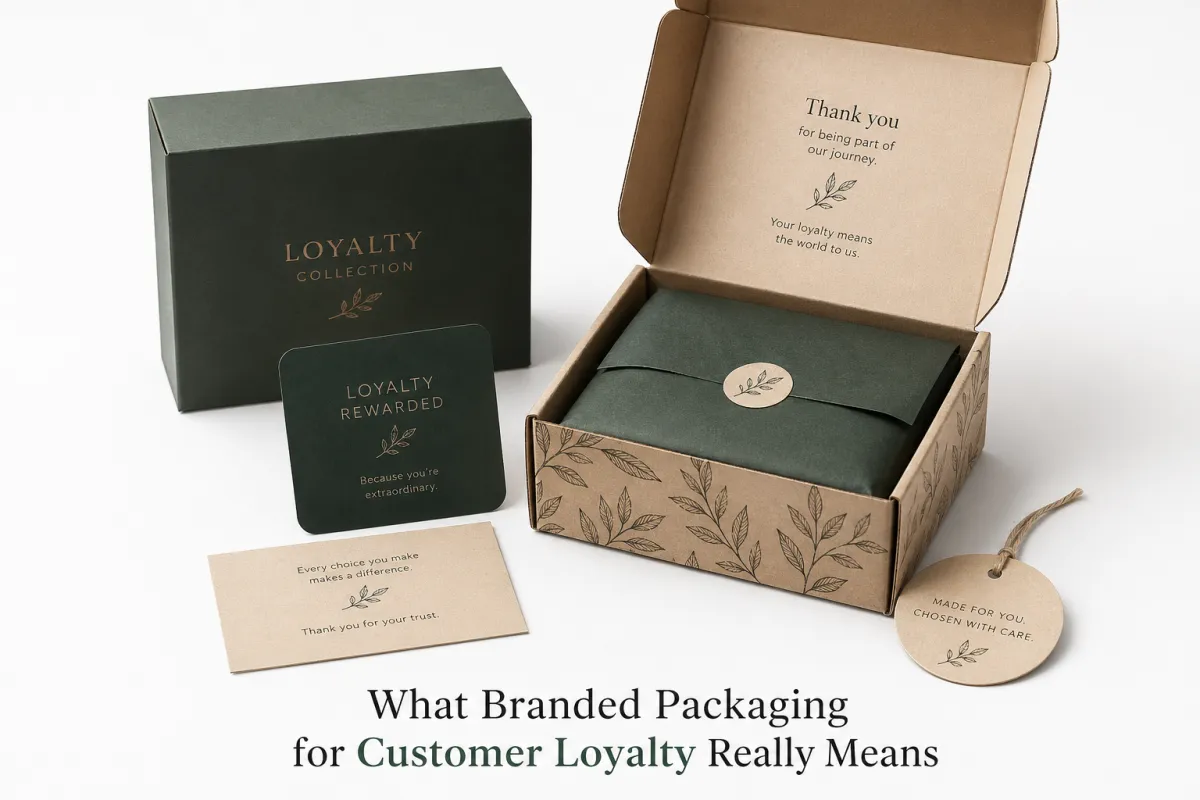
Customers remember the box longer than many brands assume. That is not sentimentality; it is behavior. Branded packaging for customer loyalty works because the package exists in the physical world, where someone touches the flap, sees the color, and decides quickly whether the brand feels careful or careless. A homepage can hide a lot. A dented corner cannot. Neither can a tape job that looks rushed or an insert that falls out before the item does.
The idea goes beyond logo placement. A shipping carton with a single-color mark, a tissue wrap in brand colors, and a clean insert can all count as branded packaging for customer loyalty if they help the customer move from unboxing to first use without friction. The package becomes part of the product story instead of a wrapper headed straight for the bin. That matters because the bin is where bad packaging goes, and customers do notice when a brand spends money on decoration while ignoring the basics.
The loyalty effect is practical, not mystical. A package that protects the item, lowers opening resistance, and gives the buyer a clear next step can shape repeat behavior more effectively than a flashy first impression. I have seen a skincare subscription brand in Austin, Texas, earn more repeat mentions from a plain but thoughtful refill card than from a metallic mailer that looked expensive and arrived dented after a 1,200-mile freight leg. That is the kind of comparison teams should keep in mind. Fancy does not always win. Sometimes boring is the part That Actually Gets reordered.
"The box was the first thing customers talked about, not the promotion," a subscription brand operations lead told me after the second reorder cycle on a 2,000-unit launch. I have heard versions of that from coffee, cosmetics, and apparel teams in Chicago, Manchester, and Seoul alike.
Consistency is the real test. Branded packaging for customer loyalty is not a one-time reveal. It has to keep earning attention across multiple orders, which means the whole system matters: the outer shipper, the inner protection, the printed message, and the way the package is assembled in the warehouse. When those pieces line up, the result feels intentional every time, not lucky once. That consistency is what keeps the experience from fading after the first unboxing video shot on an iPhone 15 Pro.
Attractive packaging and loyalty-building packaging are not the same thing. A box can photograph beautifully and still fail in transit. Another can look modest and still outperform because it opens cleanly, protects a fragile item, and nudges the buyer to reorder before they run out. That is the part of branded packaging for customer loyalty that usually gets missed. The visual finish gets the praise; the structural decision earns the retention.
I visited a folding-carton line in Shenzhen, Guangdong, once where 4,000 units were rejected because the logo sat 3 mm too close to a crease. On screen, the design looked fine. On the board, the fold swallowed the type. The production manager stared at the proof with the expression of someone who had just found out the parking meter ate the whole morning. That sort of problem is why packaging design, structural design, and fulfillment logic need to sit in the same room, especially for branded packaging for customer loyalty.
How Does Branded Packaging for Customer Loyalty Actually Work?
The mechanism is part memory, part emotion, and part perceived value. A customer opens a box that feels considered, and the brand gets credit for the entire experience, not just the item inside. That is the real engine behind branded packaging for customer loyalty: repeated cues build recognition, and recognition lowers the effort it takes to buy again. People like to think they are making purely rational choices. They are not. They remember details, especially the ones that make a purchase feel easy the second time.
Map the path a package takes. A shipping label on the outside, a printed message under the flap, a tissue wrap or insert at the second layer, and then the product itself. Each step is a brand signal. In a well-run branded packaging for customer loyalty program, those signals stay consistent across product lines, so a buyer can spot the brand before they even read the name. Familiarity is not flashy, but it is sticky, and sticky usually beats flashy in the long run.
That consistency matters more than many teams think. Generic fulfillment feels transactional. Curated packout feels cared for. The difference usually shows up in retention rather than first-order conversion, which is why I treat branded packaging for customer loyalty as a retention asset rather than a decorative line item. It can also reduce churn anxiety for subscription buyers, especially when the packaging makes the refill or reorder path obvious. If the customer has to hunt for the next step, you have already introduced friction you did not need.
One founder in Portland told me he wanted to spend heavily on gold foil because it "looked premium" on a 3D render. I asked what would happen if the box arrived crushed or the customer could not open it with one hand while carrying groceries. The budget moved into stronger corrugated board, a cleaner opening notch, and a shorter thank-you insert. The repeat feedback improved more than the original mockup suggested, and that pattern shows up often in branded packaging for customer loyalty. I do like elegant finishes, but reality is a harsher art director than any brand team.
There is also a social layer. Customers share experiences that feel specific. A clever inside print, a simple reveal, or a reuse cue can trigger an Instagram story or a review mention. That is not magic; it is the response to a package that feels worth noticing. Branded packaging for customer loyalty can support that kind of sharing without turning the box into a billboard. A little surprise goes a long way. A giant shouting logo usually just feels needy.
I like to compare it to store music in a 900-square-foot shop. Nobody walks in because of the playlist, yet the playlist changes how long people stay and whether they return. Packaging works the same way. The outer box may not win the first sale, but branded packaging for customer loyalty can shape the next one by making the experience memorable, stable, and easy to repeat. The customer may not say, "I loved the packaging," but they often feel it.
Key Factors That Make Packaging Feel Premium, Not Gimmicky
Visual hierarchy comes first. Color, typography, and logo placement should be clear, but controlled. A box crowded with every brand asset usually reads as nervous rather than premium. In branded packaging for customer loyalty, I prefer one dominant visual cue, one supporting cue, and one practical cue, such as a tear strip or a reorder note. That combination keeps the package readable from across a room and polished up close, even under retail lighting that makes every white surface look slightly blue.
Material choice matters just as much as graphics. Corrugated mailers, folding cartons, tissue, labels, and inserts each shape how the customer reads the package. A 32 ECT corrugated mailer with water-based ink behaves very differently from a 350gsm C1S artboard carton with soft-touch lamination or a 1200gsm rigid setup wrapped in coated art paper. Both can work, but only if the structure matches the product weight and the brand promise. That is the center of branded packaging for customer loyalty. The material has to carry the message instead of fighting it.
Protection is where too many teams save pennies and lose dollars. A fragile serum in a loose insert may look elegant in one photo and still break in transit after a 36-inch drop. A premium feel starts with the box closing square, the product sitting tight, and the opening sequence making sense. I once watched a buyer at a supplier meeting run a thumb along the flap edge and say, "If this catches here, my customer will blame us." He was right. That tiny comment probably saved the project from a pile of future complaints. Good branded packaging for customer loyalty often lives in details nobody notices until they go wrong.
Tactile details do a lot of work. Soft-touch lamination, matte aqueous coating, embossed logos, and a tight magnetic closure on rigid packaging can all improve perceived quality, but they need restraint. If every surface shouts, the package loses confidence. branded packaging for customer loyalty succeeds when the customer feels calm care, not pressure. There is a difference between "considered" and "trying to seduce me with cardstock."
Messaging is the quiet layer most brands underuse. A short thank-you, a refill reminder, a usage tip, or a referral prompt can deepen loyalty more effectively than another decorative flourish. In my experience, a 20-word insert that explains how to store a product in a humid bathroom in Miami can create more trust than a whole sheet of empty brand copy. That is especially true for branded packaging for customer loyalty, where function and tone have to work together. Customers remember practical help because it saves them a headache later.
Consistency across product lines marks maturity. If a customer orders a cleanser in March and a refill in May, the packaging should feel related even if the SKU changes. Same color family, same icon system, same tone of voice. That is package branding with discipline, and it helps branded packaging for customer loyalty stay recognizable without forcing every product into the same box size. The trick is sameness in language, not sameness in everything.
For teams that want a sustainability angle, ask for FSC-certified paperboard when the sourcing claim matters to the brand story. The FSC system helps verify responsible forest sourcing, but the paperwork has to match the claim exactly. I have seen brands spend money on recycled messaging and then stumble because the chain-of-custody files were incomplete. Sustainable positioning is strongest when it is precise, not vague, and that precision strengthens branded packaging for customer loyalty. Consumers are quick to spot performative language, and they are even quicker to complain about it.
Branded Packaging for Customer Loyalty: Cost and Pricing Factors
Pricing gets messy because teams compare a blank mailer to a fully printed packout and call the second one "expensive." That comparison is too thin. branded packaging for customer loyalty should be measured against returns, damage, repeat orders, and support load. If the cheaper option creates two extra damage claims per hundred shipments, the real cost is higher than the invoice suggests. I have sat through enough budget meetings to know the cheapest option often has a sneaky habit of showing up on the wrong line item later.
The main cost drivers are straightforward and easy to underestimate: print method, material grade, packaging dimensions, quantity, custom inserts, and fulfillment labor. A 5,000-piece run of Custom Printed Boxes in a simple one-color layout can price very differently from a rigid magnetic box with foil, embossing, and a die-cut insert tray. I have seen a $0.07 unit difference matter only because the sales team forgot to count hand assembly time. Seven cents sounds tiny until 50,000 units arrive and everybody suddenly becomes very interested in calculators.
Here is a realistic planning range I have used in supplier conversations from Dongguan, Guangdong, to Ningbo, Zhejiang. These are examples, not fixed rates, because freight, board availability, and finishing choices shift the numbers. Even so, they help teams budget for branded packaging for customer loyalty without guessing in the dark. I prefer a rough plan with honest assumptions over a beautiful spreadsheet that collapses the minute a supplier changes board stock.
| Option | Typical spec | Estimated unit cost at 5,000 units | Best for | Main risk |
|---|---|---|---|---|
| Budget mailer | 1-color print, kraft corrugate, label, no insert | $0.15 per unit | Low-margin subscription shipments, simple retail packaging | Less protection, less brand memory if the outside is plain |
| Mid-tier carton | 2-color print, 350gsm C1S artboard, tissue, thank-you card | $0.68 per unit | Beauty, wellness, accessories, premium DTC | Can look polished but still miss the loyalty goal if the insert is generic |
| Premium unboxing set | Rigid box, soft-touch lamination, custom insert, specialty finish | $1.94 per unit | Giftable launches, high-AOV items, flagship product packaging | Higher setup costs and more hand assembly time |
MOQ, setup fees, and shipping weight change the real spend more than many buyers expect. A short run can carry a low headline unit cost and still produce a painful total because of plates, dies, and freight. For branded packaging for customer loyalty, I usually ask clients to compare packaging cost against customer lifetime value, not against the cheapest blank box on the market. That framing tends to cut through a lot of bad assumptions fast, especially if the brand sells a $38 serum or a $120 accessory set.
A useful lens is margin plus retention. If a packout increases repeat rate by even a small amount, payback can arrive quickly, especially for consumables. A coffee brand I advised moved from plain poly mailers to a branded carton with a reorder reminder and a QR code to the refill page. The material cost rose by $0.41 per order, but the support team saw fewer "how do I reorder?" tickets and the reorder path shortened by one click on mobile Safari. That is the economics behind branded packaging for customer loyalty. Small operational gains can have outsized revenue effects.
Low unit cost can be misleading if breakage rises. The EPA encourages waste prevention and source reduction, and that pressure matters even more when returns are involved. If your packout crushes in transit, the "cheap" box can become an expensive apology. I would rather spend an extra $0.20 on board and avoid a $38 replacement shipment than keep the lower invoice and absorb the churn. You can explain a slightly higher packaging budget. It is much harder to explain why the customer received a broken product and a headache.
For teams still shaping the budget, compare a simple mailer, a printed carton, and a premium multi-component set. Then ask one question: which version actually supports repeat buying in month two, not just week one? That question keeps branded packaging for customer loyalty tied to business value instead of finishing-room vanity. A package should earn its cost by helping the customer come back, not by winning a design award on a mood board in London.
Step-by-Step Guide to Building a Loyalty-Building Packout
Start with audience and order context. A refillable body-care brand has a different packout need than a premium electronics accessory seller or a subscription snack box. I ask three questions immediately: how often do customers reorder, what kind of damage happens in transit, and what single moment should the buyer remember? Those answers keep branded packaging for customer loyalty from turning into a random bundle of nice ideas. If the answer to those questions is fuzzy, the packaging plan will be fuzzy too.
Next, audit the current journey from warehouse to doorstep to first use. Look at the box size, the void fill, the opening behavior, the first printed message, and the disposal path. If the customer has to fight tape, scissors, and a loose insert just to reach the product, the whole experience feels clumsy. That is exactly where branded packaging for customer loyalty can remove friction instead of adding clutter. I have watched a buyer go from delighted to annoyed in under 20 seconds because the tape job was a disaster. Not exactly the mood a retention strategy needs.
Then choose one primary brand moment. Do you want a reveal, a thank-you, an education cue, or a refill prompt? Pick one. I have watched teams try to cram all four into a single carton and end up with a noisy mess. A cleaner approach is to let one moment do the heavy lifting, then support it with a smaller detail. A 2-inch sticker on the inner flap can do more for branded packaging for customer loyalty than a whole page of unused copy. That tiny moment can be the thing people remember when they reorder.
- Write a short packaging brief with product weight, dimensions, fragility level, reorder behavior, and target unit cost.
- Request dielines and structure options before visual design starts, ideally from suppliers in Shenzhen or Dongguan.
- Prototype with the actual product inside, not a placeholder block of foam.
- Ship a test batch through normal fulfillment and compare damage, opening speed, and customer feedback.
- Document the assembly order so the warehouse or 3PL can repeat it without guessing.
Prototype, test, revise. That sequence sounds basic, yet it is where many projects break. Mockups can flatter a design that fails under vibration, compression, or humid transit conditions in summer warehouses at 85 degrees Fahrenheit. I ask for an ISTA transport test or an equivalent drop-and-vibration review for e-commerce shippers because packaging that survives the photo shoot but fails the truck ride does not help branded packaging for customer loyalty. The truck does not care how good the render looks.
Use internal tools too. Many brands begin by comparing ideas inside Custom Packaging Products, then grounding the visuals with a few real case studies from their category. That shortcut saves time because the team can see which material grades, insert styles, and print approaches have already worked for similar order sizes and shipping conditions. I have seen that cut decision cycles from three weeks to five days. I like decisions that move, honestly. Endless review loops are where good ideas go to nap.
Prepare a rollout checklist before the first production order leaves the supplier. Include artwork approval, dielines, proof stamps, carton packout instructions, barcode placement, storage needs, and reorder triggers. It sounds procedural, but procedure is what makes branded packaging for customer loyalty consistent across the first 500 units and the next 50,000. No one brags about a checklist, but everyone notices when the checklist is missing.
One small client lesson still stands out. A vitamin brand in Toronto insisted on a folded instruction sheet inside every carton, but the sheet curled in humid warehouses and jammed the packout line. We changed it to a heavier insert card with a coated finish and moved the detailed instructions to a QR page hosted on the brand's .com site. The package looked cleaner, the warehouse team moved faster, and the customer still got the guidance. That is the kind of adjustment that makes branded packaging for customer loyalty practical instead of theoretical. Also, the warehouse crew stopped muttering under their breath, which I count as a win.
Process and Timeline: From Brief to First Shipment
A solid workflow usually starts with brief and discovery, then moves to concept development, structural sampling, artwork approval, production, and delivery to the fulfillment team. For simple branded mailers, I have seen timelines run 12-15 business days from proof approval. More complex projects can take 4-8 weeks because of custom inserts, specialty finishes, or supplier queue time in places like Ningbo and Wenzhou. That range is normal, and it is one reason branded packaging for customer loyalty needs backward planning from launch. If the launch date is fixed, the packaging calendar should be the first thing everyone respects.
Delays usually happen in the same three places: dieline revisions, material substitutions, and approval loops between marketing and operations. A marketing manager wants the foil to hit the logo just right. Operations wants the carton to close without bulging. The supplier wants a decision before the board shipment closes. I have sat in that triangle more than once, and the only way through is to make the decision criteria explicit. That keeps branded packaging for customer loyalty from getting trapped in review limbo. Fewer opinions, more measurable choices.
Build buffer time for sample testing, freight delays, and first-run adjustments. If the launch date matters, do not schedule the first arrival for the exact week you need to go live. Give yourself at least one sample cycle and one warehouse rehearsal. That matters even more for retail packaging packed by hand, because a five-second assembly change can add hours to the line over a full run of 10,000 units. Strong branded packaging for customer loyalty deserves a calm launch, not a rushed one. Rushed launches are how people discover little disasters that could have been caught a month earlier.
For larger or heavier SKUs, ask the supplier what test data they can share. Compression strength, board grade, print finish, and transit assumptions should all be visible before the first production run. If the vendor cannot explain why they chose a certain flute or adhesive, that is a warning sign. The best partners talk in numbers: E-flute versus B-flute, 32 ECT versus 44 ECT, 300gsm versus 350gsm, and even 1.5 mm versus 2 mm rigid board. Those numbers matter because they determine whether branded packaging for customer loyalty arrives looking premium or beaten up. Good packaging suppliers should sound a little like engineers, not just stylists.
Do not forget the handoff. The warehouse or 3PL should receive a one-page packout guide with photos, not just a PDF buried in an email thread. Include the order of operations, where the thank-you card goes, how the tissue folds, and what to do if the inner tray is missing. The most elegant packaging system in the world can fall apart if the fulfillment team assembles it in a slightly different way each day. Consistency is where branded packaging for customer loyalty turns into a repeatable system. If you have ever watched five people interpret "fold neatly" five different ways, you already know why this matters.
I often tell clients to imagine the project as a relay race, not a single sprint. Marketing hands off to design, design hands off to sourcing, sourcing hands off to operations, and operations hands off to the customer. If one baton is dropped, the whole experience slows down. The good news is that branded packaging for customer loyalty can be built so each handoff feels simple: clear specs, clear dates, and clear ownership. That kind of clarity reduces the chaos that usually sneaks in right before launch.
Common Mistakes That Quietly Undercut Loyalty
Overbranding is the first trap. If every surface carries a logo, a slogan, and three calls to action, the package starts to feel loud instead of premium. The box should guide the eye, not shout over it. In branded packaging for customer loyalty, restraint often reads as confidence, especially for higher-priced product packaging and giftable items. Too much ink can feel like the packaging is trying to win an argument with the customer.
Weak structure is another silent problem. A box that crushes a corner, pops open in transit, or forces the customer to wrestle with the flap can erase a polished design in seconds. I have watched a carefully printed carton lose trust because the adhesive strip was 5 mm too short. That kind of flaw can produce avoidable returns, and once a buyer has to send something back, the loyalty effect gets much harder to recover. Good branded packaging for customer loyalty protects the product before it tries to impress the eye. Function first, then flourish.
Inconsistent inserts also create damage. A thank-you card in one shipment, a missing reorder code in the next, and a different tone of voice from a third supplier all make the brand feel stitched together. Customers notice repetition. If the message changes every time, the system looks improvised. The fix is simple but not glamorous: one approved insert set, one approved visual language, and one owner for the final packout of branded packaging for customer loyalty. I wish this sounded more dramatic, but most of the best fixes are boring and effective.
Trendy finishes can waste money if they do not support the retention goal. Spot UV, holographic film, oversized foil, and heavy embossing all have their place, but they should serve a customer behavior, not a mood board. I once saw a beauty brand spend heavily on reflective packaging that looked fantastic under studio lights and terrible on a damp porch after rain in Seattle. That package photographed well and performed badly, which is not what branded packaging for customer loyalty is supposed to do. The customer should not need perfect lighting to appreciate your box.
Another mistake is ignoring the actual customer use case. If the product is a refill, make the refill obvious. If the customer will store it in a bathroom, choose moisture-aware materials. If the item is a subscription, build a reminder into the packout. Many teams design for the first reveal and forget the second purchase. branded packaging for customer loyalty should support repeat behavior, not just a nice first impression. The next order is the point, not the photo op.
One supplier negotiation still comes to mind. We were debating a 1,000-piece insert run, and the cheapest option saved $84 total. The problem was that it added one more manual fold on the fulfillment table and made the whole assembly slower by 9 seconds per order. We chose the slightly higher price, saved labor, and removed a point of frustration. That choice did more for branded packaging for customer loyalty than the lower quote ever would have. Sometimes the annoying option is the smart one, which is deeply unfair but true.
Expert Tips and Next Steps for Your Next Packaging Rollout
Start small if you need proof. A pilot run of 250 to 500 orders can reveal a lot about repeat-order rates, social mentions, and customer comments before you scale the design across every SKU. That is the cleanest way to validate branded packaging for customer loyalty without committing the whole annual budget to one guess. I like pilots because they expose reality without making the whole team suffer if one idea needs work.
Track a few practical metrics: damage rate, reorder rate, support tickets, and the percentage of customers who mention packaging in reviews. You do not need a dashboard with 40 fields. Four numbers are enough to show whether the packout is helping or just looking nice. When those numbers move together, branded packaging for customer loyalty is doing real work. If they do not, the packaging may still be attractive, but it is not pulling its weight.
Ask your supplier for alternatives at different price points. A good packaging partner should be able to show you a lower-cost mailer, a mid-tier printed carton, and a premium set with a clearer margin story. That comparison gives you room to protect brand impact while staying honest about budget pressure. The best supplier conversations are the ones where nobody hides the trade-offs around branded packaging for customer loyalty. I trust vendors more when they tell me what will not work.
Build one packaging element around one loyalty goal. If the goal is education, use a useful insert. If the goal is retention, add a reorder cue. If the goal is referrals, keep the social prompt short and obvious. If the goal is subscription renewal, show the next delivery date or refill path. The more focused the goal, the easier it is to measure whether branded packaging for customer loyalty is doing its job. A package trying to do everything usually does none of it very well.
I also recommend comparing the design against your actual operational limits. Can the warehouse staff assemble it in under 15 seconds? Does the outer shipper fit the current cube size? Will the insert survive humidity in a 90-degree warehouse in Dallas or Manila? Those questions sound mundane, but they decide whether the concept becomes a repeatable system or a one-off prototype. A package that is easy to build is easier to scale, and scaling is where branded packaging for customer loyalty starts to compound. The glamorous stuff gets the attention; the practical stuff gets the repeat order.
My final advice is to treat packaging as part of customer experience, not a side task. A buyer does not separate the box from the product when they remember the brand. They remember the whole handoff. That is why branded packaging for customer loyalty should be designed, tested, priced, and refined with the same seriousness as the product itself. Define the goal, test the packout, measure the response, and improve the next shipment. Pick one loyalty outcome, prototype it with the real product, and pilot it before scaling. That is the system that keeps loyalty from becoming a slogan. And yes, it takes a little more work, but the alternative is a brand that looks polished and quietly gets forgotten.
How does branded packaging for customer loyalty increase repeat purchases?
It makes the post-purchase experience feel intentional, which raises trust and perceived value. It also gives customers a memorable brand cue the next time they reorder, so branded packaging for customer loyalty keeps working after the box is already open. I have seen a tiny reorder note do more for repeat behavior than a whole expensive finish treatment on a 3,000-unit run.
What is the most cost-effective branded packaging for customer loyalty?
A well-designed printed mailer or carton with one strong brand moment is often the best value. Simple inserts, labels, or tape can add recognition without heavy material costs, and branded packaging for customer loyalty often performs best when the design is focused instead of overloaded. Honestly, a smart one-color system can beat a flashy box that costs $1.40 a unit for no real reason.
How long does a branded packaging rollout usually take?
Simple projects can move quickly if artwork, sizing, and supplier approvals are already clear. More complex projects need time for samples, revisions, and production scheduling, so branded packaging for customer loyalty should be planned with buffer time for freight, testing, and warehouse setup. For a straightforward carton, 12-15 business days from proof approval is realistic; for a rigid box with foil, 4-8 weeks is more common.
Can small businesses use branded packaging for customer loyalty on a budget?
Yes, by prioritizing one or two high-impact elements instead of a fully custom unboxing system. A strong label, thank-you insert, or custom mailer can do a lot without a premium spend, and small brands usually get the best return when branded packaging for customer loyalty stays consistent and clear. Small budgets can still make a sharp impression if the choices are disciplined and the unit cost stays near $0.15 to $0.68.
Which packaging elements matter most for customer loyalty?
Consistency, protection, and an easy opening experience matter before decorative extras. A concise message, a useful insert, and a clean visual identity can strengthen the loyalty effect, which is why branded packaging for customer loyalty works best when each element matches the product and the buyer's expectations. If the box is pretty but annoying, the customer will remember the annoyance first, usually in under 30 seconds.


