Buyer Fit Snapshot
| Best fit | Branded Packaging Wholesale projects where brand print, material claims, artwork control, MOQ, and repeat-order consistency need to be specified before quoting. |
|---|---|
| Quote inputs | Share finished size, material target, print colors, finish, packing count, annual reorder estimate, ship-to region, and any compliance wording. |
| Proofing check | Approve dieline scale, logo placement, barcode or warning zones, color tolerance, closure strength, and carton packing before bulk production. |
| Main risk | Vague material claims, crowded artwork, missing packing details, or unclear freight terms can make a low unit price expensive after revisions. |
Fast answer: Branded Packaging Wholesale: Specs, Pricing, Timelines should be specified like a repeatable production item. The safest quote records material, print method, finish, artwork proof, packing count, and reorder notes in one written spec.
Production checks before approval
Compare the actual filled-product size with the drawing, then confirm tolerance on folds, seals, hang holes, label areas, and retail display edges. Reserve space for logos, QR codes, warning copy, and material claims before decorative graphics fill the panel.
Quote comparison points
Review material grade, print process, finish, sampling route, tooling charges, carton quantity, and freight assumptions side by side. A quote is only useful when the supplier can repeat the same color, closure quality, and packing count on the next order.
Branded packaging wholesale can look almost too tidy in a spreadsheet. The columns behave, the mockups line up, and the quote arrives with just enough confidence to make the decision feel easy. Then you stand on a packing floor in Shenzhen, Chicago, or Leeds and the illusion starts to crack. Four hundred units moving through a carton sealer at 28 boxes per minute will tell you more than a polished render ever will. A box either keeps pace or becomes the thing everybody complains about by mid-morning. I have seen a good branded packaging wholesale spec save more money through fewer returns, fewer reworks, and faster pack-out than a tiny freight discount ever could. That matters whether the job is Custom Printed Boxes, retail packaging, or Product Packaging That has to protect the goods while still carrying the brand story.
At Custom Logo Things, the first question is never just the unit price. Honestly, that number is usually the least interesting one in the room. The useful question is what the full order does to the business once the carton, insert, print method, and finish land in real operations in Dallas, Los Angeles, or Manchester. Branded packaging wholesale starts affecting cost long before the invoice prints. Board grade changes how the box behaves under compression. Insert fit changes how quickly a worker can close a carton. Print coverage changes drying time, scuff resistance, and the odds that the logo still looks sharp after a 600-mile truck ride. If the spec is right, packaging design supports the product, protects the barcode, and holds up long enough to reach the customer intact.
Why Branded Packaging Wholesale Changes the Cost per Shipment
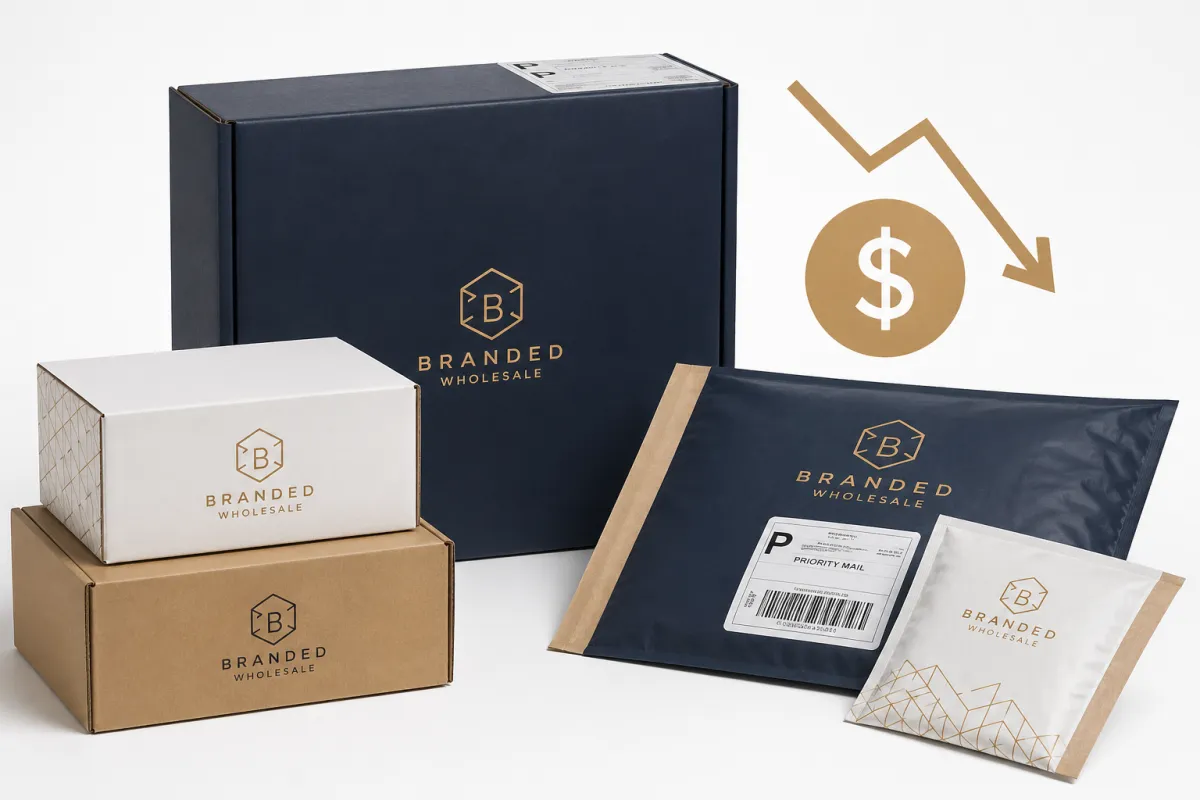
I learned this on a cosmetics program in Shenzhen in 2019. A client wanted to shave a few cents from each unit by moving from a 350gsm C1S carton to a thinner sheet that looked almost identical on a render. The sample looked fine on paper. The line told a different story. Corners softened. Tabs loosened during a 1,200-km transit to a distribution center in Guangzhou. The warehouse crew lost seconds on every pack trying to coax boxes back into shape, and I still remember one foreman muttering something I cannot print here. That project made one thing plain: branded packaging wholesale changes the cost per shipment before it changes the invoice total.
Packaging becomes part of the unit economics the moment the carton, mailer, insert, and label need to work as a system. A sound branded packaging wholesale order carries four jobs at once. It protects the product. It keeps the brand visible. It speeds the packing line. It cuts waste. A box that stacks cleanly on a 40 x 48-inch pallet, closes in one motion, and holds a bottle without rattling gives the operation room to breathe. A spec that misses by even 1 or 2 mm can throw off the whole rhythm. And once the rhythm is off, everybody feels it: the picker, the packer, the supervisor, and the buyer who has to explain the budget overrun with a straight face.
Buyers still compare unit price first, then wonder why the final bill creeps upward by 6% or 8%. A carton that crushes at the corners can trigger returns. A mailer that resists folding can add 5 to 10 seconds per order. A sleeve that scuffs because the coating is too light can create complaints before the product is even opened. Those are not abstract costs. They show up in labor reports, defect counts, and reorder anxiety. They also show up in the awkward silence that follows a bad receiving inspection in Atlanta or Rotterdam, which is my least favorite kind of silence.
"We stopped treating the box as an afterthought," a fulfillment manager told me during a plant walk in Chicago after we switched their subscription line to a better tuck style with 18pt board. "The packaging finally matched the product, and the team stopped fighting the carton every shift."
That is the frame I use for branded packaging wholesale: total landed cost, not just the printed carton price. A slightly better board grade, a cleaner die line, or a more durable finish can be the smarter buy if it lowers returns, trims labor time, or survives parcel handling without damage. Buyers who want to sanity-check packaging standards usually benefit from comparing their spec against the Packaging Institute resources and then testing those ideas against the realities of their own warehouse in Memphis, Phoenix, or Milton Keynes. The warehouse, as usual, is the place where theory goes to get humbled.
Branded Packaging Wholesale Product Options That Scale
The right branded packaging wholesale product depends on how the item sells, ships, and is opened. A folding carton made from 18pt SBS works well for shelf-facing cosmetics and retail presentation. An E-flute mailer usually fits ecommerce brands that want a branded exterior without piling on weight. A rigid setup box, built on 1.5 mm grayboard with wrapped art paper, still owns the premium lane for luxury accessories, gift sets, and high-touch unboxing programs. Each format solves a different problem, and each one behaves differently on the packing floor in Los Angeles, Shenzhen, or Krakow.
Here is the practical map I use with buyers comparing branded packaging wholesale options for launches of 2,000 to 20,000 units:
- Corrugated shipping boxes - Best for protection and stacking strength, usually single-wall B-flute or E-flute with kraft or white liner, often 32 ECT or 44 ECT.
- Folding cartons - Best for retail packaging and secondary packaging, especially for cosmetics, supplements, candles, and small electronics, often in 18pt SBS or 350gsm C1S artboard.
- Mailer boxes - Best for ecommerce presentation, subscription kits, and ship-ready product packaging, commonly E-flute with CMYK print and matte lamination.
- Rigid boxes - Best for premium branding where the lid, base, and wrap quality matter as much as the product inside, usually 1.2 mm to 2.0 mm grayboard.
- Paper bags, tissue, and sleeves - Best for add-on branding, gift packaging, and layered retail presentation, often specified with 120gsm to 157gsm art paper.
- Custom inserts - Best for holding bottles, jars, hardware, or fragile items in place during transit, usually molded pulp, EVA foam, or die-cut board.
Material choice matters just as much as format. On factory floors in Dongguan, Suzhou, or Monterrey, CCNB makes sense when the budget is tight and the print coverage is moderate. White kraft suits brands that want a cleaner natural look with more visible fiber character. Coated recycled board sits in the middle for retail packaging that needs stronger print contrast without tipping into rigid box pricing. Single-wall corrugated remains the workhorse for shipping cartons because it is predictable, available, and cost-effective at scale, especially for runs above 5,000 pieces.
Customization changes how the brand lands in the hand. Full-color CMYK printing handles patterns and photography. Spot colors and Pantone matching keep logos stable across repeat runs from April to December. Foil stamping, embossing, and debossing add texture, but they also add tooling and setup cost, which is why they belong in the conversation early. Window cutouts, aqueous coating, soft-touch lamination, and gloss varnish each shift the feel in a different direction. In branded packaging wholesale, feel is not decoration; it is part of the sale. I have had buyers change their minds the second they touched a sample in New York or Singapore, and I do not blame them. People trust their hands before they trust a spec sheet.
During a supplier negotiation in Dongguan, I watched one box spec move from a plain two-color print to a foil-stamped and embossed front panel after the client realized the product would sit under bright retail lighting in Seoul and Dubai. The quote moved with it by roughly $0.11 per unit on a 5,000-piece run. So did the shelf presence. The client later said the higher-end finish helped the box hold attention longer at the shelf edge. That is the sort of tradeoff a serious branded packaging wholesale discussion should surface before production starts, not after. After production starts, everyone suddenly becomes very fond of the phrase "we should have discussed this earlier."
If you want to see how these categories show up across different industries, our Custom Packaging Products page is a practical starting point, and our Case Studies page shows how other buyers approached box style, finish selection, and product packaging fit. Those examples matter because they show the carton after freight, handling, and storage conditions get counted, not just the mockup on a screen in a conference room in Austin or Bristol.
Branded Packaging Wholesale Specifications That Affect Quality
Most quality problems begin with incomplete specs, not bad intentions. A strong branded packaging wholesale brief should include inside dimensions, board caliper, flute profile, print coverage, finish, and insert tolerances. If the carton is meant to hold a glass jar or bottle, exact neck diameter, base diameter, and height matter. If it is a mailer, the product stack-up dimensions matter more than the marketing dimensions. Those measurements decide whether the box actually fits the product, or just fits the sample approved in a meeting room with overly flattering lighting.
I still remember a client meeting in Seattle where a beauty brand sent over a beautiful carton proof, but the insert cavity was 3 mm too narrow for the pump bottle they were launching. That tiny mismatch made the bottle sit too tightly, which scuffed the coating on the neck finish every time the product was removed. We corrected it, but six days disappeared while the approval cycle restarted. That is why branded packaging wholesale buyers should treat measurement as production control, not paperwork. A ruler is not glamorous. It is, however, annoyingly useful.
Quality also depends on how the box is built. Die-cut precision affects panel alignment. Fold memory changes whether the carton opens and closes cleanly. Glue seam strength matters on mailer boxes that will be handled, opened, and reclosed by packing teams in Chicago, Hanoi, or Madrid. Lamination shapes both appearance and durability, especially when cartons pass through several hands before they reach the customer. Color consistency across repeat runs matters more than many buyers expect. A brand that ships monthly cannot afford a red that drifts orange by the third reorder, unless the new look is "sunset" and nobody bothered to tell me.
Before I ask for a production quote on branded packaging wholesale, I like to confirm this checklist with exact values, not placeholders:
- Final inside dimensions and product orientation, measured to the nearest 1 mm.
- Board grade or paper stock, such as 350gsm C1S, 18pt SBS, or E-flute.
- Print method, color count, and Pantone targets.
- Finish details, including aqueous coating, matte lamination, or soft-touch film.
- Barcode placement, safe zones, and any compliance copy.
- Bleed, dieline approval, and artwork file format.
- Insert material, tolerance, and any assembly requirements.
That kind of preparation keeps production cleaner, and it is exactly where branded packaging wholesale buyers save time. Artwork ready on day one avoids three correction rounds. A dieline with the right fold lines keeps the factory from guessing. A barcode placed 8 mm from the trim edge has a far better chance of surviving trim than one placed by eye. Small choices like those decide whether packaging design helps the launch or turns into a production headache. I have never met a launch team in Boston or Brisbane that regretted being more specific.
For buyers working toward lower-impact materials, I also advise checking how the spec lines up with sustainable sourcing and shipment testing. If the packaging will travel through parcel networks, transit expectations deserve the same attention as a warehouse drop test. I often refer teams to ISTA guidance so the box spec is tied to a recognized transport standard rather than wishful thinking. Wishful thinking is charming in fiction. In packaging, it is expensive, usually by at least $0.03 to $0.12 per unit once damage rates are counted.
Branded Packaging Wholesale Pricing, MOQ, and Volume Breaks
The biggest drivers in branded packaging wholesale pricing are still the basics: material, size, print complexity, finish selection, tooling, and quantity. A small folding carton with one or two spot colors usually costs far less than a large rigid box with foil, embossing, and custom inserts. A mailer with one-color flexographic print can price very differently from a full-color litho-laminated version, even if the mockups look close. Production labor, press setup, and waste rates drive those gaps, and they do it with complete indifference to how nice the design presentation looked in the kickoff meeting in Brooklyn or Frankfurt.
MOQ is where many buyers get surprised. Standard corrugated boxes and basic folding cartons often start at lower minimums than rigid structures or specialty finish jobs. Add custom inserts, foil, window patches, or unique die cuts, and the minimum climbs because setup time and tooling costs have to be spread across more units. I have watched clients push back on that math, but the factory does not change its formula. A die that costs $220 still costs $220 whether the run is 2,000 units or 20,000. The press does not become sentimental because the order is small.
Here is a practical pricing view I often use during quote comparisons for branded packaging wholesale on a 5,000-piece benchmark:
| Packaging type | Typical spec | Example MOQ | Sample unit price | Best fit |
|---|---|---|---|---|
| Folding carton | 18pt SBS, full-color offset print, aqueous coating | 5,000 pcs | $0.18 - $0.34 | Retail packaging, cosmetics, supplements |
| Mailer box | E-flute, CMYK print, matte lamination | 1,000 pcs | $0.42 - $0.85 | Ecommerce, subscription kits, branded unboxing |
| Rigid box | 1.5 mm grayboard, wrapped paper, foil stamp | 3,000 pcs | $1.20 - $2.40 | Luxury gifts, premium sets, high-end product packaging |
| Corrugated shipper | B-flute or E-flute, one-color or no-print exterior | 2,000 pcs | $0.28 - $0.66 | Transit protection, warehouse handling, palletization |
Those figures help frame the conversation, but they are not a promise. A 12-inch mailer with heavy ink coverage will not price like a 6-inch mailer with a single-color logo. A carton with foam or molded pulp inserts will not compare cleanly to a simple tuck-end box. Freight, sample charges, tooling, and consolidation fees also shape the true landed cost. Branded packaging wholesale only makes sense if the full package is compared, not one quote line lifted out of context.
I have seen buyers save serious money by asking for three versions of the same spec: a base version, a presentation version, and a premium version. That approach exposes where the steps in cost really sit. A move from matte aqueous coating to soft-touch lamination may add $0.09 per unit. A foil stamp may add $0.06 when the die is already in production, or $0.14 when the artwork expands. Those are the details that let branded packaging wholesale buyers choose with clarity instead of guessing. And yes, sometimes the "cheaper" version ends up costing more in lost shelf appeal in Minneapolis or Madrid. Packaging loves to do that.
For teams that buy on a wholesale schedule, our Wholesale Programs page is worth a look because it helps organize recurring orders, reorder timing, and spec stability. That matters more than people expect. A packaging line that changes every month usually pays more in revisions and delays than one that keeps the core spec fixed and changes only the artwork, especially on quarterly programs of 10,000 to 50,000 units.
Branded Packaging Wholesale Process and Timeline
A clean branded packaging wholesale process starts with a sharp brief, not a vague request for something nice. The best workflow I have seen runs in this order: discovery call, specification review, quote, dieline creation, proof approval, sample sign-off if needed, production, quality control, and freight booking. Each step exists for a reason. Skip one, and the delay usually returns later with more cost attached. I have watched an entire launch slip in Nashville because one measurement was assumed instead of checked. It was not dramatic. It was just annoying.
- Discovery call: confirm product size, shipping method, quantity, and brand goals.
- Specification review: lock board grade, print method, inserts, and finish.
- Quote and revision: compare options for cost, lead time, and construction.
- Dieline and proof: check dimensions, folds, and artwork placement.
- Sample approval: review structure, color, and fit before production.
- Production and QC: run the batch, inspect fold quality, and verify counts.
- Freight booking: confirm packing method, pallet plan, and transit window.
Timing depends more on approvals than on press speed once the job is released. A simple folding carton often moves from proof approval to completion in 12 to 15 business days. An E-flute mailer with custom print and lamination can take 18 to 25 business days. A rigid box with foil and wrapped paper often needs 25 to 35 business days because the build takes more labor and the inspection steps are stricter. Then transit time enters the picture, which can add 3 to 7 days by air or much longer by sea from Ningbo to Long Beach, depending on the route.
Delays tend to come from missing artwork files, late color changes, unclear dimensions, or a sample revision that reopens the dieline. One client in a supplier meeting in Los Angeles insisted on moving the logo 6 mm lower after proof sign-off, and that small change forced a new plate adjustment and a second proof. On screen, it looked trivial. In production, it touched the die layout, the print file, and the carton registration. That kind of thing happens often in branded packaging wholesale, which is why strict approval discipline protects the launch date. Small tweaks can carry very large consequences, which is packaging's least glamorous party trick.
If the packaging needs to survive parcel handling, the discussion cannot stop at the factory gate. Shipping vibration, corner drop risk, humidity, and pallet compression all matter. A carton that looks perfect in the sample room in Milan can behave differently after a few hundred miles in a trailer. Test planning matters here, and using a recognized transport reference such as ISTA keeps expectations tied to actual shipping conditions rather than optimism. For many ecommerce brands, that means testing for 15 to 30 lb compression and 24-inch corner drops before mass production.
My advice stays simple: build the schedule backward from the launch date, not forward from the quote. If the product hits retail shelves on the first Monday of next month, the branded packaging wholesale schedule should already account for artwork sign-off, sample approval, production, packing, and transit. A factory can move quickly, but only if the buyer has made the decisions that let the factory move.
What Should You Look For in Branded Packaging Wholesale?
Start with fit, then move to structure, then finish. A strong branded packaging wholesale order should match the product dimensions, the shipping method, and the shelf strategy before anyone starts debating foil or gloss levels. That sequence matters because the prettiest box in the room is useless if the insert is loose, the carton crushes in transit, or the print shifts after the first reorder. I have seen brands chase decorative effects first and spend the next month patching avoidable production mistakes. The market rarely rewards that choice.
Look for a supplier that can explain board grades, dielines, and production tolerances without hiding behind jargon. If the team cannot clearly describe why 18pt SBS works for one job and E-flute works for another, the quote may be missing the logic that keeps the project stable. The best branded packaging wholesale partner should be able to compare retail packaging, ecommerce mailers, corrugated shippers, and rigid boxes in terms of cost, performance, and assembly speed. That is not a sales trick. It is the difference between a package that supports the product and one that creates friction on the floor.
Also check how the supplier handles sample review and quality control. A sample should show structure, print clarity, fold performance, and insert fit, not just the brand colors. Once production starts, repeatability matters more than enthusiasm. A good line can keep color stable, maintain glue seam strength, and ship product packaging that survives both the warehouse and the customer’s hands. That is the standard I want in branded packaging wholesale, and it is the standard buyers should ask for out loud.
Finally, ask how the order will scale. A spec that works at 3,000 pieces may need different tooling, a different finish, or a different insert strategy at 30,000. The right supplier should talk through volume breaks, reorder lead times, and what changes when the business grows. If they can explain those tradeoffs clearly, you are probably talking to someone who understands branded packaging wholesale as a working system, not just a pretty sample in a folder.
Why Choose Us for Branded Packaging Wholesale
Custom Logo Things approaches branded packaging wholesale as a manufacturing problem first and a branding project second, because that is how the best packaging performs in practice. Shelf presentation matters. So do pallet stacking, glue seam strength, reorder consistency, and whether the print still reads cleanly after a warehouse shift in Dallas or Halifax. Buyers usually need both sides of that equation, especially when retail packaging standards have to coexist with ecommerce speed.
I have spent enough time around offset presses, flexographic lines, and die-cutting stations to know that the spec sheet has to match the machine. Litho-lamination gives beautiful surface quality on heavier structures. Offset printing keeps fine detail crisp on folding cartons. Flexographic printing suits corrugated shippers and plain mailers. Hot foil stamping still delivers a premium look when the artwork calls for it, and aqueous coating often gives the practical protection a project needs without the extra cost or feel of heavier film lamination. None of those processes fits every job. A good partner talks through tradeoffs instead of pretending one finish solves everything.
One mistake buyers make is assuming that all custom printed boxes are equal once the artwork looks good on a screen. They are not. A structurally weak carton can distort after the first heat cycle in Phoenix. A loose insert can let a jar rattle. A poor glue line can fail on a humid route through Miami or Singapore. That is why our quality review focuses on color consistency, fold accuracy, glue seam strength, and protected transit packing. If the product goes to a distributor, retailer, or direct-to-consumer fulfillment center, the box has to survive the trip and still look like the brand on arrival.
We also help buyers spot avoidable cost drivers early. If a window cutout adds labor but does not improve conversion, we say so. If a rigid box is too expensive for the margin target, we usually suggest a different structure that keeps the unboxing feel without carrying unnecessary board cost. That kind of honest comparison matters in branded packaging wholesale, because the cheapest quote is not always the smartest structure and the most expensive quote is not always the best protection. I have had to say, gently, "the box is not the product," more times than I can count in meetings from Austin to Adelaide.
For teams that want a deeper look at real projects, our Case Studies page shows how different brands solved packaging design, board selection, and fulfillment issues, and our Wholesale Programs page explains how recurring purchases can be planned with fewer surprises. I would rather help a buyer choose a spec that prints well, packs fast, and reorders cleanly than hand over a flashy sample that causes trouble three weeks later.
"The box has to work at 7 a.m. in a warehouse, not just in a pitch deck," I told a purchasing manager during a supplier review in Orlando, and that line still holds up. Good branded packaging wholesale keeps the brand story intact while respecting the people who actually assemble, ship, and receive the product.
Next Steps for Branded Packaging Wholesale Orders
If you are preparing a branded packaging wholesale request, gather the essentials before asking for a quote. Product dimensions. Weight. Quantity target. Shipping destination. Artwork files. Retail or ecommerce requirements. If you already have a dieline, send it. If not, provide the product measurements and let the packaging team build one from the actual item rather than from assumptions. That first packet of information can save days of back-and-forth, and it usually saves at least one irritated email from a production manager in Columbus or Cardiff.
Then decide what matters most: presentation, protection, or cost control. All three can be balanced, but one usually deserves priority. A premium launch for a cosmetic line may justify a rigid box with foil and a soft-touch finish. A subscription campaign may work better with a printed mailer and a tight, efficient insert. A hardware kit may need corrugated construction and a clean internal divider system. The best branded packaging wholesale spec is the one that fits the product and the business model, whether the order is 3,000 pieces or 30,000.
From there, the most efficient path is simple: request a detailed quote, review the dieline, approve a sample if needed, and lock the production schedule before artwork release. That last step matters more than most teams realize. Once the art is approved, the factory plan should stay stable unless there is a real structural issue. Changing print files after that point usually means rework, and rework is where budgets slip. I have seen a tiny late-stage change turn into a week of lost momentum, and nobody enjoys being the person who has to say that out loud.
Use this as the final checklist: confirm the specs, confirm the minimums, confirm the delivery window, and confirm the freight plan before you release artwork. Do those four things and branded packaging wholesale stays tied to the actual production plan instead of the marketing calendar. That is the difference between a box that looks good on screen and a box that works on the floor, in transit, and at the customer’s door.
What is the typical MOQ for branded packaging wholesale orders?
MOQ depends on structure, size, and print method. Standard corrugated or folding carton runs are often lower than rigid box or specialty finish jobs, and custom inserts, die cuts, or foil work usually raise the minimum because setup time and tooling have to be spread across more units. For example, a basic folding carton might start at 5,000 pieces, while a premium rigid box may start at 3,000 pieces or more. The fastest way to get an accurate MOQ is to share dimensions, material preference, and target quantity up front.
How much does branded packaging wholesale usually cost per unit?
Unit cost depends on board type, dimensions, color count, finish, and order volume, so two boxes with similar artwork can still price very differently. As a rough benchmark, folding cartons often land around $0.18 to $0.34 each at 5,000 pieces, while rigid boxes may range from $1.20 to $2.40 each depending on wrap and finish. Freight, sample charges, and tooling can change the real landed cost, which is why buyers should compare full quotes instead of unit price alone.
How long does branded packaging wholesale production take?
Timing usually includes quote review, dieline preparation, proof approval, sample approval if requested, production, and transit. A simple folding carton can often move from proof approval to completion in 12 to 15 business days, while a rigid box with foil and wrapped paper may need 25 to 35 business days before freight. Artwork delays are the most common reason schedules slip, so a clear approval process is the best way to protect the launch date.
What files do I need for a branded packaging wholesale quote?
Provide product dimensions, target quantity, preferred packaging style, artwork files, and any branding or compliance requirements. If you already have a dieline, send it; if not, a supplier can usually create one from your product measurements. High-resolution vector artwork, Pantone references, and a PDF with 1 mm or 1/8-inch marks help reduce proofing changes and avoid last-minute registration issues.
Can branded packaging wholesale orders include sustainable materials?
Yes, many wholesale packaging runs can use recycled board, kraft paper, water-based inks, and FSC-style material options where appropriate. Sustainability should be matched to performance, because a greener spec still needs to protect the product and run cleanly on the packing line. Ask for material options early so the quote reflects both the environmental target and the production reality, especially if the shipment will travel by sea from Asia or by parcel network across North America.


