Buyer Fit Snapshot
| Best fit | Are Branded Sticker Labels Recyclable projects where brand print, material claims, artwork control, MOQ, and repeat-order consistency need to be specified before quoting. |
|---|---|
| Quote inputs | Share finished size, material target, print colors, finish, packing count, annual reorder estimate, ship-to region, and any compliance wording. |
| Proofing check | Approve dieline scale, logo placement, barcode or warning zones, color tolerance, closure strength, and carton packing before bulk production. |
| Main risk | Vague material claims, crowded artwork, missing packing details, or unclear freight terms can make a low unit price expensive after revisions. |
Fast answer: Are Branded Sticker Labels Recyclable: Material, Adhesive, Artwork, and MOQ should be specified like a repeatable production item. The safest quote records material, print method, finish, artwork proof, packing count, and reorder notes in one written spec.
Production checks before approval
Compare the actual filled-product size with the drawing, then confirm tolerance on folds, seals, hang holes, label areas, and retail display edges. Reserve space for logos, QR codes, warning copy, and material claims before decorative graphics fill the panel.
Quote comparison points
Review material grade, print process, finish, sampling route, tooling charges, carton quantity, and freight assumptions side by side. A quote is only useful when the supplier can repeat the same color, closure quality, and packing count on the next order.
Are branded sticker labels recyclable? What brands miss
Branded sticker labels recyclable sounds simple until a recycler, a brand manager, and a converter all look at the same pack and call out three different failure points. The short version: branded sticker labels recyclable is not just about the face stock on the label. It depends on the package, the adhesive, the liner, the print, and the recovery stream that is supposed to handle the finished item.
That distinction matters more than most teams want to admit. A label that behaves beautifully on one package can be a headache on another. Paper labels can perform well on glass and still become a problem on coated mailers. Film labels can hold up in a cold chain and still be the wrong call for paper recovery. Branded sticker labels recyclable claims live or die on those details, not on the marketing slide that sounds nicest in the meeting.
I keep seeing the same mistake: brands treat recyclability like a sticker-level decision. It is a package-level decision. It is also a production decision, because the “better for the planet” construction that looks tidy in a deck can create waste, delays, or ugly cost jumps if it does not fit the line, the artwork, or the launch date. If you are sourcing through Custom Labels & Tags, the first question should not be “Is this label recyclable?” It should be “What happens to the full package after use?”
That sounds basic, and yet it is where branded sticker labels recyclable claims get fuzzy fast. The buyer sees paper. Marketing sees a sustainability story. The recycler sees residue, mixed materials, or a package that never belonged in that stream in the first place. Once you understand the system, the whole thing gets easier to specify and a lot harder to fake.
Branded Sticker Labels Recyclable: What That Really Means
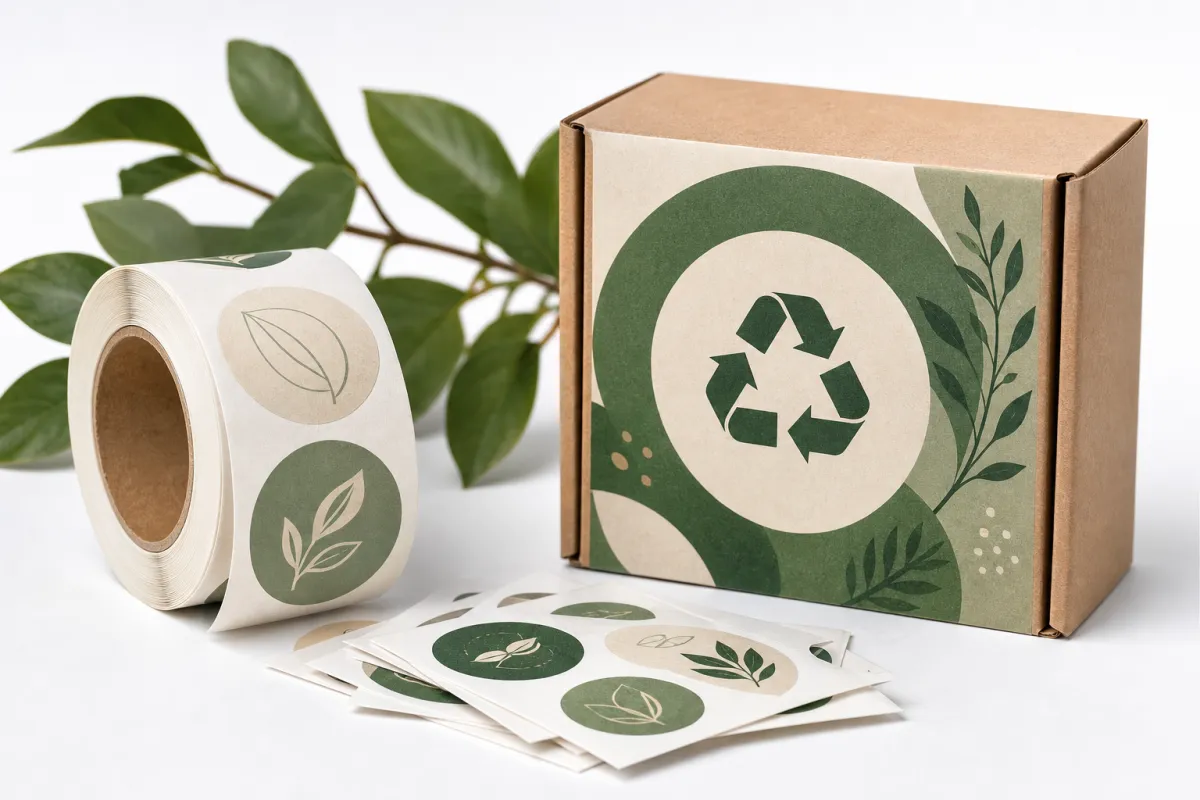
Branded sticker labels recyclable means the label construction fits the recovery path of the package it is attached to. It does not always mean the label disappears cleanly in every process. It means the label does not materially interfere with collection, sorting, pulping, washing, or remelting in the stream that handles the package.
That is a different standard from the one many marketers assume. A label can be paper and still be a problem. It can be film and still be acceptable on the right container. It can even be technically recyclable while a materials recovery facility treats it as a nuisance because the adhesive, substrate, or print finish creates stickies, residue, or visual contamination. Branded sticker labels recyclable is a compatibility claim, not a decoration choice.
Think about the packaging system in three layers. First, the package itself: glass, aluminum, PET, HDPE, paperboard, or a flexible mailer. Second, the label construction: face stock, adhesive, liner, and print. Third, the destination stream: curbside paper, glass cullet, aluminum scrap, or plastic reprocessing. If any layer fights the others, the claim weakens fast.
That is why a bottle label and a jar label are not interchangeable just because they both look fine on a spec sheet. A paper label on a glass jar may be perfectly acceptable if it releases cleanly during washing. The same paper label on a coated mailer can block the whole item from entering the paper stream. A PET label on a PET bottle may be a good fit if the adhesive and density line up with the wash process. Context decides. Always.
From a buyer’s point of view, this is less about chasing the most “sustainable” material and more about avoiding a mismatch. Recyclability is not only a material property. It is a system property. If that sounds annoyingly broad, that is because recycling infrastructure is uneven, and acceptance rules shift by region, facility type, and end-market demand. The EPA’s general recycling guidance is a useful reminder that local systems matter just as much as the package itself: EPA recycling guidance.
Practical rule: if you want branded sticker labels recyclable claims to hold up, start with the recovery stream first, then choose the label construction second. Reverse that order and you usually pay for it later in scrap, complaints, or relabeling.
There is also an awkward truth that most sustainability decks skip. “Recyclable” does not mean “recycled everywhere.” A label can be compatible with a PET bottle recycling system in one market and handled badly in another market with different wash conditions, sortation, or end-market standards. So yes, branded sticker labels recyclable can be true. It just has to be true in the specific system you are using, not in theory.
How Branded Sticker Labels Recyclable Claims Actually Work
To understand branded sticker labels recyclable claims, break the label into parts. The face stock is the visible layer. The adhesive is the hidden layer that does most of the damage when it is wrong. The liner is the waste layer removed in production. Then there is the package substrate, which is usually the deciding factor.
Here is the basic logic. If the package is recycled as paper, the label should repulp cleanly or avoid disrupting fiber recovery. If the package is recycled as glass or aluminum, the label should not leave residue that complicates cleaning, sorting, or remelting. If the package is recycled as plastic, the label should support the recycling pathway rather than interfere with density separation, washing, or pellet quality. That is the real test behind branded sticker labels recyclable claims.
Pressure-sensitive labels behave differently from cut-and-stack labels, heat-transfer labels, shrink sleeves, and in-mold labels. Pressure-sensitive labels are popular because they are flexible and efficient for short and medium runs, but they also depend heavily on adhesive behavior. A strong adhesive that is perfect for shipping can be exactly the wrong adhesive for end-of-life processing. A removable adhesive may be ideal for a returnable container and too weak for a cold, wet bottle. Packaging is never so considerate as to make one answer fit everything.
With paper packaging, the biggest issue is usually repulpability. If the label turns into stickies, coating flakes, or non-fibrous waste, it can reduce pulp quality. With glass, labels must separate cleanly during wash-off and not leave enough adhesive residue to interfere with cullet quality. With aluminum, the concern is less about fiber contamination and more about residue, coatings, and anything else that complicates reprocessing. With plastics, the concern is whether the label and adhesive are compatible with the target resin stream, especially PET and HDPE.
That is why many branded sticker labels recyclable claims depend on the phrase “compatible with” instead of “made from.” A label can be made from recycled-content paper and still be wrong for a particular package. Another label can be made from a synthetic film and still perform better in a specific recycling path because it separates cleanly and avoids contamination. People miss this all the time because they focus on the visible face stock rather than end-of-life behavior. The recycler does not care how nice the front looks.
Removal behavior matters a lot. Labels that separate in one clean sheet are easier for mills and MRFs to handle than labels that shred into tiny fragments or smear adhesive across the substrate. Clean separation reduces the chance of stickies. Stickies are not a cosmetic issue; they can reduce paper quality and create downstream processing headaches. That is why branded sticker labels recyclable often correlates more closely with adhesive chemistry than with front-side appearance.
Paper labels on paper mailers get even more annoying, because a label can be made from paper and still block a mailer from entering the paper stream if the coating, adhesive, or backing introduces too much non-fiber content. That is one reason recycling labels on shipping packs deserve the same scrutiny as labels on bottles. The package format changes the answer.
It helps to think about sorting and recovery as two separate hurdles. Sorting happens first; recovery happens later. If the package gets mis-sorted because the label or print finish confuses optical systems, that is one problem. If the package is sorted correctly but fails during wash, pulping, or remelting, that is another problem. Branded sticker labels recyclable has to survive both stages.
For teams that want a technical reference point, packaging test protocols such as ISTA methods for transport and durability can help validate whether a label holds up under abrasion, vibration, humidity, and temperature swings before it ever reaches a recycling facility. See the International Safe Transit Association at ISTA testing standards for a sense of how structured packaging validation works.
Materials, Adhesives, and Backing: The Key Factors
The quickest way to make sense of branded sticker labels recyclable options is to look at the construction in layers. Face stock first. Adhesive second. Backing or liner third. Then the finish and print method. Each one can help or hurt the package’s recovery path.
Face stock choices
Paper is still the most common starting point because it is familiar, printable, and easier to justify in paper-based applications. Uncoated and matte paper labels can work well on corrugated mailers, cartons, and some glass containers. FSC-certified paper can strengthen the sourcing story, although certification alone does not make branded sticker labels recyclable. It speaks to fiber sourcing, not end-of-life performance.
Film face stocks such as BOPP and PET are often chosen for moisture resistance, cold-chain products, shampoos, sauces, and outdoor exposure. Those materials are not automatically bad from a recyclability standpoint. The question is whether they match the recovery stream. A PET label on a PET bottle may be the right call if the adhesive releases in the wash and the label density is acceptable. A film label on a paper mailer is a different conversation entirely.
Recycled-content papers can be useful, especially for brands trying to reduce virgin fiber use, but they should be specified with realistic expectations. Recycled content does not equal recyclable in every context. If the coating, print coverage, or adhesive is wrong, the final assembly can still be a poor fit. That is why branded sticker labels recyclable is never solved by a single material checkbox.
Adhesive chemistry
This is where many projects succeed or fail. Permanent adhesives are designed to stay put, which is excellent for shelf life, shipment, and abrasion resistance. They are not always ideal for recovery. Wash-off adhesives are engineered to release during a controlled cleaning step, often with hot caustic conditions in certain plastic recycling systems. Removable adhesives are designed for clean removal, though they may not hold up as well in cold, wet, or oily environments.
For branded sticker labels recyclable applications, adhesive choice often matters more than the visible paper or film. The wrong adhesive can leave residue, create stickies, or interfere with sorting and reprocessing. The right adhesive can make a label behave almost invisibly at end of life. That is the difference between a tidy sustainability claim and one that gets challenged by the first person who actually checks.
One practical detail brands overlook is dwell time. A label that looks fine on day one may fail after 30 days in a cooler or six months on a shelf. Condensation, oils, sanitizer, and abrasion all change the adhesive’s behavior. A “recyclable” label that lifts, wrinkles, or scuffs may not survive to the recovery stage in usable condition. That is not a theoretical issue; it is a production issue.
Backing and liner
The liner is not part of the consumer-facing package, but it matters to production waste and plant efficiency. Most release liners are silicone-coated paper or film. Some converters participate in liner recovery programs, which can reduce factory waste, but that is different from making the finished label more recyclable. Brands often blur those two ideas. They are related, but not the same.
In practical terms, if a supplier can collect liner waste for recycling, that is a nice operational win. It cuts landfill volume and can improve the footprint of the production run. But it does not automatically improve the branded sticker labels recyclable status of the final product. End-of-life compatibility is still about the package and label combination, not the waste stream at the print shop.
| Label Construction | Typical Use | Approx. Unit Cost at 5,000 | Recycling Fit | Notes |
|---|---|---|---|---|
| Matte paper with permanent adhesive | Mailers, cartons, dry goods | $0.03-$0.07 | Good in paper applications, weaker on wet or film packages | Low cost, but not the strongest branded sticker labels recyclable choice for moisture-heavy packs |
| FSC paper with wash-off adhesive | Glass jars, some PET bottles | $0.05-$0.11 | Strong when the recovery stream supports clean release | Often a balanced option for branded sticker labels recyclable projects |
| BOPP film with removable adhesive | Cold-chain, skincare, beverage | $0.06-$0.13 | Depends heavily on the package substrate | Good moisture resistance; not the universal answer for branded sticker labels recyclable claims |
| PET film with specialty adhesive | Durable industrial or premium packaging | $0.08-$0.18 | Potentially compatible with PET recycling if specified correctly | Useful where durability matters more than a paper look |
The table is a useful starting point, but the final answer still depends on the package itself. I would rather see a buyer choose a slightly more expensive construction that truly fits the stream than chase the cheapest option and end up reprinting later. That is especially true for branded sticker labels recyclable claims that will show up in marketing copy or on-pack language.
One more nuance: print coverage and finish can matter too. Heavy ink coverage, metallic foils, and aggressive laminates can complicate recovery. If you need a high-end look, ask whether the finish can be simplified on the portion of the label that touches the recovery path. Small changes there can keep branded sticker labels recyclable claims intact without flattening the design.
Step-by-Step: How to Specify Recyclable Sticker Labels
If you want branded sticker labels recyclable packs without guesswork, start with the package and work backward. That sounds basic because it is basic, and it is still the cleanest way to avoid bad assumptions and expensive revision rounds.
- Identify the package material. Is it glass, aluminum, PET, HDPE, paperboard, or a flexible mailer? The substrate determines the recovery path.
- Define the disposal assumption. Are you targeting curbside paper recycling, bottle recycling, industrial recycling, or a take-back program?
- Choose the face stock. Match paper or film to the package and the environment. Moisture, oil, cold storage, and abrasion all matter.
- Select the adhesive. Ask for wash-off, removable, or recycling-compatible options where appropriate.
- Specify the liner and finish. Keep liner waste in mind, but do not confuse production waste reduction with finished-product recyclability.
- Request documentation. Ask for compatibility statements, testing data, and any third-party or industry references the supplier can provide.
- Pilot on real packaging. Test the label on the actual container, not a sample sheet on a desk.
That last step is where many programs save themselves. A label can look perfect in a proof and fail on the line because the package surface has release agents, curved edges, condensation, or a coating you did not account for. A pilot run tells you whether the branded sticker labels recyclable claim survives real handling. It also reveals whether the label can be applied at production speed without wrinkles, flagging, or edge lift.
“A label spec is only sustainable if it still works after humidity, cold storage, abrasion, and a rough shipping lane.”
That line is not just nice copy. It is the operational truth. If the label fails before the package reaches the consumer, the end-of-life story stops mattering pretty quickly. A brand may want branded sticker labels recyclable messaging, but the package still has to survive the warehouse, the retailer, and the customer’s hands.
Ask suppliers for specific answers, not vague claims. For example: Will this adhesive release in hot wash conditions? Does the face stock generate stickies in paper recovery? Is the liner recyclable through any established program? Can the label be removed cleanly after 24 hours, 7 days, or 30 days? A good supplier should answer those questions or tell you exactly where the uncertainty sits.
It also helps to document the customer-facing disposal assumption. If the package is designed for glass recycling, say so clearly. If the label is compatible only under certain conditions, be equally clear. Overclaiming is worse than staying precise. In a packaging review, precision builds trust faster than broad branding language ever will.
Teams that sell through retail often benefit from a simple one-page spec sheet. Include the substrate, adhesive, face stock, liner type, print method, application temperature range, service environment, and disposal assumption. That document becomes the anchor for procurement, compliance, artwork, and QA. It also makes it much easier to compare branded sticker labels recyclable options across suppliers without losing the thread.
Process and Timeline: From Artwork to Production
Once the construction is chosen, the process still needs room to breathe. A typical label project moves through discovery, material selection, artwork setup, proofing, sampling, approval, and production scheduling. For branded sticker labels recyclable projects, the testing step usually takes longer than teams expect, because the material conversation is tied tightly to the package conversation.
A realistic schedule for a standard custom label order often looks like this:
- Material selection: 1-3 business days if the options are standard, longer if you need specialty wash-off or recycled-content stock.
- Artwork setup and proofing: 2-5 business days, depending on how many SKUs, versions, or regulatory lines need review.
- Sampling or pilot testing: 3-10 business days if you are checking adhesion, scuffing, and application behavior on real packaging.
- Production: often 5-12 business days after proof approval, with specialty materials pushing the timeline longer.
- Shipping: 1-5 business days, depending on destination and freight method.
Those ranges are not exact promises. They are a practical planning tool. If your brand is launching a new drink, a skincare line, or a rebrand, branded sticker labels recyclable decisions should happen before final artwork locks. Last-minute sustainability edits are one of the fastest ways to blow up a launch calendar.
The most common delays are predictable. Teams wait too long to choose the substrate. Copy changes arrive after proof approval. A special finish gets added after the initial quote. Or the label passes on the art board but fails on the actual container, which sends everyone back to sampling. The more specific your package is, the less likely branded sticker labels recyclable work will stall.
Rush orders deserve special caution. If you need labels in a few days, your material choices narrow quickly. Specialty wash-off adhesives or nonstandard recycled-content papers may not be available on short notice. That is where brands get forced into a compromise they did not want. A faster lead time is attractive, but a badly matched label can cost more in relabeling than you saved in production time.
Packaging teams that care about transit durability often build in a quick test against vibration, abrasion, and temperature swings before committing to scale. That sort of testing does not need to be overengineered. Even a short pilot on a few dozen units can reveal whether the label edges lift, the ink scuffs, or the adhesive weakens in cold storage. For a branded sticker labels recyclable project, those results are often more useful than another round of design opinions.
From a workflow perspective, the easiest way to keep the project moving is to separate creative approval from technical approval. The artwork can still be reviewed for brand consistency while the label construction is reviewed for recovery fit. That way, if a change is needed, you are not reopening every file and delaying everything. Small process discipline saves a lot of time.
If you are managing multiple SKUs, consider standardizing sizes, adhesives, or liner types where possible. Fewer custom variables usually means shorter scheduling windows, lower setup friction, and a cleaner path to repeat orders. That is not glamorous, but it is how branded sticker labels recyclable programs stay manageable over time.
Cost and Pricing: What Changes the Price
Price is where sustainability conversations get real. Brands may support branded sticker labels recyclable improvements in principle, then balk when the quote lands 10% or 20% above a basic construction. That reaction is normal. It is also why the quote needs context.
The biggest pricing drivers are usually material grade, adhesive type, liner choice, order quantity, print complexity, and finishing. A plain paper label with a standard permanent adhesive will almost always cost less than a specialty construction designed for clean removal or wash-off behavior. That does not mean the specialty option is overpriced. It means you are paying for specific performance.
Here is the practical comparison I give buyers:
- Standard label construction: lowest unit cost, easiest to source, broadest availability.
- Recycling-oriented construction: moderate premium, better fit for end-of-life goals, often worth the extra spend for branded or regulated packs.
- Highly specialized construction: higher unit cost, usually justified only when moisture, temperature, or reuse cycles make it necessary.
Volume changes everything. A short run of 1,000 labels may make a specialty wash-off adhesive look expensive on a per-label basis. At 10,000 or 25,000 pieces, the gap often narrows because setup and material sourcing get spread over more units. That is one reason branded sticker labels recyclable specs should be discussed with the full annual forecast in mind, not only the first PO.
There is also a tradeoff between design ambition and production cost. Metallic foils, complex die shapes, heavy ink coverage, and multiple finishes can all raise the price. If your sustainability goal is to keep the package recovery-friendly, you may be better off simplifying the finish rather than paying for a premium effect that makes the label harder to recycle. In some cases, a cleaner matte design is both cheaper and easier to defend.
Another lever is SKU consolidation. If you can reduce six label versions to three, your costs usually fall in several places at once: setup time, proofing, inventory, and waste. That kind of simplification often does more for branded sticker labels recyclable programs than chasing a marginally greener material that only fits one specialty SKU.
For teams balancing price against sustainability, it helps to request at least two quotes: one baseline and one recycling-oriented. Then compare not just unit cost, but also application speed, waste rate, durability, and the likelihood of reprint. The cheapest quote is not always the lowest total cost if the label fails on line or triggers a packaging redesign later.
As a rough planning range, many common custom labels may land anywhere from a few cents per unit for simple paper constructions to well over a dime for specialty film or clean-release versions, depending on size and quantity. That spread is normal. What matters is choosing the level of performance your package actually needs. Branded sticker labels recyclable does not have to be the most expensive option, but it usually is not the absolute cheapest either.
One caution: do not let price alone decide the adhesive. Adhesive is the smallest line item and the biggest hidden risk. A poor adhesive choice can create residue, sorting issues, or product returns. That kind of failure costs far more than a few cents saved up front.
Common Mistakes, Expert Tips, and Next Steps
Most branded sticker labels recyclable mistakes are not technical disasters. They are judgment errors. The label itself is usually fine. The spec is incomplete, the package assumption is wrong, or nobody tested the actual combination.
Here are the most common problems I see:
- Assuming all paper labels are recyclable. Paper face stock does not guarantee recovery compatibility.
- Ignoring the adhesive. The wrong adhesive is one of the fastest ways to create residue or stickies.
- Forgetting the liner. Liner waste matters operationally, even if it is not part of the finished package.
- Skipping package-level testing. A label that works on a sample sheet may fail on a curved, wet, or oily container.
- Overstating the claim. If the package is only recyclable in certain streams, say that clearly.
Here are the expert moves that keep projects on track:
- Ask for compatibility by package type. Glass, PET, aluminum, and paper each need a different answer.
- Request real-world samples. Apply them to the actual package and leave them in the actual environment.
- Document disposal assumptions. Make sure internal teams know what the label is designed to do after use.
- Check for third-party or industry references. Even if the supplier cannot give a certification, they should be able to explain the test basis.
- Build a pilot step into the timeline. A small delay up front usually prevents a larger one later.
If you are still deciding how far to push the sustainability angle, start with a simple audit. List every package you use, identify the substrate, note the environment, and flag any labels exposed to moisture, oil, cold storage, or abrasion. That alone will reveal which branded sticker labels recyclable options are realistic and which are fantasy dressed up as strategy.
Then narrow the field to two or three constructions. One should be your current standard, one should be the most recovery-friendly option, and one should be the best balance of cost and performance. From there, request samples and run a pilot. If you want a sense of how packaging projects translate into finished print runs, the Case Studies page is a useful way to see how different formats are handled in practice.
My honest take: the best branded sticker labels recyclable strategy is not flashy. It is disciplined. It starts with the package, respects the recovery stream, and tests the label on real packaging before launch. That is how brands avoid wasted spend and avoid making claims they cannot defend. It also makes the design team happier, because the final label does not have to be reworked three times to fix a problem that should have been caught earlier.
Use this final checklist before you approve the order:
- Confirm the package substrate and target recycling stream.
- Verify the face stock, adhesive, and liner as a complete construction.
- Ask for testing or compatibility guidance in writing.
- Test on the actual container under real storage conditions.
- Check that the claim matches the package, not just the label.
That is the difference between a pretty sustainability statement and a package That Actually Works. If you get the system right, branded sticker labels recyclable stops being a vague marketing phrase and becomes a practical packaging decision you can stand behind.
Are branded sticker labels recyclable on glass jars?
Often yes, but only if the adhesive and face stock are compatible with the glass recycling stream and the label does not create contamination or residue. Wash-off or clean-removal constructions usually perform better than aggressive permanent adhesives. Ask for compatibility guidance specific to the jar, not just the label material.
What materials make branded sticker labels more recyclable?
Paper face stocks, recycling-compatible adhesives, and liners with recovery options are the most common starting points. The best material depends on the package, because a recyclable label on one substrate may cause problems on another. Testing matters more than assumptions when moisture, cold storage, or abrasion are involved.
Do adhesives affect whether branded sticker labels are recyclable?
Yes, adhesive choice is one of the biggest factors because it controls how cleanly the label separates or breaks down. Wrong adhesive performance can leave residue, create stickies, or interfere with paper or plastic recovery. Ask for wash-off, removable, or recycling-compatible adhesive options when sustainability is a priority.
How much do recyclable branded sticker labels cost compared with standard labels?
They can cost more per unit if they use specialty materials, tighter testing, or lower-volume production. The gap narrows at higher quantities and can shrink further if you simplify finishes or standardize sizes. Request quotes with at least two material options so you can compare cost against performance and recovery value.
How long does it take to source branded sticker labels recyclable options?
Timeline usually depends on whether the supplier stocks the material or needs to source a specialty construction. Artwork approval, sampling, and compatibility testing often take longer than the print run itself. Build in extra time for pilot testing so you are not forced to compromise on recyclability at the last minute.

