Buyer Fit Snapshot
| Best fit | Branded Stickers for Packaging Orders projects where brand print, material claims, artwork control, MOQ, and repeat-order consistency need to be specified before quoting. |
|---|---|
| Quote inputs | Share finished size, material target, print colors, finish, packing count, annual reorder estimate, ship-to region, and any compliance wording. |
| Proofing check | Approve dieline scale, logo placement, barcode or warning zones, color tolerance, closure strength, and carton packing before bulk production. |
| Main risk | Vague material claims, crowded artwork, missing packing details, or unclear freight terms can make a low unit price expensive after revisions. |
Fast answer: Branded Stickers for Packaging Orders: Material, Adhesive, Artwork, and MOQ should be specified like a repeatable production item. The safest quote records material, print method, finish, artwork proof, packing count, and reorder notes in one written spec.
Production checks before approval
Compare the actual filled-product size with the drawing, then confirm tolerance on folds, seals, hang holes, label areas, and retail display edges. Reserve space for logos, QR codes, warning copy, and material claims before decorative graphics fill the panel.
Quote comparison points
Review material grade, print process, finish, sampling route, tooling charges, carton quantity, and freight assumptions side by side. A quote is only useful when the supplier can repeat the same color, closure quality, and packing count on the next order.
Branded Stickers for Packaging Orders: What to Know
A branded stickers for packaging order looks small on paper. Good. It should be small. That is the point. You can turn plain mailers, kraft boxes, and basic pouches into something that feels intentional without paying for a fully printed carton run. The catch is simple: stickers only earn their keep when they stick, print cleanly, and survive the trip.
Branded Stickers for Packaging Orders: Why They Pay Off
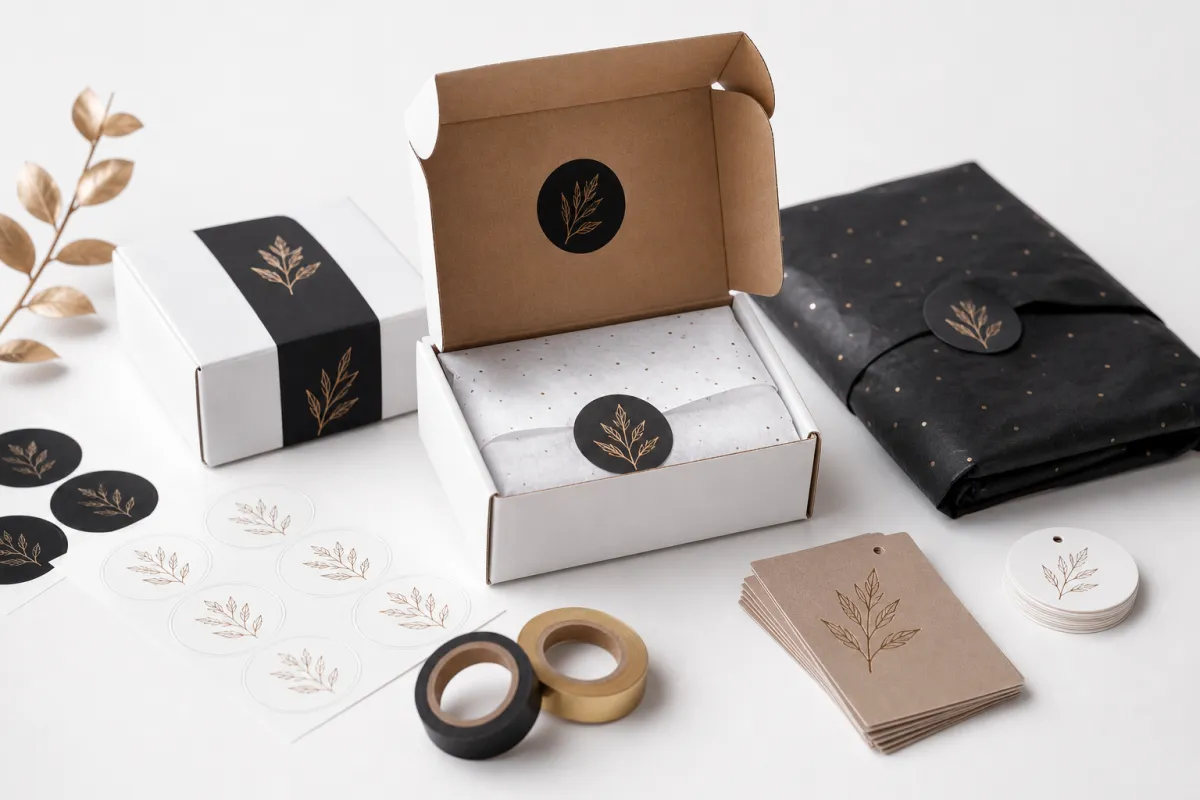
A branded stickers for packaging order is not there to decorate a box for fun. It is there to make plain packaging look like it belongs to a real brand. That matters. You get presentation without getting dragged into a high-MOQ custom box or bag run that eats cash and ties up inventory.
For packaging buyers, the value shows up fast. Better shelf appeal. Cleaner unboxing. Faster pack-out. More consistent branding across every shipment. If your team is sealing mailers, closing tissue wrap, or top-stamping boxes by hand, a branded stickers for packaging order can tighten the whole process. One well-placed sticker can carry a logo, product name, promo message, or compliance note without looking like it was slapped on five minutes before pickup.
That flexibility is the real reason people keep buying them. A sticker lets you switch seasonal artwork, test a new product line, call out a limited run, or add shipping-safe messaging without replacing the whole package. That matters for subscription kits, small-batch launches, retail packaging test runs, and brands that do not want to sit on thousands of printed cartons when next quarter brings a new design. Packaging is less about looking fancy and more about staying flexible without looking cheap. Kinda the whole job.
Where do stickers beat custom printed boxes or bags? Usually here:
- Fast product launches that cannot wait for a full carton run.
- Low-volume SKUs where the packaging design may still change.
- Seasonal campaigns that need a short brand refresh.
- Subscription kits that use the same base packaging across multiple drops.
- Retail packaging test runs where you want to validate demand first.
Here is the part people miss: the cheapest sticker is not always the cheapest order. A low-grade label that peels in transit, smudges during handling, or curls on a textured box turns into reprints, wasted labor, and a weak first impression. A branded stickers for packaging order should be treated like a packaging component, not a leftover task for whoever has five minutes left. If it fails, the whole unboxing experience looks sloppy. Customers notice. Fast.
I've seen good packaging get dragged down by a bad label more than once. The box was fine. The insert was fine. The sticker lifted at the corner after one humid truck ride, and suddenly the whole order looked rushed. That is why the material choice matters before the design ever hits print.
For brands building a broader packaging system, stickers usually sit alongside other assets rather than replacing them. A strong package branding plan might include a label, tissue, insert card, and outer box. If you need a wider view of that system, review our Custom Packaging Products and compare label formats in Custom Labels & Tags. The goal is to make the package work together, not to stick one pretty thing on top and call it strategy.
Product Details: Materials, Finishes, and Shapes
Material choice does most of the heavy lifting in a branded stickers for packaging order. Design matters, sure, but a beautiful graphic on the wrong stock is still the wrong sticker. If the label goes onto a dry paper mailer, short-term paper stock may be enough. If it faces condensation, cold storage, or rough shipping, you need a tougher face stock and adhesive combo.
Paper is the easiest starting point. It is usually the lowest-cost material, prints well, and works for indoor use, short-cycle shipping, and light handling. Most paper stickers fit tissue seals, insert seals, and branding on boxes that will not see much moisture. They also tend to be easier to write on if you need lot numbers or handwritten notes. The tradeoff is obvious: paper is not the best pick if the package might get wet, chilled, or rubbed hard.
BOPP is the workhorse for many branded stickers for packaging order projects. It stands up better against water, oil, and general handling. Gloss BOPP gives brighter color and a sharper pop. Matte BOPP looks cleaner and less reflective, which often reads as more premium on product packaging. If you sell food, bath products, supplements, or anything that may live in a humid environment, BOPP is usually a safer choice than paper.
Vinyl goes a step further for tougher use. It is thicker, more durable, and better suited to long wear, curved surfaces, and exposure that would make a paper sticker look tired. That does not mean every order needs vinyl. It means the material should match the abuse level. If the label lives on a mailer for three days, heavy vinyl is overkill. If it has to survive handling, temperature swings, or repeated contact, the extra cost can make sense.
Finishes change how the sticker reads in the hand and on the package. Matte creates a softer, more restrained look. Gloss boosts contrast and color depth. Soft-touch adds a more elevated feel, which helps when the sticker is part of the unboxing moment rather than just a utility label. If your packaging design leans muted, matte usually works better. If you want a louder logo on retail packaging, gloss can sharpen the visual hit.
Shape and format matter just as much. Circles work well for seals and badges. Squares are efficient and easy to stack on a roll or sheet. Custom die-cuts follow the outline of your logo or icon, which can look sharp when the art is simple and bold. Rolls suit higher-volume packing lines or applicators. Sheets fit hand application, mixed designs, and lower-volume packing rooms. A branded stickers for packaging order should match how your team packs, not how a catalog wants it to look.
Some orders need specialty features. Freezer-safe labels help in cold-chain use. Oil-resistant stocks matter for food or cosmetic packaging. Removable adhesives are useful when the sticker should come off cleanly. Tamper-evident materials help with seals or compliance use. Weatherproof builds make sense for outdoor exposure or rough transit. None of that is exotic. It is just matching the sticker to reality instead of hoping the package behaves nicely.
A sticker that looks great on a proof but peels off a corrugated box after one truck ride is not a bargain. It is a complaint with branding on it.
For transit-heavy projects, it helps to think about the package as a system. If you are testing durability, standards from organizations like the International Safe Transit Association are worth knowing because they focus on how packaging survives actual shipping stress. If your paper stock needs an environmental claim or chain-of-custody story, check the Forest Stewardship Council certification framework. Not every branded stickers for packaging order needs that level of scrutiny, but the ones moving through retail or regulated channels often do.
Specifications Buyers Should Lock In Before Ordering
A lot of sticker problems start before print. Not during print. Before. A branded stickers for packaging order needs clear specs, or you end up comparing quotes that are not really comparable. The core details are simple: size, shape, material, finish, adhesive type, quantity, and application format. Leave any of those vague and the quote turns into guesswork.
Size controls more than people think. A logo sticker that looks fine on screen can be too small to read once it sits on a mailer, or too large and awkward on a narrow pouch. Shape works the same way. A die-cut sticker can look premium, but if the shape is too complex, it may add cost and slow production. Keep the layout practical. A good branded stickers for packaging order usually starts with the package surface, not the artwork file.
Bleed and safe area still matter, even on simple logo labels. If the artwork does not include proper bleed, the cut line can crop a border or leave a thin white edge in the wrong place. If the safe area is too tight, text can get too close to the trim. That is how clean designs end up looking amateur. For most sticker files, a bleed of 0.125 inch is a common starting point, but the final spec depends on the die and production setup.
Color setup also deserves attention. CMYK is standard for many sticker runs, while Pantone matching is better when brand color consistency matters across product packaging, retail packaging, and other printed assets. If the artwork includes metallic stock or clear film, ask whether a white ink layer is needed under the art. Without it, colors can look washed out or disappear into the background. That is not a printing flaw. It is a setup issue.
Roll specs matter if the stickers will be machine-applied or loaded into a packing workflow. Core size, winding direction, label gap, and orientation all affect how smoothly the order runs. A label applicator may need a specific roll direction. A packing team may need the labels to dispense from a certain side. If those details are wrong, a perfectly printed branded stickers for packaging order still becomes annoying to use.
For a clean approval process, ask for a proof on every order. Not a casual screenshot. A proper proof that shows the cut line, color placement, and copy. That proof should be checked by someone who knows the packaging design, not just whoever happens to be available that morning. A five-minute review can prevent a costly reprint. Boring advice, yes. Still the right advice.
- File format: vector artwork is best for logos and cut lines.
- Resolution: 300 DPI is the usual floor for raster art.
- Color references: include Pantone codes if brand color matters.
- Adhesive choice: permanent, removable, or specialty, based on the surface.
- Application method: hand-applied sheets, roll applicator, or automated line.
One more practical point. If your brand uses more than one SKU or size, lock the spec sheet before the order goes live. A branded stickers for packaging order with five versions is not hard, but it gets messy fast if every version has a slightly different size or finish and the team is comparing them from memory. That is how packaging departments end up with three near-identical labels and one expensive mistake.
Branded Stickers for Packaging Orders: Pricing, MOQ, and What Changes the Quote
Pricing for a branded stickers for packaging order is driven by a handful of variables, and none of them are mysterious. Material, size, shape complexity, finish, quantity, adhesive type, and whether the job needs special proofing all affect the final number. If a vendor gives you a vague flat rate without asking for those details, they are either guessing or about to surprise you later. Neither is great.
Most branded stickers for packaging order requests start somewhere in the 250 to 1,000 piece range, though that can move lower for simple paper sheets or higher for specialty roll labels. The minimum order quantity depends on the production method. Simple paper stickers usually allow smaller runs. Waterproof rolls, custom die-cuts, and special finishes often push the minimum higher because the setup and make-ready cost has to be spread across the run.
At a practical level, unit pricing tends to drop as quantity increases, but the total spend still rises if the order adds premium stock or multiple SKUs. A 5,000-piece run on basic paper can be inexpensive per unit. The same quantity in matte BOPP or custom die-cut vinyl will cost more. That is not a markup mystery. It is material, labor, and waste. Fancy shapes use more production time. Specialty adhesive adds cost. More coverage means more ink. Business math still exists, annoying as that is.
Here is a realistic range buyers often use as a planning tool:
| Sticker Type | Typical MOQ | Common Unit Range | Best Use | Main Tradeoff |
|---|---|---|---|---|
| Paper label on sheet | 250-500 | $0.02-$0.06 | Short-run branding, inserts, seals | Limited moisture resistance |
| BOPP label on roll | 500-1,000 | $0.04-$0.12 | Shipping boxes, pouches, product packaging | Higher setup than paper |
| Vinyl custom die-cut | 500-1,000 | $0.08-$0.20 | Durable retail packaging, curved surfaces | Higher unit cost |
| Specialty adhesive or tamper-evident | 1,000+ | $0.12-$0.35 | Cold chain, compliance, security seals | More setup and testing |
Those numbers are not universal. A large logo with heavy ink coverage costs more than a simple one-color seal. A tiny round sticker costs less than a large custom shape. A clear film with white ink usually costs more than white stock. Shipping can matter more than people expect, especially if the order is rushed or the boxes are bulky. The honest answer is that a branded stickers for packaging order should be priced from the actual use case, not from a fantasy of “cheap labels.”
Watch for hidden costs. Artwork setup fees show up if the file needs cleanup. Rush charges appear when production has to jump the queue. Reprints cost money when the buyer changes copy after approval. Freight may be separate. If the vendor is quoting low but not mentioning those items, ask. A real quote is better than a pleasant lie.
If you are deciding how much to spend, define the role of the sticker first. Is it a branding asset, a compliance label, or a promo piece? A branding-only label for a subscription box does not need the same spec as a freezer label for chilled product packaging. That sounds obvious, but buyers still mix those categories and then wonder why the quote makes no sense. Build the budget around the job, not the sticker itself.
The cheapest quote is rarely the lowest-cost order. The lowest-cost order is the one that prints right, sticks right, and does not need a second run.
For companies buying across multiple packaging formats, this is where broader planning helps. If you are also sourcing Custom Packaging Products or building repeatable vendor relationships through Wholesale Programs, lock the sticker spec early so the label line does not drift from the rest of the brand system. Consistency is boring until you lose it. Then it becomes very expensive.
Order Process and Turnaround Timeline
A clean branded stickers for packaging order process should feel predictable. Submit the specs. Approve the proof. Confirm payment. Move into print. Finish, pack, and ship. That is the basic sequence. If any one of those steps is fuzzy, the turnaround gets longer and the risk of error goes up. This is why packaging buyers like vendors who can explain the process without hiding behind vague language.
Simple sticker runs can move quickly once the proof is approved. More complex runs take longer. Custom shapes need dieline review. Specialty stock may need testing. Big quantities need more production and more packing time. A realistic schedule often lands in the 12-15 business day range after proof approval for straightforward jobs, while more demanding runs can take longer. The best schedule is the one built before the packaging launch, not after the boxes are already stacked on the dock.
Most delays come from avoidable issues. Artwork changes after proof approval. Missing dielines. Poor file resolution. Color corrections that should have been solved earlier. And, frankly, buyer-side approval lag. A vendor cannot print a package branding job if nobody signs off on the final art. That is not a production problem. That is a process problem.
Rush options can work, but only when the artwork is final and the spec sheet is locked. If you are still debating size, finish, or adhesive, do not ask for rush service yet. You are just paying extra to make the chaos move faster. A proper branded stickers for packaging order should be rushed only when the facts are already settled.
Here is the timeline I recommend for most buyers:
- Confirm the package surface and the role of the sticker.
- Lock the size, material, finish, adhesive, and quantity.
- Send final artwork with bleed and color references.
- Review the proof line by line.
- Approve production only after the mockup is correct.
If your team is comparing vendors, ask for a real lead-time estimate, not a soft promise. “Fast” is not a schedule. “Ship after proof approval in 10-12 business days” is a schedule. There is a difference, and it matters when product packaging has to hit a launch date or a retail reset window. If you are curious about prior project handling, our Case Studies page shows how repeat packaging jobs stay organized when the spec stays tight.
One more practical habit: schedule the sticker run earlier than you schedule the box run. That gives you room to correct artwork or test adhesion before the rest of the packaging order is committed. It is a small move that saves a lot of stress. Buyers who wait until the last minute always think they are being efficient. They are usually just compressing the problem.
Why Choose Custom Logo Things for Packaging Stickers
Custom Logo Things is built around packaging-specific work, which matters more than it sounds. A lot of vendors sell stickers. Fewer of them understand how those stickers behave on shipping cartons, retail packaging, or Product Packaging That has to survive real handling. That difference shows up in the questions they ask, the proof they provide, and the recommendations they make.
For buyers, the best service is not flashy. It is useful. Material guidance should be tied to the job, not to whatever stock is easiest to sell. Proof review should catch cut lines, contrast, and copy issues before they become a reprint. Setup guidance should help your branded stickers for packaging order land on time and match the rest of the package branding. If the support sounds generic, expect generic results.
Consistency matters on repeat orders too. When a packaging buyer reorders the same sticker six weeks later, the color should match. The size should match. The finish should match. The team should not have to reopen a mystery project and hope the previous setup still exists somewhere in email. Reorder stability is a real advantage for brands that care about clean package branding across multiple product drops.
That is also where straightforward quoting helps. Business buyers want clear numbers, realistic lead times, and no drama. If you are ordering branded packaging components around a launch calendar, you do not need a sales script. You need answers. That is the standard. Anything less wastes time.
For brands that want the larger picture, the sticker is only one piece of the system. Some buyers need the whole stack: box, label, insert, and outer seal. Others only need a small label run and a quick turnaround. Either way, the order should fit the use case. If you need a single-source overview for packaging components, the Custom Labels & Tags page is a useful place to compare formats without wandering through a generic catalog.
And if you are moving beyond a one-off buy, our Wholesale Programs are built for repeat packaging runs where predictability matters more than chasing the absolute lowest sticker price. That is usually the right move for growing brands. Chasing pennies on packaging often costs dollars later.
Next Steps: Build the Right Sticker Order
Start with the surface. That is where a branded stickers for packaging order succeeds or fails. Is the package smooth or textured? Dry or humid? Flat or curved? Will the label sit on a shipping box, a pouch, a jar, a wrap seal, or a retail display piece? Those answers should guide the material before you even talk about artwork.
Then choose the spec set. Size. Shape. Finish. Adhesive. Quantity. Application format. Once those are fixed, the quote becomes useful. Before that, you are just asking for a number attached to uncertainty. Buyers waste the most time when they request pricing without deciding how the sticker will be used. That is how the same branded stickers for packaging order gets quoted three different ways and nobody can tell which one is right.
If the sticker will touch food packaging, cold storage, or high-moisture shipments, ask for a sample recommendation or proof material suggestion before production starts. If it is going into a retail packaging program, ask how the finish reads under store lighting. If it is part of a promo drop, ask whether the color and cut line support the brand story you actually want to tell. Little details like that are not decorative. They affect how the package performs.
Compare quotes on total value, not just unit price. A lower quote that comes with weak adhesive, poor color control, or a messy turnaround is not really lower. It is just future work. A stronger branded stickers for packaging order usually costs a little more because it saves labor, avoids reprints, and protects the look of the package in transit. That tradeoff is easy to justify when the packaging is part of the customer experience.
If you are still building the broader system, use this order as a chance to tighten the rest of your packaging design. Check the box size. Check the insert. Check the unboxing sequence. A good sticker can carry a lot of visual weight, but it should support the product packaging, not cover for weak structure elsewhere. Brands that think this way end up with cleaner results and fewer surprise costs.
Most importantly, lock the timeline early. A branded stickers for packaging order should arrive before the packaging run starts, not after the team has already built the cartons and hoped for the best. The earlier you approve the proof and confirm the spec, the smoother the production path. That is the whole game: fewer unknowns, fewer mistakes, better packaging.
For a closer look at how custom packaging pieces fit together, browse our Custom Packaging Products, check the answers in our FAQ, and compare options before you place the order. Before anything goes to print, lock four things: the package surface, the sticker material, the proof, and the lead time. Do that, and the sticker does its job instead of collecting blame later.
FAQ
What is the minimum order for branded stickers for packaging?
Most custom orders start in the 250 to 1,000 piece range, depending on material and shape. Simple paper jobs often allow lower MOQs than waterproof rolls or custom die-cuts. If you need multiple sizes or SKUs, expect each version to have its own minimum. That is normal for a branded stickers for packaging order.
Are branded stickers for packaging better on rolls or sheets?
Rolls work better for high-volume packing lines and applicators. Sheets fit hand application, small runs, and mixed designs. Choose the format based on how your team actually packs orders, not on what looks cheapest. A branded stickers for packaging order that matches the workflow is usually the one that saves time.
Which adhesive should I choose for packaging stickers?
Use permanent adhesive for shipping boxes and products that should not peel off. Choose removable adhesive when the sticker should come off cleanly after use. For cold, damp, or oily surfaces, ask for a specialty adhesive that matches the material. The wrong adhesive can ruin an otherwise solid branded stickers for packaging order.
How fast can branded stickers for packaging orders ship?
Simple jobs can move quickly once the proof is approved. Custom shapes, special finishes, or larger quantities usually need more production time. Rush orders are possible, but only if artwork, sizing, and payment are finalized fast. If the spec is still changing, the turnaround will stretch.
What artwork do I need for a sticker order?
A vector file is best, especially for logos, shapes, and clean edge cuts. If you are using raster art, high resolution matters to avoid fuzzy print results. Include bleed, safe area, and any special color references so production does not have to guess. That keeps the branded stickers for packaging order on track and cuts down on proof revisions.

