Buyer Fit Snapshot
| Best fit | Branded Stickers for Shipping Cartons projects where brand print, material claims, artwork control, MOQ, and repeat-order consistency need to be specified before quoting. |
|---|---|
| Quote inputs | Share finished size, material target, print colors, finish, packing count, annual reorder estimate, ship-to region, and any compliance wording. |
| Proofing check | Approve dieline scale, logo placement, barcode or warning zones, color tolerance, closure strength, and carton packing before bulk production. |
| Main risk | Vague material claims, crowded artwork, missing packing details, or unclear freight terms can make a low unit price expensive after revisions. |
Fast answer: Branded Stickers for Shipping Cartons: Material, Adhesive, Artwork, and MOQ should be specified like a repeatable production item. The safest quote records material, print method, finish, artwork proof, packing count, and reorder notes in one written spec.
Production checks before approval
Compare the actual filled-product size with the drawing, then confirm tolerance on folds, seals, hang holes, label areas, and retail display edges. Reserve space for logos, QR codes, warning copy, and material claims before decorative graphics fill the panel.
Quote comparison points
Review material grade, print process, finish, sampling route, tooling charges, carton quantity, and freight assumptions side by side. A quote is only useful when the supplier can repeat the same color, closure quality, and packing count on the next order.
Branded Stickers for Shipping Cartons: Uses, Cost, Tips
Branded stickers for shipping cartons do a strange little job. They take a plain corrugated box, the kind that disappears into a porch pile, and give it a face. Not a loud one. A recognizable one. That shift matters more than many brands expect. A carton without branding says “product moved.” Branded stickers for shipping cartons say “this package belongs to someone with a point of view.”
I have watched that distinction change how customers talk about a delivery before they ever open it. One clean seal on a kraft carton can make the whole shipment feel intentional. It sounds small. It is not. In fulfillment, the small stuff is often the part that survives contact with reality.
The appeal is not decoration for decoration’s sake. Branded stickers for shipping cartons can support identification, tamper awareness, and the unboxing moment in one move. A label that seals a flap, marks a batch, or anchors a campaign message pulls weight in the warehouse and at the doorstep. A label that wrinkles, peels, or curls at the edge does the opposite. Packaging has a brutal honesty to it, especially when adhesive labels meet rough corrugated cartons.
Brands with multiple SKUs, limited-edition launches, frequent artwork changes, or seasonal promotion cycles usually find branded stickers for shipping cartons more practical than custom-printed cartons. Custom boxes are expensive to reset every time a design changes. Stickers keep the carton flexible. If you want a broader look at how that flexibility shows up across packaging types, our Case Studies page and Custom Packaging Products lineup give a useful cross-section.
There is a logistics angle too. A sticker can call out a batch number, identify a return lane, or signal that the carton has been checked and sealed. That sounds minor until you multiply it across a packing room. If a simple cue saves two seconds per parcel on 4,000 orders, that is more than two hours of labor gone every day. Small graphics. Real money. The same logic is why packaging labels keep showing up in better fulfillment systems.
What branded stickers for shipping cartons actually do
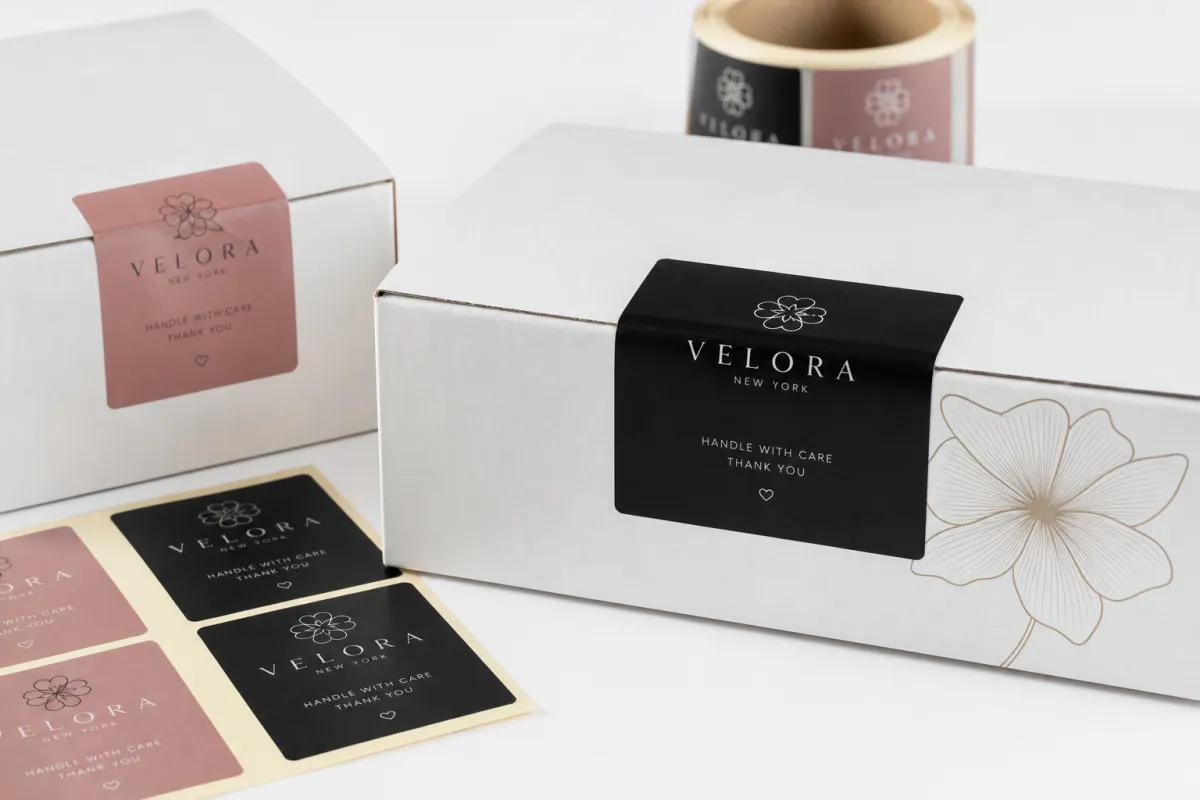
Branded stickers for shipping cartons usually handle four jobs at once: brand signaling, package identification, tamper awareness, and presentation. The carton still needs to protect the product. That part never goes away. The sticker changes the first read before the customer touches tape or filler. A plain kraft box says the warehouse did its job. Branded stickers for shipping cartons suggest the brand thought about the handoff too.
The strongest use case is easy to picture. A customer opens the door and sees a brown corrugated box with only a carrier label on top. Nothing wrong with it. Nothing memorable either. Add one clean branded sticker for shipping cartons and the same box starts to feel deliberate. It feels like a package, not a stray supply item. In ecommerce, that distinction lands early. Often it lands before the product does.
People sometimes treat branded stickers for shipping cartons as oversized logo decals. That is the wrong frame. The better version helps fulfillment staff identify inventory, shows the customer which side is intended to face up, and can indicate that the carton has been inspected or sealed. A label that saves a warehouse worker two movements per parcel is not flashy. It is efficient. Efficiency tends to be quiet.
Branded stickers for shipping cartons also make sense when a company does not want to commit to custom cartons yet. Small runs. Fast-turn campaigns. Holiday collections. Creator collaborations. Product tests that may or may not survive the quarter. Those are all bad candidates for expensive printed boxes and better candidates for labels. Brands often start with branded stickers for shipping cartons, then move to custom cartons later if volume and stability justify it.
One useful correction: a sticker does not solve carton performance. It is not protective armor. It is a layer in the transit packaging system. The corrugated spec still has to match product weight, shipping distance, and carrier handling. If the box fails, the branding does not get a medal for surviving the collapse.
“A shipping carton is not a billboard. It is a handled object. If the branding cannot survive sorting belts, stacking pressure, and a damp porch, the design was never finished.”
For brands that want a cleaner packaging system, branded stickers for shipping cartons can sit beside Custom Labels & Tags and other flexible components. That separation is useful. One format can handle branding, another can handle logistics, and the carton can still do its real job. The package stops trying to be everything at once.
How do branded stickers for shipping cartons work in production?
The production path for branded stickers for shipping cartons is simple on paper and less simple in practice. Artwork comes first. Proofing follows. Then material selection, print method, finishing, and application on the packing line. Each step can help the label feel precise or make it look like a rushed afterthought. Skip one and the cost shows up somewhere else, usually in waste, delays, or peeling edges.
Artwork should be built around the real carton, not a fantasy rectangle on a monitor. Measure the actual panel size, seam placement, tape path, and any area already reserved for a courier label or barcode. Branded stickers for shipping cartons need breathing room around the logo, especially on smaller formats. A safe margin of at least 0.125 inch makes sense for compact pieces, and larger stickers usually need more. Crowding a fold or tape seam makes the layout feel cramped and puts the adhesive edge under stress.
Material selection matters more than most buyers expect. For branded stickers for shipping cartons, paper stock is usually the cheapest option and works well on dry, clean cartons. Polypropylene handles moisture better and gives a smoother printed surface. Vinyl is tougher and better suited to rougher treatment, though many carton programs do not need that level of durability. Matte finishes hide scuffs. Gloss finishes reflect more light and make color pop. Neither finish repairs a weak bond.
Adhesive is where a lot of projects get cheap in the wrong place. A low-cost removable adhesive can look fine on a sample sheet and then fail on a dusty recycled carton. A high-tack permanent adhesive usually performs better on textured kraft and rough recycled board, especially when the carton has lint, dust, or cold-storage exposure. For branded stickers for shipping cartons, that adhesive choice often matters more than the color palette.
Application method depends on volume. Low-volume teams can hand-apply branded stickers for shipping cartons without much trouble, especially when the label shape is simple and the carton size stays consistent. Mid-volume operations often use dispenser-assisted placement, which speeds the process and improves alignment. High-throughput lines may move to automated labeling, particularly if every carton in the run gets the same mark. A little planning here saves labor later. Usually a lot later.
If cartons are recycled, dusty, or cold from storage, the material and adhesive become the priority. A beautiful file does not rescue a weak bond. For packaging performance guidance, the transit-testing resources at ISTA are useful, and FSC-certified paper options are explained at FSC. Neither site sells labels. Both are useful reminders that packaging lives in the real world, not in a mockup window.
Key factors that affect sticker performance and cost
Pricing for branded stickers for shipping cartons usually comes down to six variables: size, quantity, print complexity, material grade, adhesive type, and finish. Buyers often remember five and forget the sixth, then wonder why the quote moved. Bigger labels use more material. Specialty finishes add steps. Custom shapes need dies. None of that is mysterious. It just has consequences.
Size is not always an advantage. Many brands assume larger branded stickers for shipping cartons look better by default. They do not. A clean 3-inch seal-style sticker can look more disciplined than a full-panel label if the carton layout is tight and the logo is strong. Big stickers work when the campaign message needs more space, but bigger is not the same thing as better. Placement often wins by being smarter than the artwork.
Surface compatibility is another cost driver that gets underestimated. Kraft cartons, coated cartons, recycled cartons, and porous board all behave differently. A sticker that looks perfect on a smooth sample carton may look dull or fail to bond on rougher transit packaging. That is why branded stickers for shipping cartons should be tested on the exact board grade used in fulfillment, not on whatever sample box happens to be closest to the desk.
Design choices affect price too. One-color logo marks are efficient and usually enough for carton branding. Full-color artwork uses more ink and more proofing. Metallic details, spot gloss, and custom die-cuts increase cost. None of those are wrong. They just need a reason. If the sticker mainly serves as a brand seal on ecommerce shipping cartons, a clean one-color mark can look sharper than a crowded design trying to prove something.
Cheap decisions have a habit of becoming expensive later. If branded stickers for shipping cartons curl at the corners, the team spends time reapplying them. If the adhesive fails in cold storage, the customer sees peeling edges in transit. If the artwork is too small, the branding disappears. A low unit price does not help much if you have to buy the same label twice.
Weight is not the issue. Stickers add almost nothing to dimensional weight because they are light. The real cost lives in material, application time, and waste. That is why branded stickers for shipping cartons often sit in a useful middle ground between bare cartons and fully custom cartons. They improve presentation without turning every shipping order into a manufacturing event.
- Lowest-cost path: standard shape, paper stock, one-color print, permanent adhesive
- Balanced option: matte polypropylene, full-color logo, standard die-cut
- Higher-end option: specialty finish, custom shape, upgraded adhesive, multiple versions
If you are mapping a broader packaging budget, branded stickers for shipping cartons often land in the gap between plain cartons and printed cartons. They also work well beside Custom Shipping Boxes when selective branding makes more sense than printing every panel. That mixed approach is common in actual production. Less theater. More control.
Branded stickers for shipping cartons: pricing and timeline
Real pricing depends on quantity and spec, but branded stickers for shipping cartons usually follow a predictable shape. Small runs cost more per piece because setup and proofing are spread over fewer units. Larger quantities lower the unit price quickly. That is not a trick. It is how print production behaves. If you order 500 stickers, you are paying for the run. If you order 10,000, scale begins to do the work.
For simple branded stickers for shipping cartons, broad pricing bands are usually more useful than false precision. Paper labels at medium quantities may land around $0.03-$0.07 per unit. Polypropylene might sit around $0.05-$0.12. More durable stocks or specialty finishes can move into $0.09-$0.18 or higher. Custom die-cuts, metallic ink, and multi-version jobs can push the number again. Setup charges for dies or special tooling are usually modest compared with carton printing, but they still exist and they still matter.
| Sticker option | Typical use | Approx. unit cost at 5,000 pcs | Notes |
|---|---|---|---|
| Matte paper | Dry cartons, simple brand mark | $0.03-$0.07 | Best when cost control matters and the carton stays clean |
| Matte or gloss polypropylene | General ecommerce shipping | $0.05-$0.12 | Better moisture resistance and a cleaner surface appearance |
| Vinyl or polyester | Rough handling, longer exposure | $0.09-$0.18 | More durable than most carton branding needs, useful in harsher lanes |
| Special finish or custom shape | Campaigns, premium presentation | $0.10-$0.22+ | Useful when impact matters and the extra cost has a clear purpose |
Timeline is manageable if the project is planned before the calendar starts breathing down your neck. Standard branded stickers for shipping cartons can often move from proof approval to delivery in about 7-10 business days when the artwork is clean and the material is standard. Custom shapes, specialty finishes, or multi-version orders can stretch to 12-15 business days or more. Add shipping time and the path gets longer fast.
Seasonal campaigns are where people misjudge the schedule. Artwork gets approved late, then everyone expects branded stickers for shipping cartons to appear by magic. They do not. Proof review, sample checking, production, packing, and shipping all need room. If the labels support a launch, set the reorder point before the campaign starts, not after the last pallet disappears.
One buying rule keeps the budget steadier: match quantity to the campaign window. If the artwork changes every quarter, do not order enough branded stickers for shipping cartons to cover three design refreshes at once. That is how dead stock happens. A storage room full of obsolete labels is not a savings strategy. It is a symptom.
For buyers comparing formats, branded stickers for shipping cartons can sit alongside mailers, inserts, and corrugated boxes as part of a larger packaging system. If you are looking at broader shipping materials, see how Custom Poly Mailers or a carton program might fit your operation. Different tools. Same budget.
Step-by-step: setting up shipping carton stickers correctly
The cleanest way to set up branded stickers for shipping cartons is to begin with the job itself. Are they meant for branding, sealing, shipping identification, promo messaging, or a mix of those? The answer changes the shape, the finish, and the layout. A seal sticker used across carton flaps is not designed the same way as a logo sticker placed on the top panel for first-glance visibility.
Next, build the artwork around the carton dimensions. Measure the exact width, height, and seam location. Leave breathing room around the logo. Keep key text away from tape, folds, and label-over-label stacking. Branded stickers for shipping cartons can look elegant in a PDF and still fail once they hit the corner of a recycled box. Carton mockups help. Real cartons tell the truth faster.
Always ask for a proof on similar stock. If the order matters, ask for a physical sample too. Screens lie in predictable ways. Cardboard does not. A proof on smooth white paper does not show how branded stickers for shipping cartons will behave on rough kraft or a slightly dusty recycled surface. Test the real thing. That single step prevents a lot of arguments later.
After that, test application on the actual packing line. The team handling order fulfillment will tell you quickly whether the peel is clean, whether the sticker wants to tunnel or wrinkle, and whether alignment stays easy at speed. A label that works at five boxes a minute may become irritating at fifty. That sort of problem never appears in a mockup and always appears on a deadline.
Lock the reorder process last. Save the approved file, the exact size, the carton type, the finish, the adhesive, and the target quantity. Keep those details in one place. Branded stickers for shipping cartons are much easier to reorder when the spec is written down instead of hiding in someone’s inbox. That is not glamorous. It is how repeat orders stay sane.
- Define the job: branding, seal, identifier, or promo message
- Measure the carton: panel size, seams, tape path, and label clearance
- Test the stock: sample on the exact corrugated board
- Check the line: apply during real packing, not on a desk
- Document the spec: save the file, finish, adhesive, and quantity
For most brands, branded stickers for shipping cartons are one of the simplest packaging upgrades to standardize because the process is repeatable. The hard part is not the application. It is discipline. Keep the spec tight and future orders become straightforward instead of mysterious.
Common mistakes with shipping carton stickers
The first mistake is treating branded stickers for shipping cartons like an afterthought. Placement gets random. The logo is too small. Color is chosen because it looked nice on a screen. The box arrives and still looks generic. That is not a branding system. That is a shrug with adhesive on it.
The second mistake is choosing the wrong adhesive for the carton surface. Recycled cardboard is rougher and more porous than many people expect. A weak adhesive can lift at the corner or fail under humidity, cold storage, or dust. For branded stickers for shipping cartons, that kind of failure is visible immediately. Nothing says “we saved three cents” like a peeling label at the customer’s doorstep.
The third mistake is overloading the sticker with text. Shipping cartons move through fast environments. They are scanned, stacked, sorted, and carried by people who do not want to read a paragraph. Branded stickers for shipping cartons should be readable from a few feet away. If the design needs a second look, it is probably too busy.
The fourth mistake is ignoring the packing line. A design may look polished in a presentation and still be awkward to apply 2,000 times a day. If the sticker is too small to peel quickly, too narrow to align easily, or too glossy to handle without slipping, it creates friction. In ecommerce shipping, friction becomes labor cost. Very quickly.
The fifth mistake is skipping test orders. Everyone wants to move fast. Branded stickers for shipping cartons should still be tested on the exact carton stock, in the actual warehouse conditions, with the people who will apply them. Humid storage, dusty cartons, and cold mornings all affect adhesive behavior. The box does not care that the deadline is aggressive.
One warehouse manager put it bluntly to me: “If it tears off in the cold room, it was never a label, it was a suggestion.” That is a little harsh, maybe, but it gets the point across.
- Random placement: weakens recognition and makes the box look unplanned
- Wrong adhesive: causes peeling, lift, and waste
- Too much copy: clutters fast-moving shipping surfaces
- No line test: turns a simple label into a labor problem
- No sample run: invites expensive surprises in production
Branded stickers for shipping cartons work best when they are boring in the right way: consistent, readable, and easy to apply. The goal is not to show off every idea on the mood board. The goal is to make the carton feel intentional and survive transit without drama.
Expert tips and next steps for better carton branding
If you want branded stickers for shipping cartons to pull their weight, choose one strong hero placement and keep it consistent across carton sizes. Recognition builds faster that way. Customers do not need three sticker positions and a scavenger hunt. They need a repeatable cue that tells them the box belongs to your brand.
If budget is tight, spend on adhesive quality and print clarity before special finishes. A crisp label that stays put beats a fancy one that curls in transit. A plain matte sticker that survives a cold morning is better than a metallic version that starts lifting before the truck reaches the second stop. Branded stickers for shipping cartons should survive the shipment, not just the approval meeting.
Test two or three sizes on the same carton and compare them from three feet away. That is closer to the real viewing distance than a designer’s monitor, and it tells you a lot about readability. For branded stickers for shipping cartons, the right size is usually the one the eye finds instantly without shouting. Loud is easy. Clear takes judgment.
Build a simple spec sheet and save it. Include carton type, sticker size, finish, adhesive, placement, artwork version, and reorder quantity. One page prevents a lot of “which file was approved?” confusion later. It also helps suppliers quote faster and keeps branded stickers for shipping cartons consistent across future runs.
There is a broader packaging strategy here too. If a shipment needs more protection or structure, branded stickers for shipping cartons can sit alongside better carton specs, inserts, and dunnage instead of trying to do every job alone. Transit packaging works best as a system. The sticker is one part of that system, not the whole design.
Next steps are plain enough. Order samples. Test them on your real carton stock. Measure peel performance after packing and after a short transit test. Confirm timeline with your supplier. Set a reorder point before inventory gets low. That is the practical route. Not glamorous. Effective.
For brands comparing the wider packaging lineup, branded stickers for shipping cartons often pair well with a controlled mix of labels, mailers, and box programs from Custom Packaging Products. The cartons stay flexible, the branding stays consistent, and the team avoids being locked into one expensive format too early.
Frequently Asked Questions
Are branded stickers for shipping cartons cheaper than custom printed boxes?
Yes, usually. They avoid the cost of printing every carton panel, so they are often the better option for smaller runs, changing designs, and mixed-SKU operations. They become especially cost-effective when branding is needed only on certain SKUs, campaigns, or seasonal drops. If volume is very high and the artwork never changes, Custom Printed Boxes can eventually win on unit economics, but that is a different scale conversation.
What size works best for branded stickers for shipping cartons?
The best size depends on carton size and viewing distance, but most brands do well with labels that are readable from a few feet away. Smaller cartons often look cleaner with a compact logo mark or seal, while larger cartons can support a bigger panel sticker. Test at least two sizes on the actual box before approving a full run, because mockups love to lie.
Do branded stickers for shipping cartons stick to recycled cardboard?
They can, but recycled cartons are often rougher and more porous, so adhesive choice matters a great deal. High-tack permanent adhesives usually perform better on textured kraft and recycled surfaces. Always test on the exact carton stock, because not all cardboard behaves the same in real production.
How long does production usually take for shipping carton stickers?
Simple orders can move quickly, but custom sizes, specialty finishes, and complex proofs add time. In many cases, production can move from proof approval to delivery in about 7-10 business days when the artwork is clean and the material is standard, while more complex jobs may take 12-15 business days or more. Build in time for artwork approval, sample checking, production, and shipping so the schedule does not depend on luck.
What file do I need for branded stickers for shipping cartons?
A vector file is usually best because it keeps logos and text sharp at any size. Include the exact sticker dimensions, bleed, and any cut-line information if the shape is custom. If you are unsure, ask for a production template before sending final artwork. That one move can prevent a very predictable round of revisions.
Branded stickers for shipping cartons are one of the smartest low-friction tools in packaging because they give plain corrugated boxes a deliberate, branded look without forcing you into a full custom carton program too early. If you Choose the Right material, adhesive, size, and placement, branded stickers for shipping cartons can improve presentation, support order fulfillment, and keep the packaging budget under control. The practical takeaway is simple: pick one real carton, one real adhesive, and one real placement, then test them in the warehouse before you order at scale. That is how the box starts doing better work without making anyone else do more of it.

