Buyer Fit Snapshot
| Best fit | Branded Tissue Paper Wholesale Pricing projects where brand print, material claims, artwork control, MOQ, and repeat-order consistency need to be specified before quoting. |
|---|---|
| Quote inputs | Share finished size, material target, print colors, finish, packing count, annual reorder estimate, ship-to region, and any compliance wording. |
| Proofing check | Approve dieline scale, logo placement, barcode or warning zones, color tolerance, closure strength, and carton packing before bulk production. |
| Main risk | Vague material claims, crowded artwork, missing packing details, or unclear freight terms can make a low unit price expensive after revisions. |
Fast answer: Branded Tissue Paper Wholesale Pricing: What It Includes should be specified like a repeatable production item. The safest quote records material, print method, finish, artwork proof, packing count, and reorder notes in one written spec.
Production checks before approval
Compare the actual filled-product size with the drawing, then confirm tolerance on folds, seals, hang holes, label areas, and retail display edges. Reserve space for logos, QR codes, warning copy, and material claims before decorative graphics fill the panel.
Quote comparison points
Review material grade, print process, finish, sampling route, tooling charges, carton quantity, and freight assumptions side by side. A quote is only useful when the supplier can repeat the same color, closure quality, and packing count on the next order.
Branded Tissue Paper Wholesale Pricing: What It Includes
Branded tissue paper wholesale pricing looks simple until someone has to define the actual job. A small repeat logo on white tissue can seem inexpensive on paper, then the number shifts once the order moves to full-sheet coverage, custom color stock, tighter packing, and freight. That change is normal. The price covers more than paper. It covers a repeatable branded packing component that has to print cleanly, fold consistently, and arrive in usable condition.
From a packaging buyer’s point of view, branded tissue paper wholesale pricing only becomes meaningful when the quote matches the real specification. Sheet size, paper grade, print coverage, ink count, fold style, carton count, and delivery terms all affect the number. Put a teaser price next to a proper all-in quote and the cheaper one usually falls apart fast. Nobody wants mystery math on a packing line.
I have seen this exact mistake in supplier comparisons more times than I can count: a team chooses the lowest-looking quote, then discovers that the “cheap” option excluded cartons, proofing, or domestic freight. That is not a pricing win. That is a procurement trap wearing a friendly face.
For most buyers, the better question is not “How low can the per-sheet price go?” It is, “What does branded tissue paper wholesale pricing include, and what changes when one variable moves?” That framing keeps teams from overpaying, under-ordering, or ending up with tissue that looks fine in a mockup and weak in a real box.
Why branded tissue paper wholesale pricing surprises buyers
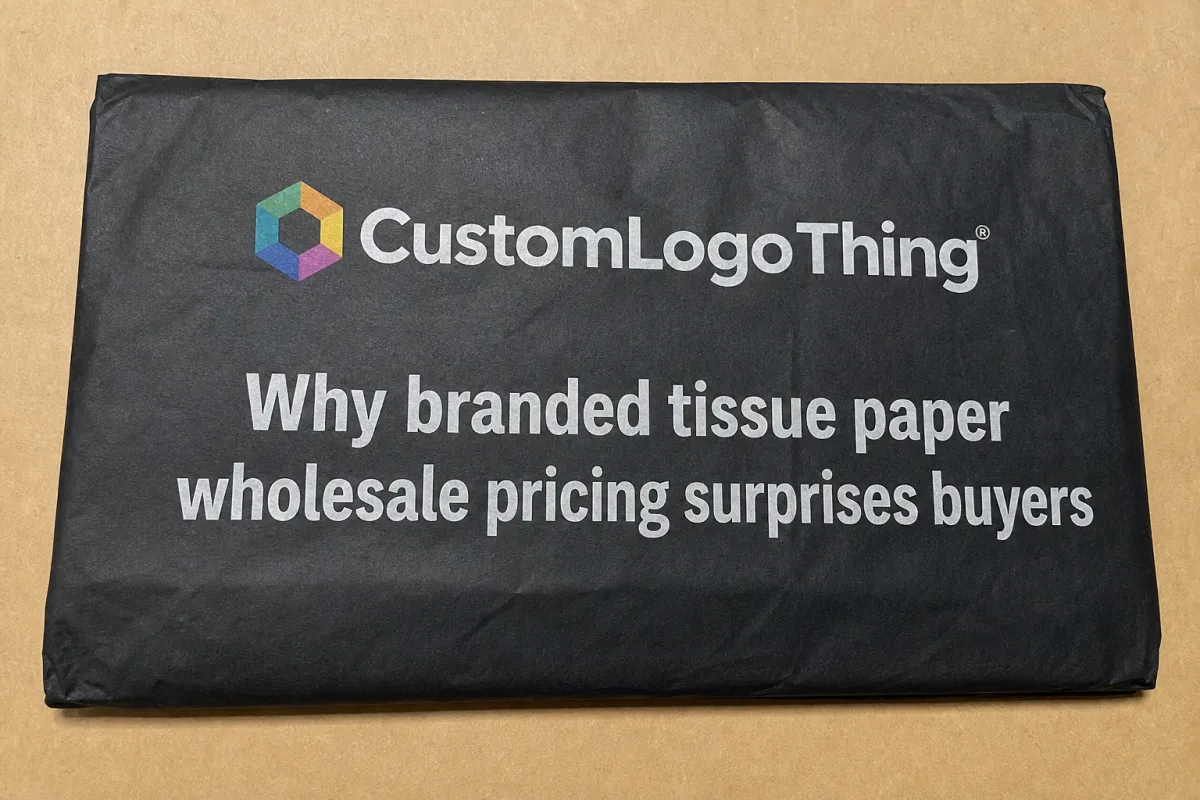
Branded tissue paper wholesale pricing surprises people because tissue feels simple. It is thin paper with a logo, right? Not quite. Once a brand wants a repeat pattern, a specific tissue grade, and a print result that does not smear, buckle, or bleed, the pricing logic starts to look more like print production than plain paper buying. That is where the numbers move.
The biggest driver is usually sheet format. A 15 x 20 inch sheet uses less material than a 20 x 30 inch sheet, and that matters on both the paper side and the freight side. Add more print coverage and the job also needs more ink, more drying control, and more attention during production. That is why branded tissue paper wholesale pricing can look fine at first glance and then shift when the buyer upgrades from a small logo repeat to a full-bleed design.
Color count matters too. A one-color repeat logo is usually the cleanest and most efficient path. Two colors are still common, but the job becomes more sensitive to registration and consistency. Dense artwork can be done, yet it often pushes branded tissue paper wholesale pricing higher because the print process needs tighter control and more setup time. Fine lines and tiny type are where people learn that tissue is not coated art paper. The stock absorbs differently, and the result needs planning.
Another common mistake is comparing a low teaser quote against a complete supplier quote. One quote may exclude plates, artwork cleanup, cartons, labels, or domestic delivery. Another may include all of it. If the scope is not lined up, branded tissue paper wholesale pricing becomes a false comparison. It is the packaging version of comparing an empty carton to a fully loaded pallet and pretending they weigh the same.
The business case is straightforward. Branded tissue paper is not filler. It shapes the unboxing experience, supports perceived value, and can reduce the amount of additional decorative packaging a brand needs. A tissue sheet adds a small cost per order, but it can lift the entire presentation when used well. For premium apparel, beauty kits, and gift packaging, that effect matters. Branded tissue paper wholesale pricing should be judged against the customer experience and the cost per packed order, not against the price of plain white tissue in a warehouse catalog.
There is also a sourcing reality that many buyers overlook: branded tissue paper wholesale pricing stays stable only when the buyer understands the repeatable production setup. If the design changes every time, or if the brand keeps adjusting the sheet size after quoting, the supplier has to rework the job. That adds cost. The same thing happens with poor art files, inconsistent brand colors, or last-minute packing changes. Suppliers do not enjoy guessing any more than buyers enjoy paying for guesses.
For teams that want to compare options cleanly, the best starting point is a single spec sheet that lists the essentials. If you already buy other branded packaging, review how those specs are written in your Case Studies and compare that structure with your tissue brief. The clearer the brief, the cleaner the branded tissue paper wholesale pricing will be.
What branded tissue paper orders actually include
Branded tissue paper wholesale pricing is built around the order spec, not around a vague “custom tissue” label. A proper quote should identify the tissue grade, sheet dimensions, print area, color count, fold style, and how the sheets are packed. If any of those pieces are missing, the price is incomplete. That sounds obvious, though obvious still has a way of getting missed.
Start with the paper itself. Most branded tissue paper orders use lightweight stock in the 17gsm to 22gsm range, depending on the look and the handling requirements. Lighter tissue can feel softer and more delicate, while heavier stock often handles better on the packing line. White stock is common because it gives the cleanest base, but tinted tissue or branded colors can work when the packaging system needs a stronger visual identity. If a buyer wants recycled content or documented fiber sourcing, ask for it early. For certified options, the supplier should be able to explain whether the stock can support FSC claims and what paperwork comes with them.
Sheet size is another basic part of branded tissue paper wholesale pricing. A small 15 x 20 inch sheet works for compact items, while a 20 x 30 inch or larger sheet gives more wrap coverage for apparel, shoes, and gift packaging. Size affects not just the print surface but also the carton count, pallet space, and shipping weight. Buyers sometimes focus only on the printed area and forget that a larger sheet means more paper per order. Then the freight bill arrives and teaches a quick lesson.
Print style changes the finished look. A simple repeat logo in one color is the most budget-friendly option. Full-sheet coverage with a large repeat or a dense pattern can look excellent, but it usually pushes branded tissue paper wholesale pricing upward. Single-side print is common. Double-sided print exists in some programs, but not every supplier offers it, and it is not always necessary. If the tissue is folded into a box or sleeve, the visible face usually does the branding work.
Finish and functional details matter more than buyers think. Some tissue is acid-free or archival, which can matter for premium garments, paper goods, or items that should not discolor in storage. Some brands prefer a smoother hand feel, while others care more about opacity and strength. Those are not cosmetic details. They affect customer perception, repacking efficiency, and whether the tissue tears during use. Branded tissue paper wholesale pricing often changes when those details are added.
What is usually not included unless requested? Custom die-cuts, special folds, retail sleeves, premium belly bands, and freight-forward packaging. If a buyer wants tissue sheets packed in a way that drops straight into a retail or e-commerce workflow, that has to be specified. Otherwise the supplier will quote a standard bulk carton. That is fine for many brands, but not for every operation.
Here is a practical way to think about it: branded tissue paper wholesale pricing covers the base product, the printing process, and the packing format. If the team wants special handling, retail-ready presentation, or test documentation, that can be added. Do not assume it is already included. Assumptions are how budgets get wrecked.
If the quote does not list sheet size, tissue grade, print coverage, and freight terms, it is not a quote. It is a guess with a logo on top.
For buyers who need to compare supplier programs, the easiest route is to line up the packaging format first, then request pricing from each source. If the supplier also supports recurring runs through a Wholesale Programs page, that can help standardize repeat purchases and reduce spec drift. Standardization is boring. It also saves money.
Specifications that change the quote
Branded tissue paper wholesale pricing changes because the quote is built from several connected specs. If the buyer changes any one of them, the math changes too. That is not a trick. That is how print production works. The job gets priced around the paper usage, the setup effort, and the time required to make the sheets come out consistently.
The first spec to lock is sheet size. It affects paper consumption, yield, and shipping volume. A larger sheet can improve presentation, especially for garments or gift sets, but it also increases the amount of paper used per order. For brands that pack high order volume, even a small size increase can turn into a real budget change across the year. Branded tissue paper wholesale pricing is often easiest to control when the sheet format stays stable across product lines.
Next comes the repeat pattern size. A small logo repeat with generous spacing is usually cleaner and simpler to print. Dense repeats with overlapping graphics, fine text, or multiple tones demand more attention. A full-sheet design may look stronger on screen, but it can create more waste during setup and more quality checks in production. Buyers often discover that the most visually ambitious art is also the most expensive part of branded tissue paper wholesale pricing.
Ink color count is another major lever. One color is efficient. Two colors are still manageable. Beyond that, the price usually climbs because registration and setup complexity go up. Dark print colors, especially on light tissue, often require tighter control to keep the image from looking patchy. That is where small design choices have a big effect on branded tissue paper wholesale pricing. There is no magic trick here. More complexity costs more money.
Artwork style matters too. Large solid blocks can be attractive, but on tissue they may show variations in density. Fine lines and small serif type can disappear or lose clarity if the artwork is not adapted to the substrate. A strong supplier should flag those issues before production. If they do not, the buyer ends up learning about the problem after the proof, which is a lovely way to burn time and budget.
Packaging style changes the economics. Some brands want bulk cartons for in-house packing. Others need smaller pack counts for faster pick-and-pack work. Carton count affects labor, storage density, and shipping volume. A neat retail-style stack may look more polished, but it can also cost more than a straightforward bulk pack. Branded tissue paper wholesale pricing should reflect that reality, not pretend all packing formats are equal.
There is also a quality-control side that is easy to miss. If the print has to be tight to brand color standards, the supplier may need extra proofing or more careful press setup. If the tissue is extremely thin, handling becomes more delicate. If the sheets must be folded a certain way for machine-fed packing, that has to be tested. For transit-sensitive projects, some teams ask whether the packaging was tested against general ISTA shipment profiles, especially if the tissue is part of a larger retail pack. It is a reasonable question. Freight damage is never fun, and it is rarely free.
A simple spec checklist keeps the process sane. Use this before requesting branded tissue paper wholesale pricing:
- Sheet size: exact unfolded dimensions, not “around standard size.”
- Paper grade: gsm, color, and whether the stock is acid-free or FSC-certified.
- Print coverage: small repeat, medium repeat, or near full-sheet coverage.
- Ink count: one color, two colors, or full artwork treatment.
- Packaging format: bulk carton, retail stack, or custom pack count.
- Order quantity: the actual run size, not the hoped-for one.
- Delivery terms: destination, freight method, and target arrival window.
That list may look basic, but basic wins. When all those fields are clear, branded tissue paper wholesale pricing becomes much easier to compare across suppliers. Without them, every quote is just a slightly different interpretation of the same brief.
Branded tissue paper wholesale pricing, MOQ, and unit cost
Branded tissue paper wholesale pricing splits into three practical buckets: material cost, print and setup cost, and fulfillment cost. Buyers who understand those buckets can spot a fair quote quickly. Buyers who do not usually get distracted by the lowest headline number and ignore the parts that show up later. That is how budget surprises happen, and nobody needs more of those.
Material cost is the easiest part to understand. More paper means more cost. Heavier stock means more cost. Larger sheets mean more cost. That is why size and gsm are so important when evaluating branded tissue paper wholesale pricing. Print cost adds another layer. One-color repeat logos are usually cheaper than dense multicolor artwork. Setup and proofing exist as well, even if they do not show up as a neat line item in every quote.
MOQ, or minimum order quantity, matters because the setup cost has to be spread across the run. Lower quantities usually carry a higher unit price. That is not greed. It is arithmetic. If a supplier has to prepare plates, line up color, and run a custom pattern, the same setup effort costs less per sheet when the order is 10,000 pieces than when it is 1,000 pieces. This is why branded tissue paper wholesale pricing almost always improves as the quantity rises.
Here is a practical pricing framework. These are indicative wholesale ranges only, and actual numbers will move with paper grade, artwork, and shipping lane. I would treat them as planning figures, not promises:
| Order Type | Typical Spec | MOQ Range | Indicative Unit Price | What Usually Drives It |
|---|---|---|---|---|
| Entry-level branded tissue | 17gsm white stock, 1-color repeat logo, standard bulk cartons | 1,000-3,000 sheets | $0.22-$0.40 per sheet | Small run, setup spread across fewer sheets |
| Core wholesale order | 17gsm-18gsm stock, 1-2 colors, moderate repeat coverage | 5,000-10,000 sheets | $0.12-$0.28 per sheet | Better production efficiency and more balanced carton packing |
| Higher-volume program | 18gsm-22gsm stock, repeat logo or medium coverage artwork | 20,000+ sheets | $0.08-$0.18 per sheet | Scale, steadier press setup, lower per-sheet handling cost |
| Premium presentation run | Color stock, stronger coverage, tighter print control | 5,000-15,000 sheets | $0.18-$0.45 per sheet | Higher material cost and more demanding color work |
Those ranges are useful only if the spec is the same. A low price on a tiny sheet with one-color print is not equivalent to a larger sheet with more coverage and better packing. Branded tissue paper wholesale pricing should always be compared on a landed basis when possible. That means the quote includes the unit cost, setup, carton packing, and freight to the actual destination. A cheap ex-works quote can become expensive once pallets, domestic transport, or import handling are added.
Here is the part that usually gets missed: the first price break is not always the best value. Sometimes the cheapest run is a little larger than the first minimum because the supplier can pack it more efficiently, reduce waste, and improve freight density. A buyer may save only a few cents per sheet at one tier, but that savings matters a lot at 20,000 or 50,000 sheets. Good branded tissue paper wholesale pricing is not only about the lowest number. It is about the best ratio of price to usable inventory.
Be careful with hidden line items. Ask whether the quote includes artwork prep, plate fees, proofing, cartons, palletizing, and domestic versus international freight. Ask whether there is a separate charge for sample sheets or a press proof. Ask whether the price changes if the brand updates the logo after approval. Those details are not filler. They can shift the real cost by a meaningful margin.
One more practical point: do not forget the cost of labor on your side. If the tissue arrives in a format that is awkward to store or pack, your labor cost goes up. Branded tissue paper wholesale pricing only looks attractive if the product fits the packing workflow. A brand that saves $0.02 per sheet but doubles packing time is not saving money. It is just moving the cost to another part of the operation.
Ask for two numbers every time: unit price and landed cost. Unit price tells you what the product costs to make. Landed cost tells you what it costs to actually receive it. That distinction is the difference between a tidy procurement decision and a budget conversation no one wanted.
Process and timeline: from quote to delivery
Branded tissue paper wholesale pricing is easier to manage when the process is clean from the start. A good workflow usually follows the same sequence: spec submission, quote review, artwork check, proof approval, production, packing, and shipment. When that sequence is respected, the job tends to move predictably. When it is not, everyone starts chasing missing details and the schedule gets soft.
Turnaround depends on how complete the buyer’s brief is. Clean artwork and a full spec sheet move faster. Missing information slows everything down. If the supplier has to ask whether the tissue is 17gsm or 22gsm, whether the sheet is 15 x 20 or 20 x 30, and whether the logo is one color or two, the project is already losing time. That is why branded tissue paper wholesale Pricing and Lead time are linked. Faster quoting usually comes from better input.
The proofing stage is where most delays happen. Some buyers send low-resolution files and expect the supplier to repair everything. Others keep changing logo placement after the proof is already approved. That is not a production process. That is a moving target. In a normal run, proofing should catch color balance, repeat spacing, edge placement, and any type that is too small for reliable print. If the design is ambitious, one extra proof round may be the right call. It is cheaper than scrapping a run.
For simple jobs, production often lands in the 12-18 business day range after proof approval, though that depends on the supplier’s schedule and the order size. More complex artwork, larger runs, or tightly controlled color work can take longer. Freight adds its own timing. Domestic trucking may be fairly fast, but international shipping can add several weeks. If the order supports a launch or a seasonal product drop, the buyer should build that buffer into the schedule from day one. Branded tissue paper wholesale pricing only helps if the tissue arrives before the product does.
Packaging and shipment planning also matter. The supplier should tell the buyer how the tissue will be packed, how many sheets per carton, whether the cartons are palletized, and whether there are any storage notes. Those details affect warehouse receiving and packing efficiency on the buyer side. A quote that ignores them is incomplete. A supplier that communicates milestones clearly is worth more than a supplier that sends cheerful email fluff and then misses the ship date.
Here is a practical timeline framework buyers can use:
- Day 1-2: Send specs, artwork, destination, and quantity.
- Day 2-4: Review branded tissue paper wholesale pricing and confirm the quote scope.
- Day 4-7: Receive proof and request any necessary corrections.
- Day 7-10: Approve the final proof and release production.
- Day 10-25: Production, packing, and dispatch, depending on complexity.
- After dispatch: Track freight and confirm receiving plan.
That schedule is not universal, and it should not be treated like one. A small domestic run can move faster. A large custom order with special packaging can take longer. Still, the structure holds. The more complete the input, the faster branded tissue paper wholesale pricing turns into a firm production plan.
There is also a real risk management side here. If the tissue is part of a product launch, reorder cycle, or retail program, the buyer should ask for status updates at each milestone. A simple progress note after proof approval, production start, and shipment release keeps the project moving. It also prevents the classic surprise of discovering that “almost ready” meant “not actually ready.”
For teams that want examples of how structured projects get handled, the most useful starting point is often a review of past packaging orders in our Case Studies. The lesson is usually the same: clear specs, firm approvals, and realistic freight timing keep branded tissue paper wholesale pricing from turning into a schedule headache.
Why choose us for wholesale tissue paper orders
Buyers do not need grand promises. They need branded tissue paper wholesale pricing that is consistent, explainable, and tied to the actual order details. That is the standard worth demanding. If the price changes, the supplier should be able to say why. If the proof has a problem, it should be fixed before production. If the lead time shifts, the buyer should hear it early enough to do something useful with that information.
Consistency matters more than dramatic marketing language. One run of tissue should print the same way as the next run, assuming the specs stay the same. That sounds basic because it is basic. Yet a lot of packaging pain comes from suppliers who act like a repeat order is somehow mysterious. It is not mysterious. It is a repeat order. That is the point.
Clear pricing also matters. A buyer should know whether the branded tissue paper wholesale pricing includes artwork prep, proofing, cartons, and freight coordination. If something is excluded, it should be stated plainly. If an MOQ is required, it should be named without dance moves. If there are faster and slower shipping options, the tradeoff should be explained in simple terms. No one wants to decode layers of sales jargon just to buy tissue paper.
Practical MOQ guidance is another reason sourcing teams care. Some projects need a small run for a product launch, internal test, or seasonal capsule. Others need a better price point and can absorb a larger quantity. A good supplier should help the buyer Choose the Right lane instead of pushing a one-size-fits-all volume. Branded tissue paper wholesale pricing should support the operation, not force the operation to adjust just to make the quote look neat.
The packaging value itself is real. Tissue paper should protect the product from scuffing, support the unboxing moment, and keep the packing line moving without extra labor. If the tissue is too flimsy, it tears. If it is too bulky, it wastes space. If the print is too heavy, the sheet may not behave well. Good branded tissue paper wholesale pricing comes from balancing all of those needs without pretending one feature solves every problem.
Communication is the last piece, and it is not optional. One contact. Direct answers. No vague statements about “checking with the factory” for every minor question. Buyers Need to Know who is managing the artwork, who is confirming the proof, and who is coordinating shipment. If the supplier controls print quality, packing, and freight coordination in-house, that is useful to know. If not, the handoff points need to be clear. Handoffs are where mistakes breed.
There is also value in seeing how a supplier handles repeat programs. If a brand plans ongoing purchases, the best partner is one that can keep the spec stable across orders and make branded tissue paper wholesale pricing easier to forecast. That is where a Wholesale Programs structure helps. It creates a repeatable buying path instead of a fresh negotiation every time someone needs tissue sheets.
From a buyer’s point of view, the right supplier is the one that makes the work easier to approve, easier to receive, and easier to reorder. That is the whole job. Fancy language does not print on tissue. Consistency does.
Next steps: get an accurate quote and compare it properly
To get usable branded tissue paper wholesale pricing, send a complete quote brief. Include sheet size, paper grade, print colors, artwork files, quantity, packaging preference, destination, and preferred ship date. If you want a sample, proof, or rush turn, say so. The more complete the brief, the less room there is for padded assumptions. That is exactly what buyers want when they are comparing suppliers.
Ask for an itemized quote. A real itemized quote lets you compare unit price, setup, freight, cartons, and any optional extras line by line. It also makes it easier to see where one supplier is stronger than another. One quote may have a lower unit price but higher freight. Another may have better packing but a slightly higher setup fee. Branded tissue paper wholesale pricing only makes sense when the components are visible.
Order a sample or proof before scaling up, especially if the design includes small type, dark fills, or a tight repeat. Tissue is forgiving in some ways and annoying in others. It does not always behave like a coated sheet. What looks neat on screen may need adjustment on the press. A proof is far cheaper than fixing an entire run.
Compare suppliers on total landed cost, lead time, and proof quality. That is the clean method. Unit price matters, but it is not the full story. A slightly higher quote with faster delivery and better proof control can easily be the smarter buy. Branded tissue paper wholesale pricing is not a trophy for the lowest number. It is a sourcing decision with storage, labor, and customer experience attached.
If you are buying on a recurring basis, keep the quote brief and the approval trail organized. Save the exact spec, proof version, and shipment terms. That way the next order can be matched against the last one without guesswork. Repeatability is where the savings compound. Randomness is where they disappear.
Branded tissue paper wholesale pricing only works when the specs stay consistent and the expectations are realistic. Get the brief right, compare on the same basis, and the quotes become much easier to judge. Get sloppy, and you will spend more time explaining the invoice than using the tissue. That is a terrible use of anyone’s afternoon.
FAQ
How does branded tissue paper wholesale pricing change with order quantity?
Price usually drops as quantity rises because setup and print costs are spread across more sheets. Very small runs tend to have the highest unit cost, while mid-sized orders usually hit the first meaningful break. Ask suppliers for tiered branded tissue paper wholesale pricing so you can see the breakpoints before you commit.
What MOQ is typical for branded tissue paper wholesale orders?
MOQ varies by print method, sheet size, and how much customization you need. Lower-MOQ orders are possible, but they often carry a higher unit price and may have fewer packaging options. If you need a budget-friendly run, ask for the smallest quantity that still gives you practical branded tissue paper wholesale pricing.
Does more print coverage increase branded tissue paper wholesale pricing?
Yes. More coverage usually means more ink, more production control, and sometimes more setup time. A small repeat logo is usually cheaper than a dense full-sheet design. If the budget is tight, reduce coverage before cutting quality or skipping proofing.
How long does production usually take after artwork approval?
Lead time depends on quantity, print complexity, and current production load. Clean artwork and a fast proof approval can shorten the schedule significantly. Build in buffer time for revisions, shipping, and any customs or freight delays so branded tissue paper wholesale pricing does not come with a late-arrival problem.
What should I send to get an accurate quote for branded tissue paper wholesale pricing?
Send sheet size, print colors, artwork files, quantity, packaging preference, and delivery location. Include whether you need a sample, proof, or rush turnaround. The more complete the brief, the faster the supplier can quote without padding the price for unknowns.