Buyer Fit Snapshot
| Best fit | Branded Void Fill Paper Wholesale projects where brand print, material claims, artwork control, MOQ, and repeat-order consistency need to be specified before quoting. |
|---|---|
| Quote inputs | Share finished size, material target, print colors, finish, packing count, annual reorder estimate, ship-to region, and any compliance wording. |
| Proofing check | Approve dieline scale, logo placement, barcode or warning zones, color tolerance, closure strength, and carton packing before bulk production. |
| Main risk | Vague material claims, crowded artwork, missing packing details, or unclear freight terms can make a low unit price expensive after revisions. |
Fast answer: Branded Void Fill Paper Wholesale: Pricing & Supply should be specified like a repeatable production item. The safest quote records material, print method, finish, artwork proof, packing count, and reorder notes in one written spec.
Production checks before approval
Compare the actual filled-product size with the drawing, then confirm tolerance on folds, seals, hang holes, label areas, and retail display edges. Reserve space for logos, QR codes, warning copy, and material claims before decorative graphics fill the panel.
Quote comparison points
Review material grade, print process, finish, sampling route, tooling charges, carton quantity, and freight assumptions side by side. A quote is only useful when the supplier can repeat the same color, closure quality, and packing count on the next order.
Branded Void Fill paper wholesale is one of those packaging buys that looks simple on a quote sheet and ends up doing a lot of quiet work behind the scenes. It fills empty space, keeps products from shifting in transit, and turns the inside of the box into a branded surface instead of a blank void. That matters more than people think. A carton that arrives neat and steady tells the customer the order was packed with care, while a carton that lets the product rattle around tends to feel rushed, even when the item itself is fine.
In my experience, buyers usually get interested in branded Void Fill Paper wholesale for one of two reasons: damage reduction or presentation. Sometimes both. The useful part is that you do not have to choose between protection and brand presence. A well-specified paper fill can do both jobs at once, as long as the weight, width, print style, and pack-out method match the actual shipment. That is where the real value lives, not in a flashy sample that only works on a clean desk.
The goal here is to walk through what Branded Void Fill paper wholesale includes, what specs actually matter, how MOQ and pricing usually shake out, and how to place an order without creating a week of avoidable back-and-forth. If you are comparing options, the smart move is not chasing the fanciest version. It is choosing the spec that fits your cartons, your fulfillment pace, and your real shipping conditions.
Why branded void fill paper wholesale is worth it
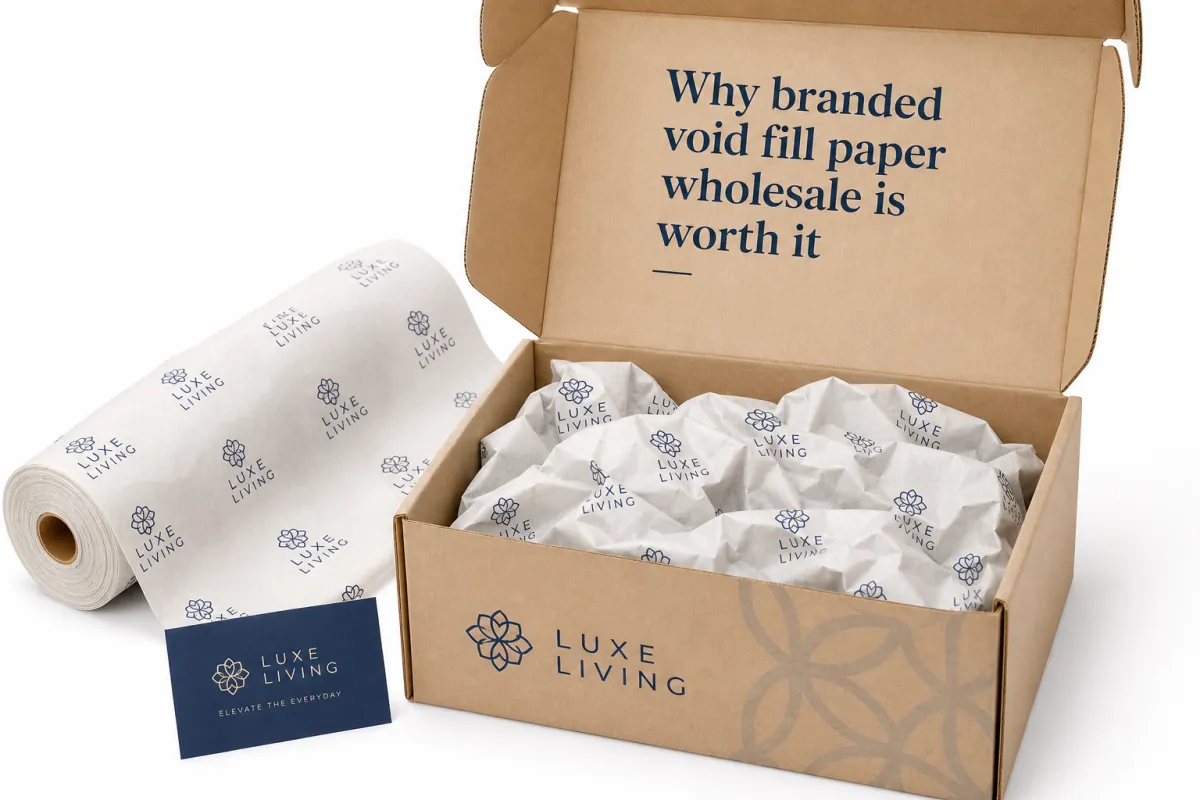
Most teams do not start shopping for void fill because they are excited about branding. They start because products are moving inside the carton, corners are getting bruised, or returns are quietly climbing. Branded void fill paper wholesale addresses that problem without forcing a full carton redesign. It fills the gaps that let products slide, and it adds a branded layer customers can see the second they open the box.
The financial case is usually stronger than people expect. Damaged goods cost money in a bunch of different ways: replacement shipments, support time, rework, repacking labor, and the kind of customer frustration that does not show up in a spreadsheet until later. One bad pack-out can wipe out the savings from a long run of low-cost shipments. That is why branded void fill paper wholesale should be judged on landed value, not just unit cost.
There is also a presentation advantage that is easy to miss if you only look at protective performance. The inside of the box is part of the experience. When the void fill is branded, tidy, and cut to the right size, the order feels intentional. When the inside looks improvised, even a good product can seem a little less premium. Funny how that works. A simple repeat logo or message can shift the tone of the entire unboxing moment without asking you to pay for a custom-printed carton.
That said, not every shipment needs the same level of protection. Branded void fill paper wholesale works well for apparel, cosmetics, accessories, subscription kits, light consumer goods, and many retail ship-outs. Heavier or more fragile items may need additional packaging components alongside it. If the product has a real drop or vibration risk, test the pack-out against your own requirements or recognized transport methods such as ISTA methods. Paper filler helps, but it is not a magic fix.
Another reason it keeps showing up in serious packaging programs is consistency. Once the paper weight, width, print repeat, and format are locked in, the warehouse team can run the same material across replenishment cycles without guessing. That keeps labor predictable and reduces the chance that someone swaps in a random filler when stock runs tight. I have seen that happen more than once, and it usually means the pack-out starts drifting right when it should be holding steady.
Put simply, branded void fill paper wholesale earns its place when you care about three things at the same time: less product movement, better presentation, and repeatable replenishment. If all you need is any loose paper to stuff empty space, a generic filler may be enough. If you want the inside of the carton to work hard and look like it belongs there, the spec has to be chosen with some care.
What branded void fill paper wholesale includes
Branded void fill paper wholesale usually means printed kraft or white paper designed to occupy empty space inside shipping cartons while carrying a visible brand mark. It is a packaging component first and a branding surface second, which is exactly how it should be. The main job is still to stop movement, reduce abrasion, and make the inside of the box look finished instead of improvised.
The most common formats are rolls, cut sheets, fanfold packs, and dispenser-ready bundles. Rolls work well in a simple pull-and-tear workflow or with a dedicated dispenser. Cut sheets fit compact pack stations and lower-volume operations that want predictable usage. Fanfold packs are often a good choice where floor space is tight and the team wants easier handling without a bulky roll stand. Each format brings a different balance of speed, waste, and storage footprint.
Common branding options
Printing is where branded void fill paper wholesale becomes useful. Most buyers do not need a full design exercise. A one-color repeat logo, a short brand line, or a simple pattern is usually enough to make the interior feel intentional without driving the quote into silly territory. If the brand runs seasonal promotions, some suppliers can produce short-run variants for holidays or campaigns, though every extra version adds setup cost and a little more complexity.
Typical print choices include:
- One-color logo repeat for the lowest practical branded cost.
- PMS spot color matching when brand accuracy matters.
- Two-color layouts for a stronger visual layer without going overboard.
- Full-width repeat graphics for premium unboxing programs.
- Short messages or patterns for direct-to-consumer subscriptions and gift shipments.
Where does branded void fill paper wholesale fit best? Direct-to-consumer orders are an obvious match. Retail ship-outs are too. Subscription boxes, light industrial parts, cosmetics, accessories, and gift packaging also make sense because the box needs to feel controlled from the moment the customer opens it. If the product is small enough that Paper Void Fill can hold it centered and tidy, the fit is usually strong.
Where it does not work as a stand-alone answer matters just as much. A fragile glass item, an electronics shipment with sharp internal edges, or a product that needs real cushion and shock management may call for molded inserts, air pillows, foam, or a mixed system. Branded void fill paper wholesale is presentation-first void fill, not a substitute for proper protective engineering when the shipment needs more than a neat nest.
One more practical point: paper filler is usually easier to sort and often easier to align with sustainability goals than mixed-material alternatives. If recycled content or chain-of-custody claims matter to your buyer, ask for documentation. Many brands want FSC-aligned sourcing or recycled content statements, and that is reasonable. General program details are available on the FSC site. If the supplier cannot explain the stock clearly, that is a signal to keep looking.
Buyers also need to think about how the material runs at the station. A roll that tears unevenly slows the pack line. A sheet format that is too short creates waste. A dispenser bundle that does not fit the station layout adds clutter. Branded void fill paper wholesale should fit the workflow, not force the warehouse to reshape itself around a roll of paper.
Branded void fill paper wholesale specifications to compare
Spec comparison is where smart buying starts. If you do not compare the right variables, you end up choosing by unit price alone, which is how people buy the wrong filler and then call the warehouse problem "temporary." The main spec that drives feel and performance is paper weight, usually expressed as GSM or basis weight. Heavier stock feels stiffer and tends to hold shape better. Lighter stock is easier to crumple and can move faster through a dispenser, but it may offer less structure. That tradeoff matters.
For branded void fill paper wholesale, width is nearly as important as weight. Too narrow, and you need too many pulls to fill a carton. Too wide, and you waste material or overstuff smaller boxes. Roll diameter and core size matter if a dispenser is involved. The material has to fit the station. Otherwise the best paper quote can turn into a poor labor quote, and nobody wants that surprise.
Print setup changes both cost and appearance. Ink coverage, color count, repeat length, and registration precision all affect the final price. One-color repeat is usually the cleanest cost-to-impact ratio. Multi-color or full-coverage designs look stronger, but they also increase setup complexity. If the artwork is tight or the logo uses small details, ask how much registration tolerance the printer can hold before the design starts to look soft. Tiny logo details are where cheaper print setups start telling on themselves.
Material and sourcing specs matter too. Buyers often ask for recycled content, FSC certification, or PEFC options if they are available. That is not just for sustainability reporting. It also helps when retail or enterprise buyers want proof that the packaging line follows a documented sourcing standard. If claims matter, get the paperwork before you place the order, not after someone in procurement asks for it.
Then there is the unglamorous but expensive part: packing. Bundle count, pallet build, carton dimensions, and warehouse storage footprint can quietly change your real cost. A quote that looks cheap per unit can become less attractive once freight is added or the cartons take up too much space. Branded void fill paper wholesale should be judged on complete landed cost, including how many pallets you can actually receive and store without turning the back room into a paper cave.
| Option | Typical Use | Print Complexity | Relative Cost | Warehouse Impact |
|---|---|---|---|---|
| Blank kraft void fill | Basic carton fill where branding is not needed | None | Lowest | Simple storage, no print control |
| One-color branded paper | Most DTC and retail shipments | Low | Moderate | Easy to stock and replenish |
| Two-color branded paper | Higher-visibility unboxing programs | Medium | Higher | Needs tighter proofing and color control |
| Full-repeat premium print | Brand-forward packaging with stronger shelf or unboxing impact | High | Highest | More lead time, more setup control |
There is also an industry reality buyers should respect: not every supplier means the same thing by the same spec. One shop may quote GSM, another may quote basis weight, and another may describe the paper as "medium strength" because apparently numbers are too much to ask. Ask for the exact material weight, width, core size, print method, and packing count. If the quote is vague, the order will be vague too.
If transport performance matters, compare the filler against the kind of shipment testing used in your category. Shipping damage does not care about the logo. It cares about drop height, vibration, and carton stability. Practical buyers should review pack-out performance against recognized testing guidance such as ISTA methods, then choose the filler spec that supports the carton instead of just the brand story.
Branded void fill paper wholesale pricing, MOQ, and volume breaks
Pricing for branded void fill paper wholesale breaks into real pieces whether people want to admit it or not. Paper stock is one part. Print setup is another. Finishing, packing, freight, and extra handling fees are the rest. If a supplier only gives you a neat unit number without showing what sits inside it, you do not actually have a price. You have a guess with better typography.
The minimum order quantity usually changes with format, print count, and customization level. Simple one-color runs can often start lower than multi-color or highly customized orders. A standard width on a common stock is easier to produce than a narrow custom size with a tight repeat and specific recycled content. That is not the supplier being difficult. That is the actual setup cost showing up where it should.
For many buyers, the useful way to think about branded void fill paper wholesale is by volume tier, not by wishful thinking. Small runs work for testing. Mid-size replenishment orders are where price starts becoming serious. Higher-volume wholesale buys usually bring the cost per unit down enough to matter, especially if the same spec is reordered consistently. The catch is storage and cash flow. Cheap paper does not help if half your inventory is sitting on the floor waiting for the next quarter.
Here is a simple way to compare buying levels:
- Trial run: useful for proofing print quality, checking dispenser fit, and confirming carton fill behavior.
- Replenishment run: good for stable monthly or biweekly usage with a spec that is already approved.
- Wholesale volume run: best when the same branded void fill paper wholesale spec is used across multiple SKUs or ship sites.
Blank filler will always look cheaper on paper. That is obvious. The real question is whether the branded version returns value through better presentation, fewer complaints, and lower damage costs. For brands that depend on unboxing perception, the branding premium is often worth it. For industrial shipments where no one sees the inside of the box, the answer may be no. Honest pricing advice starts with that distinction instead of pretending every brand needs premium print.
Here is the kind of quote structure that is actually useful:
| Quote Element | What to Ask For | Why It Matters |
|---|---|---|
| Paper weight | GSM or basis weight | Changes stiffness, fill volume, and perceived quality |
| Print method | One-color, two-color, or repeat pattern | Drives setup cost and visual impact |
| Format | Roll, sheet, fanfold, or bundle | Affects warehouse speed and storage footprint |
| MOQ | Units and pallets | Shows actual buy-in and receiving burden |
| Freight | Delivered or ex-works pricing | Changes the real landed cost fast |
Useful wholesale quotes should also show tiered pricing by quantity, paper weight, and color count. That way you can compare the impact of moving from a one-color repeat on a lighter stock to a heavier paper with a tighter print. Otherwise the quotes are just spreadsheet theater, and nobody has time for that.
There is a practical buying habit that saves trouble: request two or three versions of the same branded void fill paper wholesale job. One should be the baseline spec. One should be a lower-cost version with a simpler print or lighter stock. One should be a higher-protection or higher-impact version. When you compare landed cost and warehouse fit side by side, the right choice usually becomes clear.
Order process and timeline for branded void fill paper wholesale
The ordering flow should be straightforward. Inquiry. Spec confirmation. Artwork upload. Proofing. Production. Packing. Freight booking. That is the sequence. If anyone tries to skip the proofing step, expect trouble later. Packaging is one of those categories where "we thought it would be fine" becomes an expensive sentence.
Artwork issues are a common delay. Missing logo files, low-resolution images, brand colors that need cleanup, and print files built for screens instead of production all slow the schedule. If the printer has to rebuild the file or chase approvals from five different people, the clock starts slipping. Branded void fill paper wholesale is not hard to produce, but it does require clean input.
Lead time depends on the complexity of the order. Simple one-color runs on a standard stock often move faster. Custom sizes, multi-color work, special recycled materials, or large palletized quantities take more time. I would rather give buyers realistic timing bands than pretend every order lands on the same date. That is not how production works.
In practice, a clean timeline often looks like this:
- Quote and spec review: 1 to 3 business days, assuming the request includes carton size, artwork, and volume.
- Proofing and revisions: 2 to 5 business days, depending on how fast approvals move.
- Production: often 12 to 15 business days for simpler runs, longer for complex print or custom formats.
- Freight and receiving: depends on lane, pallet count, and warehouse booking window.
Sampling matters, especially when the brand is picky about appearance or the carton size is unusual. Ask for a sample, strike-off, or print proof if the job is new. A sample helps confirm color placement, logo clarity, paper feel, and whether the filler behaves the way you want inside the box. It is cheaper to correct the spec before production than after a truckload lands at your dock.
Warehouse planning is another thing people forget until the shipment is already on the way. Branded void fill paper wholesale can take space faster than expected if the order is palletized. Make sure the receiving team knows the delivery date, pallet count, and storage location. Peak shipping weeks are not the time to discover the packaging material is arriving at the same moment the team is already behind.
Plan for the real version of your operation, not the ideal one where every order is perfect. If the team uses multiple pack stations, confirm that the same branded void fill paper wholesale format works at each station. If you ship from more than one site, make sure the spec is easy to reorder and replicate. Consistency is the point. A supplier that can repeat the same product month after month is more valuable than one that sends a beautiful sample and disappears when you need replenishment.
Why choose us for branded void fill paper wholesale
Wholesale buyers need repeatability more than hype. The best supplier is the one that keeps the print consistent, keeps the dimensions stable, and does not decide to "improve" the spec every time someone opens a new order. Branded void fill paper wholesale should be boring in the right way. Same look. Same fit. Same packing count. No surprises.
Transparent quoting matters just as much. A price that balloons after setup, packing, or freight coordination is not a good price. Hidden fees are not a feature. They are a nuisance dressed up as process. If you are comparing suppliers, ask for all-in clarity on stock, print, packing, and delivery so you can compare landed cost instead of chasing a fake headline number.
Practical support is another reason buyers stick with a supplier. Artwork cleanup, spec matching, volume planning, and packaging advice are not glamorous, but they save time and reduce mistakes. A packaging team does not need more opinions. It needs someone who can translate the carton size, product shape, and shipping volume into a spec that actually works. That is what good branded void fill paper wholesale support looks like.
There is also value in working with a supplier that understands replenishment. Wholesale packaging is not a one-off event. It is a recurring need. The order this month should match the order next month unless you intentionally change it. If a supplier can keep a repeat job moving without making the buyer re-explain the basics every time, that is worth something. In fact, it is worth a lot.
For teams building out bigger packaging programs, it helps to see how branded interior materials fit across the whole line. Our Wholesale Programs are built for buyers who need dependable reorders and clear spec control. If you want to see how other packaging projects are handled, our Case Studies show the kind of practical problem-solving that matters when shipments have to look clean and arrive intact.
Honestly, the best branded void fill paper wholesale partner is the one that makes reorder day uneventful. No drama. No mystery substitutions. No "we thought you'd be fine with this." Just a clean order, a clean proof, and product that shows up ready to run.
Next steps for branded void fill paper wholesale buyers
If you want a useful quote, gather the basics before you ask for one. Carton dimensions. Product size. Average monthly volume. Preferred print colors. Artwork files. Storage constraints. If you have those pieces ready, the supplier can build a real recommendation instead of guessing at your pack-out from a vague description and hoping for the best.
Then request a few versions of the same branded void fill paper wholesale job. Ask for one lighter stock, one standard stock, and one version with a different print setup or width. That will show you how much extra protection or branding impact costs. Most buyers do not need the most expensive option. They need the version that gives the best balance of performance, appearance, and total landed cost.
Ask for samples, lead time, and freight options before you approve the final spec. The quote only matters if it can actually be delivered on time and received without clogging the warehouse. If the supplier cannot give a realistic schedule, the order is not ready yet. Simple as that.
A useful decision checklist looks like this:
- Brand impact: does the print improve the unboxing moment in a way your customer will actually notice?
- Void-fill performance: does the paper stop movement and reduce abrasion in the actual carton?
- Warehouse fit: does the format work with your station layout and storage space?
- Unit cost: does the pricing make sense at the order size you really buy?
- Landed cost: does freight, packing, and pallet handling still leave the deal attractive?
If you are comparing packaging vendors, do not stop at a nice-looking sample. Ask how the material behaves at volume, how long the production run takes, and what happens when you reorder. That is where branded void fill paper wholesale either proves itself or turns into another sourcing headache.
Send the specs when you are ready. The better the carton data and artwork detail, the better the quote will be. And if you want the order evaluated like a real shipment instead of an idealized spreadsheet exercise, give the full picture: size, volume, print needs, and timing. That is how branded void fill paper wholesale gets priced properly, and it is how you avoid paying for someone else’s assumptions.
If you are making the decision this week, the most useful move is to match the paper weight and width to the carton first, then decide how much branding you actually need. That keeps the order grounded in how your shipments really pack out, which is the part that matters once the boxes start moving.
What is the minimum order for branded void fill paper wholesale?
MOQ usually depends on paper width, print colors, roll or sheet format, and whether the job needs custom sizing. Simple single-color runs often start lower than multi-color or highly customized orders. Ask for MOQ in both units and pallet count so you can see the real buy-in, not just the headline number.
How long does branded void fill paper wholesale production usually take?
Production time depends on artwork approval, paper availability, print complexity, and packing requirements. Simple jobs move faster; custom sizes and multi-color work need more lead time. Build in proofing time plus freight time so the order lands before your warehouse runs out.
Can branded void fill paper wholesale be made with recycled paper?
Yes, recycled content is common for void fill paper and is often requested by retail and ecommerce brands. Ask for the recycled percentage and any certification details if sustainability claims matter to your buyer. Check whether the recycled stock still gives you the print clarity and stiffness you need.
Which print style works best for branded void fill paper wholesale?
One-color repeat logos are usually the most cost-efficient option. PMS spot colors are the safest choice when brand matching matters. Full-coverage or multi-color prints look premium, but they raise setup cost and complexity.
How do I choose the right spec for branded void fill paper wholesale?
Match paper weight and width to the carton size and the amount of void space you need to fill. Consider dispenser compatibility, warehouse storage, and handling speed before locking the spec. Compare landed cost, not just unit price, because freight and packing can change the real deal.