Buyer Fit Snapshot
| Best fit | Branded Void Fill Tissue Paper projects where brand print, material claims, artwork control, MOQ, and repeat-order consistency need to be specified before quoting. |
|---|---|
| Quote inputs | Share finished size, material target, print colors, finish, packing count, annual reorder estimate, ship-to region, and any compliance wording. |
| Proofing check | Approve dieline scale, logo placement, barcode or warning zones, color tolerance, closure strength, and carton packing before bulk production. |
| Main risk | Vague material claims, crowded artwork, missing packing details, or unclear freight terms can make a low unit price expensive after revisions. |
Fast answer: Branded Void Fill Tissue Paper: Material, Print, Proofing, and Reorder Risk should be specified like a repeatable production item. The safest quote records material, print method, finish, artwork proof, packing count, and reorder notes in one written spec.
Production checks before approval
Compare the actual filled-product size with the drawing, then confirm tolerance on folds, seals, hang holes, label areas, and retail display edges. Reserve space for logos, QR codes, warning copy, and material claims before decorative graphics fill the panel.
Quote comparison points
Review material grade, print process, finish, sampling route, tooling charges, carton quantity, and freight assumptions side by side. A quote is only useful when the supplier can repeat the same color, closure quality, and packing count on the next order.
Branded Void Fill tissue paper is one of those packaging details customers notice before they have fully taken in the product itself. A plain shipping box can feel ordinary, then the same box feels composed and deliberate the moment the inside opens with color, pattern, and a bit of structure. That small shift matters more than many buyers expect, because the first reveal often sets the tone for the whole order.
From a packaging buyer's point of view, Branded Void Fill tissue paper sits in a useful middle ground: it fills empty carton space, helps stop movement, and adds identity without forcing a major change to the box or the product. It is not just filler. It is a low-friction way to make a shipment feel considered, and that can change how customers judge quality, service, and attention to detail in a few seconds.
If you have ever opened a carton and found the item rattling around with loose air pillows, you already know the problem. The product may still arrive safely, but the experience feels thin. Plain filler solves movement. Branded Void Fill tissue paper solves movement and perception at the same time, which is why it keeps showing up in apparel, beauty, gifting, boutique retail, and subscription packaging.
That dual role is the real story. A finishing layer with a relatively small unit cost can make a shipment feel premium, more intentional, and less like generic fulfillment. For businesses that ship often, those details stack up. A customer who feels that care is more likely to remember the brand, photograph the unboxing, and compare your package favorably against a competitor that spent more on the product but less on the presentation.
There is also a practical business angle. When the inside of the box looks tidy, customers are less likely to assume damage or carelessness before they even touch the item. That psychological shift matters. In practice, Branded Void Fill tissue paper can support a premium price point without changing the product formula, the carton size, or the warehouse process in a dramatic way.
"The inside of the carton is the first showroom. If it feels intentional, the brand feels intentional."
The rest of this article focuses on the trade-offs buyers actually face: plain filler versus branded filler, sheet weight versus cost, lead time versus flexibility, and presentation versus packing speed. If you are building a packaging program for a new line or tightening an existing one, branded void fill tissue paper deserves a closer look because it tends to punch above its weight.
How Branded Void Fill Tissue Paper Works in the Carton
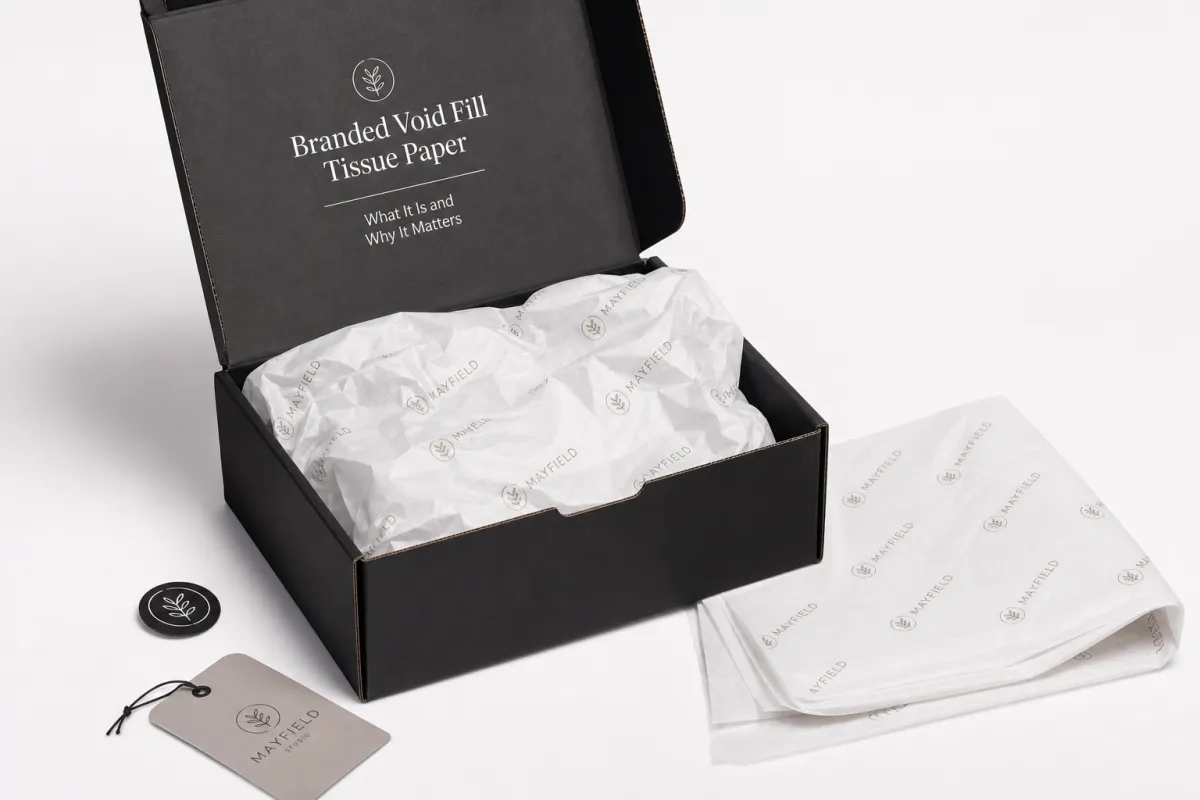
At the mechanical level, branded void fill tissue paper works by occupying air space so the product cannot slide, tip, or bang into the carton walls during transit. That sounds simple, and simple is a strength here. Most shipping damage comes from movement, not from some dramatic impact event. A box with too much empty space behaves like a drum. A box with properly placed tissue behaves more like a fitted enclosure.
There are a few ways to use it. You can crumple sheets into the void, layer them under and around the item, wrap the product directly, or lay a top sheet over the contents for a finished reveal. Each method changes the balance between protection and presentation. A lightly crumpled nest works well for apparel or soft goods. A denser wrap plus top fill makes more sense for boxed sets, candles, gift items, and products with corners that need extra restraint.
Branded void fill tissue paper also changes what the customer sees first. Empty space looks accidental. Tissue arranged with purpose looks designed. That visual shift matters because buyers often equate a tidy internal layout with careful handling, even if the real engineering advantage is simply that the item no longer shifts around. In other words, the same piece of paper can serve two jobs: stabilize the product and communicate order.
Protection first, presentation second
The best packouts do both, but they do not do both in exactly the same way. If the tissue is used only as decoration, it may look nice on a desk and fail on a conveyor belt. If it is used only for protection, the customer may miss the brand opportunity entirely. Branded void fill tissue paper works best when the fold, the paper weight, and the sheet count are chosen with transit conditions in mind.
For lighter items, 17gsm to 20gsm tissue often feels adequate. For sharper edges, denser products, or cartons that travel farther through carrier networks, buyers often prefer something closer to 22gsm or 28gsm. That is not a hard rule; it depends on item weight, box size, and how aggressively the parcel is handled. Those ranges still give a practical starting point, and they are one of the first things I look at when a packout feels a little too loose or a little too fussy.
How it compares with other fillers
Kraft paper, shredded paper, and air pillows all do a version of the same job. The difference is in the customer experience and the packing behavior. Kraft paper is often good for general void fill and can be cost-efficient, but it does not offer the same visual reveal. Air pillows are fast and light, yet they can feel utilitarian. Shred adds texture and volume, though it can be messy and harder to control on a busy pack line. Branded void fill tissue paper tends to sit closer to the presentation end of that spectrum while still giving enough structure for many retail shipments.
That is why the choice is often less about "best material" and more about "best outcome." If the order is a high-volume replenishment part with no unboxing emphasis, air pillows or kraft may be enough. If the package is part of the product story, tissue usually makes more sense. For brand-led retail, the inside of the box is not dead space; it is part of the product experience. A quick review of real packout examples in our Case Studies shows how much that internal presentation can change perceived value.
For fragile shipments, it is smart to pair your internal filler decision with transit testing. The ISTA test methods are useful because they push packaging beyond guesswork and into measurable performance. If a carton is dropping, vibrating, or compressing in ways that resemble actual carrier handling, the filler choice becomes easier to judge.
Used well, branded void fill tissue paper is not a decorative afterthought. It is a design choice that changes how the box behaves in transit and how the customer interprets the brand the moment the lid opens.
Cost, Pricing, and MOQ for Branded Void Fill Tissue Paper
Pricing is where many packaging programs get tested, because the line item looks small until you multiply it by volume. Branded void fill tissue paper usually costs more than plain tissue because printing, setup, proofing, and order quantity all affect the quote. That does not mean it is expensive in an absolute sense. It means the buyer needs to think in terms of unit economics and total package value, not just raw material cost.
The biggest pricing drivers are sheet size, paper weight, number of ink colors, print coverage, finishing method, and total quantity. A small repeat pattern on a single color usually costs less than a full-bleed design with dense ink. Larger sheets require more paper and more press time. If the artwork needs a custom die-cut or special fold style, that adds another layer of complexity. So does a request for matching a very specific brand color.
MOQ is the other pressure point. Many suppliers set minimums in the 3,000 to 10,000 sheet range, although that varies by print method and sheet format. Lower runs usually have a higher per-sheet cost. Larger runs bring the unit cost down, but they also increase inventory risk. If your seasonal range changes fast, ordering too much can tie up cash and storage space. If your volume is predictable, larger runs can make sense quickly.
| Packaging option | Typical mid-volume cost range | Brand impact | Protection level |
|---|---|---|---|
| Branded void fill tissue paper | $0.12-$0.30 per sheet, depending on size and print coverage | High | Light to moderate |
| Plain tissue paper | $0.05-$0.12 per sheet | Low | Light |
| Kraft paper fill | $0.03-$0.08 per packed unit | Low to medium | Moderate |
| Air pillows | $0.02-$0.06 per pillow | Very low | High void fill, low presentation |
| Shredded paper | $0.08-$0.20 per carton | Medium | Light |
The table is directional, not universal. A 9 x 12 inch sheet printed one color on 17gsm tissue is not the same job as a 24 x 36 inch sheet with dense coverage. Freight, carton packing, and bundling format can shift the total considerably. That is why comparing quotes apples-to-apples matters. Ask whether the quote includes setup, proofing, packing, cartons, and freight. If those items are not explicit, the low number may not stay low for long.
There is also a hidden-cost category that buyers sometimes miss. Artwork revisions can add days. Proof rounds can add more. If the supplier needs to run a color match against a tight brand standard, there may be an extra prepress step. A few percentage points of spoilage allowance may be built into the quote. None of that is unreasonable. It is simply how print work behaves. The mistake is not seeing those variables until the purchase order is already in motion.
Compared with a structural packaging change, branded void fill tissue paper is often a smarter spend because it can improve perception without changing the box spec, the dieline, or the fulfillment process. If the alternative is a much more expensive custom insert or a brand-new carton style, tissue can deliver a better return for a narrower investment. That is especially true for businesses trying to improve unboxing quickly while keeping capital spend contained.
For buyers who need sustainability documentation, request material details up front. Ask whether the paper carries FSC chain-of-custody information and whether the inks or coatings affect recyclability. If that certification matters to your customer base, the FSC site is a useful reference point for understanding what the label does and does not cover.
One practical habit helps a lot: ask for a quote in three formats. First, a low-coverage version. Second, a mid-coverage version. Third, a premium version. That makes it easier to see where branded void fill tissue paper is doing real brand work and where the spend starts to buy only decoration. It also keeps the conversation honest instead of letting everyone pretend the most expensive version is automatically the right one.
Process, Timeline, and Lead Time for Production Steps
The production path for branded void fill tissue paper is usually straightforward, but the timeline can still stretch if the front end is messy. The process typically starts with size and spec confirmation, then moves into artwork prep, proofing, color matching, print setup, production, finishing, packing, and shipping. Every stage is manageable. The delay usually comes from an unclear brief, not from the press run itself.
A buyer who locks the dimensions early and supplies clean artwork files can often move faster than a buyer who keeps changing the design after the first proof. That sounds obvious, yet it is the most common source of delay. The supplier cannot finish color work if the logo is still under revision. The factory cannot finalize layout if the sheet size keeps shifting. One late change can add several days, sometimes more.
For simple repeat patterns and limited-color artwork, a realistic production window often lands around 12 to 15 business days after proof approval. More complex designs, heavier coverage, specialty finishes, or larger quantities can push that to 15 to 25 business days. Shipping time is separate. So is customs time if the order crosses borders. Those extra days are not unusual; they are just part of the planning math.
Where projects slow down
Late artwork changes are the first culprit. Missing brand assets are the second. Slow proof approvals are the third. A designer who sends a low-resolution logo may not realize that prepress has to rebuild it. A procurement team that waits for internal sign-off before reviewing the proof can lose a full week. If the launch date matters, the schedule needs one person to own the approval path.
Branded void fill tissue paper also benefits from a clean handoff between prepress and manufacturing. The sheet dimensions, bleed, repeat size, and color references should all be locked before production starts. If the design includes a pattern that must land a certain way on the sheet, note that clearly. Otherwise, the result may be technically correct but visually off.
How to shorten lead time without cutting corners
Start with a template if the supplier offers one. That saves time on layout and bleed checks. Keep the color count tight. One or two colors usually move faster than a complicated full-coverage design. Approve a sample faster than you think you need to. And if the tissue is going into a product launch, confirm the reorder threshold before the first run ships. That prevents last-minute panic later.
One smart question is this: what is the production calendar, not just the promised ship date? A clear calendar should show proof date, approval date, print date, finishing date, pack date, and dispatch date. That is a lot easier to manage than a single vague promise. Buyers who ask for milestone dates tend to avoid unpleasant surprises, which is useful whether the order is 5,000 sheets or 50,000.
Branded void fill tissue paper is usually one of the quicker custom print items to spin up if the design is simple, but that speed depends on discipline at the buyer side. Clean brief, fast approvals, locked specs. Those three things often matter more than any supplier sales promise. If the line gets finicky, you are gonna feel it in the schedule right away.
Step-by-Step: Choosing Branded Void Fill Tissue Paper
The best way to choose branded void fill tissue paper is to work backwards from the product, not forwards from the artwork. Start with the item dimensions, the carton depth, and the amount of void space left after the product is packed. If the item is soft and light, you may need a different fold style than if it has edges, corners, or multiple components that can shift during transit.
After that, decide what role the tissue should play. Should it feel bold and retail-forward? Should it be subtle and premium? Should it echo a seasonal promotion or stay evergreen? Should it feel more eco-conscious, with natural tones and restrained print, or more expressive, with a strong logo repeat? The right answer depends on the product line and the audience. A beauty brand may want a quiet, refined internal reveal. A gift brand may want more color and contrast. A fashion label may want the tissue to feel part of the garment presentation itself.
Choose the paper weight for the job
Paper weight affects both feel and function. Very light tissue can tear easily if the product has rough edges or if the pack line handles it aggressively. Heavier tissue costs more and can feel stiffer, but it also holds shape better. In many retail applications, 17gsm to 20gsm is a practical starting point. For more durable presentation or slightly stronger restraint, 22gsm to 28gsm is worth testing. The exact fit depends on the product, not a universal rule.
Branded void fill tissue paper should be tested with the actual SKU, not just on a clean desk. A nice-looking sheet on a sample board can still fail once it meets a real product, a real hand, and a real fulfillment pace. That is where many programs get tripped up. The paper needs to tear cleanly, fold predictably, and hold the item in place without looking overstuffed.
Design for the opening sequence
Think about what the customer sees first, second, and third. Is the logo visible immediately? Does the tissue open like a curtain? Does the print reveal something only after the first fold is lifted? These details matter because the unboxing moment is a sequence, not a single image. If the first layer is cluttered, the effect is weaker. If the first reveal is clear and orderly, the whole packout feels more expensive.
That is where branded void fill tissue paper often outperforms inserts. Inserts sit flat and can feel static. Tissue moves with the product and creates a softer reveal. It can cover, frame, and cushion at once. The inside of the box starts to feel like a designed space instead of a shipping cavity. A simple repeat pattern often reads kinda cleaner than a design trying to do too much.
Match the design to fulfillment reality
Before final approval, run the packout on the line. Watch one packer, then five packers. See how long each order takes. Note whether the tissue tears, slides, or wrinkles in a way that looks inconsistent from one shipment to the next. A design that takes 20 extra seconds per carton may look fine in mockups but become expensive at volume. Conversely, a simpler layout may preserve speed and still look premium enough to move the needle.
This is also a good moment to pull in a test order or pilot run. If you want to see how internal presentation changes buyer perception, compare the response to a small test batch versus your current standard. For examples of how brands use packaging changes to improve the customer experience, our Case Studies are a useful starting point.
There is a practical rule I like to use: choose the smallest design that still feels intentional. Too much visual noise can make the tissue feel crowded. A single strong repeat, the right color, and a clean fold often outperform a busy layout. That is true for branded void fill tissue paper surprisingly often. Simpler usually reads as more controlled.
Common Mistakes That Undercut Branded Void Fill Tissue Paper
The most common mistake is overbranding every inch of the sheet. Dense ink coverage can increase cost, reduce softness, and make the packout feel heavy instead of elegant. That does not mean a bold design is wrong. It means the design needs restraint. If the customer can barely see the paper because it is covered in ink, branded void fill tissue paper starts to lose the delicate, premium quality that makes it useful in the first place.
Another mistake is treating tissue as decoration only. If the item still moves around inside the carton, the filler is failing at its primary job. That can show up as product damage, scuffed surfaces, bent edges, or extra damage claims. The tissue is there to shape the empty space, not just to create a nice photo moment. A pretty packout that does not stabilize the product is expensive confetti.
"Pretty tissue that tears, slips, or leaves the item rattling is just expensive confetti."
Color choice can also go wrong. A shade that looks rich on screen may clash in person with the box interior, the product palette, or a seasonal campaign. Bright red tissue under a pale luxury carton may feel aggressive. Gray tissue under a warm brand palette can feel flat. Branded void fill tissue paper works best when the color supports the surrounding package instead of fighting it.
Inventory planning is another weak spot. Buyers sometimes underorder because the per-unit spend looks small. Then the first run sells well, the reorder is urgent, and the brand has to choose between a rushed print job or shipping without the intended fill. That inconsistency is bad for customer trust. It also breaks the visual rhythm of the packaging program, which is more obvious than many teams realize.
Testing is the final gap. If the tissue is never packed with real product, real folds, and real hands on the line, it may fail in ways that a proof cannot show. It might wrinkle too much. It might catch on a sharp edge. It might create static or bunching in a box that looked fine in a sample photo. Branded void fill tissue paper should survive the actual workflow before it ever reaches the customer.
- Do not print more coverage than the brand needs.
- Do not skip transit testing for fragile products.
- Do not approve a color from a screen alone.
- Do not assume MOQ will stay low on reorders.
- Do not skip line testing with the real SKU.
If you avoid those mistakes, the tissue does what it should do: protect the item, present the brand clearly, and keep the inside of the box from feeling like an afterthought. That is the promise, and branded void fill tissue paper can deliver it if the spec is disciplined.
Expert Tips and Next Steps for Better Packouts
The fastest way to make branded void fill tissue paper work is to start small and measure what happens. Pick one hero SKU, one carton format, and one packout style. Then track what changes: damage rate, packing time, customer comments, and social mentions tied to the unboxing experience. That gives you real data instead of vague opinions.
Request physical samples, not just digital proofs. Tissue feels different in hand than it looks on screen. Print density can surprise you. A soft blush tone on a monitor may read far stronger once it is printed at scale. A fine repeat pattern can look elegant in a PDF and muddy in real paper if the coverage is too tight. Physical samples help prevent those mistakes before the first production run.
A simple internal spec sheet can save a lot of future frustration. Record the sheet size, paper weight, print method, approved artwork version, box match, fold style, and reorder threshold. Add a note for the freight terms and a contact name at the supplier. That way, when the next buyer, merchandiser, or operations manager takes over, they are not rebuilding the program from scratch.
Track the right three numbers
Fulfillment time tells you whether the tissue is slowing the line. Damage claims tell you whether the protection side is working. Review mentions or customer photos tell you whether the presentation side is paying off. Those three numbers cover speed, function, and brand response, which is a stronger way to judge branded void fill tissue paper than guessing from a single unboxing video.
If sustainability is part of your positioning, ask for material details in writing. Recyclability depends on the paper grade, coatings, inks, and the local recovery stream. Paper-based designs are generally easier to position as lower-impact than heavily coated alternatives, but that depends on the actual spec, not the marketing copy. The cleaner the material story, the easier it is to explain to customers.
It also helps to compare your tissue program against your other brand touchpoints. Sometimes branded tissue does more than a thick insert card or a more expensive structural change. Sometimes it does less. That is why the best answer is usually not "always use it" or "never use it." The right answer is to pilot, measure, and expand only where the numbers make sense. If you want examples of brands making that kind of decision, the Case Studies page shows how packaging changes can support both perception and operations.
My practical advice is simple: pilot branded void fill tissue paper on one product line, compare it against your current packout, and review the data after a few shipping cycles. If the numbers and the customer response both improve, scale it. If they do not, adjust the spec before you commit to a larger run. That is the difference between a packaging idea and a packaging system.
Frequently Asked Questions
What is branded void fill tissue paper used for in packaging?
It fills empty space in the carton so products do not shift during shipping, and it adds a branded first impression when the customer opens the box. It can also support wrapping, layering, and light surface protection, which makes branded void fill tissue paper useful for both presentation and basic transit stability.
How much branded void fill tissue paper do I need per order?
Estimate it from carton size, product weight, and how much empty space remains after the item is packed. Simple apparel orders may use one or two sheets, while larger or fragile items may require layered wrap and top fill. A test packout on your most common SKU is the fastest way to set a repeatable standard for branded void fill tissue paper.
Is branded void fill tissue paper more expensive than plain tissue?
Usually yes, because printing, setup, and order volume affect the price. The difference matters less when the tissue replaces another branding touchpoint or reduces the need for extra inserts. To compare fairly, look at unit cost, MOQ, freight, and any proofing fees together before deciding whether branded void fill tissue paper fits the budget.
How long does branded void fill tissue paper usually take to produce?
Timeline depends on artwork readiness, print complexity, and the supplier's production queue. Straightforward designs with approved files typically move faster than multi-color or specialty finishes. The biggest time saver is fast proof approval and locked specifications before production starts, especially if branded void fill tissue paper is tied to a launch date.
Can branded void fill tissue paper be recycled?
Often yes, but recyclability depends on paper weight, coatings, inks, and local recycling rules. A simple paper-based design is usually easier to position as an eco-conscious option than heavily coated alternatives. If sustainability is important, ask the supplier for material and ink details before ordering so you know exactly how your branded void fill tissue paper should be described.
If you are setting up a new packout, start with one SKU, one carton size, and one tissue spec, then test it in real fulfillment conditions before scaling. That keeps branded void fill tissue paper grounded in performance instead of presentation alone, which is the part that tends to hold up once the orders start moving.