Buyer Fit Snapshot
| Best fit | Branded Zipper Pouches Wholesale projects where brand print, material claims, artwork control, MOQ, and repeat-order consistency need to be specified before quoting. |
|---|---|
| Quote inputs | Share finished size, material target, print colors, finish, packing count, annual reorder estimate, ship-to region, and any compliance wording. |
| Proofing check | Approve dieline scale, logo placement, barcode or warning zones, color tolerance, closure strength, and carton packing before bulk production. |
| Main risk | Vague material claims, crowded artwork, missing packing details, or unclear freight terms can make a low unit price expensive after revisions. |
Fast answer: Branded Zipper Pouches Wholesale: Specs, Pricing & MOQ should be specified like a repeatable production item. The safest quote records material, print method, finish, artwork proof, packing count, and reorder notes in one written spec.
Production checks before approval
Compare the actual filled-product size with the drawing, then confirm tolerance on folds, seals, hang holes, label areas, and retail display edges. Reserve space for logos, QR codes, warning copy, and material claims before decorative graphics fill the panel.
Quote comparison points
Review material grade, print process, finish, sampling route, tooling charges, carton quantity, and freight assumptions side by side. A quote is only useful when the supplier can repeat the same color, closure quality, and packing count on the next order.
Branded Zipper Pouches Wholesale: Specs, Pricing & MOQ
Branded zipper pouches wholesale do a lot of quiet, practical work for a product line. They make a pouch feel deliberate instead of borrowed from a generic stock format, help a small item hold its place on a shelf, and keep refill packs, samples, and travel sizes from looking like afterthoughts. For Custom Logo Things, the real question is not whether the pouch closes. It is whether the pouch supports the product in a way that feels considered from the first glance and still holds up after the first use.
A pouch is often the first thing a buyer notices, even before the product itself gets much attention. When the zipper feels flimsy, the print looks muddy, or the layout reads like a template with a logo dropped on top, the packaging drags the brand down. A clean structure, a reliable closure, and graphics that fit the category do the opposite. They make the whole offer feel more expensive without forcing the product cost to carry every bit of the value. That is why branded zipper pouches wholesale are not a decorative line item. They are a packaging decision with real commercial weight.
I have seen brands spend weeks polishing product messaging and then hand that product a pouch that looks like an afterthought. It never helps. The packaging gets read before the label copy does, and in a lot of categories that first read is basically the whole game. If the bag looks crisp, customers assume the brand has its act together. If it looks generic, they start discounting the product before they have even opened it.
Why Branded Zipper Pouches Wholesale Beat Generic Bags
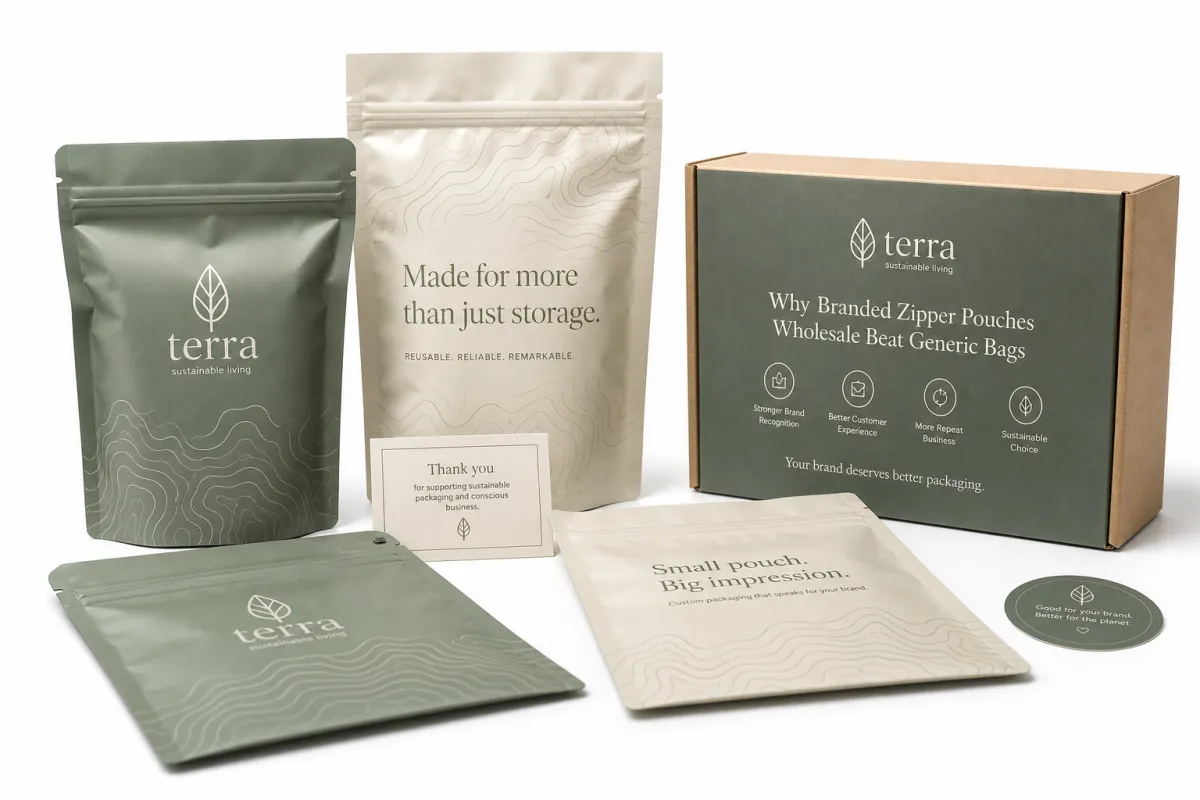
A generic bag holds product and stops there. Branded zipper pouches wholesale do that same job while adding clarity, shelf presence, and a little discipline to the supply chain. The change sounds small, yet it changes how customers read the product before they ever open it. Same formula. Same snack. Same accessory kit. Different package, different expectation.
Buyers run into the same pattern again and again. A solid product arrives in a plain pouch and gets treated like a commodity. The same product moves into branded zipper pouches wholesale with a proper logo lockup, readable panel hierarchy, and a finish that suits the category, and it suddenly looks like a private label line instead of a filler item. The product barely changed. The packaging changed the story.
That matters in retail display, subscription kits, sample packs, travel sizes, and any resealable format where the pouch becomes part of the experience. A powder supplement in a soft matte stand-up pouch looks like a different tier than the same blend in a thin off-brand zipper bag. A cosmetic refill in branded zipper pouches wholesale feels more intentional on the shelf and less disposable in storage. A snack sample in a foil barrier pouch reads as a finished product, not a loose item that happened to get sealed somewhere along the way.
Small packaging upgrades often change perceived value more than a few cents of product cost ever will. Customers do not sit down and calculate a bill of materials in their heads. They make fast judgments from finish, print quality, zipper feel, and whether the pouch looks designed for the product or merely adapted to it. Branded zipper pouches wholesale take advantage of that reality in a practical, measurable way.
"A pouch can carry the brand or hide it. The cheapest bag in the room usually hides everything."
Wholesale buying also helps on the operational side. Once the pouch structure is set, repeat orders get easier, freight becomes more predictable, and the brand stays consistent across product lines. That consistency is one of the strongest reasons to buy branded Zipper Pouches Wholesale: lower unit cost at scale, fewer spec surprises, and less drift from one run to the next. For a buyer managing multiple SKUs, that stability is worth more than a flashy finish that only looks good in a mockup.
Reorder control matters too. If every pouch is a one-off, the team spends time checking colors, correcting artwork placement, and explaining why the latest run looks a little different from the last one. Once the spec is locked, branded zipper pouches wholesale become a repeatable tool instead of a moving target. That saves time in production, in procurement, and in the back-and-forth that always seems to show up right before a shipment.
From a positioning standpoint, branded zipper pouches wholesale fit nearly anywhere a product needs a reclosable format and a clear visual identity. They work for cosmetics, snacks, dried ingredients, supplements, apparel accessories, hardware kits, and lightweight consumer goods. The point is not to make everything look fancy. The point is to make the pouch look like it belongs to the product and the channel it is being sold through.
Buyers usually get the best results when they treat branded zipper pouches wholesale as a strategic spec choice, not a decoration budget. The design should support the sales channel, shelf life, handling pattern, and fill method. If the pouch is going into e-commerce fulfillment, the graphics can be bolder and the format can be tuned for box opening. If it is going into retail, the front panel needs faster read time and stronger shelf contrast. Different use case. Different answer.
When a team is trying to stretch margin, this is one of the first places I look. A pouch that is just pretty enough to do its job and just tough enough to survive shipping tends to outperform a fancier package that burns money on finishes nobody asked for. That balance is kinda the whole trick.
Product Details: What Branded Zipper Pouches Wholesale Actually Include
Branded zipper pouches wholesale come in more structures than most first-time buyers expect. Flat pouches, stand-up pouches, gusseted pouches, matte or glossy finishes, clear-window designs, and multi-layer barrier formats all solve different problems. Choosing the wrong one is a quick way to learn that packaging is not one broad category where every option behaves the same.
Flat pouches are usually the simplest. They work well for sample sizes, accessories, single-use portions, and light goods that do not need to stand upright on a shelf. Stand-up pouches are more retail-friendly because the bottom gusset gives them shelf presence and a cleaner front view. Gusseted pouches add capacity, which matters when the product expands, shifts, or needs extra fill volume. Branded zipper pouches wholesale often use these structures because the pouch has to look neat before and after filling, not just in a catalog render.
Finish is not cosmetic fluff. Matte lamination creates a softer, more premium feel and cuts glare under retail lighting. Glossy finishes make graphics pop harder and suit bright consumer products. Clear windows let the product show through, which helps food, powders, or visually distinctive contents. If the pouch needs stronger barrier performance, the structure may use PET, PE, CPP, or foil laminate layers rather than a basic single-film build.
Zipper style matters too. A simple press-to-close zipper is common and cost-effective. A double-lock zipper improves closure feel and can help reduce accidental opening during transit. Child-resistant closures belong in specific regulated categories, and tamper-evident features matter when the buyer needs visible proof that the pack was opened. Branded zipper pouches wholesale are not only about the printed face. The closure is part of the product story.
Branding methods vary by format and print setup. Spot color printing works well for cleaner logos and simpler artwork. Full-color graphics give more freedom for gradients, photography, and denser layouts, though they can add setup complexity. Metallic accents can lift premium categories if they are used with restraint. Label applications are a lower-complexity path for some runs, especially when the buyer wants to test demand before moving into a fully printed pouch. The right answer depends on volume, shelf demands, and how much design freedom the brand actually needs.
For branded zipper pouches wholesale, the structure should match the job. Moisture protection is one job. Aroma retention is another. Reclosability for repeat use is another. If the pouch is for snacks or supplements, barrier performance starts to matter very quickly. If the pouch is for apparel hardware or small accessories, puncture resistance and zipper reliability may matter more than oxygen barrier. That is why buyers should not spec from a mood board. They should spec from the product.
Typical product categories that fit well include:
- Cosmetics and sample kits
- Supplements and wellness powders
- Dry snacks, seasoning blends, and candy
- Apparel accessories and travel kits
- Hardware, fasteners, and small consumer parts
There is also a workflow point here. Branded zipper pouches wholesale are easier to manage when the pouch format matches the fill process. If the product is hand-packed, a wider mouth and a forgiving zipper can save labor. If the product is machine-filled, consistent dimensions and flat seals matter more. If the package is meant for repeated opening and closing, zipper fatigue and seal integrity move up the list quickly. The pouch has to serve the line, not fight it.
For buyers comparing options, branded zipper pouches wholesale usually fall into three buckets: simple promotional bags, mid-tier retail-ready pouches, and high-barrier specialty packaging. Simple promotional bags are cheaper and fine for lightweight items. Retail-ready pouches give better print impact and stronger shelf presentation. Specialty barrier pouches cost more but protect the product better and reduce the risk of spoilage, flavor loss, or moisture pickup. Paying for the right level is smart. Paying for features you do not need is just an expensive habit.
For reference on sustainability and material sourcing conversations, it helps to check standards and certification bodies like FSC for fiber-based content and ISTA for packaging transit test thinking. Those are not the only references that matter, but they are useful anchors when a buyer needs to separate attractive packaging language from packaging performance.
Specifications to Check Before You Order
If a branded zipper pouches wholesale quote looks cheap but the spec sheet is vague, the quote is probably incomplete. That is where projects start to slip. The dimensions, the material stack, the closure type, the print setup, and the performance expectations all need to be written down before the order gets close to approval. Otherwise the buyer ends up comparing apples, oranges, and one very optimistic sample that was never meant to carry production truth.
Start with dimensions. Not just width and height. Ask for gusset depth, usable fill volume, zipper placement, and the finished pouch size after filling. A pouch can look fine on paper and still fail in practice if the opening is too narrow or the gusset collapses in an awkward way. With branded zipper pouches wholesale, a few millimeters can change how the pouch fills, stands, and displays.
Material selection should be practical, not aspirational. PET gives stiffness and print clarity. PE adds flexibility and sealability. CPP can help with heat resistance or inner-layer performance. Foil laminates improve barrier performance for moisture, oxygen, and aroma-sensitive products. Recycled options may be available for certain use cases, though buyers should be honest about where performance tradeoffs are acceptable. If the product needs a serious barrier, do not pretend a lightweight decorative film will carry the load.
Barrier specs are where the real value shows up. Moisture resistance matters for powders, dried foods, and anything that clumps. Oxygen barrier matters for flavor retention and oxidation-sensitive products. Puncture resistance matters for hardware, sharp components, or products with irregular edges. Heat-seal compatibility matters if the pouch is sealed after fill or uses a tamper-evident top. Branded zipper pouches wholesale are only as good as the layers behind the print.
Artwork requirements deserve their own conversation. Ask for bleed, safe area, dieline, and resolution requirements before you design the pouch. Keep important text away from seams and zipper zones. Watch logo placement near fold lines and gussets. If the print wraps too far into a crease, the design can look broken after filling. A vector file is usually the cleanest starting point because scaling stays crisp and registration stays predictable.
Color matching also needs attention. Pantone references help when brand consistency matters across runs. CMYK works for a lot of full-color jobs, but it is not a universal answer for every brand color. Metallic inks, soft-touch films, and matte coatings all shift the visual result. If the pouch has to match an existing carton, label, or secondary package, ask for a physical proof or a very clear digital reference before approving production. That saves arguments later.
Compliance is not optional just because the pouch looks nice. Food-contact suitability matters for anything eaten or ingested. Child safety features matter for certain categories. Reseal behavior matters for products that are opened repeatedly. Storage conditions matter too. A pouch that performs fine in a dry warehouse may behave differently in humid transit or warm retail storage. Branded zipper pouches wholesale should be specified with the final environment in mind.
Here is a simple checklist that should be in front of every buyer before production starts:
- Final pouch size, including gusset and zipper zone
- Material stack and thickness in microns or mils
- Print method, color count, and finish
- Closure type and any special safety features
- Use case: food, cosmetic, retail, sample, or industrial
- Target storage and transit conditions
- Artwork file format and dieline approval
Good spec work saves money twice. First, it reduces revision cycles. Second, it lowers the odds of getting stuck with a pouch that technically printed correctly but practically does not serve the product. That is the hidden cost in branded zipper pouches wholesale: not the unit price, but the cost of getting the wrong thing in bulk.
Branded Zipper Pouches Wholesale Pricing and MOQ
Branded zipper pouches wholesale pricing is driven by a handful of variables, and none of them are mysterious. Size, material thickness, print coverage, zipper style, finish, and special features all push the price up or down. If a supplier gives you a number without asking about those things, they are either guessing or planning to revise the quote later. Neither route is helpful when you are trying to build a stable margin.
For practical buying, it helps to think in order tiers instead of pretending one price fits every pouch. A simple flat pouch with one- or two-color branding at a moderate run can sit in a much lower range than a high-barrier stand-up pouch with full-color graphics, matte finish, and a custom zipper. Branded zipper pouches wholesale do not have one price. They have a price ladder.
| Structure | Typical MOQ | Indicative Unit Price | Best Use |
|---|---|---|---|
| Flat pouch, simple print | 1,000-3,000 pcs | $0.09-$0.18 | Samples, lightweight accessories, promo packs |
| Stand-up pouch, standard zipper | 3,000-5,000 pcs | $0.15-$0.32 | Retail display, supplements, snacks, refill packs |
| Matte or glossy printed pouch | 3,000-5,000 pcs | $0.18-$0.38 | Private label goods, cosmetics, lifestyle products |
| Foil barrier pouch with premium finish | 5,000 pcs and up | $0.22-$0.48 | Moisture-sensitive or aroma-sensitive products |
| Special closure or custom safety feature | Usually 5,000 pcs and up | $0.35-$0.80 | Child-resistant, tamper-evident, or regulated formats |
Those ranges are common brackets, not promises. The final number depends on artwork coverage, exact dimensions, thickness, and whether the pouch uses standard components or more custom tooling. Even so, they are more useful than vague words like "affordable" or "cost-effective," which usually mean the seller has not given you the actual number yet.
MOQ is usually tied to setup cost and sourcing logic. Print plates, film runs, color matching, and zipper procurement all have fixed costs that need to be spread across the order. That is why minimums often feel less like gatekeeping and more like math. Standard sizes usually come with lower minimums. More custom barrier constructions or special closures usually push the MOQ up. Branded zipper pouches wholesale live in that balance.
If you want to lower unit cost, there are a few practical levers:
- Choose a standard size instead of a fully custom dimension
- Limit the number of print colors
- Use one finish across all SKUs instead of mixing finishes
- Consolidate variants into a shared pouch structure
- Avoid extra features unless they tie directly to product performance
That last one matters more than people think. Buyers often add a premium finish because it looks good in renderings, then wonder why the quote climbed. A soft-touch coating, metallic effect, or custom zipper can make sense. It can also be overkill if the product is meant for fast-moving distribution or low-margin retail. Branded zipper pouches wholesale should improve the economics, not turn packaging into a hobby.
Freight and landed cost are where smart buyers stay alert. A unit price that looks good on paper can stop looking good once shipping, sampling, pallet handling, and any secondary packaging get added. Compare the total landed cost, not just the quoted unit price. That is the real number that reaches your margin.
There is also the reorder angle. If the first run is too tightly optimized around a one-time promo, the next restock can become awkward and expensive. Branded zipper pouches wholesale work best when the size, print strategy, and ordering rhythm are stable enough to repeat. A slightly higher unit price can still be the better deal if it keeps the line easy to replenish.
For brands with multiple SKUs, a common strategy is to standardize the pouch structure and vary only the artwork. That keeps setup more efficient and reduces the chance that one flavor, scent, or variant ends up with a packaging spec no one wants to reorder later. Simple. Practical. Usually cheaper in the long run.
Order Process and Timeline for Branded Zipper Pouches Wholesale
The order process for branded zipper pouches wholesale is not complicated, but it does punish indecision. The smoother the handoff, the faster the job moves. Most delays come from missing dielines, late artwork edits, or someone deciding after proof approval that they now want a different zipper, finish, or compliance note. That is how a simple pouch order turns into a calendar problem.
A normal workflow usually runs like this:
- Quote request with size, quantity, material preference, and use case
- Artwork review and dieline confirmation
- Digital proof or layout proof for visual check
- Physical sample if the project needs one
- Pre-production approval and final sign-off
- Mass production, inspection, and shipment
Digital proofs are useful for layout, text placement, and overall color direction. They are not the same as a finished production sample. A physical sample lets the buyer feel the zipper, check the stiffness, confirm pouch standing behavior, and verify the print look under real light. For branded zipper pouches wholesale, the sample stage is where expensive assumptions get corrected before they become expensive inventory.
Typical timelines vary with complexity. A standard job with ready artwork and a common pouch structure can often move in about 12-18 business days after proof approval. More complex jobs with special finishes, custom barrier layers, child-resistant closures, or multiple artwork revisions can take 18-30 business days or more. If the sample needs approval before production, add the time for sampling and review. The schedule is usually more about decision speed than factory drama.
Here is what slows projects down most often:
- Artwork without a proper dieline
- Missing bleed or unsafe text placement
- Too many uncoordinated color changes
- Late compliance edits after proof approval
- Unclear fill weights or final dimensions
- Waiting too long to approve the sample
That is why good buyers build a short approval checklist before the order starts. They confirm the size, close the material choice, lock the print method, and decide whether they need a sample or can proceed from proof. A five-minute decision at the front end can save a week at the back end. That is not marketing language. It is simply how production schedules behave.
For transit-sensitive jobs, the packaging should also be discussed with shipment testing in mind. If the product is going far, is fragile, or is packed in dense cartons, ask whether the pouch construction should be evaluated with transport conditions in mind. The testing mindset used by groups like ISTA is useful because it reminds buyers that packaging must survive movement, vibration, stacking, and handling, not just a photo shoot.
Branded zipper pouches wholesale are also easier to manage when the buyer assigns one person to own the approval chain. Too many sign-offs create slow-motion chaos. One person collects feedback, one person confirms the proof, and one person gives the final go-ahead. That sounds boring. It is also the fastest way to keep a repeat order from turning into a committee project.
If you want a clean start, the best practice is simple: send the dimensions, target quantity, art file, and product use case in the first message. That gives the supplier enough information to quote the correct pouch instead of guessing around it. Guessing is how buyers end up with the wrong barrier level or a zipper that does not match the handling needs of the product.
In my experience, the projects that move fastest are the ones where the buyer already knows the non-negotiables. If the pouch must stand on a shelf, survive shipping, and reseal cleanly after a dozen openings, say so right away. A supplier can work with that. What slows things down is vague language and a hope that someone else will fill in the blanks.
Why Work With Us for Branded Zipper Pouches Wholesale
For Custom Logo Things, branded zipper pouches wholesale should be handled like production packaging, not like a logo exercise. That means consistent specs, clear print discipline, and repeat orders that do not require a fresh argument every time. Buyers want packaging that looks the same on reorder, fills the same way, and lands in the warehouse without surprise defects. Reasonable request, honestly.
The real value is not in promising magic. It is in reducing avoidable mistakes. Good wholesale support means artwork checks before print, practical advice on material selection, and honest feedback if a spec is overbuilt for the product. A pouch with a premium finish is fine. A pouch with a premium finish that adds cost but no performance is just padding the invoice. Branded zipper pouches wholesale should protect margin as much as they protect product.
Quality control has to be concrete. The checks that matter include dimensional verification, zipper function, seal inspection, print accuracy, and packing verification. If a pouch drifts even a little in width or closure tension, the issue shows up fast during filling and retail handling. That is why the wholesale buyer's real concern is not romance. It is fewer defects, fewer delays, and fewer angry emails from operations.
We also see a common buyer mistake: trying to make every SKU unique. That creates more artwork files, more printing variables, and more chances for inconsistency. A smarter path is to hold the pouch structure steady and vary the branding where it actually matters. That keeps branded zipper pouches wholesale efficient across a product family and makes replenishment far easier.
If you want to see how packaging decisions show up in the finished result, browse our Case Studies. If you are planning a repeat program or multi-SKU rollout, our Wholesale Programs page is the better place to start because it explains the ordering structure without the usual smoke and mirrors.
There is also a practical sustainability angle that buyers should not fake their way through. If your brand uses fiber-based elements, FSC certification can be relevant. If the product is shipped in a way that needs stronger transit confidence, packaging choices should be discussed alongside handling and distribution, not after the first dented carton shows up. That is the sort of real-world thinking that keeps branded zipper pouches wholesale useful instead of merely attractive.
A good supplier should be able to handle both scale and variation. One run may be a small promotional pouch. The next may be a high-barrier retail pack with tighter print control. The job is to keep the spec tight enough that the brand does not have to relearn packaging every time it orders. That is the difference between a supplier and a packaging headache with a logo.
Next Steps for Branded Zipper Pouches Wholesale Orders
If you are preparing a branded zipper pouches wholesale order, gather the basics first. Send the pouch dimensions, material preference, quantity target, artwork file, and the exact use case. If you have a sample image or an old pouch that came close to what you need, include that too. It speeds up the quote and cuts down the back-and-forth that usually wastes time.
The fastest path to a usable quote is simple: give the size, the product type, the desired finish, and any must-have performance specs. If the pouch needs food-contact suitability, barrier protection, or a special zipper, say so upfront. If the pouch is purely for display or light accessories, say that too. Branded zipper pouches wholesale get easier to price once the use case is clear.
For first-time buyers, the order sequence should stay orderly: request quote, confirm structure, review proof, approve sample if needed, then lock production. Do not approve a pouch on mood alone. A good-looking proof can still miss a fill issue, a zipper problem, or a seam placement problem. Production rewards the buyer who checks the actual details.
A few extra minutes at the approval stage usually saves a lot more time later. Faster approvals help timelines. Clear specs reduce revision costs. And a properly written brief gives you a better chance of getting branded zipper pouches wholesale that work on the first run instead of the second or third. That is the sort of boring efficiency most packaging teams secretly want.
Before you ask for pricing, lock the essentials: size, material stack, closure type, finish, print method, and storage conditions. If those six things are clear, the rest of the process usually behaves. If they are fuzzy, the order can wander, and nobody needs that kind of trouble.
If you are ready to move, start with the right spec sheet before asking for pricing. That is how branded zipper pouches wholesale turn from a loose idea into a purchase order that makes sense.
What is the typical MOQ for branded zipper pouches wholesale?
MOQ usually depends on pouch size, material choice, and print method. Standard structures often start lower than fully custom barrier builds, and simpler artwork generally keeps the minimum more manageable. If you need a lower MOQ, choose a standard size and keep the print coverage focused.
How much do branded zipper pouches wholesale usually cost?
Price shifts with size, thickness, zipper style, finish, and how much of the pouch is printed. Higher quantities spread setup cost across more pieces, so the unit price falls as the run gets larger. Freight, sampling, and special coatings can also change the real landed cost, so compare the full number, not just the headline quote.
How long does production take for custom zipper pouches?
Timeline depends on whether the artwork is ready, whether the structure is standard, and whether a sample is needed before production. Straightforward jobs can move faster than pouches with special finishes or more complex branding. Approval speed matters a lot; delayed proofs usually mean delayed shipment. Branded zipper pouches wholesale move best when the feedback loop stays tight.
Can branded zipper pouches wholesale be made for food products?
Yes, but the material stack and seal structure have to fit the product. Food use often needs moisture, oxygen, or aroma protection that a basic pouch may not provide. Confirm food-contact suitability before production starts, and do not assume a nice-looking pouch is automatically the right barrier solution. Branded zipper pouches wholesale for food should be specified as packaging, not decoration.
What file do I need for the artwork on branded zipper pouches wholesale?
A vector file is usually the cleanest starting point because it scales without losing detail. The printer will also need a dieline, bleed, and safe-area placement so the design lands correctly on the finished pouch. If you only have a logo image, expect extra setup help and possibly redraw work before the order moves forward. That extra prep is worth it if you want branded zipper pouches wholesale that print cleanly the first time.
What should I send first if I want a quote?
Send the pouch size, target quantity, product type, material preference, and artwork file if you have one. A sample photo helps too, especially if you are replacing an existing pouch or trying to match a previous look. The clearer the brief, the faster branded zipper pouches wholesale can be priced correctly, and the less time you will spend fixing avoidable spec gaps.