Buyer Fit Snapshot
| Best fit | Bubble Wrap Custom Printed projects where brand print, material claims, artwork control, MOQ, and repeat-order consistency need to be specified before quoting. |
|---|---|
| Quote inputs | Share finished size, material target, print colors, finish, packing count, annual reorder estimate, ship-to region, and any compliance wording. |
| Proofing check | Approve dieline scale, logo placement, barcode or warning zones, color tolerance, closure strength, and carton packing before bulk production. |
| Main risk | Vague material claims, crowded artwork, missing packing details, or unclear freight terms can make a low unit price expensive after revisions. |
Fast answer: Bubble Wrap Custom Printed: Quote Scope, Sample Proof, MOQ, and Lead Time should be specified like a repeatable production item. The safest quote records material, print method, finish, artwork proof, packing count, and reorder notes in one written spec.
Production checks before approval
Compare the actual filled-product size with the drawing, then confirm tolerance on folds, seals, hang holes, label areas, and retail display edges. Reserve space for logos, QR codes, warning copy, and material claims before decorative graphics fill the panel.
Quote comparison points
Review material grade, print process, finish, sampling route, tooling charges, carton quantity, and freight assumptions side by side. A quote is only useful when the supplier can repeat the same color, closure quality, and packing count on the next order.
Bubble Wrap Custom Printed: What Buyers Need to Know
The first thing a customer notices is not always the product. With bubble wrap custom printed, the wrap can be the first branded surface to leave the carton, and that changes the tone of a shipment before anyone even lifts the item out. In a busy packing area, that same printed film can also help teams identify the right material faster, which matters more than many buyers expect.
That is why bubble wrap custom printed is never just a branding decision. It sits at the intersection of product packaging, warehouse flow, shipping protection, and package presentation, so the right spec has to do several jobs at once without slowing the line down.
Bubble Wrap Custom Printed: What It Is and Why It Gets Noticed
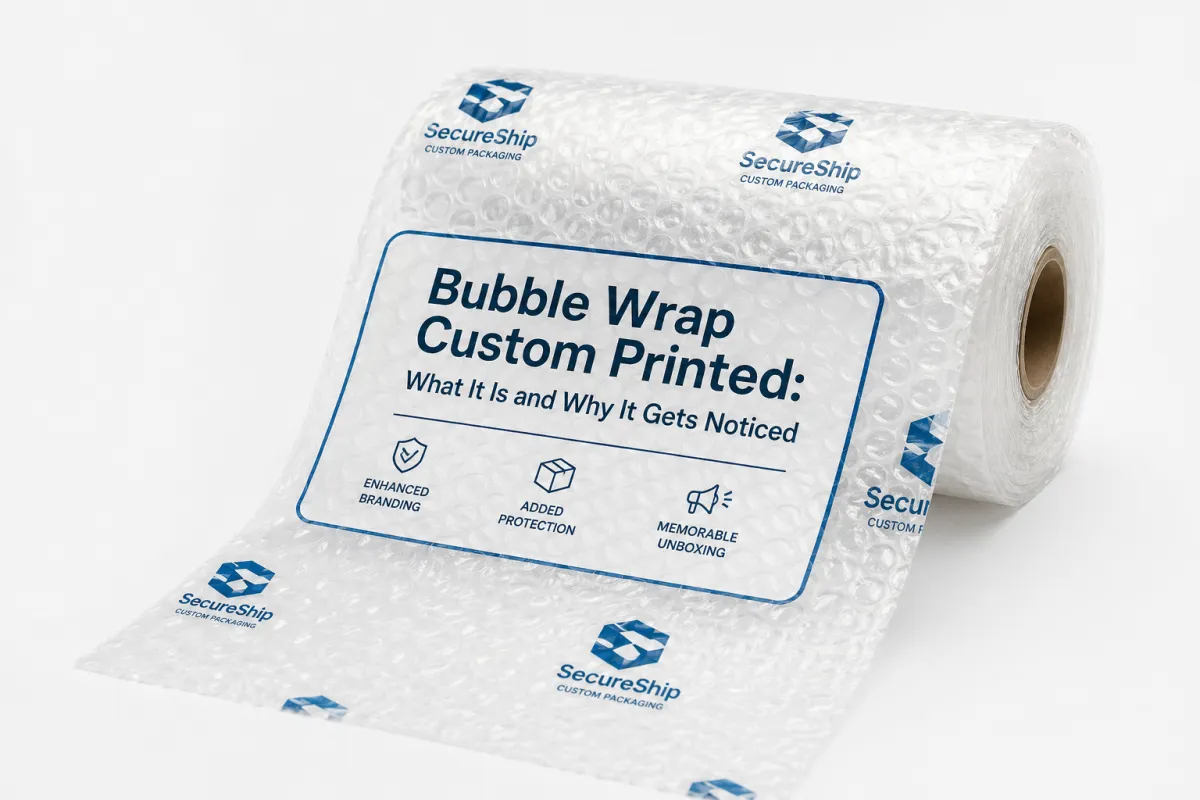
At its simplest, bubble wrap custom printed is protective bubble film with a logo, message, repeat pattern, or handling note printed directly on the material before it is converted into rolls or sheets. It still cushions the product, but it also carries brand information in the same layer that keeps corners from scuffing and surfaces from rubbing against a carton wall.
That combination gets attention for a reason. A shopper may never touch the wrap on a retail shelf, yet in the packing room, during staging, and across transit checks, bubble wrap custom printed is often seen up close and repeatedly. The print can help workers identify the correct SKU, distinguish one fulfillment lane from another, and tell a premium shipment from a standard one without opening every carton.
From a logistics point of view, that matters. Branded packaging is easier to control when the material itself is recognizable, and the same logic applies here. If a warehouse runs several programs at once, bubble wrap custom printed can reduce mix-ups between product packaging lines, especially when the company also uses Custom Printed Boxes, void fill, and inserts with similar visual themes.
The surprise for many first-time buyers is that the print is often more visible at arm's length than at a distance. A bold mark that looks fine on a design screen may disappear once it wraps around a curved bottle, a framed item, or a boxed accessory. Good packaging design respects that reality. The wrap is moving, bending, overlapping, and often only partly visible, so the artwork has to survive a lot of imperfect viewing angles.
I have seen teams approve artwork that looked crisp in a PDF and then wonder why it felt timid on the line. The issue was not the branding idea; it was scale. Bubble film is a working surface, not a poster. That difference sounds obvious in a room full of packaging people, but in practice it gets overlooked all the time.
“The best printed wrap is the one that still feels like protective packaging first. If the branding looks nice but the film is too light, the program is asking for trouble.”
That last point is where many buyers save themselves from headaches. bubble wrap custom printed should support the shipment, not distract from it. If the bubble size, film gauge, or sealing strength is wrong, the wrap can look polished and still underperform in transit. For fragile items, especially those that face vibration, stacking pressure, or corner impact, protection always comes before decoration.
There is also an honest tradeoff here: printing adds a layer of identity, but it does not magically improve cushioning. If a supplier implies otherwise, I would press for test data or a sample run. Ink on film is branding, not armor.
How Bubble Wrap Custom Printed Is Made and Applied
The production flow for bubble wrap custom printed starts with artwork preparation. The supplier checks line art, color count, repeat length, and how the design will sit on the bubble pattern before any print setup begins. If the artwork is too fine or the spacing is too tight, the design may need to be simplified so it reads clearly on film instead of becoming a blur once it is wrapped around a product.
In most programs, the print is applied before the bubble film is converted into final rolls or sheets. Flexographic printing is common for many film applications, although the exact method depends on run size, print detail, and how many colors the job needs. On larger programs, a single repeat pattern may be more efficient, while highly detailed artwork or frequent version changes may call for a different workflow. For buyers, the important part is not the machine label; it is whether the print method matches the volume and the level of detail required for bubble wrap custom printed.
Bubble size and film gauge change the visual result more than some people realize. A 3/16-inch bubble with a lighter gauge film presents a different surface than a 5/16-inch bubble on a heavier film, and the same logo can look sharper or softer depending on how much the film stretches during use. If the design uses a dense pattern, there needs to be enough open space to keep the surface from looking cluttered. If the artwork is a simple logo, there is more room to let the bubbles do their job while the print stays readable.
That is where real packaging decisions start to show up. bubble wrap custom printed can be cut to length, wrapped directly around the product, used as an outer protective layer in staging, or placed inside cartons with a branded face turned outward. It can also work as a visual signal in fulfillment when multiple products share similar dimensions but need different packaging cues. The line team cares less about abstract branding and more about whether the roll unwinds cleanly, tears at the right place, and still seals or tapes the way the process expects.
Consistency matters too. If the repeat placement drifts too much between runs, the logo may land awkwardly at the edge of a roll or repeat unevenly across sheets. Buyers who need multiple warehouses or co-packers should ask how registration is controlled and how the supplier verifies repeat accuracy. With bubble wrap custom printed, a small inconsistency can turn into a very visible one because the material gets handled so often before shipment.
For broader packaging education and transit testing methods, many teams reference industry resources such as ISTA test protocols and the educational material from the Institute of Packaging Professionals before they finalize a spec. That kind of homework is not overkill; it is a practical way to match a printed material to a real shipping environment. If a supplier cannot explain how the wrap was tested or what standard guided the spec, that is a small warning sign.
How Does Bubble Wrap Custom Printed Affect Shipping Protection and Pricing?
For buyers, bubble wrap custom printed changes both the appearance of the carton and the economics of the line. Pricing usually comes down to a handful of variables: film gauge, bubble diameter, print coverage, number of colors, order quantity, proofing work, and whether the program needs multiple versions. A simple one-color repeat on a standard roll is easier to produce than a full-coverage layout with precise logo placement, and that difference shows up in setup time and quote structure.
Material choice is the first tradeoff buyers should understand. Heavier film and larger bubbles generally improve cushioning and puncture resistance, but they also affect cost and handling. If the wrap is too light for the product weight, the branding can look great and the package can still fail under compression or vibration. If the wrap is heavier than needed, the shipper may be paying for protection that the product does not require. bubble wrap custom printed works best when the protective spec is chosen first and the branding layer is built around it.
Volume changes the math quickly. Smaller runs often carry a higher per-unit cost because the setup, proof, and plate work are spread across fewer rolls or sheets. Larger orders usually lower the per-unit price, but they also ask more from storage and cash flow. That is one reason buyers planning seasonal shipping or a launch should not only ask for a unit price; they should ask what the landed cost looks like after freight, packaging format, and minimum order quantities are included.
| Option | Best Fit | Typical Spec | Cost and Complexity Signal |
|---|---|---|---|
| Simple repeat logo | Warehouse identification, light branding, internal fulfillment use | One-color print on standard bubble film | Usually the lowest setup burden and the easiest reorder path |
| Logo plus handling message | Shipments that need visible branding and a practical cue | One or two colors with moderate coverage | Moderate setup work and a balanced price-to-visibility ratio |
| Full-pattern branding | Premium unboxing, branded packaging programs, high-visibility shipments | Higher coverage, tighter repeat control, more artwork scrutiny | Highest setup effort and the most demanding proof process |
If a quote looks unexpectedly low, ask what is missing. Are plates separate? Is the proof included? Does the price assume a certain width, core size, or roll length? Are freight charges estimated or firm? For bubble wrap custom printed, those details can swing the landed cost just as much as the print itself. A low unit price is not useful if the roll does not fit the line or if the reorder setup gets charged again later.
There is also a value question that buyers sometimes overlook. A slightly higher-cost roll can still be the better choice if it reduces damage claims, speeds packing, or presents a cleaner brand image in the carton. That is especially true when the wrap sits alongside custom printed boxes, insert cards, and other product packaging elements that need to feel like they belong to the same program. In other words, bubble wrap custom printed should be judged on total use, not on the raw quote alone.
I would add one more caution from the procurement side: if a supplier cannot clearly separate setup cost from running cost, the quote can look cheaper than it really is. That is a classic place where programs get surprised later. The numbers still have to work after the first order, not just on day one.
Bubble Wrap Custom Printed Ordering Process and Timeline
The ordering process for bubble wrap custom printed usually follows a familiar path: inquiry, spec review, artwork submission, proof approval, production, and shipment. The process sounds simple on paper, but each step can add time if the buyer is still deciding on bubble size, film thickness, or artwork direction. The faster the team can settle those basics, the sooner the job can move into production.
Artwork approval is often the biggest variable. A file that looks ready on screen may still need cleanup for line weight, contrast, repeat spacing, or print placement. If the image is pixelated or the type is too small, the proof stage can turn into a revision cycle. With bubble wrap custom printed, that is not just a design issue; every revision can affect the production schedule and the delivery window for a launch or seasonal shipment.
First-time orders almost always take longer than reorders. The initial run usually includes setup checks, plate work or equivalent print preparation, sample review, and confirmation of the final spec. Repeat runs can move much faster if the artwork and dimensions stay the same. Buyers who want a stable replenishment program should treat the first order as the setup phase for the rest of the year, not just as a one-off purchase.
Planning matters just as much as the spec. A warehouse team may need sampling time, a purchasing team may need internal sign-off, and freight transit can add another layer of delay. If a product launch depends on bubble wrap custom printed, the safest path is to work backward from the ship date and leave room for revisions. A buffer of a few business days can be the difference between smooth fulfillment and a hurried substitution.
For teams that also source other packaging formats, it helps to line up the printed wrap with Custom Packaging Products already in use so the roll width, carton fit, and general packaging design language stay consistent. When a warehouse is juggling several packaging SKUs, the less variation there is in handling, the easier it is to keep pack speed steady.
A practical timeline estimate for a standard first run might be one to two weeks for artwork and proof approval, followed by production time that varies with run size and current capacity. A reorder can move faster, often because the supplier already has the spec locked in. Even so, bubble wrap custom printed is still a printed film product, and film production schedules can shift with material availability, order mix, and press availability. No honest supplier should pretend every job runs on the same clock.
That honesty matters. I have seen a lot of frustration disappear the moment a buyer gets a realistic timeline instead of a sales-friendly one. Sometimes the right answer is simply, “we can do it, but not by Friday.” That kind of candor beats a broken promise every time.
Common Mistakes When Specifying Printed Bubble Wrap
The first mistake is treating the artwork like a desktop graphic instead of a film print. What looks crisp on a monitor can become too small, too thin, or too crowded once it lands on a curved, translucent surface. Fine lines, delicate fonts, and dense details often disappear faster than buyers expect. If the logo is central to the brand, bubble wrap custom printed deserves artwork that is bold enough to read through overlap and movement.
The second mistake is choosing branding before deciding on protection. A buyer may fall in love with the visual side of bubble wrap custom printed and only later discover that the product needs more cushioning, a different bubble size, or a heavier film gauge. That is the wrong order of operations. For fragile goods, the protective spec should be chosen based on product weight, fragility, and transit conditions, then the branding should be built into that structure.
Another common miss is ignoring the mechanics of the packing line. Roll width, core size, perforation needs, dispenser compatibility, and unwind direction all affect how fast a team can work. If a roll is awkward to handle, the warehouse may have to slow down, retrain staff, or change a packing station layout. That can erase the value of a well-designed print. bubble wrap custom printed should fit the line as well as it fits the product.
Buyers also underestimate how long approval can take. Procurement may need a proof, brand may want a color check, and operations may want to test how the roll behaves in a real packing flow. If the order is tied to a promotion, a holiday push, or a product launch, that approval chain needs to be built into the schedule from the start. A delay on proof review can be just as disruptive as a delay in manufacturing.
Price-only decisions can create expensive problems later. A lower quote may hide a weaker spec, a smaller roll count, a different print method, or higher freight. For bubble wrap custom printed, the cheapest option is not always the most economical one once damage risk, labor time, and reorder stability are included. Packaging buyers usually see that reality the hard way, after a line slows down or a shipment arrives with scuffed corners.
Teams that are considering broader source reduction or material optimization can also review guidance from the EPA on sustainable materials management. That does not replace a packaging spec, but it can help larger programs think more clearly about material use and waste. Sustainability claims should still be checked against the actual material mix, especially if inks, adhesives, or secondary packaging change from run to run.
Expert Tips for Better Branding and Better Protection
If the goal is to make bubble wrap custom printed look polished, start with a simple rule: design for close range. The wrap is usually seen from arm's length, sometimes while in motion, and often with parts of the print hidden by overlap. Big type, strong contrast, and clear spacing will outperform a clever layout that only reads from a perfect angle.
Think about the shipper's actual product, not a mockup on a flat screen. A logo that sits beautifully on a sheet may wrap awkwardly around a bottle, a frame, or a boxed accessory. The best packaging design accounts for that curvature and leaves enough room for the print to breathe. In premium programs, the repeat pattern can be subtle, but it still needs to be legible enough to signal branded packaging rather than generic film. That balance is what makes bubble wrap custom printed feel intentional instead of busy.
Another practical tip is to match the print style to the shipment. A clean repeat pattern works well for retail packaging and high-touch unboxing experiences, while a clearer message or logo may be better for warehouse identification and internal sorting. There is no single right answer for every line. The right choice depends on whether the material is acting more like a brand surface or more like an operational cue.
Standardizing the spec helps too. Warehouses run better when there are one or two approved roll sizes rather than five slightly different versions. That makes reorder planning easier, reduces training errors, and keeps the packing stations consistent across shifts or locations. For bubble wrap custom printed, repeatability is part of the value proposition. A pack team that can grab the right roll without thinking is a pack team that stays moving.
Whenever possible, request a sample or proof roll. Paper proofs can tell you a lot about the artwork, but they do not tell you everything about feel, unwind, or how the material behaves once it is cut and wrapped. A sample of bubble wrap custom printed lets operations check the actual print clarity, the cushioning feel, and the fit in the real packing workflow. That small test often saves a much larger correction later.
If you are building a larger branded packaging program, it can help to coordinate the wrap with cartons, inserts, and secondary protection so the whole system feels like one package branding story. When the box, the wrap, and the insert all speak the same visual language, the result feels more deliberate. That is true whether the product sits in custom printed boxes, ships directly to consumers, or moves through a distributor network.
One extra thing I would watch closely is ink coverage on high-friction packs. Heavy coverage can look strong in a proof but behave differently once the wrap is stretched, tucked, and taped. A little restraint usually ages better in real use. That is the kind of detail that separates a nice-looking spec from one that actually holds up.
Next Steps Before You Request a Quote
The easiest way to get a clean quote on bubble wrap custom printed is to prepare the basics before you reach out. Measure the product, estimate monthly or quarterly usage, decide what the print needs to say, and be honest about whether the priority is branding, protection, or both. That information gives the supplier a chance to recommend a spec that fits the real shipping job instead of guessing.
It also helps to gather the practical details that affect production and freight. Have the product dimensions ready, along with preferred bubble size, film thickness, roll width, core size, artwork files, destination ZIP codes, and any warehouse handling constraints. If the material needs to fit a certain dispenser or carton pack-out, say that up front. bubble wrap custom printed is easier to quote accurately when the packing environment is clear from the start.
Before placing a volume order, compare at least two or three spec options. One may be less expensive but more limited in print coverage. Another may cost more but reduce packing errors or create a better brand moment on the receiving end. The point is to compare the options as working systems, not as isolated materials. Good purchasing decisions usually come from seeing how cost, appearance, and packing speed interact.
For many buyers, the final proof step is where the decision gets real. Review the sample with the warehouse team, not only with marketing or procurement. The people who actually touch the roll will spot issues with unwind, visibility, and fit that a desktop review cannot reveal. If the sample works in the actual packing flow, then bubble wrap custom printed is doing its job in a way that helps both operations and branding.
You can also keep the program simpler by tying it to a stable product packaging system. When the printed wrap is used alongside a consistent box size, a fixed insert, and repeatable packing instructions, the whole process becomes easier to manage. That is one reason many buyers pair the wrap with other Custom Packaging Products rather than sourcing each piece separately.
Here is the practical test I would use: does the wrap fit the product, does it fit the budget, and does it fit the shipping process without creating extra friction? If the answer is yes to all three, you are close to the right answer. If not, keep adjusting the spec until the material supports the line instead of working against it. That is usually the difference between a packaging program that looks good on paper and one that holds up in the warehouse.
Choose carefully, ask for a proof, and compare the real handling experience before you commit. The best bubble wrap custom printed choice is the one that protects the item, supports the operation, and tells the brand story clearly enough to be noticed without getting in the way.
If you need a single decision rule, use this one: lock the protective spec first, approve the artwork only after a sample looks right around the actual product, and confirm that the roll behaves on the packing line before you place the full order. That order of operations keeps the program grounded, and it saves a lot of guesswork later.
How much does bubble wrap custom printed usually cost?
Pricing usually depends on material gauge, bubble size, print coverage, number of colors, and order quantity. First-time orders often cost more because of setup, proofing, or plate work, while repeat runs may come in lower. Freight, packaging format, and rush timing can also affect the final landed cost, so it is smart to ask for the full quote picture rather than just the base roll price.
What is the typical turnaround time for bubble wrap custom printed?
Turnaround depends on artwork approval, production schedule, and how complex the print is. A first order usually takes longer than a reorder because of proofing and setup steps. The fastest projects are the ones with final artwork ready, clear specs, and quick approval cycles, especially when the supplier can move straight from proof signoff into production.
Does bubble wrap custom printed still protect fragile products well?
Yes, if the film gauge, bubble size, and wrap style are chosen for the product weight and fragility. Printing should not compromise the cushioning layer, so the protective spec comes first. It is smart to test a sample around the actual item before approving production, especially if the shipment will face vibration, stacking, or long transit distances.
What artwork works best for bubble wrap custom printed?
Simple logos, bold text, and high-contrast patterns usually print more clearly than fine detail. Designs should be readable at close range and still make sense when wrapped around curved products. Vector files are often easier to work with than low-resolution images because they hold shape better during print setup and repeat placement.
What should I prepare before asking for a quote on bubble wrap custom printed?
Have product dimensions, estimated usage, preferred roll size, and any handling requirements ready. Send artwork files and note whether the goal is brand visibility, protective wrap, or both. Ask about minimum order quantity, sample options, and whether repeat orders keep the same setup so planning stays predictable.

