Buyer Fit Snapshot
| Best fit | Bulk Corrugated Boxes Quote projects where brand print, material claims, artwork control, MOQ, and repeat-order consistency need to be specified before quoting. |
|---|---|
| Quote inputs | Share finished size, material target, print colors, finish, packing count, annual reorder estimate, ship-to region, and any compliance wording. |
| Proofing check | Approve dieline scale, logo placement, barcode or warning zones, color tolerance, closure strength, and carton packing before bulk production. |
| Main risk | Vague material claims, crowded artwork, missing packing details, or unclear freight terms can make a low unit price expensive after revisions. |
Fast answer: Bulk Corrugated Boxes Quote: Pricing, Specs, and Speed should be specified like a repeatable production item. The safest quote records material, print method, finish, artwork proof, packing count, and reorder notes in one written spec.
Production checks before approval
Compare the actual filled-product size with the drawing, then confirm tolerance on folds, seals, hang holes, label areas, and retail display edges. Reserve space for logos, QR codes, warning copy, and material claims before decorative graphics fill the panel.
Quote comparison points
Review material grade, print process, finish, sampling route, tooling charges, carton quantity, and freight assumptions side by side. A quote is only useful when the supplier can repeat the same color, closure quality, and packing count on the next order.
Bulk Corrugated Boxes Quote: Pricing, Specs, and Speed
A bulk corrugated boxes quote can look tidy on paper and still miss the mark. The box price looks fine, then the pallet count shifts, the freight lane stretches, and the landed cost jumps. Packaging does that. It has a talent for making simple things annoyingly complicated. That is why a bulk corrugated boxes quote should never be treated like a one-line answer. Box size, board grade, pallet pattern, print needs, and delivery destination all belong in the same decision.
For buyers, the real question is not "What is the lowest quote?" It is "What is the lowest quote that still protects the product, fits the warehouse, and shows up when it should?" That version takes a little more work, which is usually where the useful answers live. A solid bulk corrugated boxes quote reflects the carton's cube, weight, stacking requirement, and delivery window. A lazy one hides the moving parts until the order is already underway. Then everybody acts surprised. Not great.
That gap between the number in the email and the number that hits the dock is where most surprises hide. Two cartons can look identical and still price differently because one uses heavier board, a different flute, tighter print registration, or a shipping method that eats into margin. Buyers who compare only the headline number usually discover the rest the expensive way. I have seen that happen more than once, and it is never the fun part of the job.
Bulk Corrugated Boxes Quote: Why the First Price Is Not the Whole Story
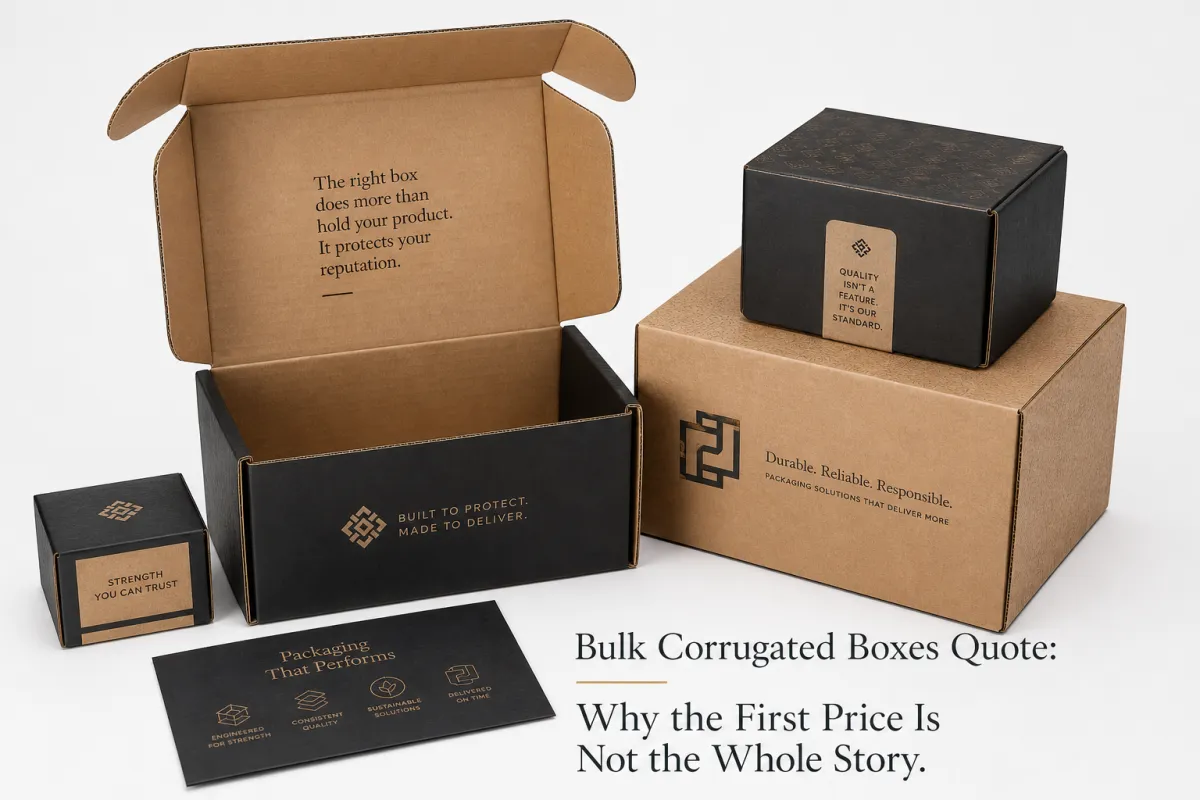
The first number in a bulk corrugated boxes quote is just the opening act. It tells you the make cost the supplier sees, not the full cost to use the carton. A box that is oversized by even a bit can increase freight cube fast. A box that is underbuilt can buckle in storage and wipe out the savings. Freight estimated on a light assumption can come back with a nasty surprise at delivery. Packaging has a way of making all three happen at once.
The practical view is simple: the carton price, freight charge, setup cost, and expected damage rate belong together. A bulk corrugated boxes quote should be judged on landed cost. That matters even more for regional shipping or long transit lanes, where fuel surcharge, accessorial charges, and pallet density can shift the final spend by a lot more than people expect. If the quote does not show that math clearly, you are basically guessing.
The usual cost drivers are not mysterious.
- Size tolerance: a loose box burns cube and dunnage; a tight one slows packing and can damage contents.
- Stacking strength: weak board looks cheap until cartons sit three or four layers high.
- Print coverage: one-color branding is not the same as full-wrap print or heavy ink coverage.
- Pallet configuration: a tighter pallet pattern can reduce freight per unit if the carton design supports it.
- Regional freight lanes: nearby shipping and long-haul shipping rarely price the same way.
Speed matters too, but speed without spec discipline is just a faster mistake. A quick bulk corrugated boxes quote only helps if it reflects the right dimensions, the right board, and the right delivery date. Otherwise you get the wrong answer sooner. Impressive, if your goal is to save time on problems. Not so impressive if the cartons are already moving through procurement.
Buyer reality: a cheap box is not cheap if it needs extra fill, collapses in storage, or triggers a freight class problem. The quote that works is the one that matches the supply chain, not the spreadsheet fantasy.
For teams that want a grounding point on corrugated packaging formats, the educational material at Packaging.org is a useful place to start before finalizing a bulk corrugated boxes quote.
Bulk Corrugated Boxes Quote: Product Details Buyers Need to Compare
A serious bulk corrugated boxes quote should make the box style obvious. If it does not, the buyer is being asked to compare apples to oranges and pretend the fruit basket is normal. The common structures include regular slotted cartons, die-cut mailers, shipper boxes, and custom folding designs. Each one has its own production cost, tooling needs, and fit for the packing line.
Regular slotted cartons are still the workhorse for a lot of fulfillment and warehouse work. They are efficient to make, easy to palletize, and available in single-wall and double-wall formats. Die-cut mailers make more sense when presentation matters, the product size is consistent, or a self-locking shape saves labor on the bench. Shipper boxes show up when protection, stackability, and transit consistency matter more than polish. Custom folding styles sit between those categories and usually earn their keep when the product shape is odd.
Board construction changes the bulk corrugated boxes quote just as much as the shape does. Single-wall board is common because it balances cost and performance for many retail and fulfillment uses. Double-wall board fits heavier items, longer shipping lanes, and cases where compression strength matters. Flute choice matters too. B flute tends to support better print and a flatter profile. C flute offers more cushioning and broad-purpose strength. BC double-wall combines properties for heavier or more demanding loads.
If your application leans toward transit packaging rather than shelf presentation, compare our Custom Shipping Boxes with the broader range of Custom Packaging Products. The structure you choose will shape the bulk corrugated boxes quote more than many buyers expect. Sometimes the "cheaper" style is only cheaper until labor, insert cost, or damage rates show up in the real numbers.
Printing and finishing add another layer. One-color branding is relatively efficient. Heavy coverage, reverse print, coatings, and inserts take more time and tighter material control. A matte aqueous coating, a stronger glue pattern, or a custom die-cut insert may only add a small amount per piece, yet the total bulk corrugated boxes quote can still move meaningfully at volume. That's the kind of detail that gets lost when people only ask for "a box price."
If you need a packaging standard to anchor the discussion, the ISTA test methods are a strong reference point. They connect the box spec to vibration, drop, compression, and ship-cycle handling. That is the part that matters. A bulk corrugated boxes quote should do the same job: tie the price to the actual performance needed, not just the cardboard itself.
Use the end use as the filter. A subscription shipper, a warehouse transit carton, a retail fulfillment box, and a heavy-item distribution carton should not be priced against the same expectation. The right bulk corrugated boxes quote is the one built for the real use case, not the closest generic size. A box can be technically correct and still be a bad fit. That happens a lot more than people admit.
Specifications That Shape a Bulk Corrugated Boxes Quote
The cleaner your data, the cleaner the bulk corrugated boxes quote. Sounds obvious. Still gets missed every day. People send outside dimensions, a rough photo, and a quantity, then act surprised when the quote changes after review. A precise request shortens the back-and-forth and cuts down on revisions after engineering looks at it. That saves time, and more importantly, it avoids the "we quoted the wrong thing" conversation nobody wants to have.
Start with inside dimensions. Exact ones. Inside length, width, and depth determine usable pack space. If the product fit is tight, even a small measuring mistake can create packing friction. It can also change freight cube, pallet count, and how much protective material you need. A reliable bulk corrugated boxes quote depends more on inside dimensions than on a casual label like 12 x 10 x 8. Outside size is useful later. Inside size is what actually tells the story.
Next, define product weight and stacking load. A carton that holds two pounds in a single-use shipment is not the same as one that sits stacked for weeks in a distribution center. Compression requirements are where a lot of quotes wobble. If the box must support pallets stacked four or five layers high, the board choice should reflect that. ECT values such as 32 ECT, 44 ECT, or stronger double-wall constructions may fit, depending on the load and transit pattern.
It also helps to specify whether the carton needs moisture resistance, temperature stability, or a particular print area. Condensation in cold-chain use, humidity in a warehouse, or long dwell times near a dock can affect performance. A bulk corrugated boxes quote that ignores those conditions may look appealing, then disappoint in use. Paper is cheap. Replacing damaged goods is not. I have watched a "good enough" board choice turn into a stack-crushed mess after two weeks in a warm facility. That was a costly lesson for someone.
- Inside dimensions: exact length, width, and depth.
- Product weight: per unit, per carton, and per packed shipper if the load is nested.
- Compression target: storage stack height, pallet stack height, or transit stack expectations.
- Print area: one panel, two panels, full wrap, or registration-critical graphics.
- Quantity breakdown: total order, release schedule, and pallet quantity per drop.
Sample approval is another quiet cost driver. If the design is custom, a proof or physical sample is worth the time. A buyer who signs off on a sample has a much better shot at getting the spec they expected. That is especially true for die-cut cartons, inserts, and boxes with exact tuck features. A clean bulk corrugated boxes quote should spell out whether proofing, plate creation, or sample shipping is included.
Tolerances deserve attention too. Corrugated cartons are not machined parts, so the spec should account for normal manufacturing variance. Ask what the acceptable dimensional tolerance is for the style you are buying. A practical bulk corrugated boxes quote should make that clear before production starts. Otherwise, a tiny difference becomes a big argument after delivery.
One more detail: board sourcing. If the carton is tied to a branded sustainability claim or a retailer requirement, confirm whether the fiber is responsibly sourced and whether the supplier can document that claim. That may not change the box structure, but it can affect which bulk corrugated boxes quote is usable for your account. Trust is built in the boring parts, like documentation and consistency.
Bulk Corrugated Boxes Quote Pricing: MOQ, Freight, and Volume Breaks
Price is where the conversation usually starts, but not where it should end. A useful bulk corrugated boxes quote separates material cost from logistics cost and shows where the volume break points sit. Low MOQ orders often carry higher unit costs. Larger runs lower unit price and also tie up more cash in inventory. There is no magic trick there, just trade-offs with cleaner invoices.
The main levers are straightforward. Board material affects the base cost. Box complexity affects labor and setup. Print count affects tooling and run time. Order quantity affects machine efficiency. Delivery destination affects freight. When those five variables move together, the quote can shift more than a buyer expects. That is normal. What matters is whether the supplier explains the movement instead of pretending it came from nowhere.
MOQ, or minimum order quantity, is not only a supplier preference. It comes from production economics. A converter needs a decent batch size to keep changeover time, waste, and freight efficient. That is why a bulk corrugated boxes quote for 500 pieces can be much less favorable per unit than one for 5,000 or 10,000 pieces. Bigger volume often lowers the piece price, but only if the warehouse can absorb the inventory and the budget can handle the purchase.
Freight deserves its own line, not a footnote. A factory price is useful only up to a point. The delivered cost is what the buyer actually pays to get the cartons into use. A bulk corrugated boxes quote that is priced ex-works may look cheaper and still end up more expensive after truckload or less-than-truckload charges, fuel, and pallet handling are added. I have seen buyers celebrate a low unit price, then get knocked sideways by freight. That part tends to ruin the mood.
Here is a practical comparison of common quote profiles. The ranges are illustrative, because board grade, size, print coverage, lane distance, and pallet density can move them a lot.
| Option | Typical Build | Indicative Unit Price | Best Fit |
|---|---|---|---|
| Simple RSC | Single-wall, 32 ECT, no print, high-volume run | $0.45-$0.95 | General fulfillment and warehouse shipping |
| Branded shipper | Single-wall, 32-44 ECT, one-color print, custom size | $0.70-$1.45 | Retail shipping and subscription packs |
| Die-cut mailer | B flute, printed exterior, self-locking style | $0.95-$1.85 | Presentation-focused direct-to-consumer orders |
| Heavy-duty shipper | Double-wall, higher ECT, minimal or no print | $1.75-$3.50 | Bulk product, heavier components, long-distance transit |
Those numbers do not replace a formal bulk corrugated boxes quote. They help frame the market so the first offer does not feel random. If the price lands far outside those ranges, the next question is simple: what changed? Board, print, dimensions, freight lane, or quantity? One of them usually did.
Setup charges and tooling should also be itemized. For custom print, plate costs and art preparation may appear as separate line items. Some suppliers absorb them at scale. Others do not. Sample charges and approval rounds work the same way. A transparent bulk corrugated boxes quote should tell you whether those costs are one-time or recurring. Otherwise the real cost keeps drifting every time the order repeats.
For larger buyers, wholesale pricing structures can help. Our Wholesale Programs are designed for repeat runs and volume planning, which makes the bulk corrugated boxes quote easier to compare across multiple releases instead of one-off panic ordering. That matters if your demand is steady or if you are planning seasonal replenishment.
One last point: if two quotes are close on unit price but different on freight, the lower line item is not automatically the better deal. Delivered cost decides the outcome. That is the number a serious bulk corrugated boxes quote should make easy to see. If the quote buries that number, ask for a cleaner breakdown.
Process and Timeline for a Bulk Corrugated Boxes Quote
A clean bulk corrugated boxes quote follows a simple path. Request intake comes first. Then estimating or engineering reviews the dimensions, board grade, print requirements, and use case. After that comes pricing, sample review if needed, and then production sign-off. The fewer the gaps at the start, the fewer the delays at the end. Rare, but nice when it happens.
For stock-like cartons and standard structures, pricing can often turn around quickly once the ship-to location and quantity are known. Custom cartons take longer because the spec has to be checked against machine limits, print setup, and tolerances. If the design includes die cuts or special inserts, the quoting path should account for tooling lead time. A strong bulk corrugated boxes quote makes that timing visible instead of hiding it in a vague promise.
Most delays come from avoidable issues. A buyer sends outside dimensions when the carton must be quoted on inside dimensions. Artwork arrives in the wrong format. The quantity changes after the quote is already priced. Freight approval waits until the end. Each change forces the supplier to revisit the estimate, which slows the whole order. A disciplined bulk corrugated boxes quote request saves days, sometimes more. Honestly, it can save a lot of back-and-forth that nobody wants.
For shipping validation, compression and transit tests are worth discussing before the first run. ASTM D4169 and related distribution test methods are often used to connect product risk with carton performance. That is not overkill for every job, but it is a sensible reference when cartons are protecting expensive or fragile products. A bulk corrugated boxes quote that aligns with those expectations is usually the safer buy. The box should be chosen for the trip it is actually gonna take, not the trip we wish it took.
Lead times also depend on scope. A plain double-wall shipper can move faster than a printed custom die-cut box. The difference usually comes from tooling, proofing, and board availability rather than manufacturing alone. In plain terms, simple cartons move sooner, custom cartons need more runway. The best bulk corrugated boxes quote will say that out loud.
Use a short planning checklist before you request pricing.
- Confirm inside dimensions and product weight.
- Define the box style and board grade.
- State print needs, including colors and panel coverage.
- Share quantity, delivery destination, and target in-hand date.
- Note whether the carton must pass stack, drop, or vibration expectations.
- Ask for sample timing, approval steps, and freight terms in writing.
That checklist sounds basic, and it is. Basic is good. It changes the quality of the bulk corrugated boxes quote more than a lot of teams realize. A supplier can quote faster when the inputs are clean. The buyer can compare offers without guessing what was assumed. Novel concept, but it works.
If the delivery date is tied to a launch, warehouse move, or seasonal demand spike, work backward from that date and leave room for proofing and freight. The prettiest bulk corrugated boxes quote in the world is useless if the cartons show up after the inventory window closes. A late carton is just expensive cardboard with a tracking number.
Why Choose Us for a Bulk Corrugated Boxes Quote
A buyer choosing a supplier for a bulk corrugated boxes quote is not only buying boxes. The buyer is buying consistency, communication, and the ability to turn product requirements into a carton That Actually Works in the field. Direct manufacturing relationships matter because fewer handoffs usually mean fewer assumptions and faster answers when the spec changes.
Quality control sits at the center of that. Board sourcing should be stable, print expectations should be documented, and samples should be checked against the approved spec. If the carton is going into a retail program or a high-volume fulfillment lane, a small variation can become a large headache very quickly. A disciplined bulk corrugated boxes quote should come from a team that treats those details as normal, not special.
There is also a difference between a middleman model and an in-house support model. With too many intermediaries, a buyer can lose time between estimating, engineering, and production. That adds friction to revisions and weakens accountability if the carton needs a last-minute correction. A direct quoting process gives the buyer a cleaner path from request to approval. That matters even more when the bulk corrugated boxes quote involves custom dimensions or print changes.
Repeat orders benefit from that structure. Once the carton spec is approved, reorders should be easier, not harder. The best suppliers keep records tight so the buyer does not have to rebuild the file every time. That is not a slogan. It just saves time and reduces mistakes on the next bulk corrugated boxes quote.
Experience matters because cartons fail in specific ways. They crush under stack load. They bow at the panels. They split at the score. They arrive with ink rub or inconsistent glue. A supplier that knows those failure modes can steer the quote toward the right board and the right structure before the order is placed. That is how a bulk corrugated boxes quote becomes a packaging decision instead of a price guess.
We also support short runs and scale-up programs. Some buyers need a test quantity before committing to a larger release. Others need a steady wholesale supply line with repeated drops. Both use cases need accurate estimating, honest lead times, and enough flexibility to adjust the carton spec when the product changes. A good bulk corrugated boxes quote should serve both realities.
In packaging, the cheapest mistake is often the one that never happens. Strong communication, documented approval, and realistic production planning keep a lot of mess off the table. If you want help matching your product to the right corrugated spec, our team is ready to Contact Us and review the details of your bulk corrugated boxes quote before production begins.
Next Steps After Your Bulk Corrugated Boxes Quote
Once the bulk corrugated boxes quote arrives, compare it against the actual job, not against the cheapest number in your inbox. Start with carton style, then board grade, then freight terms, then print scope. If one offer includes a one-color logo and another excludes printing, they are not equivalent quotes. If one assumes factory pickup and the other includes delivery, they are not equivalent either. Comparing them as if they are the same is how budgets get weird.
Ask for a spec sheet review if anything is unclear. That is the fastest way to prevent a mismatch between expectation and production. For high-volume shipments, one sample or proof is usually worth the small delay. It can confirm dimensions, print placement, glue flap behavior, and closure fit before the full run starts. A careful bulk corrugated boxes quote should support that step, not fight it.
Here is the simple decision path I recommend. Gather the inside dimensions, quantity, destination, print needs, and delivery date. Compare board grade and box style line by line. Confirm whether freight, tooling, and samples are included. Then ask for the lead time tied to the approved version of the spec, not the draft. That is how a bulk corrugated boxes quote turns into an order you can actually schedule around.
Buyers often rush the first estimate because the project feels urgent. Fair enough. Urgency happens. Speed only helps when the final spec is right. A well-built bulk corrugated boxes quote gives you both: fast enough to keep the project moving, and detailed enough to keep surprise costs from sneaking in later. That combination is kinda the whole point.
How do I request a bulk corrugated boxes quote with the right specs?
Send inside dimensions, the box style, product weight, expected stack load, and the shipping destination. If the carton needs print, include artwork or at least the number of colors and the print panels. A strong bulk corrugated boxes quote also benefits from quantity, target delivery date, and whether the boxes must fit a specific pallet pattern.
What changes the price in a bulk corrugated boxes quote the most?
Board strength, carton construction, print complexity, quantity, and freight destination usually move the price the most. A double-wall shipper will not price like a simple single-wall RSC. A custom printed run will not price like a plain unprinted carton. If two offers differ, compare the spec line by line before deciding which bulk corrugated boxes quote is actually better.
Is there a minimum order for bulk corrugated boxes pricing?
Usually, yes. The minimum depends on production efficiency, material use, and shipping economics. Simple stock-style cartons may have a lower threshold, while custom die-cut or printed boxes often need a larger run. A larger order can improve unit pricing, but the best bulk corrugated boxes quote still has to fit your storage space and cash flow.
How long does a bulk corrugated boxes quote usually take?
Standard requests can often be priced quickly if the size, quantity, and ship-to details are clear. Custom jobs take longer because engineering, print review, and sample approval may be needed. If the schedule is tight, ask for alternate specs or stock options first. That often gets a usable bulk corrugated boxes quote in hand faster.
Can a bulk corrugated boxes quote include freight and printing?
Yes, and it usually should. Delivered cost is more useful than a factory-only number, especially when freight lanes vary. Printing, plates, coatings, and freight should be itemized so the offers can be compared fairly. If they are separated, request a fully landed bulk corrugated boxes quote before you commit.
For packaging teams that want a quote tied to the actual shipping job, not a generic carton number, the next move is simple: collect the specs, check the freight assumptions, and move from estimate to confirmed production detail. That is how a bulk corrugated boxes quote becomes a workable plan instead of a loose starting point.


