Buyer Fit Snapshot
| Best fit | Buy Biodegradable Shipping Labels projects where brand print, material claims, artwork control, MOQ, and repeat-order consistency need to be specified before quoting. |
|---|---|
| Quote inputs | Share finished size, material target, print colors, finish, packing count, annual reorder estimate, ship-to region, and any compliance wording. |
| Proofing check | Approve dieline scale, logo placement, barcode or warning zones, color tolerance, closure strength, and carton packing before bulk production. |
| Main risk | Vague material claims, crowded artwork, missing packing details, or unclear freight terms can make a low unit price expensive after revisions. |
Fast answer: Buy Biodegradable Shipping Labels: Specs, Pricing, Process should be specified like a repeatable production item. The safest quote records material, print method, finish, artwork proof, packing count, and reorder notes in one written spec.
Production checks before approval
Compare the actual filled-product size with the drawing, then confirm tolerance on folds, seals, hang holes, label areas, and retail display edges. Reserve space for logos, QR codes, warning copy, and material claims before decorative graphics fill the panel.
Quote comparison points
Review material grade, print process, finish, sampling route, tooling charges, carton quantity, and freight assumptions side by side. A quote is only useful when the supplier can repeat the same color, closure quality, and packing count on the next order.
I have spent enough hours on warehouse floors to know that the label is usually the last thing anyone wants to blame, right after the carton, the pallet, and the forklift driver who swears the turn was "totally normal." I remember one afternoon in a distribution center outside Shenzhen where a stack of 12 x 9 x 4 corrugated cartons looked perfect until the conversation about buy biodegradable shipping labels exposed the real trouble: a cold-room acrylic adhesive that started to lose grip at 38 F after two hours in transit. That is the part people miss. To buy biodegradable shipping labels is not just a branding decision; it is a production decision that affects every scan, every parcel, and every handoff from packing bench to delivery truck, whether the line is running 800 parcels a day or 8,000.
For an ecommerce team shipping 5,000 parcels a month, labels are not a tiny footnote in the packaging budget. They are a daily material input that shapes order fulfillment, changes customer perception, shifts shipping materials spending, and controls how much plastic-based waste leaves the facility each week. I once watched a midsize beauty brand in Shenzhen replace its mailers and cartons first, only to discover that the label liner alone filled six waste bins by Friday, each one weighing roughly 18 to 22 kg. Their procurement director laughed in that exhausted way people do when they realize the obvious answer was hiding in plain sight, and said the label change made the sustainability gains visible in a way the outer packaging never did, because the label touched every shipment that left the dock, from the first 500 orders in Guangzhou to the last batch headed to Singapore.
That is the practical case for buy biodegradable shipping labels: less plastic-based label waste, better alignment with sustainability targets, and dependable performance during transit. The decision still needs technical discipline. Substrate, printer type, humidity, temperature swings, and route length all shape whether the label stays put for 48 hours or 12 days. People get into trouble when they treat buy biodegradable shipping labels like a decorative upgrade instead of a spec sheet exercise. The math is clear if you look at it honestly, especially when a 4 x 6 roll, a 2 x 1 barcode strip, and a 100 x 150 mm retail label each behave differently in a 22 C packing room versus a 4 C cold chain. Ignore it, and the reprint queue will show up with a vengeance.
Why Buy Biodegradable Shipping Labels Instead of Standard Options
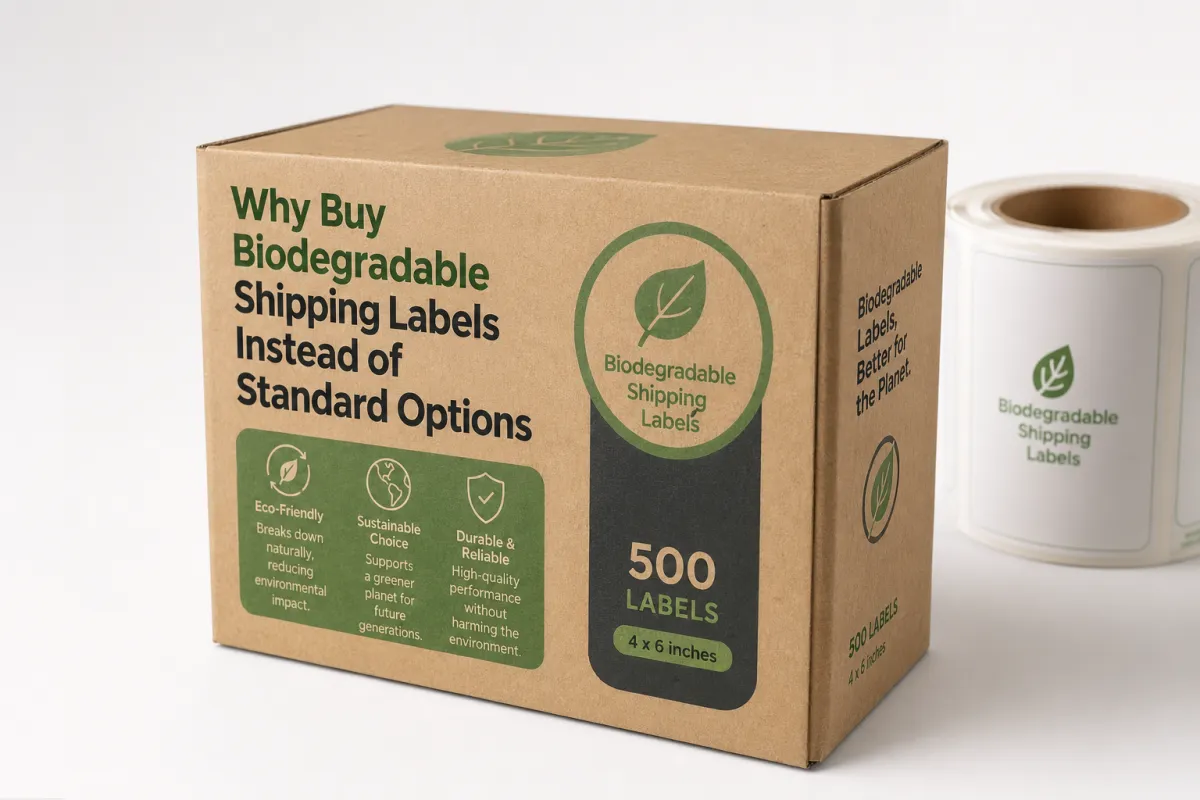
The label is not just a sticker; it is part of the shipping system. I have stood beside a conveyor line in Dongguan where a team blamed a crushed box for a manual-sort exception, only to discover the label had curled enough to confuse the scanner and kick the parcel into the wrong lane. Standard labels can work, sure, but many teams choose to buy biodegradable shipping labels when they want a lower-impact option that still holds a clean 1.5-second scan time and survives the trip from printer to truck, even on a 200-meter dock run and a 14-hour air lane to Tokyo.
In one factory meeting near Houjie, an operations manager laid out a damage report by cause, and the pattern was brutally clear: adhesive failure and edge lift appeared more often than print fade, and each incident cost more than the label itself. That is the operational reason to buy biodegradable shipping labels. Lower landfill impact matters, but so does keeping package protection intact through print, pack, palletization, and delivery scan. A label that peels at the wrong moment creates rework, relabeling, and a second touchpoint, which gets expensive very quickly even on a modest 2,000-order day. I have watched a supervisor mutter at a jammed roll of 500 labels like it had personally offended him; on a Tuesday shift with three packing stations down, I sympathize completely.
The sustainability value is real, though the business value reaches further than a green dashboard. Teams shipping 30,000 orders a month feel a switch to buy biodegradable shipping labels across procurement, waste handling, customer presentation, and internal reporting. I have seen buyers use a single label line item to support FSC sourcing claims, reduce liner waste by 18% in quarter-over-quarter reporting, and clean up sustainability metrics that otherwise looked messy and incomplete. The label itself is small. The decision attached to it is not, and that is exactly why I take it seriously when a brand in Chengdu or Rotterdam wants the numbers to hold up in a board review.
"If the label fails at the dock, the sustainability story never gets told."
Compliance language deserves the same care as the adhesive formula. Buyers often ask whether buy biodegradable shipping labels means industrially compostable, home compostable, or simply bio-based. Those claims do not mean the same thing, and no supplier should blur them together. Under ASTM and related compostability frameworks, the face stock, adhesive, and liner all matter, while FSC becomes relevant when paper sourcing is part of the spec. If your label has to support ecommerce shipping and still stand behind a documented end-of-life claim, the test language needs to be exact, not vague and cheerful, especially if the product ships from a Shenzhen plant but is sold into the EU and California at the same time.
Experienced buyers usually approach buy biodegradable shipping labels the same way they approach cartons: they ask about temperature range, peel strength, print method, and roll count before they ask for artwork. That order saves time and prevents the common mistake of approving a sample that looks clean in a product photo but fails after 72 hours on a poly mailer in humid weather. I learned that lesson the hard way in a warehouse near Foshan, and I would rather save you the headache than let a 20-roll pilot turn into a 2,000-label relabeling job.
What You Get When You Buy Biodegradable Shipping Labels
Every shipping label is a system, usually built from three or four parts. When you buy biodegradable shipping labels, you are buying a face stock, an adhesive, a liner, and sometimes a core sized for your dispenser or printer. The face stock is the visible surface. The adhesive determines whether the label stays on a recycled carton at 41 F or lifts cleanly from a smooth mailer. The liner is the backing waste. If the liner is oversized or heavily coated, disposal costs and handling time climb fast, which is exactly the kind of annoyance that sneaks into a budget and then refuses to leave, especially in high-volume packing rooms turning out 1,200 orders per shift.
I have negotiated liner specs with suppliers who wanted to save 2 cents per roll by changing thickness from 60 gsm to 45 gsm. On paper, that looks like a tiny compromise. On the floor, it changed how the roll fed through a thermal printer, and the client ended up with intermittent jams every few hundred labels. That is why buy biodegradable shipping labels should start with the feed path and the printer bay, not just the front-facing eco claim. A label that jams on Monday morning can erase the savings from a month of cleaner packaging decisions. Honestly, I still remember the smell of hot printer heads and a supervisor in Ningbo staring at me like I personally invented friction.
The common material formats are simple enough to name, but their use cases are not. Paper-based faces are often the easiest entry point if you want to buy biodegradable shipping labels for corrugated boxes and kraft mailers. Compostable films fit better when moisture resistance, stronger tear behavior, or a smoother print surface matters. Recycled liners reduce waste volume, though the exact performance still depends on release coating and printer tension. For buyers handling shipping materials across several SKUs, the right answer is often a split order rather than one universal spec, because one size rarely fits a real warehouse running cartons from 350gsm C1S artboard inserts to 32 ECT corrugated shipper boxes in the same afternoon.
- Paper-based face stock: best for corrugated cartons, kraft mailers, and indoor storage with moderate humidity, often with a 60 gsm to 80 gsm basis weight.
- Compostable film: useful for higher moisture exposure, smoother surfaces, and labels that must resist abrasion in transit packaging, such as 38 micron PLA film.
- Recycled liner options: helpful when your goal is to reduce liner waste without changing the print workflow, especially on 5,000 to 20,000 label runs.
- Custom sizing: common dimensions include 100 x 150 mm, 4 x 6 in, and narrow 2 x 1 in barcode labels for desktop printers.
Customization matters more than most catalogs admit. If you buy biodegradable shipping labels in 4 x 6 format, but your fulfillment software prints a 3.5 x 5.5 return layout, you are creating avoidable waste before the first roll is even opened. Roll diameter, core size, perforation, and orientation all change how many labels fit in a printer bay. I have seen a warehouse save 18 minutes per shift by switching to a more efficient 250-label roll count and adding perforation between labels. That kind of improvement is not flashy, but it pays freight bills and keeps the line moving without making everybody grumble before lunch in a 26 C packing room.
Branding enters the picture too. A logo, a QR code, handling icons, and a return address can all live on the same label without turning it into a cluttered billboard. The trick is to protect the scan field and keep the barcode zone clean. If you buy biodegradable shipping labels with variable data printing, fulfillment can keep moving while the package still carries the kind of brand cues that make the shipment feel deliberate. For broader packaging systems, it helps to look at labels alongside Custom Labels & Tags and the rest of Custom Packaging Products, including the 350gsm C1S artboard inserts that often sit inside the same parcel.
Biodegradable Shipping Label Specifications That Matter
If you want to buy biodegradable shipping labels with confidence, start with the specification sheet. I ask for material composition, adhesive type, liner material, core size, roll diameter, and storage conditions before I look at artwork. That sequence matters. A label that is truly compostable under ASTM D6400 or ASTM D6868 has to be evaluated as a system, not as a face stock with a pleasant description. If the adhesive or liner sits outside the claim, the label story gets weaker immediately, even if the roll comes from a polished factory in Dongguan or a cleanroom-style converting line in Xiamen.
Compliance language needs precision. Some suppliers describe a product as biodegradable when it is only bio-based, which is not the same claim at all. Others say compostable and fail to distinguish industrial conditions from home conditions. If you buy biodegradable shipping labels for a fulfillment network that ships across climate zones, ask which end-of-life route is actually supported by documentation and whether the supplier can provide test data. I have watched procurement teams lose two weeks because the quotation used broader language than the certificate, and nobody wants that kind of paperwork circle when a launch date in Seoul or Melbourne is already on the calendar.
Printer compatibility can turn a good order into a bad one very quickly. Direct thermal printers depend on heat-sensitive coatings, while thermal transfer setups rely on ribbon compatibility as much as face stock performance. If you buy biodegradable shipping labels for a Zebra, Sato, or TSC unit, confirm sensor marks, gap spacing, and heat range before the order is approved. A label that prints at 305 dpi but smears at 60 C in the warehouse is not a bargain. It is the beginning of a reprint pile, and I have yet to meet a shipping team that was thrilled about that outcome after a 9-hour shift.
| Material Option | Typical Best Use | Indicative MOQ | Example Unit Price at 5,000 pcs | Key Tradeoff |
|---|---|---|---|---|
| Paper-based biodegradable face stock | Corrugated boxes, kraft mailers, indoor storage | 1,000-3,000 labels | $0.15 per unit for 5,000 pieces | Good value, lower moisture resistance |
| Compostable film label | Humid routes, poly surfaces, higher abrasion | 3,000-5,000 labels | $0.22 per unit for 5,000 pieces | Stronger performance, higher cost |
| Recycled liner label | High-volume fulfillment with waste reduction goals | 5,000-10,000 labels | $0.13 per unit for 5,000 pieces | Lower waste, not always compostable |
| Custom printed branded roll | Retail presentation, returns, handling icons | 5,000-20,000 labels | $0.19 per unit for 5,000 pieces | Better branding, more setup time |
The most useful sample test is unglamorous, and that is a good thing. If you buy biodegradable shipping labels for a real launch, test them on the exact surface: corrugated kraft, recycled board, Matte Poly Mailers, or coated cartons. Run three checks: adhesion after 24 hours, scannability after abrasion, and print durability after a 10-minute rub test. I usually ask clients to repeat the test at room temperature and again at 40 F, because a label that behaves nicely in a meeting room may act very differently in a chilled distribution bay. That little wrinkle has saved more than one launch from becoming a very expensive apology, especially when the first production run is 8,000 labels and the ship date is already locked.
Storage conditions deserve attention too. If a supplier says the rolls should be kept between 15 C and 25 C with 40%-60% relative humidity, that is not decorative language. It affects curl, adhesive tack, and print consistency. Buyers who buy biodegradable shipping labels and leave them in a hot mezzanine for six weeks often create the exact problems they hoped to avoid. If the warehouse is already managing dimensional weight pressure on outbound cartons, a skewed label roll or an oversized carton can quietly add freight cost too, which is the sort of cost that only becomes visible after someone is already annoyed and a carrier bill from the Hong Kong lane lands on the desk.
What It Costs to Buy Biodegradable Shipping Labels
Price is where the conversation gets honest. To buy biodegradable shipping labels, you usually pay for better materials, tighter process control, or both. Material grade, adhesive performance, print complexity, label size, and order quantity are the main cost drivers. A 100 x 150 mm one-color roll is a different purchase from a 2 x 1 barcode label with variable data, and the gap widens once compostable film or specialty liners enter the quote. A factory in Guangdong can quote both on the same day, but the cost basis is never identical.
MOQ changes the picture quickly. I have seen a quote fall 28% per unit when a buyer moved from 3,000 pieces to 10,000 pieces, simply because setup and freight were spread across more labels. That is why serious procurement teams ask for tiered pricing before they buy biodegradable shipping labels. A 5,000-piece run at $0.15 per unit can be smarter than a 1,000-piece run at $0.29 per unit if storage space and forecast support it. I prefer quotes that show 1,000, 5,000, and 10,000 pieces side by side; anything less makes the comparison feel tidy while hiding the real cost curve, especially if the vendor is quoting from Shanghai while the conversion plant sits in Dongguan.
Compared with standard labels, the unit price can be higher by 10% to 35%, but the comparison should not stop at the sticker. If a label supports a sustainability target, reduces liner waste, and improves customer perception during unboxing, the business value extends beyond the line item. When teams buy biodegradable shipping labels, I ask them to calculate total cost per shipped order, not just label cost. That means including reprint risk, waste disposal, and the time your team spends fixing failed labels. The label price is the easy part; the labor is where people get surprised, especially in a facility pushing 6,000 parcels a week across two shifts.
One cosmetics client accepted a 12,000-unit order at a higher sticker price than their older label, yet they cut three internal complaints per week because the new label stayed attached to the recycled carton surface. The procurement manager told me the switch paid for itself in reduced relabeling hours and lower scrap. I see that pattern often. A label feels inexpensive until it forces a second touch. After that, the economics change fast, and nobody in the room is smiling, whether the orders are leaving a warehouse in Foshan or a co-packing line in Ningbo.
For buyers comparing suppliers, ask for quotes using the same label size, finish, printer type, and print coverage. If one vendor quotes a 4 x 6 direct thermal roll and another quotes a 100 x 150 thermal transfer roll with a satin finish, the numbers will mislead you. To buy biodegradable shipping labels intelligently, compare the same spec on each line, then decide whether the greener option is worth the monthly delta. If you are also budgeting cartons and inserts, include a 350gsm C1S artboard insert line so the whole packout stays in the same cost discussion rather than drifting into separate spreadsheets.
It also makes sense to budget for sampling. A sample roll may cost $35-$85 depending on size and material, which is still far cheaper than a failed run of 8,000 labels. If labels are part of a larger packaging update, review the full system alongside Custom Poly Mailers and Custom Shipping Boxes so the label, mailer, and carton all point in the same direction. That coordination saves headaches later, which in my experience is one of the most valuable line items nobody writes down.
From Proof to Delivery: Process and Timeline
The order path should stay simple. To buy biodegradable shipping labels, the usual sequence is inquiry, specification review, artwork submission, proof approval, production, quality check, and shipment. On a clean order with final artwork, a stock-size label can move in 5-8 business days after proof approval. A custom size with a special material usually needs 12-15 business days from proof approval, and a more involved run with certification review can stretch to 18-25 business days. If you are booking freight from Shenzhen or Ningbo into a fixed launch window, plan the calendar around those numbers from the start, because the calendar does not care about anyone’s optimism.
Production rarely slows because the press is slow. Paperwork creates most delays. Missing dimensions, uncertain adhesive selection, low-resolution artwork, and last-minute quantity changes are the usual culprits. In one supplier negotiation, a buyer wanted to buy biodegradable shipping labels with a logo, a QR code, and a 2 mm safe zone, but the file arrived without bleed and without a Pantone reference. The proof cycle stretched from 2 days to 9 because every revision had to be measured against the printer setup. I could practically hear the sighs through the phone, especially when the first revised file still did not match the barcode quiet zone.
Speed comes from sending the whole package at once. Include label dimensions, application surface, printer model, monthly volume, and target delivery date. If the labels need to work on a kraft carton shipped through ecommerce shipping channels in humid weather, say so directly. If you need 4-color branding plus barcode readability, say that too. The fastest way to buy biodegradable shipping labels is to remove guesswork before the quote lands, not after someone has already started cutting samples in a workshop outside Guangzhou.
Quality control should be visible, not assumed. I like to see roll count verification, edge finish inspection, adhesive consistency checks, and print registration checks before shipment. If the supplier can provide photo evidence or batch records, even better. Buyers who buy biodegradable shipping labels through generic marketplaces often skip this step, and that is where reorders start. A slightly cheaper unit price does not help when 600 labels arrive misaligned and the line stops for half a shift. That kind of delay can wreck a day faster than almost anything else in fulfillment, particularly if the team is already balancing a 14-container outbound schedule.
Why Businesses Buy Biodegradable Shipping Labels From Us
At Custom Logo Things, the strongest reason clients buy biodegradable shipping labels from us is not a broad eco claim. It is the spec-led recommendation behind the quote. We ask how the label will be used, on what surface, in what temperature band, and with which printer model. That approach sounds slower until you compare it with a blind order that misses adhesive strength by 15% or uses the wrong liner for the dispenser. I have seen both, and neither one is fun to clean up, whether the order is being converted in Dongguan or packed for export out of Xiamen.
We keep the process practical too. Buyers under deadline often need custom sizing, a small sample run, and a response in 24 hours because their fulfillment calendar is already locked. I have sat in meetings where a procurement lead had 48 hours to finalize packaging inputs before a launch, and the room had the kind of tight silence that tells you everyone is doing math in their head. In that kind of schedule, being able to buy biodegradable shipping labels with clear numbers, useful artwork feedback, and a realistic lead time matters far more than a polished product page. The quote needs to answer three questions: will it stick, will it print, and will it arrive on time?
Reliability comes first. A label has to survive handling, transit, and scanning before it has a chance to support its sustainability claim. That is the standard I use in every client conversation. If you buy biodegradable shipping labels from a source that cannot explain the adhesive chemistry or the liner release behavior, you are not buying certainty. You are buying a possible rework cycle. I have seen a warehouse lose two hours because labels arrived curled, and the only fix was manual reloading and reprinting 1,400 units. Everyone involved aged about five years in that afternoon, and the line supervisor still remembers the batch code.
The difference from generic marketplaces is easy to see. Marketplaces often show a product image and a price, but not the material breakdown, storage range, or printer compatibility notes. That becomes a problem for procurement teams that need consistency month after month. When you buy biodegradable shipping labels through a spec-driven supplier, you cut reorders, waste, and troubleshooting later. It is the same reason disciplined buyers do not choose shipping boxes by photo alone; they check flute, board grade, and burst strength before signing off, whether the boxes are coming from a plant in Foshan or a corrugated mill in Suzhou.
For teams building a larger packaging system, labels should fit the rest of the lineup instead of fighting it. A label that matches a kraft box, a compostable mailer, or a branded insert gives the customer a more coherent unboxing sequence. That is why we often pair label conversations with broader packaging plans in Custom Packaging Products. A coordinated packout reduces friction in order fulfillment and usually cuts the number of exceptions your warehouse team has to handle, especially when the packout includes a 350gsm C1S artboard card and a printed shipping label that share the same color profile.
My honest view is simple: if you can buy biodegradable shipping labels that meet the scan spec, survive the route, and keep the presentation clean, you are already ahead of most operations. The sustainability benefit matters, but the operational benefit is what makes the switch stick. Buyers do not keep buying what creates extra work. They keep buying what runs cleanly, day after day, without turning the dock into a drama series, and that tends to be the difference between a one-time test order and a repeat program of 20,000 labels a month.
Next Steps to Order Biodegradable Shipping Labels Today
If you are ready to buy biodegradable shipping labels, start with five numbers: label size, quantity, substrate, printer type, and target ship date. Those details let a supplier quote accurately instead of guessing. Add artwork if you have it, but do not wait on artwork before asking for pricing. A clear 4 x 6 label request for 5,000 pieces will get you a faster and cleaner answer than a vague request for "eco labels," which is the kind of phrase that makes manufacturers in Guangdong reach for another cup of coffee before replying.
After that, order a sample roll or sample sheets. I prefer testing on the exact packaging surface because cartons, mailers, and poly surfaces can differ by 30% or more in adhesion results. If you buy biodegradable shipping labels and test them on a corrugated box at 22 C and 50% humidity, then repeat the same test at 4 C or on a glossy mailer, you will learn more in 20 minutes than in a week of product browsing. Check adhesion, scannability, and print durability, then sign off only if all three pass. A 25-label test is not enough if the launch run is 3,000 parcels a day.
Ask for the end-of-life claim in writing. That step matters because "biodegradable," "compostable," and "bio-based" do not mean the same thing in procurement language or in customer messaging. If you plan to buy biodegradable shipping labels as part of a sustainability report, the claim has to align with your internal standards and your legal review. I always recommend keeping the certificate, the test standard, and the supplier’s wording in the same folder so nobody has to improvise later. Trust me, nobody enjoys trying to reconstruct a paper trail from memory when a reviewer asks for the exact batch from a factory in Shenzhen.
Ready to move? Send the label dimensions, substrate, printer model, monthly volume, artwork file, and expected launch date. If you want a complete packaging set, include your mailer and carton specs too, because the label should fit the rest of the shipping system. That is the cleanest way to buy biodegradable shipping labels without wasting time, stock, or freight budget, and it gives the factory a clear path from quote to finishing to outbound carton labels.
How Do You Buy Biodegradable Shipping Labels That Actually Pass Testing?
The best way to buy biodegradable shipping labels is to treat the purchase like a technical spec review instead of a quick catalog order. Start with the surface you will apply them to, the printer you will run, the temperature band in the warehouse, and the route the parcel will travel, because those four variables decide whether the label stays flat, scans cleanly, and holds up long enough to reach the customer. If the labels are going onto recycled corrugated cartons, ask for an adhesive designed for textured board; if they are going onto Matte Poly Mailers, ask for a different tack profile; and if the line uses direct thermal printers, confirm the coating chemistry before you approve the order.
Then test a sample on the real packout, not a desk sample. I like a simple three-part check: adhesion after 24 hours, scannability after abrasion, and print durability after a short rub test. If you buy biodegradable shipping labels with a compostable film face stock or recycled liner, ask the supplier to show the end-of-life documentation alongside the production spec so the sustainability claim and the operational claim line up. That is the point where the decision becomes easy to defend in procurement, fulfillment, and reporting, which is exactly where a label should earn its place in the shipment.
How do I know if biodegradable shipping labels will actually break down?
Ask for the exact material breakdown, including face stock, adhesive, and liner, because all three affect end-of-life behavior. A label that is only "bio-based" is not the same as one that is industrially compostable under a recognized standard such as ASTM D6400. Request documentation before you buy biodegradable shipping labels, and keep the test standard in the file so internal teams can verify the claim later. If the supplier can name the lab, the batch number, and the test date, that is even better.
Will biodegradable shipping labels stick to corrugated boxes and mailers?
Yes, if the adhesive is matched to the surface and application conditions. Corrugated kraft, recycled cartons, and poly mailers can all require different adhesive behavior, especially in cold docks or humid pack rooms. The safest path is to sample test before you buy biodegradable shipping labels, then check adhesion after 24 hours and again after a short transit simulation, such as 2 hours at 5 C and 2 hours at 30 C.
What is the minimum order quantity for biodegradable shipping labels?
MOQ depends on whether the labels are stock sizes or fully custom. A simple 4 x 6 roll may start at 1,000 labels, while a special material or branded print run may need 5,000 or more. Ask for price breaks at 1,000, 5,000, and 10,000 pieces before you buy biodegradable shipping labels so you can compare unit cost against storage space and monthly usage. If your warehouse in Dongguan only has room for 40 cartons, that storage number matters as much as the price.
Are biodegradable shipping labels more expensive than standard labels?
Usually yes on a per-unit basis, but the gap depends on material grade, volume, and print complexity. The real comparison should include waste reduction, brand value, and whether the label supports procurement or sustainability targets. If you plan to buy biodegradable shipping labels, request quotes using the same size, finish, and quantity so the comparison is fair, and make sure each vendor quotes the same 5,000-piece or 10,000-piece level.
Can I print custom artwork on biodegradable shipping labels?
Yes, most buyers can add logos, return information, handling icons, or custom branding. The print method must match the label material, so confirm whether thermal transfer, direct thermal, or another process is recommended. Send artwork early if you want to buy biodegradable shipping labels without slowing proof approval, because missing bleed or low-resolution files can add several days to production. A vector logo, a 2 mm bleed, and a 300 dpi barcode file will usually keep the proof cycle moving.
If you are ready to buy biodegradable shipping labels, send your size, quantity, substrate, printer model, artwork, and monthly volume, and ask for a sample roll before you place the production order. That is the fastest path to a label that protects your parcels, keeps scanners happy, and supports the sustainability message you plan to stand behind, whether the final shipment is leaving Shenzhen, Ningbo, or a contract packer in Foshan.


