Buyer Fit Snapshot
| Best fit | Buy Clear Front Mailers Online projects where brand print, material claims, artwork control, MOQ, and repeat-order consistency need to be specified before quoting. |
|---|---|
| Quote inputs | Share finished size, material target, print colors, finish, packing count, annual reorder estimate, ship-to region, and any compliance wording. |
| Proofing check | Approve dieline scale, logo placement, barcode or warning zones, color tolerance, closure strength, and carton packing before bulk production. |
| Main risk | Vague material claims, crowded artwork, missing packing details, or unclear freight terms can make a low unit price expensive after revisions. |
Fast answer: Buy Clear Front Mailers Online: Specs, Pricing & Process should be specified like a repeatable production item. The safest quote records material, print method, finish, artwork proof, packing count, and reorder notes in one written spec.
Production checks before approval
Compare the actual filled-product size with the drawing, then confirm tolerance on folds, seals, hang holes, label areas, and retail display edges. Reserve space for logos, QR codes, warning copy, and material claims before decorative graphics fill the panel.
Quote comparison points
Review material grade, print process, finish, sampling route, tooling charges, carton quantity, and freight assumptions side by side. A quote is only useful when the supplier can repeat the same color, closure quality, and packing count on the next order.
If you need to buy clear front mailers online, I always tell people to start with the part nobody wants to sketch out first: the real packing workflow. What has to stay visible, and for how long? How is the bag sealed, and does that seal need to survive a 48-hour parcel route or a five-day regional transfer? I remember standing at a packing table in a warehouse outside Indianapolis, Indiana, watching a clear front mailer save a team nearly a full minute per carton because the invoice, packing slip, and product insert stayed visible through the front panel. That sounds small on paper, but in a 2,000-order week it adds up to real labor time, which is exactly why buyers choose to buy clear front mailers online instead of settling for a plain poly bag that hides everything and slows the line down.
People usually buy clear front mailers online because they want speed, a clean quote, and enough technical detail to make a good decision without turning the process into a three-week scavenger hunt. That instinct is sound. The best result comes from matching visibility, film thickness, closure style, print placement, and quantity to the actual shipment instead of to a generic catalog description that sounds tidy in a sales email from a plant in Dongguan, Guangdong or a broker office in Los Angeles, California. I have seen teams buy clear front mailers online by size name alone, only to find the contents sat too high in the bag, the seal felt weak under pressure, or the front panel was clear enough to look good but not clear enough to let a barcode scan without a fight. Nothing builds confidence like a bag that does its job without drama, especially on a Friday afternoon when the trailer is already backed to the dock.
Buy Clear Front Mailers Online: What Makes Them Practical
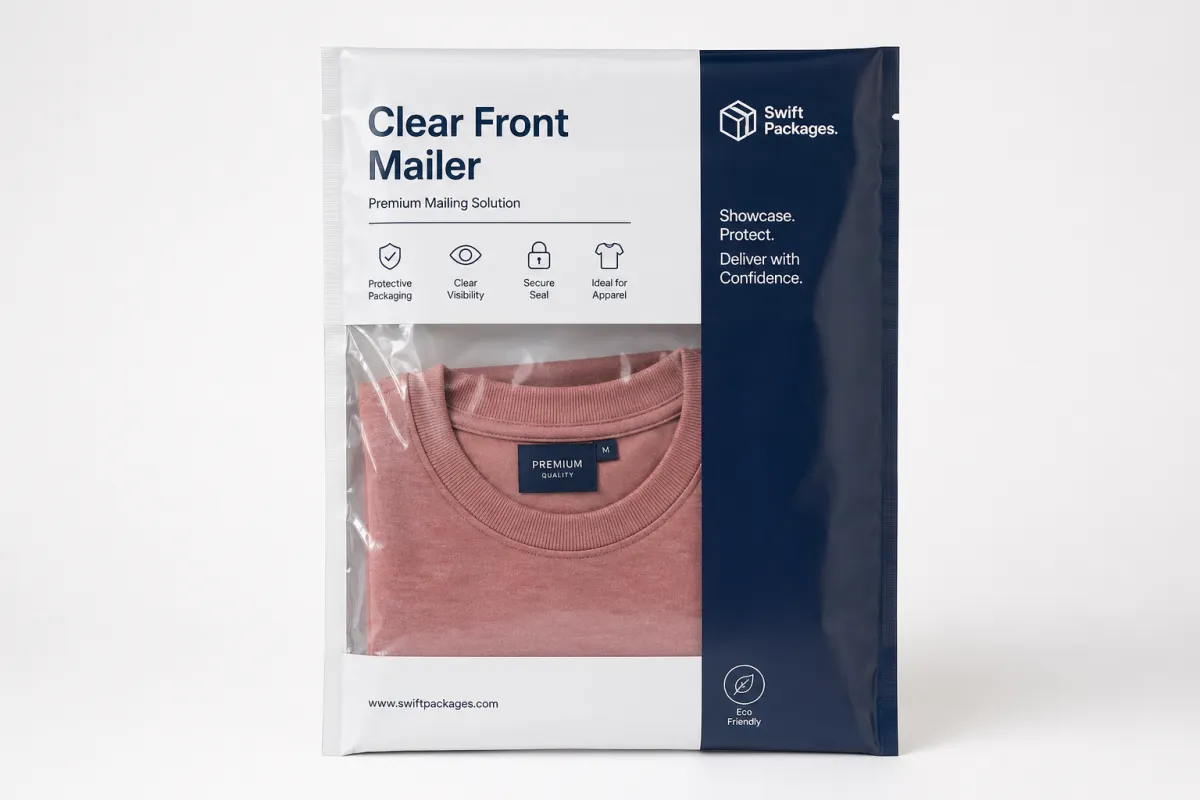
The appeal becomes obvious the moment you stand at a packing table for an hour and watch what slows people down. A clear front mailer lets the product, insert, or invoice show through while still protecting the shipment in a light poly format, and that balance is why brands buy clear front mailers online for apparel, sample kits, promotional packs, subscription shipments, and retail orders that need a cleaner presentation than a solid-color mailer can offer. At an apparel distribution center in Indiana, a supervisor once told me his team stopped opening and re-sealing certain cartons because the front panel made the customer and PO information easy to verify at a glance, which cut enough handling time to show up in their labor report over a 6-week cycle. That is not theory; it is dock-floor math, and dock-floor math is usually the only math that matters after lunch.
A lot of people overthink the choice to buy clear front mailers online. The real question is not whether the bag looks good in a mockup. It is whether the shipment still looks orderly after a carton ride, a pallet wrap cycle, and a few sharp turns in a delivery van. Clear front mailers work because they combine visibility with a lean material build, especially compared with a fully printed bag that needs ink across every surface. For a buyer trying to keep pack-out moving at 300 to 500 units per shift, that matters. The front stays transparent, the back panel carries the brand or privacy layer, and the finished package still reads as deliberate rather than improvised. I have a soft spot for packaging that looks like someone actually planned it, right down to the 15 mm adhesive flap. Shocking preference, I know.
"If I can see the contents and the packing slip without opening the bag, my team moves faster and makes fewer mistakes," a retail operations manager told me during a client meeting in Charlotte, North Carolina. "That one change saved us from a pile of open-and-reseal handling on about 8,000 units a month."
That kind of feedback is what pushes buyers to buy clear front mailers online with a more technical eye. An apparel fold, a beauty sample, a launch insert, or a membership pack all benefit from visibility because the shipment feels complete before the customer even opens it. If the order goes directly to a consumer, the clear panel adds a little showroom effect without pushing the bag into a rigid-mailer budget. I have seen subscription teams switch from plain white mailers to clear front mailers because the product looked better through the bag, and customer service notes about presentation dropped within 30 days. Small detail, real effect. Nobody calls in to praise a badly packed order; they only call when something looks like it was assembled during a power outage in a 60,000-square-foot facility.
The buying logic stays simple: if you buy clear front mailers online, ask the supplier to show actual size, film gauge, closure style, and print location before the order goes live. That difference separates a smooth repeat program from a box of surprises. The better suppliers can compare a 3.0 mil bag against a 4.0 mil bag, explain how a single adhesive strip behaves versus a tamper-evident seal, and tell you whether your artwork will sit safely on the backer without clouding the front panel. If those basics take more than a minute to explain, keep moving. Life is too short for suppliers who need a committee meeting to describe a flap on a bag running out of Shenzhen, Guangdong.
Product Details: Clear Front Mailer Construction
A standard clear front mailer is usually built from a transparent front panel paired with a backing film that can be white, silver, black, or custom printed for branding and privacy. That two-layer structure is the reason the format works so well. The front panel shows the product, insert, or barcode. The backer handles the visual identity, opacity, and often the logo placement. When buyers buy clear front mailers online, they should ask exactly how those layers are built, because a lightly frosted front and a fully optical-clear front do not behave the same in transit or under camera lights. Optical clarity helps with retail display, while a slightly softer clear finish can hide scuffs better after shipping and handling across a 1,200-mile route from Texas to Ohio. I like the clearer version for presentation, but I will admit the softer finish can be kinder once the bags have had a rough trip.
Closure style deserves the same attention as the film. Self-seal adhesive strips are the fastest option on a busy packing line, especially when the team is pushing 300 to 500 units per shift. Tamper-evident seals make sense for sample packs and direct-to-consumer shipments where first-opening integrity matters. Reinforced flaps help when the bag gets handled more than once before it reaches the end user. I have also seen buyers buy clear front mailers online with double adhesive, which sounds minor until a return label, an insert, or a reclose requirement changes the spec after the first round of testing. A 12 mm adhesive strip is common; 15 mm gives more forgiveness when the sealing operator is moving quickly and nobody wants to babysit every flap like it owes them money. On a line in Cleveland, Ohio, that extra 3 mm can be the difference between smooth packing and a pile of rejected seals.
Printability is the part many buyers underestimate. You can keep the front panel clear and still support one-color logos, warning marks, UPC placement, or spot graphics on the backer. I have negotiated jobs where the client wanted a full visual brand story, but the front panel needed to stay open for scan readability, and the answer was usually a smarter back-panel layout rather than more ink. That is one reason people buy clear front mailers online for retail launches: the bag can still carry a branded voice without hiding the product. For a simple apparel order, a white backer with black print and a clear front often looks sharper than a full flood print, and it usually costs less. I know some buyers think more ink automatically means more premium. In practice, a restrained design often looks more expensive, which is one of those annoying truths that keeps designers employed in Chicago, Illinois and everyone else honest.
Material behavior is easy to feel once the bags are on the line. Film clarity, stiffness, puncture resistance, and the way the bag drapes when filled all affect how polished the shipment looks on arrival. A flimsy 2.0 mil film can wrinkle around the product and make a packed box look worn before it leaves the dock. A 3.0 mil build usually lands in the sweet spot for most retail mailing jobs, while a 4.0 mil bag gives extra confidence for heavier knitwear, boxed goods, or any shipment that will see mixed handling. If you buy clear front mailers online for repeat use, ask for a sample filled with your real product, not a test sheet. That test tells you far more than a spec sheet ever will. A spec sheet can be charming in a bureaucratic way, but it will not tell you whether the mailer makes the product slouch like it stayed out too late after a show in Nashville, Tennessee.
Optional features are worth asking about before you commit. Tear strips help end users open the bag cleanly. Hang holes matter if the bag moves from mailer to retail display. Gussets give the contents a little more room without stressing the seam. Some buyers also ask for dual adhesive, especially when a security seal is needed and the bag might be returned for exchange or inspection. I saw a beauty brand in a supplier meeting save two rounds of rework simply by adding a tear notch and moving the closure 8 mm higher on the flap. That is the kind of detail that separates a clean purchase from an awkward one when people buy clear front mailers online. Tiny change, big annoyance avoided. My favorite kind of packaging improvement, honestly.
For industry reference, I like to check whether the supplier can speak to common test methods and transit expectations through resources like ISTA and broader packaging-industry resources through PMMI materials. If a supplier understands how a bag behaves under handling and compression, the odds of a clean launch go up fast. If they glaze over when you mention transit stress, that usually tells you enough, especially if the goods are being made in Ningbo, Zhejiang or packed for a route through Savannah, Georgia.
Buy Clear Front Mailers Online: Specifications That Matter
The first sizing question looks simple, and it is also where most mistakes begin. Match the mailer to the packed item dimensions, not just the product label size. If a folded hoodie measures 10.5 x 13.25 inches and the bag is sold as 10 x 13, the pack-out may look neat on paper and still feel cramped on the line. When buyers buy clear front mailers online, I tell them to measure the finished packed form, then add room for the flap and seal zone. That small step keeps the bag from being overstuffed, which is one of the main reasons seams split or the finished piece arrives with a bowed, uneven profile. I learned that one the hard way years ago after watching a perfectly good garment get bullied into a bag that was clearly too ambitious for it, all at a packing bench in San Diego, California.
Film gauge is the next decision, and it changes cost more than many buyers expect. A thinner film lowers unit price, but it also reduces puncture resistance and stiffness. A heavier gauge improves confidence, especially when the bag will ride with cartons, inserts, or rigid items in mixed freight. In many apparel programs, 3.0 mil is a practical starting point, and 4.0 mil is a better fit for heavier contents or longer transit lanes. I have seen clients buy clear front mailers online in a 2.5 mil build to save pennies, then spend those savings replacing damaged bags after one rough carrier lane from Atlanta, Georgia to Memphis, Tennessee. That is a poor trade. Saving a fraction on paper only to lose more in replacements is the kind of cost math that makes procurement people stare into space for a second.
Seal performance deserves the same scrutiny. Ask about adhesive strength, closure width, and whether the seal is meant for single-use security or repeated handling in a fulfillment center. If the bags are packed by hand, a wide adhesive area makes the process more forgiving. If the bags are machine-fed, adhesive consistency matters even more because the line cannot pause to nurse each flap into place. A solid spec review should also confirm the adhesive temperature window, especially if cartons sit in a hot dock in Phoenix, Arizona or a cold trailer in Minneapolis, Minnesota before they reach the packing room. Buyers who buy clear front mailers online without asking how the adhesive behaves often discover the problem on the first wet morning or cold shift. And nothing brightens a warehouse mood quite like a flap that refuses to stick because the temperature had opinions.
Clarity requirements sound obvious until a barcode refuses to scan through the front film. Buyers should confirm the exact level of transparency on the front panel, especially if the item barcode, insert, or product graphic must be easy to see. If the application depends on scan-through, ask for a real sample with the same print density and the same film. A front panel that looks clear under showroom lights may still carry enough haze to interfere with a scanner or blur fine text. I have watched a fulfillment lead reject a shipment because the label looked fine to the eye but failed the scan test on the dock. One test saves a lot of guesswork, and it saves a lot of the classic warehouse phrase: "Who approved this?"
Logistics checks belong in the spec review too. The buyer who wants to buy clear front mailers online should confirm carton count, pallet stack pattern, and how the bag dimensions interact with carrier rules for parcel size and cubic pricing. If the mailer is too large, it can push the shipment into a higher zone or trigger dimensional pricing. If the cartons are packed too tightly, the crew may slow down during replenishment because the case weight becomes awkward. It is also smart to ask how much storage space the order will take, because a 10,000-unit run of larger mailers can eat rack space faster than a smaller one-piece carton order. Nobody wants to discover that the new packaging launch also became a storage project in a 12-foot aisle in a warehouse outside Dallas, Texas.
- Size fit: measure the packed item, not the unboxed product label.
- Gauge: 2.5 mil for lighter applications, 3.0 mil for most retail orders, 4.0 mil for heavier packs.
- Closure: self-seal, tamper-evident, or double adhesive depending on the workflow.
- Visibility: confirm scan-through, product show-through, and print contrast before production.
- Carton plan: check case count, pallet pattern, and storage footprint before release.
One more practical point: if the order includes paper inserts, hang tags, or carton dividers, ask whether those components can be FSC-certified. The mailer itself is plastic, but the total package system can still support responsible sourcing choices in other layers. That matters for brands that want to buy clear front mailers online and still make a measured sustainability statement without pretending a poly bag is anything other than a poly bag. A 350gsm C1S artboard insert, printed in one color and trimmed in a shop in Columbus, Ohio, can still carry the presentation side of the package with a clean, premium feel. I respect honesty in packaging almost as much as I respect a clean seal.
How much does it cost to buy clear front mailers online?
Pricing is where many first-time buyers either save money or end up buying the wrong spec twice. The biggest cost drivers are size, gauge, print complexity, material mix, and special features such as tear notches or custom adhesives. If you buy clear front mailers online with a white backer and simple one-color branding, your quote will usually stay friendlier than a bag with multiple ink stations, a custom clear window shape, and a specialty seal. I always tell buyers to compare apples to apples first, because the difference between two quotes is often hiding in the film construction rather than in the headline unit price. A low quote that quietly omits the real spec is not a bargain; it is a future headache wearing a tie.
Minimum order quantity matters because it affects both unit cost and inventory commitment. Larger runs lower the per-unit price, but they also mean more cartons on the floor and more cash tied up in stock. A 1,000-piece order can work well for a pilot launch or artwork test. A 5,000-piece run usually fits a regional roll-out. A 10,000-piece order is where repeat programs start to feel efficient if the spec is locked and the packaging lane is stable. For a standard 3.0 mil clear front mailer with one-color black print and a white backer, a 5,000-piece order can land at $0.15 per unit before freight, while a 10,000-piece run can dip lower if the artwork is simple and the plant is running the same film on back-to-back jobs. The key is to buy clear front mailers online with a quantity that matches real usage, not wishful forecasting. I have seen otherwise smart teams overbuy by 40 percent because they chased a lower unit price that did not reflect actual monthly shipment volume.
| Run Size | Typical Unit Price | Setup / Proof | Best Fit |
|---|---|---|---|
| 1,000 units | $0.42 to $0.58 | $85 proof / setup | Pilot testing, new artwork, limited seasonal drops |
| 5,000 units | $0.15 to $0.23 | $85 proof / setup | Regional launches, steady ecommerce replenishment |
| 10,000 units | $0.11 to $0.17 | Often amortized into run pricing | Established SKUs, repeat orders, best landed cost |
That table is a practical example of how the numbers usually move, not a promise. A 9 x 12 inch clear front mailer with a white backer and one-color print can sit in one band, while a gusseted bag with a heavier film and a custom tear strip can move the quote up fast. If you buy clear front mailers online, ask for the full landed cost, not just the unit price. Freight, proofing, and any plate or print charges can change the total enough to make a cheaper quote more expensive once it lands at your dock. I have watched a purchasing team celebrate a lower unit price only to look less cheerful after a $420 freight line item turned the deal sideways on arrival in Newark, New Jersey.
That is why I recommend requesting a tiered price sheet. Ask for pricing at 1,000, 5,000, and 10,000 units, plus freight to your destination zip or port. Then compare landed cost per bag. If the difference between 5,000 and 10,000 units is only a few tenths of a cent, the larger run may make sense. If the step-up forces you to store six months of inventory, the smaller run can be the safer financial move. First-time buyers who buy clear front mailers online should also ask about sample cost, because a $30 sample pack can save thousands if it catches a size or clarity issue before production begins. That feels painfully unglamorous, and it is also exactly how good sourcing stays boring in the best possible way.
For a new program, I usually suggest a test quantity if the artwork or size is still being refined. Once the spec is locked, the buyer can move to a production run with more confidence and less waste. That approach is especially useful for brands that want to buy clear front mailers online for a seasonal launch, because the packaging often has to fit a product mix that changes by quarter and by region, especially if spring inventory is built in California and the winter replenishment is coming out of Tennessee. Seasonal packaging has a way of changing personality right when everyone is already busy, so a little buffer goes a long way.
Process & Timeline: From Artwork to Delivery
The cleanest ordering flow is direct and predictable. Inquiry, quote, spec confirmation, artwork submission, proof approval, production, quality inspection, and shipment booking. When people buy clear front mailers online and the supplier can explain each of those steps without hand-waving, the order usually runs better. I have seen production teams spend more time fixing weak instructions than making the actual bags, so I prefer a process where every decision is written down before the line starts. That is not red tape. That is damage control in the useful sense, which is the kind of bureaucracy I can live with when a job is moving through a plant in Dongguan, Guangdong and a warehouse in Chicago, Illinois at the same time.
Prepress work deserves real attention. A good supplier should review linework, color density, barcode readability, flap placement, and whether the transparent front panel stays visually clean in the final layout. If the art file puts a dark solid block too close to the clear window, the bag can feel crowded even if the artwork is technically correct. If the barcode sits too near a fold line, the scanner can struggle later. I once watched a brand owner approve artwork in a rush, then discover that the barcode landed across a seam where the bag naturally curled. The corrected version took one more proof, but it saved the launch. That is the part most buyers miss when they buy clear front mailers online. A little patience in prepress saves a lot of muttering in fulfillment, especially when the insert is a 350gsm C1S artboard card that needs to sit perfectly centered.
Timeline depends on order size, print method, material availability, and whether the job uses a standard build or a custom film structure. A standard run can often move in 12-15 business days from proof approval, while a custom film, special adhesive, or oversized build may stretch to 18-25 business days. If the run includes a new backer color or a custom pouch shape, I would ask for a calendar with milestones instead of a single ship date. That way the buyer can see whether the delay is in prepress, material sourcing, or line scheduling. Buyers who buy clear front mailers online without those checkpoints tend to hear "almost ready" too many times, which is not a phrase that inspires confidence in anybody waiting for a truck in Atlanta, Georgia.
Production controls matter because they keep a small problem from turning into a full carton rejection. Ask whether the supplier uses sample approval, in-line checks, seal testing, and final carton verification before freight release. A reliable partner should be able to tell you how often the line checks closure strength, what happens if the film rolls vary by a few microns, and how they confirm that the printed backer does not bleed into the front panel. I have stood beside operators in a Shenzhen, Guangdong facility while they pulled random bags from a run and checked seal integrity by hand at 10-bag intervals. That kind of discipline is not glamorous, but it is exactly what keeps an order honest. It also keeps your inbox quieter, which is a beautiful side effect.
"The proof passed, but the seal test still failed on one corner," a supplier engineer told me during a line review in Ningbo, Zhejiang. "We corrected the tension before the shipment left the plant, which saved everyone from a complaint later."
Delivery planning is the last piece. Ask for a realistic ship date, transit estimate, and reorder window so inventory does not run tight. If the bags support a recurring ecommerce flow, I like to build in a 15 to 20 percent safety buffer for the first two replenishment cycles. That buffer keeps the team from emergency buying clear front mailers online after a surprise sales spike. It also gives the buyer room to compare the next run with the first one, which is where the best sourcing lessons usually show up. The first order teaches you what the quote said; the second one teaches you what the line actually does, whether the goods are moving to Portland, Oregon or Orlando, Florida.
Why Choose Us for Clear Front Mailers
What buyers really want is factory-floor reliability. They want consistent material sourcing, dependable sealing, and clear communication about what is and is not included in the quote. That is the standard I would expect from any supplier, and it is the standard I use when I help clients buy clear front mailers online. If the material lot changes, the seal width changes, or the print area shifts by even a few millimeters, someone should say so before production starts. A good supplier respects that kind of transparency because it protects both the buyer and the line. Nobody enjoys learning about a hidden spec change after the goods are already on a truck headed for Houston, Texas.
Packaging-specific guidance matters more than many marketing pages admit. A team that only sells bags may not understand how a closure behaves on a fast fulfillment line, how a 3.0 mil film drapes over a folded garment, or how a front panel reflects under store lighting. I have seen buyers ask for stronger and end up with a stiffer bag that packs slower and looks worse. The better answer is to match film gauge, closure strength, and print placement to the real shipping workflow. If you buy clear front mailers online through a team that can talk in those terms, you get fewer surprises and better repeatability. That sounds simple because it is simple, even if some suppliers try to make it sound like rocket science from a conference room in Los Angeles, California.
Consistency matters even more in repeat orders. The same size, same clarity, and same closure performance help maintain brand presentation across every replenishment run, and that matters whether the bag holds a white tee, a cosmetics sample, or a seasonal promotion kit. I worked with a client who shipped the same SKU through three separate distribution centers in New Jersey, Nevada, and Georgia, and the only thing that kept customer complaints low was that every clear front mailer looked and sealed the same way. Once the packaging becomes part of the product story, variability starts to feel expensive very quickly. That is why repeat buyers buy clear front mailers online from suppliers who track specs carefully instead of treating every reorder as a fresh guess. I like vendors who make repeatability feel ordinary; ordinary is underrated.
Support should feel orderly, not theatrical. Artwork checks, sample signoff, timeline transparency, and issue resolution should all be easy to follow. If a buyer needs a size change from 9 x 12 to 10 x 13.5, the answer should include what it does to pricing, lead time, and carton count. If the artwork needs a white underbase or a darker print screen, the proof should say that plainly. I often point buyers toward related options like Custom Packaging Products when they want to compare bag styles, or Custom Poly Mailers when they want a fully printed alternative. That side-by-side comparison usually makes the decision easier, and sometimes it saves a very long email chain from stretching past a 4:30 p.m. Pacific Time cutoff.
Most of all, a good clear front mailer has to look polished and still survive transit. Presentation without protection is a weak promise. Protection without presentation is a missed branding opportunity. The sweet spot sits between the two, and that is where buyers who buy clear front mailers online tend to stay once they find a spec that works. It is not fancy. It is dependable, and in packaging, dependable wins more business than flashy ever does. Flashy gets attention; dependable gets reordered, often on a 6- or 8-week cycle.
Next Steps to Place Your Order
Before you request a quote, gather three things: packed item dimensions, target quantity, and any artwork or logo files that need review. If you buy clear front mailers online with those basics ready, the quoting process gets faster and the reply is usually more accurate. I also suggest sending one photo of the actual packed item on a flat surface, because a real product fold tells the supplier more than a spec sheet full of guesses. A 9.5 x 12.25 inch folded shirt and a 9.5 x 12.25 inch flat brochure are not the same packing problem, even if the label size looks close. One wants structure; the other wants room to breathe by about 10 to 15 mm on each side.
Ask for a sample or proof if the bag will be used for retail presentation, subscription shipments, or any order where visibility and finish matter. A proof should confirm size, seam placement, front-panel clarity, and print position, while a sample should confirm how the product actually sits inside the mailer. That sounds basic, but it is exactly how you avoid a reprint. I have seen a brand approve a file, then discover the insert slid 14 mm off center inside the bag because the product itself had a different weight distribution than expected. One sample would have caught it. That is why smart buyers buy clear front mailers online with proofing built into the schedule. A small pause up front is far nicer than explaining a whole rework later.
Confirm the decision points in writing: size, thickness, closure type, print area, carton count, and shipping destination. I like to see the numbers all in one place because it keeps both sides honest. If the quote says 3.0 mil film, 15 mm adhesive, white backer, and one-color black print, the production team knows what to run and the buyer knows what to expect. If you are comparing options, look at one standard spec, one upgraded spec, and one test run so you can judge cost, presentation, and resilience side by side. That simple three-point comparison is often enough to make the right choice without a long back-and-forth cycle. Also, fewer back-and-forth cycles mean fewer moments where everyone says "just one more tweak," which is how days disappear in a Thursday afternoon email thread.
For buyers who want to move quickly, here is the practical action plan: lock the product dimensions, choose the film gauge, confirm the closure, approve the proof, and schedule the delivery window with a small safety buffer. Once those pieces are aligned, you can buy clear front mailers online with far more confidence than if you were still sorting through rough guesses. If the goal is a clean, visible, retail-ready shipment that still protects the contents in transit, buy clear front mailers online only after the spec, proof, and pricing all match the job. That is the version that saves headaches later, and I have enough respect for your time to say that plainly.
What should I check before I buy clear front mailers online?
Confirm the packed product dimensions, not just the bag label size, so the mailer fits cleanly. Check film thickness, seal strength, and transparency to match your shipping and presentation needs. Ask for a sample or proof if the artwork, closure, or product visibility is important. I always tell people to test it with the real item if they can, because a 3.0 mil bag that looks perfect on a desk can behave differently once a 1.8-pound garment is inside it.
Can I buy clear front mailers online in custom sizes?
Yes, custom sizing is common when standard poly mailers do not fit the product well. Provide finished dimensions and any special features, such as tear strips or gussets, at the quoting stage. Custom sizes usually affect MOQ, lead time, and unit price, so confirm those details early. A good supplier will tell you the tradeoffs instead of pretending custom means free magic, especially on runs above 5,000 pieces.
How do I compare pricing when buying clear front mailers online?
Compare landed cost, not just the unit price, because freight and setup charges can change the total. Request price breaks at multiple quantities to see where the per-unit cost drops. Make sure each quote uses the same size, gauge, print method, and closure spec. If one quote looks mysteriously cheaper, I would read the fine print twice, then once more for good measure, because a $0.15 unit price can turn into a much higher landed cost after freight from a West Coast port.
What is the typical lead time after proof approval?
Lead time depends on order size, material availability, and the complexity of the print or construction. Standard jobs usually move in 12-15 business days after proof approval, while custom films or special closures can take 18-25 business days. Ask for a ship date and transit estimate together so you can plan inventory with less risk. That way you are planning, not guessing, and guessing is expensive when the warehouse is already down to one pallet.
Are clear front mailers suitable for branded retail shipments?
Yes, they work well when you want product visibility with a cleaner branded back panel. They are a strong fit for apparel, sample kits, subscription packs, and promotional orders. A good layout keeps the front panel clear while still giving the shipment a polished branded look. When done well, the bag feels intentional instead of like a default choice, especially if the backer carries a sharp one-color print and the insert is a 350gsm C1S artboard card.
What is the best final check before I place the order?
Read the quote one more time against the packed sample, then confirm the seal width, front-panel clarity, print placement, and carton count. If all four match the actual product and your shipping lane, you are in good shape. If one of them feels off, fix it before the plant starts cutting film. That last check sounds almost too simple, but it is the step that keeps a nice-looking quote from turning into a messy arrival.
Final takeaway: gather the packed sample, Choose the Right film gauge, and get a proof that shows the real product inside the bag before you place the order. If those three pieces line up, you can buy clear front mailers online with a lot less guesswork and a lot more confidence. That is the cleanest way to protect the shipment, keep the presentation sharp, and avoid the kind of last-minute rework nobody wants on a busy dock.


