Buyer Fit Snapshot
| Best fit | Buy Color Coded Shipping Bin Labels for Faster Picking projects where brand print, material claims, artwork control, MOQ, and repeat-order consistency need to be specified before quoting. |
|---|---|
| Quote inputs | Share finished size, material target, print colors, finish, packing count, annual reorder estimate, ship-to region, and any compliance wording. |
| Proofing check | Approve dieline scale, logo placement, barcode or warning zones, color tolerance, closure strength, and carton packing before bulk production. |
| Main risk | Vague material claims, crowded artwork, missing packing details, or unclear freight terms can make a low unit price expensive after revisions. |
Fast answer: Buy Color Coded Shipping Bin Labels for Faster Picking should be specified like a repeatable production item. The safest quote records material, print method, finish, artwork proof, packing count, and reorder notes in one written spec.
Production checks before approval
Compare the actual filled-product size with the drawing, then confirm tolerance on folds, seals, hang holes, label areas, and retail display edges. Reserve space for logos, QR codes, warning copy, and material claims before decorative graphics fill the panel.
Quote comparison points
Review material grade, print process, finish, sampling route, tooling charges, carton quantity, and freight assumptions side by side. A quote is only useful when the supplier can repeat the same color, closure quality, and packing count on the next order.
Buy Color Coded Shipping Bin Labels for Faster Picking
When you need to buy color coded shipping bin labels, the point is not to make a warehouse look tidy for a photo. The real job is much more practical: help people move faster, identify the right bin at a glance, and keep the wrong SKU from drifting into a cart, tote, or shipping line. One bad bin call can send a picker back across the floor, pull packing into a rework cycle, and slow down the handoff that should have been done ten minutes ago. In a busy ecommerce shipping operation, that kind of miss is never just one miss. It turns into lost labor, lost momentum, and a second round of handling that nobody wanted in the first place.
Color gets attention because the human eye catches it before it finishes reading text. A picker can spot blue, red, yellow, or green long before they decode a long bin code, especially in aisles where the pace is high and the light is uneven. That is why teams that buy color coded shipping bin labels usually see the label system as a floor tool, not decoration. With the right stock, the right adhesive, and the right contrast, those labels help with replenishment, dock staging, and bin-to-bin recognition without making workers slow down to inspect every line.
The cost conversation gets distorted pretty easily because labels feel small. A few cents or even a few dollars per label can seem minor until one recurring picking error burns 10 to 20 minutes in labor, customer service follow-up, repacking, and wasted shipping materials. Once a bin gets touched twice, the savings from a well-planned label system become a lot easier to see. From a packaging buyer’s standpoint, the question is not whether a label is cheap. The question is whether it removes enough waste to justify the line item. In a working warehouse, the answer is often yes, and sometimes by a wide margin.
Why Buy Color Coded Shipping Bin Labels for Faster Picking
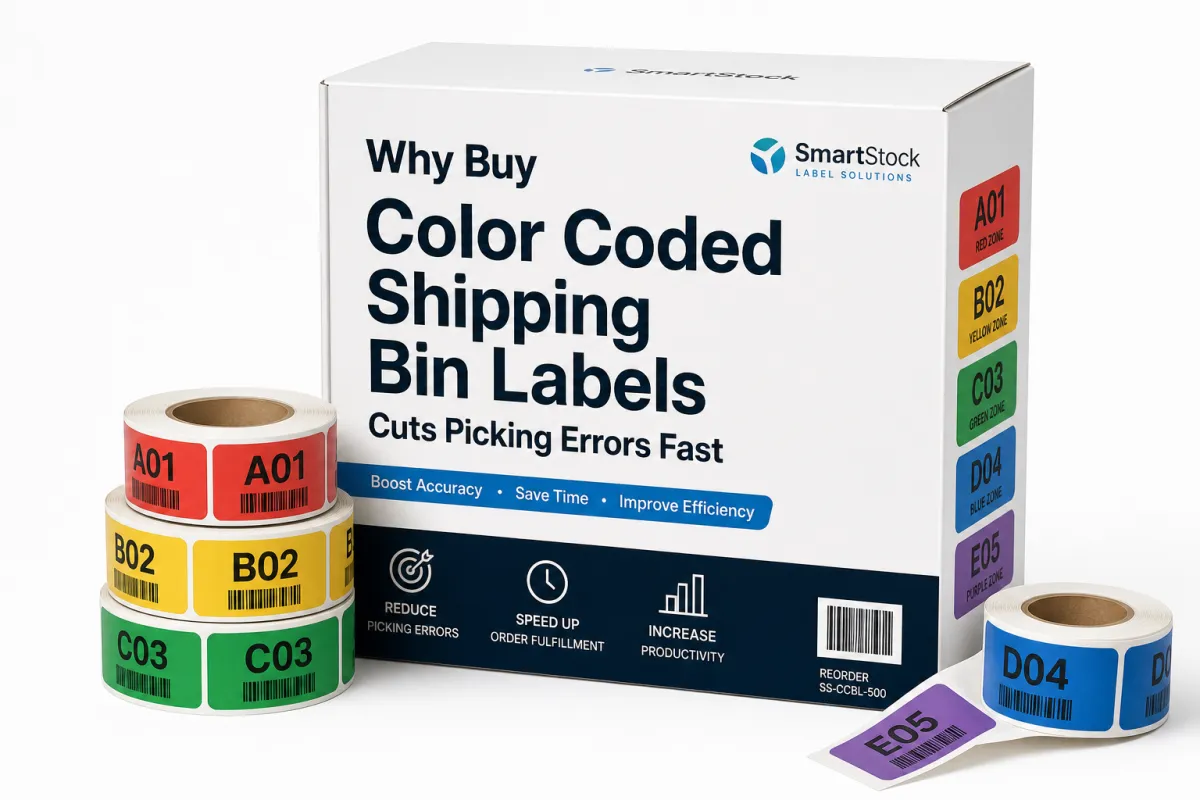
Buy color coded shipping bin labels when you want the eye to do some of the work that would otherwise depend on memory or scanning alone. A color system gives each lane, shelf, tote, or bin a visual identity that workers can recognize almost instantly. New employees move with more confidence, experienced teams stay more consistent during peak volume, and supervisors spend less time answering the same location question over and over. A lot of buyers treat color like a cosmetic detail. On the warehouse floor, it works more like a control layer.
A single mis-pick rarely stays contained. It can trigger repicking, a late dock move, a customer complaint, and another pass through packing materials and transit packaging. If the wrong bin gets pulled more than once in a shift, the labor loss compounds quickly. That is one reason operations teams often buy color coded shipping bin labels before they add headcount. A cleaner label system can cost less than an hour of repeated rework across several operators, and it keeps that hour from showing up day after day.
Picture a normal replenishment cycle. Stock comes in, gets staged, and moves into a lane that should be obvious from six to twelve feet away. A label that blends into the bin forces the worker to pause, scan again, or ask for help. That pause feels small in the moment, then becomes expensive after it repeats 200 times in a shift. Buy color coded shipping bin labels with strong text contrast, not just vivid color blocks, so the system still reads clearly under dock lighting, through dust, and on bins that have picked up a little wear.
Risk management matters too. Color reduces dependence on memory, which becomes a real advantage when temporary staff join the floor, peak season swells the headcount, or a site runs two layouts at once while a move is underway. Teams that buy color coded shipping bin labels for the same SKUs across each zone can standardize the way a bin is read from receiving to pick face to pack station. Fewer exceptions leave fewer openings for the wrong item to travel out the door.
In more than one warehouse walkthrough I have seen the same thing happen: the team knew the bin locations, but once the shift got noisy, one small sign or one faded label created a little hesitation that spread across the line. That is the part people miss. The problem is not always a dramatic error. Sometimes it is a series of tiny stalls that add up by noon.
Color systems only work when the logic stays consistent. A red bin meaning one thing in one aisle and something else in another aisle creates confusion faster than no color system at all. The strongest label programs use one color map, one legend, and one repeatable print spec.
Sticker cost is the wrong place to stop the calculation. A better comparison is label cost against correction cost. If a label run prevents even one repick every few days, it starts paying for itself. If it trims dock delays on peak days, it can protect cutoff times that would otherwise slip. That is why teams managing order fulfillment at volume often buy color coded shipping bin labels as part of a broader workflow adjustment instead of treating them like a last-minute print job.
Teams that want the label system to tie into the rest of their operation often align it with bins, cartons, and outbound packaging. Many buyers pair those labels with Custom Labels & Tags for shelf fronts or totes, then keep the same color logic moving through receiving and packing. That continuity matters more than a flashy finish or a clever design.
Buy Color Coded Shipping Bin Labels: Materials, Adhesives, and Formats
Before you buy color coded shipping bin labels, decide how the labels will be applied and how long they need to stay intact. Format matters as much as artwork. Some warehouses need labels on rolls for printer-driven application, while others prefer sheets for hand placement. Serialized sets make sense when each bin needs a unique identifier, and stock-sized labels work better for quick rollouts or repeat replenishment. The best format follows the pace of the operation, not the look of a proof file.
Paper is the lowest-cost option and can perform well in dry indoor storage. It usually fits short-cycle use, especially on corrugated surfaces and cartons that do not see much abrasion. BOPP is the stronger choice when moisture or repeated handling enters the picture. Polyester gives more durability for bins that get wiped down, moved constantly, or brushed by carts and hands all day long. If you buy color coded shipping bin labels for a damp or freezer-adjacent zone, the material choice should stay conservative. That is not a good place to chase the cheapest stock.
Adhesive selection deserves the same attention. Corrugated boxes often work with a standard permanent acrylic adhesive, while painted metal, plastic totes, and powder-coated bins may need stronger tack to stay in place. Textured or lightly curved bins should be tested with an adhesive made for that surface. A label that lifts at the corners is not a color system; it is a maintenance task waiting to happen. Buyers who buy color coded shipping bin labels without confirming the substrate often end up replacing the first order sooner than planned.
Finish changes readability more than many buyers expect. Matte stock cuts glare under bright dock lights and keeps text visible at a distance. Gloss can make color feel deeper, though it may reflect too much in certain facilities. Laminated protection adds resistance to scuffs and cleaning chemicals, but it also adds cost. For many warehouses, the right balance is a matte or satin finish with a strong color block and bold black or white type. That combination is easy to train on, easy to read, and resilient in rough handling.
Variable data becomes useful when the label needs to carry more than a zone color. Barcodes, QR codes, and sequential numbers can connect each bin to the inventory system, the replenishment list, or the pack plan. That helps when a WMS tracks location moves and the visual code needs to match the digital record. If you buy color coded shipping bin labels with variable data, ask how the data is imposed, verified, and reprinted on future runs so the format stays consistent every time you reorder.
For buyers who care about paper sourcing, recycled content, or chain-of-custody claims, FSC-certified paper can fit the brief. If that matters to your purchasing standards, review guidelines at FSC and align the label stock with the rest of your shipping materials. Small procurement details like that can make documentation easier when a purchasing team needs to show what was specified and why.
Another practical move is to keep the visual language consistent across the rest of the packaging program. When the same color logic carries through cartons, mailers, and inserts, workers spend less time learning exceptions. A unified system across Custom Packaging Products can reduce training time and make the floor easier to read from receiving to shipment.
Specifications That Matter for Bin Labels in Real Warehouses
Buyers often ask for a quote before they define the spec. That order usually causes the trouble. If you buy color coded shipping bin labels without locking down size, corner shape, and viewing distance, you can end up with a label that looks fine on a screen and falls apart on the floor. The label has to read clearly from the actual aisle, on the actual bin, under the actual lighting. That sounds obvious, yet it is exactly where first runs tend to fail.
Start with size. A 2 x 4 inch label can work for compact bins or short text strings. A 3 x 5 or 4 x 6 label gives more room when you need a larger color block, a barcode, and human-readable copy on the same face. Taller racks and wider lanes call for larger formats because the label needs to read at six to twelve feet, not just at arm’s length. If you buy color coded shipping bin labels for bins that are read from an aisle, the color block should be large enough to identify the zone before anyone reads the code.
Edge treatment matters too. Rounded corners usually hold up better than sharp corners, especially on labels brushed by hands or carts. A common practical spec uses a corner radius around 0.125 inches, though the exact number depends on the die and the label shape. Custom cuts should always be confirmed before artwork is finalized, including radius and bleed requirements. Buyers who buy color coded shipping bin labels with a custom cut should ask for an actual-size proof, not only a scaled mockup that looks cleaner than the final piece will.
Color accuracy should be stated plainly. If the warehouse uses a defined color map, provide Pantone references or a clear CMYK target. “Blue” is not enough, because the same word can mean several different shades once it moves from one print run to the next. The goal is repeatability. Teams that buy color coded shipping bin labels for multiple zones need the colors to stay steady, or the system starts to blur between receiving, replenishment, and pack-out.
Durability testing should match the environment. Labels in a dry storage area may only need to resist normal hand contact, while labels near washdowns or refrigeration need more. Ask about abrasion resistance, temperature swings, and humidity tolerance. If the operation uses manual wipes or cleaning sprays, the face stock and adhesive should be tested for that exposure. Adhesion methods such as ASTM D3330 are commonly used to measure peel strength, and that kind of data tells you more than a vague statement that the label “sticks well.”
Scan quality matters whenever the label carries barcodes or QR codes. Keep the quiet zone clear, maintain strong contrast, and avoid placing a color block behind a code unless the printer and proof are designed for that setup. A label can look polished and still scan poorly if the art is crowded. If you buy color coded shipping bin labels for a warehouse that relies on WMS data, the visual design has to respect both the human eye and the scanner.
One final check is size against the bin itself. A label that is too small disappears behind product. A label that is too large can wrap around an edge, lift early, or look messy after a week of use. A short pre-order checklist keeps the job grounded:
- Measure the visible label area on the bin face.
- Confirm the viewing distance from the aisle.
- Choose the surface type: corrugated, plastic, painted metal, or powder-coated.
- Decide whether the label needs barcode, QR, or sequential numbering.
- Specify the color map and the exact approval method for proofs.
- Ask for sample material if the surface is unusual or high-wear.
For teams that want a standard to compare against, packaging and transit packaging guidance from groups like ISTA can help frame durability expectations. The labels are not a parcel test, yet the same discipline applies: define the environment first, then match the material to it. That habit keeps you from buying a label that fails the first time a cart clips it.
Pricing, MOQ, and Quote Details for Color Coded Bin Labels
Pricing for buy color coded shipping bin labels requests usually comes down to five variables: size, quantity, material, print complexity, and whether the shape is stock or custom die-cut. A simple paper run prices very differently from a laminated polyester label with variable data and a custom corner radius. The fastest route to an accurate quote is a complete spec on the first message. That cuts the back-and-forth and usually shortens the path to proof.
MOQ follows setup efficiency. Small runs are possible, but the unit cost tends to rise because press setup, die setup, and color setup still have to be covered. Larger quantities generally reduce cost per label and make production more stable. If you plan to buy color coded shipping bin labels on a rolling basis, a larger first order can make more sense than buying a tiny pilot and paying setup again soon after. The numbers change by product, but the pattern stays the same.
For planning, this comparison gives a useful starting point. These are illustrative ranges rather than locked quotes, because artwork, size, and finish all move the final number.
| Label Type | Best Use | Typical MOQ | Indicative Price at 5,000 Pieces | Notes |
|---|---|---|---|---|
| Paper stock labels | Dry storage, short-cycle bins | 500-1,000 | $0.03-$0.08 each | Lowest cost; best for low-abrasion areas |
| BOPP labels | Plastic totes, moderate handling | 1,000-2,500 | $0.08-$0.16 each | Better moisture resistance and surface durability |
| Polyester labels | High-wear bins, frequent wiping | 2,500-5,000 | $0.14-$0.28 each | Stronger for rough handling and longer service life |
| Serialized custom sets | Mapped locations, tracked inventory | 1,000-5,000 | Depends on data and finishing | Useful when every bin needs unique numbering |
Those ranges do not account for every variable. A larger color block, more print colors, special laminates, or a nonstandard adhesive can change the price. Even so, the table gives a buying team a practical frame. If you buy color coded shipping bin labels for a warehouse rollout, ask the supplier to price the pilot, the full deployment, and the reorder quantity side by side. That makes budget planning easier and usually reveals where the real savings sit.
What speeds a quote? Dimensions. Artwork. Color count. Surface type. Quantity. Any barcode or QR data. A photo of the bin or rack helps too, especially when the label needs to stick to corrugated cartons, smooth plastic, or painted metal. That kind of detail reduces guesswork and helps a buyer buy color coded shipping bin labels that work the first time rather than after a correction cycle.
It also pays to think beyond the label alone. When an operation is standardizing outbound cartons and mailers, it makes sense to plan the label purchase alongside Custom Shipping Boxes or Custom Poly Mailers. A coordinated print program can reduce the number of SKUs the team has to manage, which is a real advantage in ecommerce shipping.
Annual buying plans usually beat one-off reorders. A warehouse that knows it will need the same color system every quarter can reduce emergency purchases and keep print specs steady. That matters because even a small change in stock or adhesive can create visible variation that operators notice right away. If you buy color coded shipping bin labels as part of a planned replenishment cycle, you preserve consistency and avoid retraining the floor on a new look every few months.
Production Process, Timeline, and Lead Time Expectations
Every order follows the same basic path, though the timing depends on how ready the customer is when they ask for a quote. If you buy color coded shipping bin labels with final dimensions, approved colors, and clean artwork on day one, the order can move quickly. If the team is still debating the color map or the surface type, the job waits. Most delays start there, not on the printer side.
The sequence is straightforward: quote, proof, approval, print, finish, inspect, pack, and ship. Proofing moves fastest when the art already matches the final spec. The printer confirms color, stock, adhesive, and any variable data. Once approval lands, production begins. Buyers who buy color coded shipping bin labels after the proof is already aligned tend to see fewer surprises and fewer revision loops because the small decisions were already settled.
For many custom orders, a realistic lead time after proof approval is often around 10 to 15 business days, though simple runs may move faster and complex ones may take longer. Laminations, specialty dies, or serialized data can add time. Rush service may be possible when the schedule and materials allow it. If a warehouse needs labels before a peak season rollout or a new distribution lane opens, the safest move is to finalize the spec early and keep the proof window tight.
Most timeline issues are preventable. Missing artwork, no color reference, a vague label size, or late changes after proof approval all slow production. Experienced buyers buy color coded shipping bin labels with a complete brief instead of a loose idea because the brief cuts revision time. That difference is often what separates a clean delivery from a stressful one.
The labels also fit into the larger logistics picture. They are one part of the operation, but they affect order fulfillment speed in the same way carton choice and void fill do. A label that reads quickly can reduce misroutes in packing and help work move cleanly through the dock. That effect becomes stronger when transit packaging is standardized as well. The less time a worker spends decoding a bin, the more time they spend moving product.
When a shipping department is expanding, the label system should fit the other packaging layers instead of fighting them. Some buyers start with the label spec, then align it with cartons, inserts, and warehouse zones. That same logic can carry through the shelf-to-shipment path if the program is scaled carefully. The point is not just to buy color coded shipping bin labels; the point is to make the entire floor easier to read.
One simple habit shortens turnaround every time: send one point of contact for approvals. If several people keep changing the color code or the copy, the project stretches. A single reviewer, a single proof decision, and a single signoff date keep production from bouncing between revisions. That is not flashy. It is just what keeps lead time under control.
Why Choose Us for Color Coded Shipping Bin Labels
Custom Logo Things focuses on labels that work in real warehouse conditions, not just in a mockup. If you buy color coded shipping bin labels here, the emphasis stays on consistency, print clarity, and fit for the surface you are using. That sounds basic, and basic is exactly what most operations teams need: labels that stick, stay readable, and match the same color system when the next order comes through. Fancy is not the point. Reliable is the point.
We also keep the packaging side of the job in view. A warehouse that handles order fulfillment, ecommerce shipping, and replenishment cannot afford a label system that breaks when volume rises. Our practical value is in helping buyers Choose the Right stock, adhesive, and format so the label does not become the weak link. When customers buy color coded shipping bin labels, they usually want fewer mis-picks, faster lane recognition, and a cleaner handoff from pick to pack. That is the use case we build for.
Repeatability matters just as much as the first order. A pilot run and a full rollout should look the same and perform the same. Color drift, font changes, and adhesive swaps can confuse workers faster than most teams expect. A good production partner helps standardize the spec across reorders and keeps the visual system intact as SKUs change. Buyers who buy color coded shipping bin labels for multiple zones need that discipline if they want the floor to trust the labels.
We can also help teams move from one bin project into a broader packaging program. Shelf tags, tote labels, and coordinated custom packaging all work better when the system is built from the same spec logic. For buyers shaping a larger labeling plan, Custom Labels & Tags is a practical starting point, and it can sit alongside carton and mailer planning without creating mismatches in the warehouse.
A color system only works when the floor believes it. That belief comes from clean proofs, steady reorders, and labels that survive real handling. When the first batch peels, fades, or changes under dock lighting, workers stop trusting the code.
We keep the buying experience practical as well. That means responsive quoting, proof support, and direct recommendations on materials and adhesive strength. If a surface is tricky, we say so. If a cheaper stock is likely to fail, we say that too. Honest guidance saves more money than optimistic promises. For a packaging professional, that is the difference between a purchase and a problem.
In practice, the best label programs are the ones that do not force the floor to think too hard. The colors are obvious, the text is clear, and the label stays put long enough to earn trust. That is what we aim for, and that is why buyers come back when the next aisle or zone needs to match the first one.
Next Steps Before You Buy Color Coded Shipping Bin Labels
Before you buy color coded shipping bin labels, lock down the basics: bin face dimensions, quantity, surface type, and the color map. That short list prevents more rework than a long design debate ever will. If the floor needs to identify zones from six feet away, measure for that. If the labels must survive frequent wipes or condensation, say so early. The more concrete the brief, the better the result.
A quick photo of the storage area is worth more than a vague description. It helps judge contrast, placement, and whether the bin face is flat, textured, or curved. It also makes it easier to decide whether a matte finish, laminated face, or stronger adhesive is the safer choice. Buyers who buy color coded shipping bin labels after sharing a real photo usually get a more accurate proof the first time, which saves time for everyone involved.
Use a short internal checklist before you request pricing:
- Measure the visible label area on each bin type.
- Confirm whether the surface is corrugated, plastic, painted metal, or powder-coated.
- List the color mapping by SKU group, zone, or department.
- Decide whether you need barcodes, QR codes, or sequential numbers.
- Note any humidity, cleaning, or temperature exposure.
- Estimate reorder frequency so the production plan can fit your cycle.
If your operation is also refreshing outer cartons or packing materials, it makes sense to plan the label order alongside Custom Packaging Products. That keeps the visual system aligned across shipping materials instead of creating one look for the dock and another for the pack table. Small consistency wins often save more time than a single large procurement move.
My advice is simple: do not rush the spec, and do not overcomplicate it either. If the labels have a clear purpose, a stable color map, and a defined surface, you are ready to move. The teams that get the most value when they buy color coded shipping bin labels are the ones that treat them as a working tool, not a decoration. Once the dimensions, quantity, and print requirements are locked, buy color coded shipping bin labels with confidence and put the system to work.
How do I buy color coded shipping bin labels in the right size?
Measure the visible label area on the bin face, not the full container size. Leave enough margin so the color block and text stay readable from aisle distance. Match the label size to the way workers scan or read bins during pick and replenish tasks.
What adhesive should I choose for color coded shipping bin labels?
Use a stronger adhesive for plastic, painted metal, or powder-coated surfaces. Choose a label stock rated for curved or textured bins if the surface is not flat. Ask for adhesion guidance if the bins face cold storage, humidity, or frequent cleaning.
What is the typical MOQ for custom color coded shipping bin labels?
MOQ depends on size, material, and print setup, so larger runs usually cost less per label. Simple stock formats often allow lower minimums than fully custom die-cut labels. Request a quote with your exact quantity so the supplier can show cost breaks clearly.
How long does production take after proof approval?
Lead time depends on artwork readiness, print complexity, and finishing requirements. Orders move faster when dimensions, colors, and adhesive specs are approved upfront. Rush timing is possible in some cases, but only if the production queue and materials allow it.
Can I use my own warehouse color code when I order bin labels?
Yes, most custom runs can match an internal color system or department-specific scheme. Provide exact color references and explain how each color maps to SKU groups or zones. Ask for a proof before production so the color logic stays consistent across every bin label.


