Buyer Fit Snapshot
| Best fit | Buy Custom Display Boxes Wholesale for Retail Shelves projects where brand print, material claims, artwork control, MOQ, and repeat-order consistency need to be specified before quoting. |
|---|---|
| Quote inputs | Share finished size, material target, print colors, finish, packing count, annual reorder estimate, ship-to region, and any compliance wording. |
| Proofing check | Approve dieline scale, logo placement, barcode or warning zones, color tolerance, closure strength, and carton packing before bulk production. |
| Main risk | Vague material claims, crowded artwork, missing packing details, or unclear freight terms can make a low unit price expensive after revisions. |
Fast answer: Buy Custom Display Boxes Wholesale for Retail Shelves should be specified like a repeatable production item. The safest quote records material, print method, finish, artwork proof, packing count, and reorder notes in one written spec.
Production checks before approval
Compare the actual filled-product size with the drawing, then confirm tolerance on folds, seals, hang holes, label areas, and retail display edges. Reserve space for logos, QR codes, warning copy, and material claims before decorative graphics fill the panel.
Quote comparison points
Review material grade, print process, finish, sampling route, tooling charges, carton quantity, and freight assumptions side by side. A quote is only useful when the supplier can repeat the same color, closure quality, and packing count on the next order.
At Custom Logo Things, I keep seeing the same pattern: brands that buy Custom Display Boxes wholesale before the first retailer meeting usually walk in with better shelf presence, cleaner replenishment, and fewer headaches once cartons start moving through stores. I watched a 24-count counter tray printed on 18pt SBS outperform a larger shipper carton in a test across 16 stores in Illinois and Indiana, and that result is hard to ignore when the merchandising decision has to hold up on an actual shelf, not just in a presentation deck. The shopper sees the display first, reaches for it first, and that simple fact changes the way retail display packaging should be planned from the first sketch rather than after the freight invoice has already landed.
Wholesale display packaging is not just a container with a logo on it. It is a working retail tool that combines presentation, protection, and cost control in one format, whether the box sits on a checkout counter, rides onto a shelf, or holds a seasonal promotion on an endcap in Phoenix, Arizona or Charlotte, North Carolina. A lot of teams underestimate how much a 350gsm C1S artboard tray or a 32ECT corrugated sleeve has to do in a single week. When a buyer decides to buy custom display boxes wholesale, the real goal is usually to make product packaging easier to sell and easier to manage in the store, while also avoiding the sloppy refill situation that makes store associates mutter under their breath at 7:30 a.m. These point-of-purchase displays are often the first thing a shopper touches, so the structure has to carry the brand story and the load at the same time.
I watched this happen with a cosmetics line where a 24-unit counter tray in printed E-flute outsold a taller shipper that took up twice the space. The tray cost less to stock, took 20 seconds to refill, and kept the brand facing tidy across 18 store locations in Ohio, Kentucky, and western Pennsylvania. I still remember standing in that warehouse in Dongguan, Guangdong, and hearing the team argue over whether the taller display "felt more premium." It did, sure, but it also hogged space like it paid rent. That is why I tell clients that the right time to buy custom display boxes wholesale is before the launch calendar gets crowded, not after a buyer is already asking for emergency freight and everyone is suddenly pretending that rush fees were part of the plan.
Why Brands Buy Custom Display Boxes Wholesale
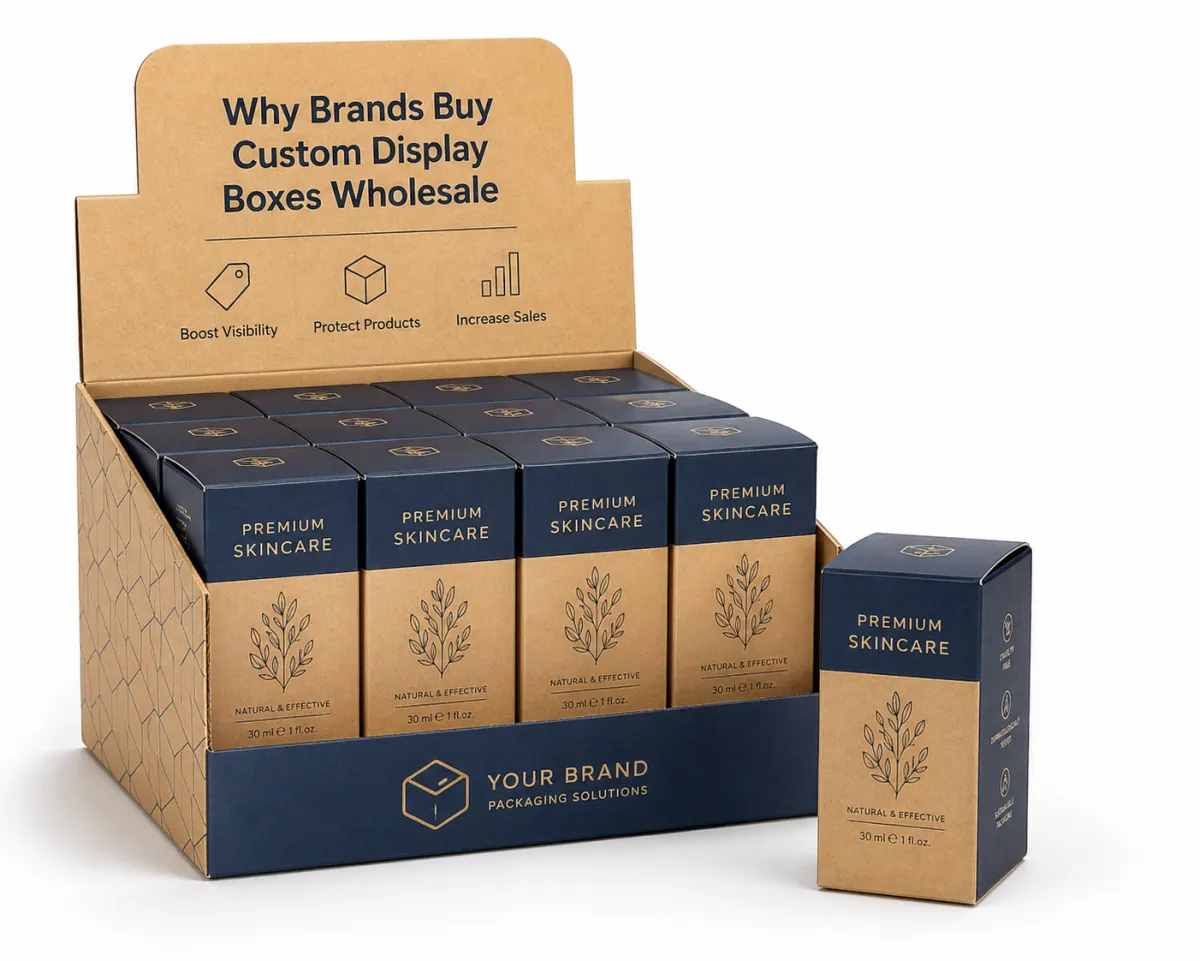
Retail shelves do not forgive sloppy presentation. If the front edge of a display is off by even 3 mm, shoppers notice it, staff ignore it, and the merchandising picture starts drifting before the first case is empty. I learned that on a snack rollout in Columbus, Ohio where the display base flexed under a 14-pound load made up of 12-ounce pouch packs; the retailer kept the product, but the store team stopped restocking it because the tray looked tired by day four. That was one of those moments where I just stared at the sample and thought, well, that is a very expensive lesson in board strength. It is one reason brands buy custom display boxes wholesale instead of grabbing a generic carton and hoping it behaves like a retail display.
The value proposition is plain. Wholesale display boxes give you presentation, protection, and unit economics in one build. A well-planned structure keeps the product upright, shields it during transit, and creates a branded retail surface that does not need extra labor at the store level. When you buy custom display boxes wholesale, you are paying for a repeatable merchandising system, not just printed board. I have seen buyers fix three separate store problems with one well-built tray: less damage in transit, less mess at shelf reset, and fewer "where did the sign go?" complaints from the retail team, all from a unit that can cost as little as $0.15 per unit for 5,000 pieces on a simple one-color run.
Consistency matters even more across multiple locations. A chain with 40 stores needs the same front panel height, the same product count, and the same barcode placement whether the box lands in a suburban pharmacy in Dallas-Fort Worth or a downtown specialty store in Brooklyn. If the display varies by a quarter inch from lot to lot, staff waste time trimming, taping, or forcing the unit into place. I have watched a tired store associate try to make it fit with a roll of tape and a look that said everything. That is why seasoned buyers buy custom display boxes wholesale in runs sized to seasonal drops, regional promotions, or recurring replenishment windows, often in 2,500-piece or 5,000-piece batches.
I care about labor too, because store labor is expensive and usually rushed. A display that ships flat, pops open cleanly, and fills in under a minute cuts friction at receiving, especially in stores where the manager is handling five vendors and a scanner that never stops beeping. When brands buy custom display boxes wholesale, the best design is often the one that helps the retail team do less, not the one with the loudest artwork. Flashy graphics can help, sure, but if the tray collapses at the fold line, all the bright printing in the world will not save it, and the mistake is visible the moment a case gets opened on the sales floor.
"The best display was the one my team could open, stock, and face in under 45 seconds," a buyer told me after a beverage rollout in Nashville, Tennessee, and that line stuck with me because it was backed by store labor data from 11 stores, not marketing language.
I see packaging teams overdesign the art and underdesign the job the box has to do on the floor. A good retail display should hold its shape through 10 to 20 touches, survive pallet handling from a warehouse in Ontario, California or Savannah, Georgia, and still present a crisp face after the first refill. That is the practical reason many brands buy custom display boxes wholesale from a packaging partner that understands production, not just graphics. I would rather see a plain-looking display that performs flawlessly than a beautiful one that needs prayer, extra tape, and a second carton to get through the week.
Custom Display Boxes Wholesale: Styles and Retail Uses
Different retail spaces call for different structures, and that is where smart packaging design starts earning its keep. When buyers buy custom display boxes wholesale, the style should match product weight, refill frequency, and the exact place the display will sit. A 6-ounce candle line does not need the same board build as a 2-pound supplement jar, and a checkout counter unit plays by very different rules than a floor display on an endcap in a club store in Atlanta or Minneapolis. I have had clients learn that the hard way, usually after someone says, "We thought all displays were basically the same." They are not. Not even close.
Counter Displays
Counter displays work best near checkout lanes, pharmacy counters, and service desks where the shopper has a few seconds to make a decision. I have seen lip balm, travel-size skincare, mints, lighters, and small accessories move well from a 12- to 24-pocket counter unit because the display sits at hand level and the shopper sees the brand mark right away. If you buy custom display boxes wholesale for counter placement, keep the footprint tight, usually under 10 inches wide by 8 inches deep and no taller than 12 inches, so the unit does not crowd registers or pin pads. Nobody wants to be the packaging person who accidentally starts a checkout-line traffic jam at a store in Raleigh or Sacramento.
Floor Displays
Floor displays support bigger promotions, holiday launches, and multi-item assortments that need visibility from several feet away. They fit snack packs, small electronics, household items, and heavier beauty kits because they can carry more structure and more product weight. When brands buy custom display boxes wholesale for floor placement, I usually recommend corrugated board in the 32ECT to 44ECT range, a reinforced base, and a clear packout plan so the bottom shelf does not sag after the first wave of sales. If the bottom shelf bows under a 15-pound to 20-pound load, the whole unit starts looking like it had a rough week, usually by the second day in store.
Shelf-Ready Trays
Shelf-ready trays are built to move from warehouse to shelf with minimal handling. They make sense for products that refill often, such as vitamins, personal care cartons, tea sachets, and small hardware kits. If you buy custom display boxes wholesale in this format, the key is front cutouts and easy-open perforations that let store staff convert the shipper into a display in seconds, not minutes. I have seen a well-designed tear strip save an entire reset in a Kroger or Publix aisle, and I have also seen a bad one turn into a frustrated two-minute tug-of-war that nobody had time for during a 6:00 a.m. store walk. Shelf-ready packaging works best when it is designed for the associate who has to stock it under pressure, not the creative review board.
Pop-up display cartons and cutout-front retail boxes also have a place, especially in tight spaces where a full floor display would be too much. I have used cutout-front cartons for candles in 3.5-inch jars and for sample-size skincare kits where the open face mattered more than the total volume of the unit. For many brands, the decision to buy custom display boxes wholesale becomes a question of how often the display will be touched, how heavy the contents are, and whether the unit ships flat or pre-glued. That last detail sounds small until you are staring at a pallet in a warehouse near Shenzhen and realizing someone forgot to tell the receiving team it would need a folding step.
Sometimes a simple folding carton is enough. If the product is light, the run is short, and the display only needs a few facings, a well-printed SBS carton with a clean die-cut front can do the job at a lower total cost. Once you start stacking weight, shipping mixed cases, or asking store staff to replenish the same unit multiple times, a reinforced corrugated display usually makes more sense. That is the part many teams miss when they buy custom display boxes wholesale: a few cents saved on board can turn into labor headaches later, and labor headaches always find a way to get expensive by the end of the first promotional week.
Materials, Printing, and Finishing Specifications
The material choice changes everything: strength, print feel, freight performance, and the way the unit behaves under fluorescent retail lights. When buyers buy custom display boxes wholesale, I usually start with board selection before I talk about artwork, because a beautiful display printed on the wrong substrate is still the wrong display. I have watched a polished design on weak board slump like a cheap folding chair after one afternoon in a 72-degree store with bright LED fixtures, and that always stings a little because the art team did their job and the structure simply gave up. For light retail packaging, SBS and CCNB are common; for stronger structures, E-flute and B-flute corrugated are the workhorses I see most often in active stores from Chicago to Charlotte.
Here is how I think about the board options in practical terms. SBS gives a crisp printable face and works well for premium cosmetics, small electronics, and branded packaging that needs a polished look, especially on 16pt to 24pt stocks. CCNB is often a cost-conscious choice for inner-facing graphics or product packaging where the display will be handled less aggressively. E-flute is a sweet spot for many counter units because it prints well and holds shape, while B-flute gives more crush resistance for larger floor displays and freight-sensitive runs. If you buy custom display boxes wholesale with the wrong flute, you may not notice it in the sample room, but you will notice it on a pallet truck in a warehouse in Houston or Fresno, especially when a driver takes a turn a little too confidently.
Printing method matters too. Offset printing is the route I prefer for sharp graphics, broad color coverage, and larger wholesale quantities where consistency across thousands of units matters. Digital printing can be the faster route for shorter runs or testing a new SKU, especially if the brand wants to buy custom display boxes wholesale in smaller lots before committing to a larger retail rollout. Flexographic printing has its place on more utilitarian runs, particularly where line speed and efficiency matter more than photo-level detail. I have a soft spot for offset because it gives a package that crisp, anchored feel, but I am also realistic: sometimes speed beats perfection, and the calendar does not care about my preferences or my favorite print method.
Finishing is where the retail impact becomes physical. Matte coating gives a softer, more premium read under store lighting; gloss adds brightness and can help saturated colors pop from across an aisle. Aqueous coating is a practical finish when scuff resistance and cost control both matter, and UV varnish can protect high-contact panels on busy displays. I have seen foil accents, embossing, and spot finish lift a launch, but I also warn buyers that every extra finish changes price and schedule. If you buy custom display boxes wholesale with foil on a front lip and spot UV on a side panel, expect the production team to spend more time on alignment and proofing, especially if the design uses fine type smaller than 6 pt.
Before production starts, buyers should have a tight spec sheet ready. The core details I ask for are:
- Exact dimensions in inches or millimeters, including product height, width, depth, and stacking allowance.
- Unit count per display, such as 8, 12, 24, or 36 pieces.
- Structure type like tuck-end, tray, pop-up, counter unit, or floor display.
- Insert needs for bottles, jars, vials, or loose products.
- Window cutouts or front openings for visibility.
- Ship-flat or pre-glued preference for warehouse handling.
- Barcode or UPC zone so scanning is not blocked by artwork.
That last point sounds small, but it matters. I once watched a buyer in a factory meeting in Ningbo approve a gorgeous display, only to discover the UPC panel was covered by a seasonal pattern that wrapped too far around the corner. We fixed it, but not before the team had to rework the dieline and rerun the proof, which added four business days and one very long phone call. I was genuinely annoyed on their behalf, because nothing kills enthusiasm faster than discovering the beautiful box cannot be scanned where it needs to be scanned. If you want to buy custom display boxes wholesale without friction, the barcode, artwork, and structure all need to be planned in the same conversation.
For buyers who want technical validation, I often point them to standard testing and certification references. ISTA's published guidance at ISTA is useful for shipment testing and transit expectations, and fiber sourcing can be reviewed through FSC when certified paperboard is part of the brief. Those references do not replace a production spec, but they help keep wholesale display orders grounded in real testing and real material standards. I like having that paper trail, because the factory floor in Dongguan is no place for guesswork dressed up as confidence.
Pricing, MOQ, and How to Buy Custom Display Boxes Wholesale
Pricing is usually the first question, and the honest answer is that unit cost depends on a handful of measurable inputs: size, board grade, print coverage, finishing, structure complexity, and the quantity ordered. When brands buy custom display boxes wholesale, the quote is built from those variables, not from a single flat rate that fits every project. A small counter tray with one-color printing can price very differently from a full-coverage litho-laminated floor display with a die-cut window, reinforced base, and glued side wings. I wish there were a magic number I could hand people, but packaging pricing is not that tidy, and anyone who tells you otherwise is probably about to surprise you later.
MOQ changes the math fast. A 3,000-piece run may cost more per unit than a 10,000-piece run, even if the layout and material stay the same, because setup time, press make-ready, and finishing overhead get spread across fewer boxes. I have seen a buyer move from 4,000 units to 6,000 units and save enough per display to improve margin on the retail side by nearly 8 percent. That kind of improvement is not glamorous, but it does make the finance team sit up straighter. That is why smart teams buy custom display boxes wholesale after comparing pricing at two or three quantities, not just one.
Here is a practical way to think about how a quote is built. Setup covers the dieline work, prepress review, and file preparation. Plates or digital prep depend on the print method. Structural tooling may apply if the display needs a special die or a unique cut pattern. Printing and finishing cover the actual press run, coating, foil, or UV. Packing, palletization, and freight are the final pieces that determine the landed cost. If you buy custom display boxes wholesale without asking about freight and pallet count, the quote can look attractive until the warehouse invoice arrives, and that is a very annoying surprise to explain in a budget meeting in front of a procurement lead.
How Do You Buy Custom Display Boxes Wholesale Without Overpaying?
The cleanest way to keep the budget under control is to narrow the structure before you ask for a quote. A counter display, a shelf-ready tray, and a floor unit all solve different merchandising problems, and each one has a different cost profile because of board usage, printing area, and assembly time. If you want to buy custom display boxes wholesale without overpaying, start with the product weight, the retail location, and the refill frequency, then let the structure follow from those facts instead of chasing the cheapest-looking sample on the table.
I also recommend comparing at least two board options and two quantities. That gives you a real view of where the price break lives, which is especially useful for shelf-ready packaging and point-of-purchase displays that may need recurring replenishment. A slightly higher MOQ can reduce unit cost enough to improve margin, while a better flute or a cleaner glue line can save labor later. I have seen buyers buy custom display boxes wholesale at a quantity that felt a little uncomfortable on paper, only to discover the lower unit price made the whole launch easier to defend inside the company.
The last piece is scope control. Once the dieline, dimensions, barcode placement, and finish callouts are locked, resist the urge to keep reworking the structure because someone on the team had a fresh thought after approval. Every late change adds time, and time is usually the more expensive line item. If you keep the brief steady, you can buy custom display boxes wholesale with fewer surprises, tighter freight planning, and a much better chance that the display will arrive in the store looking exactly like the sample that won the room.
| Display Type | Best Use | Typical MOQ Pressure | Main Cost Drivers | Buying Note |
|---|---|---|---|---|
| Simple Counter Tray | Checkout lanes, pharmacies, service counters | Lower, often 1,000 to 3,000 units | Board grade, print coverage, cutout shape | Good choice if you want to buy custom display boxes wholesale with fast replenishment and a modest footprint |
| Shelf-Ready Tray | Grocery shelves, club-store racks, vitamin aisles | Moderate, often 2,500 to 5,000 units | Perforation quality, glue points, packout style | Works well when staff need quick shelf conversion |
| Floor Display | Endcaps, seasonal launches, aisle promotions | Higher, often 3,000 to 10,000 units | Corrugated strength, base support, finishing | Best for heavier branded packaging and larger product counts |
| Premium Litho-Laminated Display | Beauty, gifting, higher-margin launches | Higher setup, stronger savings at volume | Offset printing, coating, premium artboard, lamination | Ideal when package branding has to carry the shelf story |
For realistic budgeting, I usually tell buyers to compare examples rather than chase one mythical price. A simple 1-color counter unit in E-flute might land around $0.18 to $0.45 each at 5,000 pieces, depending on the die and packing method. A more complex litho-laminated floor display with spot UV, reinforced base panels, and multiple inserts can move into the $1.20 to $2.40 range at comparable quantities. A very efficient 5,000-piece run with minimal coverage can even hit $0.15 per unit in some factories, especially in South China where the print line and gluing line are both set up for high-throughput work. Those numbers are not promises; they are planning ranges that help teams buy custom display boxes wholesale with their eyes open and their expectations anchored in something real.
There are hidden cost factors too. Sampling revisions can add time and money if the structure changes after the first prototype. Special coatings can add setup cost. Insert die-cuts increase tooling. Split shipments and storage requests can create handling fees. I have seen all four appear on the same order because the brief changed three times after the artwork was already locked. That is why the cleanest orders are the ones where teams buy custom display boxes wholesale with final dimensions, final pack counts, and final shipping instructions all in hand. Fewer mysteries, fewer surprises, fewer gray hairs.
Production Timeline and Delivery Process
The production path is straightforward, but only if the buyer sends usable information at the start. A typical order moves through specification review, quote, dieline creation, artwork setup, proof approval, production, finishing, and shipping. If you buy custom display boxes wholesale with incomplete dimensions or a rough sketch instead of a real product spec, that chain slows down immediately because the structure cannot be checked for fit or load. I have had projects stall because someone sent a nice-looking mockup with no unit depth, and "approximately this size" is not a production measurement in any plant I trust.
Delays usually show up in the same places: artwork files are not print-ready, the product dimensions change after the first proof, or the retail team wants a different opening style once the prototype is already underway. I remember a supplement launch where the customer changed from 12-count to 16-count inserts after proof approval, which meant the tray depth had to be recut and the repack schedule slipped by six business days. Six days may not sound dramatic until you are trying to hit a retailer reset in St. Louis or San Diego, and then it feels like somebody pulled the floor out from under your calendar. If you plan to buy custom display boxes wholesale, protect the calendar by locking the count, the structure, and the artwork at the same time.
Samples are worth the extra step. A plain mockup or prototype box lets you test fit, load strength, shelf clearance, and assembly time before the full run starts. This matters even more for heavy jars, tall bottles, or stores with shelf depths under 11 inches. I have seen sample approval prevent expensive rework more than once, and that is one of the biggest reasons experienced teams buy custom display boxes wholesale through a manufacturer that can produce a physical prototype quickly in 3 to 5 business days. There is something reassuring about holding the actual structure in your hands instead of squinting at a screen and hoping gravity will be kind.
The timing depends on the print method and structure. A digital run for a simple counter display can often move from proof approval to shipment in about 12 to 15 business days, not counting transit. Offset projects with premium finishing or larger corrugated structures usually need longer, often 18 to 25 business days after approval, because prepress, make-ready, and finishing steps are heavier. If you need to buy custom display boxes wholesale for a launch date tied to a retailer planogram, share that deadline on the first call so the schedule can be built backward from the receipt window. Nothing makes a sales team quieter than realizing the product is ready and the display is still sitting in prepress limbo.
Fulfillment details matter just as much as print quality. I always ask where the goods are going, how they need to be packed, whether the receiving dock wants pallet labels, and whether the retailer will accept split shipments. Some distribution centers want 40 cartons per pallet with stretch wrap and edge protectors; others want mixed pallets with clearly labeled SKUs. If you buy custom display boxes wholesale without confirming palletization and carton counts, the warehouse may accept the shipment but slow the receiving process by a full day. That is the sort of delay nobody wants, and yet it happens because one tiny logistics detail got left for later.
- Ask for a sample. Check the fit, the fold, and the load before mass production.
- Confirm the ship date. Match it to the launch date and inbound receiving window.
- Review the carton packout. Make sure the warehouse can handle the final carton count per pallet.
- Approve artwork carefully. Verify barcodes, copy, and finish callouts before the press run starts.
That process sounds detailed because it is. In factory work, the difference between a smooth rollout and a late-night freight scramble is often a 30-minute preproduction check. I have watched one missing barcode callout turn into three people on a phone call trying to fix a problem that could have been caught in five minutes. That is why buyers who buy custom display boxes wholesale from an experienced packaging partner usually spend a little more time upfront and save a lot more time later, especially when the goods are shipping from Guangzhou to Los Angeles or from Ningbo to Newark.
Why Choose Us for Custom Display Box Manufacturing
What I value most is production discipline. A display box that looks sharp on screen but scores poorly at the fold line is not a good retail tool. Our approach is built around consistent print quality, dependable board conversion, clean glue control, and careful score alignment so the unit opens the same way on the first pallet as it does on the last. When clients buy custom display boxes wholesale through Custom Logo Things, they should expect factory-level attention to detail, not vague promises and a pile of cheerful buzzwords. I am not interested in pretty phrases if the tray cannot survive handling.
I have spent enough time around corrugators in Guangdong and prepress rooms in California to know where display boxes fail. Weak fold memory, off-center cutouts, and bases that buckle under a 10- to 15-pound load are not cosmetic problems; they are production problems that show up on the retail floor. A good manufacturing partner catches those issues in prepress and sample stages, before the customer has a room full of inventory that will not stand properly. That is the difference between a supplier that just prints and a supplier you can trust to buy custom display boxes wholesale from repeatedly, month after month, in consistent lots of 2,500 to 10,000 units.
Another reason buyers come back is communication. If a spec is not practical, I say so. If the structure needs a heavier flute, I say so. If the retail shelf height will not allow a full-face graphic, I say so. That honesty matters when you are ordering branded packaging for a launch tied to a retailer meeting, a distributor deadline, or a seasonal planogram in September or February. It also helps buyers buy custom display boxes wholesale with fewer revisions and fewer surprises on the invoice. I would rather have one uncomfortable conversation early than three expensive ones after production starts.
We also help buyers think through material guidance based on the product, the retail environment, and the shipping method. A display destined for a dry-goods aisle in a warehouse club does not need the same surface treatment as a display sitting beside a humid checkout lane in Tampa or New Orleans. A lightweight cosmetic line can use a different board than a supplement jar that will be picked up 40 times a day. That kind of selection work is part of smart packaging design, and it is one reason brands choose to buy custom display boxes wholesale through a manufacturer that knows the factory floor as well as the artwork desk. You want someone who understands both the numbers and the messiness of real retail.
If you want to compare other formats, you can also review our Custom Packaging Products for matching retail packaging across multiple SKUs, or explore our Wholesale Programs if you are planning recurring shipments instead of a one-time run. Those pages help buyers who need Custom Printed Boxes that stay consistent across a full product line, not just one promotional display. I like that kind of consistency because it keeps the brand looking like it actually has its act together, whether the order ships from a plant in Dongguan or a fulfillment hub near Los Angeles.
I also like to remind teams that retail packaging is not only about ink and board. It is about how the unit behaves in real stores, under real time pressure, with real staff trying to keep the shelf full. I once watched a grocery merchandiser restock a display in 38 seconds because the tear-open front was designed right and the tray had a stable ledge. That kind of result is why experienced brands keep coming back to buy custom display boxes wholesale from a supplier who understands production control. That is not theory; that is what happens when the display is designed for the person touching it, not only for the person approving it.
Next Steps to Buy Custom Display Boxes Wholesale
If you are ready to move, start with the product dimensions, the target quantity, the retail placement, and the artwork files. That four-part brief lets a packaging team quote faster and more accurately. When buyers buy custom display boxes wholesale, the best results come from giving the supplier exact numbers: unit height, width, depth, product count, and the store location where the display will sit. I know that sounds simple, but simple information is what keeps a project from wandering off into avoidable confusion.
Decide on the format before you request pricing. A countertop display, a floor display, and a shelf-ready tray all solve different merchandising problems, and the quote will make more sense once the structure is chosen. I also recommend asking for the dieline, sample, and MOQ confirmation in the same conversation so the buying process stays efficient. If you plan to buy custom display boxes wholesale for a new launch, that one call can save several rounds of back-and-forth. Nobody enjoys ten emails that all ask the same question in slightly different words.
Then check the deadline against your launch calendar, your retailer promotional window, and the warehouse receiving rules. A display that arrives two days after the reset date is still a missed opportunity, even if the print quality is perfect. I have seen brands lose an entire weekend of retail traffic because inbound receiving was not aligned with store setup. That kind of miss always feels avoidable in hindsight, which is exactly why I tell every client who wants to buy custom display boxes wholesale to verify the timeline before they approve production.
- Send the exact product size and weight.
- Choose counter, floor, or shelf-ready placement.
- Share artwork, barcode files, and finish notes.
- Ask for a dieline and prototype.
- Confirm MOQ, freight, and delivery window.
Those five steps keep the process tight and practical, which is exactly what wholesale buying should feel like. If you are ready to buy custom display boxes wholesale, send the specs first and let the structure, board, and print plan follow from there. That is how we keep quotes accurate, production stable, and retail packaging ready for the shelf. I am biased, sure, but I think a good packaging process should feel steady and sensible, not like a scavenger hunt across three emails and a forgotten spreadsheet.
How many units do I need to buy custom display boxes wholesale?
Minimums depend on the structure, the print method, and the board spec, but many wholesale display orders start at 1,000 to 3,000 units for simpler counter trays and climb higher for larger floor displays. A larger run often lowers the unit cost enough to improve margin, so the best MOQ is the one that fits your inventory plan and sales forecast. Ask for pricing at two or three quantities so you can see the break point before you place the order. I have seen teams save a surprising amount just by asking for one extra tier, which takes almost no extra effort and can change the whole budget picture.
What affects the cost when I buy custom display boxes wholesale?
Size, board type, print coverage, finishing, inserts, and whether the display ships flat or assembled all affect price. Premium coatings, foil, embossing, and complex die-cuts cost more than a simple printed tray with standard glue points. Freight and rush production can also change the total landed cost, so those details should be reviewed with the quote. If you want the short version, the box gets pricier when it gets bigger, fancier, heavier, or more annoying to assemble.
Can I get a sample before I buy custom display boxes wholesale?
Yes, and I strongly recommend it for any display that carries weight, uses a new structure, or needs to fit a tight retail shelf. A prototype lets you check fit, graphics, barcode placement, and assembly time before the full run begins. Sampling is the safest way to catch load issues and avoid rework on the production order. I have saved customers from some very avoidable headaches by insisting on a sample instead of trusting a computer render and a hopeful nod.
What files should I send for wholesale display box artwork?
Send the dieline if you have one, plus print-ready artwork in the requested format with fonts outlined and images embedded. Include brand colors, barcode files, copy, and any finish callouts such as gloss, matte, foil, or spot UV. If the dieline is not ready, send exact product dimensions and the display style so the structure can be built first. The cleaner the file set, the less likely we are to have a painful surprise right before proof approval.
How long does it take to buy custom display boxes wholesale and receive them?
Timing depends on proof approval, production method, quantity, and shipping distance. Simple digital runs can move faster, while larger offset or custom-structure projects need more time for setup and finishing. If you have a launch date, share it early so the production schedule can be matched to the delivery window. A good timeline is the difference between calm receiving and everybody in the building asking who moved the truck schedule.
Practical takeaway: before you buy custom display boxes wholesale, lock the display style, exact dimensions, unit count, board grade, finish, and ship date in one brief. That single step keeps the quote honest, the prototype useful, and the delivery window tied to the retail reset instead of to a guess.

