Buyer Fit Snapshot
| Best fit | Custom Sleeve Boxes Wholesale projects where brand print, material claims, artwork control, MOQ, and repeat-order consistency need to be specified before quoting. |
|---|---|
| Quote inputs | Share finished size, material target, print colors, finish, packing count, annual reorder estimate, ship-to region, and any compliance wording. |
| Proofing check | Approve dieline scale, logo placement, barcode or warning zones, color tolerance, closure strength, and carton packing before bulk production. |
| Main risk | Vague material claims, crowded artwork, missing packing details, or unclear freight terms can make a low unit price expensive after revisions. |
Fast answer: Custom Sleeve Boxes Wholesale: Pricing, Specs, and Buying should be specified like a repeatable production item. The safest quote records material, print method, finish, artwork proof, packing count, and reorder notes in one written spec.
Production checks before approval
Compare the actual filled-product size with the drawing, then confirm tolerance on folds, seals, hang holes, label areas, and retail display edges. Reserve space for logos, QR codes, warning copy, and material claims before decorative graphics fill the panel.
Quote comparison points
Review material grade, print process, finish, sampling route, tooling charges, carton quantity, and freight assumptions side by side. A quote is only useful when the supplier can repeat the same color, closure quality, and packing count on the next order.
Custom Sleeve Boxes Wholesale: Pricing, Specs, and Buying
I still remember a candle client in our Shenzhen facility walking in with a plain mailer, a 420 ml jar, and a packaging budget that had already been cut twice. We slid a tight printed sleeve over the carton, checked the fit against a 1.5 mm side clearance, and the whole pack suddenly looked like it belonged on a retail shelf in Austin or Berlin instead of a warehouse bench in Guangdong. I looked at it and thought, "That fixed more than it should have." That is why I keep telling buyers that Custom Sleeve Boxes Wholesale can do more branding work than a lot of heavier structures, and usually for less money per unit. For the right product, custom sleeve boxes wholesale can turn a plain carton into a retail-ready package without forcing the budget into expensive territory.
People spend too much time trying to force a full custom box into every project, even when a 350gsm C1S sleeve over a stock tuck box would do the job at a fraction of the cost. I get why; everyone wants the dramatic reveal and the premium unboxing moment, especially on a launch with 3 to 6 SKUs. But that habit can burn budget fast, and it can make even a good launch feel overdesigned. A well-built sleeve can carry the logo, the Pantone 293 C color story, the matte finish, and the shelf message while the inner carton or tray does the plain work of holding the product. If you are comparing Custom Sleeve Boxes Wholesale options for cosmetics, candles, apparel accessories, supplements, or promo kits, this format deserves a serious look. It is one of the cleanest ways to balance branded packaging, unit cost, and shelf presence in the same build.
At Custom Logo Things, I like sleeve projects because the math stays honest down to the last 0.5 mm and the last $0.08. You can see the dimensions, the fold direction, the seam position, and the tolerance before the presses in Dongguan or Foshan start running. You can also see where a stock change saves real money across 5,000 units, not just in theory. That is the kind of packaging discussion I prefer, because custom sleeve boxes wholesale should make the buyer money, not just make the artwork look polished in a render. I have had more than one client stare at a quote like it was written in another language, and then relax once we broke the numbers down line by line with board specs and freight terms attached. When buyers understand the sleeve packaging structure early, the whole project usually moves faster and with fewer surprises.
Why do custom sleeve boxes wholesale work so well on shelf?
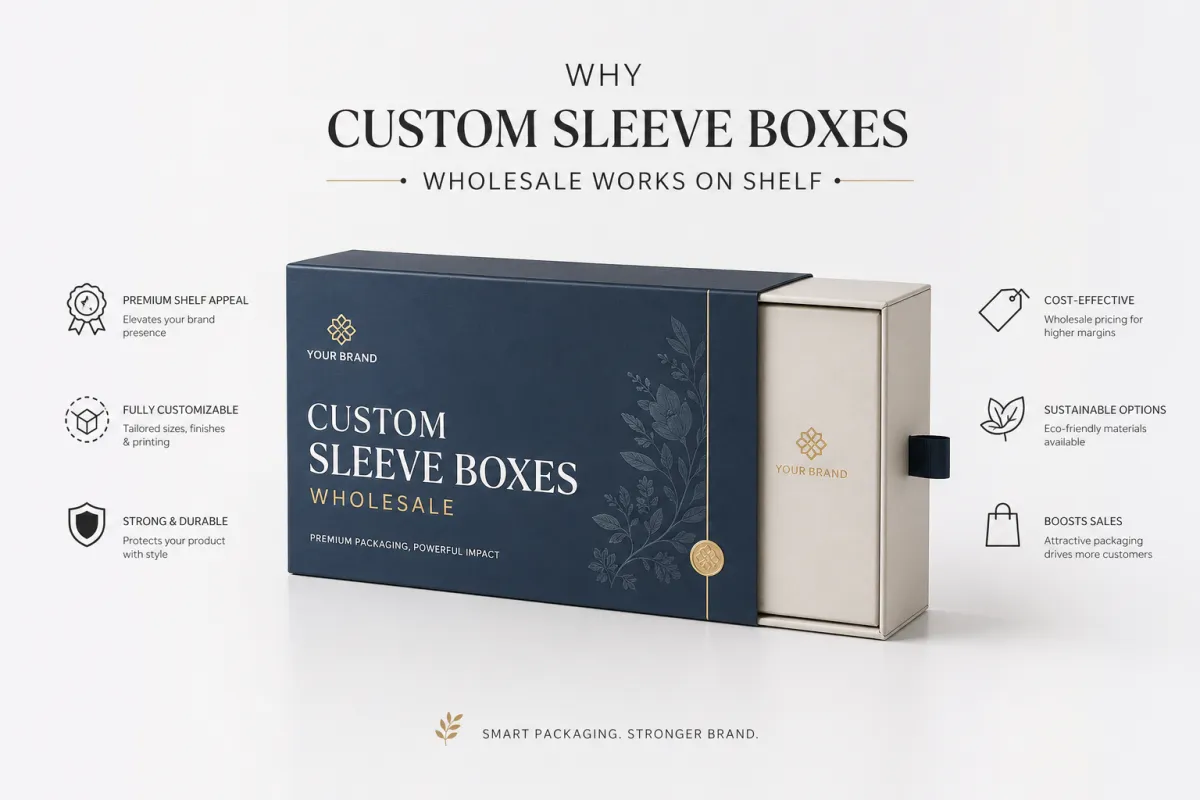
Good shelf packaging has one job: get noticed fast enough to earn a second glance before the shopper walks 2 feet farther down the aisle. I watched that happen on a factory floor in Dongguan when a plain white mailer got a matte sleeve with one black logo, one copper foil line, and a 1.2 mm emboss around the wordmark. Nothing else changed. No rigid box. No expensive insert. The sample went from forgettable to premium in under five minutes, which was irritating in the best possible way because it proved how much money people waste on structure when the graphic treatment is doing the real work. That is the real appeal of custom sleeve boxes wholesale for brands that want branded packaging without paying for structure they do not need. In retail packaging, the sleeve often carries the first impression while the base carton quietly does the holding.
The value proposition is simple. A sleeve gives you the visual layer shoppers see first, while the inner pack keeps the product protected and organized, whether it is a 2 oz candle, a set of lip glosses, or a 30-count supplement pouch. You get print surface area, color control, and room for messaging, but you avoid the cost of fully printed custom boxes on every panel. For many product packaging jobs, that balance is the sweet spot. Seasonal updates also become easier. If the holiday campaign changes in Q4, you can refresh the sleeve artwork without rebuilding the whole box architecture. That kind of flexibility saves both money and patience, and I have watched enough packaging projects go sideways to appreciate anything that reduces drama by even 20 percent. It is one reason custom sleeve boxes wholesale keeps showing up in practical sourcing conversations.
That flexibility matters in categories where the product changes often or the launch calendar moves like a freight train between Guangzhou, Los Angeles, and Chicago. Cosmetics brands use sleeves to separate shades and line extensions. Candle makers use them to dress up a stock tuck box that measures 83 mm by 83 mm by 92 mm. Supplement companies use them to carry compliance copy, flavor details, or bundle names. Apparel accessory sellers use them to give small items a more premium retail packaging story. I have seen custom sleeve boxes wholesale save a brand from a full reprint simply because the sleeve carried the new SKU while the base carton stayed the same. That kind of practical thinking is not glamorous, but it keeps budgets from getting chewed up. It also keeps brands from remaking packaging every time the assortment shifts.
The wholesale angle is where the economics get better. Once you move past a 1,000-piece test run, the per-unit cost starts to make sense because the setup is spread across more pieces in Shenzhen, Zhongshan, or Ningbo. That means better unit economics, easier package branding updates, and fewer headaches when a buyer wants to test two designs against each other. I would rather quote two sleeve variants at 3,000 units each than push a client into an overbuilt rigid setup just to chase a premium look. Custom sleeve boxes wholesale is often the smarter buy, and in my opinion it is one of the easiest places to make a packaging budget look much sharper without pretending the product is something it is not. The right sleeve packaging can make a modest item feel intentional, finished, and ready for retail.
"The sleeve did the selling; the carton just had to show up straight." That was a buyer in Los Angeles after we fixed a weak launch pack with a 0.5 mm stock change and a cleaner matte finish from a run we had produced in Dongguan. He said it with a grin, which I appreciated, because he had spent two weeks blaming the artwork before admitting the structure was the problem.
There is another reason this format keeps winning shelf space: it is easier to keep consistent across a line of 4, 6, or 12 SKUs. If you have six flavors, four scents, or a handful of bundle sizes, the sleeve can do the organizing while the base structure stays constant. That reduces errors in fulfillment and keeps the line looking unified in a retail set or on a warehouse pallet. In my experience, custom sleeve boxes wholesale works best when the brand needs speed, visual impact, and enough cost control to leave room for marketing spend. I have seen it rescue product launches that were in danger of looking cheap, and I have seen it save teams from arguing for three meetings about whether a rigid box was really necessary. Usually, it was not. For many brands, custom sleeve boxes wholesale are the middle path that delivers the best mix of presentation and practicality.
For buyers who want to compare structure options, I usually point them to our Custom Packaging Products and the broader Wholesale Programs page. That keeps the conversation grounded in actual formats, not fantasy packaging that looks great in a mockup and falls apart on the packing table in Shenzhen. I am a big fan of practical choices, partly because I have seen too many attractive ideas become very expensive mistakes when the carton tolerance was off by 2 mm. When the sleeve dimensions and the base carton are aligned, the entire custom sleeve boxes wholesale order becomes much easier to approve and produce.
Custom sleeve boxes wholesale product details
Structurally, a sleeve is straightforward. It is an outer printed wrap that slides over a tray, a tuck box, a rigid carton, or a bundled product set. The sleeve carries the branding, and the inner component does the holding. That split is the reason custom sleeve boxes wholesale is so practical. You are not paying to print every hidden panel if the consumer only sees one clean face and one side edge on shelf. That may sound obvious, but I have had buyers light up when they realized they were paying for less ink coverage and fewer wasteful surfaces across a run of 5,000 or 10,000 units. It is a simple structure, but it can change the whole feel of the packaging line.
When I visited a converter in Shenzhen last summer, their line manager showed me three ways a sleeve was being used on the same shift at 2:30 p.m. One sleeve wrapped a folding carton for a facial cream. Another held a gift set insert in place so the items would not rattle during UPS transit. The third sat over a stock box as a seasonal layer for a corporate promo kit headed to Singapore. Same basic structure. Three different jobs. That is the kind of flexibility buyers want from custom sleeve boxes wholesale. It is also the kind of thing that makes production people nod instead of sigh, which is always a good sign at 7:00 a.m. on press day. In other words, the same sleeve packaging format can adapt to multiple channels without changing the inner box.
Size flexibility is one of the biggest advantages. We can make sleeves to exact dimensions, then build in just enough tolerance for smooth assembly. Too loose, and the sleeve shifts during transit. Too tight, and your pack line turns into a complaint line. I usually work with a clearance of about 1.5 mm to 2 mm per side for hand assembly, then adjust if the application is machine-applied or if the carton has a slightly compressed edge from a 350 gsm sheet. That level of detail is what separates decent custom sleeve boxes wholesale from packaging that fights the people loading it. I have seen a perfectly good launch get delayed because someone ignored that half a millimeter. Half a millimeter. Packaging has a cruel sense of humor, and sleeve packaging is especially unforgiving when the size math is off.
Useful design features are practical, not flashy. Thumb cuts help with opening. Easy-open notches help retail staff in stores with 12-hour shifts. Window cutouts can reveal part of the product or the inner box art. Tuck flaps can lock the sleeve in place if the product moves through fulfillment rougher than it should. Barcode and SKU placement also matters, because a sleeve that hides the scan zone creates a mess in the warehouse. For custom sleeve boxes wholesale, the best design is the one that makes production, retail, and shipping all slightly easier. If it also looks good, great. But easy first, pretty second, because pretty does not fix a jammed line at 4:45 p.m. Clean sleeve packaging should help the packer, the retailer, and the customer in that order.
- Thumb cuts: useful for consumer opening and display setup on shelves 48 to 72 inches high.
- Windows: best when a visible product sample improves trust or color selection.
- Locking tabs: helpful for sets that need a snug fit in transit cartons.
- Barcode zones: keep the scan area clean and readable for retail teams and 3PL warehouses.
If you are comparing custom sleeve boxes wholesale across suppliers, ask for the dieline before you ask for the quote. I have watched people chase price for three rounds only to discover their product is 4 mm taller than the sleeve allowance. That is not a design issue. That is a measurement issue. It happens more often than people admit, and it always seems to happen right after someone says, "It should fit fine." Those words have caused more problems than I care to count, especially when the production team in Guangdong is already holding a press slot. A good sleeve packaging supplier will ask for exact measurements and confirm them before print starts.
For brands that sell across retail and direct-to-consumer channels, sleeves also help bridge the presentation gap. You can use the same outer branding on the shelf, in a kit, or in a shipping-safe inner pack. That is a cleaner way to manage product packaging than trying to force every SKU into one luxury format. It is one reason custom sleeve boxes wholesale keeps getting used by practical buyers who want good-looking packaging without unnecessary structure. I respect that approach because it leaves room for the actual product to matter, and it keeps the carton budget from swelling by 18 percent just for show. It also makes the packaging system easier to repeat when new SKUs are added later.
Materials, print, and finishing specifications
Material choice drives the feel in your hand, the accuracy of your print, and the final cost. For custom sleeve boxes wholesale, I usually start with SBS paperboard, C1S artboard, kraft stock, or corrugated wrap depending on how much stiffness and presentation the pack needs. A 300 gsm SBS sleeve feels clean and holds its shape well on cosmetics. A 350 gsm C1S artboard sleeve gives stronger ink hold and a smoother print face for candle labels or beauty kits. A 350 gsm kraft sleeve looks more natural for organic products. Corrugated wraps make sense when the sleeve has to sit around heavier contents or travel through rough handling from Shenzhen to Phoenix. I have a soft spot for SBS because it prints cleanly and gives me fewer reasons to mutter at proofs under my breath. For sleeve packaging that needs a cleaner retail impression, SBS is often the first place I start.
Print method matters just as much. Offset printing is the better choice for larger runs where consistency and color control matter, especially on 5,000-piece or 10,000-piece runs. Digital printing makes more sense for shorter runs, test launches, or SKU-heavy projects where you do not want plate costs eating the budget. If the brand color has to match a very specific Pantone shade, I tell clients to ask for PMS matching instead of guessing with process color. Guessing is how logos drift from navy to something that looks like a tired denim pocket. That is not a good look for custom sleeve boxes wholesale or any other branded packaging. I once watched a deep green come back looking like broccoli left in a hot car in July, and nobody in that room laughed as much as they pretended to. Accurate print is part of what makes sleeve packaging feel intentional rather than improvised.
Finishing is where a sleeve earns its premium feel. Matte lamination gives a softer, less reflective surface. Gloss brings contrast and sharper color pop under aisle lighting. Soft-touch lamination adds a velvety feel, though it can increase cost and sometimes show scuffs if the freight team gets rough. Foil stamping, embossing, debossing, aqueous coating, and UV spot treatments all have a place, but only if they support the product story. I have sat in meetings where a buyer wanted every finish under the sun, and the quote climbed by $0.27 per unit before the design had even improved. That is how budgets get careless. With custom sleeve boxes wholesale, finish should be chosen for effect, not ego. I feel pretty strongly about that, because flashy packaging that does not help sell the product is just expensive decoration. Good sleeve packaging should look polished and still make business sense.
Confirm structure specs early. I want the buyer to lock in board thickness, sleeve length, sleeve depth, bleed, safe area, folding direction, and fit tolerances before we touch final artwork. If the sleeve uses a thumb cut, the cut size matters. If the pack needs a corner seam, the seam placement matters. If the artwork wraps around a fold, the safe area matters even more. These are not glamorous details, but they decide whether custom sleeve boxes wholesale lands on time or gets dragged into a second proof round. And yes, the second proof round always seems to appear on a Friday afternoon, just to keep everyone honest. The best custom sleeve boxes wholesale orders are the ones where these details are resolved before print plates are made.
Here is the short version I give new buyers:
- SBS paperboard: cleaner print, good stiffness, strong retail presentation for 300 gsm to 350 gsm builds.
- Kraft stock: natural look, lower ink coverage, popular for organic or earthy branding.
- Soft-touch finish: expensive feeling, useful for premium cosmetics and gift sets.
- Foil or spot UV: best when one logo or detail needs to pop hard under store lighting.
If sustainability is part of your brief, ask for FSC-certified board and keep the documentation attached to the quote. For terminology and basic packaging standards, I often send buyers to Packaging.org and, for transit testing logic, to ISTA. That does not replace a supplier conversation in Guangdong or Zhejiang, but it gives the buyer a sharper vocabulary and fewer nonsense assumptions when they compare custom sleeve boxes wholesale options. It also helps them evaluate sleeve packaging quotes on facts instead of guesses.
I also tell clients not to overload a sleeve just because the screen mockup felt empty. A brushed matte sleeve with one foil hit can outperform a noisy full-coverage design, especially on Custom Printed Boxes that sit beside louder competitors in a 40-foot aisle. In practical terms, custom sleeve boxes wholesale should support the shelf story, not bury it under effects. My opinion on this is pretty simple: restraint usually looks more expensive than clutter, which is annoying for people who thought more decoration meant more value. That is a lesson that applies to many forms of sleeve packaging, not just one category.
Custom sleeve boxes wholesale pricing, MOQ, and unit economics
Price is where most buyers start, and where many of them ask the wrong question. They ask, "How cheap can we make it?" I would rather hear, "What does the box need to do, and what is the lowest-cost way to make that happen?" For custom sleeve boxes wholesale, that difference matters. The cheapest sleeve that fails on shelf is not cheap. It is a waste with a discount attached. I have said that to more than one buyer, and sometimes they laugh because they know I am right. Good sleeve packaging should be judged by both appearance and performance, not just by the quote line.
Three things drive cost the fastest: board choice, print coverage, and finishing complexity. Size also matters more than people think. A 90 mm by 120 mm sleeve with one-color print can land very differently from a 260 mm by 180 mm sleeve with full bleed and foil. Quantity matters too. The jump from 1,000 to 5,000 units can cut unit cost by 30% to 45% because setup and tooling are spread out. That is why custom sleeve boxes wholesale rewards buyers who can commit to a real run instead of nibbling at the edges. I would rather help a client size up correctly once than watch them place three tiny orders and pay for the same setup three times. The best custom sleeve boxes wholesale plan usually starts with the right MOQ, not the lowest possible entry number.
Here is a practical pricing framework I have seen hold up across several projects in Shenzhen and Dongguan. A simple kraft sleeve at 5,000 units may land around $0.14 to $0.24 per piece depending on size, with a real example at $0.15 per unit for 5,000 pieces on a one-color 350 gsm kraft build. A full-color SBS sleeve with matte lamination can sit closer to $0.22 to $0.42. Add foil, embossing, or a custom die cut, and the same sleeve can move into the $0.55 to $0.95 range. At 1,000 units, the per-unit cost can easily climb by $0.15 to $0.30 because the fixed setup costs do not care how excited you are about the launch. That is the blunt math behind custom sleeve boxes wholesale. It is not glamorous, but it is the math that protects margins. It also explains why sleeve packaging is often the better buy than a more complex structure.
| Build option | Typical MOQ | Estimated unit price | Best use | Cost driver |
|---|---|---|---|---|
| Plain kraft sleeve, 1-color print | 1,000-3,000 | $0.15-$0.31 | Natural brands, sample kits, simple retail packs | Low ink coverage, simple die cut |
| Full-color SBS sleeve, matte lamination | 2,000-5,000 | $0.22-$0.42 | Cosmetics, candles, apparel accessories | More print coverage, finishing pass |
| Premium sleeve with foil and embossing | 3,000-10,000 | $0.55-$0.95 | Gift sets, premium launches, holiday editions | Special tooling and multiple finishing steps |
| Corrugated wrap sleeve | 2,000-5,000 | $0.28-$0.58 | Heavier products, shipping-friendly retail packaging | Thicker substrate and added material weight |
That table is not a quote. It is a starting map. If your artwork uses heavy coverage, a metallic ink, a large window cut, or a 0.5 mm register shift on a specialty seam, the price changes. If your pack uses a narrow sleeve with minimal print, the price drops. I have also seen sleeve projects pick up $75 to $250 in prepress or sample charges, plus $120 to $300 for special die work depending on complexity. Freight can add more than the packaging itself if you are ordering small volumes and sending cartons to California or Ontario. This is why custom sleeve boxes wholesale should always be compared on the same spec sheet, not on a vague email thread with three different assumptions. One supplier called "economical" and another called "premium" can still be the same box if the specs match, which is why I ask for real numbers early. That kind of comparison keeps sleeve packaging decisions grounded in real economics.
Ask every supplier for the same four things: dimensions, board thickness, finish, and shipping terms. Then make them quote the same approval stage. A quote based on flat artwork is not the same as a quote based on approved dieline, and a quote that excludes freight is not cheaper just because the bottom line looks small. I have watched buyers compare two custom sleeve boxes wholesale quotes that were not even close to equivalent. One used coated paper, the other used lighter stock. One included export cartons, the other left them out. That is not a comparison. That is chaos with a spreadsheet. And yes, I have had to explain that more than once in rooms where the coffee was better than the sourcing discipline. A clean sleeve packaging quote needs matching assumptions before it can be useful.
Here is where hidden costs sneak in:
- Sample charges: usually $35-$90 for a physical proof or mockup.
- Dies and plates: can add $120-$300 depending on cut complexity.
- Rush fees: common when artwork arrives late or a ship date moves up by 3 to 5 days.
- Freight: often the biggest surprise on lower-volume orders.
- Reprint risk: usually caused by unclear art files or late color changes after proof approval.
I once negotiated a supplement sleeve quote down by $0.11 per unit just by changing the stock from a heavier coated board to a cleaner 350 gsm SBS sheet and removing an unnecessary foil band. The buyer thought we were losing value. We were not. We were removing dead weight. That is the kind of buying discipline that makes custom sleeve boxes wholesale useful rather than decorative. A box that feels smart to buy is usually a box that was specified with a calm head instead of a dramatic mood board. The same applies to sleeve packaging across cosmetics, wellness, and gift categories.
Sampling, production, and timeline for wholesale orders
Good production starts with a clean approval flow. I like to move in this order: brief, dieline, artwork setup, material sampling, pre-production proof, then full production. If the buyer is trying to skip the structure step and jump straight to print, that usually means we are about to waste time. Custom sleeve boxes wholesale runs faster when the dimensions are right before color gets involved. I know that sounds basic, but basic is often where projects fall apart, especially when the sample carton is still sitting in a warehouse in Shenzhen. Sleeve packaging has a habit of exposing every loose end in the schedule.
Sampling can be quick if the structure is simple and the artwork is ready. A plain structural sample may be turned in 3 to 4 business days, while a printed proof takes longer because someone has to match the board, check the folds, and make sure the seam does not land on the logo. Full production depends on quantity and finish. A straightforward sleeve run can move through production in about 12 to 15 business days after proof approval. Add foil, embossing, or custom inserts, and that window stretches. Add freight, and it stretches again by 4 to 8 days if the cartons are going by air or 20 to 30 days if they are going by ocean. This is not me being dramatic. This is just how printing behaves, and the sooner people accept that, the fewer angry emails everyone has to read. For custom sleeve boxes wholesale, the calendar matters as much as the artwork.
Most delays happen for the same boring reasons. Artwork arrives incomplete. The buyer changes the color after proof approval. The product measures 2 mm taller than the sample pack. Someone approves a sleeve on the desk, then discovers it will not slide over the actual carton in the warehouse. I have seen that exact mistake three times in Guangdong, and every time it cost more to fix than it would have cost to verify the fit early. That is why I push buyers to test the sleeve with the actual product, not just with a paper mockup. For custom sleeve boxes wholesale, the real test is how it behaves in the hands of the people packing and opening it. A sample can look perfect and still fail at the loading table. Packaging loves that kind of surprise, especially when sleeve packaging is being assembled at speed.
If your launch date matters, build buffer time. I tell clients to leave room for one correction, one transport delay, and one problem that nobody predicted. That is not pessimism. That is experience from too many projects that started in March and wanted to ship by the first week of April. Packaging always finds a way to throw a small wrench into a clean calendar. If the calendar cannot move, the sleeve needs to be approved earlier. Simple as that. That is how you keep custom sleeve boxes wholesale from turning into a late-night emergency. I would rather be the annoying person who asks for one more day than the person explaining why a container missed the ship. Good sleeve packaging planning always buys you breathing room later.
Shipping tests also deserve a mention. If the sleeve is part of a retail-ready shipper or a mailer that will move through parcel networks, ask whether the pack needs testing against ISTA logic or another transit method. I am not saying every sleeve has to be lab tested like a satellite. I am saying a buyer should know whether the product needs drop, vibration, or compression attention before the cartons leave the dock. That is why standards language matters, especially for custom sleeve boxes wholesale tied to e-commerce or mixed freight. I have seen one weak corner turn into a whole batch of crushed sleeves, and nobody wants to explain that to accounting at month-end. A little testing can protect an entire custom sleeve boxes wholesale run from avoidable damage.
Here is the schedule I recommend for a launch that cannot slip:
- Week 1: lock dimensions, stock, and finish.
- Week 2: review dieline and send print-ready artwork.
- Week 3: approve sample or proof with the actual product inside.
- Weeks 4-5: production, packing, and freight booking.
- Buffer: keep at least 5 business days for a surprise.
That buffer is not wasted time. It is cheap insurance. A sleeve project with one extra review round is still easier than a reprint, and a reprint is still cheaper than missing a retail launch in April or September. I have had buyers thank me for being annoying about the schedule. That usually happens after they realize the plan saved them $1,800 in air freight or a missed promo window. For custom sleeve boxes wholesale, discipline beats panic every time. That is one of those unglamorous truths that only gets more true the longer you do this. It is also one of the reasons sleeve packaging remains so popular with brand teams that need predictability.
Why choose us for custom sleeve boxes wholesale
My bias is obvious: I like direct factory communication. Too many suppliers add a middle layer that does nothing except translate your request badly and then charge for the privilege. I have sat in negotiation rooms where a buyer was paying a premium for a middleman who could not even explain the dieline orientation or the difference between 300 gsm and 350 gsm board. That is absurd. If you are buying custom sleeve boxes wholesale, you want the people quoting the job to understand the board, the print, and the assembly, not just the email subject line. I say that with affection and a little frustration, because I have seen too many projects lose time to people who should have simply asked one more question. The best sleeve packaging suppliers make the technical side easy to understand.
Quality control is where a good supplier earns repeat work. I want print checks on color, fit testing on the actual product, finish inspection under bright light, and packing methods that reduce crush damage. A sleeve can look perfect on the approval sheet and still fail if the fold score is off by 0.3 mm or the carton corners are weak. At our side, we check the fit, the seam placement, and the scuff resistance before the job moves ahead in Shenzhen or Dongguan. That is how custom sleeve boxes wholesale stays consistent across a bigger run. It is not magical. It is just careful work repeated the same way every time. Good sleeve packaging depends on that discipline from the first proof to the final carton.
What should buyers evaluate in a supplier relationship? Speed, clarity, and honesty. If a quote arrives in 20 minutes with no spec questions, that is not efficiency. That is guessing. If a supplier refuses to quote multiple volumes, they are probably hiding the point where the pricing actually becomes sane. If they tell you foil can be done on a tight seam with no risk at all, they are either inexperienced or hoping you will not check. I would rather work with the supplier who says, "We can do it, but the seam needs 8 mm more room," because that is how you avoid rework on custom sleeve boxes wholesale. It also tells you they understand the realities of sleeve packaging instead of just the aesthetics.
There is also a practical buying advantage that people underestimate: better construction advice saves cash. Sometimes the sleeve can carry the brand story so effectively that the inner carton can be simpler, lighter, and cheaper. Sometimes a small fold change removes a whole extra operation. Sometimes the smartest move is to keep the base pack plain and let the sleeve do the heavy lifting. I have seen buyers shave hundreds of dollars off a run just by adjusting the build from overdesigned to sensible. That is not a slogan. That is procurement reality, and it is exactly why I keep recommending custom sleeve boxes wholesale to brands that want the right balance of image and cost. The right sleeve packaging strategy can improve margins without weakening the presentation.
When the numbers are tight, I am direct about it. A buyer with a $0.30 target cannot pretend a four-pass premium finish is the answer. A buyer with a luxury position can absolutely justify the extra steps if the shelf value is there. My job is to say which side of that line the project sits on. That is how we keep the quote honest and the result sharp for custom sleeve boxes wholesale. I would rather tell someone no than help them buy the wrong thing and pretend it was smart. Honest advice makes for better sleeve packaging decisions later.
If you want one vendor that can quote sleeves alongside other packaging formats, our Custom Packaging Products page is a good place to start. If you already know you want volume pricing and a repeatable buying path, the Wholesale Programs page gives you the next layer of detail. I prefer buyers who compare options before they sign, because the worst packaging mistake is the one made too quickly. I have had enough of those phone calls to know that patience is cheaper than reprints. In the custom sleeve boxes wholesale space, a careful comparison usually pays for itself.
How to order custom sleeve boxes wholesale without delays
If you want custom sleeve boxes wholesale without the usual back-and-forth, send one clean message with the right details the first time. I want dimensions, product type, target quantity, print coverage, finish preference, and deadline. If the sleeve wraps a carton, give the outer carton size. If it wraps a bundle, tell me what is inside. If retail compliance matters, say that up front. Every missing detail adds time, and time is what shipping and production schedules love to steal, whether the job is moving through Foshan or leaving port in Yantian. Clear sleeve packaging specs cut down the total number of email rounds immediately.
The files matter too. Send the dieline, editable artwork, logo files, brand colors, barcode needs, and any compliance notes in the same package. A PDF with flattened art is not enough if we need to move type, adjust the seam, or correct the safe area by 2 mm. The cleanest projects I have handled all had one thing in common: the buyer came prepared. That is true for custom sleeve boxes wholesale and it is true for every other custom packaging project I have touched. The less time spent guessing, the more time spent actually making the box. It also helps the sleeve packaging team make faster technical checks before print.
I also recommend a fast decision path. Approve the structure first. Then lock the material and finish. Then move to proofing. Do not keep reopening the structure while you are debating foil. That is how projects drift. If a sleeve has to fit a cosmetic kit, the fit question comes first. If the sleeve has to survive warehouse handling, the board question comes early. If the brand image depends on the finish, finalize that after the fit is stable. That order keeps custom sleeve boxes wholesale moving instead of circling the runway. And yes, I have seen projects spend three days arguing about gloss while the dimensions were still wrong. That is the packaging version of buying curtains before the house is built. A sensible sleeve packaging workflow avoids that mess.
One more thing: keep your expectations real. A premium sleeve does not need ten colors and four effects to feel expensive. Sometimes the strongest result is a crisp logo, a controlled matte field, and one foil detail that catches light at the right angle. I learned that in a client meeting with a beauty brand that had already spent too much on decoration and not enough on structure. We stripped the design back, fixed the fit, and the final pack looked better because it was calmer. That lesson still applies every time I quote custom sleeve boxes wholesale. Clean work usually beats loud work, even when the loud work feels more exciting in the moment. For sleeve packaging, calm design often sells better than clutter.
If you are ready to move, send the spec sheet, and I will tell you whether the build is realistic or whether it needs a cheaper path. That is the point of working with people who know packaging. You get an answer that protects your schedule and your margin. For brands that want custom sleeve boxes wholesale built around budget, timeline, and shelf impact, that is the conversation worth having. I would much rather spend ten minutes getting the spec right than three weeks cleaning up a preventable mistake. That is especially true when the order includes retail packaging, freight timing, and a hard launch date.
What is the minimum order for custom sleeve boxes wholesale?
MOQ depends on material, print method, and finish, but wholesale orders are usually priced to reward larger quantities. A 1,000-piece digital run may work for a seasonal SKU, while a 5,000-piece offset run in Shenzhen often gets much better unit economics. If you need a lower starting quantity, digital print and simpler finishing usually keep entry costs down. Ask for pricing at two or three volumes so you can see where the unit cost drops enough to matter for custom sleeve boxes wholesale. I like that approach because it shows the real tradeoff instead of forcing you to guess. It also helps you plan sleeve packaging around the budget you actually have.
How much do custom sleeve boxes wholesale cost per unit?
Unit cost is driven by board type, sleeve size, print coverage, finish, and order quantity. A plain kraft sleeve at 5,000 pieces can land around $0.15 per unit, while a full-color SBS sleeve with matte lamination may sit closer to $0.22 to $0.42. A premium sleeve with foil or embossing can move higher, often into the $0.55 to $0.95 range depending on the die and setup. The cleanest comparison is an apples-to-apples quote using the same specs across every supplier, especially for custom sleeve boxes wholesale. If one quote looks too good to be true, it usually is missing something boring and expensive. Those missing items are often where sleeve packaging budgets go sideways.
Can I get custom sleeve boxes wholesale with a quick turnaround?
Yes, if the artwork is ready and the structure is simple, production can move much faster. A straightforward sleeve can often be produced in 12 to 15 business days after proof approval, especially when the job is running in Dongguan or Foshan with standard finishing. Delays usually come from artwork revisions, fit issues, or complex finishing requests like foil and embossing. Build in extra time if you need freight, approvals, or a launch date that cannot move for custom sleeve boxes wholesale. A little scheduling discipline saves a lot of late-night panic. It also keeps the sleeve packaging process calmer for everyone involved.
What files do I need to start a custom sleeve boxes wholesale order?
Send the dieline, editable artwork, logo files, target dimensions, and your quantity range. Include finish preferences, brand colors, barcode requirements, and any retail packaging specs. If the product is already prototyped, include the physical dimensions or a sample, because a 2 mm mismatch can change the entire fit. Clear files upfront reduce proof rounds and keep the schedule from drifting on custom sleeve boxes wholesale. If you can add a sample product, even better, because real-world fit beats optimistic guesses every time. That extra step makes sleeve packaging approval much more reliable.
Are custom sleeve boxes wholesale good for retail display?
Yes, sleeves are strong for shelf impact because they add brand visibility without requiring a fully printed inner box. They work especially well when you want a premium look on a controlled budget, such as a 350 gsm C1S sleeve with matte lamination and one foil logo. They also make seasonal design updates easier because you can refresh the sleeve without rebuilding the whole package, which is why custom sleeve boxes wholesale stays popular with retail buyers in cosmetics, candles, and gift sets. That mix of flexibility and presentation is hard to beat. It is one of the main reasons sleeve packaging continues to get chosen over heavier structures.

