Custom Embroidered Baseball Caps for retail merch work when the cap feels like a real product, not a promo leftover. A clean logo, a good blank, and controlled stitch density do more for perceived value than a louder graphic ever will. Buyers decide fast, so the hat has to read finished at first glance.
The strongest retail caps are built around the whole package: panel structure, crown height, thread choice, logo scale, placement, and packaging. If one of those feels off, the product drops a level. Often more than one.
The best retail caps are usually restrained. They do not try to explain the brand; they just wear it well.
Why custom embroidered baseball caps for retail merch sell better
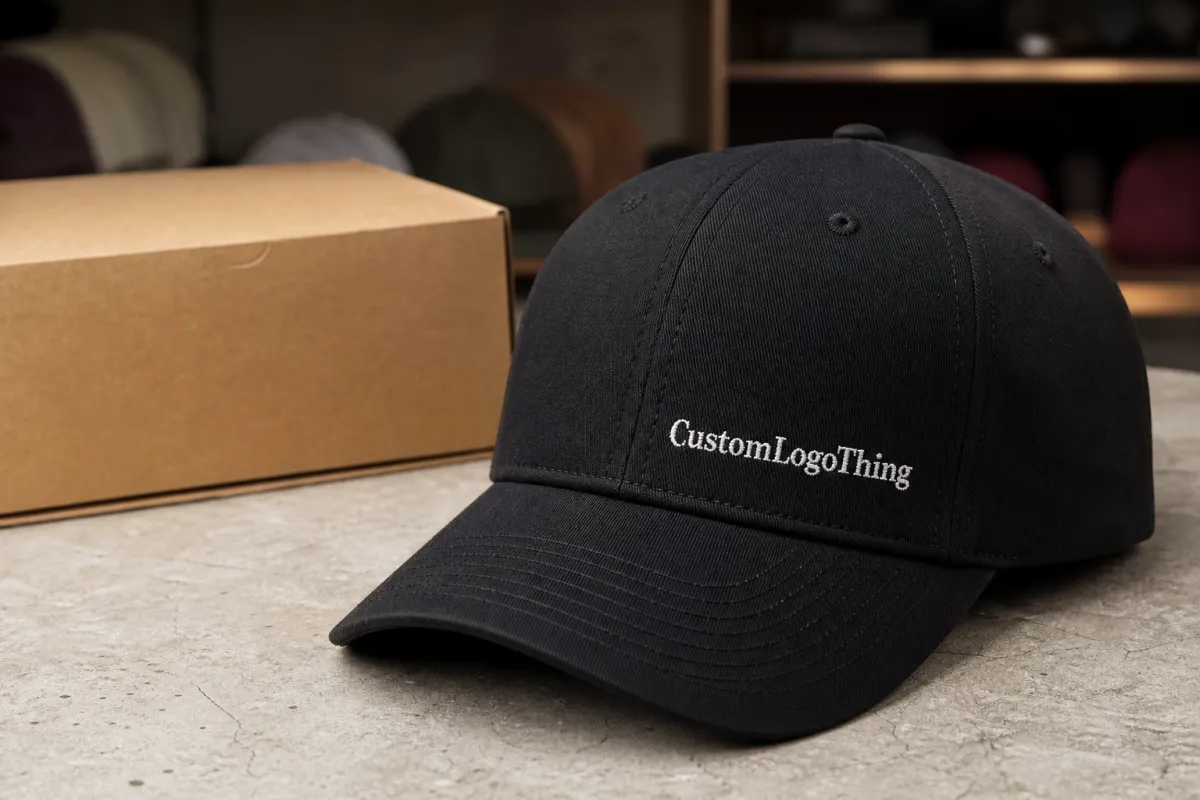
Shoppers judge hats quickly. They touch the front panel, look at the stitching, and decide whether the price feels right. Embroidery helps because it adds texture and depth, and it usually reads as more durable than a flat print.
Retail caps also stay visible on a shelf or hook. A folded shirt disappears into a stack; a cap keeps its silhouette. If the shape is clean and the logo is modest, the hat looks like part of a real collection instead of a giveaway item.
There is a margin angle too. A retail buyer needs something that can support a higher shelf price without becoming fragile or hard to reorder. A compact embroidered logo on a classic cap usually does that well. Oversized artwork often does not; it can make the hat feel louder, not better.
If the cap looks like promo merch, shoppers treat it like promo merch. If it looks like a brand accessory, they pay retail for it.
That is why the cap body and decoration should be chosen together. A small logo can look sharp on a structured front panel. The same art forced onto a low-profile crown can look crowded and shrink the retail value.
How the embroidery process turns artwork into sellable caps
Good embroidery starts with cleanup. Vector files help, but even vector art often needs edits before it becomes stitches. Thin lines, tiny type, gradients, and detailed shading usually have to be simplified so the design survives the curve and seam structure of a cap.
Digitizing is the next step. It converts the artwork into stitch instructions: where the machine fills, trims, locks, and changes color. Clean digitizing keeps edges crisp and density consistent. Poor digitizing can make good art look rushed, even on a premium blank.
The main decoration methods solve different problems:
- Flat embroidery is the cleanest option for logos, icons, and small type.
- 3D puff adds lift, but it needs bold shapes and enough open space.
- Woven or embroidered patches work better when the art has too much detail for direct stitching.
For retail merch, flat embroidery is often the safest starting point. Patches preserve detail better when direct stitching would collapse. Puff can work, but only if the brand can support a stronger, sportier look. Too many techniques on one cap can make the product feel busy.
QC should look beyond the logo alone. Check stitch count, edge crispness, thread tension, placement symmetry, and how the design sits on the crown. A sample that only looks good from a distance is not enough for retail.
For packaging specs, hangtags, and shelf-ready presentation, the terminology used by the Packaging Industry Association is a useful reference point when writing product notes and packaging requirements.
Cost, MOQ, and the levers that change unit pricing
There is no flat price for this kind of order. Cost changes with the blank cap, stitch count, thread changes, decoration type, packaging, and freight. Still, a rough range helps separate a fair quote from a padded one.
For a retail-ready run of 100 to 300 pieces per style, a basic embroidered cap often lands around $6.25 to $10.25 per unit before freight in 2026 if the blank is standard and the logo is simple. Better blanks, thicker fill, added side embroidery, or specialty closures can push the number higher. A one-time digitizing fee of roughly $30 to $95 is common, depending on complexity. Retail packaging, hangtags, barcode labels, and polybags add smaller but real per-unit costs.
The MOQ question is mostly about setup costs. Below about 100 pieces per style, digitizing, sampling, and machine setup stop being spread across enough hats, so the unit price rises fast. For many buyers, 100 to 300 pieces is the practical middle ground: enough volume to keep the math sane without creating a large inventory bet.
| Decoration option | Typical use | Typical cost impact | Retail read |
|---|---|---|---|
| Flat embroidery | Simple logos, small type, clean marks | Lowest added cost; usually the best value | Classic and dependable |
| 3D puff embroidery | Bold front panels, large letters | Higher than flat work because of foam and extra stitching | Sporty and high impact |
| Woven patch | Fine detail, mixed textures, small elements | Mid-range after patch production and application | More premium and retail-friendly |
| Multi-location embroidery | Front plus side or back branding | Raises labor and stitch count | Strong brand presence, higher price |
Retail math still matters. If landed cost sits at $8.40 and the target shelf price is $28, there is little room for markdowns, freight, display materials, and shrink. That does not make the cap overpriced; it means the margin plan has to be realistic.
Bundling caps with hangtags, cartons, or branded inserts can help the product feel complete. If the merch line includes boxes or other pack-out items, it is worth reviewing Custom Packaging Products alongside the order so the finish level stays consistent.
Cap specs that affect fit, shelf appeal, and reorder speed
The cap body matters more than many first-time buyers expect. A 6-panel cap is the safest all-around retail choice because it feels familiar and fits a broad audience. A 5-panel cap leans more modern and streetwear-friendly. Unstructured caps feel softer and more relaxed. Trucker caps bring a louder, nostalgic look. None is universally best.
Material choice changes how embroidery lands. Cotton twill is predictable and easy to decorate. Brushed cotton can feel a little softer and more premium. Washed caps look lived-in, which helps some lifestyle brands, but the surface can vary enough to affect stitch consistency. Performance fabrics can work too, though they need testing because stretch and finish can affect thread tension.
Closure style also affects retail and inventory. Snapbacks are easy to fit and easy to stock. Strapbacks and buckles feel a little more fashion-forward. Fitted caps look clean, but the size curve creates more SKUs and more inventory risk. If the line needs quick reorders, lower complexity usually wins.
Front-panel structure is another quiet decision that changes the product. Structured crowns support cleaner embroidery and flatter logos. Softer, unstructured bodies look more casual but can make a large design distort or sink. If the artwork is dense or the type is small, structure helps.
For shipping-heavy programs, packaging and transit testing should not be ignored. Guidance from ISTA is useful if the caps will move through cartons, distribution centers, or multiple handling points before they reach the shelf. A hat that looks good in the sample room but arrives crushed in transit is not a retail win.
New retail merch trends for 2026
One trend I have seen repeatedly in recent retail cap programs is a move toward cleaner front branding with one premium detail elsewhere, such as a side hit, under-brim print, or branded inside taping. Buyers still want a hat that reads instantly on shelf, but they are paying more attention to subtle finishes that make the product feel intentional.
Retail merch teams are also asking more often for lower-waste packaging and faster replenishment on best-selling colorways. In 2026, the strongest programs usually combine a core blank, one neutral color, and one limited seasonal color so buyers can test demand without overcommitting. That shift matters because it keeps inventory lean and supports quicker reorders when one style starts moving.
Another change is the growth of patch-and-embroidery hybrids. A woven or felt patch with a stitched border can preserve detail and still look premium, especially for logos that are too intricate for direct embroidery. For many brands, this is the sweet spot between a simple cap and a more fashion-forward retail piece. If you plan to compare logo placement options, it helps to consider whether the decoration should stay front-only or extend to the side for added retail value.
Finally, buyers are requesting more transparent landed-cost breakdowns. They want to see blank price, decoration, packaging, and freight separated before they place a PO. That level of clarity makes it easier to compare quotes and protects margin when the order scales.
Production steps and turnaround: from quote to delivery
The smoother the inputs, the smoother the order. A useful quote request should include quantity, cap style, color count, artwork files, placement, packaging needs, and the delivery window. Leaving any of that vague usually means another round of emails and a slower schedule.
The normal workflow looks like this:
- Quote and spec review.
- Artwork cleanup and digitizing.
- Sample or digital proof approval.
- Bulk embroidery or patch application.
- Final inspection and packing.
- Carton labeling and freight booking.
Timing is usually predictable if the artwork is ready. Quoting often takes 1 to 2 business days. Digitizing is commonly 1 to 3 days. Samples can take about 5 to 10 business days, depending on the method and how busy the shop is. Bulk production often lands in the 2 to 4 week range after proof approval. Rush orders can happen, but they depend on blank stock and usually cost more.
Delays usually come from holiday spikes, out-of-stock blanks, too many revisions, or files that are nowhere near production-ready. If the supplier has to chase vector art, confirm thread colors, and wait on packaging notes, the schedule slips.
A good factory will ask the annoying questions early. Better to catch a weak logo scale before the sample proves it on the press.
Common mistakes that erase margin on retail merch orders
The most common mistake is asking too much of the front panel. Oversized logos, tiny text, and overly detailed artwork force the stitching to do work it cannot do cleanly. The hat ends up looking busy or cheap even when the blank is good.
SKU sprawl is another margin killer. Too many cap bodies, too many colorways, and too many closure types split the order into small pieces. That raises setup cost and makes reorder planning harder. One strong body with one or two colorways is usually a better retail move than a long list of near-duplicates.
Artwork prep gets ignored more than it should. Low-resolution files, missing Pantone targets, and vague placement notes create extra revision loops. Those loops cost time, and time is where budgets quietly leak. If brand standards already exist, send them. If they do not, build them before asking for pricing.
Packaging mistakes are quieter but still expensive. A cap meant for retail should arrive ready to display, not loose in a carton with no tags, no size mark, and no clear fold. Polybags, hangtags, carton labels, and UPCs are not glamorous, but they matter.
QC should not stop at the embroidery. Check the brim curve, the stitching at the sweatband, the consistency of the closure hardware, and whether the logo sits level across the crown. Those details are easy to miss in a photo proof and obvious in person.
What to lock before you request a quote
Before asking for pricing, lock the spec sheet. Keep it simple and specific: cap body, crown height, closure, thread colors, logo size, decoration placement, packaging, quantity, and delivery window. One clean page saves more time than a chain of follow-up emails.
Ask for a sample or digital proof before bulk production. That is the stage where stitch density issues, placement drift, and color mismatches get caught while they are still fixable. A retail cap has less room for sloppiness than a giveaway item because the customer is paying attention.
If the artwork is complex, compare at least two decoration methods. Direct embroidery may be the cleanest and cheapest option. A woven patch may preserve detail better and feel more premium. 3D puff can work, but only if the logo is bold enough to support it. The right choice is the one that looks good at the target price and survives production without drama.
For custom Embroidered Baseball Caps for retail merch, the smartest path is straightforward: confirm the spec, verify the price break, approve the sample, and then release the bulk order. That keeps the project under control and gives the cap the best shot at looking like a real retail product.
FAQ
What is the best MOQ for custom embroidered baseball caps for retail merch?
For most buyers, 100 to 300 pieces per style is the practical sweet spot because setup costs spread out better. Under 50 pieces usually pushes the unit cost up fast, so it only makes sense for a very small launch or a niche test run.
How much do custom embroidered baseball caps for retail merch usually cost?
Pricing depends on the blank cap, stitch count, number of colors, and packaging, so there is no honest one-size-fits-all number. Simple caps with one front logo usually cost less than specialty builds with patches, multi-location decoration, or premium fabric.
How long does production usually take for retail embroidered caps?
A realistic timeline is often 2 to 4 weeks after proof approval, with sampling adding another 5 to 10 business days. Rush orders are possible sometimes, but they usually cost more and depend on blank cap availability.
Which cap style sells best for embroidered retail merch?
6-panel caps are the safest all-around choice, while 5-panel and unstructured caps work better for trend-driven brands. Truckers can sell well when the brand leans casual, outdoorsy, or nostalgia-driven.
Can I mix colors or cap styles in one custom embroidered order?
Yes, but every added colorway or style usually makes pricing less efficient because the order gets split into smaller runs. If margin matters, keep one main body and one backup colorway instead of building a long list of options.

