Buyer Fit Snapshot
| Best fit | Buy Custom Printed Mailers in Bulk projects where brand print, material claims, artwork control, MOQ, and repeat-order consistency need to be specified before quoting. |
|---|---|
| Quote inputs | Share finished size, material target, print colors, finish, packing count, annual reorder estimate, ship-to region, and any compliance wording. |
| Proofing check | Approve dieline scale, logo placement, barcode or warning zones, color tolerance, closure strength, and carton packing before bulk production. |
| Main risk | Vague material claims, crowded artwork, missing packing details, or unclear freight terms can make a low unit price expensive after revisions. |
Fast answer: Buy Custom Printed Mailers in Bulk: Pricing, Specs, Process should be specified like a repeatable production item. The safest quote records material, print method, finish, artwork proof, packing count, and reorder notes in one written spec.
Production checks before approval
Compare the actual filled-product size with the drawing, then confirm tolerance on folds, seals, hang holes, label areas, and retail display edges. Reserve space for logos, QR codes, warning copy, and material claims before decorative graphics fill the panel.
Quote comparison points
Review material grade, print process, finish, sampling route, tooling charges, carton quantity, and freight assumptions side by side. A quote is only useful when the supplier can repeat the same color, closure quality, and packing count on the next order.
Buy Custom Printed Mailers in bulk and you are not just purchasing a shipping supply. You are buying repeat visibility. I’ve watched one mailer move from a shipping table in Austin, Texas to a conference room in Chicago before it was ever opened. Five people saw the logo first. The package had not even reached the customer’s hands. That kind of exposure is difficult to get from a paid placement, and the unit cost keeps falling as the order volume rises. On a 5,000-piece run, the math can be striking: a mailer that lands at $0.15 per unit is far easier to justify than one that costs $0.34 in a small run.
A surprising number of brands still treat packaging like a back-office expense. Honestly, I think that view leaves money on the table. The right custom printed mailers protect the product, keep fulfillment consistent, and reinforce package branding every time an order leaves the warehouse. Apparel, accessories, cosmetics, books, subscription kits—each one benefits in a different way, but the logic stays the same. When you Buy Custom Printed mailers in bulk, you usually gain tighter control over all three. And yes, that control matters in places like Los Angeles, Newark, and Dallas, where fulfillment teams may be shipping hundreds of parcels before lunch.
Custom Logo Things works with buyers who want clear facts. No hype, no recycled talking points. What follows is practical: specs, MOQ, timing, print choices, and the tradeoffs that come with buying in volume instead of picking up stock mailers one carton at a time. If you need Custom Poly Mailers, Custom Packaging Products, or broader Wholesale Programs, the aim is the same—help you place the order with fewer surprises. And yes, fewer surprises is a lovely thing in packaging (my tolerance for “mystery fees” is basically zero). For buyers shipping from hubs in Shenzhen, Guangdong, or Ho Chi Minh City, that clarity can shave days off the approval process.
Why Brands Buy Custom Printed Mailers in Bulk
The biggest reason brands buy custom printed mailers in bulk is simple: the per-unit cost drops as quantity increases. That is not a slogan. It is production math. A 5,000-piece run spreads setup, plate preparation, and color calibration across far more units than a 500-piece run, so the cost per mailer can fall sharply. Depending on size and print coverage, I’ve seen buyers save 18% to 34% per unit by moving from small runs to bulk ordering. On a straightforward one-color 10" x 13" mailer, a buyer may pay $0.15 per unit for 5,000 pieces, while a lower-volume order can sit much higher once setup is counted.
Consistency matters just as much. Plain poly mailers function well enough, but they do little for recognition. Generic boxes can be the right answer for fragile items, yet they often weigh more, cost more to ship, and take up more storage space. Buy custom printed mailers in bulk and every shipment leaves with the same dimensions, the same seal, and the same branding. That matters when a team ships from multiple locations or when a third-party fulfillment center handles a large catalog. A brand operating out of Atlanta and Phoenix, for example, can keep one approved mailer spec across both sites instead of managing two visual standards.
I remember a meeting with a mid-size apparel brand that was using three mailer suppliers across two warehouses. One warehouse stocked white bags, the other used gray film, and the print methods did not match. Customers started emailing support to ask whether the products were authentic. One bulk spec, one approved artwork file, and one reorder process cleared up most of the confusion. Not dramatic. Very effective. In that case, the brand moved to a single 12" x 15.5" mailer printed in two Pantone colors, and returns tied to “wrong package” dropped within one quarter.
Repeated exposure is another piece of the puzzle. A package is seen by the recipient, then by coworkers, roommates, mailroom staff, or family members, and again when it is discarded or recycled. A digital ad might hold attention for less than a second. A mailer can sit in view for hours, sometimes days. Brands that buy custom printed mailers in bulk often get stronger recall than brands that treat shipping materials as invisible. That’s not theory. A simple unboxing trail in New York or Toronto can expose the logo to three or four people before the first product touch.
Subscription brands understand this quickly. So do ecommerce stores shipping on a weekly cycle. Seasonal sellers feel it too, especially when inventory needs to land before demand spikes. Buy custom printed mailers in bulk and reorder friction drops. Fewer approvals. Fewer proof cycles. Less artwork drift. In practical terms, that means tighter control over retail packaging standards and a steadier customer experience. A July campaign in Miami or a November push in Seattle is much easier to manage when the packaging is already approved and sitting on a dock.
People often assume “bulk” only means cheap. It doesn’t. It means predictable. It means fewer disruptions in quality, branding, and replenishment. That predictability is the real business case. A supplier in Dongguan can quote a 12-15 business day production window from proof approval, and a buyer in London can plan around that with actual inventory math instead of hope.
For brands comparing custom printed mailers against custom printed boxes, the decision usually comes down to product type and shipping profile. Soft, light, and non-fragile items tend to do better in mailers because freight and storage stay efficient. Fragile goods usually need a box. Either way, buying in volume strengthens negotiating power and makes planning easier. I’ve seen brands shipping 2 oz accessories from Portland save more than 20% in outbound costs just by staying with mailers instead of heavier corrugated packaging.
Product Details: What You Get When You Buy Custom Printed Mailers in Bulk
Buy custom printed mailers in bulk and you are usually choosing a polyethylene film product made for lightweight shipment. Standard poly mailers use polyethylene, while higher-spec versions use co-extruded film for added tear resistance, opacity, or surface performance. In plain language: the material can be tuned for strength, print clarity, and privacy. That matters for apparel, books, swimwear, or small accessories that do not need rigid protection. For buyers who want a more premium feel, a 50-micron co-extruded film can hold ink more sharply than a thinner stock bag from a convenience supplier.
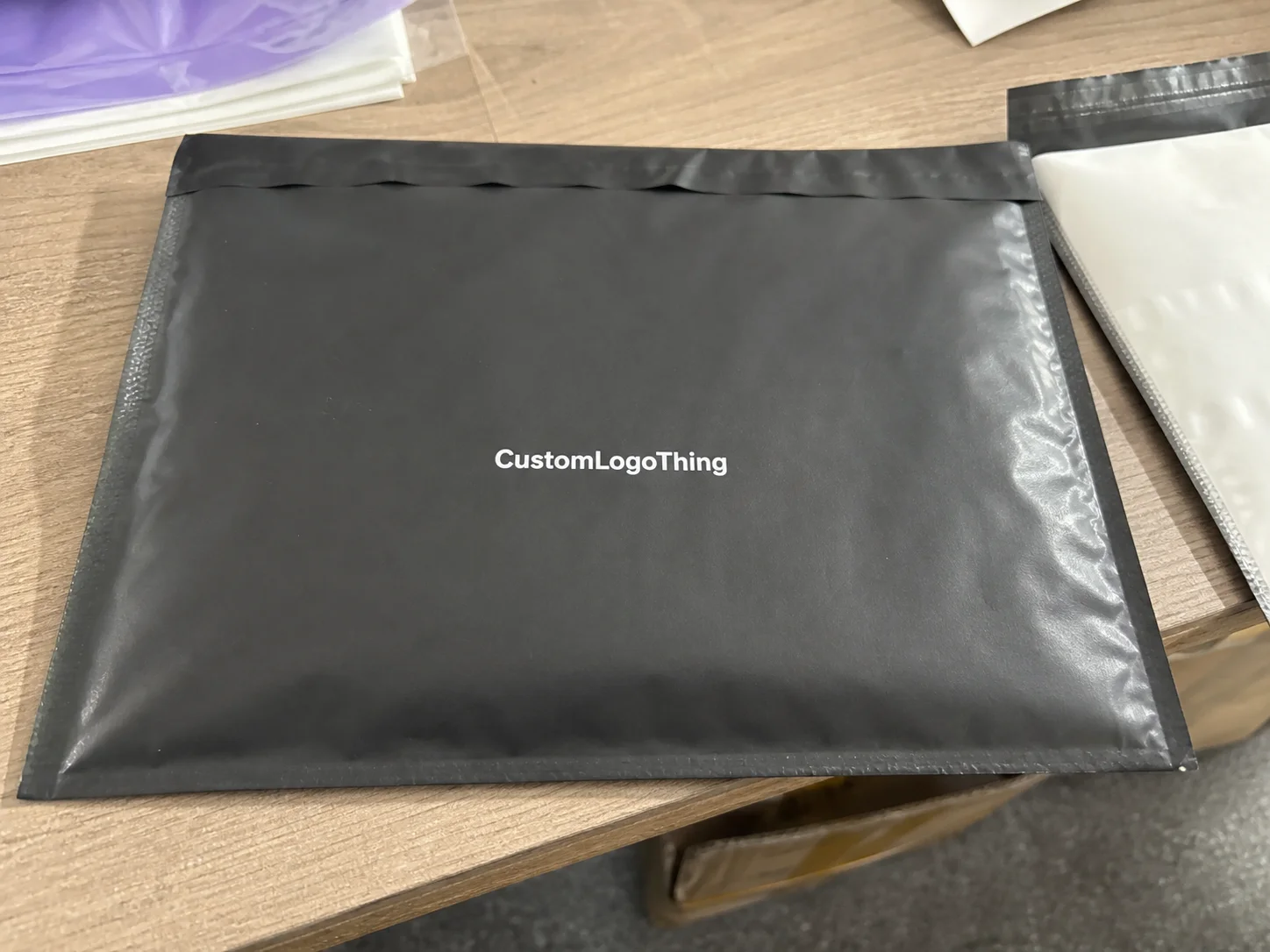
Customization options vary, but the common choices are easy to recognize. A logo on the front. Brand messaging on the back. A return address on the flap. A simple one-color design that keeps production efficient. Some buyers go with two colors, especially when the artwork needs strong contrast. Others lean on bold typography and a single mark. Both approaches can work. The right choice depends on how much print area you need and how much of the budget belongs to print. A one-color print on a 10" x 13" mailer may be all a DTC basics brand needs, while a subscription box company in Toronto may want a full-coverage design with a custom back panel.
When you buy custom printed mailers in bulk for apparel, the mailer does more than hold the garment. It sets expectations. A matte white or metallic silver bag says something different from a black co-extruded mailer with high-contrast print. That’s part of packaging design. Color, placement, and finish all shape how professional the package feels when it reaches the doorstep. I’ve always had a soft spot for the mailers that look sharp without trying too hard—those tend to age better than the ones that scream, “We hired three people and a font battle ensued.”
Functional details matter too. Most mailers include a self-seal adhesive strip for quicker packing. Many are waterproof, which helps when packages meet rain, snow, or damp receiving areas. Tamper-evident seals add confidence for direct-to-consumer shipments. Poly mailers also weigh less than corrugated alternatives, which can help keep dimensional weight in check on certain shipping profiles. That is one reason brands buy custom printed mailers in bulk instead of defaulting to heavier product packaging. In a warehouse in New Jersey or Tilburg, that lighter pack-out can add up across 20,000 monthly shipments.
Here is a simple comparison I use with buyers:
| Mailer Type | Typical Use | Branding Impact | Shipping Efficiency | Best For |
|---|---|---|---|---|
| Standard polyethylene poly mailer | Light apparel, soft goods | Moderate | High | Cost-sensitive ecommerce orders |
| Co-extruded poly mailer | Higher abrasion, better opacity | High | High | Brands needing stronger presentation |
| Printed mailer with custom flap or back panel | Subscription, campaign-driven shipments | Very high | High | Launches, loyalty programs, retention mailings |
One lesson from a factory visit in Shenzhen stayed with me: print area matters as much as the ink. A dark navy logo on light film read cleanly from a distance. The same logo, placed too close to a seam, lost definition once the adhesive area pulled slightly during sealing. That is not an abstract design issue. It is a production issue. It is exactly why buyers should ask how artwork behaves on the actual substrate before they buy custom printed mailers in bulk. A 2 mm shift can be enough to make a clean mark look crooked once a packer seals 1,200 units a shift.
Not every order needs finishing flourishes. A clean one-color logo, sized correctly, can outperform an overworked layout. I’ve seen brands pay extra for a complicated multi-color composition only to discover that their fulfillment team wanted a simpler file that printed faster and caused fewer rejection risks. Fancy is not always better. Clear usually wins. My printer brain still twitches a little when a beautiful design becomes a packing-line headache. A 350gsm C1S artboard insert can look great in a premium box; a mailer, by contrast, often performs better with a straightforward 1- or 2-color layout.
If you sell cosmetics, books, supplements, or small accessories, custom mailers can be an efficient alternative to some custom printed boxes. If the items are more fragile, pair the mailer with an inner carton or switch materials. The product should shape the packaging, not the other way around. That’s the kind of operational thinking that makes buy custom printed mailers in bulk decisions actually profitable. For fragile skincare glass, for instance, a mailer plus a 350gsm carton insert in a secondary pack might be the wiser move.
Specifications to Check Before You Buy Custom Printed Mailers in Bulk
Before you buy custom printed mailers in bulk, check the basics: dimensions, film thickness, seal type, print coverage, and opacity. That sounds obvious, yet orders still get delayed by one bad dimension or one vague artwork file more often than anyone wants to admit. A 10" x 13" mailer can work for folded tees, while a 12" x 15.5" size may suit hoodies or bulkier soft goods. Oversizing wastes material and can increase cubic shipping charges. Undersizing leads to damage, returns, and slower packing. In a warehouse shipping from Dallas or Manchester, that difference can show up immediately in labor and postage.
Film thickness is usually measured in microns or mils, depending on the supplier. The label matters less than the use case. Lightweight mailers are fine for low-risk products. Thicker construction makes sense for sharper edges, heavier fills, or shipments that get handled repeatedly in transit. If you buy custom printed mailers in bulk for mixed product lines, ask for SKU-level guidance instead of relying on one universal spec. A 2 oz accessory and a 1.5 lb apparel bundle do not need the same film profile. A 60-micron mailer may be suitable for soft tees, while a 75-micron version can better handle zipper-heavy hoodies or boxed sets.
Print quality deserves its own checklist. Ask for artwork resolution standards, bleed zones, safe margins, and the number of ink colors. Vector files are usually best for logos because they scale cleanly. If the art is raster-based, check that the resolution is high enough for the final print size. Dark ink on light film usually reads best, though high-contrast layouts can work on darker mailers too. The issue is not style alone. It is legibility at pack-out speed and during transit. A 300 DPI file may be acceptable on paper, but a full-coverage poly bag in a busy facility in Chicago can punish sloppy spacing fast.
I’ve seen a client lose two weeks because their logo sat too close to the sealed edge. The supplier flagged it during proofing, the buyer brushed off the warning, and the first run showed slight distortion after sealing. That kind of mistake looks tiny on a screen and expensive on a production line. Buy custom printed mailers in bulk and use proofs as a real checkpoint, not a formality. I’ll be blunt: a proof that nobody reads is just expensive wallpaper. One millimeter of safe margin can save 5,000 pieces from a costly reprint.
Adhesive performance and storage conditions deserve attention as well. Some adhesives behave differently in warmer warehouses or humid climates. If your pack-out area runs hot, tell the supplier. If the mailers will sit in a fulfillment center for three months, say that too. I’ve watched adhesive performance slip when cartons were stored near heat sources. Not always. Enough to make climate and storage part of the conversation. A facility in Houston in August behaves differently from a dry warehouse in Denver in January, and the film should be selected with that in mind.
Here’s a practical spec checklist I use in buyer reviews:
- Mailer size: matched to the folded product, not just the item category.
- Film thickness: selected for weight, abrasion, and handling risk.
- Seal type: self-seal adhesive with appropriate tack strength.
- Opacity: enough to protect privacy and reduce show-through.
- Print area: front, back, flap, or full coverage as needed.
- Ink colors: one-color, two-color, or multi-color as budget allows.
- Proof approval: signed off before mass production starts.
Compliance belongs in the conversation too. Depending on the market, some brands want FSC-certified paper components in other packaging formats, or materials that align with sustainability expectations. Poly mailers are not paper, but buyers still ask about recycling guidance and source transparency. For broader packaging context, I often point teams to resources like the EPA’s recycling information and the Institute of Packaging Professionals. Those references do not replace supplier due diligence, but they help frame the discussion.
My advice is blunt: buy custom printed mailers in bulk without checking the basics, and you are gambling with the least expensive item in your shipper while risking the most visible one. That is a poor trade. A 500-piece shortcut can easily create a $2,500 reprint if a spec mismatch slips through.
Pricing and MOQ for Custom Printed Mailers in Bulk
Pricing for custom printed mailers depends on quantity, size, film thickness, print complexity, and shipping destination. That is the short version. The longer version is that setup fees, artwork preparation, and freight can change the total by more than buyers expect. I’ve sat in supplier negotiations where two quotes looked close on unit price, then one added plate fees, sampling costs, and inland freight that pushed the landed cost far above the first offer. If you buy custom printed mailers in bulk, compare the full number, not just the headline rate. A quote from Shenzhen may look lean until you add ocean freight to Los Angeles and domestic drayage to a warehouse in Ontario, California.
For example, a smaller run might come in at $0.18 per unit for 5,000 pieces in a simple one-color layout, while a larger quantity can lower the unit price because setup costs are spread across more mailers. In some cases, 10,000 pieces can land at $0.15 per unit for a similar spec. Thicker film, more ink colors, or a larger format can move that number upward. Shipping can shift it again. A buyer who requests a quote without specifying size, thickness, and destination usually gets a number that is too vague to help. A buyer in Sydney asking for EXW pricing and comparing it to delivered pricing in Melbourne is not comparing like for like.
MOQ is another area where clarity saves time. Minimum order quantity varies by product size and print method, but bulk pricing usually begins where production efficiency improves. A supplier may accept a smaller test order, which can help with sample validation, but the real savings show up when you buy custom printed mailers in bulk at a volume that keeps the presses running efficiently. That is why subscription brands and fulfillment-heavy ecommerce stores often do well with batch buying. In practical terms, 3,000 to 5,000 pieces is where many projects start to make sense, while 10,000 pieces or more often unlocks better pricing tiers.
Here’s a simple way to evaluate quotes:
| Cost Factor | What It Means | What to Ask |
|---|---|---|
| Unit price | Base cost per mailer | Does this include one-color printing and standard size? |
| Setup/plate fee | Artwork and print preparation | Is it one-time or repeated on every reorder? |
| Sample charge | Mockup or test production | Can the sample cost be credited toward the bulk order? |
| Freight | Shipping from origin to destination | Is this EXW, FOB, or delivered pricing? |
| Reprint terms | What happens if there’s a defect | How are defects documented and replaced? |
One of my favorite lessons came from a buyer who compared only unit price. The supplier with the lowest sticker cost had a weak proofing process and slower turnaround. The “expensive” supplier ended up cheaper once rework and freight were counted. That is why total landed cost matters. Buy custom printed mailers in bulk and you want the number that lands in your P&L, not the number that looks tidy in an email. I’ve seen the difference amount to 12% to 19% on a 20,000-piece order.
Usage rate helps too. If your warehouse ships 800 orders a week, a 10,000-piece purchase covers a predictable window and reduces procurement strain. If you ship in bursts, like holiday-heavy campaigns, higher bulk volumes can still make sense because they lock in supply and reduce stockout risk. In both cases, the cost advantage comes from production efficiency and fewer reorder cycles. A brand moving 2,400 units per month out of Atlanta may find that a 12,000-piece order covers roughly five months and cuts emergency purchasing to nearly zero.
For brands building branded packaging across multiple channels, the same logic applies to mailers, inserts, labels, and custom printed boxes. Standardizing one or two formats can simplify sourcing and keep artwork consistent across the customer journey. That consistency is worth real money. It reduces errors, rework, and design drift between batches. If your packaging partner also handles cartons with 350gsm C1S artboard inserts or similar print-heavy components, it can simplify vendor management further.
How the Ordering Process Works and What Timelines to Expect
The ordering process is usually direct, assuming the buyer arrives prepared. It starts with the inquiry: size, quantity, print coverage, ship-to location, and intended use. Then comes quote confirmation. Next is artwork submission and proofing. Once the proof is approved, production begins, followed by inspection and shipment. Buy custom printed mailers in bulk and each step can move quickly or slowly based on how complete the information is. A buyer who sends final files on Monday can often get a proof the same week; a buyer who sends a phone photo of a logo will wait longer.
What should be ready before the quote request? Final logo files, Pantone or color references, dimensions, quantity, and the name of the person who can approve proofs without waiting three days for internal signoff. I’ve seen a simple typo in a return address stall a batch because nobody owned the proof review. That is avoidable. Gather the inputs first, then request the quote, and the process will usually move faster. A supplier in Guangzhou can quote within 24 to 48 hours if the spec is clean and the artwork is usable.
The proof stage is the guardrail. It should show layout, scale, color placement, and any text elements. It is not just a courtesy PDF. It is the final chance to catch bad spacing or a logo sitting too low on the panel. Buy custom printed mailers in bulk and skip careful proofing, and you raise the odds of paying for a full run that misses the intended spec. A proof approved at 9:00 a.m. on Tuesday can prevent a 5,000-piece mistake by Friday.
Timeline depends on artwork readiness, production queue, and freight method. Custom printing usually takes longer than stock inventory. That is normal. Transit time sits on top of that, especially if the order moves by ocean freight or if destination handling is slow. I tell clients to plan reorder windows around actual consumption rates, then add a safety buffer. A 15% buffer is a reasonable starting point for brands with stable demand. For seasonal spikes, I’d go higher. A typical production window is 12-15 business days from proof approval, and ocean freight from East Asia to the U.S. West Coast can add another 18 to 28 days.
A fulfillment manager once told me the best packaging decision they made was not changing suppliers; it was changing reorder timing. They moved their restock point up by three weeks. Same mailer. Same print. Less panic. That is operational discipline, and it matters when you buy custom printed mailers in bulk for active ecommerce lines. If your average daily usage is 400 units, even a small delay becomes visible in a matter of days.
“The quote was fine. The proof caught the problem. That one extra day saved us from a five-thousand-piece mistake.” — ecommerce operations lead, apparel client
Inspection deserves a place in the process too. Ask whether the supplier checks print registration, seam integrity, and seal performance before dispatch. For shipping tests, some brands align packaging with standards from groups like ISTA when they want a more formal transit validation process. That does not mean every mailer needs a full lab program. It means good buyers ask how the mailer behaves under transport stress. If you ship from Mumbai to Berlin or from Shenzhen to Toronto, the route matters as much as the design.
Why Choose Us for Custom Printed Poly Mailers
Buy custom printed mailers in bulk from us and you are not buying guesswork. You are buying clear specs, responsive proofing, and repeatable print quality. That sounds basic. It is also where many suppliers stumble. They quote loosely, proof late, and ship without enough clarity on material or print placement. We treat those details as the work itself, not as extras. If your order calls for a 10" x 13" matte white mailer with a one-color black logo, we will quote that exact build rather than a vague “custom mailer” bucket.
Custom Logo Things is built for buyers who care about operational reliability. If your warehouse needs the same result every month, we focus on the same result every month. That means matching dimensions, maintaining print consistency, and documenting the order so reorders do not drift. I’ve seen brands lose days because a second supplier interpreted the same artwork differently. We work to remove that risk before it starts. A brand shipping out of Dallas in Q1 should get the same result in Q4, not a color shift or a resized mark.
We also understand ecommerce fulfillment. That matters. A packaging supplier who only thinks like a printer may miss practical issues like pallet count, carton packing efficiency, or how a mailer behaves on a fast packing line. A packaging partner thinks about throughput. How many pieces fit in each carton? How does the self-seal strip perform at a busy pack station? Does the film feed cleanly? Those details affect labor and error rates. Honestly, nothing makes a warehouse team grumpier than a box of “almost right” supplies. If a carton packs 250 mailers instead of 200, that difference can change the number of pallets a 20,000-piece run consumes.
Buyers appreciate transparency. If a design needs a larger print area, we say so. If a lower-cost one-color layout will look cleaner and ship faster, we say that too. I’d rather have a direct conversation than oversell an option that creates problems later. That is how good branding support should work. A one-color run at $0.15 per unit for 5,000 pieces can be smarter than a two-color version that adds time, cost, and rejection risk.
We also help with sampling and order tracking. First-time buyers often need reassurance that the mailer will fit the product, that the color will read correctly, and that the seal will hold in transit. Reorders need a different kind of support: version control, repeat spec matching, and timing discipline. Both matter if you buy custom printed mailers in bulk and want fewer headaches across multiple shipments. Our buyers in Los Angeles, Newark, and Vancouver often ask for the same thing: one clean spec file and a reorder that does not require a fresh project meeting.
For buyers comparing packaging partners, I usually suggest checking three things: clarity of quoting, proofing speed, and follow-through after the order ships. That simple filter tells you a lot. If a supplier is vague at the beginning, they rarely get clearer later. Ask how long they need to respond, whether proofs are returned in 24 to 72 hours, and whether they can support a reprint if something fails in transit.
And yes, we can support broader packaging needs too. Some brands start with mailers, then add inserts, stickers, labels, and eventually move into custom printed boxes for premium lines. Others stay with mailers because the economics make more sense. Either path can work. The point is to make the package fit the business, not the other way around. If your product line grows into rigid cartons with 350gsm C1S artboard components, we can discuss that too.
Next Steps to Buy Custom Printed Mailers in Bulk
If you are ready to buy custom printed mailers in bulk, start with a tight checklist. Confirm the mailer size, estimate your monthly usage, gather your logo files, and decide whether you want front-only printing, full coverage, or a simple back-panel message. Those four decisions shape the quote more than almost anything else. A brand shipping 1,200 orders a week from Phoenix will need a different inventory plan than one shipping 150 orders a day from Boston.
Next, request a sample or mockup if the design is new or if you are comparing suppliers. I recommend doing that even for experienced buyers when switching material types. A sample reveals more than a spec sheet about color, finish, and seal feel. It is a small cost compared with a bad run. Buy custom printed mailers in bulk without checking a sample, and you take an avoidable risk. A physical sample can also show whether a 60-micron film feels too thin for your product or whether the seal is too aggressive for your pack line.
Then compare at least two or three quotes using identical specs. Same size. Same thickness. Same quantity. Same print coverage. Otherwise, you are not comparing suppliers; you are comparing different products. That mistake happens constantly. It also leads to purchasing decisions that look smart only on paper. A 5,000-piece quote at $0.16 per unit with no freight is not better than a $0.18 delivered quote if the first one adds another $450 in transport and handling.
Inventory planning matters too. Calculate how many weeks of supply you need, then add a safety buffer for shipping delays or campaign spikes. A 10,000-piece order sounds large until a promotion sells faster than forecast. I’ve seen brands run out during a holiday push and scramble for plain stock mailers just to keep shipping moving. That is exactly the problem bulk purchasing is supposed to prevent. A 12-week supply is often safer than an 8-week supply if your order volume spikes in Q4.
Here is the simplest action plan I can give:
- Choose the correct mailer size for the product.
- Confirm thickness and print coverage.
- Prepare final artwork in vector format if possible.
- Ask for a proof and review it carefully.
- Compare total landed cost, not unit price alone.
- Place the order with enough lead time for transit.
Buyers who follow that process usually get better results, fewer delays, and fewer reorders. That is the practical value of branded packaging: it doesn’t just look good, it behaves predictably. In a fulfillment operation, predictability is money. A stable mailer spec can save 10 to 20 minutes per pallet in packing-line adjustments, especially in busier facilities.
If you are ready to buy custom printed mailers in bulk, send your size, artwork, quantity, and target delivery window. I’d rather help you Choose the Right spec now than fix the wrong one later. That is the difference between a packaging purchase and a packaging strategy. If your production is based in Hong Kong, Vietnam, or the Shenzhen manufacturing corridor, include that too so transit and lead times are accurate from the start.
FAQ
What is the minimum order when I buy custom printed mailers in bulk?
MOQ varies by size, print complexity, and material, but bulk orders usually start at a production-efficient quantity rather than a single-carton purchase. Higher quantities often lower the unit price because setup and print costs are spread across more mailers. If you need a smaller test run, ask whether sample quantities or limited-production options are available. Many buyers begin around 3,000 to 5,000 pieces, while larger orders of 10,000 pieces or more often bring the best pricing.
How long does it take to buy custom printed mailers in bulk and receive them?
Timeline depends on artwork approval, proof sign-off, production queue, and shipping distance. The quickest orders are usually the ones with final artwork ready, clear dimensions, and fast proof approval. Typical production is 12-15 business days from proof approval, and freight from manufacturing hubs like Shenzhen or Dongguan can add another 18 to 28 days depending on destination and shipping method. Always build in extra time before a product launch or seasonal sales period.
Can I print a logo in multiple colors on custom mailers?
Yes, multi-color printing is often available, though it can affect pricing and production complexity. Simple one-color designs may be more cost-efficient and can still look strong when placed on high-contrast film. Submit vector artwork when possible to improve print clarity and scale accuracy. A two-color layout on a matte white 10" x 13" mailer can look sharp without pushing the cost far above a single-color build.
What mailer thickness should I choose when buying in bulk?
Choose thickness based on product weight, edge sharpness, and shipping conditions. Lighter goods usually work with standard film, while heavier or more abrasion-prone items benefit from thicker construction. Ask for spec guidance if you are between sizes or shipping mixed product lines. For example, a 60-micron film may suit soft apparel, while a 75-micron option can better handle denser kits or items with zippers and hardware.
What should I compare besides price when I buy custom printed mailers in bulk?
Compare total landed cost, not just unit price: setup fees, sample charges, freight, and reprint policy matter. Check material thickness, adhesive performance, print clarity, and proofing support. A lower quote may cost more later if it leads to delays, poor print quality, or the wrong size. If one supplier quotes $0.15 per unit for 5,000 pieces and another quotes $0.18 delivered to your warehouse in Ohio, the delivered number may be the better deal once freight is included.
Buy custom printed mailers in bulk and treat the order like a production decision, not a shopping cart purchase. Confirm the specs, compare the landed cost, review the proof, and choose the mailer that fits your product and your fulfillment rhythm. That is how custom printed mailers in bulk turn into brand control instead of extra work. A clean spec, a real timeline, and a fixed price per unit can save more than a hurried order ever will.