Buyer Fit Snapshot
| Best fit | Product Packaging Pricing projects where brand print, material claims, artwork control, MOQ, and repeat-order consistency need to be specified before quoting. |
|---|---|
| Quote inputs | Share finished size, material target, print colors, finish, packing count, annual reorder estimate, ship-to region, and any compliance wording. |
| Proofing check | Approve dieline scale, logo placement, barcode or warning zones, color tolerance, closure strength, and carton packing before bulk production. |
| Main risk | Vague material claims, crowded artwork, missing packing details, or unclear freight terms can make a low unit price expensive after revisions. |
Fast answer: Product Packaging Pricing: Quote Scope should be specified like a repeatable production item. The safest quote records material, print method, finish, artwork proof, packing count, and reorder notes in one written spec.
Production checks before approval
Compare the actual filled-product size with the drawing, then confirm tolerance on folds, seals, hang holes, label areas, and retail display edges. Reserve space for logos, QR codes, warning copy, and material claims before decorative graphics fill the panel.
Quote comparison points
Review material grade, print process, finish, sampling route, tooling charges, carton quantity, and freight assumptions side by side. A quote is only useful when the supplier can repeat the same color, closure quality, and packing count on the next order.
Product Packaging Pricing Guide: What Really Drives Cost is the phrase I wish every first-time buyer had in front of them before signing off on a quote in Shenzhen, Dongguan, or Los Angeles. I still remember staring at a carton quote for a 500-unit run and thinking, “That cannot possibly be right.” It came back at $0.91 per unit, while a 5,000-unit version landed at $0.27. The smaller order was not cheaper because it was smaller; it was pricier because setup, proofing, and press calibration had nowhere to spread out. That is where many buyers lose the thread. A product packaging pricing guide matters because it turns a number on a quote into a decision model you can defend. Honestly, I think half the pain in packaging buying comes from people treating the first quote as the answer, instead of the starting point. A good guide turns a quote into a map, not a surprise.
What can a product packaging pricing guide reveal in one conversation?
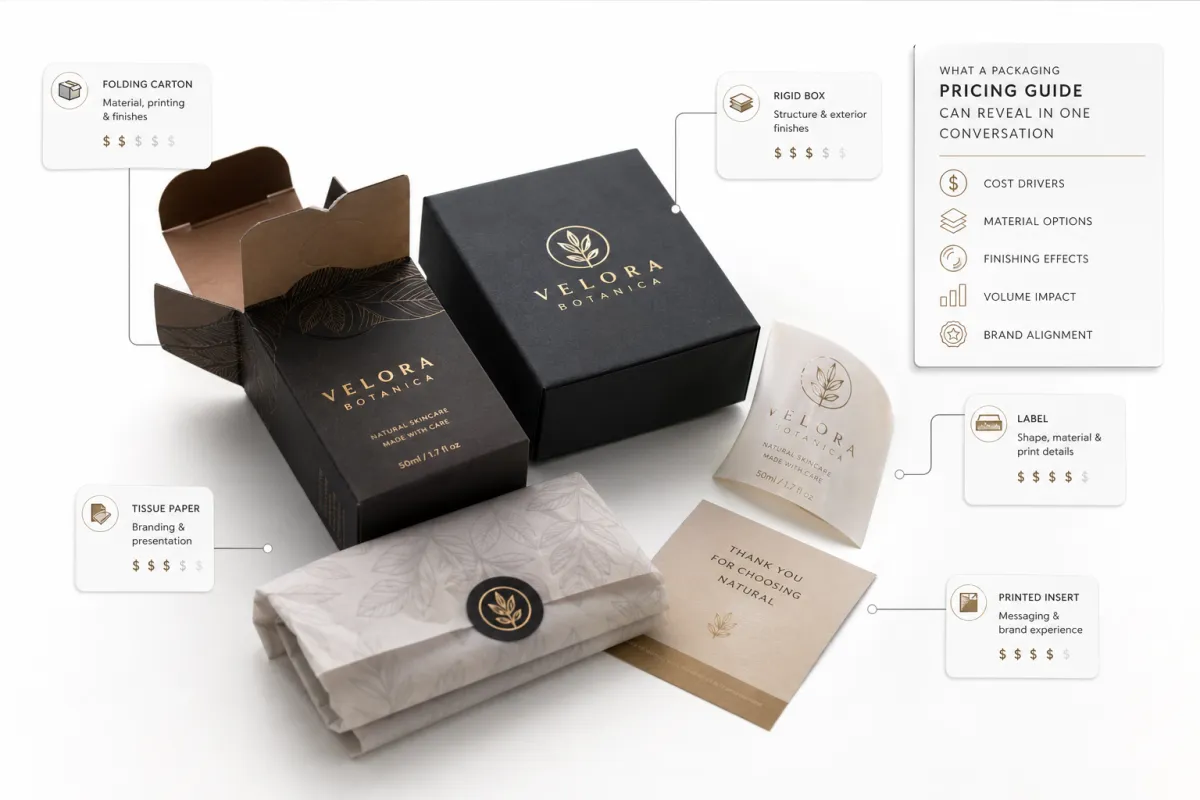
A product packaging pricing guide is not a spreadsheet trick. It is a practical framework that turns vague quote language into comparable numbers across material, tooling, finishing, shipping, compliance, and revision costs. The first useful question is often not, “What is the unit price?” It is, “What assumptions are built into this unit price?” That change in framing moves the discussion from bargain hunting to margin protection. In one review, that meant I spent less arguing and more choosing.
I still remember standing on a factory floor in Shenzhen while an operator ran a short carton job for a candle brand using 350gsm C1S artboard, matte aqueous coating, and a straight tuck end. The buyer wanted 500 units to test the market, and the quote was higher than a 5,000-unit version because setup, plate handling, and waste allowance did not shrink with quantity. The machine still had to be cleaned, calibrated, and run up the same way either way. That is why a packaging pricing guide has to explain why 500 pieces can cost more per unit than 5,000, even when the material stack looks identical on paper. I was half amused and half irritated, because the buyer kept looking at the package as if it had personally offended him.
“We thought the smaller order would protect cash, but it just concentrated the setup cost into every box.” That was a buyer’s exact line in a Guangzhou meeting, and it was the right complaint for the wrong reason.
Where do buyers usually go wrong? They judge total cost first, skip print area, ignore waste allowance, and treat MOQ commitments like a footnote. Then they loop back to the supplier three times asking for revisions that should have been locked before pricing. I say this with affection and a little frustration: packaging teams create their own emergencies by not pinning down the basics early. A strong product packaging pricing guide breaks that cycle. It gives teams a repeatable way to compare a 350gsm C1S folding carton against a 24pt SBS rigid sleeve, or a soft-touch mailer against a matte varnish version, before rework starts eating schedule and cash.
- Look at setup costs first: die cutting, plates, file prep, and proofing are often fixed across small and mid-volume runs.
- Check the waste allowance: a 5% variance on 500 units behaves very differently than the same percentage on 10,000 units.
- Compare landed cost: freight, duty, palletization, and carton dimensions can erase savings that looked strong at quote stage.
- Lock the revision count: two included rounds are not the same as unlimited edits.
That baseline mindset shift matters because the lowest sticker price is often the least useful quote. I have seen a $0.18 unit price turn into a $0.31 reality after freight from Ningbo to Chicago, reproofing, and a second coating pass. A practical guide reduces quote anxiety, exposes price levers, and turns intuition into decision logic that procurement, design, and leadership can all understand. Yes, I have watched people argue for forty minutes over a finish they could barely see while ignoring freight, which is packaging’s version of rearranging deck chairs on a ship that is already moving away from the dock. The price tag is only useful when the assumptions behind it are visible and measurable.
What is included in a product packaging pricing guide and why it matters
A useful product packaging pricing guide starts with the cost stack, not with the glamorous parts of package branding. Stock grade, converting, printing technique, finishing, labor, packaging format, compliance marks, and fulfillment touches all sit in different buckets, and each bucket behaves differently at scale. A 16pt C1S carton is priced differently from a rigid setup box with magnetic closure, or from a 1200gsm greyboard sleeve wrapped in 157gsm art paper. If the quote does not separate those pieces, you are reading a marketing story, not a cost model. I learned that while untangling a quote that looked clean on page one and turned into a detective novel by page three.
I split every line item into fixed and variable costs because that one discipline clarifies almost everything. Fixed costs usually include die creation, prepress cleanup, mock-up rights, and press setup. Variable costs include board, ink, lamination, spot UV, assembly labor, and carton packing. Once fixed and variable are clear, people stop asking for a cheaper quote when what they need is a larger run size, fewer revisions, or a simpler finish spec. Honestly, this is the least romantic part of packaging buying, and that is why it is the most useful: boring math keeps the project from wandering off a cliff. It is also where most quote arguments should be settled.
Some quote terms are still being used like magic vocabulary when they should be standard operating language. A die-cut is the shaped cut line that forms the structure. Reverse imposition controls how sheets are nested to maximize yield. UV spot is selective gloss on one element, not a free upgrade. Soft-touch coating improves feel but often slows throughput by 8% to 15%. A dieline proof is the technical drawing that prevents the structure from collapsing in production. And mock-up rights matter if you need an approved sample for a buyer, investor, or compliance review. Each term can move cost, so “just send me the quote” is not a reliable instruction unless everyone is using the same language.
One quote may use premium vocabulary and still hide weak assumptions. A stronger approach is to ask for exact paper certifications and transit conditions early. If your design requires FSC-certified board, ask for exact paper grade and chain-of-custody status. If transport performance matters, ask whether the supplier is benchmarking against ISTA 3A, ISTA 6, or another method; guessing from sales language is how hidden cost creeps in. I keep packaging.org open for general references, and I check ISTA when handling and shock criteria are central. This habit belongs in every serious product packaging pricing guide.
Trust is also technical. A supplier who can explain ASTM references, coating cure times, and board caliper tolerances is usually giving a stronger signal than one who only says “premium looks.” On one line in Dongguan, I watched a 0.2 mm board thickness difference alter folding behavior at a rate of 1,400 cartons per hour. That is not theory. In production, a millimeter (or less) is enough to trigger stoppage and rework. If you have seen a line pause because a fold was off by a hair, you know that frustration is very real. A reliable product packaging pricing guide does not hide those details; it uses them to set expectations before the order is locked.
How this product packaging pricing guide handles cost and pricing drivers
The easiest way to use a product packaging pricing guide is to build a cost matrix and then run a few “what if” passes. Start with carton structure, board weight, print color count, coating or lacquer, cutting complexity, and quantity tiers. Then add practical costs: assembly time, insert handling, packing method, and whether the job is retail packaging, shipper packaging, or a hybrid. A 4-color printed sleeve with matte aqueous coat is one profile. A two-piece rigid box with foil, embossing, and ribbon pull is another animal entirely. I say this because people underestimate how much “one extra finish” can distort the full quote.
The biggest multiplier in practice is finish intensity relative to carton size. Extra post-print treatment can increase unit cost over mid-volume runs because the job slows at more than one station. I once reviewed a beauty client's design that seemed simple: white box, one logo, one metallic accent, 157gsm art paper over 2mm greyboard. The spot UV pass alone added 18%, because the line speed dropped and reject rate climbed when the coating hit a dense logo area. The buyer imagined elegance; the factory was paying for complexity. That gap between intent and machine reality is where budgets go to misbehave, and it is exactly where a product packaging pricing guide earns its keep.
Artwork and prepress are quiet cost drivers with loud impact. Rushed cleanup, color correction cycles, and dieline edits can add money quickly when not pre-approved. A buyer who sends a low-res logo, an unlocked file, and a resized dieline tends to pay for confusion in one form or another. Good guide language should explicitly say whether prepress is included, whether the supplier owns the mock-up, and whether proof revisions are billed per round. I have watched teams treat this as a minor detail until the invoice lands. Better to resolve it in the quote than in the postmortem.
| Run Size | Setup | Board + Print | Finishing | Freight | Effective Unit Cost |
|---|---|---|---|---|---|
| 500 units | $280 | $0.62 | $0.24 | $115 | $1.59 |
| 5,000 units | $280 | $0.18 | $0.11 | $390 | $0.35 |
| 10,000 units | $280 | $0.15 | $0.09 | $620 | $0.29 |
This table is illustrative and simplified, and your numbers will move with currency, lane, and supplier capability. It still shows the shape of the problem: setup is almost flat, while variable costs fall quickly as volume rises. That is why a product packaging pricing guide should normalize quotes to one run-size baseline and one freight assumption before final comparison. For anyone shopping Custom Packaging Products, the difference between a 500-piece pilot and a 5,000-piece launch is usually not creative brilliance; it is math, material yield, and line speed.
Logistics inputs can alter the final number more than buyers expect. Freight class, destination surcharges, pallet footprint, carton-to-carton void rates, and stacking strength all matter. A lightweight carton in an oversized master case can look cheap in the quote and expensive at the dock. I saw one polished Custom Printed Boxes order absorb 7% more than budget because pallet loading wasted space and triggered an extra lane charge from Guangzhou to Atlanta. If the plan is national rollout, those cents become dollars fast. A few teams say “it was only packaging,” then watch inventory miss dates. A clear guide keeps freight from hiding in plain sight.
My working sanity rule is simple: if a 10% spec change shifts unit cost by more than 7%, I flag it as a pricing lever. If the same change moves the number by less than 2%, I treat it as design preference and prioritize timing and reliability first. That rule keeps the model focused on decisions that move margin. It also keeps teams from arguing about sheen while ignoring yield, damage rate, and freight variability. In my opinion, that is a practical trade, not a fancy one.
Step-by-step process and timeline: turning the guide into a decision model
Step one is fixing business requirements before someone opens CAD. Shelf life, storage conditions, and transport reality should be priced before style decisions. A tea box in humid Miami does not need the same board or finish as a dry-goods sleeve in a climate-controlled retail back room in Denver. I ask teams to answer three things first: how it will be stored, how it will be shipped, and what failure looks like if it fails. That sets a product packaging pricing guide on real-world ground instead of mood-board vibes.
Step two is collecting historical data. If a company has launched one or two programs, the best benchmark is already in old files: purchase orders, complaint logs, fulfillment reports. Dimensions, quantities, damage rate, and return reasons all matter. One cosmetics client had a 3.4% crush issue on a mailer that looked fine in photos but failed in transit because the insert was 1.5mm too thin. The number mattered more than the mock-up. The buyer kept pointing at renders as if the image could fix the fold structure. It could not. A product packaging pricing guide becomes more accurate when it learns from those past misses.
Step three is requesting three scenario quotes from each supplier: low, mid, and high spec. That one habit removes a lot of noise. It forces suppliers to show exactly what changes if you move from 1-color to 4-color, from aqueous coating to soft-touch lamination, or from standard tuck flap to magnetic closure. A practical guide converts those scenarios into cost per sellable unit and cost per launch cycle, which are better lenses for decision-making than unit price alone. It also reduces supplier side-stepping, because the apples are now much easier to compare.
Step four is timeline control, because cost without dates is half a plan. Confirm design lock, proof approval, tool setup, production, QC, and shipping windows, and tie each milestone to what happens if it slips. I have seen a supplier hit a perfect print spec and still miss launch because the die line proof sat in an inbox for six business days. That delay is common, and it is usually avoidable. A good guide makes those delays visible before they become your problem. In a typical Shenzhen-to-West-Coast program, production can be 12 to 15 business days from proof approval, plus 3 to 5 days for air or ocean handoff depending on the lane.
- Design lock: freeze dimensions, copy, barcode placement, and compliance text before quoting.
- Proof approval: complete structure, color, and finish sign-off in one cycle where possible.
- Tool setup: confirm die, plate, and cutting schedule before claiming a start date.
- Production: track press time, coating cure time, and packing labor separately.
- Shipping: verify pallet count, carton count, and delivery window before release.
Step five is adding a contingency bucket, usually 10% to 20%. Material yield variance, regulatory copy updates, label fit changes, and late-stage artwork corrections happen in almost every project. A buyer who budgets with zero buffer is betting that every line item behaves perfectly. That rarely happens. I prefer comparing final totals, not optimistic one-time numbers, because your guide should protect launch outcomes, not spreadsheet ideals. If the plan only works in theory, then it is not a plan, just wishful math.
To make the timeline real, I build a calendar with explicit dates: quote due, sample due, approval windows, and production cutoff. Once dates are visible, timeline stops being a rumor and starts being a control variable. It sounds basic. It is not basic when design, purchasing, and three vendors are all waiting on the same carton approval. A physical sample from Dongguan to New York can take 4 to 6 business days by courier. That transit window should be in the plan from day one, not added after the fact.
Common pricing mistakes in custom packaging and how to catch them early
The first mistake is comparing only unit price and ignoring minimum order quantity traps. A supplier may quote $0.24 on 10,000 units and $0.46 on 1,000 units, but the effective starting position can make the smaller run much more expensive once setup and freight are included. A solid product packaging pricing guide forces you to calculate the real starting point, not just the cleanest line on page one. It sounds obvious. In practice, people get hypnotized by the lowest number as if a trophy came attached.
The second mistake is underestimating artwork revisions. Three revisions can sound harmless, but one dieline shift, one logo recolor, and one legal copy update can become three separate prepress passes. I recommend every comparison sheet include a fixed number of revision cycles and a stated cost beyond that threshold. In one supplier negotiation, a buyer argued over a $75 proof fee while ignoring a $420 re-plate bill from late copy changes. The fee was not the issue. The process was. A guide should make revision economics impossible to ignore, because that is where surprises are born.
The third mistake is treating sample and proof fees like dead overhead. They are not dead. They are risk-reduction investment, and a disciplined product packaging pricing guide folds them into the first production run. If a mock-up costs $95 and avoids a 2,000-unit reprint, that was a smart use of budget. If someone skips sample to move faster and then approves a rushed version with a wrong insert slot, the project pays later. I would rather spend a bit on proofing than spend a lot arguing about why the launch shipped with a structural error.
The fourth mistake is choosing the most creative supplier and assuming production discipline will automatically follow. I have seen award-level visuals collapse under weak QC, uneven glue lines, and slow response windows. The box looked gorgeous in render. The cartons arrived with scuffed corners and inconsistent fold memory. A supplier who can do aesthetics is useful. A supplier who can also meet timeline and spec is the one worth paying. If you want real examples across formats, the Custom Packaging Products catalog helps you compare structure and finish at a glance. A practical product packaging pricing guide keeps creative appeal and manufacturing discipline separate.
A simple error log catches these issues early. Tag each discrepancy under material, finishing, labor, logistics, or compliance. In my experience, about 60% of surprises fall into material and finishing. That means the biggest gains usually come from board, coating, and print complexity, not from squeezing freight by a few cents. A disciplined guide makes that pattern obvious before order lock. It is less poetic than “big idea” packaging talk, but far more profitable.
- Material mismatch: 16pt board quoted as 18pt, or SBS swapped for C1S without disclosure.
- Finishing mismatch: soft-touch, foil, or embossing omitted from first draft and added later.
- Logistics mismatch: domestic trucking assumed while the route is actually palletized air freight.
- Compliance mismatch: FSC, barcode, warning copy, or recycling mark added after approval.
Most buyers lose money not because they negotiate badly, but because they never compare the same object twice. A product packaging pricing guide helps by standardizing the spec before conversation starts. Once the data is clean, negotiation becomes real. Before that, it is just noise with a price tag. And noise in packaging buying is expensive in the long run. I have seen launch plans wobble because teams never aligned on the same version of the box.
Expert tips for faster approval and fewer surprises in the product packaging pricing guide
My favorite approval tool is a one-page scorecard with weighted criteria: cost 40%, quality 25%, lead time 20%, compliance 15%. That may sound rigid, and yes, it is. It keeps teams from choosing a supplier just because a render looked polished in a deck. A good product packaging pricing guide should support decisions that survive finance review, not just creative review. I have worked with teams who optimized for “looks great in a meeting” and paid for that choice in the warehouse.
Ask every supplier for a manufacturing readiness checklist. If the vendor cannot explain process choke points—lamination line speed, coating curing, die-cut capacity—I delay commitment. During one negotiation in Ho Chi Minh City, a supplier promised a 9-business-day turnaround on a soft-touch carton, but omitted an overnight cure requirement before folding. When that surfaced, the schedule moved by four days. That was not the supplier being deceptive. It was the buyer not asking technical questions early. I have empathy for everyone in the room, but only one side gets blamed when the shipment lands late.
Benchmark lead times by process step, not by slogan. Ask for accepted jobs with similar finish and similar quantity, not generic averages. A 1-color sleeve with no coating is not comparable to a 4-color box with foil and embossing. If you want better outcomes, compare like with like: same board, same finish, same route, same destination. It sounds strict because it is. Precision hurts briefly and saves heavily. In practice, a Ningbo-to-Dallas lane may be 16 to 21 days door to door, while a domestic run from Ohio can land in 5 to 7 business days. Those differences must sit in the pricing model before margin review.
Protect cash flow by separating pilot spend from scale spend, and stating when pricing locks from pilot to production. A 500-unit pilot can be valuable, but only if everyone agrees the 5,000-unit quote is based on the same assumptions. I have seen buyers assume a pilot price rolls straight into launch. It almost never does. Press setup, yield curve, and shipping profile change as quantity changes, and a guide should spell that out plainly. If it stays vague, surprise arrives later with the next invoice and a freight line item.
When two suppliers are close on cost, I choose the one with stronger proof-to-production consistency. Packaging errors are hidden multipliers no price sheet fully reveals. A supplier that hits proof and misses production turns a modest quote into repackaging cost, late shipment, and a frustrated sales team. It is one of the least glamorous truths in package branding, but the one that saves most money. I would rather be slightly less dazzled by visuals and slightly stronger on outcomes by quarter-end.
If you want a practical rule: do not let 3% savings lure you into 12% operational headache. A reliable product packaging pricing guide keeps focus on net outcome, not vanity savings that disappear after launch. I have had clients thank me only after one missed launch window, because then the cost of delay becomes visible in stockouts. The cheapest quote can look clever until the shelves stay empty. That is why this guide exists: to protect margin, schedule, and sanity in the same pass.
So the principle is this: the strongest product packaging pricing guide tells the truth about tradeoffs. It does not promise perfect numbers. It makes numbers practical. For a team buying custom printed boxes, that is the difference between guessing and planning. That also makes branding decisions easier to defend when finance asks hard questions.
FAQ
How do I use a product packaging pricing guide without overcomplicating procurement?
Keep every quote on the same sheet and score it against identical line items: material, setup, print, finish, freight, and lead time. Then compare total landed cost per unit instead of headline price. I usually tell teams to keep it to one spreadsheet and one scorecard. If your structure is consistent, it is enough to make good decisions without creating a process nobody enjoys running. I am all for rigor, but not for a bureaucracy that needs its own badge and an intern to explain it.
What are the fastest ways to estimate product packaging pricing before requesting formal quotes?
Start with prior jobs of similar size and material, then adjust for finish depth and quantity. Add a realistic 10% to 20% buffer for sample development and approval cycles. If the rough estimate already misses your margin target, tighten the spec before suppliers spend engineering time on full quotes. A product packaging pricing guide works best when it prevents bad briefs, not just bad buys. I have seen bigger budget wins from better scope discipline than from squeezing a supplier, because bad assumptions are expensive.
How can a product packaging pricing guide help predict timeline risks?
Tie every milestone to a clear assumption. If design freeze slips by two days, setup and press time usually shift too. Ask each supplier for process and timeline charts with explicit deadlines, proof windows, and late-step contingencies. My rule is simple: no production starts until artwork, proof, and compliance are approved in one cycle. That rule belongs in every practical guide, because it prevents one delay from becoming three, four, and then a full week of noise.
Can a product packaging pricing guide reveal hidden costs in high-end finishing?
Yes. Lamination, spot UV, embossing, debossing, and specialty adhesives are often presented as optional upgrades, but they should appear as separate cost lines in the spec. Ask for finish-specific unit costs and approved yield rates. A finish can look stunning and still reduce speed, raise waste, or increase reject rate. A good guide makes those tradeoffs visible before order lock, which is what keeps “nice idea” from becoming “why is this invoice so high?”
Should I prioritize low unit price or lower total cost in a product packaging pricing guide?
Prioritize total landed cost. The lowest unit price is often offset by setup, freight, rework, or late-delivery penalties. Build a break-even model across three to five order sizes and choose the option that is lowest at your actual run size, not the one with the prettiest headline. I also score reliability and timeline compliance because stockouts and emergency fulfillment can erase savings faster than any single line item. If a supplier saves pennies and creates headaches, I do not call that saving. The guide should point you toward lower total risk, not just lower sticker.
If you keep your product packaging pricing guide anchored to the same assumptions, same board grade, and same delivery reality, it becomes a reusable tool instead of a one-time spreadsheet exercise. That is the part I trust most: clear specs, honest timing, and enough detail to make the next order cheaper to approve and easier to launch. It is not magic. It is just the kind of clarity that saves teams from relearning the same lesson on the next project, and that is what, over time, cuts packaging costs in a way people can actually feel in cash flow and on shelf availability.

