Buyer Fit Snapshot
| Best fit | Order Custom Dieline Shipping Boxes That Fit Right projects where brand print, material claims, artwork control, MOQ, and repeat-order consistency need to be specified before quoting. |
|---|---|
| Quote inputs | Share finished size, material target, print colors, finish, packing count, annual reorder estimate, ship-to region, and any compliance wording. |
| Proofing check | Approve dieline scale, logo placement, barcode or warning zones, color tolerance, closure strength, and carton packing before bulk production. |
| Main risk | Vague material claims, crowded artwork, missing packing details, or unclear freight terms can make a low unit price expensive after revisions. |
Fast answer: Order Custom Dieline Shipping Boxes That Fit Right should be specified like a repeatable production item. The safest quote records material, print method, finish, artwork proof, packing count, and reorder notes in one written spec.
Production checks before approval
Compare the actual filled-product size with the drawing, then confirm tolerance on folds, seals, hang holes, label areas, and retail display edges. Reserve space for logos, QR codes, warning copy, and material claims before decorative graphics fill the panel.
Quote comparison points
Review material grade, print process, finish, sampling route, tooling charges, carton quantity, and freight assumptions side by side. A quote is only useful when the supplier can repeat the same color, closure quality, and packing count on the next order.
If you need to order custom dieline shipping boxes, stop guessing and start measuring the actual packed product. Use calipers where they make sense, use a ruler where they do not, and measure the item in the condition it will ship in, not the condition you wish it had. I remember a packaging audit in Los Angeles in 2023 where a team had already burned six hours on returns while insisting their “close enough” carton was fine. On the bench, it looked acceptable. In transit, it was kinda expensive. A stock box that is off by even 1/4 inch can create extra filler cost, dimensional-weight creep, and corner damage that turns a healthy margin into a quiet loss.
That is why I push buyers toward a dieline instead of a random carton pulled from a catalog. A correct structure protects the product, removes dead space, and gives warehouse teams a repeatable pack-out for ecommerce shipping. In a Shenzhen line I watched, a brand cut average pack time from 52 seconds to 39 seconds per carton after moving from a loose stock shipper to a custom dieline with locking tabs. If you want a starting point, our Custom Shipping Boxes page shows the structures we build every week, and our Custom Packaging Products lineup covers the rest of the packing mix.
Most packaging waste starts with one lazy assumption: “good enough.” That sounds harmless until you see the bill. In a Dongguan factory, it can mean 300 cartons, two extra rolls of tape, and another labor hour burned on avoidable rework. A box that is off by a few millimeters shifts in transit, the void fill gets messy, and the brand starts looking improvised instead of deliberate. I have seen that mistake in a corrugate plant near Shenzhen and again at receiving docks in Ontario, California; the invoice always arrives later, and it is never generous.
Here is the part people underestimate: bad fit is contagious. Once one team member starts taping extra seams, stuffing one more layer of tissue, or folding a flap twice because the first closure did not hold, everyone else copies the workaround. The process drifts. Shipping cost per order starts climbing like a broken stock ticker. On a DTC candle project in Chicago, one sloppy carton spec added 18 seconds of packing time and 9% more dunnage across a 4,000-unit run. The fix was boring, and boring was exactly why it worked: get the dieline right, then lock the spec.
Why order custom dieline shipping boxes instead of guessing sizes
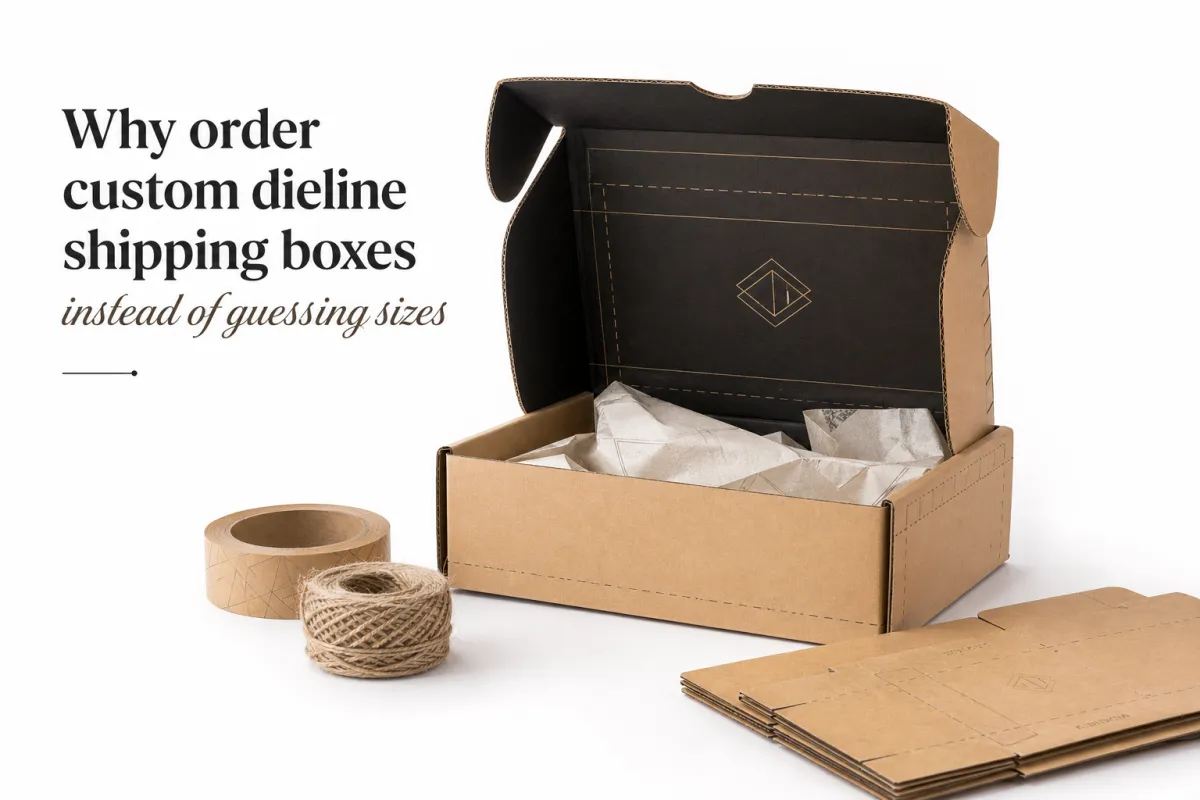
The first reason to order custom dieline shipping boxes is fit. Stock boxes create dead air, and dead air costs money in corrugate, in dunnage, and in freight cube. I once stood beside a packing line where a cosmetics client was shipping glass jars in a carton that was only 3/8 inch too tall. On the bench, the fill looked acceptable. In parcel testing, the jars moved, the corners split, and every damaged order carried a $6.20 replacement cost plus another $4.75 in outbound freight. That is not a tiny mismatch. That is a margin leak with a label on it, and the label says “avoidable.”
A custom dieline handles three problems at once. It shapes the carton around the product instead of forcing the product into a random rectangle. It lowers dimensional weight when the finished size is right. It also makes the unboxing cleaner, which matters whether the item is a DTC candle, a supplement bottle, or a 14-ounce electronic accessory kit. Good product packaging is not decoration. It is a shipping decision with a measurable cost, and unlike brand mood boards, that cost is paid at the dock in dollars, not opinions.
I learned that lesson during a factory visit in Dongguan, where a folder-gluer was running 2,400 blanks an hour until one “almost right” carton started jamming because the flap depth was off by 1.5 mm. The operator did not care that the artwork looked polished. He cared that the line stopped for 17 minutes while the crew cleared a jam and reset the guides. That is what a bad dieline does: it interrupts labor, piles up rework, and turns a cheap-looking carton into an expensive headache. I remember telling the team the box was not cheap at all; it was expensive in disguise, and nobody laughed except me.
That is why I tell buyers to order custom dieline shipping boxes before they place a pallet order for the wrong size. Fewer crushed corners. Less slop in the shipper. A clearer read on whether the carton can survive parcel handling, drop tests, or pallet stacking in a 48-inch-high load. If you use ISTA testing standards as a reference, you are already thinking like a buyer who understands transit risk instead of gambling on it. One ISTA 3A-style test can save a 3,000-unit run from a 2.5% damage rate.
“We cut our damage claims by 52% after the carton fit the product instead of swimming around it, and our reprint spend dropped by $3,400 in one quarter.”
That line came from a client meeting in Los Angeles after we moved a small appliance line into a tighter kraft shipper with a one-color mark and a 350gsm C1S artboard insert. Nothing ornamental. Just a box that fit, a cleaner pack-out, and less filler. That is the point of order custom dieline shipping boxes: practical protection, predictable packing, and fewer returns from transit damage, usually within 12-15 business days from proof approval for standard runs.
Presentation matters too. A carton with the right structure feels like branded packaging even if it uses one ink color, a matte varnish, and a simple kraft base. The box opens cleanly, the insert sits flat, and the customer sees that someone planned the shipping experience instead of improvising it. That carries more weight than glossy noise. A practical structure also creates fewer “why is this so flimsy?” messages from customers, which is a weirdly powerful signal of trust-building. On one subscription kit in Seattle, those messages dropped from 31 a month to 7 after the box depth was corrected by 4 mm.
Most teams think structure is only for fragile goods. I would argue the opposite: structure is for every shipment, especially the ones everyone assumes are harmless. A shampoo bottle, a pair of shoes, a tiny metal tool kit, a 900-gram coffee grinder. If it can shift, it will. If it can shift, your box design gets tested anyway, usually during the first 300 miles and again at the final delivery scan.
Product details for custom dieline shipping boxes
A dieline is the blueprint. It shows cut lines, fold lines, glue areas, flap layout, and print placement for your carton. If you want to order custom dieline shipping boxes without confusion, start here. The dieline becomes the shipping carton specification that decides whether your piece is a regular slotted container, mailer-style shipper, tuck-top box, or a die-cut packaging format with a tighter retail feel. In practical terms, it is the difference between a carton that closes in 3 steps and one that takes 9, then gets taped shut anyway.
For lighter ecommerce items, I usually point buyers toward single-wall corrugated with the correct flute profile and board grade. For heavier loads, I will not pretend a soft board can carry the job. You need the correct caliper, the right ECT, and sometimes a stronger wall construction if the box sits on a warehouse pallet for 24 or 48 hours before pickup. A carton that looks good but fails under 40 pounds is just a nicely printed collapse, and I have seen one fail at 38.6 pounds in a lab in Ningbo. The lab report was polite. The shipping floor was not.
There are a few common structures worth knowing before you place a dieline order:
- Regular slotted containers for straightforward shipping, especially when the SKU is stable and the goal is to keep board cost below $0.70 per unit at 1,000 pieces.
- Mailer-style shippers for DTC brands that want a better opening moment and a tighter closure, especially on 6 x 4 x 2-inch and 9 x 6 x 3-inch formats.
- Die-cut packs for product packaging that needs a specific presentation and a precise fit around inserts, sleeves, or trays.
- Partitioned cartons for glass, bottles, cosmetics, or kits with multiple SKUs in one shipper, often with 2-cell, 4-cell, or 6-cell layouts.
In practice, inserts and locking tabs can save more money than a bigger carton ever will. I visited a food subscription co-packer in Xiamen where they were using oversized shippers because “the product varies a little.” We tightened the structure, added a paperboard insert, and cut void fill by 38%. Packing labor dropped by 11 seconds per box. That sounds small until the line runs 8,000 units a week and every second has a payroll cost. I remember standing there thinking, “If only we could bill those seconds back to the carton,” but the carton was never going to pay us.
For branding, restraint usually wins. A kraft-only build can work if the customer already knows the brand. A one-color flexographic print is enough for many shipping programs, especially when the imprint area stays under 20% of the exterior panel. Full-coverage print makes more sense for launches, retail packaging crossover, or any carton that has to carry the story on its own. If you want a more promotional look, compare the structure with our Custom Poly Mailers for lightweight fulfillment lanes, but do not force a mailer to do a shipper’s job when the item weighs 22 ounces or more.
Plainly put, structure comes first and ink comes second. If the structure is wrong, pretty print does not rescue it. If the structure is right, even a plain box feels intentional. I once reviewed a shipment where a beautifully colored carton arrived with soft corners and a torn top edge; the brand team was upset about the fade, but what they really meant was that the box did not hold up after a 1,200-mile lane from California to Texas.
There is also the hidden detail people forget: scoring direction and glue edge location determine whether the box opens in a way the warehouse team can repeat. If the fold behavior is unpredictable, staff invents their own method, which is fine in a training simulation and disastrous in full production. A proper dieline is a promise: this shape should fold the same way every time, whether packed by me, you, or a third-party warehouse in Mexico City, Nashville, or Toronto.
Specifications to lock down before you order custom dieline shipping boxes
Before you order custom dieline shipping boxes, lock down the measurements. Not “roughly 9 by 6.” I mean finished product dimensions, insert clearance, and whether the box needs to hold one unit, a kit, or a full packed set. Sloppy dimensions produce a sloppy fit. That is not a supplier problem. That is math with bad inputs, and math usually wins.
People confuse internal size, external size, and ship-ready size all the time. Internal size is the usable space inside the carton. External size includes board thickness. Ship-ready size is what matters to freight quotes and warehouse shelving. I have seen teams compare the wrong number, then act surprised when the pallet plan misses by 2 inches and the truck load jumps $180 on a 600-mile run. I can tell you from experience that one wrong decimal place has a way of turning into a very expensive phone call.
You should also be specific about board performance. Ask for the ECT, burst strength, and suggested weight range. A 32 ECT single-wall shipper may be fine for a 6-pound apparel box, but not for a 28-pound kit that gets moved twice before delivery. If the carton is going parcel instead of pallet, the test profile changes. That is why I ask how the package travels before I quote anything. A lot of people quote for distance, not handling reality, and the difference shows up after the first drop test.
Here are the details that matter most when you plan a custom dieline shipping boxes build:
- Finished product dimensions and whether the item ships in a sleeve, bag, or protective wrap.
- Closure style, including tuck flaps, dust flaps, tape seal, or self-locking tabs.
- Print-safe zones so logos do not land on folds, seams, or glue areas.
- Stacking strength if the cartons are stored in a warehouse for 7 to 30 days before ship-out.
- Orientation of the product inside the box so inserts and cutouts line up properly.
If the product is fragile, premium, or expensive to replace, I always recommend a structural proof or physical sample before mass production. That is not a luxury. It is insurance. A sample costs far less than 300 boxes that are 1/8 inch too short for the insert. I have watched teams spend more than that trying to make it work with foam, tape, and a prayer. In one Philadelphia project, a $42 sample prevented a $1,900 rework charge.
For anything with breakage risk, I also want the buyer thinking about FSC-certified material options and whether the board spec matches their sustainability claims. No sermon required. You need a carton that fits the product, supports the shipping lane, and does not force the warehouse to improvise with extra tape and extra foam. If the carton has a recycled-content claim, ask for the percentage in writing, such as 80% post-consumer fiber or 100% virgin kraft, before the run starts.
So yes, order custom dieline shipping boxes only after the spec sheet is boringly complete. Boring is useful here. Boring prevents mistakes. My least favorite quote from a project manager was, “We need to ship fast.” My favorite was, “We need to ship right.” Usually, right ends up being faster too, especially when the run is 2,000 units and the first sample is approved on the first pass.
As a final prep step, confirm the tolerance for your insert fit and corner radii. It sounds nerdy, but in one run a 1 mm difference at one corner became a full rework because the accessory tray never seated flat. The CAD looked good. The floor did not. That is why I always ask for the tolerance band in writing, not as a passing comment in a thread.
Pricing for custom dieline shipping boxes: what actually moves the number
If you want to order custom dieline shipping boxes and keep the budget under control, learn the price drivers. Size is the first one. A box that uses 12% less board can save real money at scale. Print coverage is the second. A plain kraft shipper costs less than a full-color carton with coated finishes, and that difference shows up faster than most people expect. Quantity matters too. Setup costs, die-cut prep, and press calibration get spread across the run, so 250 units will always cost more per box than 5,000.
There is a detail buyers miss all the time: a cleaner structure can lower cost even when the unit quote looks slightly higher. If the dieline cuts down void fill, reduces carton weight, or lets you shrink the ship-ready size, your total landed cost can drop. That is the number that matters, not the sticker price in the email. I see this all the time in Q4 planning, where teams chase a tiny print savings and end up paying more in courier charges and damage claims. On one run in Atlanta, a $0.06 cheaper carton created $0.19 more in shipping expense per order.
These figures are directional, not universal. Board mills, freight lanes, ink coverage, and seasonality all move the number, so treat any quote as a snapshot rather than a law of nature.
| Option | Typical Use | Approx. Unit Cost at 1,000 pcs | Notes |
|---|---|---|---|
| Kraft mailer, no print | Light ecommerce shipping | $0.62-$0.88 | Simple structure, low setup, best for low-friction fulfillment |
| One-color printed shipper | Branded packaging for DTC orders | $0.84-$1.25 | Good balance of package branding and cost control |
| Heavy-duty die-cut box with insert | Fragile product packaging | $1.30-$2.10 | Higher material use, better protection, stronger presentation |
| Premium printed carton with special finish | Retail packaging crossover | $1.95-$3.40 | Best for launches where presentation matters more than bare-bones cost |
| High-volume custom run, 5,000 pcs | Recurring shipping program | $0.15-$0.39 | Typical for a simplified one-color structure with standard board and no special finish |
Those figures move with board grade, ink coverage, insert count, and tooling complexity. If you are quoting Custom Printed Boxes with custom inserts, do not pretend the price should match a plain carton. That argument runs straight into physics and loses. A 44 ECT carton with a two-piece insert and full-coverage print is not the same animal as a plain shipping box, and the difference can be $0.58 to $1.10 per unit depending on the run size.
I also want buyers to request tiered pricing at 250, 500, 1,000, and 5,000 units. That is where break points show up. On one beverage project in Portland, the jump from 500 to 1,000 boxes cut the per-unit price by $0.14 because the die and press setup were spread out properly. At 5,000 units, the price fell again to $0.15 per unit on a simplified shipper. That matters when your order fulfillment margins are thin enough to feel in your sleep.
Ask for landed cost, not just ex-factory price. Freight, pallet prep, sample charges, and repacking can quietly add $120, $280, or more depending on the lane. I have seen a quote that looked 8% cheaper turn out 11% more expensive after freight from Ningbo to Dallas. That is why you should lock cost assumptions with the full math on the table, including the cost of one sample at $25 to $75 if you need a physical prototype.
One more thing. If you are buying at volume and need repeat runs, ask about Wholesale Programs. A good supplier should keep the structure stable, the pricing predictable, and the reorders less annoying than they need to be. I prefer a supplier who can answer with clear numbers on Wednesday and still has bandwidth to support Monday mornings when the first batch ships from Shenzhen, Dongguan, or Suzhou.
And yes, ask about die changes and tool reset cost before production. I have sat in too many meetings where “no problem, it is just one tweak” became a week-long reprint saga and an extra $220 setup fee. Transparency here saves your sanity and your spreadsheet.
How to order custom dieline shipping boxes without delay
The fastest way is to send clean input on day one. I want finished product dimensions, product weight, shipping method, target delivery date, and whether the carton needs inserts, partitions, or a special closure. If you send a vague email that says “need a box for our stuff,” the process slows down immediately. Nobody can quote against mystery meat, and no factory in Guangdong should be expected to guess your packaging intent from a three-word message.
The proofing stage is where the important work happens. The supplier sends a dieline file, usually as PDF or AI, and you check the dimensions, folds, glue areas, and print placement. If the logo sits too close to a flap or the locking tab interferes with product clearance, fix it now. Not after the run is on press. I have been on a floor where a missed fold line cost a client 1,200 blanks and half a day of labor. That kind of mistake is cheap to catch on screen and expensive to catch on a machine that runs 3,000 cartons per hour.
For fragile or premium items, I push for a physical sample. A digital proof cannot tell you how a bottle rattles, how a divider flexes, or whether the lid rubs against the top flap. I visited a skincare client in Long Beach where the 3D render looked perfect. The sample told the truth: the inner tray needed 2 mm more depth. That single sample saved them from a very embarrassing first shipment. I thought we had one of those “thank me later” moments, and I have to admit it was a small victory worth celebrating.
Timing depends on how fast you approve. Proofing can be quick, sampling adds a few days, and production time changes with quantity, board availability, and print complexity. For a standard corrugated run, you can usually expect 12-15 business days from proof approval to finished cartons leaving the factory. If you want a rush job, be ready to answer emails fast. I have seen buyers ask for a 10-business-day turn, then sit on the proof for 4 days. The calendar does not care about excuses. It just keeps counting like a metronome.
Here is a practical sequence that keeps the job moving:
- Send exact dimensions, weight, and a photo of the product.
- Confirm whether the carton is for parcel, pallet, or mixed shipping.
- Approve the structural dieline before any print lock.
- Request a sample if the item is fragile, expensive, or oddly shaped.
- Lock quantity, freight destination, and ship date before production starts.
If you already know your shipping lane and SKU mix, you can order custom dieline shipping boxes with far less drama. That is true for one-off launches and for recurring order fulfillment programs. The goal is not just getting a box made. The goal is getting a box made on time, built correctly, and delivered without a second round of corrections from a plant in Shenzhen, a warehouse in Arizona, or a co-packer in New Jersey.
At the operational level, this sequence is the same as reducing handoffs in production: clarify, confirm, validate, then execute. I use a shorthand for this in meetings: C-C-V-E. It sounds like a school lunch menu, but it has saved us from repeat edits more times than I can count, especially on 2,500-unit launches where every day costs real money.
Why choose us when you order custom dieline shipping boxes
People do not need more fluff. They need a supplier who can measure twice, quote honestly, and ship what was promised. That is the real advantage when you order custom dieline shipping boxes with us. Better QC. Clearer communication. Fewer spec mistakes. Less time spent translating “close enough” into a usable carton, and fewer surprises when the first pallet reaches Chicago or Denver.
I have sat through enough factory negotiations to know where the money disappears. A reseller with no control over the structure pads the quote. A supplier who guesses at board grade creates damage. A team that does not understand dieline cleanup sends files back and forth for a week. We cut through that. When I visited a corrugate line near Shenzhen, I watched a low-grade spec turn into rework because the flap score was off by 1.5 mm. The operator called it “cheap trouble.” He was right. Cheap trouble is still trouble, and it still shows up on your invoice.
We keep the quote grounded in actual material and production costs. If a board change saves $0.04 per unit, I will say so. If a stronger spec adds $0.09 but saves replacements, I will say that too. That is the kind of honesty buyers need when they are balancing Custom Printed Boxes, shipping performance, and margin. A 350gsm C1S artboard insert, for example, is not the same as a 24pt SBS sheet, and the cost difference shows up in both the line item and the performance.
We also help with structural adjustments and file cleanup. If your dieline needs a stronger lock, a tighter insert, or a better print-safe zone, we handle it before the order moves. That matters for product packaging, retail packaging crossover, and brands trying to keep package branding consistent across 6-inch, 9-inch, and 12-inch carton families. I have seen one missing cut line create a 2-day delay in Ho Chi Minh City and a $310 airfreight correction.
The best part is practical, not glamorous. The boxes run cleanly on the line. They close right. They stack right. They show up ready for warehouse staff who do not have time for creative problem-solving at 6:30 a.m. That is what you pay for when you order custom dieline shipping boxes. Not hype. Not a promise written in glitter. A box that fits the item, travels correctly through parcel or pallet lanes, and keeps its shape in transit from factory to final scan.
For buyers who want a broader packaging mix, our FAQ covers common production questions, and our other Custom Packaging Products options can help if you need cartons, mailers, or other formats in one program. If your SKU mix is wide, that consistency saves time during procurement and order fulfillment. I like this part because it prevents the “different supplier for everything” trap that causes chaos during reorders and usually adds 1 to 2 days of internal admin time per SKU.
And yes, if sustainability is part of your brief, keep the spec honest. Use the right material claims, reference real certifications, and do not slap “eco” on a carton just because it is brown. I have seen brands get burned by vague claims more than once. If you need a clearer packaging design path, ask for structure first and decoration second, then confirm whether the run uses recycled kraft, virgin corrugate, or FSC-certified board from the start.
So, if you want to order custom dieline shipping boxes that fit right, run right, and do not chew through your budget, start with the structure and let the rest follow. Think of it as architecture for shipping, not cosmetics for shipping, and the difference is usually visible in the first 500 units.
Next steps to order custom dieline shipping boxes
The next move is straightforward. Gather the exact product dimensions, weight, photos, shipping method, and any insert or branding requirements. If you want to order custom dieline shipping boxes without wasting a week on revisions, send those details in one clean brief. I would rather get one accurate email than five messy ones. Seriously, I do not care if it takes you longer to write the first message, as long as it includes the SKU, the package count, and the target lane.
Then ask for a structural dieline proof first. If the product is fragile, premium, or packed in multiples, request a sample before production. That is especially true for glass, cosmetics, electronics, and subscription kits. I have never heard a buyer regret approving a sample. I have heard plenty regret skipping it, especially when they had to explain why half the first batch was bent after a 900-mile freight leg.
Before you release the order, confirm the carton count, the ship-to ZIP, and the delivery window. Freight can change the math by a decent margin, and a 300-mile move is not the same as a cross-country lane. If you are comparing options, compare landed cost, not just the box price. The smallest mistake here can feel like a small thing until your logistics team starts looking haunted and the freight invoice adds another $240.
Here is the operational checklist I use for every client:
- Approve the structure.
- Confirm the print.
- Lock the quantity.
- Check the freight destination.
- Release production only after the sample or proof is correct.
That checklist saves time, and time is money whether you are shipping 500 units or 50,000. If you want the short version, here it is: order custom dieline shipping boxes only after the fit is verified. Guessing is how cartons get expensive fast, and I have seen that mistake cost brands more than the print budget itself. If I had a trophy for this, it would be labeled “The Quarter-Inch Cost,” with 1/4 inch engraved on the base.
FAQ
How do I order custom dieline shipping boxes for a new product?
Send the finished product dimensions, weight, closure style, and whether you need inserts or partitions. Ask for a structural dieline first so the fit is confirmed before print or tooling starts. Include your target ship date, destination ZIP, and the number of units per carton so the supplier can quote timing and freight accurately. If you can attach one product photo and one packing photo, that usually cuts one revision round out of the process.
What is the minimum order quantity for custom dieline shipping boxes?
MOQ usually depends on board type, box size, print complexity, and whether tooling is needed. Smaller cartons often allow lower MOQs because they nest better and use less board per unit. Request tiered quotes at 250, 500, 1,000, and 5,000 units so you can compare the per-box cost, not just the entry price. On many programs, 5,000 pieces is where the unit price can fall to $0.15 to $0.39 depending on board and print. I usually advise starting low, then scaling after the first successful run.
How much do custom dieline shipping boxes cost?
Cost is driven by size, material grade, print coverage, inserts, and order quantity. A simple kraft shipper is cheaper than a fully printed carton with custom inserts and special finishing. Ask for a landed price that includes freight and samples so the final number does not keep changing after the quote. If you are quoting a 350gsm C1S artboard insert, a 32 ECT shipper, or a one-color flexo print, ask for each piece itemized so you can see where the money goes instead of guessing.
What information do you need to create the dieline?
Provide exact product dimensions, weight, packing orientation, and any clearance needed for inserts or protective wrap. Include logo files and print expectations if the box is branded. If fit is tight or the product is fragile, send photos or a sample for reference before production starts. A quick measurement note now beats a long correction cycle later, especially if the product has a locking tab, a divider, or a lid that needs 2 mm of headroom.
How long does it take to get custom dieline shipping boxes made?
Dieline proofing is usually fast, but the exact turnaround depends on revisions and how quickly you approve the file. Sampling adds time, but it is worth it when the product is valuable or the fit is unforgiving. Production and transit depend on quantity, material availability, and whether the job requires custom print or special finishing. For standard orders, production is typically 12-15 business days from proof approval, while rush work can move faster if the specs are locked and the board is in stock. If you are trying to hit a launch date, build in buffer early and do not wait for the last-minute miracle. The practical move is simple: lock dimensions, approve the dieline, and test one sample before you buy in volume.

