Buyer Fit Snapshot
| Best fit | Buy Embossed Kraft Sleeve Wholesale for Brand Builders projects where brand print, material claims, artwork control, MOQ, and repeat-order consistency need to be specified before quoting. |
|---|---|
| Quote inputs | Share finished size, material target, print colors, finish, packing count, annual reorder estimate, ship-to region, and any compliance wording. |
| Proofing check | Approve dieline scale, logo placement, barcode or warning zones, color tolerance, closure strength, and carton packing before bulk production. |
| Main risk | Vague material claims, crowded artwork, missing packing details, or unclear freight terms can make a low unit price expensive after revisions. |
Fast answer: Buy Embossed Kraft Sleeve Wholesale for Brand Builders should be specified like a repeatable production item. The safest quote records material, print method, finish, artwork proof, packing count, and reorder notes in one written spec.
Production checks before approval
Compare the actual filled-product size with the drawing, then confirm tolerance on folds, seals, hang holes, label areas, and retail display edges. Reserve space for logos, QR codes, warning copy, and material claims before decorative graphics fill the panel.
Quote comparison points
Review material grade, print process, finish, sampling route, tooling charges, carton quantity, and freight assumptions side by side. A quote is only useful when the supplier can repeat the same color, closure quality, and packing count on the next order.
Buy Embossed Kraft Sleeve Wholesale for Brand Builders
A 10% shift in die-cut geometry, kraft basis weight, or coating choice can erase margin on a 2,000-piece launch. I have watched that happen on what looked like a clean, simple sleeve order, and the surprise usually starts in the first quote. That is why teams that buy embossed kraft sleeve wholesale should read the quote like a production blueprint, not a design shopping list.
For packaging buyers, a sleeve has to do three jobs at once: protect the pack, communicate the brand, and survive transport from printer to shelf or fulfillment floor. If a team says they want to buy embossed kraft sleeve wholesale without defining volume, storage profile, and route-to-market, the factory is forced to guess the trade-offs. Guessing is expensive.
For brands comparing custom printed sleeves and die-cut packaging sleeves, the difference between a polished sample and a profitable run usually shows up in board weight, emboss depth, and freight math. Teams that buy embossed kraft sleeve wholesale should ask a blunt question: is the sleeve protecting margin, or just looking expensive?
A stronger frame helps. Decide first whether the order is a pilot, a recurring wholesale program, or a seasonal push. Then fix expected shelf life, sales channel, and the visual ambition of the sleeve. A premium-facing gift SKU can justify heavier board and deeper embossing. A food-adjacent or high-turn retail SKU usually wins from a simpler build, tighter registration, and fewer finish layers.
Before you move toward buy embossed kraft sleeve wholesale, put the economics on the table:
- What is the target unit volume, and how stable is that volume over three replenishment cycles?
- Will fulfillment move as full pallets, mixed LTL, or parcel split across multiple locations?
- Is the priority better pick visibility, a smoother unboxing sequence, shelf presence, or a blend where one element matters more than the others?
- Will the sleeve target an artisanal, sustainable, gift-ready, luxury-leaning, or retail-practical position?
- Is this a one-time campaign buy, or a repeatable replenishment schedule?
Teams that buy embossed kraft sleeve wholesale often see the clearest savings in the small operational details. A sleeve that is easier to identify can cut pick errors. Correct stiffness can lower crush complaints. Better edge control reduces manual rework in packing. If 1% of 20,000 orders become corrections, that is 200 touches that never needed to happen. Unit price matters, but correction cost moves the margin further.
A hidden cost stack appears only when you ask the right questions. Die setup, board conversion, emboss tooling, plate prep, and finish calibration do not rise and fall with the unit price. That is why a buyer can approve visual samples and still miss the part that drives profitability. If you buy embossed kraft sleeve wholesale for a long-running program, you are buying predictable output, not a pretty picture.
Product Details: Texture, Form, and Design Impact in Embossed Kraft Sleeves
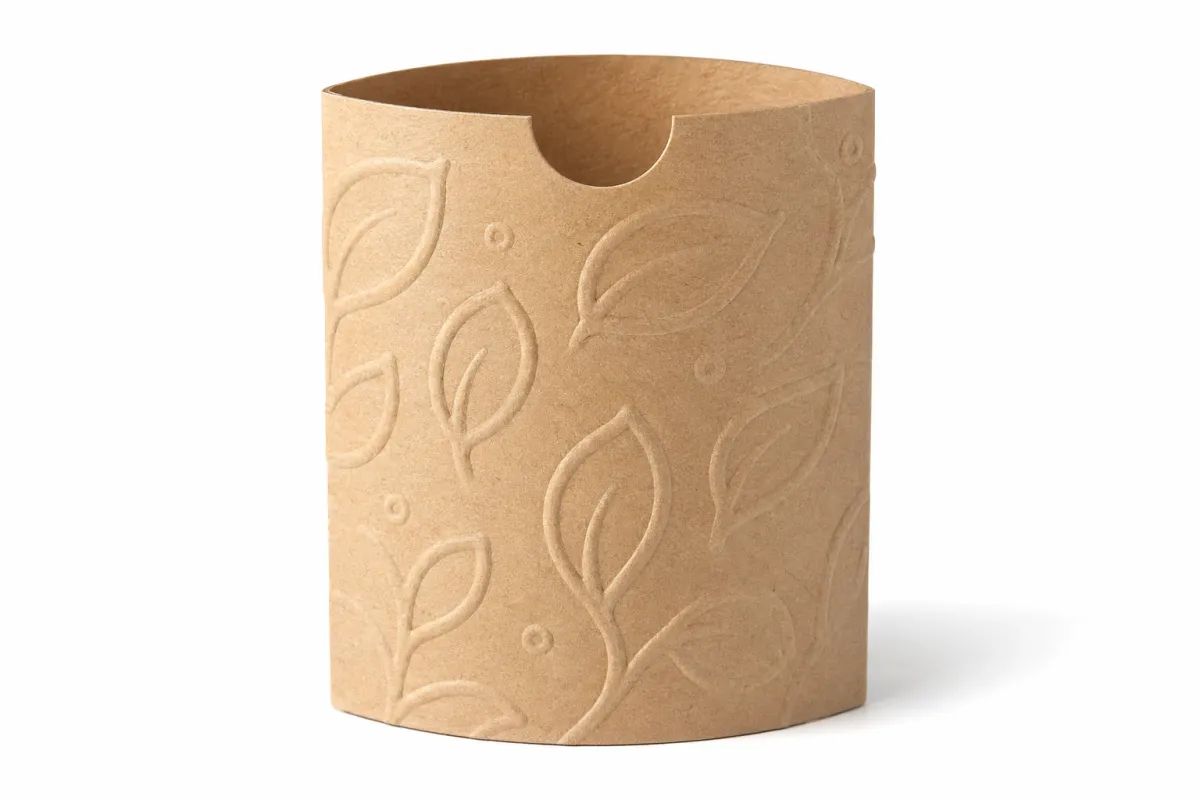
If buyers buy embossed kraft sleeve wholesale for cosmetics, candles, snacks, or gifting, the first technical question is the board. Most workable kraft sleeves run 250-400 gsm, with the upper or lower end set by needed stiffness and how much emboss depth the structure can absorb without crushing fiber memory. Lightweight board can look refined, but it also shows handling marks sooner. Heavier board feels richer, while also lifting cost and tightening fold tolerances.
The form is equally decisive. Full-wrap, partial-wrap, and bottom-wrap sleeves perform differently under press and on line. One blank can serve multiple dimensions when print zones, score lines, and glue position are engineered together. That setup reduces tooling interruptions and lowers the chance that a late size revision triggers a second die setup. A lot of first-time buyers underestimate this part because the sample looks clean and flat on a desk, which is not the same as running 12,000 units through a line.
Embossing is mechanical, never decorative theater. A male and female die compress paper fibers under controlled force, and the cleanest relief appears where the board has enough body to hold shape without cracking or rebound. Blind emboss reads premium when texture and shadow are the point. Registered emboss aligns the relief to art for precision, but it amplifies drift risk when artwork is dense or lot variation is high.
For brands seeking higher contrast on custom printed sleeves, the finish stack deserves careful sequencing. Matte aqueous topcoats, soft-touch lamination, spot UV, foil stamping, and clear windows each alter hand-feel and visual depth, and each changes process control risk. A dense dark print with foil and emboss can look excellent in the sample room and still drift in production if tolerances are loose. The failure is not usually design quality; it is often missing specification discipline.
Common print methods need hard scrutiny:
- CMYK only is versatile and cost-effective, but natural kraft often needs stronger contrast planning in design to avoid a flat finish.
- CMYK plus one spot color can tighten brand recognition for logos that must read clearly at shelf distance.
- Foil adds visual weight and depth, yet it introduces extra tooling and another checkpoint where alignment can drift.
- Spot UV creates controlled gloss contrast, and works best when used as a targeted accent rather than a blanket treatment.
Buyers who buy embossed kraft sleeve wholesale should test whether the sleeve does more than look premium. Can the barcode scan after UV and matte finish? Does the text remain legible at arm's length? Does the opening sequence reduce packer hesitation or add another step? These sound like operations questions, and they are exactly what separates a sample from a sellable system.
Practical rule: if embossing improves the look but hurts scanability, readability, or packer speed, the finish is over-specified for the use case. Texture should make the pack work, not argue with it.
For sustainability claims, keep documentation straightforward. FSC chain-of-custody proof remains the clearest way to support fiber sourcing claims, and it is easier to negotiate early than after production starts. If shipping durability is central, compare expected abuse against standards used in ISTA tests; that standard proves more than any generic claim that the packaging "was tested for shipping."
In practice, a sleeve should be selected as a production component. Teams that buy embossed kraft sleeve wholesale from a visual-only lens often overinvest in features they never use. Teams that buy with a packaging lens get sleeves that behave on shelf, in cartons, and through fulfillment.
What Should You Check Before You Buy Embossed Kraft Sleeve Wholesale?
If you buy embossed kraft sleeve wholesale without a complete technical brief, assumptions fill the gaps and speed disappears from the schedule. The quickest way to protect lead time is to provide exact files and tolerances before the quote cycle, not after the sample phase closes. A clean spec sheet saves more money than a prettier render, and that is not a theory; it is the difference between a two-round approval and a three-week detour.
Ask for a spec pack with technical drawing, dieline, punch points, fold lines, glue-line limits, inside channeling, and tolerance bands for width, height, and score drift. A capable production team can absorb some variation, but it still needs to know the edges of acceptable variation. On a sleeve, a 1-2 mm shift can ruin panel alignment and alter how each unit stacks. On a high-run program, that small miss can become a line headache.
Quality targets should be listed as numbers, not adjectives. Burst and puncture resistance matter for rigid primaries under hard handling. Edge crush resistance matters when stock is palletized tall or routed long-haul. Contrast matters when text sits on natural brown stock under low light. Weak contrast creates an underprinted appearance regardless of artwork quality.
For brands that buy embossed kraft sleeve wholesale with food-adjacent products, verify the compliance folder thoroughly. Ask what inks, adhesives, and coatings are accepted in each destination channel. Even when the sleeve is not a direct food-contact layer, regulatory channels still care about indirect handling and claims language. Recyclability statements can fail fast if windows, coatings, or laminates break downstream sorting behavior, so do not assume a green icon on the mockup will survive the compliance review.
When a supplier quotes a buy embossed kraft sleeve wholesale program, this checklist keeps everyone anchored:
- Material grade and basis weight
- Exact dieline version and revision history
- Tolerance range for cut, fold, and emboss registration
- Finish stack selected: matte, aqueous, foil, soft-touch, or window patch
- Print method and approved color count
- Artwork approval workflow and physical sample signoff
- Inspection frequency and criteria for longer runs
- Traceability rules, including lot codes and trace-back logic
Fit validation is where wholesale orders win or lose real margin. If the inner product changes dimension with humidity, the sleeve needs breathing room in the right places without appearing sloppy. Heated storage means glue stability checks under thermal stress. Seasonal movement through multiple climates calls for a worst-case fit sample, not a cosmetic best-case photo. In one 8,000-piece run I reviewed, a 1.5 mm fold drift was enough to shift the product window off center, and the fix was not pretty or cheap.
To buy embossed kraft sleeve wholesale without schedule shock, set the approval chain in this order: freeze dieline, lock finish, finalize color target, approve physical sample, then release production. Mixing these steps causes calendar drag. The delay is usually not a two-day hiccup. It can be a full week, especially if the art team keeps asking for one more round after the proof is already signed off.
Pricing & MOQ: How to Evaluate Cost for Buy Embossed Kraft Sleeve Wholesale
To buy embossed kraft sleeve wholesale on commercial terms, break each quote into separate buckets. Unit price only shows part of the story because setup, tooling, emboss prep, inspection, and freight can dominate total cost. A higher headline price sometimes wins when it avoids reprints, damage, and emergency shipping. That is not a sales line; it is a procurement reality.
Typical buckets include tooling, color count, emboss die preparation, print plates, coating or lamination, warehousing, freight class, and inspection support. Foil or window inserts usually add another cost layer. Oversized blanks can add packaging costs around the packaging itself, especially if repacking is required. If a quote leaves these items vague, the final invoice will usually fill in the blanks for you.
| Run Type | Typical MOQ | Unit Price Range | Setup / Tooling | Best Fit | Main Tradeoff |
|---|---|---|---|---|---|
| Pilot | 2,000-3,000 pcs | $0.42-$0.68 | $280-$650 | Launch test, shelf validation, buyer sample program | Higher per-unit cost and less room for design changes |
| Balanced | 5,000-10,000 pcs | $0.19-$0.34 | $220-$480 | Recurring retail or gifting SKU | Artwork and finish must be frozen before production |
| Scale | 20,000+ pcs | $0.11-$0.22 | $180-$350 | Stable wholesale program with predictable replenishment | Inventory carrying cost and longer exposure to forecast error |
The ranges above are directional, not universal. Board market swings, region, freight lane, labor, and finish complexity can move them quickly. Still, the math helps. If you buy embossed kraft sleeve wholesale at 2,000 pieces and pay $380 setup, that setup alone is $0.19 per sleeve before freight. At 10,000 pieces, the same setup contributes $0.038 per unit. The arithmetic is straightforward; the procurement decision is usually messier. Higher MOQ is not automatically the best option, but it often beats lower MOQ once second-order fixes are considered.
The hidden costs hit first-time buyers hardest. Revisions after approval, re-proofs after a late art move, extra freight from oversized panels, shipping damage from poor stacking controls, and expedited production when design freeze slips toward a fixed launch date. Each event looks minor by itself. In combination, they can erase the advantage of a lower unit price. That is why a quote that looks cheap can turn out kinda expensive once the real totals show up.
For teams building recurring orders, lock three quote elements into the contract: validity period, freight terms, and reprint policy. The quote should state pricing durability, who pays outbound freight, and what threshold triggers replacement or remake. If possible, ask for a short tolerance hold so one noncritical pause does not force full repricing.
Apply negotiation rules that prioritize clarity. When you buy embossed kraft sleeve wholesale, compare at least two scenarios: pilot and repeat. Track freight, setup, sample cost, pack inserts, and correction charges in parallel. That reveals whether a supplier is truly strong on economics or only attractive on one line item.
What most buyers miss: the quote is only the first page in the cost book. The real answer sits in the stacked totals.
For replenishment-based sourcing, connect pricing directly to an actual replenishment model. Teams who align forecast and lead-time history generally build cleaner contracts than teams negotiating only for the smallest initial number. Use the Wholesale Programs page as a baseline before asking for your first full estimate.
Process & Timeline: Order-to-Delivery Path for Buying Embossed Kraft Sleeves in Bulk
A team planning to buy embossed kraft sleeve wholesale should treat schedule as a chain of dependent approvals. The process moves at the pace of the slowest control point. A late dieline freeze stalls the full job. A late print file pushes emboss test timing. A finish change after sample acceptance forces recalibration, adding another run and test pass.
For a standard program, proof-to-shipment windows often sit around 12-15 business days. Complex variants with foil, deep emboss, or layered finishing typically need 18-25 business days. If a six-week launch is fixed, files need to travel fast and revision rounds should stay controlled. Slow approvals are the most common reason a schedule that looked easy on Monday turns into a scramble by Friday.
A common path is the one below:
- Specification lock: 1-2 business days when dimensions, constraints, and performance intent are complete.
- Artwork proofing: 1-3 business days based on revision volume.
- Physical sample build: 3-7 business days for standard structures.
- Client signoff: usually 1-2 business days if internal approvers are pre-routed.
- Pre-production run: 1-2 business days for press calibration and pressure checks.
- Mass production: 5-10 business days, depending on quantity and finish depth.
- Final QA and packing: 1-2 business days before shipment handoff.
Some checkpoints cannot tolerate delay. Digital proof review should come first because it catches layout conflicts early. Soft proof must verify color behavior on kraft stock. A first article should be evaluated against dieline and dimension, not just the render. Inline checks should monitor emboss depth, print position, and glue stability through a run. Final lot inspection should confirm count, labeling, and lot-code requirements.
Buyer teams that plan to buy embossed kraft sleeve wholesale for a launch should insert calendar slack for congestion, holiday windows, and supplier reroute events. Many schedules look accurate on paper but stretch when one essential file lands two days late. The fix comes from process discipline, not optimism.
Escalation rules reduce these delays. Set in advance who approves artwork, who changes budget, and who can accept sample deviations. Define response windows for each approval tier so no one waits for a status update on a $400 variance. For buyers using backup suppliers, define which specifications can flex and which cannot, including the visual identity guardrails. That clarity avoids the launch-delay chain caused by indecision.
For transport risk, tie assumptions to standards used in ISTA testing. Those tests clarify vibration, drop, and stacking behavior better than generic durability language. The distinction matters when one damaged pallet can erode margin across an entire shipment.
What a Dependable Embossed Kraft Sleeve Wholesale Program Should Prove
If you buy embossed kraft sleeve wholesale for a sustained program, the deciding factor is not sample polish. The real difference is operational control: version tracking, approval traceability, repeatability checks, and clear production communication. Those capabilities reduce surprises and keep cost discipline intact over multiple replenishments.
A dependable supplier should run mixed-size programs without treating each SKU as a brand-new campaign. Material sourcing should stay stable by lot. Prepress should verify dieline compliance before print release. Production should keep emboss depth, glue line, and cut registration inside the approved tolerance window. That consistency is the foundation of a repeatable buy embossed kraft sleeve wholesale relationship.
Brand protection starts in the workflow. Secure file handling matters where multiple teams touch artwork. Revision logs become critical when a logo changes after approvals. Approval workflows keep unauthorized spec changes from slipping in after first sample acceptance. Clear documentation lowers internal debate and shortens response time.
For long-term buyers, visibility should be practical, not performative. A single point of contact prevents handoffs from sales to prepress to fulfillment with no clear owner. A stable update cadence shows whether production is on plan. A supplier that connects sample release to fulfillment tracking gives better visibility of landed cost before inventory funding is committed.
Most teams buying in bulk need more than a quote. They need predictable arrival, objective acceptance criteria, and calm packing floors. A strong relationship is usually measured through cycle time, defect trend, and communication clarity instead of slogan quality. If scale is the objective, choose a partner that handles sleeves as a controlled production asset.
For current structures and qualification notes, start at Wholesale Programs before requesting a full estimate. That approach keeps the conversation grounded in volume, timeline, and structure instead of marketing language.
Buy Embossed Kraft Sleeve Wholesale: Actionable Next Steps for Your First Contract
The most reliable path to buy embossed kraft sleeve wholesale starts with a contract-ready brief, not a mood board. Include what product it wraps, how many units are needed, acceptable finish boundaries, and where risk limits sit. Clear technical instructions reduce quote cycles and simplify production execution.
Step 1 is SKU size confirmation, retail use case, and target economics. Decide whether this is a pilot event or a standing wholesale flow. That choice sets quantity, cost structure, and acceptable tooling risk. If the order is meant to repeat, say so plainly; if it is meant to test the market, say that too.
Step 2 is to upload the dieline, logos, and top/bottom profile constraints at once. Set color, cut, emboss depth, and glue-line tolerances while files are still in revision mode. Loose interpretation windows usually produce unintended outcomes, and those outcomes usually appear before sampling. Put another way: the supplier cannot read your mind, so the brief has to do the heavy lifting.
Step 3 is to request at least two quotations and evaluate total landed cost. Include tooling, freight, insert packaging, correction fees, and one-time revisions in the scorecard. If you buy embossed kraft sleeve wholesale by unit price alone, a hidden $350 die edit can quietly remove the margin advantage.
Step 4 is to approve one physical sample against both shelf test and opening test before approving volume. Define pass/fail criteria in writing: allowable emboss shift, scuff resistance, and shelf-distance legibility. A sample that cannot answer those points cannot become the final production signal.
Step 5 is to finalize order terms with milestones, revision limits, acceptance protocol, and contingency timing. This step converts a concept into a production commitment. That is the real objective when you buy embossed kraft sleeve wholesale: not a polished render, but a repeatable package that can be measured, tested, delivered, and renewed.
Once production starts, your team should have a documented risk budget, timeline, and quality benchmark. That foundation is what turns buy embossed kraft sleeve wholesale into a scalable program instead of a recurring emergency. If one thing should happen next, it is this: freeze the dieline, lock the finish stack, and ask for a quote that breaks out tooling, run price, freight, and reprint terms before anyone talks about volume discounts.
Can I buy embossed kraft sleeve wholesale with a low initial quantity without hidden setup penalties?
Yes, but the unit price generally remains higher until setup is spread across more units. Request a pilot quote that separates tooling, plate work, and sample labor from ongoing production. Ask for explicit terms on whether die edits, plate corrections, or prototype charges are free, prorated, or treated as separate paid services. If you plan to buy embossed kraft sleeve wholesale again within the same quarter, ask the supplier to hold tooling notes for the repeat run.
How should I price a buy embossed kraft sleeve wholesale order if my artwork may change after first sample?
Late-stage art changes should be priced as defined line items before work starts. Strong suppliers separate prepress corrections, re-proof cycles, and repeat setup costs. Finalize color and emboss depth before pre-production, then hold to one revision round to prevent hidden cycle creep. A team that wants to buy embossed kraft sleeve wholesale cleanly should freeze the dieline first and leave artwork edits for only the approved window.
What timeline can I expect when buying embossed kraft sleeve wholesale for a launch in six weeks?
A six-week window is realistic if file movement is steady and sample cycles stay to one major revision round. Standard sleeve programs often ship 12-15 business days after proof signoff, while foil-heavy or deep-emboss programs can stretch to 18-25 business days. Freeze dieline, then finish sequence, then artwork, so a late redesign does not reset the schedule. If you buy embossed kraft sleeve wholesale on a fixed launch date, build a few days of cushion for transit and receiving.
What specs should I verify before buying embossed kraft sleeve wholesale for food-adjacent products?
Confirm board behavior under moisture, coating and adhesive limits, and print system compatibility for your handling environment. Ask for bend, flex, and edge stress performance when the sleeve is stacked or repeatedly handled. Confirm room for lot codes, storage icons, and required legal text before artwork is locked. If the plan is to buy embossed kraft sleeve wholesale for multiple markets, confirm each destination's claim language before production begins.
Can you help compare whether to buy embossed kraft sleeve wholesale from one supplier or split between two?
If tolerance for variation is tight, one supplier usually reduces risk because tooling continuity is easier to control. Split sourcing can de-risk capacity, but it can also create lot-to-lot variation unless color standards, emboss depth, and cut tolerance are tightly specified. Many buyers keep one primary supplier and one backup for overflow or urgent reroute events. That structure works best when both partners can buy embossed kraft sleeve wholesale from the same approved spec package.