If a packing team is still handwriting return details, the bottleneck is not creativity. It is speed, legibility, and the cost of small mistakes that multiply across a batch. For Brands That Ship the same formats repeatedly, the practical move is to buy personalized address labels and remove the weakest link in the process: handwritten addresses that get cramped, smudged, or copied wrong under pressure.
That matters more than it sounds. A label takes seconds to apply; a misread apartment number can take a customer-service exchange, a return, and another shipment. On a run of 1,000 parcels, even a 1% address problem rate means 10 fixes. That is not an abstract loss. It is labor, delay, and avoidable noise inside the fulfillment queue.
Address labels are also part of the package’s first impression. A clean return block on a mailer, a sharply printed recipient panel on a sample kit, or a consistent internal routing label tells the receiver that the brand handles details with care. The label itself may be small, but it sits in the same visual field as the product packaging. That makes it part of the system, not an accessory.
For teams that already use Custom Labels & Tags elsewhere in the packout, personalized address labels usually fit best when they follow the same basic rules: consistent type, clear hierarchy, and a material choice that matches the work, not the mood board.
Buy personalized address labels when mail speed matters more than handwriting
The largest mailing errors usually happen before the parcel ever reaches the carrier. Someone squeezes the last line into a margin that is already too tight. Someone corrects a suite number by hand. Someone copies an address from an old spreadsheet and misses a new postal code. These are not dramatic failures. They are ordinary ones, which is why they recur.
Personalized address labels cut through that pattern because the information is preformatted. The name, company, street, and postal code land in the same place every time. That matters in apparel and ecommerce operations, where the same address formats may appear across returns, wholesale samples, replacement shipments, and internal transfers. If the format is stable, the label becomes a repeatable tool instead of a one-off print job.
The visual effect is not trivial either. Buyers often focus on shelf packaging and forget the smaller pieces of the mail path. But a customer notices the difference between a package that looks assembled and one that looks planned. Address labels are part of that judgment. They make the whole shipment feel more controlled, even when the box itself is plain.
A useful address label is not trying to impress anyone. It reads fast, peels cleanly, and stays put long enough to do its job.
There is a practical side to the same argument. If an operator spends 8 to 12 seconds writing, checking, and straightening each address, a batch of 500 shipments can burn through more than an hour that could have been spent on picking, packing, or quality review. Multiply that by a peak season, and the case for labels gets stronger without any marketing language attached.
Some teams try to solve this with generic office labels, then wonder why the result looks temporary. The answer is usually obvious in the material choice, the print quality, or the adhesive. Address labels for a fulfillment environment do not need to be fancy, but they do need to be designed with the actual workflow in mind.
Material, size, and finish options that fit clothing-label workflows
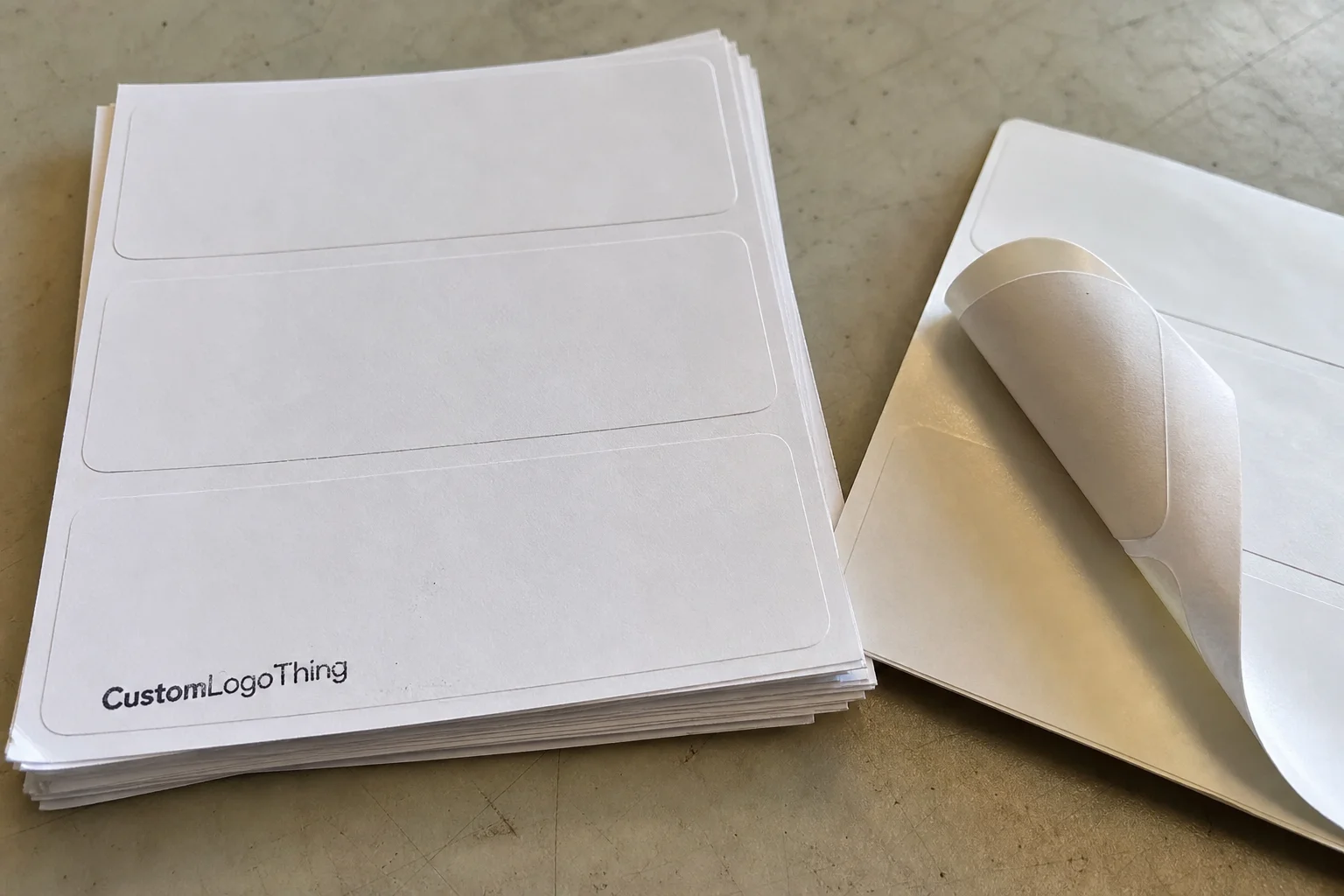
Paper remains the standard choice for many mailing applications because it is inexpensive and easy to print. For labels going onto envelopes, inserts, short-life mailers, or light-volume cartons, paper is often enough. It is also the cleanest entry point for buyers who want to buy personalized address labels without paying for durability they will never use.
Synthetic stocks make sense when the label has to survive more handling. BOPP and similar films resist scuffing better than plain paper and cope better with humidity, friction, and longer storage. They cost more, sometimes noticeably more, but the extra spend is easier to justify when the label must remain readable after transit and manual sorting. If the label sits near the inside of a humid packing room or on a parcel that will be handled multiple times, paper can be the weak link.
Finish affects function. Matte stock is easier to read under warehouse lighting and tends to hide glare on dense layouts. Gloss can look sharper on proofs and may suit customer-facing mail, but glossy surfaces can become harder to scan quickly if the label carries a lot of text. For address labels, matte is usually the safer default unless the brand has a specific visual reason to use gloss.
Size should match the information load. A compact return-address label works well for short blocks and single-line routing, but it can become cramped when the contact block expands. Larger formats such as 2" x 4" or 3" x 1" give room for longer names, apartment numbers, company lines, and postal codes. The real test is not whether the label fits the logo. It is whether the longest address still reads comfortably.
Application format matters too. Sheets are efficient for desk-side use and low-volume packing. Rolls make more sense for batch application and faster hand placement. If a team is applying labels in a production rhythm, roll format usually saves motion and reduces handling. That may sound minor until it is repeated a few thousand times. Then it is labor.
For sourcing decisions, FSC certification is one of the clearest paper-origin signals buyers can ask for. It does not solve every sustainability question, but it gives procurement teams a recognized framework for chain-of-custody documentation. For distribution expectations, packaging buyers often compare transit stress and handling conditions against guidance from groups such as Forest Stewardship Council and testing standards discussed by ISTA.
Print specifications that keep every address readable at a glance
A label can be the right size and still fail if the typography is poor. The first rule is basic readability. Keep the font large enough to read from arm’s length, leave enough line spacing for long addresses, and avoid stacking too much information into one block. A logo should never push the postal data into a compressed corner. That is cosmetic thinking in a functional format.
Contrast matters just as much. Black text on white or soft-white stock remains the most reliable choice because it is fast to read and tolerant of poor lighting. Pale gray on a tinted stock may look refined in a proof, but it can blur under warehouse lights or on textured packaging. If the address needs to be scanned quickly by a person, clarity wins over style.
Variable data becomes valuable the moment the address list changes often. A supplier should be able to manage multiple ship-to entries without mixing formats or dropping fields. That includes duplicate addresses, renamed recipients, apartment identifiers, and postal formatting. If the file structure is clean, the proof stage is faster and the risk of misprints drops.
One good rule: design for the longest address, not the average one. Long names, international destinations, suite numbers, and extended company names expose weak layouts quickly. If the label still reads well when the longest line is inserted, the design is probably stable. If not, it needs more breathing room, even if that means a larger label or a more restrained type size.
Proofing should check more than spelling. Margins, trim safety, barcode or QR placement if used, and any logo alignment should be verified before production starts. A label can look fine on a screen and still print too close to the edge, which is enough to make it unreliable in real use. The proof is not a formality. It is the control point that prevents repeat mistakes.
If the address label is part of a larger packaging system, keep the visual rules consistent with carton art, insert cards, and outer mailers. The goal is not perfect match across every substrate. Paper, film, and coated stocks will never behave identically. The goal is a consistent logic across the whole packout so the parts feel like they belong together. Buyers who keep that discipline across matching label formats usually end up with cleaner reorders and fewer layout exceptions.
Pricing, MOQ, and unit-cost tradeoffs for larger orders
Unit cost usually drops as quantity rises, but the lowest per-label price is not always the best purchase. If you buy personalized address labels in quantities that outlast the actual mailing cycle, you create dead inventory. That matters when address data changes, branding shifts, or a campaign ends early. The right order size should follow usage, not just the spreadsheet logic of “more equals cheaper.”
Standard paper sheet labels generally sit at the lowest entry point. In broad buying terms, a straightforward one-color address label might land around $0.02 to $0.06 per unit at higher quantities. Paper roll labels usually cost a little more because of conversion and application format. Synthetic roll labels and specialty finishes climb again, sometimes into $0.06 to $0.18 per unit or beyond, depending on coverage, setup, and finishing requirements.
MOQ follows the structure of the job. A simple sheet label often has a lower minimum than a custom roll with a special shape, adhesive, or finish. That is normal. It reflects production economics, not arbitrary policy. The key is to quote the exact spec you intend to use, because an “almost right” quote can be misleading enough to distort the buying decision.
Setup and prepress often move the total more than tiny differences in size. A minor dimension change may be almost invisible on the invoice, while a new die cut or specialty laminate can move the price sharply. Rush schedules do the same. If a launch date is fixed, it is better to confirm the proof and turnaround early than to pay a premium for compression later.
| Option | Typical use | Typical MOQ | Common price range | Tradeoff |
|---|---|---|---|---|
| Paper sheet labels | Office mail, return envelopes, light-volume packing | Low to moderate | $0.02-$0.06 per unit | Lowest cost, least durable |
| Paper roll labels | Batch labeling and faster hand application | Moderate | $0.03-$0.08 per unit | Better throughput, more format discipline needed |
| Synthetic roll labels | Moisture, abrasion, longer shelf life | Moderate to higher | $0.06-$0.18 per unit | Higher durability, higher cost |
| Custom die-cut labels | Special branding or nonstandard shapes | Usually higher | Varies by tooling and coverage | More distinctive, more setup |
That table is a buying frame, not a quote. Real pricing depends on stock, adhesive, artwork coverage, finishing, and whether the labels are printed on sheets or converted to rolls. Still, it keeps the comparison honest. Buyers can see where cost comes from instead of chasing the cheapest number on a spec that does not match the job.
Process, timeline, and proof approval steps from upload to delivery
The order flow should be simple: send the address file, upload the logo if one is needed, confirm the size, and review the proof. Most delays come from missing one of those steps or sending a file that does not reflect the latest address list. If you want to buy personalized address labels without friction, get the data cleaned up before it reaches production.
The proof is the gatekeeper. It should show the full address block, text hierarchy, spacing, trim boundaries, and the final placement of any logo or mark. It should also catch the small errors that are easy to miss in a spreadsheet view: inconsistent abbreviations, misplaced apartment markers, and text that shifts too close to the edge. A proof that looks rushed usually means the job has not been fully checked.
Turnaround depends on complexity, but simple labels are usually faster than multi-piece packaging runs. A practical planning window is often 8 to 15 business days after proof approval, with specialty stock, custom die cuts, or heavy data handling adding time. Shipping time sits on top of that. The difference matters. Production completion is not delivery.
For launches, relocations, and peak fulfillment periods, build in a buffer. A buyer who approves a proof on Monday and assumes arrival the following week without checking freight is setting up a preventable deadline problem. Production can move quickly; transit still has its own clock.
For repeat orders, the best safeguard is a clean record of the approved spec: size, stock, adhesive, finish, artwork file, and address format. That record turns the next reorder into a controlled repeat instead of a new project. It also keeps well-meaning edits from slipping into the file and changing the label without anyone noticing until it is printed.
If the order includes multiple ship-to versions, ask whether the supplier will keep them under one proof set or split them by SKU. That detail matters more than most buyers expect, because inventory control gets messy fast when the same brand uses one label for retail mail, another for wholesale samples, and a third for internal routing.
Quality controls that matter for repeat reorder accuracy
Repeat orders should become easier, not more fragile. The most reliable way to keep them accurate is to archive the final approved artwork and the final address format together. Not the first mockup. Not the draft with corrections. The actual approved file. That single habit prevents a surprising amount of rework.
Color consistency matters if the address labels have to sit beside mailers, insert cards, or other branded packaging. Paper shade, finish, and ink density can shift the appearance more than buyers expect. A soft-white stock will not match a bright-white insert exactly, and it does not need to. The issue is whether the team planned for that difference or discovered it after the order arrived.
Data hygiene is another hidden variable. Standardize suite formatting, abbreviations, and postal code conventions before every reorder. Mixed forms like “Ste.” and “Suite” may both be acceptable in a general sense, but mixed usage across a single shipment looks untidy and can create inconsistencies in production. A clean file should look like one system prepared it.
Storage and finishing should be checked before shipment. Flat stack, roll, or sheets each affect how the packing station runs. A label that arrives in a format the team did not expect can slow the line more than a minor print defect. That is why storage format belongs in the spec, not in a side note.
For larger programs, ask about tolerance on registration, trim, and adhesive performance. Not because the order needs lab-grade paperwork, but because you need evidence of repeatability. A supplier that can describe its quality checks clearly is more useful than one that only says the output is “premium.” Quality is a process, not a promise.
If your team already sources other label formats from the same label catalog, keep the reorder notes centralized. The artwork is only part of the story. The rest is recordkeeping: what was approved, what stock was used, and what changed, if anything, from the previous run.
Next steps to place the right order quantity on the first try
Start with real volume. Count the parcels, sample kits, or return mailers you send in a normal month, then add a buffer for replacements and seasonal spikes. That gives you an actual consumption number instead of a guess based on optimism. If you want to buy personalized address labels with less waste, order against usage and turnover, not against a vague idea of “better to have extra.”
Then choose the format that fits the team. If labels are applied one at a time by hand, sheets may be sufficient. If the pace is higher, rolls can reduce wasted motion. If the environment is humid or the labels are handled often, synthetic stock may be worth the added cost. The best option is the one that fits the work as it exists, not the one that sounds nicest on paper.
Send the address list, logo file, preferred size, and packaging notes in one file set if possible. That gives the proofing team enough context to check line breaks, spacing, and legibility before production starts. Missing context is one of the main reasons label jobs slow down. A complete brief does not just speed things up; it lowers the chance of correction later.
Ask for the quote, review the proof, and confirm the ship date before the reorder is locked. Those steps are routine because they should be routine. Routine is what keeps a label program from turning into a patchwork of emergency fixes, last-minute revisions, and inventory that no longer matches the address list.
For apparel shipping and repeat mailings, the cleanest approach is also the least dramatic. Keep the spec simple. Keep the formatting stable. Keep the quality checks visible. That is how personalized address labels stay useful after the first order, the second order, and the reorder that arrives when the schedule is already full.
Where should I buy personalized address labels for frequent clothing shipments?
Choose a supplier that can match your application method, whether labels are applied by hand or through a packing line. Look for proof support, clear minimums, and repeat-order file storage before the first run. If shipments are frequent, ask for a format that stores easily and applies quickly during peak periods.
What is a practical MOQ for personalized address labels?
MOQ varies by stock, print method, and format, so ask for the minimum on the exact spec you need. Small brands can often start with a lower quantity on standard sheet labels than on Custom Roll Labels. If you need multiple versions, ask whether the supplier can combine designs or split the minimum across SKUs.
What affects personalized address labels pricing the most?
Quantity has the biggest impact on unit cost, followed by stock type, finish, and application format. Setup work, proofing, and any special die cuts can change the total more than minor size differences. Rush jobs and moisture-resistant materials usually cost more than standard paper labels.
How long does the process usually take after I approve the proof?
Simple label orders often move quickly after approval, while custom shapes or specialty finishes take longer. Production time should be confirmed separately from shipping time so you know the real delivery window. If your launch date is fixed, request the turnaround and transit estimate before you approve artwork.
Can I reorder the same personalized address labels without rebuilding the file?
Yes, if the supplier keeps the approved artwork and final production specs on record. Reorders should be faster when the size, stock, and address format stay unchanged. Before you reorder, confirm whether any data, logo, or postal information has changed since the last run. If those records are intact, you can buy personalized address labels again without rebuilding the file from scratch.