Buyer Fit Snapshot
| Best fit | Buy Seasonal Shipping Boxes for Fall projects where brand print, material claims, artwork control, MOQ, and repeat-order consistency need to be specified before quoting. |
|---|---|
| Quote inputs | Share finished size, material target, print colors, finish, packing count, annual reorder estimate, ship-to region, and any compliance wording. |
| Proofing check | Approve dieline scale, logo placement, barcode or warning zones, color tolerance, closure strength, and carton packing before bulk production. |
| Main risk | Vague material claims, crowded artwork, missing packing details, or unclear freight terms can make a low unit price expensive after revisions. |
Fast answer: Buy Seasonal Shipping Boxes for Fall: Pricing & Specs should be specified like a repeatable production item. The safest quote records material, print method, finish, artwork proof, packing count, and reorder notes in one written spec.
Production checks before approval
Compare the actual filled-product size with the drawing, then confirm tolerance on folds, seals, hang holes, label areas, and retail display edges. Reserve space for logos, QR codes, warning copy, and material claims before decorative graphics fill the panel.
Quote comparison points
Review material grade, print process, finish, sampling route, tooling charges, carton quantity, and freight assumptions side by side. A quote is only useful when the supplier can repeat the same color, closure quality, and packing count on the next order.
If you plan to buy seasonal shipping boxes for fall, start with the shipment itself instead of the artwork file. The box is often the first seasonal object a customer touches, and that first touch can color the entire order before the product insert, the thank-you card, or the follow-up email ever shows up. A plain shipper says routine order. A well-planned seasonal box says the brand thought through the moment from warehouse to doorstep.
Fall has its own commercial rhythm, and it is not subtle. Gift sets, limited drops, subscription mailers, influencer kits, and retail replenishment all tend to carry more perceived value when the outer packaging feels timely and intentional. If you want to buy seasonal shipping boxes for fall that support the launch instead of muddying it, the real job is to match structure, graphics, and transit performance to the way the box will actually move through fulfillment and shipping.
Why buy seasonal shipping boxes for fall now
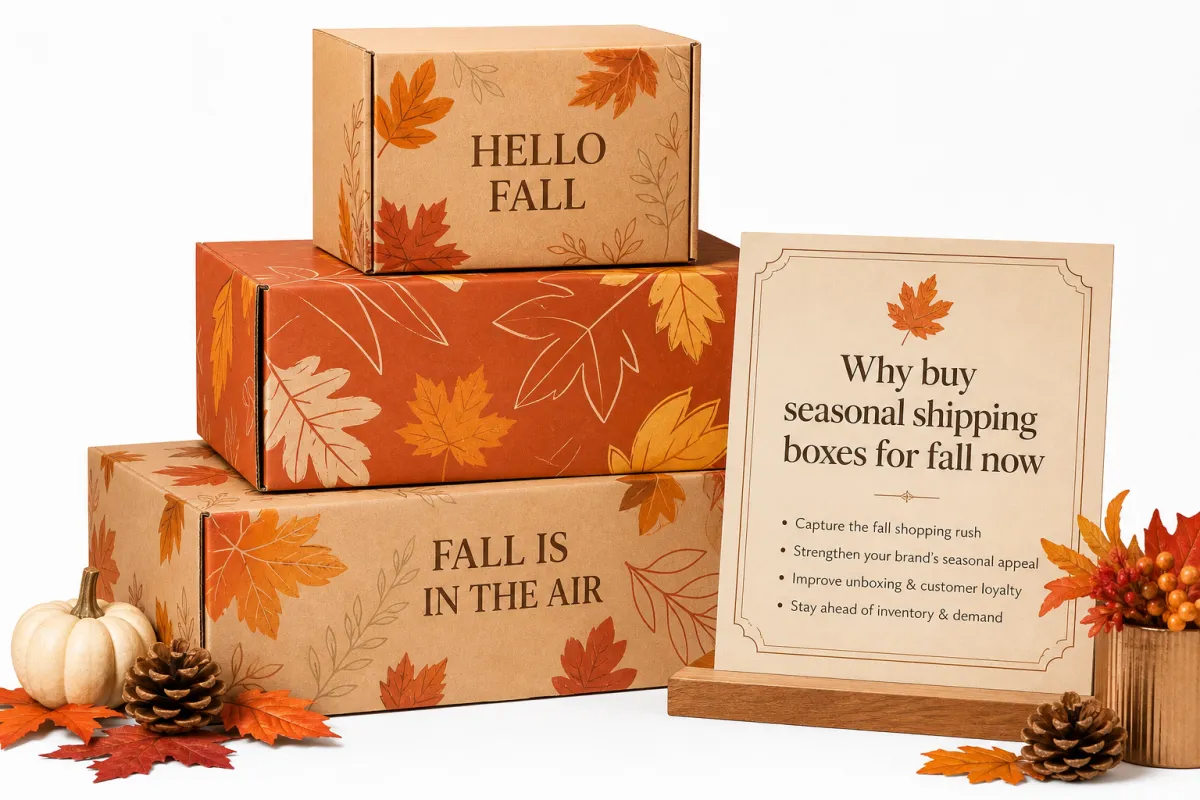
The shipping box is usually the first seasonal touchpoint a customer sees, long before the product is opened. That single fact changes the role of the carton. It is not just holding the product in place; it is setting expectation, framing value, and giving the buyer a reason to feel the order was prepared with care. If you buy seasonal shipping boxes for fall with that in mind, the box becomes part of the sale rather than a neutral container.
Seasonal packaging has a direct effect on perception. A gift set packed in a kraft mailer with a warm-toned print feels more considered than the same product in a generic brown shipper. The difference does not need to shout to work. Brands get the strongest result when they buy seasonal shipping boxes for fall that echo the story already appearing on the site, in ads, and in email, because the customer experiences one connected message rather than three separate ones.
The budget case is easy to miss during campaign planning. Teams often spend heavily on fall media, discounting, and creative assets, then send the finished order in packaging that looks unchanged from midwinter. That creates a disconnect. When you buy seasonal shipping boxes for fall with the right size and print coverage, the carton carries part of the marketing burden and makes the whole launch feel more deliberate, especially in ecommerce shipping where the shipper may be the only physical brand surface before unboxing.
Consistency matters just as much as aesthetics. Seasonal packaging can make a mixed assortment look organized, current, and worth a higher unboxing expectation. It does not need to shout to do that. In practice, the strongest fall boxes are often the quiet ones: a rust accent, a leaf pattern inside the flap, a short line of copy revealed only after opening. If you buy seasonal shipping boxes for fall that stay on-brand, the result reads as premium instead of promotional.
For fulfillment teams, seasonal cartons also create a useful layer of control. A single box system can unify candles, scarves, accessories, and sample kits without forcing the warehouse to treat each SKU as a separate visual experience. That is one reason many buyers now treat buy seasonal shipping boxes for fall as a planning decision instead of a decorative add-on.
Packaging standards from groups like ISTA help teams think beyond appearance and into real transit performance, while material guidance from FSC supports sourcing decisions that align with responsible fiber use. A seasonal box can look refined and still hold up in the shipment. That balance is the standard if you want to buy seasonal shipping boxes for fall without paying for avoidable errors later.
What to check before you buy seasonal shipping boxes for fall
Start with the use case. Direct-to-consumer orders, wholesale replenishment, subscription mailers, and influencer kits behave differently in transit, even before the package reaches the customer. A subscription box usually needs fast pack-out and a clean reveal. A wholesale carton needs stackability and compression strength. A gift shipment may need more presentation. A replenishment shipper may care more about pallet efficiency than decoration. If you buy seasonal shipping boxes for fall before defining that use case, the quote can look fine while the box itself misses the job.
Size comes next. Oversized cartons create void fill, crushed corners, and higher dimensional weight charges. Undersized cartons create pressure on the product and can slow pack-out. The practical approach is to measure the product footprint, then allow only the clearance needed for inserts, tissue, or protective padding. That matters even more in ecommerce shipping, where a small increase in empty space can change freight cost across a large run. Teams that buy seasonal shipping boxes for fall with a quarter-inch error on each side often feel that mistake in both damage rates and shipping spend.
The seasonal look should be chosen with restraint. A buyer does not need full coverage art to create a fall feel. A muted palette, a small seasonal icon, and a line of copy on the inside lid can carry more weight than a loud exterior. If you buy seasonal shipping boxes for fall for a longer launch window, the design should also survive past October. Wood tones, muted orange, olive, copper, cream, and black accents usually age better than novelty artwork that only feels right for one week.
Durability belongs in the first round of review, not as an afterthought. Confirm stackability, print clarity, storage footprint, resistance to humidity, and how the board will behave in cool or damp conditions. If the boxes will sit in a warehouse, on a porch, or in a truck for hours, the transit packaging needs to tolerate that cycle. A nice-looking box that softens in wet storage is not a good purchase. Buyers who buy seasonal shipping boxes for fall based only on visual design can create customer complaints faster than brand excitement.
Pack-out is the last part people often under-specify. A carton that works for loose apparel may fail for bottles, candles, or rigid gift sets. Inserts, dividers, or chipboard trays may need to be part of the build. If the shipment includes several SKUs, decide whether the interior needs to hold one item, two items, or a full assortment. Teams that buy seasonal shipping boxes for fall without that step often end up redesigning the insert later, which adds cost and slows production.
Buyer checklist:
- Product dimensions and weight
- Desired unboxing style
- Quantity by SKU
- Shipping method and destination zones
- Seasonal artwork complexity
- Storage space for finished cartons
Fall-ready styles, prints, and unboxing details
Box style is where the decision becomes visible. Mailer boxes are a common choice for direct-to-consumer shipments because they open neatly, pack efficiently, and allow printed interior surfaces. Corrugated shipping cartons fit heavier products and shipments that need more protection. Rigid presentation boxes create a stronger premium signal, although they cost more and usually make sense only for gift-like or retail-facing shipments. If you buy seasonal shipping boxes for fall in the wrong style, the carton may look beautiful and still perform poorly in the warehouse.
Print is where restraint usually pays off. A one-color exterior can look exceptionally sharp on kraft or white board. Two-color artwork adds depth without pushing the unit cost too far. Full-color graphics work well when the campaign depends on illustration, photography, or a stronger seasonal narrative. Interior branding often gives the best return because it appears at the moment of opening, when attention is highest. Brands that buy seasonal shipping boxes for fall often get more mileage from a simple exterior and a more expressive interior than from heavy decoration on every surface.
Unboxing details can improve the experience without complicating the run. Tear strips make opening cleaner. Easy-open tabs reduce the risk of a customer slicing into the product. A well-fitted insert keeps items from shifting, which supports package protection and keeps the inside from looking messy. Product placement matters too; if a candle rolls or a kit tilts during shipping, the premium effect falls apart quickly. That is why teams who buy seasonal shipping boxes for fall should think about the reveal sequence, not only the exterior panel.
Seasonal design can stay memorable without becoming disposable. Modular artwork themes can be refreshed later instead of being thrown away after a single promotion. A leaf pattern, a harvest stripe, a warm gradient, or a short line such as “packed for the season” can stay current across several SKUs and several weeks. If you need multiple campaigns in one quarter, the smarter path is a flexible design system rather than separate boxes for every moment. That way, when you buy seasonal shipping boxes for fall, the design still has value once the calendar moves on.
Many buyers find a direct comparison helpful:
| Style | Best for | Typical feel | Common unit range | Notes |
|---|---|---|---|---|
| Mailer box | DTC, subscriptions, influencer kits | Clean and branded | $0.85-$2.10 | Good for printed interiors and easy pack-out |
| Corrugated shipper | Heavier ecommerce shipping, retail replenishment | Practical and durable | $0.65-$1.60 | Strong choice when package protection matters most |
| Rigid presentation box | Gift sets, premium launches | High-end and giftable | $2.75-$6.50 | Better for presentation than for low-cost transport |
| Printed product shipper | Limited seasonal drops | Balanced and efficient | $0.95-$2.80 | Good middle ground for custom shipping boxes |
If you want a broader starting point, review the full range of Custom Packaging Products, then narrow to Custom Shipping Boxes for the structural options that fit the shipment. For soft goods or lightweight accessories, Custom Poly Mailers may be a better fit than corrugated packaging, especially when dimensional weight is the deciding factor. The box style should match the payload, not the mood board. That difference separates smart seasonal packaging from expensive shelf theater.
Materials and specs that protect products in wet, cold weather
Fall shipping is harder on packaging than many buyers expect. Rain, damp storage, temperature swings, and longer dwell times all affect board performance. A carton that looks fine in a dry conference room can soften after two days in a cooler dock or a porch drop during wet weather. If you buy seasonal shipping boxes for fall, the material spec should reflect those conditions instead of only the visual direction.
Corrugated board is still the right answer for many shipments. E-flute can work well for light products and sharper print detail. B-flute gives more cushion and better structure. C-flute is common for standard shippers that need a stronger wall. Double-wall BC flute is worth a look for heavier loads, stackable cartons, or longer transit lanes. The right board depends on product weight, stacking load, and route length. That is why buyers should buy seasonal shipping boxes for fall only after confirming the level of abuse the carton is likely to take.
A few specs deserve close review before production is approved. Check flute type, board caliper, ECT or burst strength, adhesive performance, and whether the print coating can tolerate humidity. If the box uses inserts or dividers, confirm the insert stock and the fit tolerance as well. For shipping tests, many teams use ISTA 3A or ASTM D4169 as a baseline. Those standards do not replace real-world testing, but they give the packaging team a common language for package protection and internal review. Brands that buy seasonal shipping boxes for fall with a test plan usually avoid the costly surprise of returns from crushed corners or scuffed surfaces.
Food, candles, cosmetics, apparel with premium finishes, and fragile retail goods often need extra protection. That may mean a stronger board grade, an insert, a divider, or a wrap around the primary product. The trick is not to add layers blindly. Every extra piece adds labor and cost. The useful rule is simple: add protection where the failure cost is higher than the packaging cost. Buyers who buy seasonal shipping boxes for fall should make that call SKU by SKU, not by instinct.
Common spec ranges:
- Lightweight DTC items: E-flute or 32 ECT single-wall corrugated
- Standard ecommerce shipping: B-flute or 32-44 ECT single-wall corrugated
- Heavier shipments: C-flute or BC double-wall corrugated
- Premium kits: rigid board with protective inserts and print coating
Material choice also shapes sustainability claims. If the brand wants recycled-content language or certified fiber sourcing, confirm the paperboard specification and documentation before the first proof. A lot of teams want to say the box is recyclable, but they cannot explain the board structure or finish with any precision, which weakens the message. Clear claims land better than broad ones. If you buy seasonal shipping boxes for fall with FSC-aligned sourcing or a documented recycled-content path, you can support the brand story with facts instead of slogans.
Pricing, MOQ, and what changes your unit cost
Most buyers begin with the wrong question. They ask, “What is the price per box?” The better question is, “What Drives the Price per box at my quantity, with my print coverage, and with my shipping requirements?” If you buy seasonal shipping boxes for fall without separating those variables, the quote can look cheap or expensive for the wrong reason.
The main cost drivers are easy to identify. Size matters because larger cartons use more board. Material grade matters because stronger corrugated board costs more. Print complexity matters because each added color, coating, or inside-panel graphic adds setup and production time. Inserts increase both material and assembly cost. Quantity matters because setup gets spread across more units in a larger run. Teams that buy seasonal shipping boxes for fall at 5,000 units usually see a lower unit price than teams ordering 500, but the upfront spend is higher and storage becomes a bigger part of the decision.
There is a practical middle ground. A standard dieline can save both design time and tooling cost. Limiting print to one or two colors can preserve the seasonal look without pushing the box into a premium bracket. Simplifying inserts, using one insert instead of three parts, or standardizing dimensions across SKUs can lower cost in ways that do not hurt performance. That is why brands that buy seasonal shipping boxes for fall often save more by simplifying structure than by pushing hard on the final quote.
Request quotes at more than one quantity. A serious buyer should compare at least two or three tiers, such as 500, 1,500, and 5,000 units, to see how the per-box cost changes and how storage needs shift with run size. That comparison also shows whether the savings justify the extra inventory. If you plan to buy seasonal shipping boxes for fall for a short campaign, a lower MOQ may be the smarter choice even when the unit price is slightly higher.
Typical pricing framework for planning purposes:
- Mailer boxes with simple one-color print: often $0.75-$1.45 at mid-scale runs
- Corrugated shippers with moderate print coverage: often $0.65-$1.80 depending on strength
- Printed product shippers with inserts: often $1.10-$2.60
- Rigid presentation boxes: often $2.75-$6.50 or more based on finish and assembly
That framework is directional, not universal. A smaller run with high print coverage may cost more than a larger run with a simple design, and freight can change the landed cost faster than many buyers expect. Still, it gives procurement teams a way to compare options. If you buy seasonal shipping boxes for fall, compare unit cost, total spend, and storage footprint side by side. That is the only way to see the full trade-off.
A useful rule keeps many projects out of trouble: do not overbuild the box simply to save on product risk if the product itself is not fragile. Do not under-spec the carton just to make the quote attractive if the shipment will face wet conditions, stacked pallets, or long dwell times. The cost of damage, replacement, and customer service can erase the savings quickly. Buyers who buy seasonal shipping boxes for fall with a full landed-cost view usually make stronger decisions than those focused on the quote line alone.
Ordering process, proofing, and production timeline
The best packaging programs move in a predictable sequence: product specs, dieline selection, artwork submission, proof review, approval, production, and shipment. If you buy seasonal shipping boxes for fall and skip one of those steps, the risk of delay rises fast. The process is not difficult, but it does reward careful preparation.
Custom structural design usually takes longer than print-only changes. A print update on an existing dieline is often faster because the box geometry already exists. A new structure can require dimensions, prototypes, fit checks, and sometimes a revised insert. That is normal; it just needs time. Seasonal freight also gets busier as demand rises, so a schedule that looked generous in early planning can tighten later. Brands that buy seasonal shipping boxes for fall in a rush often pay more for expedited freight than they would have paid for a steadier timeline.
Prepare your inputs before you request a quote. Have product dimensions, product weight, logo files, brand colors, copy approvals, destination zip codes, and the target in-hand date ready. If several people must sign off, identify that chain early. A quote can sit still for days because one stakeholder has not approved a single line of copy. That delay is avoidable. Buyers who buy seasonal shipping boxes for fall with complete information usually move through proofing faster and create fewer revisions.
Once the proof arrives, review it carefully. Check panel orientation, barcode placement, color breaks, text spelling, and fold lines. If the box includes an insert, inspect the product fit and the open/close sequence. If the design uses a seasonal message on the inside flap, confirm that it still reads clearly after pack-out. This is the stage where small details matter. Anyone who plans to buy seasonal shipping boxes for fall should understand that a two-minute proof review can prevent a two-week reprint.
How to keep the schedule under control:
- Approve dimensions before artwork begins.
- Send clean logo files and final copy in one package.
- Confirm the shipping method early.
- Build a buffer for reprints or test cartons.
- Keep one person responsible for final sign-off.
Typical timelines vary by complexity. A print-only run on an existing structure may move faster, while a new box with a custom insert can take longer. Freight timing also changes the calendar. Ground service may work for some domestic routes, while larger shipments or tight launch dates may require another mode. If you buy seasonal shipping boxes for fall for a launch with a hard in-hand date, work backward from delivery and leave room for revisions. That habit prevents a lot of expensive surprises.
Testing is another detail that often gets skipped. If the shipment is new, test it before volume production. A short internal drop test, a fit check, or a pilot run can reveal whether the product shifts, scuffs, or compresses under load. That matters especially for package protection on glass, candles, cosmetics, and food packaging. If you buy seasonal shipping boxes for fall without testing, you are trusting that the box behaves exactly the way the drawing suggests. Shipping has a way of punishing that assumption.
Next steps to place your fall box order
The cleanest path forward is to shorten the decision tree. Shortlist the box style, confirm the target dimensions, and decide how seasonal the design should feel. If the shipment is mostly functional, choose a restrained print system. If the box needs to carry the launch story, give it stronger graphics and a more deliberate opening sequence. Either way, if you buy seasonal shipping boxes for fall, make the seasonal choice intentional rather than decorative.
After that, request a quote with quantity tiers. Ask for multiple levels so you can compare unit cost against total spend and storage capacity. A 500-unit run may make sense for a test launch. A 5,000-unit run may make sense for a national promo with steady order fulfillment. The point is not to choose the biggest number. The point is to choose the run that fits the campaign without creating dead inventory. Brands that buy seasonal shipping boxes for fall this way usually make better cash-flow decisions.
Gather the final inputs before you send the brief. Product specs, artwork, seasonal copy, and delivery timing should travel together. Separate inputs create separate delays. If the box needs multiple SKUs or a protective insert, include that information from the beginning. If the shipment will also use mailers or accessory packs, compare the box against other transit packaging options so the structure matches the full kit, not just one component. You can browse broader options under Custom Packaging Products and then move into the more specific structural range under Custom Shipping Boxes if that is the best fit.
If your product is light, flexible, or better suited to lower dimensional weight, do not force it into corrugated packaging just because it feels familiar. In some cases, a branded mailer is the more economical answer. That is why the final spec review matters. The right buyer knows how to buy seasonal shipping boxes for fall only after checking the shipment itself, not the assumption around it.
Best next moves:
- Confirm the box style and inner dimensions
- Decide on print coverage and insert needs
- Request pricing at multiple quantities
- Prepare artwork and shipping details together
- Set a proof approval deadline before production starts
Fall packaging works best when it is disciplined. The color can be warm, the artwork can be seasonal, and the unboxing can feel premium, but the carton still has to protect the product and fit the budget. That is the part many people skip. If you buy seasonal shipping boxes for fall with the right structure, price point, and timeline, the box supports the campaign instead of competing with it.
How early should I buy seasonal shipping boxes for fall?
Start the quote and proofing process as soon as product dimensions and artwork are approved, because custom packaging usually needs time for review and production. Leave extra time if you need structural changes, specialty finishes, or a larger freight shipment. If your launch has a hard in-hand date, work backward from delivery and keep a buffer for revisions or reprints. If you buy seasonal shipping boxes for fall late, the schedule tightens faster than most teams expect.
What box style should I choose for fall shipping campaigns?
Use mailer boxes for direct-to-consumer and subscription shipments where unboxing matters. Use corrugated shippers for heavier, higher-volume, or more protective applications. Choose a rigid or presentation style only when the shipment needs a premium retail feel or gift-level presentation. The right answer depends on how the box travels, not only how it looks. If you plan to buy seasonal shipping boxes for fall, start with the shipment type and choose the structure from there.
How do seasonal shipping boxes affect unit cost?
Unit cost is driven by size, material strength, print coverage, inserts, finish, and quantity. More colors, more complex structures, and smaller runs usually raise the per-box price. Standardizing dimensions or simplifying the print can reduce cost without sacrificing protection. That is why teams that buy seasonal shipping boxes for fall often save more by simplifying the design than by chasing the lowest quote alone.
Can I order custom fall shipping boxes in a low MOQ?
Yes, but lower quantities usually come with a higher unit cost because setup is spread across fewer boxes. Ask for pricing at multiple quantities so you can compare the total spend against storage capacity and launch volume. If you are testing a new seasonal design, a smaller run can help validate demand before scaling. For a new campaign, it is often smarter to buy seasonal shipping boxes for fall in a manageable quantity than to overcommit early.
What should I prepare before requesting a quote?
Have product dimensions, weight, desired quantity, delivery location, and target timeline ready. Share logo files, brand colors, and any seasonal messaging so the proofing stage moves faster. If you want to buy seasonal shipping boxes for fall efficiently, prepare artwork and specs together instead of in separate steps. That keeps the project moving and lowers the chance of avoidable back-and-forth.


