Tea PVC garment Bags Bulk Order Planning starts with quotes that look cheap until the missing details are added back in. Film thickness, seam strength, packing density, sample corrections, and freight weight all move the landed cost. A bag that wrinkles, cracks, or tears in transit is not a bargain. It is a reorder.
The buyer's real task is to make sure every supplier is pricing the same product. If size, closure style, film spec, and packing method are not fixed before quoting, each vendor fills in the blanks differently. That makes the bids hard to compare and hides the true cost of the order.
The cheapest quote is often the one that forgot to price the details.
Tea PVC garment bags bulk order planning: where low quotes hide costs
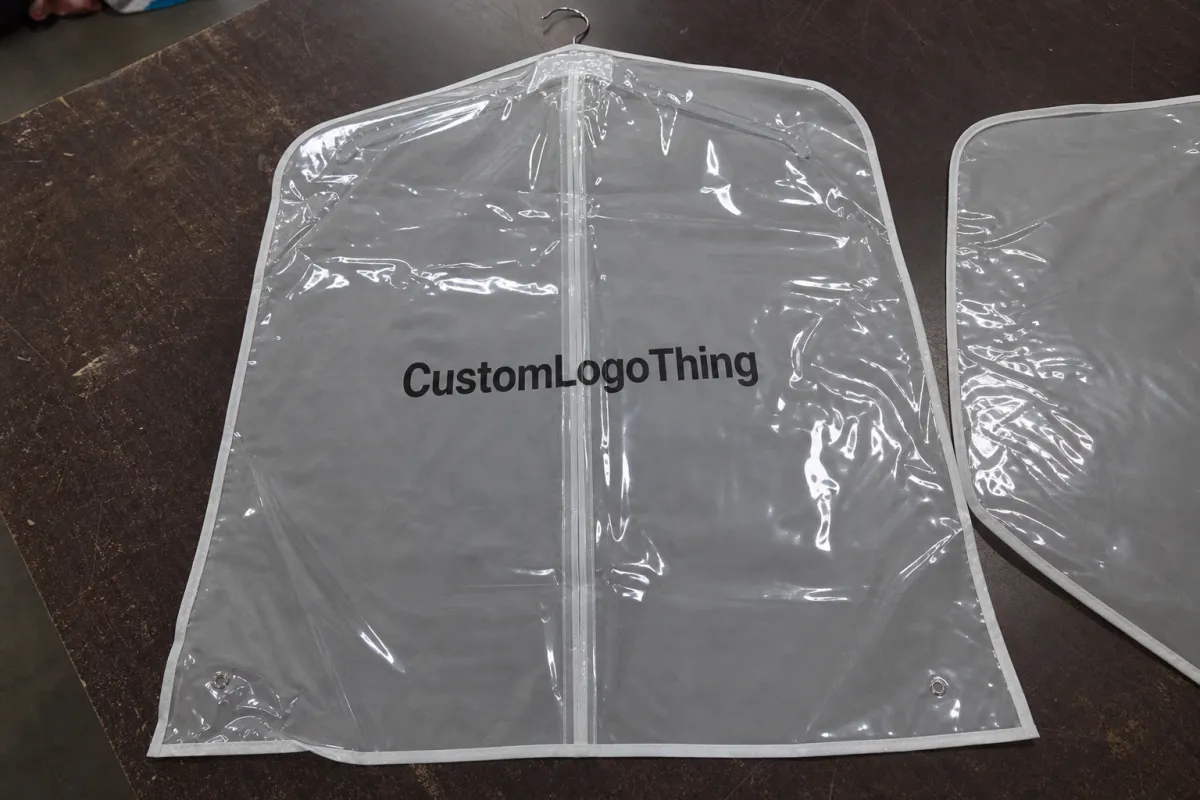
Tea-tinted PVC sits between clear display packaging and practical storage cover. The tint softens the bright look of fully clear film and helps minor scuffs disappear under retail lighting. For brands that want a consistent rack appearance across sizes, that softer tone can be useful.
The trap is assuming color affects price more than construction. Usually it does not. Material grade, film thickness, closure hardware, hanger reinforcement, and gusset depth move the number far more than tint. A low quote can become expensive once the supplier adds the parts the buyer actually needs.
Freight matters too. Thicker film and bulkier folds reduce carton density, so fewer bags fit in each case. That pushes up the landed cost even if the unit price looks flat. Air freight shows the problem fastest, but sea freight still reflects it through more cartons, more pallet space, and more warehouse handling.
That is why this purchase should be treated as landed-cost planning, not quote-chasing. The useful question is not "What is the lowest price?" It is "What is the total cost after material, labor, packing, freight, and rework?" Buyers who skip that step usually learn the answer after the first inspection.
Use case matters as well. A bag for showroom display can tolerate a lighter build if handling is controlled. A warehouse cover for outerwear needs better puncture resistance and a closure that survives repeated opening. If the supplier knows the use case early, the spec gets priced correctly. If not, the order turns into a correction project.
Product details that matter: clarity, finish, closures, and display
Tea PVC Garment Bags live in a narrow middle ground. They need to look presentable enough for the sales floor, but they also need to behave like storage products. That balance comes down to film finish, edge treatment, and closure design. A glossy finish gives more visual depth. A softer finish reduces glare. Neither is automatically better.
Closures deserve more attention than they usually get. Zippers are common, but not all zippers perform the same. Light coil zippers work for shirts, blouses, and short-term use. Jackets, uniforms, and frequent-access garments usually need a stronger zipper tape, a better puller, or a closure with less tendency to snag. The hanger opening matters too. If it is too tight, the bag twists on the rack. Too loose, and the top collapses during storage.
Gussets change both capacity and appearance. A flat bag is cheaper and ships smaller, but it compresses sleeves and creates pressure points on structured garments. Side gussets or bottom gussets improve fit for coats, longer dresses, and layered apparel, but they also use more film. Buyers should decide early whether the bag is mainly for presentation or protection, because the answer changes the build.
Tea tint also changes how the product reads in a room. Fully clear PVC shows every wrinkle, label, and scuff. Tea-tinted film lowers the visual noise and makes the line feel more controlled. That is useful for seasonal programs, uniform storage, showroom stock, and repeat replenishment where consistency matters more than maximum transparency.
If the order must survive transit testing, align the pack-out with a realistic shipping profile and not just the prettiest folded sample. The ISTA resources are a useful reference for transport testing logic, while packaging.org is helpful for broader material and packaging guidance. Neither replaces a clear spec sheet, but both help buyers avoid approving a bag that only works in a showroom.
Specifications buyers should lock before requesting a quote
For tea pvc garment bags Bulk Order Planning, the quote request should read like a specification sheet. Start with the garment, not the bag. Length, shoulder width, fold method, and garment type all affect the layout. A 36-inch bag for shirts is not the same thing as a 48-inch cover for coats, even if both get labeled "standard."
Film thickness is one of the biggest cost drivers. In practice, garment bag runs often fall somewhere around 0.08 mm to 0.20 mm depending on use, with lighter options for short-term storage and heavier options for outerwear or repeated handling. Buyers should also state tint consistency, transparency target, and yellowing resistance if the bag will sit under bright lights for months.
The functional list should be blunt and specific:
- Closure type: zipper, snap, or another closure
- Hanger slot: width, shape, and reinforcement method
- Gusset: none, side gusset, or bottom gusset
- Venting: required or not, based on storage duration
- Pack count: bags per carton and cartons per pallet target
Pack count is not a minor logistics note. It changes freight cost, warehouse handling, and defect risk. A tight carton pack can raise carton count and freight expense. A loose pack can crush the bags or bend the zipper line. The right choice depends on bag size, storage duration, and how much handling the cartons will see before the product reaches the end user.
If printing is included, define the logo size, location, ink color, and durability expectation. A one-color mark is easier to control than a full-coverage graphic. The same goes for packaging. Printed inserts, barcode labels, and branded cartons all add setup work. Buyers who want apples-to-apples pricing should send the same spec sheet to every supplier and ask each one to confirm the exact same dimensions, materials, finish, and packing configuration.
Missing details usually become expensive details. A supplier will not guess whether the bag needs a reinforced hanger slot or a soft retail finish. If it is not written down, it is negotiable.
Pricing, MOQ, and unit cost planning for bulk runs
PVC garment bag pricing usually follows a few familiar variables: resin grade, film thickness, closure hardware, printing, labor time, and packing efficiency. MOQ follows the same logic. Standard sizes and plain builds can often start lower. Custom dimensions, branded film, and special closures raise the minimum because setup cost has to be spread across more units.
That is why a single price request is weak sourcing. Ask for tiered pricing at two or three volume levels. A run at 2,000 pieces may still carry too much setup cost. At 5,000 or 10,000 pieces, the same product can become more efficient because waste, setup, and labor are distributed better.
| Build option | Typical use | Approx. MOQ effect | Typical unit price at 5,000 pcs |
|---|---|---|---|
| Standard tea-tinted PVC, light hardware | Shirts, blouses, short-term storage | Lower threshold | $0.36-$0.60 |
| Midweight PVC with reinforced zipper and hanger slot | Jackets, uniforms, showroom stock | Moderate threshold | $0.54-$0.92 |
| Gusseted, printed, or premium-finish bag | Outerwear, retail presentation, repeat programs | Higher threshold | $0.78-$1.30 |
Those numbers are directional. Bag size, zipper grade, film thickness, print coverage, and carton efficiency can move them quickly. A small change in width can alter material yield enough to matter. So can a change in carton count. That is why the landed number is better than the unit number, especially on repeat programs where shipping and warehouse handling become part of the real cost.
Sample fees should be separated from production. A basic mockup may cost very little. A matched sample with print, special closure details, and proper packing can cost more. If the sample fee is waived, good. If it is not, keep it visible. Hidden sample charges are one of those small items that disappear into the final invoice and make the buyer wonder why the margin moved.
A slightly higher unit price can still win if it reduces defects, cuts freight waste, or lowers the chance of returns. A bag that packs flatter and ships cleaner can offset a small price increase fast. On a recurring program, consistency usually beats the cheapest first order.
Compare landed cost, not the first number in the email.
Process, lead time, and production steps from sample to shipment
The standard workflow is simple: inquiry, spec confirmation, sample or mockup approval, mass production, final inspection, packing, and shipment. What slows it down is revision churn. Change the size after the sample. Change the zipper after the artwork. Change the carton count after the production slot is booked. Every change resets material planning and usually adds days.
Lead time depends on more than line capacity. Raw material availability, color matching, printing, seasonal demand, and shipping schedules all affect the finish date. A clean production run can still miss the deadline if freight space is not reserved in time or customs paperwork is left to the last minute. For replenishment programs, the shipping plan matters almost as much as the factory schedule.
Good suppliers describe quality checkpoints without hiding behind jargon. Look for incoming material inspection, in-line sealing checks, final dimensional checks, and carton verification before dispatch. For film performance, some buyers refer to standard methods such as ASTM D882 for tensile properties where that level of testing is appropriate. Not every program needs lab testing on every order, but every program needs an acceptance standard.
A realistic timeline for many bulk runs looks like this:
- Sample phase: confirm shape, closure, print, and finish
- Production phase: lock materials and run the approved spec
- Shipment phase: pack to carton target and secure freight booking
For standard tea PVC Garment Bags, sample approval can be quick if the spec is clear. Mass production often takes longer than buyers expect once printing, custom widths, or stronger closures are involved. A common range is around 20-35 days after sample approval for straightforward orders, with custom programs or peak-season schedules moving closer to 35-50 days.
How to evaluate suppliers for consistency, compliance, and communication
Ask for proof, not promises. A supplier should be able to show recent production photos, material certificates, tolerance ranges, and comparable bag builds. If they cannot show a similar run, the buyer is stepping into a blind spot. That may be fine for a test order. It is not fine for a bulk order that needs to land on time and match the approved sample.
Factory-direct pricing and trading-company pricing both have a place. Factory-direct can be cleaner if the plant actually controls materials, revisions, and inspection. Trading companies can sometimes manage communication better when the project has multiple moving parts or the buyer needs faster coordination. The real question is which one can keep the spec stable from approval to shipment.
Communication quality is a useful warning sign. Fast replies are nice. Precise replies are better. The supplier should confirm dimensions, packing count, closure details, artwork size, and approval steps without drifting into vague language. If every answer changes by the next message, the order will probably change too.
Compliance also belongs in the conversation early. Buyers should ask whether the material meets their market requirements for restricted substances, labeling, or disposal expectations. PVC is not always the easiest material from an end-of-life point of view, and some retailers or regions have restrictions around it. If the buyer needs a recycling plan, carton disposal plan, or specific marking requirements, those should be discussed before the deposit is sent.
Inspection should cover more than appearance. Dimensional tolerance, zipper travel, seam strength, hanger slot reinforcement, and carton labeling all matter. A bag can look fine and still fail in use because the zipper tracks unevenly or the hanger slot tears after a few cycles. A supplier with a boring, repeatable inspection process is usually safer than one with a flashy quote and weak documentation.
If the buying process will repeat, keep the rules visible in your internal workflow. The Wholesale Programs page helps structure larger buying decisions, and the FAQ is useful for the small process details that slow approvals. Neither page replaces a good spec sheet, but both can reduce the back-and-forth that burns time for no reason.
Next steps to place a smarter bulk order and avoid overbuying
The cleanest next step is a three-part checklist: finalize the spec sheet, request a sample or mockup, and ask for tiered pricing at two or three volume levels. That gives you a fair comparison and cuts down the most common source of confusion, which is each supplier pricing a slightly different product while everyone pretends the quotes are equivalent.
Then check demand against storage. Match order size to sales velocity, warehouse space, and the next replenishment window. If the bags are for seasonal apparel, overbuying the wrong size or closure style is a fast way to clog the back room. PVC garment bags are easy to stock in bulk only if the cartons are efficient and the inventory turns at a pace that makes sense.
Before production starts, confirm carton count, labeling, tolerance limits, and sign-off authority. Make sure the supplier knows which details are locked and which can move a little. A good order is not micromanaged into submission. It is controlled where control saves money.
That is the point of tea pvc garment bags Bulk Order Planning. It turns a one-off buying guess into a repeatable procurement process. Once the spec is locked, the pricing tiers are understood, and the lead time is mapped, the next order gets easier to control. Predictability is not flashy, but it beats a discount that looks good only until the first shipment arrives.
What MOQ should I expect for tea PVC garment bag bulk orders?
Standard sizes and plain builds usually allow a lower MOQ, while custom dimensions, printing, or stronger closures push it higher. Ask for pricing at multiple volume tiers so you can see where the unit cost starts to make sense.
How long does tea PVC garment bag production usually take?
For straightforward orders, a common range is about 20-35 days after sample approval. Custom print, special hardware, or peak-season demand can extend that to 35-50 days, especially if freight booking or artwork approval moves slowly.
Which specs change the quote most for PVC garment bags?
Thickness, closure type, hanger opening, gusset size, and print coverage usually have the biggest effect on price. Carton pack count and pallet efficiency also matter because they change freight and handling cost.
Can I order mixed sizes in one tea PVC garment bag run?
Yes, but mixed sizes work best when the film width, closure style, and packing method stay consistent. If each size needs a different layout or tooling setup, the supplier may split the run and charge more per unit.
What should I approve before placing the deposit?
Approve the final dimensions, material thickness, closure type, packing count, and any printing or labeling details. Also confirm the inspection standard and replacement policy so there is no dispute if the finished bags miss the agreed spec.

