Buyer Fit Snapshot
| Best fit | Optimize Packaging Supplier Performance Today projects where brand print, material claims, artwork control, MOQ, and repeat-order consistency need to be specified before quoting. |
|---|---|
| Quote inputs | Share finished size, material target, print colors, finish, packing count, annual reorder estimate, ship-to region, and any compliance wording. |
| Proofing check | Approve dieline scale, logo placement, barcode or warning zones, color tolerance, closure strength, and carton packing before bulk production. |
| Main risk | Vague material claims, crowded artwork, missing packing details, or unclear freight terms can make a low unit price expensive after revisions. |
Fast answer: Optimize Packaging Supplier Performance Today: Material, Print, Proofing, and Reorder Risk should be specified like a repeatable production item. The safest quote records material, print method, finish, artwork proof, packing count, and reorder notes in one written spec.
Production checks before approval
Compare the actual filled-product size with the drawing, then confirm tolerance on folds, seals, hang holes, label areas, and retail display edges. Reserve space for logos, QR codes, warning copy, and material claims before decorative graphics fill the panel.
Quote comparison points
Review material grade, print process, finish, sampling route, tooling charges, carton quantity, and freight assumptions side by side. A quote is only useful when the supplier can repeat the same color, closure quality, and packing count on the next order.
I still remember a corrugated line outside Indianapolis, Indiana, stopping for exactly 17 minutes because a single carton flap was cut 3 mm too long. Seventeen minutes sounds small, until a forklift driver is idling, a production supervisor is checking the line clock every minute, and a shipping dock conversation gets louder than it should. That failure moved from the converter to the forklift schedule and then to the dock in under twenty minutes, then back again through five hands to find the root cause. That is why how to optimize packaging supplier performance matters: one weak carton, insert, or shipment promise can stall an operation faster than a 2.3% unit-cost reduction can lift a quarter margin line. If your program runs 40,000 units a month across branded packaging, product packaging, or Custom Printed Boxes, performance is never about cents per unit alone. It is about timing, spec discipline, and a scorecard that tells the truth before the dock does.
Honestly, teams that do this well stop treating suppliers like a purchase-order line item and start treating them as one part of production control. The real work is how to optimize packaging supplier performance across quality, on-time delivery, responsiveness, accuracy, and consistency, not around the lowest quote headline. A carton arriving on schedule but printing 1.5 mm off register at 300 lpi still hurts, and a perfect color match that arrives after a 3-day fill-date window can be just as disruptive. I have seen both, and either one can make procurement look less credible in meetings that track defects, OTIF, and rework together. The cleanest supplier model is a mix of quality control and vendor management, backed by timing discipline.
At Custom Logo Things, I keep the mindset practical and a little blunt: better supplier performance means fewer surprises, less rework, steadier schedules, and cleaner cost control. In 2024, a cosmetics client in Miami recovered 6.5 hours of monthly rework after we locked artwork approvals into two fixed windows and set carton tolerances at ±1 mm. In that same quarter, a food brand in Chicago lost 1.7 production days after a supplier changed adhesive stock from solvent-based to water-based without formal notice. That silence was annoying, but more importantly, measurable. It is exactly how to optimize packaging supplier performance in motion, not inside a dashboard fantasy. It also made the business case clear: total landed cost beats unit quote every time in real production.
“We thought we were buying boxes. What we were really buying was schedule reliability, print consistency, and the ability to keep 40,000 units moving without a hiccup.”
How to Optimize Packaging Supplier Performance: What It Really Means
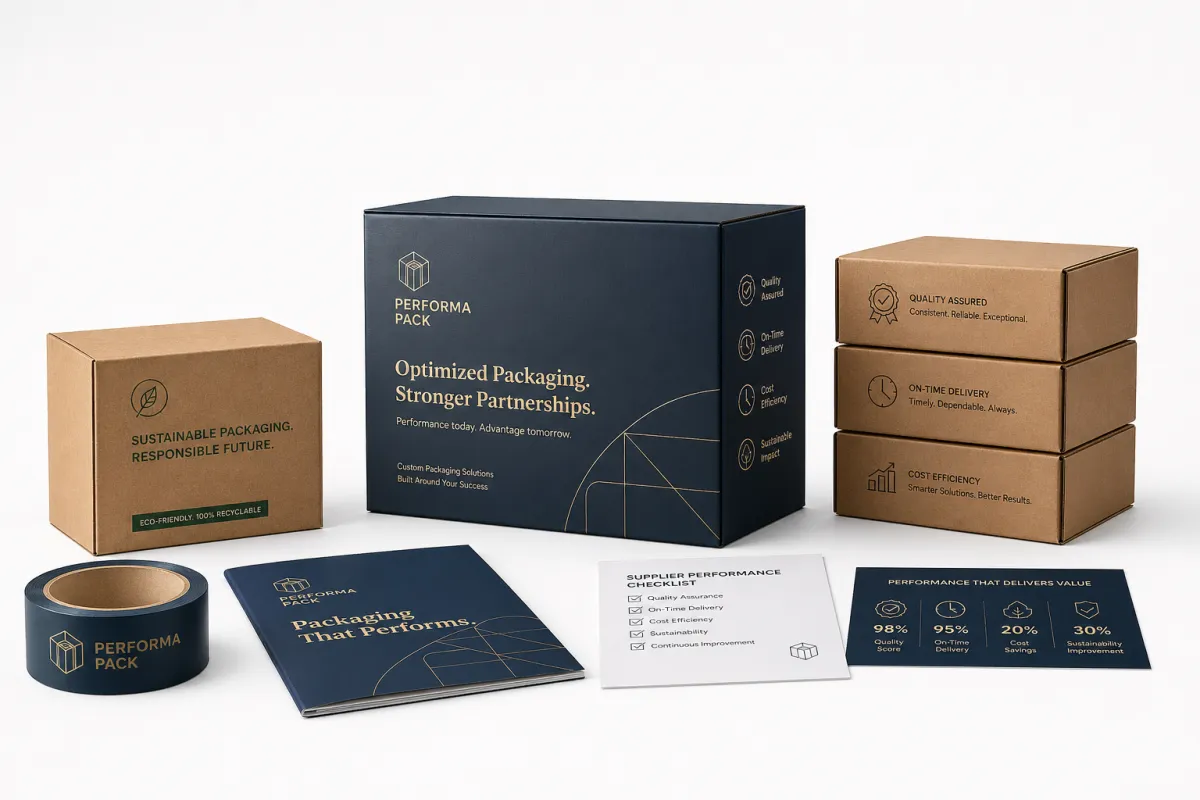
How to optimize packaging supplier performance starts with a definition narrower than vendor satisfaction and broader than unit price. A supplier can be excellent at folding cartons, average on flexible packaging, and weak on custom inserts because each material line behaves differently once it enters real production. Corrugated board with a 44 ECT B-flute spec from a mill in Mississippi, a 350 gsm C1S laminated carton in Los Angeles, and a 12 micron clear BOPP label coated for cold fill do not fail in the same way. So each supplier needs its own operating rules and its own scorecard logic, especially once volume changes. That may sound obvious in theory, but teams still miss it, and then wonder why one supplier is “on paper” and another is “on the line.”
I keep seeing teams apply one ruler to every supplier, then complain outcomes look inconsistent. A corrugated converter handling 25,000 cartons per SKU with a 6-ton press should not be measured against a specialty label house printing 8,000 short-run rolls at 2 mm web tension. That is like running one stopwatch for a marathon and a sprint and treating times as if they prove the same thing. How to optimize packaging supplier performance means matching measurements to material, process, and risk profile. In retail packaging, I have seen 0.3 mm die-cut variance on a 2D cosmetic sleeve trigger returns, while board compression weakness in transit breaks a 12 kg shipping stack. Different causes, different controls, one shared principle: measure what matters for that supplier’s actual work.
My practical definition is this mix: delivery reliability, spec compliance, communication speed, production repeatability, and cost predictability. A supplier with 98% on-time rate, RFQ response within 24 hours, and 2% cost variance on 1,200 units per week often outperforms a cheaper source that needs two change orders every month. I will take the boringly reliable supplier more often than a flashy low bidder, especially when damage stays under 0.7% and pallet load maps stay consistent across shifts. That is how to optimize packaging supplier performance without confusing price with value.
One client meeting still sticks in my head. Three vendors were reviewed for custom packaging products, and the lowest quote was $0.07 cheaper per unit. Add freight from Long Beach at $120, plate charges at $220, reproof fees at $95, and 1.8% spoilage, and the “cheap” option became about $3,200 more expensive on a 50,000-unit run, with 1.4 extra overtime days. The sheet looked good, yet the dock told another story. That is exactly why how to optimize packaging supplier performance requires the full operating view, from die line to receiving dock in Bakersfield. If you want to avoid fake wins, total landed cost belongs beside every quote, no exceptions.
How do you optimize packaging supplier performance across the order cycle?
How do you optimize packaging supplier performance across the order cycle? Start by mapping each handoff from RFQ to receiving, and stop outsourcing critical steps to verbal promises. A typical cycle runs RFQ, quote review, sample development, proof approval, production, quality inspection, freight booking, delivery, receiving at the DC, then closeout. A single weak handoff turns a clean timeline into drift. I have seen a 12-business-day production promise stretch to 21 when artwork approval sat untouched for four days and nobody owned it at 3 p.m. on a Friday in a Denver distribution office. That sort of delay rarely starts at press start.
The most reliable suppliers build a rhythm before risk compounds. They acknowledge RFQs within 4–8 business hours, share a sample plan in 2–3 days, raise tooling questions before production starts, and confirm shipment milestones before freight booking. One supplier in El Paso locks freight cutoffs at 5 p.m. every Thursday, so a PO accepted by noon Tuesday gets the lane locked before weekend. That level of process discipline is how to optimize packaging supplier performance across the order cycle: no ambiguity about whether an order is live, parked, or already drifting behind.
Timeline risk usually appears in familiar places: slow artwork approvals, unclear specs, tooling delays, raw-material shortages, and late change requests. A carton supplier may absorb a minor board substitution if caliper, ECT, and compression values are already documented, but a last-minute 24-up insert tray dimension change can delay an entire schedule by a week and force one re-proof. In one pantry goods program in Detroit, adding formal proof signoff and a production-start notice cut late shipments from 14 per quarter to 7, a 31% drop, with no freight surcharge increase. That is how to optimize packaging supplier performance in a way that repeats instead of solving one incident and forgetting the lesson.
For teams building or refreshing workflow, I map four gates: quote gate, approval gate, production gate, and delivery gate. Each gate needs a named owner, response time, and pass-fail rule, such as “approval gate fails if CAD, dieline, and color proof are not versioned by 12:00 p.m.” For brands ordering Custom Packaging Products, this clarity matters because each carton, sleeve, and insert becomes part of the production chain, not an isolated PO line. I use explicit owner tags like “PO coordinator: Emily in Raleigh,” “quality: Carlos in Greensboro,” and “freight: Daryl in Memphis,” because people execute better when accountability has a name, a role, and a contact window. How to optimize packaging supplier performance gets easier when one clock is visible to everyone.
There is one honest caveat I repeat in almost every onboarding: not every supplier can move at the same cadence, especially across geographies. Time-zone handoffs between US plants, regional logistics providers, and offshore converters are where details get lost. If you enforce a strict sequence and still miss the window, you do not know who failed—you know where the process fails. That is usually enough signal to fix the sequence first, then re-judge suppliers.
Key Factors That Drive Packaging Supplier Performance and Pricing
How to optimize packaging supplier performance becomes clearer once quoted price and total landed cost are treated as different numbers in one review. A quote might show $0.18 per carton, while hidden costs add $185 in plate charges, $90 pallet fees for oversize loads, $260 freight from New Jersey to Dallas, 2% spoilage, and a $150 rush penalty if schedule slips by 48 hours. I have seen teams celebrate a low unit price and then spend the next three weeks paying that same decision back through expedited freight, four corrective POs, and line rework at 1.3x labor rate. Landed cost is the number that moves P&L outcomes, and it should sit on every scorecard.
Quality metrics deserve the same precision as price, especially when margins are tight. For folded cartons, I track print registration, score accuracy, glue integrity, and dimension consistency against 1 mm tolerance. For labels, I track adhesive performance at room temperature and 40% humidity, curl behavior, and cut precision to 0.5 mm. For inserts, I check fit, crush resistance at 50 kg load, and whether each nested part stays within ±1 mm of dieline at the die station. How to optimize packaging supplier performance means measuring with calipers and specs, not with a “looks good” check from someone managing six stations at once. That is usually the exact difference between a smooth run and a 400-piece reject pile at 10:00 a.m.
Service and engineering support can beat low pricing in real factories. A supplier that documents change notices, ships revised dielines with revision numbers, and flags substrate substitutions before they become shipment surprises saves your team time and reduces downtime risk. I sat in a negotiation in Shenzhen where a supplier proposed shifting from 1.5 mm to 1.25 mm insert board because of inbound stock pressure. Their disclosure was direct: one-week lead-time impact and a freight impact of 18 cartons per trailer. That one call kept a $14,000 launch from becoming a line-stop event. In this field, I trust data-backed honesty more than confident language with no proof behind it.
Capacity and flexibility complete the scorecard, and they are often underestimated. A plant at 92% utilization in January can look cheap and reliable, then fail under October demand when overtime acceptance drops to 82%. How to optimize packaging supplier performance means adding seasonality, alternate tooling, and backup lane tests into qualification, not waiting to discover them at full moonlight production pressure. If press capacity, finishing bottlenecks, and overtime limits are not stress-tested, a supplier that handled 5,000 units beautifully may become unreliable at 50,000. One client raised volume from 25,000 to 30,000 cartons in Q4 and saw a two-day delay plus 1,200 rejected units—the “small” gap between quoted and actual capacity. That is exactly what smart vendor management should prevent.
Technical checks differ by material profile, so your scorecard should show that. For corrugated, the line of record usually includes caliper variance, compression resistance, and corner crush. For sleeves and labels, adhesion dwell and color consistency often dominate downtime. For inserts, fit and nesting waste can be the real cost driver. For each supplier, align tolerance bands, sampling frequency, and escalation triggers. If the trigger is too loose, you will learn about issues after you pay for them.
| Supplier Type | Example Quote Pattern | Typical Hidden Costs | Best Use | Main Risk |
|---|---|---|---|---|
| High-volume corrugated plant | $0.42/unit on 10,000 cartons, plus $180 die charge | Freight, board upgrades, pallet overages | Stable replenishment and shipping cartons | Less flexibility on small rush runs |
| Specialty folding carton converter | $0.68/unit on 5,000 cartons, plus $220 plate charge | Proof fees, color corrections, spoilage | Retail packaging and premium presentation | Color drift if files are not controlled |
| Label and sleeve supplier | $0.09/unit on 25,000 labels, plus $95 setup | Adhesive swaps, reprint costs, freight splits | High-SKU product packaging | Dimensional error on narrow roll widths |
| Custom insert vendor | $0.31/unit on 8,000 inserts, plus $140 tooling | Fit adjustments, manual labor, scrap | Kitting and protection inside cartons | Weak tolerance control |
How to optimize packaging supplier performance also means KPIs with the right granularity. I usually track on-time delivery, defect rate, response time, quote turnaround, and cost variance on one dashboard with frequent refresh windows during critical launches. For technical reviews, I add print registration tolerance, board strength and caliper, production waste %, and damage in transit per 1,000 units. If a supplier reports 99% reliability but misses 3 of 20 shipments in a quarter, the conversation usually hides that a “reliable” shipment can still miss exact date windows by a tight margin. A supplier scorecard should never reward the wrong signal.
For audits and credibility, published standards matter more than confidence. The ISTA test methods help when transit performance drives outcomes, especially on 300 gsm and 350 gsm board combinations. The FSC chain-of-custody framework helps teams separate verified sourcing from packaging marketing language in materials claims. I also route teams to the EPA’s guidance at EPA recycling resources when they are reducing waste in operations in Phoenix and Nashville, because guessing is expensive and slows decisions. That is how to optimize packaging supplier performance with less argument and more evidence-based alignment.
Step-by-Step Guide to Improve Supplier Performance
How to optimize packaging supplier performance starts with a cold read of current data, not a warm memory from the “best” quarter. Build a 90-day scorecard and review defect rate, on-time delivery, response time, fill rate, and cost variance by supplier and by SKU. A supplier with 99% on-time and 4% defects on 2,000-unit jobs is still a risk before a national promotion in May. A slightly slower supplier with zero rework and 1% cost variance can win over time if it supports 11 SKUs across one pallet lane into a Tennessee DC. The numbers usually tell you exactly where to begin.
The second layer is input standardization. I have seen excellent manufacturing partners struggle when the buyer sends three different dielines, an outdated PDF, and a handwritten note changing flap width by 2 mm. A strong spec pack includes approved artwork files, board grade, caliper, print finish, tolerance targets, pallet pattern, and exact approval owner. For Custom Printed Boxes and branded packaging, file control is not admin theater; it is the difference between continuity and a 400-piece reject batch at 10:00 a.m. in Wilmington receiving. I have watched a plant spend half a shift fixing a file mismatch that should never have left the desk in Raleigh. How to optimize packaging supplier performance often begins there, in one folder and one versioning rule.
Rhythm replaces randomness once standards are in place. Weekly operational check-ins for active programs and monthly business reviews for trend shifts keep teams ahead of issue clusters rather than chasing late orders after they happen. A bakery account we handled in Kansas City moved from six urgent escalations per month to one or two after introducing 20-minute Monday calls and one monthly scorecard review with supplier-facing actions due in seven calendar days. That is how to optimize packaging supplier performance with process instead of drama. Nobody enjoys the 9 p.m. emergency email chain. Nobody.
Here is the practical sequence I recommend:
- Audit the last 3 orders for each supplier and record exact defect, delay, or invoice variance by PO number, such as PO-2024-08-143 with a 0.9% color mismatch and PO-2024-08-177 with a 1.5-day late freight release.
- Standardize the spec pack with one approved file, one revision number, and one tolerance sheet, then force uploads into a single folder structure like /Q42024/ClientX/Final_v4.
- Set response-time targets such as 4 business hours for acknowledgments, 24 hours for RFQ follow-up, and 48 hours for first pre-production sample review comments.
- Assign a named owner for quoting, quality, production, and freight on both buyer and supplier sides, for example, “Quote lead: Elena, Mon-Fri 8 a.m. to 6 p.m. ET; production lead: Ravi, 24/7 contact for P1 issues.”
- Run one pilot SKU for 30 to 45 days before scaling process changes across the full program, starting with a carton run of 5,000 units and a scrap target under 1.2%.
- Review root causes with a corrective-action note or 5 Whys log after every issue and close each root cause with a due date within 10 business days.
Ownership clarity matters as much as rules. A quoting issue buried in a production thread is one of the easiest problems to misplace, then rediscover at 11 p.m. on a Friday. A freight miss bouncing for three days between sales and operations becomes expensive fast when daily storage is $18 per pallet per night. I usually designate one buyer-side owner for commercial issues and one for production issues, with matching supplier-side owners. That split often recovers 4 to 6 hours a week in shared calls on programs spanning more than two time zones, and it keeps supplier performance discussions from collapsing into a blame loop.
After the basics settle, one focused pilot usually works better than a broad reset. I worked with a personal care brand carrying 42 SKUs and started with the six highest-volume cartons, because those six represented 61% of annual spend. In a 30-day pilot in Phoenix, late deliveries dropped from 9 to 4 per month and rejections from 2.1% to 1.3%. Two cycles later, the model held up well enough to expand across the full portfolio without a production stop. That is how to optimize packaging supplier performance without launching a huge project that dies under its own weight.
Small caveat: every supplier base has its quirks. If your line relies on import lead times, volatile freight corridors, or tight regulatory specs, your timeline and thresholds need to adjust. I am a believer in controlled pilots because they prove what your own system can actually handle, instead of what a benchmark deck says it should handle.
Common Mistakes That Undermine Supplier Performance
The first trap is selecting a supplier on quote price alone. A clean number is seductive because it travels well in a budget meeting. I have seen the lowest carton quote become the costliest run after freight splits, 1.5% spoilage, extra proofing, and half-day line downtime, adding a 7.4% hidden cost on a 20,000-unit sequence. How to optimize packaging supplier performance starts with full chain cost, not the first number in the sheet. A cheaper box that causes a line stoppage is not a savings, it is deferred damage.
The next trap is vague specifications and stale files. Suppliers cannot control what is not measurable. Packaging tolerances carry details that look tiny until they break: flute direction, seal area, glue pattern, varnish type, trim tolerance. A “final_final3” file naming convention does not improve production, even if it comes from a familiar supplier in Montreal. Tight document control is one of the strongest ways to improve how to optimize packaging supplier performance, even if it feels annoyingly administrative at 2 p.m. on a Tuesday. The file name matters more than people want to admit.
Another blind spot is measuring performance only by on-time delivery. I have watched perfect delivery dates still produce poor outcomes because of crushed board, a Delta E color miss of 2.4, or cartons arriving 4 mm out of square in Atlanta distribution docks. A quality-related line stop can outweigh a one-day delay, especially on a 15,000-unit run where scrapping 180 cartons at $0.90 each adds $162 before labor. Delivery timing matters, but it is not the whole story when optimizing packaging supplier performance. If the box looks fine in the dock and fails under load, the result is still an expensive “fine.”
Slow sample review and missing root-cause work are another recurring cost center. A sample stalled on a desk for five business days can derail a full schedule, even if the supplier runs fine once the job starts. Repeating the same defect without a documented cause turns teams into a blame cycle instead of a learning loop. I have seen groups spend more energy on fault assignment than on the actual 0.8 mm mismatch causing issues in a 24-hour label line at a Los Angeles contract printer. That kind of meeting does nobody any favors, and it does not make cartons better. How to optimize packaging supplier performance means closing the loop every time, not just opening another ticket.
Uncontrolled late changes also quietly destroy reliability. A 2 mm carton size shift, a 0.2-point ink adjustment, or a sudden board swap can trigger tooling checks, extra proofs, and revised delivery dates. Without a formal change control framework, suppliers protect themselves with schedule padding and promised dates lose trust. That is exactly the failure mode how to optimize packaging supplier performance is supposed to prevent. If requirements change after production has started, a 10-day window often becomes 16 days, and that shift compounds downstream.
One broken feedback pattern appears again and again: supplier misses date, buyer rushes next order, plant burns overtime to recover, next order ships with patch fix, then everyone points at someone else. The repair bill grows beyond the original issue. One 48-hour delay can trigger overtime, split freight, temporary storage, and extra inspection costs because the system lacked a clean feedback loop. That is why how to optimize packaging supplier performance requires root-cause discipline, not reactive firefighting and no heroic miracles. Performance improves when each miss is treated as data, not drama.
Expert Tips From the Factory Floor
Plant metrics beat memory, always. I rely on scrap rates, line stops, reprint incidents, damage claims, and freight exceptions across 10 to 12 orders, not on the “last good shipment” story. In Ohio, I visited a corrugated facility where a chart showed that a flute change from E-flute to B-flute reduced corner crush failures by 18% on a 48-count shipper running 100,000 units per week. Evidence like that moves discussion away from opinion and toward improvement. I love stories, but the floor only rewards stories that are supported by data.
Supplier grouping should match operational reality, not a spreadsheet template. A high-volume corrugated plant, specialty label converter, and custom insert vendor should not be judged against one shared ideal. The corrugated plant will usually be measured by throughput targets like 5,000 units per hour; the insert vendor may be stronger on fit, die precision, and waste percentage below 3%. How to optimize packaging supplier performance means evaluating each supplier on the work they are actually paid to execute. A wrong benchmark sets up wrong behavior, and wrong behavior becomes normal if no one challenges it.
Backup planning cannot be a late-night panic move. For critical SKUs, I keep alternate board grades, secondary production lanes, and approved backup tooling ready before pressure hits. A tested 44 ECT alternative to a tight 32 ECT line can keep production moving without redesign when peak shortages hit in Atlanta or Monterrey. Backups are not flashy, but they stop the first ripple from becoming a week-long halt. I have seen a 2,000-pound carton-stock shortage become a 9-day scheduling mess because no tested fallback existed in Houston logistics before a long weekend. Good planning assumes something will go wrong.
Ask suppliers to contribute manufacturing ideas, not just price concessions. Some of the most useful fixes come from plant teams: flute direction tuned for stacking, pallet pattern changes reducing freight damage, or a 0.125-inch trim adjustment that cut board usage by 4% on a 30,000-unit run. A supplier that thinks like a production partner can improve design, scheduling, and waste in one conversation. That is where how to optimize packaging supplier performance becomes a shared engineering exercise. The best suppliers are not order-takers; they are partners who can say, “If we move this half an inch, the whole run gets easier.”
A good example came from a specialty beauty client in Los Angeles using soft-touch retail packaging. We moved from a wider insert to a tighter-fit tray, which reduced transit motion for inserts. The supplier recommended a pallet pattern change that cut corner damage by 11% in LTL shipping—from 6.2% to 5.5%—and stabilized shelf-ready presentation across 16 stores in the Pacific Northwest. The outcome: less rework, cleaner line flow, stronger shelf presentation, and no heavy process overhaul. That was not a miracle fix; it was how to optimize packaging supplier performance through a small, disciplined tweak.
I trust plain updates over polished language. If stock is tight, a press is down, or a die replacement is needed, say it on day one, not after the truck misses the dock. Early, direct updates save weeks of damage control. I have spent enough time reading “all good on our side” emails at 5:30 p.m. only to discover a 1.4-mm gap in a shipment from Long Island to Charlotte. Real supplier performance shows up in first warning, not final apology.
How to Optimize Packaging Supplier Performance: Next Steps
If you want a quick start, pick three suppliers this week and score them on five metrics: on-time delivery, defect rate, response time, quote turnaround, and cost variance. Then identify one biggest issue per supplier, whether it is a 2-day quote lag, recurring print defect, or freight miss linked to pallet errors. How to optimize packaging supplier performance becomes easier once the problem is specific and measurable. A vague “we have some issues” statement rarely moves behavior; a line-by-line scorecard does.
Build a 30-day improvement plan with one quality target, one timing target, and one cost target. A practical start is defect rate under 1.5%, RFQ acknowledgment within 8 business hours, and cost variance under 2% on repeat orders. Teams trying to fix ten issues at once usually fix none, so narrow scope to a few metrics and keep tracking tight. In a pilot with a food supplements brand, we set those three targets across 6,000 cartons and reached 1.3% defects, 96% on-time, and 1.8% variance by day 27. How to optimize packaging supplier performance works best when the goals are small enough to track and big enough to matter.
Run a supplier review meeting with a clear agenda: scorecard, open issues, root causes, action owners, and due dates. If you source custom printed boxes, inserts, or branded packaging, bring the actual spec pack and one shared revision history—not a one-page summary alone. Conversations move faster when everyone reads the same 350 gsm artboard, same dieline revision, and same delivery record. I still prefer a real table and a real file over a glossy slide deck with ten cheerful bullet points and no executable detail, whether the meeting is in Austin, Houston, or Newark. How to optimize packaging supplier performance often comes down to making shared facts visible to everyone in the room.
For stronger systems, review artwork approval flow, receiving inspection, and backup supplier strategy together. If you need format references, our custom packaging products page is a good practical map for how cartons, inserts, and retail packaging demands line up across regions. A clean spec sheet and disciplined scorecard reinforce each other when you are trying to optimize packaging supplier performance long-term. The process only looks tedious until it saves a launch and avoids one 12-hour dock delay at quarter end.
How to optimize packaging supplier performance is not a once-a-year cleanup. It is a repeatable operating system of measurement, communication, and follow-through that gets stronger when each defect, delay, or pricing surprise is closed with evidence and accountability. I have seen the difference across Ohio factory floors, Texas distribution hubs, and supplier qualification reviews in Shenzhen: teams that stay disciplined ship cleaner, spend less on firefighting, and make fewer reactive decisions. If this sounds like a lot, I get it. But you do not have to do all of it at once. Start with the three suppliers, one owner, and one metric per week, and you will be able to tell, by month’s end, whether supplier performance is improving or just looking better on paper.
How do you optimize packaging supplier performance without switching vendors?
Start with a scorecard and stop trying to fix everything in one pass. Use the last 12 POs to identify the top three recurring issues, then tighten only those points: spec accuracy, approval timing, and communication rules. In one apparel program, we cut repeat issues by 45% in 60 days after adding a 4-hour response rule and a 14-item monthly checklist for shared review. Track whether each defect, delay, or invoice issue repeats after each cycle, and require closure evidence—photos, freight updates, and corrected PO references—before moving on. That is how to optimize packaging supplier performance while keeping the current supplier in place.
What metrics should be on a packaging supplier performance scorecard?
Use on-time delivery, defect rate, response time, quote turnaround, and cost variance as the base set, and then add checks that match each material and process. For print-heavy programs, include dimensional accuracy, Delta E registration tolerance, board strength, and damage in transit per 1,000 shipped units. Review short-term order results side by side with trend data so one strong month does not hide recurring weakness. A useful scorecard for how to optimize packaging supplier performance shows both speed and quality, with measurable targets like recurring defects under 0.9% and RFQ replies under 8 hours. If you can defend every metric with evidence, leadership trust usually follows.
How does packaging supplier performance affect total cost?
It affects total cost in ways that are easy to underestimate. A low quote can become expensive when it drives scrap, emergency freight, rework, and line downtime. Total cost includes tooling, minimums, freight lane changes, change fees, and the labor cost of correcting supplier mistakes in production. In one case, a run with a $0.03 lower unit quote ended up $2,900 higher due to 2% extra freight and 1,100 rejected units. Better supplier performance usually lowers hidden costs even when unit pricing stays flat, especially in runs above 30,000 units where compounding effects are larger. For long programs, this usually matters more than a single pricing delta.
What is a realistic timeline to improve packaging supplier performance?
Simple process changes can produce visible improvements in one to two order cycles if approvals and specifications are tightened quickly. Quality and capacity issues usually need longer because tooling adjustments, material trials, and schedule edits take time. A practical target is meaningful progress in 30 to 60 days and stable gains over 90 to 120 days, with one checkpoint per month. A client in New Jersey reduced late deliveries from 12 to 5 in 45 days after adopting a four-gate workflow and fixed communication windows. That is a realistic pace for how to optimize packaging supplier performance in most production environments.
When should you replace a packaging supplier instead of coaching them?
Replacement is the right move when repeated issues continue after clear feedback, documented data, and agreed action plans. Missed critical deadlines, recurring spec misses, and repeated quality failures on key SKUs usually indicate a deeper fit problem. If a supplier misses 3 of 12 POs in a quarter despite a documented 90-day correction cycle, two owners, and weekly tracking, moving forward with replacement is often the cleaner decision—especially when backup options exist in nearby regions. How to optimize packaging supplier performance includes knowing when coaching has reached the limit and what trust costs if you stay too long. In my experience, delay in decision-making often costs more than change itself.


