The Uniform Detail That Quietly Controls Replacement Spend
Picture 300 aprons moving through weekly laundry across five or six restaurant locations. Buyers researching Care Labels Unit Cost for restaurant groups are usually not chasing the cheapest tag. They are trying to reduce reorders, laundry errors, mixed inventory, and branding drift.
A missing label looks harmless until the wrong wash temperature shrinks server shirts, a bleach-heavy cycle fades black aprons, or a laundry vendor cannot tell which garments belong to which location. Multiply that across 40 employees per site, two to four uniform sets per employee, and a 10% to 20% annual replacement allowance. Suddenly a label measured in cents is touching a budget measured in thousands.
Care labels behave like date labels in a prep kitchen or tamper seals on delivery packaging. They are small controls that prevent avoidable mistakes. A durable label helps staff sort garments, gives laundry partners clear instructions, supports textile disclosure requirements, reinforces brand ownership, and reduces confusion when uniforms come from more than one decorator.
Restaurant uniforms take rougher treatment than most retail apparel. Commercial detergents, high-heat dryers, fryer oil, sanitizer, bleach exposure, and repeated wash cycles all compress the useful life of a garment. A consumer T-shirt may see 30 washes over a long stretch. A back-of-house apron can see that in a season.
Custom Logo Things approaches Custom Labels & Tags from a procurement angle: material, print method, MOQ, quantity breaks, setup charges, proofing, and reorder planning. The useful quote is the one built around how your uniforms are actually washed, worn, sorted, and replaced.
Buyer reality: the lowest cost per piece can become expensive if unreadable labels cause premature garment replacement, laundry disputes, or emergency reorders.
Here is the practical breakdown: product options, specifications, cost drivers, MOQ planning, production timeline, quality checks, common mistakes, and the quote inputs that procurement, operations, and marketing can all defend.
Care Label Products Built for Aprons, Chef Coats, and Staff Uniforms
Restaurant uniform labels are not one product. They are a small family of constructions with different jobs: woven care labels, printed satin labels, printed nylon labels, cotton labels, and heat-transfer labels.
Woven labels make sense when brand permanence matters. They suit hem tags, logo tabs, premium aprons, retail merchandise, and staff apparel where the label is partly visible. The tradeoff is detail. Tiny wash symbols, fiber percentages, origin copy, and QR codes often reproduce more cleanly on printed labels because woven thread has a physical limit.
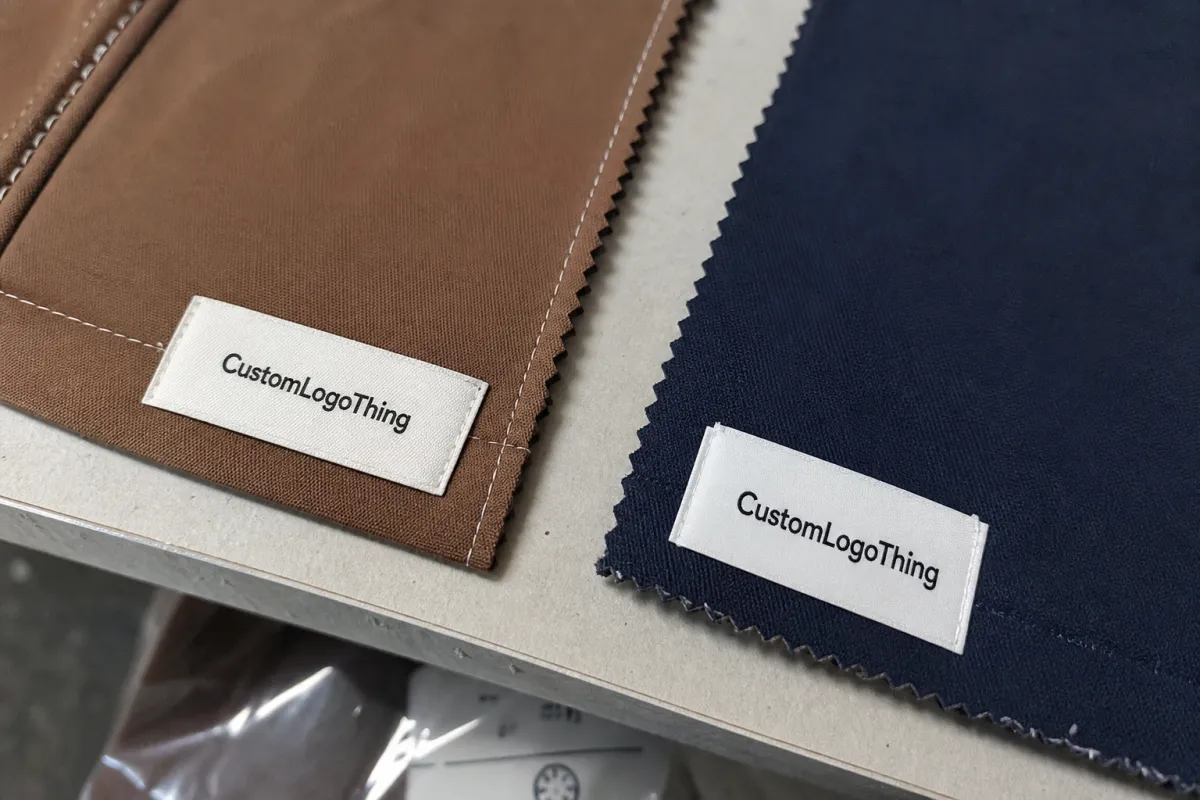
Printed satin labels are common for neck labels, side-seam labels, and front-of-house garments. They feel smooth and look polished. A typical restaurant care label might run 25 mm x 50 mm or 30 mm x 60 mm, with black print on white satin for clear instructions.
Nylon labels are tougher. For back-of-house aprons, chef coats, kitchen towels, and washable hospitality linens, printed nylon is often the practical option because it resists repeated laundering and remains readable under rough handling. Cotton labels give a softer natural look, but they are not always the best match for grease, bleach, or aggressive drying.
Heat-transfer labels reduce scratch and bulk. They work well for tagless comfort on shirts, polos, and some merchandise. They still need testing against the fabric, heat press settings, and wash program. A transfer that performs on a cotton tee may behave differently on a polyester-blend chef coat.
| Label Type | Best Restaurant Use | Typical Strength | Cost Note |
|---|---|---|---|
| Printed satin | Server shirts, polos, front-of-house uniforms | Smooth hand feel and readable care text | Efficient for simple black print at medium quantities |
| Printed nylon | Aprons, chef coats, kitchen towels | High wash durability and strong readability | Often the best balance of unit cost and durability |
| Woven polyester | Brand labels, hem tags, retail merchandise | Premium brand permanence | More colors and fine detail can raise cost per piece |
| Cotton | Natural-look merchandise or light-duty apparel | Soft, matte appearance | May require testing for shrinkage and print clarity |
| Heat transfer | Tagless shirts and comfort-focused uniforms | No sewn-in label edge | Application testing matters; failures can be costly |
Label content can include wash instructions, fiber content, country of origin, size, style code, location code, batch number, QR code, and reorder SKU. Restaurant groups often underuse reorder SKUs. A short internal code can save hours later, especially if uniforms move through several apparel vendors or decorators.
Readability deserves more weight than it usually gets. A smaller label may save fractions of a cent, but if staff cannot read wash instructions under dim back-of-house lighting, the savings are cosmetic. Standardizing one label system across multiple garment vendors also gives restaurant groups cleaner inventory control and less fragmented branding.
Specifications That Change Durability, Compliance, and Comfort
Before asking for pricing, confirm the core specifications: label size, material, fold type, print colors, ink type, cut method, stitching allowance, and packaging preference. These are production variables, not clerical details. They drive durability, comfort, compliance risk, and unit cost.
Fold style is one of the most common sources of confusion. A straight cut label is flat with finished edges, often sewn on all sides or inserted into a seam. An end fold tucks the left and right ends under for a clean sew line. A center fold works well in side seams or neck seams, with content on one or both panels.
A loop fold creates a looped label for hems or hanging points. Book fold labels create multiple readable panels, useful when care copy is long or several languages are required. A Manhattan fold gives a more structured finish, often used where presentation matters.
Material choice should follow the laundering reality. Satin feels smooth, but poorly finished satin can fray. Nylon stands up to heavy wash processing and is a workhorse for aprons and towels. Woven polyester handles logos well, but very small text can lose definition. Cotton can look attractive on retail merchandise, though it may not be the right answer for high-heat, high-chemical wash programs.
Print method also matters. Screen printing can be efficient for simple, high-volume copy. Thermal transfer is common for crisp variable-style information. High-resolution digital print may suit QR codes, small symbols, or more complex artwork, depending on material and durability targets. For repeated commercial washing, ask how the ink system is tested and whether a physical sample is recommended.
Compliance depends on garment type and sales channel. Textile labels may need accurate fiber content, country of origin, and care instructions. The Federal Trade Commission publishes textile labeling guidance in the United States, and the FTC clothing and textiles guidance is a useful starting point. This is not legal advice; requirements depend on the product, market, and where the garment is sold or distributed.
Contrast is cheap insurance. Black text on white or light satin remains the benchmark for care instructions because it survives poor lighting and quick handling. Low-contrast branding may look tasteful in a mockup and fail in a laundry room.
For uniforms exposed to bleach, heat, oil, or repeated commercial washing, order physical samples or approve a pre-production proof. A digital proof confirms layout. It does not prove hand feel, fray resistance, fold accuracy, scan quality, or wash performance.
Quality-control checks should be basic but non-negotiable: verify label dimensions after cutting, confirm fold orientation, inspect edge finish, check spelling and symbols against the approved proof, test QR codes if used, and review print density under normal lighting. If the label will be sewn into a seam, confirm the sewing allowance before bulk production.
Specification discipline reduces cost. Fewer custom versions across locations mean stronger bulk pricing, cleaner inventory management, and fewer rework disputes.
Care Labels Unit Cost for Restaurant Groups: What Moves the Number
Care Labels Unit Cost for restaurant groups is driven less by the label alone and more by the combined effect of quantity, material, size, print complexity, finishing, packaging, and shipping method. The first units carry setup charges, proofing labor, loom preparation, plates, or artwork handling. Higher quantities spread those fixed costs across more pieces.
Simple printed satin labels often price lower than woven multi-color labels. That does not automatically make satin the better buy. If a tougher printed nylon label prevents relabeling or replacement on back-of-house aprons, the higher cost per piece may still win.
As a planning range, a straightforward printed care label in a moderate restaurant quantity may fall around $0.05 to $0.18 per unit, depending on dimensions, print method, finishing, and order volume. Small pilot runs can land higher because setup charges are spread thin. Complex woven branding labels, multi-color details, special folds, heat-transfer constructions, or individually packed labels can move above that range. These are budget figures, not a quote.
MOQ should be treated as a planning tool, not a nuisance. A 500-piece test run may be useful for one new apron style. A 5,000- or 10,000-piece group order can improve unit cost for chains, franchise groups, and hospitality operators because the same production setup serves more garments.
Buyers often overlook the quiet cost drivers: individually bagged labels, multiple size runs, rush production, Pantone color matching, QR code testing, split shipping to several decorators, and last-minute copy changes. Tooling fees and setup charges can also appear differently by supplier, so compare the full quote structure rather than the headline number.
| Cost Driver | Why It Changes Price | Procurement Move |
|---|---|---|
| Quantity | Setup and proofing costs spread over more labels | Request pilot, rollout, and annual reorder tiers |
| Material | Nylon, satin, cotton, and woven polyester process differently | Match material to wash exposure, not appearance alone |
| Print complexity | More colors, QR codes, and fine type can add labor or testing | Keep care copy high-contrast and brand art controlled |
| Fold and finishing | Book folds, loop folds, and special cuts add handling | Use the simplest fold that supports sewing and readability |
| Shipping | Split shipments and rush freight raise landed cost | Consolidate destinations when the rollout calendar allows |
Ask for landed cost, not only unit price. Freight, duties, rush fees, rework risk, and laundry failure can erase a cheap quote. Custom Logo Things can quote practical options side by side through custom label and tag production, so procurement can decide whether savings, speed, or durability matters most.
MOQ and Quote Inputs Procurement Teams Should Prepare
A fast quote starts with complete inputs. Send the label type, dimensions, quantity, artwork, text, colors, fold style, garment application, destination, deadline, and expected reorder frequency. If one detail is unknown, say so. Guessing creates revisions.
Restaurant groups should map quantities from the operation backward: number of locations, staff count, uniform sets per employee, seasonal hiring, replacement rate, and safety stock. A 12-location group with 35 uniformed employees per location and three garments per employee already touches 1,260 garments before spares. Add 10% safety stock and the label need changes quickly.
MOQ can protect consistency. One approved label run can serve several properties, decorators, or laundry programs. Without that discipline, a group may end up with different label sizes, different wash instructions, and different brand marks inside the same uniform program.
Create a master label spec sheet. Include dimensions in millimeters or inches, material, fold, print colors, approved copy, logo file reference, placement photo, and reorder SKU. If different locations use different apparel decorators, this document becomes the control point.
Consolidation is not always best. One universal care label can reduce unit cost and simplify inventory. Separate labels for chef coats, aprons, retail merchandise, and linens may improve accuracy if fiber content or wash instructions differ. The right answer depends on the garment mix.
Separate mandatory information from optional branding elements. Fiber content, origin, size, and wash instructions may be non-negotiable. A slogan, location nickname, or extra icon might be optional if the budget is tight or the label is already crowded.
Artwork readiness affects both pricing and timeline. Vector files, approved copy, Pantone references, and clear placement instructions reduce back-and-forth. For the most useful view of cost, ask for tiered quotes by quantity and finishing option. The breakpoints are often more revealing than a single flat number.
Process and Timeline From Artwork Check to Delivered Labels
The production path is straightforward, but each step can add or save time. It normally moves through inquiry, spec review, artwork preparation, quote, digital proof, sample or pre-production approval when needed, bulk production, quality check, packing, and shipment.
A digital proof confirms layout: text position, fold orientation, logo placement, color references, and approximate size. A physical sample confirms what a PDF cannot: texture, readability, fold accuracy, edge finish, and print behavior on the chosen material.
Timelines vary with material availability, order volume, approval speed, label complexity, and shipping destination. Simple printed labels can often move faster than complex woven labels or projects with several versions. Rush orders may be possible, but they can increase cost, narrow material choices, or reduce testing time.
Buyer response time is the hidden bottleneck. A proof that sits for four business days can push the order behind other production runs. For restaurant openings, that can collide with uniform decoration, staff onboarding, and soft-launch schedules.
Build the label calendar around operational deadlines: new unit openings, franchise rollouts, seasonal hiring, menu launches that require new branded uniforms, and laundry vendor changes. Approve the master label before garment production begins, not after the decorator is waiting.
For multi-location rollouts, split shipments need early discussion. Sending labels to one apparel decorator is simpler than shipping five cartons to five locations. If split freight is needed, include full addresses, contact names, and required delivery windows in the quote request.
Quality checks before shipment should match the risk of the order. For a simple black printed label, visual inspection against the proof may be enough. For QR codes, small compliance text, or high-wash back-of-house garments, scan checks and sample review are worth the extra attention.
Custom Logo Things helps flag timeline risks early, especially where restaurant groups need label consistency across several apparel vendors. That advisory work is not glamorous. It prevents delays.
Mistakes That Make Cheap Labels Expensive
The first mistake is choosing the lowest unit price without checking commercial laundry performance. A label that looks fine on arrival can fade, curl, crack, or fray after repeated hot washes.
Unreadable care text is an operational failure. Laundry vendors rely on clear instructions to prevent shrinkage, fading, heat damage, and fabric breakdown. If a 26 mm label is expected to hold wash symbols, fiber content, origin, size, brand copy, and a QR code, something will suffer.
Inconsistent labels across locations create another problem. One kitchen uses “tumble dry low.” Another uses “do not bleach.” A third has no fiber content. Staff stop trusting the label system, and brand control weakens.
Material mismatch is common. Soft satin may suit front-of-house shirts. Back-of-house aprons exposed to grease, sanitizer, and bleach may need printed nylon or another tougher construction. The label should match the garment’s worst week, not its best photo.
Artwork errors add avoidable cost: raster logos instead of vector art, missing bleed, unclear fold orientation, unapproved copy, low-resolution QR codes, and color references that nobody signed off. Each correction can delay proof approval and raise the chance of rework.
Overcustomization also hurts. Ten location-specific label versions may feel organized, but they increase setup charges, complicate inventory, and raise the risk of shipping the wrong label to the wrong decorator. A short location code or batch number may solve the same problem with less complexity.
Another quiet mistake: treating care labels as an afterthought until the garments are already in production. If the label arrives late, the decorator may hold the order, use a temporary substitute, or sew in whatever is available. That shortcut can follow the uniform program for years.
Use a simple risk-control system: test, standardize, document, and reorder from the same approved specification. That is how care labels move from a nuisance purchase to a controlled operating component.
Build a Label Spec That Gets a Better Quote
Start with a count. List garments by category: aprons, chef coats, server shirts, polos, caps, towels, linens, and retail merchandise. Gather existing labels, photograph placement, list laundry conditions, and identify which information is mandatory.
Then decide the label’s primary job. Compliance? Durability? Branding? Sorting? All four? That priority shapes the material, print method, size, and fold. A branding label and a care label can be separate if one construction cannot do both jobs well.
Request three quote tiers: minimum viable order, planned rollout quantity, and annual replenishment volume. This exposes the true bulk pricing breakpoints and helps procurement avoid frequent emergency runs with poor cost per piece.
Send artwork in vector format with approved text, desired dimensions, fold style, and shipping addresses. If the budget is tight, ask for alternatives: printed nylon instead of woven, a universal care label plus a separate brand label, or black-on-light instructions instead of extra color complexity.
Confirm proof approval responsibility before the order starts. Restaurant groups often have procurement, marketing, operations, and franchise stakeholders reviewing the same small label. One named approver keeps the order moving.
The fastest way to compare Care Labels Unit Cost for restaurant groups is to send real uniform counts, laundry conditions, artwork, and rollout timing. With those inputs, Custom Logo Things can quote practical label options instead of guesses.
FAQ
What affects care label unit cost for restaurant uniforms the most?
Quantity, material, label size, print method, number of colors, fold style, packaging, and shipping all affect unit cost. Setup charges and proofing costs matter more on small orders because they are spread across fewer labels. For high-wash restaurant uniforms, a slightly higher unit cost can be justified if it reduces relabeling, laundry errors, or premature garment replacement.
What MOQ should a restaurant group expect for custom care labels?
MOQ depends on the label type, material, and production method. Printed satin or nylon labels may have different minimums than woven labels. Restaurant groups can often improve pricing by consolidating locations into one standardized order. Ask for tiered pricing at pilot, rollout, and reorder quantities to see where the best cost break occurs.
Which care label material is best for restaurant aprons and chef coats?
Printed nylon is often practical for high-wash, back-of-house garments because it is durable and readable. Printed satin can work well for front-of-house uniforms where comfort and a clean finish matter. Woven labels are better for branding but may not be ideal for dense care instructions unless paired with a printed care label.
How long does custom care label production take for a restaurant rollout?
Timeline depends on artwork readiness, proof approval, label complexity, quantity, and shipping destination. Digital proofs are faster than physical samples, but samples are useful when durability, texture, or readability must be verified. For new restaurant openings or franchise rollouts, start the label process before garment decoration begins.
How can restaurant groups lower the cost of care labels without reducing quality?
Standardize label specs across locations and garment vendors where possible. Use clear black-on-light printed instructions instead of unnecessary color complexity. Order in planned replenishment quantities rather than frequent small emergency runs. Provide complete artwork, dimensions, copy, and shipping details upfront to avoid revision delays and rework.