Cereal Box Custom: What Actually Matters Before You Approve the Box
A cereal box custom order is a packaging decision, not just a print job. The carton has to hold product, fit the line, meet retail expectations, and survive shipment without looking damaged or off-brand. Those requirements are why the structure, material, artwork, and proofing process matter as much as the final graphic.
The best outcomes usually come from simple decisions made early: confirm the finished size, Choose the Right board, lock the legal copy, and design for the folded carton instead of a flat mockup. If those pieces are clear, the rest of the job becomes much easier to quote, approve, and produce.
If you are comparing Custom Packaging Products, the real question is not whether the box can be printed. It is whether the printed carton will still look clean, scan properly, and hold up after folding, gluing, and handling.
A cereal carton is a retail object with structural limits. The job is to balance shelf appeal, production reality, and cost without creating surprises at approval.
Why cereal box custom packaging stands out on shelf
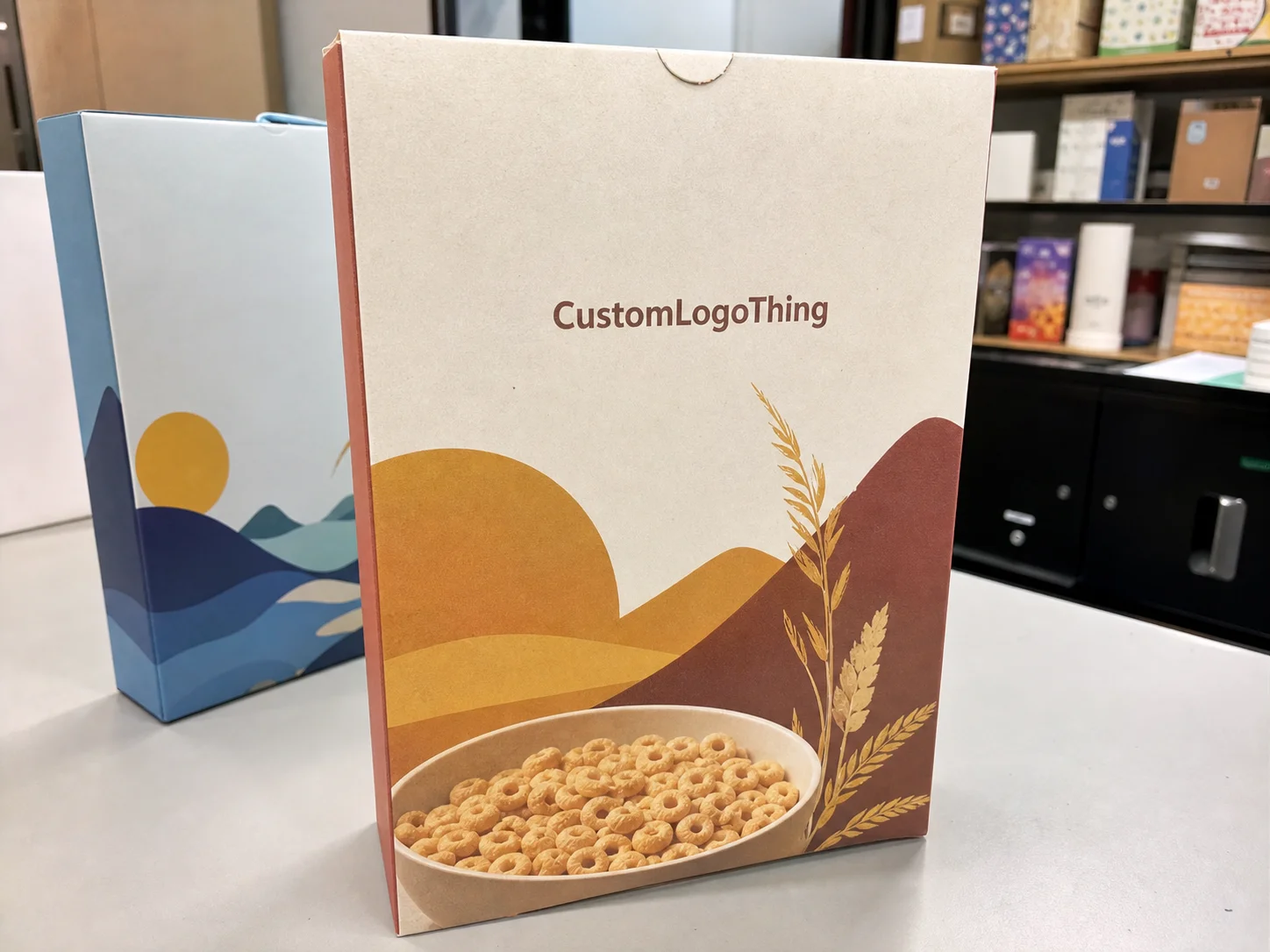
Cereal sits in a crowded, fast-scanning aisle. That means the front panel has to work immediately. Shoppers see shape, contrast, and hierarchy before they read claims or ingredients, so the box needs a clear focal point, readable product name, and enough visual contrast to stand out under store lighting.
A cereal box custom project gives you more control than artwork alone. You can change the dimensions, adjust the board grade, choose the finish, and set the panel layout to match the product. A kid-oriented cereal, a premium granola, and a high-protein breakfast mix should not use the same carton language or the same structural approach.
Many packaging problems start when teams design for a mockup instead of the assembled carton. Creases can cut through logos, glue tabs can crowd side-panel copy, and panel widths can shrink once the dieline is finalized. If the structure is not locked early, the design often looks fine on screen and awkward in production.
Retail buyers also notice consistency. A carton that prints cleanly, folds correctly, and holds its shape reads as controlled and trustworthy. A box that is slightly off in proportion or finish can make the entire product line feel less polished, even if the contents are unchanged.
Box construction also affects perceived value. Crisp type, good contrast, and a board that feels substantial help the product justify its price point. A low-cost-looking carton can weaken shelf appeal even when the formula is strong.
How the carton design and print process works
The process starts with structure. You need the finished dimensions, target quantity, closure style, shipping format, and any compliance or retail requirements before the artwork can be built properly. From that information, the supplier creates or adapts a dieline, which is the flat map of the carton.
Once the dieline is set, artwork is placed into the template. Safe zones matter here. Text near a fold can distort, a barcode too close to an edge can scan poorly, and claims that cross a seam can become hard to read after folding. A flat PDF is useful, but it does not replace a production-aligned proof.
For most cereal-style cartons, paperboard is the normal substrate rather than corrugated board. SBS, C1S, and recycled board are common options. SBS usually gives a bright, smooth surface with strong print fidelity. C1S can work well when the design and coating choice suit it. Recycled board is a good fit when sustainability matters, but the surface and color response may differ from virgin board.
Coating changes the final result more than many buyers expect. Aqueous coating adds basic scuff resistance and is common for retail cartons. UV coating can increase color vibrancy and surface protection. Matte reduces glare. Spot gloss or spot UV can draw attention to a logo or product name, but those effects should be used with restraint so the carton does not look overfinished.
There is a difference between a visual proof and a production proof. A visual proof checks layout and general appearance. A production proof checks how the file sits on the real dieline and whether the print setup, coatings, and panel placement are practical for manufacturing. That step catches issues that are easy to miss on screen.
For outside references, ISTA is useful when shipment performance matters, and FSC is relevant if the project needs certified fiber or sustainability documentation. Those standards do not design the carton, but they help define material and shipping expectations.
For buyers comparing custom printed boxes, the best results usually come from fewer assumptions. Lock the structure first, then build the artwork around it.
Production steps, timeline, and turnaround planning
A standard workflow is intake, dieline confirmation, artwork setup, proofing, prepress, printing, finishing, die cutting, gluing, packing, and shipping. The sequence is straightforward. Delays usually come from missing information, late revisions, or unclear approvals.
Proof approval is often the slowest step. If the dimensions are still changing, the nutrition panel is not final, or the legal copy has not been reviewed, the schedule pauses before production begins. A quote is only useful when the specification behind it is stable.
Typical turnaround for a standard run is often around 12 to 15 business days after final proof approval. That assumes standard tooling and no unusual finishing. New cutting dies, special ink matching, premium coatings, or heavy coverage can extend the schedule. Larger quantities can also require more press time and more drying or curing time.
Launch dates and retail resets need more buffer than casual reorders. Freight timing matters. Internal receiving and packing matter too, especially if the cartons arrive flat or pre-glued. The box is only one part of the timeline; the rest of the workflow has to match it.
If you are ordering through Custom Packaging Products, separate approvals into stages. Confirm the structure first, then the artwork, then the production proof. That keeps the job from restarting because one late change touched the wrong part of the carton.
Cost, pricing, MOQ, and quote drivers
Custom cereal carton pricing is driven by a short list of variables. Size matters because it changes board usage. Board thickness matters because it affects both material cost and folding behavior. Print coverage matters because heavier coverage takes more press work. Finish choice matters because coatings and special effects add setup and processing time. Quantity matters because setup costs are spread across the run.
MOQ is where many buyers see the biggest jump in unit price. Lower quantities are possible, but the per-box cost usually rises quickly because the fixed work does not shrink in the same proportion. A custom cereal-style carton might land around $0.22 to $0.45 per unit at 5,000 pieces, depending on size, board, color count, and finish. At 1,000 pieces, the unit cost usually climbs because the setup burden is still there.
Other quote drivers show up later than buyers expect. Tight color matching can add prepress work. Multiple revision rounds add labor. Freight can affect the landed cost more than expected if the cartons are bulky or the delivery window is short. Flat shipping and pre-glued shipping can both work, but they affect handling and receiving differently.
Here is a practical comparison of common board and finish combinations before requesting pricing.
| Option | Typical Use | Look and Feel | Cost Impact |
|---|---|---|---|
| SBS paperboard with aqueous coating | Standard retail packaging | Bright, clean, and resistant to light scuffing | Lowest to moderate |
| C1S board with gloss UV | High-color branded packaging | Sharp color response and stronger shine | Moderate |
| Recycled board with matte finish | Eco-positioned product packaging | Natural and softer visually | Moderate, sometimes higher if sourcing is tight |
| Soft-touch coating with spot UV accents | Premium shelf presentation | Tactile surface with selective contrast | Higher |
If you want a quote that is actually useful, send the finished dimensions, target quantity, artwork status, finish preference, and any compliance requirements in the first message.
Specs that change performance, retail look, and durability
Specs affect more than appearance. They decide how the carton behaves in production, shipping, and retail. Dimensions need to match the filled product, not just the nominal volume of the cereal. If an inner bag, liner, or insert changes the footprint, the carton spec has to reflect that or the box may look loose or bulge on shelf.
Board caliper is another important choice. Thin board can reduce cost, but it may bow under stacking pressure or feel flimsy in handling. Thicker board improves structure and shelf presence, though it can affect fold quality and automated packing compatibility. More stiffness is not automatically better; it has to work with the line.
Finish also changes performance. Matte and soft-touch coatings create a softer, more premium feel, but they can show scuffs differently than gloss. Gloss makes color read louder under retail lighting, which can help bold brands. The right finish depends on brand position, distribution conditions, and how the carton will be handled.
Readability matters once the carton is assembled. Nutrition panels, ingredient lists, barcode contrast, and legal copy need enough space and contrast to remain usable after folding. If the design is too busy, the side panels stop functioning as information space and become clutter. Good packaging keeps the main story clear and the required copy legible.
Durability should match the route the box will travel. A cereal carton should resist light scuffing, hold its shape on shelf, and survive distribution without crushed corners or seam failures. If humidity, transit, or warehouse stacking are concerns, board choice and coating choice should reflect that. For tougher shipping conditions, it is sensible to reference ISTA-style expectations or similar handling tests.
The best spec balances shelf impact, budget, and production behavior. A beautiful carton that collapses in transit is a bad purchase. A rugged carton that looks weak on shelf is also a bad purchase. The goal is a deliberate compromise, not a guess.
Common mistakes buyers make before approving artwork
The first mistake is using approximate measurements. “Close enough” is not close enough. If the finished dimensions are off, the carton can wrap poorly or leave dead space that makes the package look careless. This happens often when the inner liner or bag changes the true volume and nobody updates the spec sheet.
The second mistake is ignoring fold and glue zones. A logo too near a crease can break visually after assembly. Legal copy can drift into the seam. A barcode can land too close to an edge and become unreliable. These are basic issues, but they are still common when the dieline is reviewed at thumbnail size instead of full size.
The third mistake is treating a screen render like a production proof. Coated paperboard does not behave like a monitor. Gloss lifts color, matte softens contrast, and soft-touch changes how light hits the carton. Proofs should be reviewed on the actual material or a production-accurate simulation whenever possible.
The fourth mistake is leaving schedule risk unresolved until the end. If the retailer has a fixed launch date and the carton is still in revision, urgency becomes expensive. Rush work does not improve quality; it compresses the review window. If the spec is still moving, the schedule is still moving too.
The fifth mistake is mixing aesthetic preference with operational need. One buyer may care most about shelf pop. Another may care most about machine compatibility. Both are valid, but they are not the same requirement. A cleaner cereal box custom order starts when those priorities are stated clearly before the file goes to prepress.
Expert tips and next steps for a cleaner order
Start with a complete spec sheet. Include finished dimensions, target quantity, carton style, preferred finish, shipping format, and any retailer or compliance requirements. If the carton must fit a shelf height, pallet pattern, or pack-out constraint, say that early. Ambiguity at the quote stage becomes cost later.
Send the strongest artwork files available. Editable text, vector logos, and high-resolution images reduce cleanup time and improve proof accuracy. Call out the non-negotiables: barcode placement, legal copy, nutrition panel, claims, and branding elements that cannot move. If the design still has open questions, mark them clearly instead of forcing prepress to guess.
Review the proof twice. The first pass checks artwork on the dieline. The second pass checks the folded logic. That second review catches more issues than people expect, especially on Custom Printed Boxes with dense information or multiple side-panel messages. A flat layout can be correct while the assembled box is awkward.
Think beyond print price. Ask how the carton ships, how it stores, how it folds, how it stands up in retail lighting, and how much handling it can take. The lowest quote is not the best deal if it creates rework or damages shelf presentation. A good packaging buy is one that survives the path from press to pallet to shelf.
If the goal is a carton that prints cleanly, folds fast, and holds up in retail, the next move is to tighten the specs before the first proof. That is where most of the savings live. Once the file is already in prepress, options are narrower and more expensive.
What information do I need for cereal box custom packaging quotes?
Provide the finished product dimensions, target quantity, board preference, print colors, finish choice, and any compliance requirements. If the artwork is already underway, include the file format and say whether it is final or still being revised.
How long does cereal box custom production usually take?
A standard run often takes about 12 to 15 business days after final proof approval, but the actual schedule depends on quantity, finishing, and whether new tooling is required. Delays usually come from late artwork changes or incomplete specs.
Why does MOQ affect the price so much?
Setup, cutting, and press preparation costs stay fairly fixed whether you order 1,000 boxes or 10,000. Lower quantities have fewer units to absorb those costs, so the per-box price rises.
What finish works best for a premium cereal box look?
Matte and soft-touch finishes usually feel more premium, while gloss creates stronger shelf pop. The better choice depends on your brand style, lighting conditions, and how much scuff resistance the carton needs.
How do I avoid artwork mistakes on a custom cereal box?
Use the exact dieline, keep text inside safe zones, and check the barcode and legal copy carefully. Review the proof at full size so folds, seams, and panel flow are visible before production starts.