A private label Clear Poly Retail Bags supplier does more than print a logo on transparent film. The real job is to make the bag disappear visually while still protecting the product, holding its shape, and staying consistent from one order to the next. Clear packaging is unforgiving in a way opaque formats are not. Every wrinkle, scuff, cloudy patch, and weak seal shows up immediately under retail lighting.
That is why buyers who source clear retail bags are usually solving three problems at once: presentation, protection, and repeatability. If the bag looks good but jams on the packing line, it is the wrong bag. If it runs well but hazes over in transit, it is still the wrong bag. The best programs balance film choice, size, closure style, print coverage, and pricing so the finished pack looks intentional on the shelf and does not turn into a recurring production issue.
For brands building a coordinated packaging system, the bag should fit the broader visual language rather than stand alone. That is also where related packaging pieces such as Custom Labels & Tags and broader Custom Packaging Products help keep the shelf presentation consistent across formats.
Why Clear Poly Bags Matter on the Retail Shelf
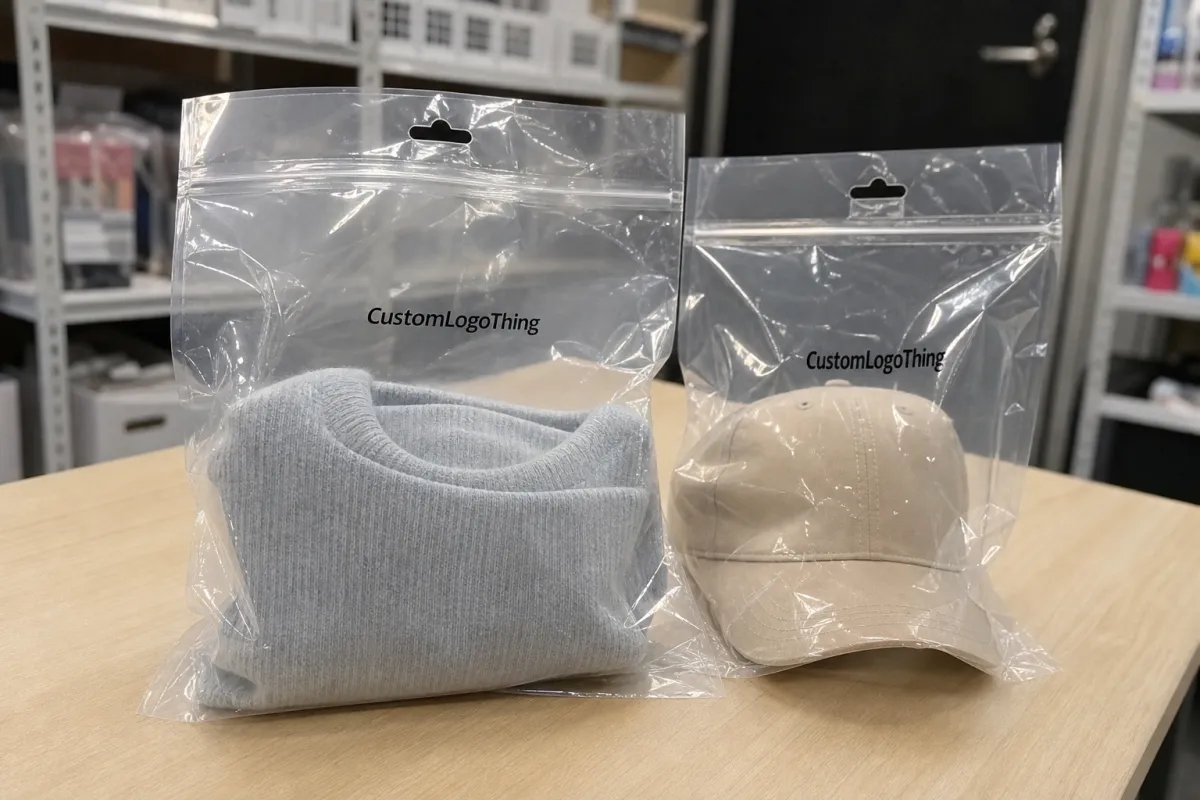
Transparent poly bags are deceptively simple. The customer sees the product, the branding, and the bag quality at the same time, so the material has to stay quiet and clean while doing real work. In retail, the bag is often judged in seconds. If the film has too much haze, the product looks tired. If the bag sags, the pack looks underbuilt. If the seal line wanders, the whole presentation feels less credible.
That visual pressure is part of what makes a private label Clear Poly Retail Bags supplier valuable. A good supplier is not only manufacturing film and seals. They are helping control the variables that make a transparent package look polished: resin quality, film thickness, cut accuracy, print placement, and packing format. A small change in one of those areas can affect the way a full product line looks on shelf, especially when multiple SKUs need to read as a family.
Retail bags also have to live inside actual operating constraints. Warehouse staff need to load them quickly. Merchandisers need them to hold a neat outline. Purchasing needs them to stay within budget. That combination is why buyers should think in terms of total performance rather than a single spec. The cleanest-looking bag is not always the cheapest, and the cheapest is rarely the one that saves the most time on the line.
There is also a practical reason to stay disciplined here: clear film shows defects that printed or opaque packaging can hide. A slight gauge inconsistency, a weak seal, or a cut that is a few millimeters off tends to be visible immediately. That makes quality control more important, not less. Suppliers who understand that reality will usually talk about tolerances, sample approval, and packing methods without being prompted.
How a Private Label Bag Program Works From Brief to Production
The process usually starts with a brief, and the quality of that brief determines how many revisions follow. A supplier will normally ask for product dimensions, bag style, target quantity, artwork needs, and the retail use case. For some programs, a stock-style clear bag with branding is enough. For others, the right answer is a modified stock format or a fully custom size built around the product footprint.
Once the quote is in motion, the details matter more than the concept. Finished width, length, gusset depth, seal placement, print area, and any retail copy have to be locked before production starts. If the bag needs a hang hole, barcode zone, warning panel, or adhesive flap, those features should be decided early. Changing them after proof approval almost always adds time and cost.
A well-run order typically moves through quote, artwork check, proof, sample or mockup, approval, production, inspection, and shipment. That sounds orderly on paper. In practice, the most common delays come from missing dimensions, unclear artwork, late feedback, or a sample that was never evaluated against the actual product. A private label clear poly retail bags supplier can move quickly only when the buyer helps close those gaps early.
One useful habit: treat the approval stage like a production lock, not a design discussion. Once the proof is approved, small changes can become expensive because they affect film usage, print plates or cylinders, and scheduling. That is the point where accuracy matters more than speed.
If the bags must survive a tougher distribution path, ask about testing expectations before the order is released. Retail-ready packaging does not always need full distribution lab work, but if the bag is part of a premium line or a more fragile product, discussing drop, compression, or transit handling early can prevent unpleasant surprises later.
Specs That Decide Clarity, Strength, and Fit
Film choice is the first spec that changes how the bag behaves. Thickness affects stiffness, puncture resistance, and seal performance. Resin quality affects haze and clarity. Finishing methods affect whether the bag feels crisp or soft in the hand. Thicker film can improve body, but it can also increase cost and create a stiffer look than the product needs. There is no universal sweet spot. The right gauge depends on the product weight, retail environment, and how the bag will be handled during packing.
Fit is just as important as film. Width, length, gusset depth, and lip style determine whether the product sits neatly inside the bag or shifts around with too much empty space. A bag that is technically large enough can still look wrong if the item moves inside it or if the corners bunch up. On the other side, a bag that is too tight slows down loading and increases stress on seals and edges. Buyers often underestimate how much inserts, folds, clips, closures, or tags change the final footprint.
Printing can support the transparent look, but only if it stays restrained. A simple logo on a clear field often works better than heavy coverage. Dense ink blocks more of the product and can make the bag feel busier than necessary. Print placement matters too. Too low, and the artwork competes with the item. Too high, and it looks like an afterthought. The cleanest retail programs usually reserve the central viewing area for product visibility and keep branding and compliance text in separate zones.
Retail buyers should also think about the way the bag will be used after the shelf interaction. Will it be handled by staff with gloves or bare hands? Will the package be resealed by the customer? Does the bag need a heat seal, adhesive flap, zipper, or open-top format? If it is a retail bag that will also move through an e-commerce or warehouse process, the film and closure choice should account for that extra handling, not just the display moment.
Before requesting pricing, it helps to define the specs in plain language:
- Film thickness in mil or micron, with a target range instead of a vague preference.
- Finished size, including gusset depth, header area, or seal allowances.
- Print coverage, number of colors, and artwork placement.
- Closure or seal type, such as heat seal, adhesive flap, zipper, or open top.
- Pack format, including carton count, bundle count, and retail labeling needs.
Production Steps and Lead Time: From Sample to Ship Date
Most custom bag programs follow the same broad sequence, even if the details vary by supplier. First comes the quote and spec review. Then artwork is checked and a proof is issued. Some jobs move through a digital proof only; others need a physical mockup or preproduction sample, especially when fit or visual clarity is sensitive. After approval, the order moves into production, inspection, packing, and shipment.
The schedule depends less on the calendar than on how quickly decisions get locked. A simple one-color bag in a standard size can move faster than a job with multiple print colors, special packaging, or repeated artwork changes. If dimensions are still shifting, the timeline is not really underway. It is still in planning.
That is where buyers often lose time. Missing copy, late compliance text, poorly organized artwork, or a sample that was never checked against the actual product can stall a run for days. Once production is scheduled, changes become more expensive because they affect material planning and machine time. A supplier with experience in clear retail packaging will usually push for final approval before run time begins, and that caution is a good sign rather than a nuisance.
A realistic planning window for many custom poly bag orders is about 12-20 business days after final proof approval, with more time if the order has complex print, special pack-out, or nonstandard construction. Freight is a separate step. If the bags have to arrive for a retail launch, build a cushion instead of treating the production date as the finish line. Seasonal programs should be booked earlier than a normal replenishment order because even a small delay can interfere with in-store timing.
Physical validation is often worth the extra step. A sample can show whether the bag is too soft, too glossy, too hazy, or too tight for the item. Photographs and digital proofs help, but they do not always reveal how the film behaves when folded, loaded, or stacked. With transparent film, the difference between acceptable and excellent can be subtle until the bag is under actual light with the product inside it.
Cost, MOQ, and Unit Pricing: What Actually Moves the Number
Pricing for custom clear poly bags is driven by more than size. Film thickness, dimensions, print colors, closure style, packaging format, and whether the run is fully custom or adapted from a stock structure all affect the final number. A larger bag with heavier film and multiple print colors will almost always cost more than a small, simple sleeve. The trap is comparing quotes that are not built on the same spec sheet.
MOQ is the other variable that changes the economics. Lower minimums can be useful for a new launch or a limited test, but the unit price usually climbs because setup costs are spread across fewer pieces. Larger runs often improve price efficiency, though only if the inventory risk makes sense. A buyer who orders too little can end up paying more per bag; a buyer who orders too much can end up discounting or scrapping excess stock. Neither outcome is ideal.
| Program type | Typical MOQ | Typical unit price at 5,000 pcs | Lead time | Best fit |
|---|---|---|---|---|
| Stock-style private label | 1,000-3,000 | $0.05-$0.11 | 7-12 business days | Fast launches and simple branding |
| Modified stock format | 3,000-5,000 | $0.08-$0.16 | 10-15 business days | Better fit and print control |
| Fully custom run | 5,000-10,000+ | $0.12-$0.28 | 12-20 business days | Exact dimensions, branding, and shelf requirements |
Those ranges are only useful when the quote inputs match. A bag priced at the low end with thin film and minimal print is not comparable to one built with heavier gauge, tighter tolerances, and more controlled pack-out. Buyers should also look at landed cost rather than unit cost alone. Setup, tooling, sampling, freight, labeling, and repackaging can move the total more than a small change in per-piece pricing.
If you want to lower cost without damaging performance, simplify the design before cutting material quality. Standardize the size where possible. Reduce unnecessary print coverage. Avoid decorative extras that do not affect the retail result. A bag that protects the item, loads quickly, and stays visually quiet usually delivers better value than one that only looks inexpensive on paper.
The smartest price comparison is the one that includes real-world issues: waste on the packing line, damaged product, shelf presentation, and the time spent correcting mistakes. A slightly higher quote can still be the better buy if it reduces rework and keeps the program stable.
Common Ordering Mistakes That Create Rework
The most frequent mistake is sizing the bag to the bare product instead of the finished packed item. Inserts, folds, clips, caps, and closures all change the footprint. If the bag is built to the item alone, loading becomes awkward and the pack can look cramped. That error is common because the product often looks smaller on the workbench than it does after everything is assembled.
Artwork is another trouble spot. Missing color targets, low-resolution files, unapproved revisions, or vague placement notes create delays that are easy to avoid. Clear film does not hide messy typography or awkward logo alignment. It amplifies them. If the bag includes warning copy, barcode space, regulatory language, or a size mark, those elements should be checked carefully before approval. Fixing them after the first run is far more expensive than fixing them in proof.
Price-only buying creates its own problems. A low-cost film that scuffs easily or clouds in transit can turn into a higher-cost program once returns, reprints, and damaged goods are counted. The same is true for a bag that looks acceptable in a carton but displays poorly on shelf. For retail packaging, appearance is part of performance.
Skipping sample validation is risky whenever the product is delicate, premium, or visually sensitive. If there is any uncertainty about clarity, rigidity, gloss, or fit, ask for a sample or a physical mockup. A transparent bag should be checked in the same light and with the same product it will carry in production, not only under office lighting with an empty film sample.
Another issue buyers run into is poor tolerance communication. If the supplier cannot explain acceptable variation in width, length, seal position, or film gauge, the order is carrying hidden risk. A solid private label clear poly retail bags supplier should be able to discuss tolerances plainly, because those numbers decide whether the bag behaves predictably in production.
Expert Tips for Faster Approvals and Cleaner Reorders
The simplest way to speed approvals is to build a one-page spec sheet and keep it current. Include dimensions, thickness, closure style, print area, target quantity, packaging format, and ship date. With one document in circulation, quote comparisons become cleaner and the approval trail is easier to manage. Nobody has to guess which version is current.
Keep one master artwork file as well. Reorders go much more smoothly when the supplier can pull from a single approved source instead of reconstructing a logo from old PDFs, email attachments, and screenshots. That matters even more when the same design appears across multiple bag sizes or retail channels. Small shifts in line weight or print placement can creep in when file control is loose.
For visually sensitive programs, ask for photos or samples before production is locked. Clear film can behave differently depending on resin, gauge, and finish. A sample often reveals whether the bag has enough body, whether the seal looks clean, and whether the transparency supports the product rather than flattening it. If the package must show a premium item, load the sample with the actual product before approving the run.
Reorder timing deserves more attention than it often gets. Track sales velocity and inventory coverage before the first run is almost gone. Once you are inside the final stock window, freight options narrow and approvals get rushed. The best suppliers do not wait for that moment; they flag it early so the next order can be scheduled while the line is still calm.
Sustainability questions should be handled carefully and honestly. If recycled content is required, ask what level is realistic without hurting clarity or seal performance. If the program includes paper inserts or cartons, ask whether any fiber-based claims need to align with recognized certification expectations. Not every clear poly bag should carry a green claim. Sometimes the correct answer is that the material is chosen for visual clarity and protection, and that is the end of it.
Good reorder habits are practical, not glamorous:
- Save the final approved spec with the date and revision number.
- Record actual packed dimensions from the first run, not just design dimensions.
- Note fit issues early, even minor ones, so the next order can be corrected.
- Ask for pricing at multiple volume breaks before inventory pressure forces a decision.
Next Steps Before You Request Quotes
Before sending RFQs, assemble the information the supplier actually needs. Product dimensions, target bag size, material thickness, print requirements, pack format, and ship date belong in the same brief. If you have a reference sample, a product photo, or an existing bag that is close to the target, include it. A visual reference usually removes more guesswork than a long email ever will.
It also helps to map out internal approvals before the first quote arrives. Decide who signs off on artwork, who confirms cost, and who gives the final production release. If those responsibilities are unclear, the order can sit in limbo while multiple people wait for someone else to make the call. A clean approval path is boring, but it saves time.
Use the same spec sheet with every vendor you compare. That is the only way the numbers will mean the same thing. Ask for samples before placing the full order, especially if the bag needs to support a premium product, a barcode workflow, or a retail display standard. Compare the sample against the actual packed product, not against a ruler and a guess.
The best supplier relationship is usually the one where the questions are specific and the answers are direct. If you need a private label clear poly retail bags supplier, start with a complete brief, review comparable quotes on the same basis, and validate the sample before release. That approach reduces surprises, keeps the program repeatable, and gives the final bag a better chance of looking right the first time and the next time.
How do I choose a private label clear poly retail bags supplier?
Compare suppliers on clarity, print consistency, tolerance control, and their ability to produce your exact bag style at the volume you need. Ask each one to quote from the same spec sheet so the numbers are comparable, then review a sample before approving production. Price matters, but so do visual quality and repeatability.
What specs should I provide for custom clear poly retail bags?
Provide product dimensions, target bag size, thickness preference, closure style, print requirements, and packaging format. Include any retail details such as hang holes, warning copy, barcode placement, or display needs. A sample product or a clear photo usually improves the quote and reduces the chance of a fit problem.
What is a typical MOQ for private label clear poly retail bags?
MOQ depends on film type, print complexity, and whether the bag is fully custom or adapted from a stock format. Lower minimums usually carry a higher unit cost because setup time is spread across fewer pieces. Ask for pricing at several volume levels so you can see where the economics improve.
How long does production usually take?
Lead time usually includes proofing, sample approval, production, inspection, and shipping, so it changes with each approval step. Simple orders move faster than jobs with multiple print colors, tight tolerances, or special pack-out requirements. To avoid delays, lock the artwork and dimensions before the run is scheduled.
How can I lower unit cost without hurting bag quality?
Standardize the size where possible, reduce unnecessary print complexity, and choose only the features that affect actual retail performance. Compare pricing at several volume breaks so you can see where unit economics improve. Avoid cutting film strength or clarity if the bag needs to protect the product or present it cleanly on shelf.


