Custom Clear Poly Retail Bags Bulk Order: Specs & Pricing
A custom Clear Poly Retail Bags bulk order looks straightforward on paper, yet the bag that reaches a peg hook or shelf can make the merchandise feel polished, flimsy, or hard to sell. Clarity, stiffness, seal quality, and the way the package loads all shape the final impression more than most buyers expect.
For repeat SKUs, bulk buying usually makes practical sense. One stable spec can reduce handling time, simplify replenishment, and keep the package consistent across seasons or store resets. It also helps buyers avoid redesigning the same bag every time a colorway changes or a new size is added to the line.
Custom Clear Poly Retail Bags Bulk Order: What Buyers Overlook
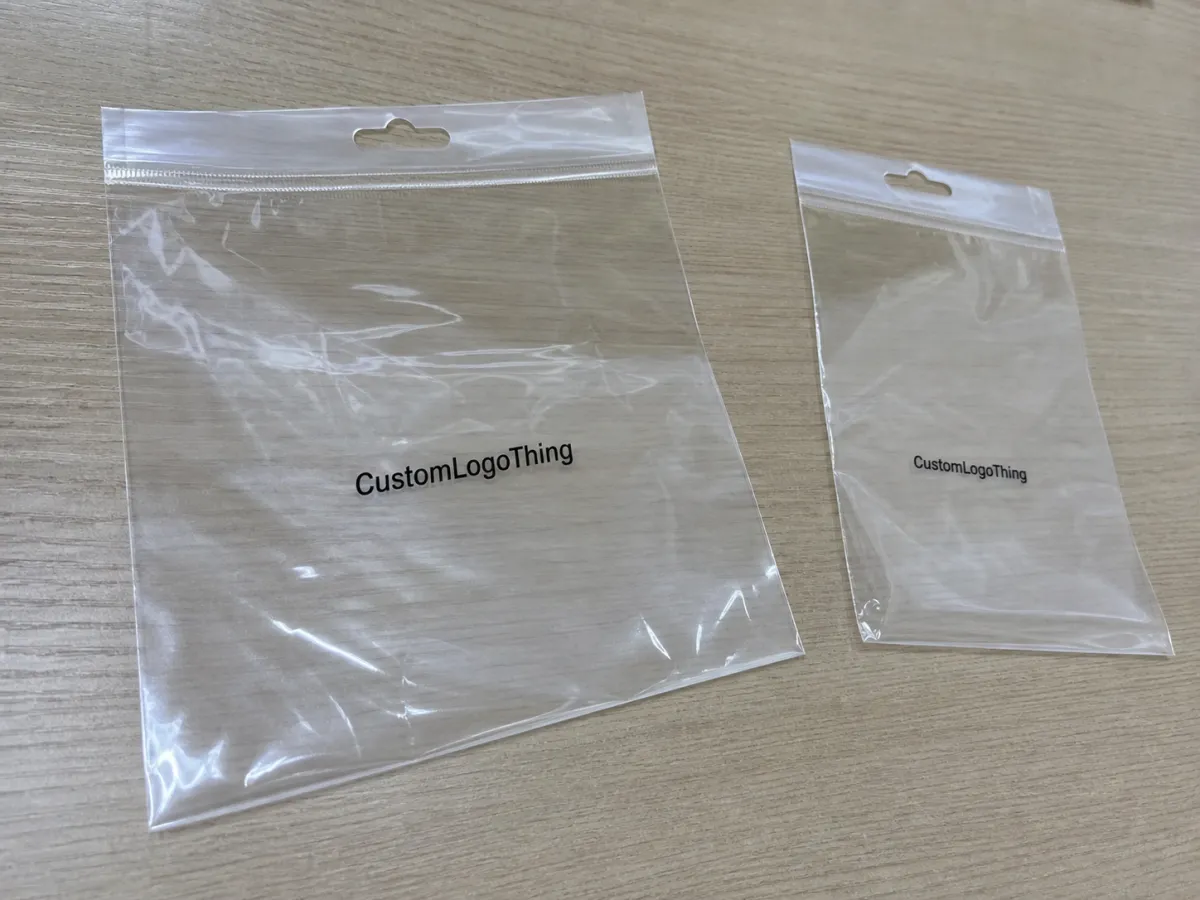
The most common mistake is treating clear poly as a generic sleeve. It is not. A bag for folded apparel needs a different mix of stiffness and clarity than one for stationery, cosmetics, or small hardware. Too thin, and the film wrinkles or bows around the product. Too stiff, and it can fight the pack-out process or show stress at the seal line.
Before requesting a custom Clear Poly Retail Bags bulk order quote, start with the product itself. What has to be visible? How often will shoppers touch it? Does the package need to hold up in a fulfillment center, then sit cleanly on a rack for weeks? Those questions matter more than the logo placement at the beginning of the process.
The product groups below show up often in clear retail programs:
- Apparel: folded shirts, socks, undergarments, seasonal garments, and gift-ready basics.
- Stationery: card sets, journals, envelopes, planners, and other flat paper goods.
- Accessories: jewelry cards, belts, hair accessories, phone add-ons, and small soft goods.
- Health and beauty: sample kits, bath items, and shelf-ready packs that need dust protection.
- Small hardware: parts kits, fasteners, tool accessories, and items that must stay visible without opening the bag.
Clear packaging only works if the film stays straight, the seal stays even, and the opening loads cleanly. Miss one of those pieces and the shelf look slips quickly.
Bulk ordering is also the better move for programs that repeat across stores or seasons. A buyer who locks in a clear bag spec can reorder without redoing the structure, carton count, or proof setup every time the product changes color. That kind of predictability is one reason wholesale packaging programs save time as well as money.
If the same line also uses mailers, labels, or cartons, keeping the spec family aligned makes the whole program easier to manage. Our Wholesale Programs page is useful for teams planning repeat runs, and our Custom Packaging Products catalog helps buyers compare bags, pouches, and related packaging formats without rebuilding the plan from scratch.
Film Weight, Closure Style, and Transparency Options
Film thickness shapes the feel of the bag more than almost any other detail. A 1.5 to 2 mil bag can work well for light products that do not get handled much. Once the item gains weight, has sharper corners, or needs a stronger retail presence, moving to 2.5 or 3 mil usually gives a cleaner look and a more controlled load. For taller packs, hardware kits, or pieces that shoppers may open and close again, 3 to 4 mil often performs better.
Closure style matters just as much. An open-top bag is usually the fastest option on the packing line and often the least expensive. That makes sense for folded apparel or products that are packed inside a carton after bagging. A resealable zipper adds cost and labor, but it gives the customer a practical benefit for products that will be handled repeatedly. A flap seal tends to look more finished on shelf and works well for apparel, cards, or accessory packs. Tamper-evident styles are better for higher-trust items, health and beauty kits, or small components where security matters.
Transparency is not only about whether the film is clear. Buyers should ask about haze, gloss, and how the material reads under store lighting. Low-haze film gives a cleaner display, and a stable gloss level can make a modest product look organized rather than washed out. Logos, fabric texture, and product labels should remain visible without the bag turning milky.
Anti-static treatment matters for some products. Small plastic parts, sleeves, and light accessories can cling to the film during loading, which slows the line and leaves the package looking messy. Venting is another detail that is easy to miss. Small vents or micro-perfs can keep apparel from ballooning and help the bag sit flatter on a hook or shelf.
Here is a simple way to compare the common options:
| Spec | Best Fit | Retail Benefit |
|---|---|---|
| 1.5-2 mil open top | Light accessories, stationery, flat apparel | Fastest packing and lowest setup cost |
| 2-2.5 mil flap seal | Apparel and gift-ready kits | Cleaner presentation with easier loading |
| 3 mil resealable zipper | Repeat-open retail items | Better consumer utility and stronger structure |
| 4 mil tamper-evident or vented | Heavier or higher-touch products | More security, more durability, more shelf presence |
If the choice is between a clear retail bag and a shipper format, the product journey should decide it. Clear retail packaging is about presentation and dust protection. A mailer or carton is about transit protection. For teams comparing those functions, Custom Poly Mailers can help show where retail packaging ends and shipping protection begins.
Sizing, Artwork, and Print Specs That Prevent Rework
Size should always be defined by the finished product, not by guesswork around the outer dimensions. Measure the finished width, length, and gusset depth if the bag has one, then confirm the usable opening. A bag can be technically large enough and still feel awkward if the opening is too tight or the product fills the pack so fully that the seal line looks strained. Too much empty space creates the opposite problem, making the item look underpacked.
For a custom clear poly retail Bags Bulk Order, a spec sheet should list the folded product size, the clearance needed for loading, and any insert card or header card dimensions. That is where many rework problems start. A 9-inch folded item does not always belong in a 9-inch bag. A little extra width helps loading, a little extra length gives room for the seal, and header or hang-tab features need their own allowance.
Artwork is another place where buyers run into trouble. Clear film is unforgiving. A small logo can look elegant, but a large dark print panel can erase the main benefit of choosing a transparent bag. If the design uses white ink, the printer needs the exact placement of the underprint because white changes color appearance dramatically on clear substrate. The jump from a one-color mark to a layered multi-color layout affects proofing time, registration risk, and cost.
Most print files should be vector-based whenever possible, with raster images at least 300 dpi at final size. Keep critical copy away from edges and seals, and leave a safe zone around barcodes so scanning remains reliable. If the bag will carry a retail panel, reserve enough room for price, item code, and required copy without crowding the logo. A barcode placed too close to a fold is a classic cause of late corrections.
Common prepress mistakes include low-resolution logos, expecting a Pantone match to behave exactly the same on clear film as it does on paperboard, and forgetting that ink over transparent material reads lighter. Buyers who also work with custom printed boxes often ask for a separate proof process for that reason. The brand may be the same, but the substrate behaves differently.
One practical step prevents a lot of disappointment: ask for a sample or digital proof that shows the design on a clear background rather than only on white artboard. That simple view catches more issues than a polished mockup ever will.
Cost, MOQ, and Unit Pricing: What Drives the Quote
Pricing for a custom clear poly retail bags bulk order is shaped by a handful of variables: size, film gauge, closure style, number of print colors, carton configuration, and any special handling such as venting or anti-static treatment. Quantity matters too, because setup costs and line efficiency spread out over more pieces as the run grows.
MOQ is usually not an arbitrary sales rule. It reflects material setup, print method, and the way a production line can run that exact bag spec. A simple unprinted bag may have a practical MOQ in the low thousands. A printed zipper or flap-seal order often lands higher because the setup time and inspection load are greater. For planning purposes, 3,000 to 5,000 pieces is a realistic starting point for simpler retail bags, while 5,000 to 10,000 is more common once printing or special closures enter the build.
Here is a useful pricing snapshot for common retail runs at around 5,000 pieces, assuming standard dimensions and normal production conditions:
| Option | Typical Unit Range | What It Usually Means | Buyer Takeaway |
|---|---|---|---|
| 1.5-2 mil unprinted open top | $0.04-$0.10 | Basic clarity, low setup | Best for tight budgets and fast replenishment |
| 2-2.5 mil one-color printed bag | $0.07-$0.16 | Balanced presentation and branding | Often the strongest value for shelf-facing items |
| 3 mil zipper or flap seal | $0.10-$0.22 | More material and more labor | Useful where customers handle the pack more often |
| 4 mil tamper-evident or vented print run | $0.14-$0.30+ | Higher durability and special features | Expect a stronger price jump, and stronger shelf performance |
The landed number matters more than the bag price alone. Freight, palletization, proof fees, and any special carton packing can change the real cost enough to affect the buying decision. A quote that looks lower on paper can become more expensive once the bags are packed in smaller cartons, shipped to multiple destinations, or rushed into a tight delivery window.
Teams that buy both retail bags and shipper formats usually save time by comparing the complete package instead of debating small unit differences that disappear once freight is added. If a program includes several SKUs, the best mix often comes from looking at the whole packaging stack together rather than one line item at a time.
Process, Timeline, and Production Steps from Proof to Freight
The cleanest orders follow a steady path: quote request, spec review, artwork intake, digital proof, sample approval if needed, production, quality check, and freight booking. A buyer who sends a complete package at the start usually sees a much faster turnaround than a buyer who is still adjusting dimensions after the proof has already begun.
For a custom clear poly retail bags bulk order, a standard printed run often takes about 12 to 15 business days after proof approval. That depends on inventory, print method, and whether the bag needs a sample round. Simple stock-size unprinted bags can move faster. Custom closures, more complex art, and approval chains with several stakeholders usually add days.
The schedule usually slips for the same few reasons:
- Missing dimensions or unclear bag orientation.
- Artwork revisions after proofing has started.
- Waiting for multiple people to approve copy or color.
- Changes to carton pack or ship-to details after production is scheduled.
- Requests for rush freight after the bags are already in line.
Expedited turnaround is possible on some specs, but speed depends on readiness. A final spec sheet, finished artwork files, a clear ship-to address, and one person authorized to approve the proof can remove a lot of delay. If the bag is part of a larger retail packaging rollout, that same discipline helps the full launch stay on track.
For shipments that need extra confidence in transit, many suppliers refer to testing standards such as ISTA, which covers common distribution and package testing methods. For broader packaging material and sustainability context, packaging.org is a useful industry reference. Those sources do not replace a supplier conversation, but they do help buyers ask better questions.
Quality control should be part of the plan from the start. On a well-run job, the supplier checks dimensions, seal integrity, print registration, and carton counts before freight moves. If the order will be repeated for retail resets, that front-end control is worth more than a small price difference, because a stable spec cuts down on surprises every time the shelf gets replenished.
What a Reliable Supplier Should Provide Before You Approve
The strongest supplier relationships in packaging are built on consistency. Dimensional consistency, film clarity, predictable seal performance, and clear communication when something needs adjustment matter more than polished sales language. A bag that is off by a small amount can create loading problems, carton waste, or a poor fit at the rack.
Before approving a custom clear poly retail bags bulk order, ask for sample checks, tolerance guidance, and carton pack details. If the bags will be used for repeat retail resets, confirm how the supplier measures width and length, what tolerance they hold, and how they handle variation between lots. For many retail programs, a tolerance around 1/16 to 1/8 inch may be acceptable, but that depends on the bag size and the product inside it.
I also like to see how a supplier talks about seal performance. Do they reference peel, burst, or seal integrity checks in a way that fits the product? Do they know where a stronger closure is needed and where a simple seal is enough? That kind of conversation tells you a lot about whether they understand the job or only the sale.
Reliable support matters even more after the first order ships. When demand spikes, the best partner can document the spec cleanly, keep the carton count stable, and help you reorder without rebuilding the file from zero. That is where long-term package branding gets easier, because the bag becomes a repeatable part of the program instead of a recurring headache.
If you are comparing this format to other packaging options, or planning a mixed order with labels, cartons, and inserts, it helps to keep the conversation in one place. A clear bag spec, a carton spec, and a mailer spec all affect the way the package is built, priced, and received by the buyer. The cleaner the instructions, the fewer surprises later.
Clear bags are forgiving only on paper. In production, a small drift in seal placement or a sudden change in haze shows up on the shelf faster than most teams expect.
Next Steps to Get an Accurate Quote and Faster Delivery
The fastest way to get a useful quote is to send the full spec in one message. For a custom clear poly retail bags bulk order, that means finished width, length, and gusset depth if needed; film thickness; closure type; print area; quantity; carton format; delivery zip code; and target in-hand date. If you have a photo of the product going into the bag, include that too. It helps the supplier judge fit and presentation quickly.
Here is the minimum information that belongs on a one-page spec sheet:
- Finished bag dimensions and any gusset depth.
- Film gauge or desired stiffness.
- Closure style and whether the bag is open-top, zipper, flap seal, or tamper-evident.
- Artwork files, logo placement, and print colors.
- Quantity, carton count, and pallet or master-pack preferences.
- Ship-to location and target delivery date.
A simple comparison table also helps buyers move faster internally. If one quote includes better freight terms, a tighter carton pack, or a cleaner proof process, that value should sit next to the unit price. Teams that buy repeat retail packaging often save time by comparing the full landed cost instead of debating small unit differences that disappear once freight is added.
If several SKUs are being standardized, it helps to coordinate the bag order with other brand elements so the package stays coherent across the shelf. That may mean keeping the logo lockup consistent, matching the color system to custom printed boxes, and keeping copy concise enough to read through clear film without clutter.
The most efficient orders usually start with one clear spec, one final art file, and one decision-maker on approval. That gives the quote, proof, and production schedule a clean path forward and reduces the back-and-forth that tends to slow packaging projects down.
Frequently Asked Questions
What affects pricing for custom clear poly retail bags bulk order projects?
The main drivers are bag size, film gauge, closure style, print complexity, and total quantity. Freight, carton pack style, and proofing requirements can also change the landed cost.
What MOQ should I expect for clear poly retail bags in bulk?
MOQ usually depends on the film, print method, and setup required for your specific bag spec. A simple unprinted or one-color order often has a lower practical MOQ than a multi-color printed version.
How long does production usually take after artwork approval?
Lead time depends on inventory availability, print setup, and whether the job needs a sample or proof revision. Orders move faster when dimensions, artwork, and shipping details are final before approval starts.
Can custom clear poly retail bags stay transparent with printed logos?
Yes, clear film can still look highly transparent with a small logo or a controlled print panel. The key is balancing ink coverage, placement, and the level of clarity needed for shelf display.
What should I send for an accurate quote on clear poly retail bags bulk order?
Send finished bag dimensions, gauge, closure type, quantity, artwork, and the ship-to location. If possible, include a target delivery date and a sample photo of the product that will go inside the bag.
A well-planned custom clear poly retail bags bulk order does more than control cost. It shapes shelf appearance, labor time, and replenishment for months, so the best results come from a clear spec, a clean proof, and a bag that fits the product instead of merely holding it.

