Buyer Fit Snapshot
| Best fit | Cmyk Printed Cartons Manufacturer projects where brand print, material claims, artwork control, MOQ, and repeat-order consistency need to be specified before quoting. |
|---|---|
| Quote inputs | Share finished size, material target, print colors, finish, packing count, annual reorder estimate, ship-to region, and any compliance wording. |
| Proofing check | Approve dieline scale, logo placement, barcode or warning zones, color tolerance, closure strength, and carton packing before bulk production. |
| Main risk | Vague material claims, crowded artwork, missing packing details, or unclear freight terms can make a low unit price expensive after revisions. |
Fast answer: Cmyk Printed Cartons Manufacturer: Board, Finish, Dieline, and Unit Cost should be specified like a repeatable production item. The safest quote records material, print method, finish, artwork proof, packing count, and reorder notes in one written spec.
Production checks before approval
Compare the actual filled-product size with the drawing, then confirm tolerance on folds, seals, hang holes, label areas, and retail display edges. Reserve space for logos, QR codes, warning copy, and material claims before decorative graphics fill the panel.
Quote comparison points
Review material grade, print process, finish, sampling route, tooling charges, carton quantity, and freight assumptions side by side. A quote is only useful when the supplier can repeat the same color, closure quality, and packing count on the next order.
Custom Logo Things
CMYK Printed Cartons Manufacturer: What to Know First
See how a CMYK Printed Cartons manufacturer handles color control, pricing, proofs, and timelines so cartons arrive on spec, on budget, and on time.
A carton can look perfect on a monitor and still land in the warehouse darker, flatter, or just slightly off in a way the brand team spots in five seconds. That gap is why a cmyk printed cartons manufacturer matters so much. The work is not just ink on board. It is artwork, structure, substrate, coating, packing method, and freight all pulling in the same direction, or failing together when one detail slips.
Custom Logo Things runs into that mismatch often enough to make buyers rethink how they request quotes. If you want a quick sense of the company behind the work, the About Custom Logo Things page is a useful starting point. The larger lesson is simpler: a cmyk printed cartons manufacturer does far more than press print. They translate a file into something a press can reproduce, a folder-gluer can finish, and a warehouse can stack without the carton turning into a sad geometry problem.
I have seen buyers approve artwork from a laptop in a bright conference room, then stare at a press sample as if the factory had switched the ink overnight. Usually it had not. The board, coating, and lighting changed the story. Packaging is annoyingly physical like that.
What a cmyk printed cartons manufacturer actually does
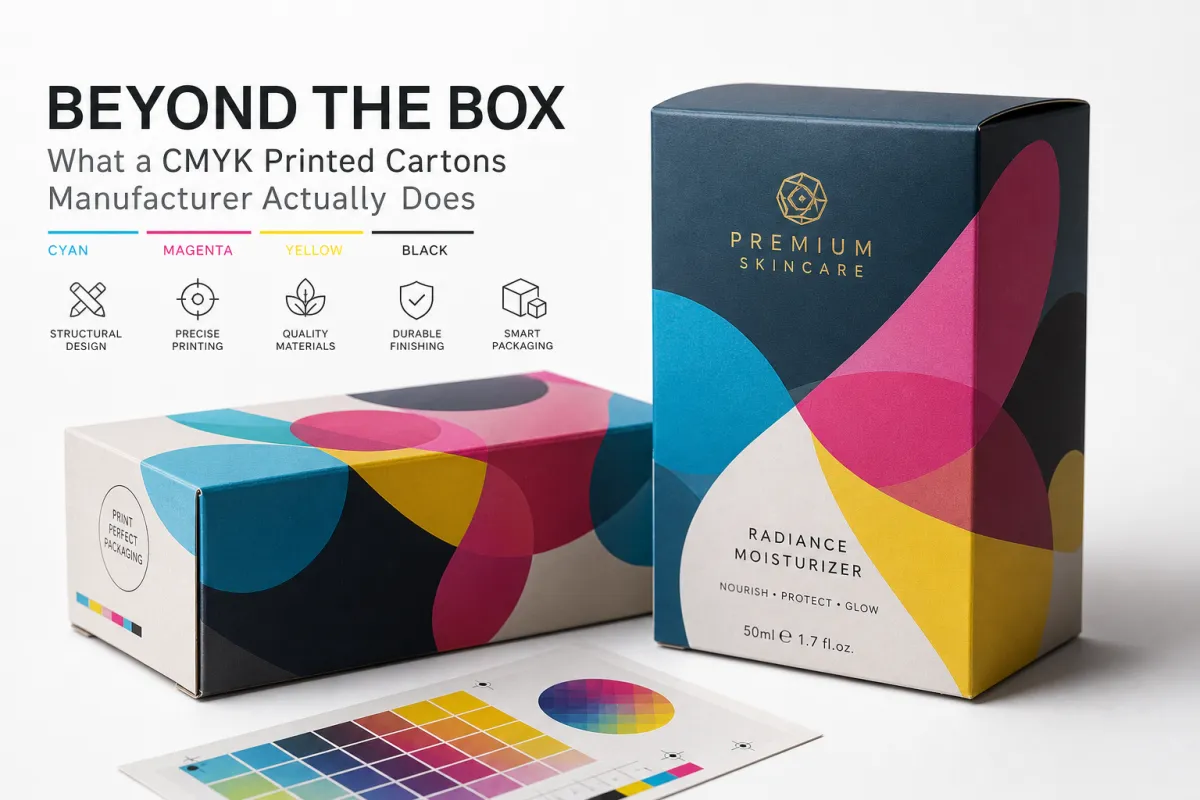
A cmyk printed cartons manufacturer has to manage three linked pieces: your artwork, your dieline, and your board choice. Miss one and the other two start to wobble. The carton may be built on SBS, CCNB, kraft, or another coated paperboard. Each material changes how ink sits, how highlights read, and how the finished box behaves under overhead lights, fluorescents, and the harsh glare of a fulfillment center.
CMYK remains the standard because it can reproduce a wide range of imagery without forcing every box into a custom-color project. Cyan, magenta, yellow, and black handle photos, gradients, product illustrations, and text-heavy packaging with good efficiency. For retail cartons, cosmetic boxes, and branded packaging that needs a lot of visual detail, a cmyk printed cartons manufacturer can usually keep the process practical. Brand colors with narrow tolerances are a different story. A specific red, a metallic accent, or a fluorescent pop can drift in CMYK, which is why spot color or a hybrid setup often becomes the better fit.
Printing is only one part of the equation, and that is where plenty of buyers get fooled by mockups. Board grade controls stiffness. Coating changes scuff resistance and gloss level. Score quality affects folding accuracy. Glue style decides whether the carton stays shut after a rough ride across a delivery network. Even storage conditions matter. A cmyk printed cartons manufacturer can produce beautiful graphics and still miss the mark if the carton is too soft for stacking or if the glue seam opens because the structure was chosen without enough thought.
Early decisions carry more weight than most teams expect. Product weight, shelf presentation, storage temperature, stack height, and distribution method all change the spec. A carton that only has to travel from a display shelf to a customer’s bag has very different needs from one that will be palletized, warehoused, and shipped across multiple regions. A good cmyk printed cartons manufacturer asks those questions before quoting. The ones that do not ask are usually the ones planning to find out later, after the mistake has already been packed.
Bottom line: the best carton outcomes start before artwork goes out for print. When structure, board, print method, and finish line up, the supplier has a much better chance of producing cartons that look right and behave right.
How a cmyk printed cartons manufacturer keeps color consistent
CMYK seems straightforward until it hits real packaging board. A file that looks rich on coated SBS can go dull on kraft, and the same art can shift again on CCNB because the clay coating and liner structure reflect light differently. That is why a cmyk printed cartons manufacturer has to treat substrate, ink density, drying, and finish as one system instead of pretending a PDF tells the whole story.
The print method changes the outcome too. Offset printing usually fits clean carton graphics with crisp type, controlled gradients, and a premium look. Digital printing makes sense for prototypes, short runs, and fast approval cycles when the buyer wants to test color direction before committing to volume. Flexographic printing often appears on corrugated packaging and some lower-detail carton work, but it behaves differently from offset and usually carries wider tolerances. A serious carton supplier chooses the process that suits the board and the order size instead of forcing one method to carry every job.
Color control starts with proofing. A digital proof shows layout and general direction, but it is not the same as a press sheet. A hard proof or production sample comes closer, though even that cannot mirror every press variable. A press check sits closest to real production, and it matters most when brand color is non-negotiable. Many buyers want a perfect answer from one PDF proof. Packaging does not work that way. A cmyk printed cartons manufacturer should say plainly what each proof can show and where the limits begin.
"A proof is a map, not the territory. The final carton still has to pass through the board, the coating, the press, and the hands that pack it."
Approved color targets help. Density controls help. Repeat-order consistency helps even more. If you plan to reorder the same carton over several runs, ask whether the supplier keeps a master sample or stored color standard. That sounds mundane, yet it saves real money and a lot of arguing. A dependable cmyk printed cartons manufacturer should be able to talk about target densities, registration tolerances, and what happens when a repeat order needs to match an earlier run.
Finish changes perception in ways that are easy to underestimate. A gloss aqueous coat deepens CMYK color and pushes saturation a little farther. Matte softens contrast. Lamination protects graphics and slightly flattens the surface look. Spot UV lifts certain areas out of the background, while embossing changes how light moves across the panel. The ink itself does not change, but the eye absolutely notices the difference. A carton partner that ignores that is either inexperienced or hoping nobody inspects the carton in normal lighting.
For buyers who want outside references, organizations like packaging.org publish useful packaging guidance, and ISTA transport testing standards help connect package design to real handling risk. Those references will not replace factory experience, yet they keep the conversation anchored in something more useful than wishful thinking.
If color matters to the brand, ask the cmyk printed cartons manufacturer what they recommend on your exact board: CMYK only, CMYK plus spot color, or a different substrate that behaves better under press. That single question often reveals whether the quote reflects reality or just optimism dressed up as procurement. Packaging is expensive enough without paying for optimism.
Key factors that shape quality, cost, and usability
A carton has a surprisingly crowded job description. It needs to protect the product, carry the brand, survive shipping, and still open cleanly for the end user. A cmyk printed cartons manufacturer weighs all of that against material cost and press efficiency. Focusing only on print quality misses the part that keeps the carton functional after it leaves the sample table.
Board choice is usually the first major decision. For lightweight cosmetics, supplements, and small consumer goods, 18pt to 24pt SBS or coated board can be enough. For heavier products or cartons that will be stacked, 24pt to 28pt, or a stronger paperboard spec, usually makes more sense. When crush resistance matters, or the outer box needs to travel through rough handling, corrugated construction or a tougher board grade can be smarter still. A cmyk printed cartons manufacturer should talk about caliper, stiffness, and score performance, not just the printed surface.
Structure shapes cost, speed, and usability. A slim tuck flap can look elegant and take longer to assemble. A compact layout may cut shipping volume and reduce freight, while a bulky one wastes pallet space and increases transport cost. Attractive folding cartons that crush under load are not attractive for long. A careful manufacturer will check whether the size works for the product, the insert, and the shelf footprint before anything goes to press.
Usability matters after the carton lands, too. If the carton has to be opened by retail staff, merchandisers, or end customers with tired hands and bad lighting, small design choices suddenly become very visible. A flap that catches, a lock that tears, or a panel that splits at the score line turns a decent carton into a daily annoyance.
What changes price the fastest
- Coverage: full-bleed graphics and heavy solids cost more than a design with more open space.
- Colors: CMYK is usually efficient; extra spot colors add setup, material, and control steps.
- Finishes: foil stamping, embossing, spot UV, and window patches each add labor or tooling.
- Complexity: unusual folds, lock bottoms, and difficult glue setups slow production.
- Quantity: short runs carry more setup cost per carton than longer orders.
Finishing deserves a hard look before anyone signs off. Embossing can elevate a premium cosmetic box, but it also adds tooling and press time. Foil can give a logo real presence, though too much foil turns a carton into a loud display of expensive decisions. Spot UV gives contrast between matte and gloss, yet it cannot rescue weak artwork. Window patches help customers see the product, but they add labor and can weaken the board if the layout is poorly handled. A cmyk printed cartons manufacturer should explain what each finish does for the carton, not simply celebrate the upsell.
Logistics matter more than many teams expect. Carton size changes case pack counts. Case pack counts change pallet height. Pallet height changes freight cost and warehouse handling. A dimension error of 10 to 15 mm can remove a full row per case or waste space across hundreds of cartons, which sounds small until the freight invoice arrives. A practical cmyk printed cartons manufacturer thinks about the carton as printed, folded, packed, stacked, and shipped, not just as a front-facing mockup.
There is also the sustainability question. If your buying team needs FSC claims, the paper trail has to be real and complete. The FSC system covers certified fiber and chain of custody, not vague claims that sound good in a deck. A reliable cmyk printed cartons manufacturer should be able to explain exactly what documentation they can supply and what they cannot. I have had procurement teams assume the logo on the carton meant the whole supply chain was certified. It does not. The paperwork has to match the claim.
What drives pricing from a cmyk printed cartons manufacturer
Packaging pricing looks messy until it gets broken into parts. A cmyk printed cartons manufacturer is usually pricing five things at once: board, print, finishing, labor, and logistics. If a quote looks strangely low, one of those parts is probably missing. Or hidden. Buyers run into that constantly, then act shocked when the “cheap” option gets expensive after the first change order. That surprise is as old as procurement itself.
The biggest cost driver is often the board. SBS, CCNB, kraft, and other paperboard options do not price the same way. Print coverage shifts the number too. Full-bleed cartons with rich solids need more control and usually more waste allowance than a white carton with one logo and a few lines of copy. A cmyk printed cartons manufacturer will often quote a higher unit price for deep coverage because maintaining color stability takes more time and attention on press.
Quantity changes the math. Setup costs are real. Plates, prepress checks, press setup, and waste all have to land somewhere. That is why a short run can look expensive per unit while a larger order feels far easier to absorb. A buyer who asks for 500 cartons and expects the rate of 20,000 is not requesting a discount; they are asking the factory to absorb the setup cost. A fair cmyk printed cartons manufacturer will price short runs differently, and that is exactly what should happen.
| Order type | Typical use | Common unit range | What pushes it up |
|---|---|---|---|
| Sample or prototype run | Artwork approval, shelf tests, internal review | $0.45-$1.10 per unit | Digital print, fast turnaround, one-off setup |
| Short production run | Launches, seasonal items, smaller SKUs | $0.22-$0.48 per unit | Board grade, finishing, die tooling, color control |
| Full-scale production | Stable SKUs, repeat replenishment | $0.11-$0.28 per unit | Heavy coverage, special finishes, insert packing |
Those numbers are not universal. They move with board spec, print coverage, finish choice, market location, and freight terms. Still, they are useful enough to stop people from pretending a premium carton should cost pocket change. A supplier that gives you a realistic range is usually more trustworthy than one that promises a miracle and forgets to mention tooling.
Quote traps show up all the time. One supplier uses a thinner board. Another leaves freight out. A third includes packing labor while the fourth bills it separately. The “lowest” bid often stops being the lowest once every line is visible. Ask for an apples-to-apples breakdown: board grade, print method, finish, tooling, proofing, packing method, and delivery destination. A good cmyk printed cartons manufacturer will not mind the request. The ones that do mind are usually the ones hoping you will not notice the gaps.
If your team wants a cleaner comparison, ask for landed cost instead of unit cost. Landed cost includes the product, packing method, freight, and any extra handling. That reduces spreadsheet theater. It also makes it easier to compare one carton supplier against another without getting fooled by a low line item that grows teeth later.
For buyers who care about sustainability and shipment damage at the same time, the better carton spec is often the one that protects the product with less waste. A board choice that cuts return rates by even a few percentage points can save far more than shaving two cents off the unit price and paying for a damaged product later.
The process and timeline from file to freight
Production follows a familiar path, but the schedule can slip fast when one step gets rushed. A cmyk printed cartons manufacturer usually moves through artwork review, dieline confirmation, proofing, sampling, production, finishing, packing, and shipping. Skip one piece or hurry it, and the timeline starts behaving like it has a second job somewhere else.
Artwork review checks whether the file is built for print. Resolution, bleed, font outlines, overprint settings, and image placement all matter. Dieline confirmation checks whether the carton structure matches the graphic layout. This is the stage that prevents logos from crossing folds or legal copy disappearing into a glue flap. A careful cmyk printed cartons manufacturer will not shrug that off just because the rendering looks nice.
Proofing can move quickly or slowly depending on how many changes are in play. A repeat order with approved files may move fast. A new structural carton with special finishing needs more time because the art, the structure, and the production method all need to line up. Sample sign-off matters too. If the brand takes three days to answer every proof, the schedule stretches. That is not the supplier being difficult; that is production waiting for a yes or no that should have arrived earlier. A seasoned carton partner builds some buffer into the schedule, but nobody can create lost time out of thin air.
"A three-day approval delay can ripple into press booking, finishing, and freight. By the time it shows up, it looks like a shipping problem with an email trail."
Timelines vary, but a few ranges help. A straightforward carton reprint can often move through production in 7-10 business days after proof approval. A custom carton with a new die, heavier coverage, or moderate finishing may take 12-18 business days. Add foil, embossing, windows, or unusual packing requirements, and 18-25 business days is not unusual. Freight can add several more days, especially when space is tight. A cmyk printed cartons manufacturer should break down each stage instead of hiding everything inside one vague delivery promise.
Seasonal demand changes the picture quickly. Machine schedules fill. Freight bookings tighten. Someone in purchasing disappears for a week, then returns asking why production did not pause politely and wait. The fix is practical: set approval deadlines, ask for stage-by-stage timing, and leave a real buffer before launch. That keeps the supplier working with a plan instead of reacting to a crisis created by silence.
Shipping terms matter too. State the destination, the delivery window, and the Incoterms clearly. If the team does not know the difference between port delivery and door delivery, now is the right time to ask. The quote only works if everyone is pricing the same journey. A cmyk printed cartons manufacturer cannot build a freight plan around vague optimism.
Common mistakes buyers make with printed cartons
The most expensive carton mistakes are usually the dull ones. They are not dramatic factory disasters. They are avoidable details that nobody checked. A cmyk printed cartons manufacturer sees the same problems repeatedly: low-resolution artwork, wrong dielines, overambitious finishing, and approvals pushed through too quickly because everyone is tired of looking at the file.
Low-resolution artwork is a classic failure point. A logo copied from a website is not print-ready. A tiny image stretched across a large panel is not print-ready either. CMYK will not rescue a blurry source file. It will reproduce the blur faithfully, which is the part people usually regret. A cmyk printed cartons manufacturer will print what you send, including the mistakes you wish had stayed hidden.
Ignoring the dieline creates another mess. Teams approve a design before checking flap positions, tuck depth, glue zones, or final folded size. The carton arrives and the graphics misalign, or the copy lands in a fold, or the legal text disappears into a closure. That is not random bad luck. That is process failure. A practical carton supplier will ask for art on the final dieline, not a pretty rendering with no structural logic behind it.
- Approve structure first, then print.
- Use the actual dieline, not a guessed size.
- Ask for proof of board strength before launch.
- Confirm packing counts and pallet plans in writing.
- Leave time for sample review and revisions.
Color assumptions also cause trouble. People assume CMYK will match every screen, every board, and every finish. It will not. Screens emit light; cartons reflect it. That alone creates a shift. Then substrate and coating add another layer. A cmyk printed cartons manufacturer can get close, but if the brand color is sensitive, spot color or a different board may be the better answer.
Overdesign can wreck both cost and speed. Too many finishes slow production. Too much ink coverage makes press control harder. Strange dimensions raise waste and reduce freight efficiency. Fancy is fine. Fancy that crushes or costs too much is just expensive noise. A skilled manufacturer will help trim the waste without stripping the carton of its presence.
Communication gaps create their own damage. Missing carton counts, unclear shipping destination, no Incoterms, no mention of inserts, and no note about storage conditions can all turn a decent quote into a bad order. The more exact the brief, the better the result. A reliable cmyk printed cartons manufacturer should welcome detail because detail prevents rework.
If the cartons will be stacked in a warehouse or pushed through distribution testing, it helps to look at transit performance and recovery, too. ISTA methods can inform handling risk, while packaging recovery should not be treated as an afterthought. A carton that prints beautifully and fails in transit is an expensive decoration.
How do you choose a cmyk printed cartons manufacturer?
Start with the job itself, not the quote. The right cmyk printed cartons manufacturer should match your board, print method, finishing needs, and timeline, then explain the tradeoffs in plain language. If the answers stay vague, the risk will show up later in proofing, color, or freight.
Ask the questions that expose process, not just price. What board grades do they run? Do they offer digital printing for samples and offset printing for production? Can they handle spot color if the brand needs it? What finishes do they support, and what does each finish do to the final look? A competent cmyk printed cartons manufacturer should answer without drifting into supplier poetry.
Experience shows up in the questions a manufacturer asks back. If they want to know product weight, drop risk, fill method, stack height, and shelf environment, that is a good sign. They are trying to prevent rework before it starts. If they only ask for artwork and quantity, you are probably dealing with a printer, not a packaging partner.
What to ask before you place the order
- Can you provide a dieline check before printing?
- What proof type do you offer: digital, hard, or press check?
- Which board grades do you recommend for this product weight?
- How do you control color on repeat runs?
- What is included in the quote, and what is separate?
- How are cartons packed for freight?
Ask for sample cartons or photos of previous work, but do not stop there. Photos can hide a lot. Ask how the manufacturer controls color, how often the equipment is calibrated, and whether a master sample is retained for repeat orders. That is where experience shows up. A cmyk printed cartons manufacturer with decent process control will be comfortable talking about tolerances, not just showing attractive pictures.
Confirm the spec in writing. Board grade, print side, coating, glue style, folding direction, case pack count, and packing method should all be spelled out. If a detail matters to your warehouse, it belongs on the spec sheet. A cmyk printed cartons manufacturer that helps document the full package is saving you future arguments before they even start.
One more useful filter: does the supplier ask more questions than you expected? Good. That often means they understand cartons as a system rather than a single print file. The best carton partner is usually the one that narrows risk early instead of promising every project is easy. Easy projects are rare. Pretending otherwise is how mistakes get recycled into the next quote.
If you want a better sense of how a supplier thinks, the team behind About Custom Logo Things keeps the conversation focused on actual packaging decisions instead of hollow marketing talk. That is the mindset that belongs in carton buying.
Here is the decision framework I recommend: choose the cmyk printed cartons manufacturer that balances color accuracy, durability, speed, and cost for the real shipment, not the fantasy version. The fantasy version is always prettier. The real version has to be stacked, stored, shipped, and opened by someone who cares far more about speed than about your brand story.
That is why the best buyers compare process, not just price. They ask how the carton will print, how it will fold, how it will ship, and how it will repeat. A strong cmyk printed cartons manufacturer can answer those questions without hand-waving. And if they cannot, you have learned something valuable before the order leaves the desk.
Frequently asked questions
What should I send a cmyk printed cartons manufacturer for an accurate quote?
Send the dieline, artwork file, carton dimensions, quantity, board preference, finish requirements, and delivery destination. If you need samples, inserts, or palletized shipping, say so upfront. A cmyk printed cartons manufacturer can quote much more accurately when the brief includes those details instead of a hopeful one-line email.
Can a cmyk printed cartons manufacturer match exact brand colors?
CMYK can get close to many brand colors, but not every shade is a perfect match on every board. Use approved proofs, color targets, and substrate-specific testing when color accuracy matters. For critical brand colors, ask whether spot color or a hybrid print approach is better. The manufacturer should be honest about the limits instead of pretending every color behaves the same.
How long does production usually take with a cmyk printed cartons manufacturer?
Simple runs move faster than custom cartons with special finishes or structural changes. Proof approval, sample sign-off, and freight booking can add meaningful time. Always ask for a production schedule with each stage listed separately, not just one vague delivery promise. A dependable cmyk printed cartons manufacturer will give you stage timing, not guesswork.
Why do quotes from cmyk printed cartons manufacturer suppliers vary so much?
The biggest differences usually come from board quality, print coverage, finishing, and order quantity. Some suppliers leave out tooling, freight, or packing labor, which makes the quote look cheaper than it is. Compare full landed cost, not just unit price. A supplier that prices transparently is usually easier to work with over the life of the SKU.
What is the biggest mistake first-time buyers make with printed cartons?
They approve artwork before checking the dieline and carton structure. That leads to misaligned graphics, weak folds, or cartons that do not fit the product properly. The fix is simple: confirm structure first, then print. A cmyk printed cartons manufacturer can only build a solid carton if the order starts with the right foundation.
If you want cartons that look good and function properly, the smartest move is to treat the supplier as a production partner, not just a quote source. A careful cmyk printed cartons manufacturer will save you money in rework, freight problems, and awkward launch delays. Before you place the order, lock down the dieline, proof type, board grade, finish, packing count, and delivery terms in writing. That is the practical checklist that keeps the carton from becoming a problem later.