Buyer Fit Snapshot
| Best fit | Custom Laminated Packaging Boxes Manufacturer projects where brand print, material claims, artwork control, MOQ, and repeat-order consistency need to be specified before quoting. |
|---|---|
| Quote inputs | Share finished size, material target, print colors, finish, packing count, annual reorder estimate, ship-to region, and any compliance wording. |
| Proofing check | Approve dieline scale, logo placement, barcode or warning zones, color tolerance, closure strength, and carton packing before bulk production. |
| Main risk | Vague material claims, crowded artwork, missing packing details, or unclear freight terms can make a low unit price expensive after revisions. |
Fast answer: Custom Laminated Packaging Boxes Manufacturer: Board, Finish, Dieline, and Unit Cost should be specified like a repeatable production item. The safest quote records material, print method, finish, artwork proof, packing count, and reorder notes in one written spec.
Production checks before approval
Compare the actual filled-product size with the drawing, then confirm tolerance on folds, seals, hang holes, label areas, and retail display edges. Reserve space for logos, QR codes, warning copy, and material claims before decorative graphics fill the panel.
Quote comparison points
Review material grade, print process, finish, sampling route, tooling charges, carton quantity, and freight assumptions side by side. A quote is only useful when the supplier can repeat the same color, closure quality, and packing count on the next order.
A custom Laminated Packaging Boxes manufacturer can take a plain carton and make it look expensive without turning the project into a circus. That is the part buyers tend to miss. The premium feel usually comes from the surface finish, the print quality, and the board choice, not some dramatic structural stunt. If you are comparing Custom Packaging Products or reading through About Custom Logo Things, the real question is not “which box looks fancy?” It is “which box sells better, ships better, and keeps the margin where it belongs?”
Laminated boxes show up anywhere packaging has to do more than hold a product. Cosmetics, electronics, apparel, subscription kits, food gifts, and retail packaging all benefit from better scuff resistance and cleaner color. A custom laminated packaging boxes manufacturer is part print shop, part finishing partner, and part reality check. The right lamination protects the artwork, sharpens the color, and gives the packaging a more deliberate feel before the customer even opens it.
I have seen brands spend extra on structure and then skimp on finish, which is kinda backwards. A simple folding carton with the right laminate can outperform a more complicated build if the surface treatment is wrong. A good custom laminated packaging boxes manufacturer helps you balance appearance, durability, and unit cost so the box supports the product instead of hogging all the attention.
What a Custom Laminated Packaging Boxes Manufacturer Really Adds
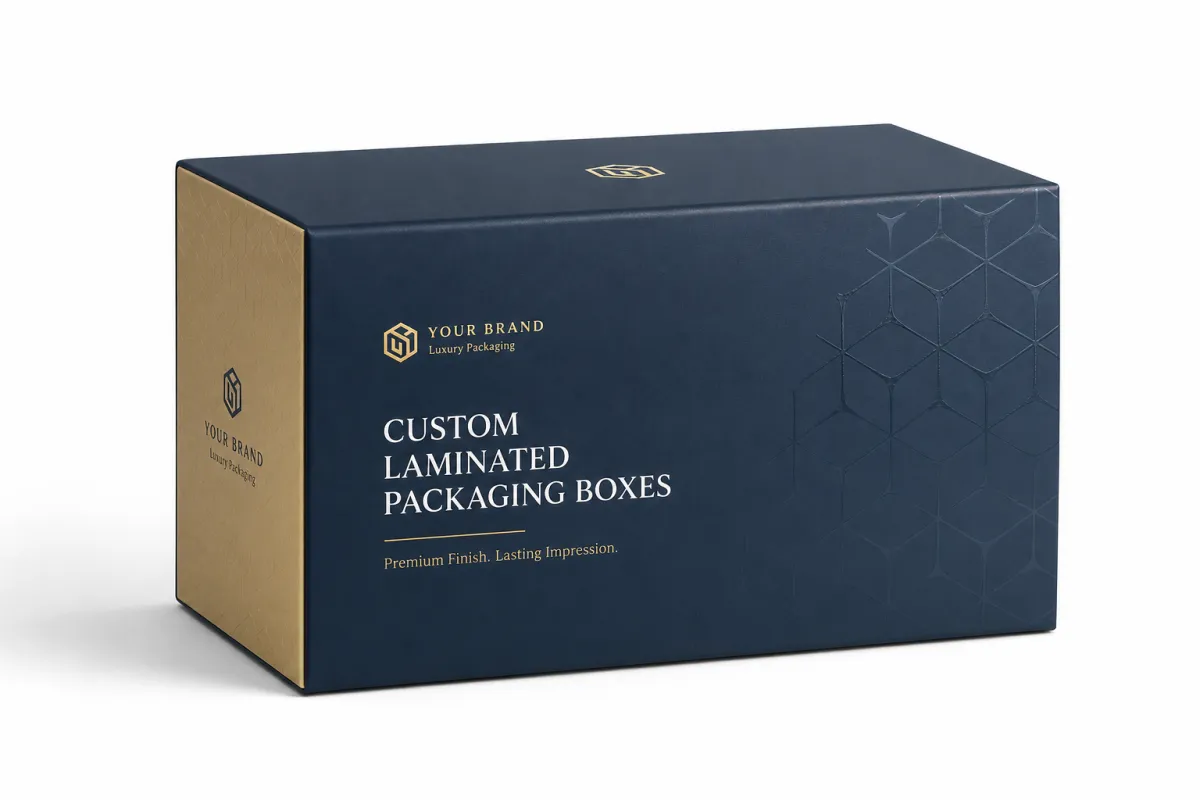
A laminated box is not just a printed carton with a shiny coat slapped on top. A custom laminated packaging boxes manufacturer bonds a film or laminate layer to the printed sheet, which changes how the surface feels, how it wears, and how it reads on shelf. That can be the difference between “decent carton” and “okay, this looks like a premium product.”
The value shows up in three places. First, lamination improves scuff resistance, which matters when cartons rub during transit or get handled by retail staff. Second, it deepens color and keeps the artwork looking controlled, especially on full-coverage packaging. Third, it changes tactile perception. Matte feels quieter. Gloss feels louder. Soft-touch feels expensive, sometimes with a little too much confidence for its own good.
From a packaging buyer’s point of view, laminated boxes are useful because they solve more than one problem at once. They work for cosmetics cartons, electronics sleeves, Rigid Gift Boxes, apparel mailers, food gift packaging, and custom printed Packaging for Subscription kits. If the product needs a cleaner shelf presence, a custom laminated packaging boxes manufacturer can usually get there without loading the project with unnecessary structure.
A good laminated box does not shout. It makes the product look like it belongs at the price point.
There is a branding upside too. Package branding works best when the surface holds the artwork cleanly. When ink looks flat, scratched, or uneven, the product feels cheaper before it even leaves the box. That is why a custom laminated packaging boxes manufacturer often plays a quiet role in the brand story, even if the customer never thinks about the lamination itself.
For basic material and transit context, groups like ISTA and fiber-based sourcing standards such as FSC are useful reference points. They do not design the box for you. They do help frame what the box should survive and where the board came from. Different products need different levels of protection, and a custom laminated packaging boxes manufacturer should ask for those details instead of tossing out vague promises.
One more thing buyers miss: lamination can save money indirectly. If the finish holds up better, you reduce reprint risk, warehouse damage, and customer complaints about packaging arriving beat up. That is not glamorous. It is just good buying.
How a Custom Laminated Packaging Boxes Manufacturer Builds the Box
The production flow is usually more methodical than people expect. A custom laminated packaging boxes manufacturer starts with the dieline, then moves into artwork prep, printing, lamination, die-cutting, folding, gluing, and inspection. Skip one step, and the box will make the mistake obvious. Usually by refusing to close the way it should.
The dieline is the anchor. If the dimensions are off by even a few millimeters, the insert can bind, the flap can misalign, or the print may sit too close to a fold. A custom laminated packaging boxes manufacturer should review the dieline before production, not after cartons are already halfway through a run. That sounds obvious. It still gets missed.
Printing comes next, usually on coated paperboard or a printed wrap sheet. Common board choices include 250gsm to 400gsm SBS for folding cartons, and 1.5mm to 2.5mm rigid board for premium structures. A custom laminated packaging boxes manufacturer will often recommend board thickness based on product weight, shipping method, and the retail experience you want. A lightweight lipstick box does not need the same build as a rigid gift box for a glass fragrance bottle.
Then comes lamination. This is where finish changes the whole mood of the box:
- Gloss lamination adds shine and makes colors pop. It works well for bright retail packaging and bold graphics.
- Matte lamination softens the look, cuts glare, and usually feels more restrained and premium.
- Soft-touch lamination creates a velvety feel, which is popular in luxury packaging and high-end branded packaging.
- Anti-scratch lamination helps when the box will be handled often or stacked during distribution.
Each finish changes both appearance and handling. Gloss shows fingerprints more easily. Matte hides a lot more. Soft-touch feels elegant but can show wear if the box gets dragged across rough surfaces. A custom laminated packaging boxes manufacturer should spell out those tradeoffs instead of pretending one finish works for every job.
| Finish | Best For | Typical Price Impact | Buyer Note |
|---|---|---|---|
| Gloss | Bright retail packaging, bold color, food gifts | Usually the lowest add-on cost | Strong shelf pop, but fingerprints and glare can show |
| Matte | Clean premium branding, apparel, cosmetics | Low to moderate add-on cost | Good balance of feel and durability |
| Soft-touch | Luxury product packaging, gift sets, premium kits | Moderate to higher add-on cost | Great tactile effect, but not ideal for heavy handling |
| Anti-scratch | High-touch retail, e-commerce, transit-heavy orders | Moderate add-on cost | Helpful when scuff marks would hurt presentation |
After lamination, the sheets are die-cut and creased, then folded and glued into the final structure. A custom laminated packaging boxes manufacturer may build a folding carton, a sleeve, a drawer box, a shoulder box, or a lift-off rigid box depending on the product and the price point. Inserts can be paperboard, molded pulp, EVA foam, or custom board partitions. The more complex the insert, the more carefully you need to check tolerances.
One place mistakes happen is finish selection versus brand message. A loud gloss box for an understated skincare line can look off. A dull matte box for a candy brand can look sleepy. Packaging design should serve the product. That sounds basic, but buyers still shop for finishes like they are picking wallpaper.
Another common issue is ignoring glue tabs, wrap edges, and fold allowances in the artwork file. A custom laminated packaging boxes manufacturer should flag those issues early, because once print is approved, every small mistake becomes a cost item. Good box building is less about drama and more about precision.
Cost Factors That Shape Laminated Box Pricing
Pricing is where buyers either get disciplined or get surprised. A custom laminated packaging boxes manufacturer usually bases quotes on size, board thickness, print coverage, finish type, insert count, and order quantity. That is the normal set of variables. Anything beyond that, like foil, embossing, spot UV, or specialty structural work, adds another layer of cost.
Quantity matters more than almost anything else. Setup costs, plate costs, die costs, and machine setup get spread across the run. That is why a small order can cost dramatically more per unit than a larger one. For standard folding cartons, you might see rough pricing around $0.18-$0.45 per unit at 5,000 pieces, depending on size and print coverage. At 500 pieces, the same style can land much higher because the fixed costs do not shrink just because the order is small.
Rigid boxes sit in a different lane. A premium rigid box with lamination, wrap paper, and a basic insert may run roughly $1.20-$3.50 per unit at lower quantities, depending on size and complexity. Those are rough ranges, not promises. Freight, region, labor, and finish selection can move the number fast. A custom laminated packaging boxes manufacturer should be able to separate the structure cost from the finishing cost, because that is where buyers often discover they are paying for things they do not actually need.
The easiest way to see cost drivers is to compare them directly:
- Box size: larger boxes use more board and more printed area.
- Board thickness: thicker material raises material and conversion cost.
- Print coverage: full-bleed graphics use more ink and need tighter control.
- Lamination type: soft-touch and anti-scratch usually cost more than basic gloss or matte.
- Insert count: custom inserts can add tooling and assembly labor.
- Packaging style: rigid structures cost more than simple folding cartons.
Special finishes are where budgets quietly disappear. Spot UV, foil stamping, embossing, and magnetic closures can all look great, but they should earn their place. A custom laminated packaging boxes manufacturer will usually tell you if a premium detail is doing real work or just making the quote look prettier than the margin. That advice is worth more than a decorative metal sheen, frankly.
Here is a practical breakdown of how finish choices often affect pricing on a standard custom printed box run:
| Option | Typical Use | Approximate Cost Effect | Tradeoff |
|---|---|---|---|
| Gloss lamination | Retail packaging, food gifts | Lowest or near-lowest finish add-on | Bright appearance, but glare can be harsh |
| Matte lamination | Luxury product packaging, apparel | Small to moderate add-on | Cleaner look, slightly softer color pop |
| Soft-touch lamination | High-end branding, gift sets | Moderate add-on, sometimes more on small runs | Very tactile, but marks may show under heavy handling |
| Anti-scratch film | High-touch shelves, shipping-heavy orders | Moderate add-on | Better durability, less dramatic tactile effect |
Ask for separate quotes on structure, print, finishing, inserts, and freight. That lets you see what is driving the number. A custom laminated packaging boxes manufacturer that only gives one lump sum is making it harder for you to control the project. And yes, you should ask whether the quote includes tooling, sampling, and packaging design support. “Included” means something different to everyone until the invoice lands.
If you want a sanity check on transit requirements, compare your shipping scenario with ISTA test standards. If a box will be stacked, knocked around, or shipped through multiple touchpoints, a slightly better lamination or a sturdier board can be cheaper than eating returns and reprint waste later.
Step-by-Step Ordering Process and Production Timeline
The ordering flow is usually straightforward, but only if the buyer brings clear inputs. A custom laminated packaging boxes manufacturer will usually move through brief, quote, dieline, proof, sample, production, packing, and freight. If one of those steps gets delayed, the whole schedule slips. It is not glamorous. It is just production.
Start with a product brief that includes dimensions, target quantity, board preference, finish preference, insert needs, and delivery location. A custom laminated packaging boxes manufacturer can quote faster when those basics are fixed. If the dimensions are still “around this size,” you are not ready for a clean quote yet.
Sampling can be quick or annoying, depending on how prepared the file is. A digital proof may take 1-2 business days. A physical sample often takes 3-7 business days if the line is already set up. If the box is complicated or if the insert needs custom tooling, the sample stage can take longer. A custom laminated packaging boxes manufacturer should tell you that upfront instead of acting like every sample is instant.
Production usually takes about 10-20 business days after proof approval for standard laminated cartons, though rigid boxes and complex insert builds can take longer. Shipping is the wildcard. Domestic freight may take a few days. Ocean freight can take weeks. If your launch date depends on the box arriving on a Monday morning, give yourself more room than your optimism wants to admit.
Here is what tends to slow things down:
- Artwork revisions after proofing starts.
- Late approvals from internal stakeholders.
- Unclear specs on finish, coating, or board weight.
- Low-resolution files or missing vector logos.
- Change requests after sample approval.
There is also a hidden timing issue: the more people who weigh in, the slower the job moves. Marketing wants the box to feel premium. Operations wants it to ship flat. Sales wants shelf impact. Finance wants the price lower. A custom laminated packaging boxes manufacturer can balance those pressures, but only if one person actually owns the final call.
For buyers shipping products that need stricter protection, it helps to align the box with recognized material and transit expectations. FSC certification on fiber-based materials is a useful sustainability signal, and it is easy to verify through FSC. That matters for packaging brands that want cleaner sourcing stories without turning the packaging into a lecture.
One smart move: keep one approval path. Send the proof to one owner, not five people with five different opinions. A custom laminated packaging boxes manufacturer can move faster when feedback is consolidated. Clean approvals are boring. Boring is good.
Common Mistakes Buyers Make With Laminated Boxes
The biggest mistake is picking a finish because it looks nice on its own. A custom laminated packaging boxes manufacturer should be helping you choose based on handling, product category, and shelf environment. Gloss can be right for loud retail packaging. Matte can be right for luxury. Soft-touch can be right for tactility. None of those is automatically correct without context.
Sizing errors are another classic. Too much extra space makes the box look cheap and wastes material. Too little space crushes the insert or leaves the product rattling inside like a bad shipping decision. A custom laminated packaging boxes manufacturer should insist on exact product dimensions, not rough estimates pulled from a sketch and a guess.
Artwork prep causes its own damage. Low-resolution images lead to fuzzy print. Inconsistent color profiles make one panel look different from another. Ignoring bleed or safe zones can leave logos clipped near the edge. These are not tiny issues. They are the kind that turn a clean custom printed packaging project into a remake nobody planned for.
Communication gaps are where hidden costs live. If the buyer says “premium” but does not define whether that means matte film, rigid board, foil, or soft-touch, the manufacturer has to guess. Guessing is expensive. A custom laminated packaging boxes manufacturer can only quote against the information they get, and unclear instructions usually turn into rework, not magic.
Another mistake is overbuilding. Some brands jump straight to rigid boxes because they want the package to feel premium, but a well-made folding carton with the right lamination can hit the same visual target at a lower unit cost. That is why a custom laminated packaging boxes manufacturer should be part engineer, part reality check. The product does not always need a luxury box to look premium.
Many buyers also forget the shipper. The shelf box may look beautiful, but if it dents in transit, the first impression is already gone. Product packaging should survive both the warehouse and the retail floor. If it cannot do both, you need either a better structure or a better secondary package.
Finally, do not ignore tolerances. Inserts with rigid components, bottles, electronics, or fragile pieces need enough clearance to load cleanly, but not so much that the product shifts. A custom laminated packaging boxes manufacturer should talk in millimeters, not vague hopes. That is the difference between a box that presents well and a box that fights the line team.
Expert Tips for Better Results and Cleaner Margins
The cleanest projects are usually the ones with the fewest unnecessary variables. A custom laminated packaging boxes manufacturer can do a lot, but the buyer still controls how complicated the job becomes. Fewer finish changes, fewer structural oddities, and fewer custom parts usually mean fewer production headaches and better cost control.
Choose finishes by use case, not by mood board. Gloss is strong when you need bright retail impact and bold color. Matte works well for understated premium branding and better fingerprint resistance. Soft-touch makes sense when tactile feel is part of the sale. A custom laminated packaging boxes manufacturer should help you match finish to channel, because the same box can behave differently in a boutique, a warehouse, or a subscription shipment.
Design for shelf and shipper at the same time. That means thinking about carton corners, print durability, stacking pressure, and how the box will look after it has traveled. A box that arrives rubbed raw is not helping anyone. Good packaging design respects the shipping path as much as the retail display.
Ask for physical samples or at least finish swatches before a full run. Screens lie. They always have. A sample shows whether the matte film feels too dull, whether gloss creates unwanted glare, and whether the color shift is acceptable. A custom laminated packaging boxes manufacturer who cannot provide a sample path is asking you to gamble on appearance, and that is a silly place to save a few days.
Keep the spec sheet simple when possible. A single box style, one insert style, and one main finish are much easier to repeat than a deeply customized package with three materials and four decorative effects. That does not mean boring. It means controlled. And control is how margins survive.
If sustainability matters, ask about paperboard sourcing and whether your structure can support FSC-certified material. You do not need a manifesto. You need clean documentation and a material choice that fits the product. A custom laminated packaging boxes manufacturer should be able to tell you what the board is, what the film is, and what tradeoffs come with each.
There is also a retail trick that gets ignored: preserve contrast. A matte carton with one glossy accent can feel more intentional than a fully shiny box crammed with effects. The point is not to add everything. The point is to make the product look considered. That is how package branding gets remembered.
One last buying habit saves real money: separate want from need. Foil may be nice. Embossing may be nice. Magnetic closures may be nice. But if the box is going into a mid-market retail channel, those extras can eat margin faster than they earn attention. A good custom laminated packaging boxes manufacturer will tell you that, even if it is not the answer you were hoping for.
What to Do Next Before You Request Quotes
Before you ask for pricing, gather the basics: product dimensions, target quantity, board preference, finish preference, insert requirements, shipping destination, and whether the box needs to be flat-packed or assembled. A custom laminated packaging boxes manufacturer can work much faster when the brief is clean. Vague inputs are how projects drift.
Ask for a quote that splits out unit price, tooling, sampling, inserts, and freight. That way you can compare options on a real basis instead of staring at one large number and pretending it tells the whole story. A custom laminated packaging boxes manufacturer that is transparent about cost structure makes buying easier, not harder.
Request one sample or prototype before you commit to mass production, especially if the box has tight tolerances or a premium finish. This is the moment to test fit, texture, print accuracy, and closing performance. It is much cheaper to catch an issue in sample form than after 5,000 boxes have already been printed and laminated.
For most brands, the best next move is to choose the simplest structure that meets the product’s retail and shipping needs. Then layer in finish and branding only where those details add real value. A custom laminated packaging boxes manufacturer should make the process clearer, faster, and less expensive to fix. That is the mark of a useful packaging partner, not just a printer with a catalog.
If you are still deciding between options, start with the material, then the finish, then the structure. That sequence keeps the project grounded. A good custom laminated packaging boxes manufacturer should be able to turn that sequence into a clean spec sheet, a realistic timeline, and a box that actually helps sell the product. Lock those three things first, and you are already ahead of most packaging orders.
What should I ask a custom laminated packaging boxes manufacturer before quoting?
Ask which board, finish, and box style fit your product weight and sales channel. Confirm whether the quote includes tooling, samples, inserts, and freight, because a cheap unit price means very little if the rest is missing. Also ask for file requirements early so your artwork does not get held up later by avoidable corrections.
How much do custom laminated packaging boxes usually cost?
Pricing depends mostly on size, quantity, board thickness, and whether you choose matte, gloss, soft-touch, or specialty film. Small runs cost more per box because setup and tooling are spread across fewer units. Rigid structures and custom inserts usually push pricing higher than standard folding cartons, especially when the project needs premium finishing.
How long does production take with a custom laminated packaging boxes manufacturer?
Sampling can take a few days if your dieline and artwork are already ready. Production often takes about 10-20 business days after proof approval, though revisions and seasonal backlog can stretch that. Shipping time depends on distance, freight method, and whether the boxes ship flat or assembled, so that part should be planned separately.
Which laminate finish is best for packaging boxes?
Gloss works well when you want bright color and a strong retail shine. Matte gives a cleaner, quieter premium look and usually hides fingerprints better than gloss. Soft-touch is strong for luxury positioning, but it costs more and can show wear in high-handling settings, so it is best reserved for the right use case.
What files do I need before ordering laminated packaging boxes?
You usually need a dieline, print-ready artwork, and logo files in vector format. Images should be high resolution, and text should stay inside safe margins so nothing gets cut off during die-cutting or folding. If you are unsure, ask the manufacturer for their template and proofing rules before design work starts.
Pick one box style, one finish, and one approval owner before you request quotes. That single move cuts confusion fast, keeps revisions under control, and gives a custom laminated packaging boxes manufacturer a clean target to build against.

