Buyer Fit Snapshot
| Best fit | CMYK Printed Poly Mailers projects where brand print, material claims, artwork control, MOQ, and repeat-order consistency need to be specified before quoting. |
|---|---|
| Quote inputs | Share finished size, material target, print colors, finish, packing count, annual reorder estimate, ship-to region, and any compliance wording. |
| Proofing check | Approve dieline scale, logo placement, barcode or warning zones, color tolerance, closure strength, and carton packing before bulk production. |
| Main risk | Vague material claims, crowded artwork, missing packing details, or unclear freight terms can make a low unit price expensive after revisions. |
Fast answer: CMYK Printed Poly Mailers: How They Work and Why They Matter should be specified like a repeatable production item. The safest quote records material, print method, finish, artwork proof, packing count, and reorder notes in one written spec.
Production checks before approval
Compare the actual filled-product size with the drawing, then confirm tolerance on folds, seals, hang holes, label areas, and retail display edges. Reserve space for logos, QR codes, warning copy, and material claims before decorative graphics fill the panel.
Quote comparison points
Review material grade, print process, finish, sampling route, tooling charges, carton quantity, and freight assumptions side by side. A quote is only useful when the supplier can repeat the same color, closure quality, and packing count on the next order.
CMYK Printed Poly Mailers can turn a plain shipping bag into the first physical brand moment a customer touches after checkout. That sounds small until you watch a parcel land on a doorstep and realize the package gets a real shot at making an impression before the product is even seen. A mailer still has to protect the order, survive the parcel grind, and arrive without looking like it lost a fight with a conveyor belt. That is exactly why CMYK printed poly mailers work so well for ecommerce, subscription shipments, and promo drops.
Buyers usually want three things: less weight, better presentation, and fewer packaging layers. A full-color mailer checks those boxes without asking for a box, extra label stack, or a wrap that needs its own run. The catch is color. CMYK Printed Poly Mailers shine when the artwork is built for process color, not when someone expects a spot color to behave like a saint and match a Pantone chip by sheer force of will.
If you are comparing packaging formats, the rest of the lineup matters too. Our Custom Poly Mailers page is a good place to compare sizes and constructions, and the broader Custom Packaging Products catalog can help you decide whether the mailer should stand alone or work with inserts, cartons, or labels.
What CMYK Printed Poly Mailers Are and Why They Stand Out
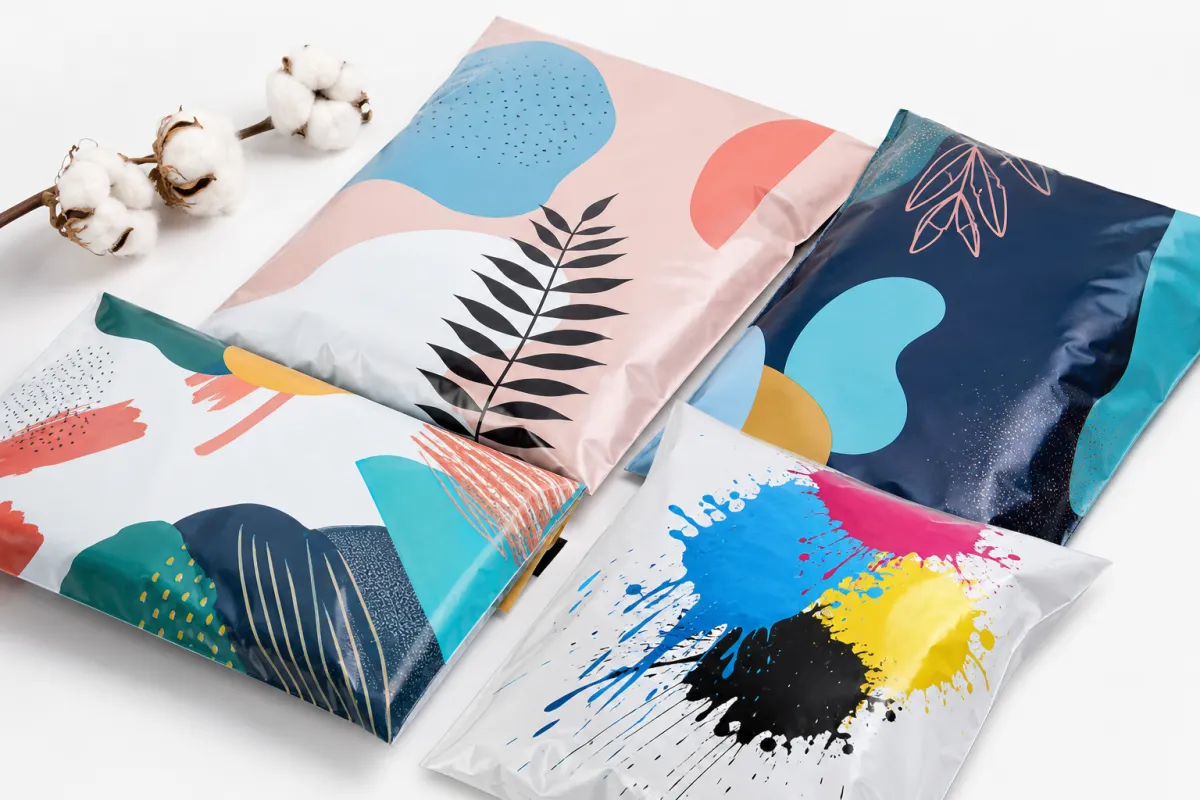
CMYK printed poly mailers are polyethylene shipping bags printed with cyan, magenta, yellow, and black process inks. Simple on paper. More useful in real life. Full-color process printing gives the bag room for gradients, photography, layered graphics, campaign art, and brand colors without adding another item to the packout. For apparel brands, accessories sellers, and subscription programs, that means the mailer becomes part of the brand story instead of just the thing holding the order together.
The strongest use cases are the ones where the package gets handled before the product gets admired. A fulfillment team pulls it from a shelf. A courier scans it on a dock. A customer notices it on the front step before opening anything. In those moments, CMYK printed poly mailers can carry a logo, a repeat pattern, a seasonal graphic, or a simple campaign message that makes the shipment easier to recognize and harder to ignore.
They also fit brands that want a lighter package structure. A poly mailer is thinner and usually cheaper to ship than a corrugated carton, which matters when dimensional weight starts bullying the budget. The canvas is smaller, sure. That is not always a bad thing. A smaller surface forces cleaner design choices. Good CMYK printed poly mailers often look better because the artwork has nowhere to hide.
The mistake people make is treating process color like a miracle. CMYK is great for full-color work. It is not a promise that every brand color will land with perfect spot-color precision. If a color is central to the brand, the design team needs to know how the supplier is printing it. Digital printing, flexographic printing, and other methods all behave differently on film. Strong CMYK printed poly mailers start with a real design brief, not a final file tossed over the fence and hoped for the best.
A good poly mailer has two jobs: survive the trip and make the brand look deliberate. If either one fails, the package feels unfinished no matter how good the product inside may be.
There is a cost conversation hiding under the branding conversation. More visual work means more attention to ink coverage, legibility, production method, and material choice. A simple two-color layout can be easier to control. Dense graphics, gradients, and tiny legal text demand more from the print process. That is why CMYK printed poly mailers deserve the same planning as a carton or hangtag, even if the substrate is much lighter and less expensive to move around. I have seen more than one “simple” mailer order get derailed by artwork that looked fine on a laptop and then turned muddy once the film and ink actually met.
How CMYK Printed Poly Mailers Are Produced
Production starts with artwork separation. A designer may hand over an RGB file because that is how the artwork lived on screen, but the supplier has to translate it into CMYK for print. In some shops that becomes digital print data. In higher-volume programs, the art may be prepared for plates in a flexographic setup. Either way, CMYK printed poly mailers work best when someone reviews the conversion with actual print behavior in mind, not just what looks nice on a monitor.
That shift matters because film does not act like paper. Polyethylene is smooth, flexible, and a little reflective, so the same ink stack can look brighter or flatter depending on how light hits the surface. Ink sits on top of the material instead of soaking in like it would on paperboard. Curing, drying, and adhesion all need to be controlled. On a proper run of CMYK printed poly mailers, the supplier is watching registration, ink laydown, and surface tension closely so the image does not smear, drift, or fade into a sad gray version of the mockup.
White ink or an opacity layer can come into play too. If the film is tinted, metallic, recycled with visible content, or just not a bright white base, the artwork may need a white underprint so the colors stay readable. Without that layer, a logo can sink into the substrate or come out muddy. That is one reason mockups are not enough. A screen preview can show the layout. It cannot tell you how a translucent or colored film will change the appearance of CMYK printed poly mailers.
Proofing is where good programs save money. A soft proof helps with layout, spelling, and broad color direction. A press proof or sample is better for line weight, seam placement, and the way the bag folds in real life. On larger or color-sensitive runs, that review step often catches issues like a barcode that is too light, a headline that looks crisp on screen but thin on film, or a background gradient that bands more than anyone wanted. For a brand that depends on CMYK printed poly mailers, those checks are not busywork. They are part of the job.
Print placement matters too. Some bags are printed only on the front panel, some on both sides, and some use a repeat pattern that stretches across the visible face of the mailer. The usable area is shaped by seams, the opening edge, the adhesive flap, and the way the bag sits once packed. A layout that looks roomy in a mockup can get squeezed fast once the production template and seal zones show up. Experienced teams treat CMYK printed poly mailers like a packaging project, not a logo placement exercise with a nicer name. That distinction saves headaches, and a few ugly emails, later on.
Color, Film, and Finish Factors That Change the Result
Film gauge is one of the first details that affects both appearance and durability. A thinner mailer can drape better and keep postage weight down, but it may flex more in transit and show more movement in the print. A heavier gauge usually feels sturdier and resists puncture better, yet it can also shift the visual character of the print because the surface tension and stiffness are different. For CMYK printed poly mailers, gauge is not just a strength spec. It is part of the look.
Surface finish changes the result as well. Glossy film tends to push color brighter and more saturated. Matte film softens reflections and can make artwork feel calmer, cleaner, or more premium depending on the brand direction. Recycled content can change the surface slightly too, and that can influence how dense the ink appears. Two bags with the same artwork can look surprisingly different once the finish changes. That is why CMYK printed poly mailers should be judged as a full system: film, ink, and finish together.
Design complexity matters more on flexible film than many teams expect. Large solid fields can show banding if coverage is uneven. Gradients need careful control so they do not step or break apart. Fine text and thin rules may look fine on a computer render and then get fuzzy once the bag flexes. If the layout depends on tiny legal copy or a detailed QR code, the production team should check that it still reads from a normal arm’s length. That practical check can save a round of rework on CMYK printed poly mailers.
Bag dimensions shape the layout too. A small pouch offers limited real estate, and the seam lines, adhesive strip, and opening direction can eat more room than a designer expects. On the other end, oversized mailers can handle more graphic movement but may create waste if the bag is much larger than the product. I usually tell buyers to start with the item dimensions, add packing allowance, then work backward into the bag spec. That keeps CMYK printed poly mailers intentional instead of crowded.
Order quantity changes the economics and sometimes the production method. Short runs may fit digital printing better because setup is lighter and revisions are easier to absorb. Larger runs often favor flexographic printing because plate costs get spread across more units and the unit price drops. Offset printing can be a useful comparison point for artwork teams, but it is not the same thing as printing directly onto poly film; the substrate and handling rules are different. Knowing that helps buyers make better decisions about CMYK printed poly mailers before they sign off on the spec.
Transit performance deserves attention beyond the artwork. If the shipping program will go through rough parcel systems, look at testing expectations from ISTA and take drop, vibration, and compression concerns seriously. A mailer that looks beautiful but splits at the seam is not doing its job. That stays true no matter how polished the graphic looks. The bag has to survive the boring parts of shipping, because that is where packaging usually gets tested.
CMYK Printed Poly Mailers: Pricing and Timeline Basics
Pricing starts with the obvious variables: quantity, bag size, film thickness, print coverage, and shipping distance. After that, the quote usually reflects how much prepress work is needed, whether the artwork is simple or image-heavy, whether a proof round is included, and whether the order needs a rush slot. For CMYK printed poly mailers, the art itself can affect the price because dense graphics usually ask for more review time than a clean logo and a repeat pattern.
Setup costs are where many first-time buyers get surprised. A digital run may keep setup lower, but color review and file preparation still take time. A flexographic run can bring plate charges, color calibration steps, and a more formal proof stage. If the design needs opacity control, special registration, or extra inspection, those steps can move the number upward. The supplier is not just charging for plastic bags. They are converting your brand file into CMYK printed poly mailers that can be run repeatedly with predictable results. That takes time, tools, and a decent amount of patience.
Here is a practical way to compare common order profiles:
| Order Profile | Typical Unit Price | Setup Cost | Best Fit | Notes |
|---|---|---|---|---|
| 500-1,000 pieces, digital print | $0.55-$1.10 | Low to moderate | Launches, seasonal campaigns, test runs | Faster to start, but the unit price stays higher. |
| 3,000-10,000 pieces, flexographic print | $0.18-$0.40 | Moderate | Steady ecommerce SKUs and repeat packaging programs | Better economics once the artwork is locked and demand is stable. |
| 10,000+ pieces, optimized production | $0.12-$0.28 | Higher upfront planning | Established brands with predictable demand | Best pricing usually comes from stable specs and fewer revisions. |
Those numbers are planning ranges, not promises. Supplier location, freight method, resin cost, and print complexity can move the final quote. The pattern still holds: the larger the order, the more setup gets spread across each unit. That is why CMYK printed poly mailers often look much better at scale. A buyer who plans three short runs may spend more than a buyer who locks one clean spec and repeats it.
Timeline usually runs from quote to artwork review, then proof approval, then production, then packing and freight. A straightforward order might move in 12-15 business days from proof approval. A more complex order can stretch longer if color revision or material substitution is needed. Revisions are what usually add time. A small logo change can feel harmless, but if it triggers another proof round, it can push the schedule by days. Teams that rely on CMYK printed poly mailers should build in a buffer before launch, especially if the mailing date is tied to a promotion or product release.
For buyers comparing material and program choices, the cleanest move is to request the same spec sheet from every supplier and compare like for like. Bag size, thickness, print coverage, proofing policy, freight method, and lead time should all be listed in the same format. If one quote includes a sample and another does not, or if one includes domestic freight while another leaves it out, the number on the page is not really comparable. That discipline keeps CMYK printed poly mailers from turning into a guessing game.
Artwork Prep and Approval Steps Before Production
The best artwork process starts with the template, not the logo. A proper dieline or production file shows the safe area, bleed zone, seam lines, adhesive zone, and any print boundaries the bag needs. Once that file is in hand, the designer can place the logo, product message, and support graphics where they will actually survive production. For CMYK printed poly mailers, that step prevents a lot of invisible problems before they turn visible and expensive.
File setup matters more than many people think. Vector logos should stay crisp, images should be high resolution, fonts should be outlined or packaged correctly, and the color profile should be set with the production process in mind. If a design contains gradients or subtle shadows, those should be checked for smooth transitions instead of assumed to print perfectly. The same goes for barcode files, legal copy, and line art. In a flexible substrate environment, CMYK printed poly mailers reward artwork that is clean, organized, and built for print, not for a social feed.
Before approval, I always recommend checking contrast and scale under normal office or warehouse lighting. Screen brightness can make a design look richer than it will on film, and fluorescent warehouse lighting can expose weak contrast that looked fine on a laptop. That is also the moment to verify whether the package needs a spot-color look or whether a process build will do the job. If brand color is a hard requirement, say so early. If the artwork can tolerate a close visual match, say that too. The more precise the brief, the better the final CMYK printed poly mailers will be.
Here is a simple approval checklist that saves time later:
- Dimensions: confirm width, length, flap, and usable print area.
- Artwork: verify file format, resolution, and font handling.
- Color: set the target for CMYK, not a screen preview.
- Placement: check logo position, barcode location, and seam clearance.
- Logistics: confirm ship-to address, pack count, and delivery window.
That checklist sounds basic, and that is the point. A lot of projects drift because nobody checked the flap location before approval. A logo can sit too close to the seal. A barcode can read fine on the proof and then land too close to the fold line on the finished bag. Those mistakes are preventable, and they are exactly why CMYK printed poly mailers should go through a formal signoff before production starts.
If your program uses paper inserts, labels, or outer cartons alongside the mailer, it is also worth paying attention to the material standards in the rest of the packout. FSC certification can matter for paper components, and that can help if your brand wants the entire shipping story to stay aligned. The mailer itself may be plastic, but the broader packaging system can still reflect a cleaner material strategy. That kind of consistency is what makes the whole order feel intentional instead of pieced together.
Common Mistakes When Ordering Printed Poly Mailers
The first mistake is designing for the screen instead of the substrate. RGB artwork can look great on a monitor and then shift once it is converted for print. That is not a supplier problem. It is the difference between light on a display and ink on film. CMYK printed poly mailers behave better when the design team expects that shift and plans for it instead of acting surprised after the proof arrives.
The second mistake is loading the bag with too much detail. Tiny text, ultra-thin rules, and complicated gradients can break apart once the film flexes or the ink spreads a little during production. A mailer is a moving surface, not a rigid carton, so a design that feels polished on a proof may look busy or muddy on the finished package. Strong CMYK printed poly mailers usually have a clearer hierarchy than the first draft. Cleaner is often better. Boring is not the same thing as clear.
Another common error is assuming every color can be matched exactly through CMYK. A brand that needs a very specific blue, red, or green may need to confirm whether the supplier can get close enough or whether the expectation should change. A true spot-color system behaves differently, and that distinction matters. If the design team treats CMYK printed poly mailers like a dedicated spot-color project without checking the process, disappointment is almost guaranteed.
Then there is the practical side of the bag itself. Adhesive placement, opening direction, and courier handling all affect how the customer experiences the package. A beautiful design can feel awkward if the logo is upside down when the mailer is held for sealing, or if the tear strip cuts into the main graphic. That is one reason some of the best-looking CMYK printed poly mailers are also the simplest: fewer visual interruptions, clearer handling logic, and more room for the product to do the talking.
Skipping samples is the last big miss. A quick test often reveals what a monitor cannot show: seam interruptions, a color that feels flatter on glossy film than expected, a barcode that needs more contrast, or a layout that crowds the flap. A sample does not just prove the bag exists; it proves the design works in real conditions. For any serious order of CMYK printed poly mailers, that step is usually cheaper than fixing a full run after the fact.
One more practical note: do not treat every supplier like they are running the same setup. A quote built around digital printing will not behave the same as one built around flexographic printing, and both will differ from an offset mindset used for paper packaging. The equipment, material path, and finishing considerations are different enough that the same file may need different prepress treatment. Buyers who understand that tend to get better results from CMYK printed poly mailers because they ask the right questions before approval instead of after the bags are already moving.
Next Steps for CMYK Printed Poly Mailers
If you are planning an order, start with three inputs: the bag dimensions, the quantity you expect to ship, and the artwork you want printed. Those three pieces of information let a supplier give you a real quote instead of a guess. From there, build a one-page brief that includes brand colors, logo files, any finish preferences, and the way the mailer will move through the parcel stream. That brief is the fastest path to getting CMYK printed poly mailers that look right and function well.
It also helps to compare quotes on the same spec sheet. If one supplier quotes matte film and another quotes gloss, or one includes a proof and another does not, the numbers are not directly comparable. Ask whether the order is better suited to digital printing or flexographic printing, and ask how long proofing and transit will really take. Those details matter more than a polished sales line, especially if the mailer is part of a product launch. Clean planning upfront is what keeps CMYK printed poly mailers from becoming a logistics headache.
Here is the simplest way to move forward:
- Gather size, quantity, and artwork.
- Request quotes from at least two suppliers using the same spec.
- Review a proof under real lighting.
- Check seam placement, barcode readability, and color expectation.
- Approve only when the layout, lead time, and cost all line up.
That sequence may feel slow if you are used to quick online ordering, but it is how you keep packaging from becoming a last-minute correction. Good shipping materials do not need to be complicated; they need to be predictable. If you want to compare formats before you commit, our Custom Packaging Products page and Custom Poly Mailers page can help you narrow the field without guessing. If your broader packaging program includes paper components, it is worth checking FSC guidance so the rest of the packout stays aligned with your brand standards.
CMYK printed poly mailers work because they solve two problems at once: they protect the shipment and they carry the brand with real visual impact. If the artwork is planned well, the film choice makes sense, and the proof gets the attention it deserves, CMYK printed poly mailers can do a lot of quiet marketing every time a parcel leaves the warehouse and every time a customer opens the bag. The takeaway is simple: lock the spec early, approve from a real sample or proof, and treat the mailer like packaging, not just decoration. That is how you get something that ships well and looks like you meant it.
FAQ
What are cmyk printed poly mailers best for?
CMYK printed poly mailers are best for lightweight ecommerce orders, subscription shipments, and promotional mailings where the bag itself needs to carry branding. They are especially useful when you want full-color graphics without adding another printed layer such as a wrap, insert card, or outer box. They are less ideal for products with sharp corners, heavy contents, or a higher puncture risk.
Can cmyk printed poly mailers match Pantone colors exactly?
Usually not exactly. CMYK printed poly mailers can approximate many brand colors very well, but process color depends on film color, ink density, print method, and curing behavior, so a perfect spot-color match is not guaranteed. If color accuracy is critical, ask for a sample or proof and review it under the same lighting where the final approval will happen.
What affects the price of cmyk printed poly mailers most?
Quantity is usually the biggest cost driver because setup costs spread across more units as the order grows. Bag size, film thickness, print coverage, proofing, and shipping method all move the price too. For CMYK printed poly mailers, production method also matters, since digital printing and flexographic printing do not carry the same setup structure.
How long does it take to produce custom cmyk printed poly mailers?
The timeline usually starts with artwork review and proof approval, then production, finishing, packing, and freight transit. Simple CMYK printed poly mailers orders can move faster, while complex artwork, color revisions, or material changes can add days. A realistic buffer before launch is smart because revisions often take longer than the first quote suggests.
Are cmyk printed poly mailers durable enough for shipping?
Yes, for many apparel, soft goods, and low-sharpness products they are a strong fit. The key is choosing the right gauge, seal strength, and layout for the contents. If the package will face rough handling or moisture, test the sample first. Well-specified CMYK printed poly mailers can balance branding, protection, and shipping efficiency very effectively.


