Buyer Fit Snapshot
| Best fit | Cmyk Printed Tissue Paper Supplier for Brands projects where brand print, material claims, artwork control, MOQ, and repeat-order consistency need to be specified before quoting. |
|---|---|
| Quote inputs | Share finished size, material target, print colors, finish, packing count, annual reorder estimate, ship-to region, and any compliance wording. |
| Proofing check | Approve dieline scale, logo placement, barcode or warning zones, color tolerance, closure strength, and carton packing before bulk production. |
| Main risk | Vague material claims, crowded artwork, missing packing details, or unclear freight terms can make a low unit price expensive after revisions. |
Fast answer: Cmyk Printed Tissue Paper Supplier for Brands: Material, Print, Proofing, and Reorder Risk should be specified like a repeatable production item. The safest quote records material, print method, finish, artwork proof, packing count, and reorder notes in one written spec.
Production checks before approval
Compare the actual filled-product size with the drawing, then confirm tolerance on folds, seals, hang holes, label areas, and retail display edges. Reserve space for logos, QR codes, warning copy, and material claims before decorative graphics fill the panel.
Quote comparison points
Review material grade, print process, finish, sampling route, tooling charges, carton quantity, and freight assumptions side by side. A quote is only useful when the supplier can repeat the same color, closure quality, and packing count on the next order.
CMYK Printed Tissue Paper Supplier Guide for Brands
A cmyk Printed Tissue Paper supplier is not just a printer with a guillotine and a roll of paper. For a brand, that partner shapes the first tactile moment a customer gets when the box opens. That moment has to hold together color, fold quality, and shipping reality at the same time. The right cmyk printed tissue paper supplier can turn a plain sheet into packaging that feels intentional without making the box heavier, slower to pack, or stupidly expensive to ship.
If you have ever seen branded tissue that looked crisp in the mockup and muddy in the carton, you already know why supplier choice matters. Tissue paper is thin, absorbent, and unforgiving in a few very specific ways. So the right cmyk Printed Tissue Paper supplier needs to understand artwork, paper behavior, and pack-out as one connected process rather than three separate jobs.
I have seen good packaging ideas get flattened by bad tissue specs. Usually not because the concept was weak. Because somebody treated tissue like a postcard and, well, it is not a postcard.
What a cmyk printed tissue paper supplier actually does
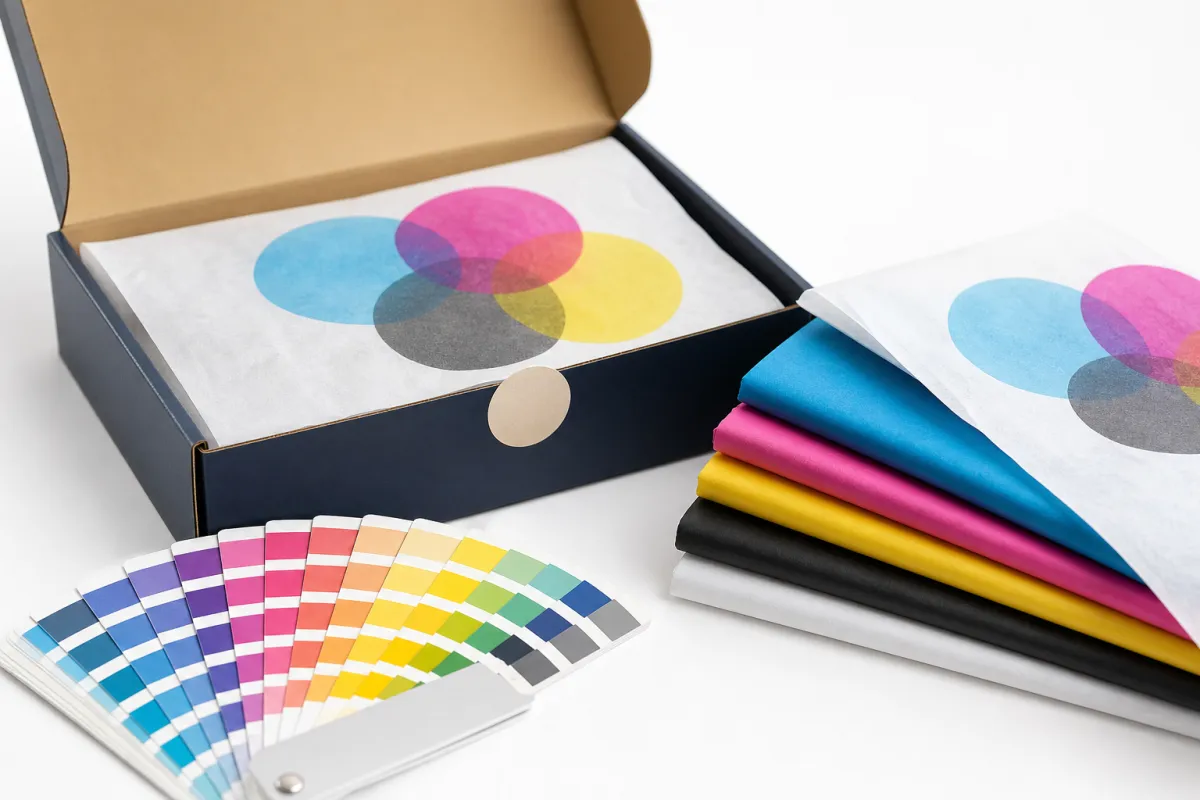
Picture a customer opening a mailer box and lifting the first layer of tissue before they see the product itself. That sheet is doing three jobs at once: it protects the item from scuffs, it frames the unboxing moment, and it tells the customer whether the brand pays attention to detail. A cmyk printed tissue paper supplier handles all three, which is why the work is more technical than it looks from the outside.
In plain language, CMYK printing builds a design from cyan, magenta, yellow, and black ink. That is different from spot color, where a specific ink is mixed to match a brand color more tightly, and it is also different from foil decoration, which adds metallic shine rather than full-color artwork. For tissue, CMYK is often the practical choice because it lets a cmyk printed tissue paper supplier reproduce logos, patterns, and illustration-style graphics without setting up separate inks for every color.
Where tissue paper sits in the pack line matters too. It is not only presentation material; it is part of the product’s shipping system. A sheet that folds cleanly around apparel, cosmetics, gift items, or light accessories helps stop abrasion and keeps the interior of the carton looking organized. The best cmyk printed tissue paper supplier will think about how the sheet behaves when it is flattened, folded, stacked, and packed, because the appearance in the box is only one piece of the requirement.
Most branded tissue runs use paper somewhere in the 17gsm to 22gsm range, although the right weight depends on the product and the box size. Lighter paper feels delicate and can show more of the product underneath; slightly heavier stock hides more and resists tearing a bit better. That balance is why a cmyk printed tissue paper supplier should ask about the item inside the package, not just the logo file. A sheet that works for jewelry may be too sheer for dark apparel, and a sheet that feels elegant in one pack size can look bulky in another.
The supplier choice matters even more at scale. Once you order thousands of sheets, small problems become obvious: a color that drifts from one batch to the next, a fold that shifts the print off-center, or a carton count that does not match the warehouse pick plan. A strong cmyk printed tissue paper supplier keeps those variables controlled so your team is not fixing them at the fulfillment stage.
There is also a practical, boring side to this job. Good tissue is supposed to disappear into the pack-out process. If it slows the line, jams in the carton, or arrives with the wrong fold direction, it stops being pretty and starts being a problem. Nobody wants that. Not your warehouse team. Not the person who approved the quote in a hurry.
If the artwork only looks good on a backlit screen, it probably needs simplification before it hits absorbent tissue stock. Fine lines, tiny type, and dense solids are the first things to suffer.
- Protection: prevents rubbing and minor surface marks during packing and transit.
- Presentation: creates a consistent branded layer inside the box.
- Operational fit: must fold, stack, and count the way your warehouse needs it to.
How CMYK tissue printing works from file to folded pack
A cmyk printed tissue paper supplier usually starts with artwork review, not with ink. That first pass is where the supplier checks image resolution, repeat pattern size, bleed, safe area, and whether the design will still look sharp when it is printed on a thin, absorbent sheet. If the file was built for coated carton stock or a glossy label, it may need adjustment before it can become a tissue print that actually survives production.
The production flow is straightforward on paper, but each step can affect the final result. Artwork is prepared, the colors are separated, a proof is produced, the press or digital device is set up, the print run begins, the sheets dry, and then the tissue is cut, folded, counted, and packed. A careful cmyk printed tissue paper supplier watches registration closely, because tissue can shift more than heavier paper if the feed or stack is not managed well.
Here is where printing method matters. Digital printing works well for shorter runs and frequent artwork changes because setup is lighter and proof cycles can be faster. Offset printing is often better for cleaner detail and more economical large runs when the design is stable. Flexographic printing can be a practical fit for repeat patterns and certain volume ranges, especially when the design is simpler and the supplier is tuned for tissue behavior. A knowledgeable cmyk printed tissue paper supplier should explain which method they are using and why, because the method changes both the cost structure and the look of the finished sheet.
Paper absorbency changes the final color more than many buyers expect. On tissue, inks sit differently than they do on smoother packaging materials, so the print can read slightly softer and less saturated. That does not mean the print is wrong; it means the substrate is doing what tissue does. A cmyk printed tissue paper supplier should set expectations early, especially if the design uses gradients, dark solids, or brand colors that are supposed to hit a very specific shade.
A proof is worth insisting on whenever the design is brand-sensitive. A digital proof may show layout and general color direction, but a physical proof or pre-production sample gives you a far better read on how the sheet will actually look in hand. If your project is tied to a seasonal launch or a retail campaign, ask the cmyk printed tissue paper supplier for the clearest proofing step available before the full run is released.
Two small file details save a lot of trouble. First, keep raster images at a practical resolution, usually around 300 dpi at print size if the artwork contains photos or fine detail. Second, build in bleed and repeat logic so the sheet can be trimmed and folded without chopping off brand marks. A cmyk printed tissue paper supplier can often work with a wide range of art styles, but the cleaner the file, the more predictable the tissue print.
One more thing: tissue is not the place to gamble on tiny reversed-out type. It might look gorgeous in the PDF, then print like a nervous little smudge in real life. That is the fun part nobody talks about until the sample arrives.
Key cost and pricing factors to compare before you order
Pricing from a cmyk printed tissue paper supplier can look simple until you compare the details behind the quote. The sheet price is only one part of the total. Sheet size, paper weight, artwork coverage, number of colors, print method, carton format, and freight all affect the final landed cost. If a quote seems unusually low, it is worth checking what is missing rather than assuming you found the best deal.
The biggest driver is usually quantity. Low minimums carry more setup cost per sheet, so the unit price is higher. Larger runs spread the setup cost over more pieces and usually bring the number down, sometimes significantly. A cmyk printed tissue paper supplier may quote one price for a small trial run and another for a larger replenishment order, and that difference is normal. The important part is comparing like for like.
Artwork coverage matters too. A design with light logo repeats on a mostly open sheet often costs less to print than a heavy all-over pattern with strong solids. If the artwork needs tighter alignment, special color correction, or additional proofing time, the supplier may add setup or sampling charges. A cmyk printed tissue paper supplier that explains those fees clearly is usually easier to work with than one that buries them in a vague quote.
Shipping is especially important because tissue is light but bulky. That means a pallet can take up a lot of space without weighing much, and freight carriers price that space. A quote that looks attractive before transit can turn expensive once cartons are packed and dimensional weight is calculated. Any cmyk printed tissue paper supplier serving multiple markets should be able to give you a realistic freight estimate, not just a sheet price.
| Printing option | Best for | Typical quantity range | Typical unit cost | Notes |
|---|---|---|---|---|
| Digital printing | Short runs, fast artwork changes, multiple SKUs | 500 to 5,000 sheets | $0.22-$0.45 per sheet | Lower setup, but higher per-sheet cost at scale |
| Offset printing | Stable artwork, sharper detail, larger volume | 5,000 to 50,000 sheets | $0.10-$0.28 per sheet | Plate and setup costs matter, but the print can be very clean |
| Flexographic printing | Simple repeats, steady replenishment, efficient production | 10,000 sheets and up | $0.08-$0.20 per sheet | Can be cost-effective, though small type and fine detail need care |
Those figures are typical planning ranges, not fixed quotes, because sheet size and print coverage can move them in either direction. A cmyk printed tissue paper supplier may also price by pack format, not only by individual sheets. For example, flat-packed tissue in cartons of 240, 500, or 1,000 sheets may have different handling and packing costs, especially if the sheets need inner wrapping or moisture protection.
Freight deserves its own line item because it can change the total faster than people expect. If you are comparing two suppliers, ask whether the quote includes export cartons, palletizing, inland freight, customs support, and delivery to your warehouse. A cmyk printed tissue paper supplier with clear freight terms is often the safer choice, even if the sheet price is a little higher.
There is also a sustainability angle that can affect pricing. If you need FSC-certified paper or want chain-of-custody paperwork for your brand claims, the paper source and documentation may change the quote slightly. The documentation matters, though. For reference, the FSC system is commonly used to verify responsibly sourced paper supply chains.
I would rather pay a little more for clean paperwork than spend a week explaining to a retailer why the support file is missing. Packaging buyers who have dealt with that headache once usually never forget it.
Process and timeline: what happens after you approve the art
Once the proof is approved, a cmyk printed tissue paper supplier moves into production release, and that is where the schedule becomes real. A straightforward order often spends a few business days in prepress, then moves through printing, drying, inspection, cutting, counting, and carton packing. For many projects, a sensible planning window is 12 to 15 business days after final proof approval, but larger runs, more complex art, or overseas shipping can extend that.
The slowdowns usually come from changes after approval. A late file swap, a missing repeat dimension, or a color correction requested after proofing can reset the calendar. A cmyk printed tissue paper supplier can move quickly when the artwork is clean and the spec is fixed, but no supplier can speed through rework that has to be checked again. The most reliable projects are the ones where the buyer treats the proof as a real production checkpoint rather than a rough draft.
Drying and curing time also matter. Tissue paper is light, and the ink load has to dry fully before the sheets are stacked or folded. If the supplier packs too early, you risk offsetting, smearing, or a slightly tacky feel on the printed face. That is why the best cmyk printed tissue paper supplier will not promise a timeline that ignores the physical behavior of the paper and ink combination.
Transit can easily be the longest part of the schedule. Domestic freight may take only a few days, while overseas production and ocean freight can stretch the calendar much more. Seasonal congestion, port delays, and customs processing all matter. For shipping-sensitive packaging programs, many teams use ISTA test methods or a similar shipping-performance framework so they can understand how the package behaves in transit before it is released to customers.
If your tissue paper supports a product launch, trade show, or holiday packaging cycle, build your buffer backward from the date the boxes need to be packed, not from the date you send the art. A cmyk printed tissue paper supplier can help with timing, but your internal plan should leave room for proofing, possible revisions, and freight. As a practical rule, I would treat three to five weeks as a safe planning window for many custom jobs, and longer if the order crosses borders or needs special documentation.
That timing matters even more if your tissue is part of a broader pack-out with boxes, inserts, ribbons, or mailers. The paper should arrive before the other components are scheduled for assembly, otherwise the warehouse ends up waiting on one missing piece. A cmyk printed tissue paper supplier that understands the full pack-out sequence usually gives better dates because they are accounting for the real workflow, not just the print press.
And yes, some suppliers will promise the moon. If the timeline sounds magical, it probably is. Ask for the steps, not the slogan.
Common mistakes buyers make when sourcing printed tissue
One of the most common mistakes is approving artwork on a screen and assuming the print will match perfectly. Screen color is backlit and can look brighter than the final sheet, while tissue absorbs ink and softens the tone. A cmyk printed tissue paper supplier can help narrow the gap, but the buyer still needs to judge color with the right expectation: tissue will usually read a little less saturated than coated board or a glossy label.
Tiny design elements cause more trouble than people think. Very fine lines, delicate serif type, and small reversed-out logos can disappear or break up on tissue paper, especially if the print coverage is heavy. A cmyk printed tissue paper supplier will usually recommend bolder shapes, more open space, and cleaner line weights so the design survives the jump from art file to thin substrate.
Another mistake is assuming that every supplier uses the same paper basis weight, same folding style, and same carton count. They do not. One supplier may quote 17gsm tissue in flat packs of 480 sheets, while another may be quoting 22gsm with a different fold and different pack-out. If you compare those quotes without checking the spec sheet, you are not comparing the same product. A careful cmyk printed tissue paper supplier should list those details clearly.
Freight can also make a cheap quote expensive. Buyers sometimes look at the unit price and forget that tissue is bulky, so a large sheet size or a loosely packed carton may increase chargeable volume. I have seen orders where the print itself was competitive, but the freight doubled the landed cost because the packing dimensions were not planned early. That is the kind of detail a cmyk printed tissue paper supplier should help you think through before you approve the order.
Packaging damage during transit is another avoidable issue. If inner wrapping is weak, if cartons are underfilled, or if the warehouse handling plan is not clear, corners can crush and sheet edges can curl. If the tissue is traveling alongside other packaging materials, ask how the supplier cartons and pallets the order. A cmyk printed tissue paper supplier that understands warehouse handling can save you from receiving a technically correct order that is awkward to use.
Finally, do not ignore the difference between print method and intended design. A pattern that looks fine in offset may behave differently in digital, and a layout meant for flexographic printing may need cleaner spacing to keep registration under control. If the supplier does not explain those tradeoffs, ask again. Good sourcing is less about chasing the lowest number and more about getting a cmyk printed tissue paper supplier to match process to purpose.
There is a reason the same logo can look polished on one tissue run and clumsy on another. The paper, the ink, the fold, the cutoff, the carton, the humidity, and the freight all pull on the result. Ignore one of them and the whole thing gets a little weird.
Expert tips for better color, better handling, and fewer surprises
Strong tissue artwork usually starts with restraint. Bold brand marks, controlled color fields, and repeat patterns with enough open space tend to print better than extremely intricate illustrations. A cmyk printed tissue paper supplier will usually get more stable results when the design uses clear structure instead of trying to cram too much detail into a fragile substrate. That does not mean the sheet has to be plain; it means the design should respect what tissue can do well.
If the color matters to your brand, ask for a physical proof instead of relying only on a PDF. A cmyk printed tissue paper supplier may be able to show a digital sample quickly, but a real proof gives you a truer read on saturation, registration, and how the paper handles ink. This is especially useful for seasonal campaigns, where a small shade shift can make a whole run feel off.
Sheet size should be chosen around the box, not around a guess. Measure the inside dimensions of the carton and decide how much overlap you need before you specify the tissue size. A cmyk printed tissue paper supplier can help you decide whether a sheet should line the box, wrap the product, or both. If the sheet is too large, it can look sloppy and create waste. If it is too small, the unboxing moment loses presence and the pack line may need extra trimming.
Storage is easy to overlook, yet it matters more with tissue than with heavier packaging. Keep packs flat, dry, and away from humidity, because moisture can curl the sheets and make folding less predictable. If the warehouse is warm or damp, use sealed cartons and move the tissue as close as possible to the pack-out area only when needed. A good cmyk printed tissue paper supplier should also tell you how they protected the cartons before shipping, because that affects how the sheets arrive and how well they hold their shape.
Ask direct questions about quality control. You want to know how the supplier checks print registration, whether they compare lot-to-lot consistency, and what happens if one carton is outside spec. You can also ask whether the supplier uses internal checks for paper thickness, count accuracy, and transit preparation. Those questions do not sound fussy; they sound like a buyer who knows what can go wrong and wants a clean result from the cmyk printed tissue paper supplier.
When a supplier answers those questions clearly, you can usually feel it. There is less hedging, fewer vague promises, and fewer weird surprises later. That is the difference between a vendor and a partner.
- Use bold shapes: they survive tissue better than micro-detail.
- Request a physical proof: especially for brand colors and launch graphics.
- Match sheet size to the box: fit is part of the design.
- Protect the stock: humidity and rough handling can deform thin sheets.
- Confirm QC steps: registration, count, and carton integrity should be explicit.
What to do next when you are ready to source a cmyk printed tissue paper supplier
The fastest way to get a useful quote is to send a complete spec sheet the first time. A cmyk printed tissue paper supplier needs the artwork files, target sheet size, desired paper weight, estimated quantity, packaging format, delivery destination, and any color expectations you already know. If those details are missing, you are likely to get a placeholder number that changes later.
Before you compare quotes, make sure each supplier is looking at the same inputs. Two bids can seem far apart when one includes proofs, cartons, and freight while the other only covers the print stage. A cmyk printed tissue paper supplier should be willing to tell you whether the quote includes setup fees, sampling, pack-out, and delivery. If it does not, ask for that breakdown so you can compare apples to apples.
It also helps to ask for a production schedule before you approve anything. You want to know the proof timing, expected print window, and estimated shipping date so the tissue arrives before your pack-out date. A cmyk printed tissue paper supplier that gives a realistic schedule is usually easier to manage than one that promises an unrealistically fast turn just to win the order.
From a packaging buyer’s point of view, the smartest approach is simple: confirm the spec, review the proof, approve the timeline, and keep enough buffer for transit. If the tissue is part of a launch kit or holiday run, place the order early enough that a freight delay does not force a last-minute substitution. A cmyk printed tissue paper supplier can only control part of the chain; your timing has to cover the rest.
So if you are ready to move, send the full artwork package, ask for a sample or proof, check the freight estimate, and compare at least two suppliers using the same sheet size and carton format. That is the cleanest path to choosing a cmyk printed tissue paper supplier that gives you the look you want without creating avoidable problems in production or shipping.
The real takeaway is simple: the best result comes from matching the design, the paper, and the supply chain before production starts. Get those three aligned and the tissue will do its job quietly, which is exactly what good packaging is supposed to do.
What should I ask a cmyk printed tissue paper supplier before ordering?
Ask about paper size, paper weight, print method, minimum order quantity, proofing, and freight. Confirm whether the quote includes setup fees, cartons, and delivery to your location. Request a sample or proof if your colors and logo placement matter, because a cmyk printed tissue paper supplier can only control the final look if the spec is clear from the start.
How long does cmyk printed tissue paper production usually take?
Timeline depends on artwork approval, proofing, print method, and order quantity. Build in time for revisions, drying, packing, and transit. Rush orders may speed up approval steps, but they do not remove physical production time, so a cmyk printed tissue paper supplier still needs enough runway to print and pack the order correctly.
Why do cmyk colors look different on tissue paper than on a screen?
Tissue paper is absorbent and thinner than coated packaging materials, so colors can print softer. Screen color is backlit, while printed tissue reflects light in a more muted way. A physical proof is the best way to judge final appearance, and a cmyk printed tissue paper supplier should be able to explain where a color shift is normal versus where a correction is needed.
What affects the price of custom tissue paper the most?
The biggest drivers are quantity, sheet size, number of colors, artwork coverage, and shipping. Larger runs usually lower the unit price, while small runs cost more per sheet. Extra proofing or rush timing can also raise the total cost, so a cmyk printed tissue paper supplier should break the quote into setup, print, packing, and freight whenever possible.
How do I make sure my tissue paper fits my shipping boxes?
Measure the product box interior and decide how much overlap or wrap you want. Choose a sheet size that folds cleanly without excessive trimming or waste. Ask the supplier for guidance if the sheet needs to work inside multiple box sizes, because a cmyk printed tissue paper supplier can often suggest a size that balances appearance, pack speed, and material use. Once the spec is confirmed, proofed, and scheduled, you can place the order with confidence and keep the launch moving.