Buyer Fit Snapshot
| Best fit | printed tissue paper cost for packaging buyers comparing material specs, print proof, MOQ, unit cost, freight, and repeat-order risk where brand print, material, artwork control, and repeat-order consistency matter. |
|---|---|
| Quote inputs | Share finished size, material target, print colors, finish, packing count, annual reorder estimate, and delivery region. |
| Proofing check | Approve dieline scale, logo placement, barcode or warning zones, color tolerance, and any recyclable or compostable wording before bulk production. |
| Main risk | Vague material claims, crowded artwork, or missing packing details can create delays even when the unit price looks attractive. |
Fast answer: Printed Tissue Paper Cost: Pricing, MOQ, and Value should be specified like a repeatable production item. The safest quote includes material, print method, finish, artwork proof, carton packing, and reorder notes in one written spec.
What to confirm before approving the packaging proof
Check the product dimensions against the actual filled item, not only the sales mockup. Ask for tolerance on folds, seals, hang holes, label areas, and retail display edges. If the package carries a logo, QR code, warning copy, or legal claim, reserve that space before decorative graphics fill the panel.
How to compare quotes without losing quality
Compare board or film grade, print process, finish, sampling route, tooling charges, carton quantity, and freight assumptions side by side. A lower quote is only useful if the supplier can repeat the same color, closure quality, and packing count on the next order.
Printed Tissue Paper Cost: Pricing, MOQ, and Value
Printed Tissue Paper cost looks simple on the surface. A sheet price lands in your inbox, a second quote arrives with a different number, and suddenly the comparison stops behaving like a comparison at all. That is usually the moment buyers realize they are not pricing paper alone. They are pricing setup, print coverage, sheet size, packing format, artwork complexity, and freight. The tissue itself is only one piece of the bill.
I have seen this go sideways in more than one procurement review. A buyer will ask for “the same thing” from three suppliers, then discover that one vendor priced a 20 x 30 sheet with a light logo repeat, another quoted a smaller format, and the third built in heavier packing and delivery charges. On paper, the numbers looked close. In practice, they were not even describing the same job.
A good tissue spec does more than decorate a parcel. It keeps unit cost predictable, protects the product visually, and gives the unboxing experience a deliberate finish instead of a generic one.
That is why the quote matters so much. The right Printed Tissue Paper cost depends on the exact dimensions, the number of colors, the repeat layout, the quantity ordered, and where the shipment is headed. Even a minor shift in coverage can move pricing more than a first-time buyer expects. A switch from stock sizing to a custom format can do the same. Custom Logo Things helps buyers work through those tradeoffs in practical terms, so the printed tissue paper cost reflects the actual spec instead of a hopeful estimate that falls apart once production starts.
What Buyers Miss First About Printed Tissue Paper Cost
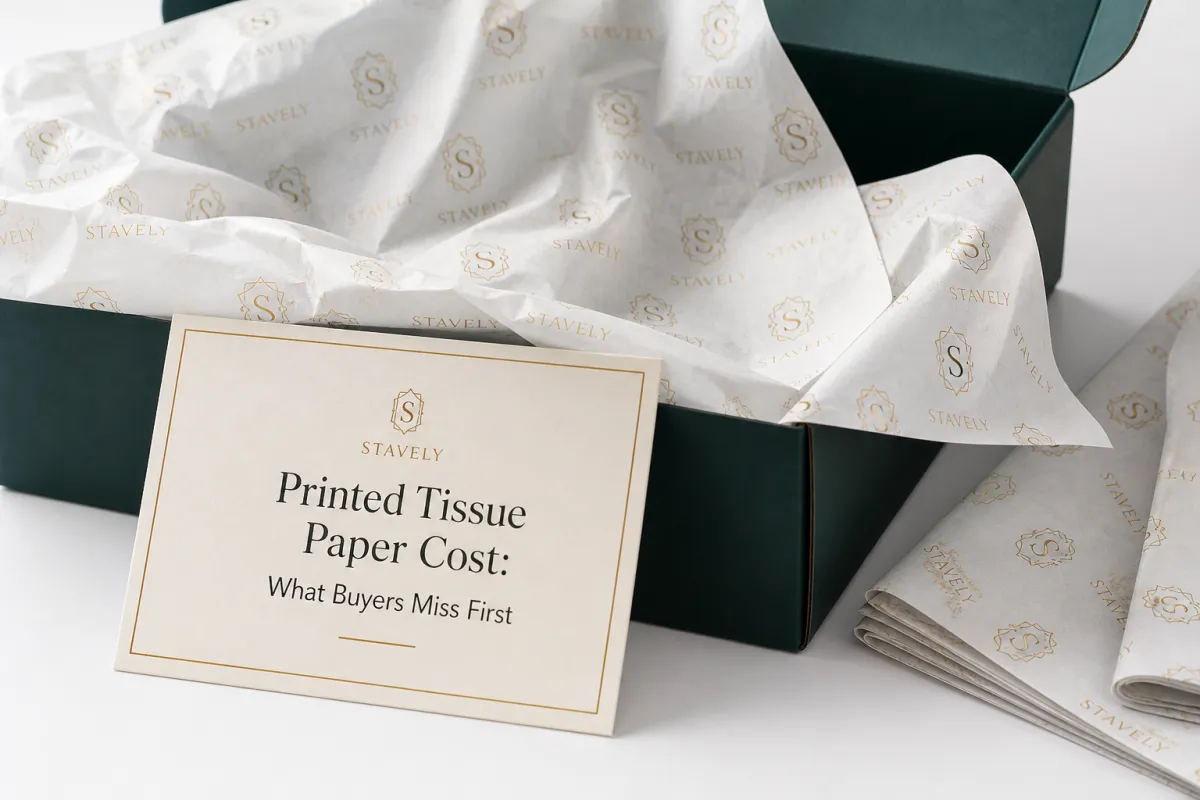
Most buyers begin with a price per sheet. That number is useful, but only if the rest of the quote is speaking the same language. Printed tissue paper cost usually reflects the production path, not just the raw paper moving through the press. A one-color logo repeat on a standard sheet is a different job from a full-coverage custom pattern that asks for tighter registration, more handling, and more proofing. The paper may be inexpensive. The process usually is not.
That is the part people miss first. Printed tissue paper cost often comes down less to the substrate than to everything around it. If a supplier has to prepare plates, review artwork, run test sheets, pack tissue in a custom count, or move to a nonstandard size, each step leaves a mark on the unit cost. Small orders feel that pressure immediately because setup charges are spread across fewer sheets. Larger orders soften the impact, especially when the spec stays simple. The printed tissue paper cost stops looking mysterious once you stop treating it like a single number.
The better question is practical: what is the tissue doing for the brand? If it exists only to fill a box, plain tissue may be enough. If it has to support a boutique unboxing moment, printed tissue paper cost belongs in the packaging budget and the marketing budget. A custom wrap can make a modest product feel finished. That effect often outlasts the tissue itself, which is a strange but useful way to think about paper: the sheet is gone in seconds, but the impression can linger for months.
Another common mistake is comparing printed tissue paper cost without matching the specification. One vendor may quote a 20 x 30 sheet with a modest print area, while another is pricing a smaller sheet, fewer ink colors, or a less demanding repeat pattern. Those quotes are not interchangeable. Ask every supplier for the same dimensions, the same count, the same print coverage, and the same destination. Only then does the printed tissue paper cost tell you something worth acting on.
Think of tissue as part of the packaging system, not as loose filler. It may be thin, yet it is often the first branded surface a customer touches. That means the printed tissue paper cost should be judged against the role the tissue plays in perceived value. A low sheet price can still be expensive if the tissue tears too easily, bleeds color, or lands in the box looking tired. A slightly higher printed tissue paper cost can be the smarter buy if the result is cleaner, more consistent, and easier to pack.
There is also a perception gap that buyers underestimate. A package may arrive in a corrugated carton with all the structural protection in the world, but the tissue is what a shopper sees first when the lid opens. That first layer sets the tone. It is one reason retail teams and ecommerce teams often end up arguing for tissue even when finance would rather skip it. The argument is not about paper. It is about the few seconds when the brand feels either considered or cut-rate.
How Printed Tissue Paper Supports Sustainable Packaging
Printed tissue paper fits neatly into many sustainable packaging programs because it adds visual polish without much weight or bulk. That matters for shipping efficiency, carton fill, and the total material footprint. A lightweight tissue insert can make a package feel complete without bringing in heavier embellishments that drive freight or complicate recovery. For brands trying to keep packaging lean, printed tissue paper cost can be justified by how little mass the material adds compared with the presentation value it creates.
Sustainability is not only recycled content, although that helps. It is also about using the right amount of material in the right place. Printed tissue paper cost often compares well with plastic presentation options because tissue is paper-based, easy to format, and generally aligned with paper recovery systems where accepted. Buyers who want lower-impact packaging often ask for FSC-certified paper or recycled-content options, and that request belongs early in the conversation. You can review paper and paper product guidance from the EPA at epa.gov and forest certification details at fsc.org.
Compared with other inserts, tissue often lands in a useful middle ground. Stickers are compact, but they do not create the same wrap-and-reveal moment. Crinkle fill adds void fill, yet it can look busier and take up more carton space. Poly bags may protect a product well, but they rarely deliver the same soft, branded presentation. When a buyer compares those options honestly, printed tissue paper cost can make sense because the material performs several jobs at once: it brands, cushions visually, and keeps the pack orderly.
That said, printed tissue paper cost is not automatically the lowest-cost sustainable choice. The outcome depends on how the tissue is specified. A large custom sheet with dense artwork and multiple colors may cost more than a simpler insert that still satisfies the brand standard. The trick is to use only what the product and the pack actually need. Buyers often save money by trimming the sheet size slightly, simplifying the repeat, or reducing coverage without weakening the design. Those changes bring printed tissue paper cost down while keeping the package aligned with the sustainability message.
There is a practical warehouse angle too. Tissue that is neatly folded, packed in sensible counts, and printed consistently is easier for staff to use at packing stations. Less waste during handling means the printed tissue paper cost is not being eaten by scrapped sheets or rework. On busy lines, that kind of operational cleanliness matters more than many teams admit. A packaging material does not have to be expensive to be valuable, and it does not have to be cheap to be efficient.
From an operations standpoint, I have watched sustainability claims hold up only when the supply chain is boring in the best possible way: consistent sheets, predictable folds, and a reorderable spec. Fancy language does not save a packer from a wrinkled bundle at 6:45 a.m. Practicality does. That is usually where the real environmental win sits anyway.
Printed Tissue Paper Specifications That Change Cost
Specifications drive the conversation. If you want a useful printed tissue paper cost, you need sheet size, basis weight, print coverage, number of ink colors, and whether the design is a simple repeat or a full-sheet pattern. A 17 x 24 tissue sheet printed with one logo in one corner is a very different job from a 20 x 30 sheet covered edge to edge in several colors. The second version uses more material, more ink, and usually more production attention, which is why printed tissue paper cost rises.
Sheet size matters because bigger sheets use more fiber and often require different handling. A larger format can also change packing efficiency and freight. If the tissue is too large for the product, the brand pays for material no one will ever see. If it is too small, the pack can look cramped or unfinished. The sweet spot is the size that wraps the product cleanly without waste. That is where presentation and printed tissue paper cost usually meet.
Paper weight matters too. Lighter tissue can work for decorative wrapping, but heavier tissue often feels more substantial and resists tearing during packing. The tradeoff is simple: better hand feel and sometimes better durability, but a higher printed tissue paper cost. In some cases, standard tissue weight still delivers an excellent result if the print and folding are handled well. In other cases, heavier tissue makes sense because the product has edges, corners, or surface details that need a tougher wrap.
Artwork complexity Changes the Quote in less obvious ways. A single-color logo repeat is usually easier to manage than a design with tight halftones, multiple spot colors, or dense coverage. A full-bleed look often needs more care to keep the print even across the sheet. That means more prepress review, more proof checking, and sometimes more setup time. Clean vector art and efficient color use usually reduce printed tissue paper cost more than buyers expect.
Packaging format plays a part too. Some tissue is packed in stacks, some in flat folded bundles, and some in counts tailored to the packer's workflow. Custom packing may cost more, but it can reduce handling time on the line. That matters when the order is used every day rather than occasionally. A buyer who only thinks in terms of printed tissue paper cost per sheet can miss the labor savings created by the right bundle format.
The simplest way to read it is this: every additional layer of customization adds some mix of tooling fees, setup charges, or handling time. Those costs do not always show up dramatically, yet they are real. If a supplier is quoting a suspiciously low printed tissue paper cost, check the same size, the same print method, the same packing count, and the same delivery terms before celebrating. The cheapest-looking number can become the most expensive landed cost once the missing pieces appear.
| Order Profile | Typical Spec | Indicative Unit Cost Behavior | Best For |
|---|---|---|---|
| Small branded run | Custom size, 1-2 colors, moderate coverage | Higher printed tissue paper cost per piece because setup is spread across fewer sheets | Launches, sample programs, niche product lines |
| Mid-volume repeat order | Standard sheet size, repeat logo pattern, efficient artwork | Balanced unit cost with better bulk pricing and manageable setup charges | Ongoing replenishment, seasonal packaging, steady ecommerce use |
| Large production run | Standardized sheet, simplified print, packed for line use | Lowest cost per piece when artwork and logistics stay consistent | High-volume fulfillment and multi-location rollout |
| Premium presentation run | Full-coverage design, heavier tissue, more colors | Higher printed tissue paper cost, justified by stronger visual impact | Luxury goods, gifting, high-touch unboxing |
Those are not fixed prices, and they should never be read like a quote. They show the way printed tissue paper cost tends to move when the spec changes. A strong quote should show where the money goes: paper, print, setup, packing, and freight. If a supplier cannot explain that clearly, the buyer does not have enough information to make a sane decision.
I have seen one buyer cut a per-sheet quote by more than 15 percent simply by moving from a dense full-sheet pattern to a lighter repeat that still looked premium in the box. No one on the brand side cared that the design was technically “less ambitious.” Customers cared that it looked sharp. That is the kind of tradeoff procurement should be looking for.
Printed Tissue Paper Cost: Pricing, MOQ, and Volume Breaks
MOQ is one of the biggest levers in printed tissue paper cost. Minimum order quantity exists because presses, setup, prepress checks, and packing work all take time whether the run is 1,000 sheets or 10,000 sheets. Small orders feel that fixed cost more sharply because the base is narrower. As quantity rises, the unit cost usually falls, provided the spec stays stable and the production run stays efficient. That is why printed tissue paper cost often drops quickly once a buyer moves from a trial order to a replenishment order.
For many buyers, the real question is not, “What is the cheapest printed tissue paper cost?” It is, “What order size gives the best balance between cash outlay and unit economics?” A small brand may not want to carry too much inventory, yet ordering too little can make every sheet expensive. A larger program may benefit from bulk pricing by locking in a predictable spec and ordering enough volume to absorb setup charges well. The sweet spot depends on usage, storage space, and how often packaging changes.
Here are the major cost inputs buyers should ask about before comparing quotes:
- Setup charges for artwork review, press preparation, and first-run confirmation.
- Tooling fees when a specific print method or plate preparation is required.
- Ink coverage if the design uses dense prints or multiple colors.
- Packing format if the tissue must be counted, folded, or bundled a certain way.
- Freight to the final destination, which can materially change the landed price.
Those details matter because a quote that looks low on paper can rise fast once shipping and packing are included. A proper printed tissue paper cost analysis should ask for landed cost, not just ex-works or factory price. If a supplier only gives a headline unit rate, the buyer still does not know the final bill. That is especially true for orders moving across regions or to multiple warehouses.
Volume breaks also depend on whether the design is repeatable. If the same artwork will be used across several replenishment cycles, the first order may carry more setup charges, but later orders often become more efficient. That is where printed tissue paper cost can improve without changing the design. Buyers who build a stable packaging spec often save more over a year than buyers who switch suppliers repeatedly just to chase a slightly lower quote.
To put real numbers around the conversation, many buyers will see lower-volume custom tissue land in a broader per-piece band than a large repeat order. A smaller run with more print coverage might sit in the rough range of $0.20-$0.60 per sheet, while a larger, cleaner repeat can move lower depending on size, colors, and shipping. Those numbers are illustrative only, but they show the pattern: printed tissue paper cost is controlled by spec discipline and order size more than by wishful negotiating. When the order grows and the artwork stays efficient, the unit economics usually improve.
One more point that matters in procurement: the best quote is often the one that spells out what will not change. If the supplier confirms sheet dimensions, print colors, packing count, approved artwork, and delivery ZIP before pricing, the buyer is less likely to face surprise changes later. That kind of clarity is worth real money. It keeps the printed tissue paper cost honest from the start and reduces the chance of disputes once the order moves into production.
When buyers ask for multiple quotes, compare them on the same basis: exact size, same print coverage, same MOQ, same packing, and same freight terms. If one supplier looks much cheaper, there is usually a reason. Sometimes it is a simpler spec. Sometimes it is a lighter paper. Sometimes it is an incomplete quote. The only reliable comparison is the one built on identical inputs, because printed tissue paper cost is easy to misunderstand when the input list changes midstream.
There is a quiet financial reality here that gets missed in spreadsheet culture. A company can save a few cents per sheet and still spend more overall if it orders twice as often, stores tissue badly, or pays rush freight because the reorder window was too short. The cheapest unit price is not always the cheapest program. That distinction matters, and it matters a lot.
Production Process and Timeline for Printed Tissue Paper
The production path is simple enough on paper, yet each step contains a place where delays can creep in. It usually starts with artwork intake, then proofing, then print setup, then production, then packing, and finally shipping. If the file arrives clean and the spec is clear, the job can move quickly. If the artwork needs resizing, the repeat pattern is unclear, or color expectations are not settled early, the printed tissue paper cost may stay the same while the schedule stretches. A rushed timeline often costs more than people expect because it leaves little room for correction.
Proofing is the stage most likely to slow a first order. This is where the buyer confirms layout, logo placement, ink colors, and sheet dimensions before the run begins. If a color needs to match a brand standard closely, the proof review matters a great deal. A packaging buyer who signs off carefully saves time later. It is not glamorous work, but it protects the printed tissue paper cost from being inflated by reprints or avoidable delays.
Repeat runs are usually easier. Once artwork is approved and the spec is locked in, the process becomes more predictable. That often improves delivery speed and unit cost, because the production team is not repeating the same checks from scratch. For ongoing packaging programs, that stability is valuable. It helps a buyer forecast inventory and makes the printed tissue paper cost easier to budget across the year.
Timelines vary by job complexity, but a practical planning window is often 12-15 business days from proof approval for production, plus shipping time on top of that. Simpler repeat orders can move faster. Custom sizes, heavy coverage, or more detailed color matching usually take longer. The useful distinction is between production time and transit time. A buyer may hear a short production estimate and assume the order will arrive just as fast, but freight can add several days depending on distance and carrier mode. That distinction affects printed tissue paper cost in a very real way when urgent freight becomes necessary.
Packaging standards matter too when the tissue is part of a regulated or quality-sensitive program. Some brands want color consistency, lot traceability, or tighter incoming inspection. Tissue paper is not a technical material in the same way as electronics packaging or temperature-controlled freight, yet the production process still benefits from basic quality checkpoints. If you are comparing suppliers, ask how they verify the print, the count, and the packing condition before shipment. That kind of discipline may not show up in the unit price, but it changes the true printed tissue paper cost when errors are avoided.
For buyers planning launches, a buffer in the schedule is smart. A first run almost always has more moving parts than a repeat order. Artwork changes, proof revisions, and freight decisions can all affect timing. If the packaging window is tight, a small slip can push the order into a more expensive shipping method. That is why printed tissue paper cost should be planned together with the delivery date, not treated as a separate line item with no consequences.
There is a useful standard to keep in mind when packaging needs more than visual consistency. Organizations such as the International Safe Transit Association help define testing and transit expectations for packaged goods. Tissue itself may be simple, but the broader pack still benefits from a process that respects how products move, ship, and arrive. That mindset usually leads to better specifications and fewer surprises.
In my experience, the projects that go best are not the fanciest ones. They are the ones where everyone agrees on the proof, the sheet count, the packaging method, and the delivery window before a press ever starts. Boring, maybe. But boring is kind of beautiful when the goods are already in motion.
Why Choose Custom Logo Things for Printed Tissue Paper
Custom Logo Things is a practical partner for buyers who want branded packaging that looks polished without turning the purchase into a guessing game. The value sits in the details: clear spec review, direct communication, and guidance that helps you understand what actually raises or lowers printed tissue paper cost before you commit. That matters because the cheapest quote is not always the best one, especially when hidden setup charges or mismatched sizes appear later.
Buyers tend to appreciate straightforward quoting. If your tissue needs a specific sheet size, a certain print coverage, or a fixed delivery destination, the quote should reflect those details plainly. That is how surprises stay out of the order. It is also how you decide whether a slightly higher printed tissue paper cost is justified by better presentation, less handling waste, or fewer production headaches. A packaging partner should make those tradeoffs visible instead of hiding them behind vague language.
Custom Logo Things also helps buyers think through repeatability. A tissue program that works once should be easy to reorder, especially for brands with seasonal packaging or steady replenishment needs. Consistency in size, color, and packing format protects the brand and makes operations smoother. Over time, that stability often matters more than squeezing a tiny reduction in printed tissue paper cost on the first order.
There is a real benefit in knowing where the budget is going. If the job needs a custom layout, a particular fold count, or freight to multiple locations, those items should be visible in the quote. A transparent process gives buyers confidence to approve the order sooner, which can shorten the path from artwork to delivery. That is useful whether the program is a small boutique launch or a larger multi-SKU rollout.
In plain terms, the goal is not just to sell tissue. It is to help buyers choose the spec that makes sense for their products, their pack line, and their budget. That is the most responsible way to handle printed tissue paper cost, and it is also the most practical. Good packaging decisions are rarely about chasing the lowest number alone. They are about matching the material to the job so the result looks right, performs well, and fits the business.
A supplier earns trust by being honest about what a design will do to the price before the order is placed. If a full-coverage print will need extra setup, say so. If a recycled sheet changes the feel, say that too. Buyers do not need cheerleading; they need straight answers. The packaging world has enough smoke in it already.
Next Steps to Lock In Your Printed Tissue Paper Cost
Before requesting a quote, gather the basics: sheet size, quantity, logo files, number of colors, print coverage, packing style, and delivery location. Those details give the supplier a real foundation for pricing and help keep printed tissue paper cost tied to the spec you actually need. If you already know your target budget, share it. That makes it easier to shape the recommendation around the right tradeoffs instead of starting with the wrong assumptions.
It also helps to decide which items are fixed and which are flexible. Maybe the logo color is nonnegotiable, but the sheet size can move. Maybe the quantity has to stay low for inventory reasons, but the print coverage can be simplified. Those decisions have a direct effect on printed tissue paper cost. Buyers who make them early usually get cleaner quotes and fewer revisions.
Ask for a sample, a proof, or a clear spec confirmation before placing the order, especially if it is your first custom run. That small step can prevent expensive mistakes. It also gives you a chance to judge whether the paper feel, print clarity, and folded presentation fit the brand. A quote is useful, but a confirmed spec is better when the printed tissue paper cost has to line up with customer expectations.
If you are comparing multiple vendors, do not let one low headline price dominate the decision. Match the dimensions, the MOQ, the print method, the freight terms, and the packing format first. Then compare. That is the only fair way to see the true printed tissue paper cost. Otherwise you are comparing different products and calling them the same thing.
For many brands, the right tissue order is the one that balances presentation, sustainability, and cash flow without waste. A well-chosen print spec can make a box feel polished, support paper-based packaging goals, and keep the per-piece economics under control. That is the kind of value buyers should look for. If you approach printed tissue paper cost with clear specs and realistic expectations, you will usually end up with a better result and a more predictable budget.
The most useful next move is not to ask for a vague “price list.” It is to define the job tightly enough that every quote can be compared on equal ground. Once that happens, the numbers get a lot less slippery.
What Affects Printed Tissue Paper Cost the Most?
The biggest drivers are quantity, sheet size, print coverage, number of ink colors, and shipping distance. Setup work and proofing matter more on small orders because those costs are spread across fewer sheets. In many cases, a cleaner spec lowers printed tissue paper cost faster than trying to negotiate the unit cost alone.
MOQ and artwork complexity usually sit just behind those first variables. A simple repeat on a standard sheet keeps the job efficient, while full-coverage artwork, custom dimensions, or heavy color matching tend to raise printed tissue paper cost. Landed cost matters too, because freight and packing can change the final number more than buyers expect.
Put differently: the lowest quote is often the one with the fewest moving parts. The more bespoke the job, the more the price starts reflecting labor, setup, and the time needed to get it right. That is not a flaw in the system; it is the system.
FAQ
What affects printed tissue paper cost the most?
The biggest drivers are quantity, sheet size, print coverage, ink count, and shipping distance. On smaller runs, setup and proofing can weigh heavily because they are divided across fewer sheets. A simpler specification usually brings printed tissue paper cost down faster than aggressive price haggling.
How much does custom printed tissue paper cost per order?
There is no dependable flat price without sheet dimensions, quantity, artwork details, and destination. A low-volume job with more coverage usually costs more per sheet than a larger repeat order with a clean layout. For that reason, the most useful printed tissue paper cost is a landed quote that includes production, packing, and delivery.
What MOQ should I expect for printed tissue paper?
MOQ varies by size, print setup, and whether the design is a simple repeat or a more complex custom layout. Lower quantities may be possible, but the unit price is usually higher because setup is spread across fewer sheets. Ask for MOQ tied to your exact spec so you can compare printed tissue paper cost fairly.
How do I get an accurate printed tissue paper quote?
Provide sheet dimensions, quantity, artwork files, ink colors, print coverage, packing style, and the delivery ZIP code. If you know the brand target or the budget ceiling, include that too. The more specific the inputs, the more useful the printed tissue paper cost will be.
Can sustainable printed tissue paper still be affordable?
Yes, if the sheet size is sensible, the artwork is efficient, and the order volume is high enough to spread setup costs well. Paper-based packaging can stay cost-conscious while still improving presentation and reducing plastic use. The best value usually comes from matching the material to the job, which keeps printed tissue paper cost under control.
Printed tissue paper cost is easiest to manage when the spec is clear, the volume is realistic, and the shipping terms are part of the conversation from the start. If you line up those details Before You Buy, you will usually get a better quote, fewer surprises, and a tissue program that supports the brand instead of straining the budget. The actionable takeaway is simple: lock the sheet size, print coverage, quantity, and delivery terms before you compare vendors. That is the fastest way to get a printed tissue paper cost that actually means something.