Buyer Fit Snapshot
| Best fit | compare bagasse and molded pulp uses costs tradeoffs for packaging buyers comparing material specs, print proof, MOQ, unit cost, freight, and repeat-order risk where brand print, material, artwork control, and repeat-order consistency matter. |
|---|---|
| Quote inputs | Share finished size, material target, print colors, finish, packing count, annual reorder estimate, and delivery region. |
| Proofing check | Approve dieline scale, logo placement, barcode or warning zones, color tolerance, and any recyclable or compostable wording before bulk production. |
| Main risk | Vague material claims, crowded artwork, or missing packing details can create delays even when the unit price looks attractive. |
Fast answer: Compare Bagasse and Molded Pulp Uses Costs Tradeoffs: Cost, MOQ, Proof, and Reorder Checks should be specified like a repeatable production item. The safest quote includes material, print method, finish, artwork proof, carton packing, and reorder notes in one written spec.
What to confirm before approving the packaging proof
Check the product dimensions against the actual filled item, not only the sales mockup. Ask for tolerance on folds, seals, hang holes, label areas, and retail display edges. If the package carries a logo, QR code, warning copy, or legal claim, reserve that space before decorative graphics fill the panel.
How to compare quotes without losing quality
Compare board or film grade, print process, finish, sampling route, tooling charges, carton quantity, and freight assumptions side by side. A lower quote is only useful if the supplier can repeat the same color, closure quality, and packing count on the next order.
To compare bagasse and molded pulp properly, you have to look past the fiber label and check how each material behaves in real packout. On paper, both are plant-based, both can replace plastic in the right setup, and both sound sensible in a sales deck. In practice, they are not interchangeable. Bagasse usually gives you a smoother, more food-facing finish. Molded pulp usually gives you better structure, better restraint, and a cleaner answer for protective packaging.
I have watched buyers choose one of these materials because the sample felt good in the hand, then get blindsided by grease, steam, stacking pressure, or transit vibration. That is why I prefer to compare bagasse and molded pulp by use case first, not by buzzwords. If the job is hot carryout, bagasse often makes more sense. If the job is an insert, tray, or shipping protector, molded pulp usually earns its keep faster. The right call depends on what the package has to survive after it leaves the mold, the carton, and the printer.
For custom branded packaging, the real question is simple: what performs best for the customer’s product, price point, and lead time without creating avoidable failures on the line or in the field? Below, I compare bagasse and molded pulp from the angles buyers actually live with: touch, fit, finish, Pricing, Lead Times, and the tradeoffs that tend to hide until the goods show up.
Quick Answer: Compare Bagasse and Molded Pulp
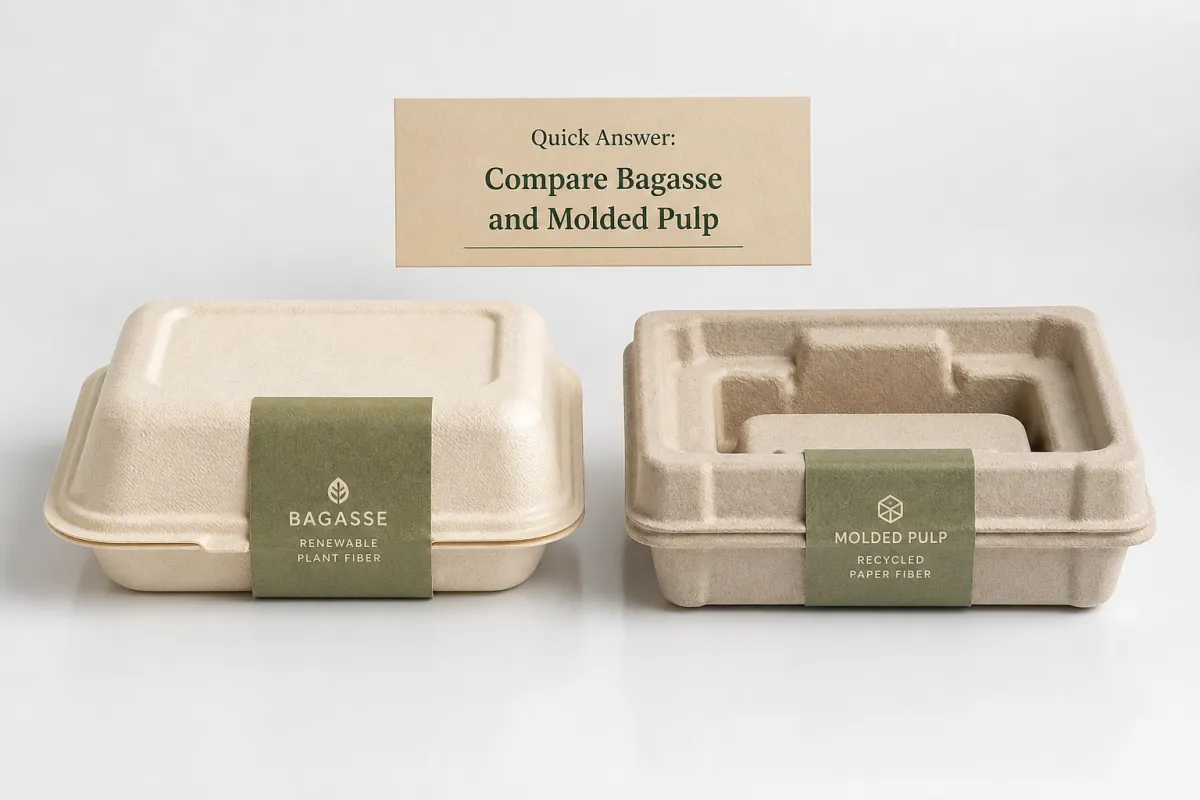
If you compare bagasse and molded pulp in one sentence, bagasse is usually the better choice for direct food contact and a cleaner consumer-facing look, while molded pulp is usually the better choice for structure, cushioning, and lower-cost protective formats. Short version: one is built to be seen, the other is built to protect.
Bagasse comes from sugarcane fiber left after juice extraction. It is formed into plates, clamshells, bowls, trays, and compartment containers. The appeal is easy to understand. It feels more finished than raw fiber, it handles hot food well, and it usually looks more intentional on a table or delivery shelf. When people compare bagasse and molded pulp for takeout or catering, bagasse often wins because the customer sees it directly.
Molded pulp is a formed-fiber packaging family used for egg cartons, custom inserts, end caps, fruit trays, bottle shippers, and internal supports for retail or e-commerce packaging. It can be made from recycled fiber or virgin fiber, depending on the spec. Its value is not polish. Its value is shape control. It cradles a product, resists movement, and turns loose items into a more stable shipment.
That difference sounds small until you pack actual product. A food tray needs to resist grease, hold its shape under steam, and still feel decent in the customer’s hands. A protective insert needs to survive compression, nesting, and transit shock without letting the product rattle around. If you compare bagasse and molded pulp without asking which of those jobs matters most, you can make an expensive mistake.
Practical rule: if the consumer eats from it, bagasse is often the first sample I request; if the package protects something fragile, molded pulp usually gets the first look. Compare bagasse and molded pulp only after you define the job.
For a buyer, that means the “best” material is not the greener one in a marketing claim or the cheaper one on the first quote. It is the one that passes the actual use test. Hot food, cold carryout, nested stacking, storage footprint, and delivery vibration all matter. That is why I compare bagasse and molded pulp with the same discipline I would use on any packaging line: function first, then price, then presentation.
In the sections that follow, I will compare bagasse and molded pulp across formats, performance, cost, timing, and selection criteria so you can make a clean decision instead of a hopeful one.
Compare Bagasse and Molded Pulp: Top Options at a Glance
When you compare bagasse and molded pulp by format, the material difference gets clearer than the marketing copy. Bagasse is usually selected for visible food packaging, while molded pulp is usually selected for contained, protected, or nested product support. Shape matters just as much as fiber source.
Bagasse is commonly formed into plates, bowls, clamshells, lidded containers, compartment trays, and serving platters. In a food-service setting, it has to do more than merely hold food. It has to look decent under bright lights, sit flat on a counter, and tolerate moisture without turning limp. That is why many buyers compare bagasse and molded pulp and then circle back to bagasse for presentation-focused applications.
Molded pulp is commonly used for egg packs, produce trays, bottle holders, electronics inserts, end caps, and shipping cushions. In those roles, it does not need to impress a diner. It needs to stop movement, absorb impact, and keep parts separated. The best molded pulp pieces feel quiet and functional. Good ones disappear into the experience because they do their job without asking for applause.
The hand feel is different too. Bagasse is usually smoother, denser, and more uniform at the surface, though quality still varies by mold and finishing pressure. Molded pulp has a more open, fibrous texture and may show more visible fiber pattern. That is not a defect by itself. For protective packaging, it is often exactly what you want. For a front-of-house meal presentation, it can look too raw unless the brand is intentionally going for that style.
Here is a simple comparison that helps buyers compare bagasse and molded pulp without getting lost in spec-sheet language:
| Factor | Bagasse | Molded Pulp |
|---|---|---|
| Typical use | Food trays, bowls, clamshells, plates, takeout containers | Inserts, trays, cartons, end caps, shipping protection |
| Surface look | Smoother, more consumer-facing | More fibrous, utilitarian |
| Best strength profile | Rigid enough for food service and stacking | Better for cushioning and product restraint |
| Moisture handling | Usually better for wet or greasy foods | Usually weaker around sustained moisture |
| Brand perception | Cleaner, more polished for visible meals | Practical, functional, protective |
| Typical cost pattern | Can be higher for refined food-service shapes | Can be lower for simple protective forms |
There is one mistake I see often enough to call out plainly: people compare bagasse and molded pulp as if both can do any fiber job equally well. They cannot. A molded pulp tray might be perfect for a beverage kit, but it can look and behave wrong for an upscale lunch program. A bagasse clamshell may feel great for hot food, but it will not replace a molded pulp shipper that needs to keep glass bottles from bouncing in transit.
For more on the broader fiber and paper packaging landscape, the Paper and Packaging Board is a good place to see how fiber-based materials fit into modern packaging choices, while ISTA remains a practical reference if your package needs to survive shipping tests rather than just shelf display.
So, if you compare bagasse and molded pulp at the shortlist stage, the first question should be simple: does the package touch food directly, or does it mainly protect a product in transit? That one question usually cuts the list in half.
Detailed Reviews: Strength, Finish, and Real-World Performance
To compare bagasse and molded pulp honestly, you have to go beyond the sample table and imagine how the package behaves after ten minutes of use, not just in the first ten seconds. That is where the differences start to matter. Bagasse usually has the advantage in surface finish and food presentation, while molded pulp usually has the advantage in structural function and product restraint.
Bagasse in use tends to hold up well under hot food, especially when the shape is designed with enough wall thickness and ribbing. It does not act like coated paperboard, which can soften quickly under steam. Still, it is not magic. A very saucy entrée, a long hot-hold window, or a heavy oily load can expose weak design fast. I have seen bagasse clamshells do a good job with rice bowls, noodles, and mixed plates, and I have also seen thin designs bow under poor stacking or weak lid geometry. Compare bagasse and molded pulp, and you will usually notice bagasse feels more refined, but that polish does not automatically make it stronger in every direction.
Molded pulp in use is less about elegance and more about geometry. A good insert grips corners, keeps clearance, and manages vibration. The best units feel dull in the hand because they are doing a serious job. Where molded pulp sometimes struggles is consistency at the edges and in moisture-heavy environments. It can be perfectly suitable for dry or semi-dry products, but direct wet food is usually not its strongest lane unless the design has been engineered and validated for that purpose. That is why I compare bagasse and molded pulp with actual content in mind, not just a generic category name.
Finish is another place where the two materials part ways. Bagasse often presents a smoother face, with a more deliberate appearance under retail lighting or front-of-house service. Molded pulp usually shows more fiber texture and a more matte, utilitarian finish. That is not a problem for protective packaging. In fact, many buyers want molded pulp to look like packaging, not like dinnerware. But if the product is something a customer will touch and inspect up close, the finish can affect perceived quality more than people expect.
Another real-world detail is nesting and stack behavior. Bagasse items may nest tightly, which is helpful for storage, but overly tight nesting can create separation issues or slow down the line if operators have to pry pieces apart. Molded pulp can stack efficiently too, but the tolerances may vary more by mold and drying control. If you compare bagasse and molded pulp for a high-volume packing line, I would ask how the unit separates from the nest and whether operators can grab it one-handed without distortion.
Food safety and odor deserve a close look as well. Neither material should carry a strong unwanted smell, and both should be tested for your specific product load. Grease resistance, heat resistance, and migration claims all depend on the actual construction and the supplier’s documentation. If you need a claim set, ask for the right compliance paperwork rather than assuming the fiber source tells the whole story. For shipping-related designs, look at ASTM D4169 or an ISTA protocol that matches your distribution environment.
Sustainability claims need a clear, unsentimental view. Fiber-based materials are attractive because they can reduce plastic content, but the most responsible package is the one that gets used successfully with the least wasted material. Overspecifying a heavy bagasse container for a dry snack, or using a complex molded pulp structure where a simpler design would work, can add cost and mass without adding much value. I always compare bagasse and molded pulp through that lens: enough performance, no excess.
I have spent enough time around packaging lines to know the ugly truth. A nice-looking sample can still fail once the operators start moving fast and the cartons start disappearing. That is why I care more about fit, nesting, and damage rate than about a shiny first impression. Fancy does not pay the freight bill.
Honestly, the biggest packaging mistake I see is choosing a material for its story and not for its failure mode. Compare bagasse and molded pulp by what happens in heat, compression, moisture, and handling, or the real test will find you later.
Price Comparison: What Bagasse and Molded Pulp Really Cost
Price is where buyers often oversimplify the decision. A unit quote tells only part of the story. To compare bagasse and molded pulp properly, you need to look at tooling, freight, nesting efficiency, box counts, storage, and the cost of failure. The cheapest quote on paper can turn into the most expensive option if it damages products, slows packing, or forces extra labor onto the line.
For standard food-service items, bagasse pricing is often tied to shape, finish, wall thickness, and whether the item is a stock or custom form. In volume, a basic bagasse plate or simple compartment tray may land in a relatively modest range, while a more refined clamshell or lidded container can move higher because the mold is doing more work and the finish expectations are tighter. As a rough planning range, many buyers see bagasse pieces from about $0.08 to $0.28 per unit depending on size, spec, and order volume, with custom or premium formats rising above that.
Molded pulp is often more cost-effective in simple protective shapes, especially when the geometry is straightforward and the production run is long enough to absorb setup efficiently. A basic tray, corner protector, or insert can often price well, particularly when recycled fiber is acceptable and the mold design is not highly intricate. In planning terms, molded pulp pieces may range from about $0.04 to $0.20 per unit for many common protective forms, though custom structures can run higher if the detail is complex.
Those ranges are not promises. They are working numbers for budgeting. The real figure depends on order quantity, tooling ownership, freight class, nesting ratio, and whether the supplier is quoting ex-works, FOB, or landed pricing. If you compare bagasse and molded pulp without asking about freight, you may miss the biggest hidden cost. Fiber packaging is bulky. A product that looks cheap per piece can occupy more carton space than expected, and that changes the delivered number fast.
Tooling matters too. Standard bagasse items may need little or no new tooling if the shape already exists in production. Custom Molded Pulp usually needs a mold, sample tuning, and sometimes a second round of adjustments if the first pull shows uneven walls or poor fit. That does not make molded pulp bad value. It just means the upfront path is different. If you are launching a custom tray, ask about tool ownership, tool life, and whether the mold cost is amortized or separate.
Here is a practical pricing checklist I use when I compare bagasse and molded pulp bids:
- Ask for landed cost, not just factory unit price.
- Confirm whether the quote includes tooling, samples, and revisions.
- Check carton count per pallet and how much warehouse space the item will take.
- Compare reject risk if the part is hard to nest, separate, or pack.
- Ask what happens if you need print, embossing, or tighter tolerances.
There is also labor cost, which people forget. If one material is slightly cheaper per piece but creates line stoppage, extra hand-stacking, or frequent quality checks, the savings shrink quickly. I have seen a buyer compare bagasse and molded pulp on unit price alone, choose the lower number, and then spend more in labor because the packaging did not feed the line cleanly. That is not a theoretical risk. It is a common one.
If you want a clean decision, compare bagasse and molded pulp on total cost of ownership: unit price, freight, storage, failure rate, and the time people spend handling the package. That is the number that matters to procurement and operations alike.
Process and Timeline: From Fiber to Finished Packaging
Understanding the production path helps a lot when you compare bagasse and molded pulp. Lead time is not just a calendar issue; it reflects how much shaping, drying, trimming, and tuning the product needs before it can ship consistently. Buyers who know the manufacturing flow usually plan better and ask sharper questions.
Bagasse packaging starts with fiber preparation, pulping, forming, pressing, drying, and finishing. Depending on the item, there may be a hot-press stage that improves surface quality and rigidity. A standard stock item can move relatively quickly once the spec is approved because the mold and process already exist. Custom shapes take longer, but the path is usually clearer if the item resembles an existing form.
Molded pulp follows a similar broad sequence but can vary more in the details. The fiber slurry is formed over a mold, drained, transferred, dried, trimmed, and sometimes further pressed for tighter tolerance. If the item is custom, mold development becomes a real part of the timeline. That is why I compare bagasse and molded pulp not just by unit cost but by how much production setup the project is asking for. More setup usually means more time.
For stock bagasse items, a reasonable schedule after sample approval may be measured in weeks rather than months, depending on inventory status and shipping method. Custom molded pulp often needs a longer runway because the tool must be built, samples must be reviewed, and the geometry may need fine-tuning. For some projects, one sample round is enough. For others, especially where the product is fragile or the fit must be exact, a second round is the normal part of the process.
Moisture control is one of the hidden variables. Fiber products are sensitive to drying consistency, and the same mold can produce slightly different results if the forming or drying conditions drift. That matters for nesting, wall thickness, and dimensional stability. If you compare bagasse and molded pulp for a tight-fitting application, ask about acceptable tolerances and how the supplier controls consistency across the run.
Lead time also changes with shipping method. Bulky fiber packaging can be economical by sea when the forecast is stable, but if a launch date is fixed, air or expedited freight can erase the cost advantage quickly. I always tell buyers to build a schedule that includes sample review, revision time, production, quality check, and freight, because a packaging launch usually fails on timing before it fails on concept.
Here is the way I would structure a realistic timeline:
- Spec review: confirm size, wall thickness, food-contact or protection requirement, and finish expectation.
- Sample phase: test fit, stack, closure, moisture, and handling with real product.
- Revision window: adjust mold details or spec language if the first sample misses the target.
- Production slot: lock the order once the approved sample matches the job.
- Freight and receiving: plan cartons, pallet count, warehouse space, and QC on arrival.
If you compare bagasse and molded pulp for a seasonal launch, add buffer time. Promotions, holiday volume, and retail commitments have a habit of making a normal lead time feel short. A package that looks ready in June can become late in November because everyone else in the supply chain is moving at the same time.
One more practical point: ask for photos or dimensional reports from prior production if the supplier has them. That is not a substitute for samples, but it can reveal whether the process is stable. Good suppliers are usually willing to talk plainly about tolerance, tooling, and the likely sample path. That is the kind of conversation that saves time later.
How to Choose: Match the Material to the Job
The easiest way to compare bagasse and molded pulp is to start with the use case and work backward. Do not begin with the fiber story. Begin with the product, the customer, and the failure you cannot afford. A greasy meal, a fragile bottle, a retail gift set, and a shipping insert do not need the same packaging logic.
Choose bagasse if the package touches food directly, the customer will see it, and presentation matters as much as function. It is a strong candidate for hot meals, lunch combos, catering trays, deli service, and carryout where the container is part of the perceived product quality. If the food has steam, moderate grease, and repeated handling, bagasse often gives a better balance of look and performance. That is why many buyers compare bagasse and molded pulp and still land on bagasse for visible foodservice.
Choose molded pulp if the package’s main job is to protect, separate, or support. That includes inserts around electronics, bottle shippers, inner trays for product kits, and cushioning for items that cannot move much in transit. When a package needs to fit tightly around corners or divide a set into clear compartments, molded pulp is often the better answer. Compare bagasse and molded pulp in those situations and molded pulp usually wins on utility, not appearance.
Here are the questions I would ask before I place an order:
- What temperature range will the package actually see?
- Will it touch wet food, grease, condensation, or sauce?
- Does the item need to hold shape under stacking pressure?
- Is the package meant for display, delivery, or transit protection?
- Do we need a compostability or recycled-content claim that can be documented?
- What happens if the product sits for 20 minutes before use?
- How will the pack perform in a drop test, vibration test, or handling test?
A small test plan goes a long way. I like a fill test, a heat hold, a moisture exposure check, a stack test, and a customer handling review. For shipping formats, I would add an ISTA-style drop sequence or an ASTM D4169-based distribution review. For food formats, test the actual meal, the actual sauce load, and the actual service temperature. Guessing is expensive. Real testing is cheaper than a recall, refund, or rejected shipment.
It also helps to be honest about the brand goal. If the packaging must feel polished and customer-ready, bagasse usually reads better. If the packaging must disappear into a protective system, molded pulp usually does the job with less fuss. I compare bagasse and molded pulp with that simple lens because it keeps the decision grounded in function.
If you still have two or three viable options after testing, compare bagasse and molded pulp again using the same product, the same packout, and the same handling condition. A fair comparison only works when the test conditions are matched. Anything less turns into a guessing game dressed up as procurement.
Our Recommendation: Next Steps Before You Place an Order
My recommendation is straightforward. Use bagasse for food-facing packaging where the customer sees and handles the item directly, and use molded pulp for protective packaging where the real requirement is restraint, cushioning, or separation. That does not mean one is universally better. It means each material has a lane, and the better buyer respects the lane before comparing bagasse and molded pulp on price.
If you are stuck between them, request samples at the same spec level and test them with the actual product. Do not compare a premium bagasse clamshell to a lightweight molded pulp tray and call that a fair match. Compare bagasse and molded pulp by the same size, same loading condition, same temperature, and same handling expectation. That is the only way the result means anything useful.
Before you issue a purchase order, confirm four practical details: mold status, minimum order quantity, lead time, and freight assumption. If the item is custom, ask whether the tooling cost is separate and whether the supplier owns the mold or transfers it. If the item is standard, ask how often it is stocked and whether the quoted price assumes ongoing production or just current availability. Those are ordinary questions, but they prevent ugly surprises.
I would also ask for a short line test if the package will be filled or assembled at speed. A part that looks perfect on a desk can behave differently at the line. Nesting, pick-and-place ease, and stack stability all matter. If the operators have to fight the packaging, you will feel it in labor and consistency long before the product reaches the customer.
For teams working with custom branded packaging, the cleanest path is usually to compare bagasse and molded pulp against the job, not against each other as abstractions. What is the package holding? How long does it sit? What temperature does it see? How much presentation does the customer expect? If those answers point to food contact and visual appeal, bagasse is often the better fit. If they point to protection and dimensional restraint, molded pulp usually makes more sense.
The last thing I would say is this: compare bagasse and molded pulp with a little skepticism and a lot of field reality. Fiber packaging can be excellent, but only if the design matches the use. A good decision here saves money, reduces waste, and makes the final packout feel far more intentional. That part is not glamorous. It is just the difference between a package that works and one that sort of works until Tuesday.
Compare bagasse and molded pulp by the work they must do, not by the marketing words attached to them. If you keep that rule, the choice becomes clearer, the quote review gets faster, and the finished packaging is far more likely to perform the way you need it to perform.
FAQ
When should I compare bagasse and molded pulp for food packaging?
Compare them when the package must touch food directly and also survive heat, moisture, grease, and stacking pressure. Bagasse is usually the stronger starting point for visible foodservice packaging, while molded pulp is usually better for protective inserts around food-related kits or delivery items. Test the exact meal, sauce load, and temperature before choosing.
Is bagasse stronger than molded pulp?
Not in every way. Bagasse often feels stiffer and smoother for trays and clamshells, but molded pulp can be structurally better for cushioning and product restraint. Strength depends on wall thickness, forming quality, and the job the package has to do. For shipping protection, molded pulp often performs better; for food presentation, bagasse usually feels more refined.
Which is usually cheaper, bagasse or molded pulp?
Molded pulp is often cheaper in simple protective formats because it is built for efficient structure and transport. Bagasse can cost more when the finish is cleaner, the shape is more refined, or the item is meant for direct food service. Always compare landed cost, not just the unit price, because freight and failure rates change the real number fast.
How long does it take to move from samples to production?
Stock bagasse items can move quickly once the spec is approved, while custom molded pulp often takes longer because tooling and sample tuning may be required. A realistic schedule should include sample review, fit testing, revisions, and freight planning. Build in extra time if the packaging will be used for a launch date, seasonal menu, or retail shipment.
Can I use molded pulp instead of bagasse for takeout containers?
Sometimes, but only if the molded pulp design is made for food contact and can handle the moisture, heat, and presentation needs of the meal. Many molded pulp products are better suited to inserts, trays, and protective packaging than to direct-service takeout. If the customer will see and handle it like a food container, test bagasse first.