Buyer Fit Snapshot
| Best fit | Custom Molded Pulp Inserts Supplier projects where brand print, material claims, artwork control, MOQ, and repeat-order consistency need to be specified before quoting. |
|---|---|
| Quote inputs | Share finished size, material target, print colors, finish, packing count, annual reorder estimate, ship-to region, and any compliance wording. |
| Proofing check | Approve dieline scale, logo placement, barcode or warning zones, color tolerance, closure strength, and carton packing before bulk production. |
| Main risk | Vague material claims, crowded artwork, missing packing details, or unclear freight terms can make a low unit price expensive after revisions. |
Fast answer: Custom Molded Pulp Inserts Supplier: Material, Print, Proofing, and Reorder Risk should be specified like a repeatable production item. The safest quote records material, print method, finish, artwork proof, packing count, and reorder notes in one written spec.
Production checks before approval
Compare the actual filled-product size with the drawing, then confirm tolerance on folds, seals, hang holes, label areas, and retail display edges. Reserve space for logos, QR codes, warning copy, and material claims before decorative graphics fill the panel.
Quote comparison points
Review material grade, print process, finish, sampling route, tooling charges, carton quantity, and freight assumptions side by side. A quote is only useful when the supplier can repeat the same color, closure quality, and packing count on the next order.
Custom Molded Pulp Inserts Supplier: How to Choose Well
A product can look perfect on a desk and still arrive mangled. Scuffed corners. Cracked shoulders. A box that rattles like a cheap toy. The carton did not betray you. The product had room to move, and movement is where damage starts. A custom Molded Pulp Inserts supplier closes that gap by shaping the insert around the product, the outer carton, and the trip it actually has to survive. For brands working on product packaging, retail packaging, or branded packaging, that difference shows up in fewer claims, faster pack-out, and fewer frustrated customer emails. It also keeps custom printed boxes and the insert working as one system instead of two pieces pretending to be a system.
A custom Molded Pulp Inserts supplier turns recovered fiber and water into a formed protective part that holds a product in place. Simple sentence. Complicated job. Draft angles matter. Moisture control matters. Tooling matters. So does how the part releases from the mold without tearing a weak edge or distorting a cavity. That is where packaging design gets real. The right supplier does not hand you a tray that merely resembles your product. They build fit around weight, fragility, ship method, and line speed, then prove it with samples and test packs. If you already have a carton program and just need a better insert, a quick look at Custom Packaging Products helps frame the conversation before you lock dimensions.
Picking a supplier is less about buying a material and more about finding someone who understands what packaging has to do in transit. A custom molded pulp inserts supplier should be able to explain why a lens face needs softer support than a corner rib, why a bottle shoulder needs a different pocket depth than an electronics shell, and why a subscription kit may need two retention points instead of one giant cavity. That kind of guidance saves time. It also keeps the project tied to the actual job the insert has to do. No drama. Just packaging doing its job.
What a custom molded pulp inserts supplier does
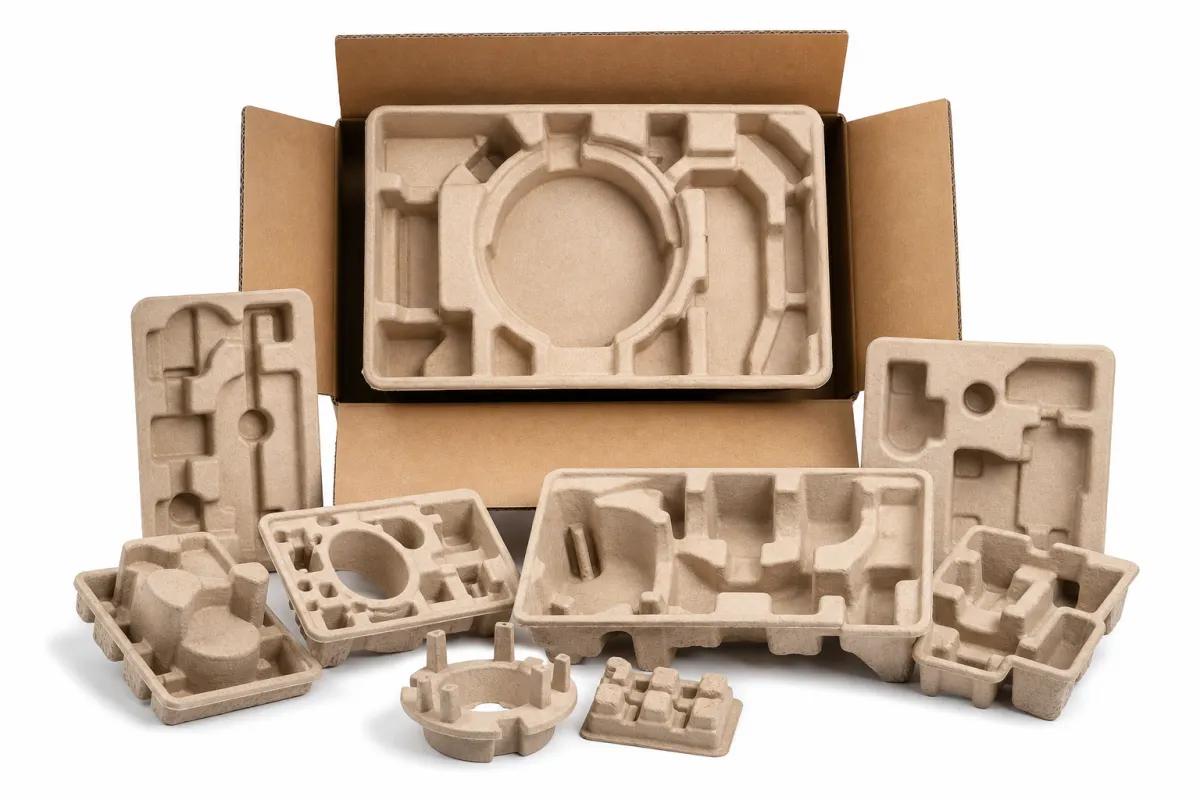
A custom molded pulp inserts supplier builds packaging around movement control. Plain idea. Big consequences. The carton can survive a drop and still fail if the product inside shifts, rubs, or loads pressure onto a fragile edge. In a lot of damage claims I have looked at, the weak point is not the corrugated box. It is the dead space around the product. A custom molded pulp inserts supplier solves that by creating a shaped cradle that matches the product's geometry, its center of gravity, and the way workers will pack it on a line. The result is not just padding. It is packaging design that supports the whole shipping system.
Molded pulp inserts are formed fiber pieces, usually made from recovered paper fiber mixed with water and shaped in a mold. Once dried and trimmed, they become trays, end caps, corner supports, or full protective shells. A custom molded pulp inserts supplier can adjust wall thickness, pocket depth, ribs, and edge geometry so the insert grips the product where it needs support and leaves room where it does not. That is very different from generic cushioning. Loose-fill, folded paper, and off-the-shelf dunnage can absorb impact, but they rarely hold a product in the exact position needed for repeatable results.
Some products are just needy. Electronics need edge control and room for cords or accessories. Cosmetics want a clean presentation and a stable bottle shoulder. Glass needs real immobilization, not a polite landing spot. Tools can be heavy enough that the insert has to resist crush. Subscription kits need speed and repeatability at pack-out. A custom molded pulp inserts supplier can tailor all of that. The insert may never be seen by the end customer until the box opens, yet it still shapes package branding, unboxing quality, and how intentional the contents feel next to custom printed boxes.
A strong insert does not beg for attention. It keeps the product where it belongs, even after a rough sort, a long line haul, or a warehouse stack that was heavier than anyone wanted.
A custom molded pulp inserts supplier is not just a material vendor. They are part of the packaging development process, and their work touches damage performance, labor efficiency, and sustainability claims. Brands trying to reduce plastic or move toward fiber-based packaging need honest talk about tradeoffs. Fiber-based protection can be a solid fit, but only if the design suits the product and the shipping environment. Get the fit wrong and the material choice will not save the pack. I have seen beautiful sustainability decks fall apart the second the sample box got dropped from shoulder height. Reality is rude like that.
Here is the quick test I use: does the insert control motion, protect the weak points, and still let the packer close the carton without fighting the part? If yes, the custom molded pulp inserts supplier did real work. If no, the insert is probably too generic, too tight, or too dependent on luck. That kind of fit issue shows up fastest with asymmetrical shapes, printed surfaces that scratch easily, and kits that ship in mixed orientations.
How a custom molded pulp inserts supplier turns fiber into fit
The forming process looks simple on paper. A custom molded pulp inserts supplier starts with recovered fiber, water, and a forming tool. The slurry gets pulled onto the mold, vacuum helps define the shape, and the wet part dries until it holds form. After that, trimming, edge finishing, and quality checks turn it into a usable insert. Clean description. Messier reality. Temperature control, mold surface behavior, drying time, and the part's geometry all affect the result. If those variables drift, dimensional consistency drifts with them, and fit gets harder to trust.
There are a few molded fiber styles worth knowing. Thick-wall molded pulp tends to be more cushion-oriented, with more bulk and a slightly rougher surface. Transfer molded parts are common for many protective applications and can balance strength with efficient material use. Thermoformed pulp usually delivers tighter tolerances and a smoother surface because heat is part of the final shaping stage. A custom molded pulp inserts supplier should explain which method suits the job instead of defaulting to the cheapest option. The method changes wall thickness, surface finish, stacking efficiency, and how the part behaves under load.
What mold design changes
Mold design is where packaging design turns physical. Draft angles decide whether the part releases cleanly or tears at the edge. Wall thickness affects stiffness and compression behavior. Corner radii affect how well the insert resists cracking during handling. A custom molded pulp inserts supplier that understands tool design will think through those points before sampling begins. They will also look at how the product loads into the cavity. If a part needs a deep recess but the geometry is too vertical, release gets ugly and scrap rises. If the cavity is too open, fit gets sloppy and retention suffers.
Quality checks should go beyond a quick look. A serious custom molded pulp inserts supplier checks dimensional consistency from sample to sample, edge cleanliness, moisture content after drying, and how the insert contacts the product's fragile points. I also want to know whether the insert nests cleanly for shipping, because stackability matters once you move from sample quantities to production pallets. If the parts are hard to count, hard to stack, or prone to sticking together, the production line pays for it later.
For validation, many teams use parcel or transit methods tied to ISTA distribution testing standards. That matters because a fit that looks fine on a warehouse table can still fail after vibration, repeated drops, or compression in a stacked load. The insert should be tested in the full pack configuration, not as a standalone part sitting under fluorescent lights. A custom molded pulp inserts supplier that works this way will usually ask for the carton, the closure method, and the ship profile before quoting anything.
Timing matters too. If tooling needs to be built from scratch, the schedule may include concept review, prototype tooling, first samples, a revision loop, final approval, and pilot production. A custom molded pulp inserts supplier that gives a realistic timeline will not promise magic. For straightforward projects, sample parts may appear in 7-14 business days after proof approval. More complex tooling changes can stretch longer. Production lead times often land in the 3-6 week range after signoff, depending on factory load and part complexity. Not slow. Just normal for a custom packaging process that has to fit properly.
Material claims deserve real documentation, not a shiny marketing line. Fiber recovery, recycled content, and end-of-life assumptions all matter. The EPA recycling guidance is a useful reference point, especially if your team is comparing molded fiber against foam or mixed-material inserts. A custom molded pulp inserts supplier should be able to talk clearly about material source, trim waste, and whether the product fits your recycling or composting assumptions in the markets where you ship. If they hand-wave that part, be skeptical.
Choosing a custom molded pulp inserts supplier: cost and pricing
Price is never just price with molded pulp. A custom molded pulp inserts supplier is quoting tooling, part complexity, fiber usage, production speed, and the labor needed to trim or assemble the insert. Deep cavities cost more. Thick walls cost more. Precise corner support costs more. If the artwork or branding needs a cleaner exterior surface, that can affect the tooling style too. The more complicated the insert, the more the cost reflects design work instead of raw material alone.
Tooling is usually the first line item that surprises buyers. A low-volume project may need custom tooling that looks expensive at the start, even if the per-unit price later seems attractive. A design that looks inexpensive per unit can turn costly if it needs extra assembly, awkward release geometry, or high scrap during production. A custom molded pulp inserts supplier should help separate startup cost from ongoing unit cost. That matters because a launch order of 2,000 pieces and a steady program of 50,000 pieces do not behave the same way in pricing.
When I compare quotes, I ask four things: Does the price include tooling? Does it include sample runs? What are the quality acceptance limits? Does it cover freight or pack-out requirements? A custom molded pulp inserts supplier that gives a clean, complete quote is easier to work with than one that hides setup costs in later revisions. If you are comparing molded fiber to foam or corrugated alternatives, compare the whole pack, not just the insert. Material price alone rarely tells the full story.
| Program type | Typical volume | Tooling expectation | Typical unit range | Best fit |
|---|---|---|---|---|
| Prototype or pilot | 500-2,500 units | Lower-cost or temporary tooling | $0.45-$1.20 | Fit testing, launch checks, short runs |
| Mid-volume production | 5,000-25,000 units | Custom production tooling | $0.18-$0.55 | Regular shipments, seasonal programs |
| High-volume steady supply | 50,000+ units | Multi-cavity, efficiency-focused tooling | $0.10-$0.32 | Established products, repeat SKUs |
Those numbers are directional only. Part depth, trim complexity, fiber grade, and shipping location all move the final price. They still help buyers have a realistic conversation with a custom molded pulp inserts supplier. A quote that lands far below the market deserves a hard look. Sometimes the design is underbuilt. Sometimes the supplier is assuming a different moisture target, looser tolerances, or a production process that will not hold up once volume starts. Cheap can get expensive fast if the insert creates slow pack-out, higher damage, or a carton that needs extra fillers just to stay stable.
A better comparison starts with total pack cost. Add the insert, the carton, the closure method, the labor needed to assemble it, and the expected damage rate. Then compare that against foam, paper nests, or heavier corrugated structures. A custom molded pulp inserts supplier that understands total pack cost will help you Choose the Right configuration instead of pushing the lowest per-piece number. That is where the value lives.
If your team is building a new line or refreshing an old one, it helps to review the broader custom packaging solutions available alongside the insert. A custom molded pulp inserts supplier does the best work when the carton, the insert, and the outer graphics are all part of one plan. That matters especially for retail packaging, where presentation and protection need to work together without adding extra labor at the pack line.
What a fair quote should include
A fair quote from a custom molded pulp inserts supplier usually states the tooling method, the expected unit range, the trim assumptions, and the lead time for samples and production. It should also say whether the insert is a single part or part of a multi-piece set. If the product needs end caps, trays, and a top brace, the quote should show that structure clearly. Good quotes are not just price sheets. They are a map of how the project will actually run.
Step-by-step process and timeline with your supplier
The first brief should be specific enough that the custom molded pulp inserts supplier can picture the pack without guessing. Send product dimensions, product weight, fragile areas, the outer carton size if you already know it, and the shipping method you expect to use. Parcel, courier, and palletized freight all create different risks. A product that ships safely by pallet may still need much tighter retention in a parcel network. If you know the drop concerns, vibration concerns, or compression risks, include those too. That detail saves time and keeps the first sample from being built around the wrong assumptions.
Next, send anything that helps the supplier understand the geometry. CAD files are ideal. Photos, a simple dieline, and a few notes about weak points can work just fine in the early stage. A custom molded pulp inserts supplier can work from a lot of inputs, but they need enough clarity to know where support is needed and where clearance matters. If you already have Packaging That Works, send that. If you have packaging that fails, send that too. Failure examples are often more useful than success examples because they show exactly what the insert needs to fix.
The sampling loop usually moves in this order: concept review, prototype, fit test, small revision, final approval, and pilot production. A custom molded pulp inserts supplier that handles that flow well will tell you where the risks are before you spend too much time on artwork or carton printing. Packaging design should not get frozen too early. If the insert changes the interior dimensions or the closure method, the carton may need adjustment. That is one reason buyers should not leave insert design until the end of the project.
One of the easiest mistakes is treating the insert like decoration instead of a structural part of the pack. In product packaging, the insert and the carton work together. The carton handles the outer load, but the insert handles motion, contact points, and orientation. If the insert is too tight, pack-out slows down and operators start forcing the product into place. If it is too loose, scuffing and rattling increase. A good custom molded pulp inserts supplier will spot that tension during sampling and help tune it before production starts.
Timeline pressure usually shows up in three places: tooling lead time, sample revisions, and seasonal demand. A simple project can move quickly if the geometry is clean and the product dimensions stay stable. A more complex project may need extra revision because the first sample reveals a corner radius issue or a release problem that drawings did not capture. A custom molded pulp inserts supplier should be honest about that. Honest timing is more useful than a fast promise that falls apart later.
There is also a production-readiness step buyers sometimes skip. Ask for pack-out guidance, stack limits, and clear QC criteria before the first full run. A custom molded pulp inserts supplier who gives those details is helping you control the long game, not just approve a sample. In my experience, that is the difference between a one-time project and a stable supply program. Good documentation turns a custom insert into a repeatable part of the line instead of a one-off packaging puzzle.
If the supplier cannot explain how the insert will be packed, stacked, and inspected on a real line, the sample is not ready yet.
Common mistakes when buying molded pulp inserts
Waiting too long causes more problems than people admit. Buyers lock the carton, the graphics, and the ship plan first, then ask the custom molded pulp inserts supplier to fit a protective part into whatever space is left. That can work. It is also harder than designing the pack as a system from the start. By the time the insert gets squeezed into a fixed carton, the design may already be fighting the box dimensions instead of supporting them. That is a slow way to build packaging.
Fit that is too tight or too loose causes different kinds of pain. A tight insert can look secure but slow down pack-out, increase handling force, and create wear on printed surfaces. A loose insert may be easier to load, but it often leads to movement, scuffing, and higher breakage. A custom molded pulp inserts supplier should help you find the middle ground where the product stays put and workers can still assemble the pack efficiently. The best fit is not the smallest cavity. It is the one that protects the product without turning the line into a wrestling match.
Many teams also test one sample and call it done. That is risky. Production tolerances matter, and so do environmental conditions. A part that fits one sample product may not fit the full run if the product body varies by a few millimeters or if the insert absorbs moisture during storage. A custom molded pulp inserts supplier should push for testing with real production samples, not just one perfect unit. That matters especially for glass, coated surfaces, and products with snap-fit accessories.
Humidity and long transit times can change how molded pulp behaves. The part may stay stable, but surface feel, stiffness, and compression response can shift if storage is damp or if cartons sit too long before use. A custom molded pulp inserts supplier should talk about moisture targets and storage conditions, especially if you ship through multiple warehouses or across climate zones. This part gets ignored all the time. Bench testing alone does not tell the whole story.
There is also a sustainability trap. People make broad claims about eco-friendliness without checking whether the material source, the coatings, or the end-of-life pathway support those claims. A custom molded pulp inserts supplier should be able to speak clearly about recycled fiber content, any additives, and whether the insert fits the recycling guidance in the regions where it will be sold. That level of honesty matters more than vague green language. Customers notice the difference, and so do regulators.
- Do not lock the carton size before the insert design is reviewed.
- Do not approve a fit based on one hand sample only.
- Do not ignore humidity, stack pressure, or transit time.
- Do not assume the lowest quote includes the whole pack program.
- Do ask a custom molded pulp inserts supplier for test criteria in writing.
The best buyers treat the project as a controlled process, not a guessing game. A custom molded pulp inserts supplier can do plenty of heavy lifting, but they still need clear inputs and realistic expectations. Give them the product, the carton, the ship method, and the performance target, and the odds of success rise quickly. Give them only a vague request for something greener, and the project tends to drift.
Expert tips for stronger protection and cleaner production
Good molded pulp design starts with the failure points. A custom molded pulp inserts supplier should ask where the product is weakest: corners, lens faces, bottle shoulders, threaded necks, board edges, display panels, or accessory ports. Once that is clear, the insert can add retention where it matters and stay lighter everywhere else. That usually improves both protection and efficiency. It also suits brands that care about package branding and presentation, because the insert can look tidy without being overbuilt.
Ribs, pockets, and controlled crush zones are the three features I watch most closely. Ribs add stiffness without turning the part into a brick. Pockets help center the product and limit side-to-side movement. Controlled crush zones give the insert a way to absorb energy without sending too much force into the item. A custom molded pulp inserts supplier that balances those features can often reduce material use while improving protection. Smart trade. Especially when annual volume is high and every gram of excess fiber adds cost.
Pack-out guidance matters more than most teams expect. Ask the custom molded pulp inserts supplier for assembly notes, insertion sequence, and any handling warnings. If a packer needs to rotate the product three times to get it into the cavity, the design is probably too complicated. If the product drops into place and stays there without force, the pack line will run better. Cleaner production is not glamorous, but it is where a lot of packaging programs win or lose money.
Testing should happen in the final configuration, not as a loose insert sitting by itself. Drop, vibration, compression, and humidity all interact with the carton, closure, and product surface. For many programs, ISTA 1A, ISTA 3A, or ASTM D4169-style thinking gives a useful framework, even if you are not running a formal certification path. A custom molded pulp inserts supplier who understands full-pack testing will usually give a better answer than one who stares only at the insert geometry. The outer box, the insert, and the product all share the load.
Working with a supplier who flags manufacturability issues early saves pain. If the design has a release angle problem, too many thin walls, or a pocket that creates a weak spot, better to hear that during sampling than after production starts. A custom molded pulp inserts supplier that speaks up early is saving you time, cost, and frustration. In packaging, quiet problems have a nasty habit of becoming expensive problems later.
Simple rule: if the packaging looks elegant but the line crew has to think too hard, the design is probably not finished. A custom molded pulp inserts supplier should make the process easier, not more fragile. That matters especially for custom printed boxes and higher-touch retail packaging, where every extra second at pack-out can affect labor and consistency across the full run. And yes, the line crew will absolutely notice if something is fiddly. They always do.
A better insert often does two things at once: it protects the product more reliably and it makes the packing motion easier for the operator.
Next steps with a custom molded pulp inserts supplier
If you are ready to move, start with a practical checklist. Gather product dimensions, unit weight, fragile zones, the outer carton size, annual volume, ship method, and any current packaging problems you are trying to solve. A custom molded pulp inserts supplier can work from photos and notes, but clear measurements make the first design much stronger. If the pack is part of a broader launch, include the branding goals too, because the insert may affect how the unboxing story feels.
Then ask for samples or a preliminary design review. Compare fit, protection, and pack-out speed side by side. If you already have a working pack, keep it nearby as a baseline. A custom molded pulp inserts supplier should be willing to show how the new proposal performs against the old one, not just say it is better. That is where the conversation gets useful, because you can see whether the new part really reduces motion, reduces damage, or just changes the appearance of the pack.
Before final approval, confirm pricing assumptions, tooling ownership, lead time, and quality checkpoints. A custom molded pulp inserts supplier that puts those details in writing gives you a cleaner path to production. It also reduces the chance of confusion if the product dimensions change or the schedule gets tight. I have seen plenty of projects slowed down by assumptions that were never written down in the first place. That is avoidable with a careful handoff.
If you want the best result, send drawings, photos, and test goals to a custom molded pulp inserts supplier before you lock the final carton. Ask for one baseline concept, one cost-optimized version, and one protection-first version. That three-way comparison gives you a real sense of the tradeoffs. It also keeps the decision grounded in your actual product packaging needs instead of a single quote that may or may not fit the job.
For brands balancing sustainability, protection, and presentation, the right custom molded pulp inserts supplier can make the entire pack feel calmer and more predictable. The insert does not need to be flashy. It needs to do the work, fit the product, and hold up in the real shipping environment. Start with the product, the carton, and the route it will travel. Everything else gets a lot easier from there.
Frequently Asked Questions
What should I send a custom molded pulp inserts supplier for an accurate quote?
Send product dimensions, weight, fragile zones, and the intended outer carton size. Include CAD files, photos, and the shipping method so the custom molded pulp inserts supplier can judge real protection needs. Share expected annual volume and whether you need one insert or a full set with multiple parts. Better inputs mean less guesswork in the quote, and less back-and-forth later.
How long does a custom molded pulp inserts supplier usually need to go from concept to production?
Timing depends on whether tooling already exists or has to be built from scratch. Sampling and revision cycles often take the most time because fit testing reveals issues drawings do not show. A clear brief, fast feedback, and stable product dimensions usually shorten the timeline. A custom molded pulp inserts supplier with a clean workflow can move efficiently, but the process still needs room for samples, approval, and a pilot run.
Is molded pulp cheaper than foam when working with a custom molded pulp inserts supplier?
At scale, molded pulp can be very competitive, especially when tooling is spread across larger volumes. Foam may look cheaper at first, but molded pulp often reduces material waste and can improve carton efficiency. The best comparison uses total pack cost, not just the price of the insert itself. A custom molded pulp inserts supplier should help you compare labor, damage risk, and shipping efficiency along with the part price.
Can a custom molded pulp inserts supplier protect heavy or fragile products?
Yes, if the insert is designed around the product's weak points and the shipping environment. Heavier items usually need stronger ribs, deeper pockets, or a broader support footprint. Fragile products benefit from fit testing, compression checks, and actual drop tests in the final carton. A custom molded pulp inserts supplier that understands those limits can build protection that is practical, not just theoretical.
What makes one custom molded pulp inserts supplier better than another?
Look for a supplier that asks detailed questions about the product, shipping path, and pack-out process. A stronger partner will explain tooling, tolerances, and revision steps in plain language. The best supplier helps you balance cost, protection, and production speed instead of pushing a generic design. In other words, the right custom molded pulp inserts supplier makes the packaging easier to live with after launch, not just easier to approve on paper.

