Buyer Fit Snapshot
| Best fit | Compare Biodegradable Poly Mailers for Skincare Brands projects where brand print, material claims, artwork control, MOQ, and repeat-order consistency need to be specified before quoting. |
|---|---|
| Quote inputs | Share finished size, material target, print colors, finish, packing count, annual reorder estimate, ship-to region, and any compliance wording. |
| Proofing check | Approve dieline scale, logo placement, barcode or warning zones, color tolerance, closure strength, and carton packing before bulk production. |
| Main risk | Vague material claims, crowded artwork, missing packing details, or unclear freight terms can make a low unit price expensive after revisions. |
Fast answer: Compare Biodegradable Poly Mailers for Skincare Brands should be specified like a repeatable production item. The safest quote records material, print method, finish, artwork proof, packing count, and reorder notes in one written spec.
Production checks before approval
Compare the actual filled-product size with the drawing, then confirm tolerance on folds, seals, hang holes, label areas, and retail display edges. Reserve space for logos, QR codes, warning copy, and material claims before decorative graphics fill the panel.
Quote comparison points
Review material grade, print process, finish, sampling route, tooling charges, carton quantity, and freight assumptions side by side. A quote is only useful when the supplier can repeat the same color, closure quality, and packing count on the next order.
Can one shipping choice quietly wreck a beauty launch and your margin in the same week? If you compare Biodegradable Poly Mailers for skincare the right way, the answer is usually no. If you do it lazily, the answer is annoyingly yes. The mailer touches your brand every time a customer opens the box, and it touches operations every time it moves through the line.
I have seen a brittle seam turn a polished serum launch into a pile of support tickets before the ad team even finished its first report. That is why this decision is not about a nice-looking bag and a feel-good label. It is about print quality, seal strength, handling behavior, and whether the disposal claim can survive a customer asking a real question about where the package actually goes.
The term "biodegradable" gets abused a lot. Some films break down in industrial composting. Some need heat, oxygen, and specific microbial conditions. Some are just marketing with a nicer font. So yes, the keyword matters, but only if the materials behind it are honest.
How to compare biodegradable poly mailers for skincare before you commit to launch?
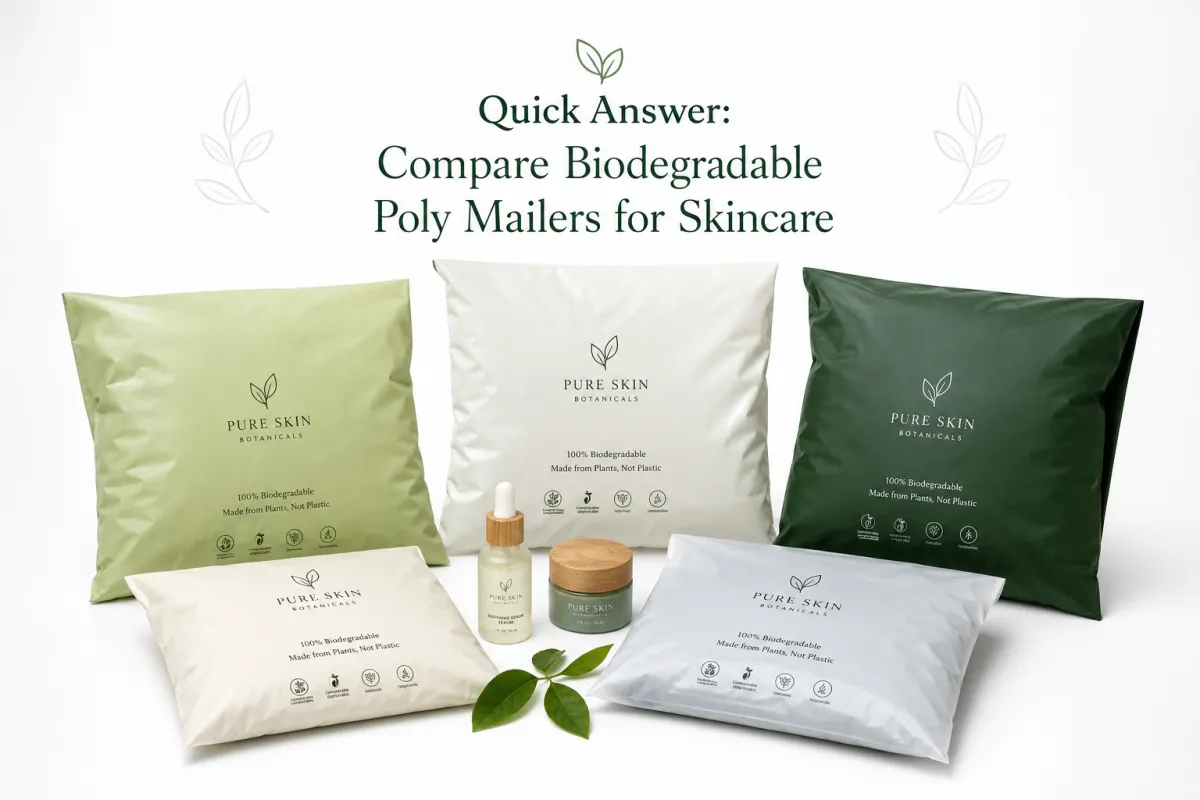
Start with the failure modes, not the sales pitch. A sample that looks kind of perfect on a clean table can still go gummy after a humid receiving day or split at the corner when a glass dropper presses into the seam. That is the gap that hurts teams.
You do not need a materials PhD. You need a short checklist and the discipline to use it.
- Seal integrity under real packing pressure and temperature drift.
- Print and surface performance after stacking, rubbing, and courier handling.
- Disposal claim clarity that matches how customers and waste systems actually behave.
Most teams miss the problem because the sample looks fine in a quiet room. Then one humid staging day later, the film softens, the flap curls, and the bottle corner starts working on the seam. That is when a quick compare Biodegradable Poly Mailers for skincare mindset pays off: score the physical performance first, then the brand finish.
For an initial shortlist, I usually keep three lanes open:
- One premium PBAT-based blend for launches where appearance has to do the heavy lifting
- One recycled-content mailer with a biodegradable additive for utility-focused replenishment flow
- One certified compostable option if your audience or retail partners need documentation they can verify
The hard truth? A pretty bag that fails at packed weight is not premium packaging. It is a future return center. A less glamorous option with better corner recovery and a cleaner seal can save money in damage, reshipment, and the kind of customer service mess nobody wants to explain on a Monday.
"A tiny claim mismatch can become a pile of support tickets. Once the seal fails, nobody cares how poetic the sustainability copy sounded."
If you need a quick screen, score each candidate out of 10 on seven points: appearance, seam consistency, puncture resistance, print rub tolerance, moisture reaction after 48 hours, shape retention after storage, and clarity of disposal instructions. Then compare Biodegradable Poly Mailers for skincare again using that scorecard. The cheapest sample usually loses once the numbers are in front of you.
This is not anti-sustainability. It is anti-surprise. You can build a premium skincare brand on eco packaging, but only if the mailer protects the product and does not invent new problems during fulfillment.
Top Options When You Compare Biodegradable Poly Mailers for Skincare
Four material families show up again and again in procurement conversations. None solves every problem. Each one solves a different slice of the problem, and each one comes with a tradeoff that procurement decks love to hide in footnotes.
Once you know how they behave under real shipping stress, the decision gets a lot less dramatic. Which is nice. Drama is expensive.
PBAT-based blends
PBAT-based blends are usually the performance-first option. In practice, they are often blended with PLA or starch to balance flexibility, tear behavior, and compostability claims. The exact feel depends on the formula, so do not assume one supplier's PBAT behaves like another's. That would be optimistic in the worst way.
Practical fit: best for premium presentation when you need a clean matte or gloss finish and stable print output. These films usually handle white ink and metallic accents better than cellulose-heavy alternatives, which matters if your brand lives on restrained contrast and crisp marks.
I keep seeing teams pick PBAT early because the sample looks right. Fair enough. Then they discover that appearance and durability are not the same thing. A film can look premium and still recover stiffness too slowly in a cold room or get a little tacky after a humid handoff. That is not a reason to avoid it. It is a reason to test it like a grown-up.
For skincare, a gauge around 1.5 to 3.5 mil is common, but the number alone does not tell you much. Seal windows, print adhesion, and post-seal handling matter more than the headline spec. I would always test heat exposure, overnight storage, and packing-line friction before final approval.
Plant-starch blends
Plant-starch blends can look attractive on paper because they often come in cheaper at the sample stage. The catch is moisture sensitivity. In humid climates, the film can lose crispness faster than you expect, and a thin 2.0 mil sample may feel a little floppy by the end of the day. That is not ideal if the package has to make a premium impression.
Practical fit: best for short-distance fulfillment and lighter SKUs. Refills, sachets, and soft packs can work well here if your storage and transit conditions stay controlled. If the product is light and the route is boring, starch blends can be a sensible option.
For premium creams and serums, though, I would want batch-to-batch gloss consistency, corner stability, and a real humidity test. Starch blends can drift more than the datasheet suggests, and your buyers will see that drift long before they know what caused it.
Recycled-content mailers with biodegradable additives
These often win the spreadsheet battle. Price can look attractive, handling is predictable on standard equipment, and lead times are usually easier to manage than with more specialty films. The trouble is claim language. A biodegradable additive is not the same thing as compostability, and sloppy wording can create legal or marketplace headaches fast.
Practical fit: best for high-volume fulfillment where unit economics and throughput matter more than packaging storytelling. If your line is stable and your brand does not need a deep sustainability narrative on the mailer itself, this category can be a clean operational choice.
Watch for vague claims. If the supplier cannot spell out the degradation pathway, disposal environment, and testing basis in writing, price that uncertainty as risk. Do not pretend it is a small issue just because the quote looks tidy.
Certified compostable mailers
Certified options usually carry the strongest trust signal because the claim is anchored in documented standards. For film mailers, that often means standards such as ASTM D6400, EN 13432, or a third-party certification like BPI or TÜV Austria, depending on the region and exact construction. The details matter. A lot.
Practical fit: best for brands that need documentation for retailers, marketplaces, and compliance review. If your sales team keeps getting asked for proof, this is often the cleanest lane.
The tradeoff is cost and, sometimes, lead time. Custom print can take longer, and the per-unit price can be higher than simpler stock options. That does not make the film bad. It just means you need enough brand value or channel pressure to justify it.
Quick verdict by use case:
- Best for luxury presentation: PBAT-based blend with tight gauge control
- Best for high-volume fulfillment: recycled-content mailer with additive, if the claim is defensible
- Best for short lead times: certified compostable stock sizes with simple print
- Best for retailer documentation: fully certified compostable with third-party proof
Still abstract? Tie each material to actual SKUs. Glass droppers, serum sets, and refill bundles punish weak stiffness and sloppy gusset control. Compare options using real product-in-bag simulations, not empty samples and a lot of optimism.
For teams buying at scale, start by checking production capabilities through Custom Packaging Products, then lock geometry in Custom Poly Mailers before final spec sign-off.
Detailed Reviews: Biodegradable Poly Mailers for Skincare Use Cases
Packaging gets judged three times. First by a human eye, then by conveyors, then by return inspectors. That is the real order in DTC skincare logistics. If one of those three hates your mailer, the others usually follow along.
We can compare Biodegradable Poly Mailers for skincare by use case: cream and serum shipments, fragile glass, and refill or accessory bundles. That is a more honest way to look at the decision than a generic feature matrix.
Cream and serum shipments
Skincare launches fail first on first-touch cues. For 30 ml and 50 ml serum bottles, the mailer needs shape retention, clean shoulder corner protection, and readable logo contrast in daylight and store lighting. Across a lot of trials, PBAT blends tend to outperform starch-heavy options on presentation and handling.
That matters directly for conversion. If your growth depends on unboxing and reposts, a scuffed flap can make the whole order feel less premium in seconds. I keep seeing the same pattern: one rough fold and the brand suddenly looks accidental. The line between luxury and ordinary is often 0.1 mm of stiffness and one decent seal line.
Fragile glass droppers and pump bottles
Glass changes the rules. The first failure is usually puncture stress near the cap or at the corners of the packed bundle. For these shipments, gauge and seam margin matter more than the marketing copy on the front of the bag. Compare Biodegradable Poly Mailers for skincare against a corner-rub test, not a visual pass. A 2.5 mil film with poor orientation can look fine on a desk and still fail at the third tote handoff.
For glass-heavy bundles, thicker walls and tighter seam control usually beat visual polish. That is not glamorous. It is just effective. I would also keep a moisture and temperature check in the protocol. If seal temperature drifts below target, adhesive creep can show up after short staging. Two hours is not a long time in fulfillment, but it is long enough to cause trouble.
Sample sets, cards, and accessory bundles
Bundles are geometry problems disguised as simple SKUs. Sample vials, cards, and small tools add hard edges that catch seams. In this group, recycled-content mailers with biodegradable additives can be practical because tear propagation is often lower, although print durability may lag if your palette uses deep black or multiple inks.
If inserts are involved, add seam abrasion checks and 90-degree fold stress tests. Static cling also shows up more often in bundle runs, and that becomes a throughput issue before anyone notices in QA reports. A slightly thicker wall can reduce static, reduce manual separation, and speed packing without hurting the brand look if you tune the finish properly.
Unspoken flaws and recurring quality symptoms
These defects show up more than teams like to admit:
- Static cling at filling stations in low-humidity environments
- Inconsistent gusset shape at high-speed sealing lines
- Odor drift in certain blends after heat exposure
- Weak adhesive layers that release under temperature spikes
- Labels peeling when surface energy does not match adhesive class
These issues affect delivery outcomes more than any eco phrase. A brand can recover from an awkward copy line. It does not recover as easily from unstable fulfillment. Use measurable thresholds, not adjectives, in your review notes.
Print quality still matters, though. Customers infer texture, care, and trust from the package before they even open the order. Matte finish with clean edges usually fits calm, clinical, premium skincare identities. Gloss can work when your brand needs brighter contrast. White ink remains expensive on some grades, especially darker stock, but in a premium launch it can be the difference between polished and awkward.
If you use custom graphics, request proof against your approved color library. I once watched a muted rose drift just enough to trigger a visual QA review after concept approval had already been signed off. The delta was 14 units in Delta-E after scale-up. Not subtle. Not fun either.
Price Comparison: What Biodegradable Poly Mailers for Skincare Really Cost
Here is where teams go wrong: cost is not the quoted unit price. It is landed cost, returns, packing drag, and claims risk. If you compare biodegradable poly mailers for skincare only by quote, you miss the expensive part of the equation.
A clean way to model this is with three order bands. Run all three before you negotiate, then compare the scenarios instead of the sticker price.
- Sample packs: 100-500 units
- Mid-volume: 5,000-20,000 units
- Bulk: 50,000-200,000 units
| Option | Sample pack | 5,000 units | 50,000 units | Primary strength | Main caution |
|---|---|---|---|---|---|
| PBAT-based blend (premium print) | $0.95 - $1.30 | $0.32 - $0.58 | $0.20 - $0.36 | Premium finish, strong brand look | Higher proofing and tighter lead time |
| Plant-starch blend | $0.68 - $1.00 | $0.24 - $0.48 | $0.16 - $0.28 | Lower raw-material profile | Can soften in humid distribution |
| Recycled-content + biodegradable additive | $0.60 - $0.95 | $0.22 - $0.44 | $0.14 - $0.30 | Reliable handling in many lines | Claim clarity and compliance risk |
| Certified compostable | $1.10 - $1.80 | $0.45 - $0.76 | $0.28 - $0.52 | Strongest documentation posture | Premium printing and lead time pressure |
Those ranges assume simple 1-2 color print, common pouch sizes, and standard gusset profiles. Add custom artwork, larger film gauges, or more complex sealing specs and the numbers move fast.
- Custom artwork setup: often $150-$350 one-time
- Freight and customs: can add 8-18% depending on route
- Storage overhead: bulky rolls need floor space, especially if humidity control matters
- Failure risk: a 1% rise in damage can erase gains above 3,000 units
The landed-cost formula that matters is this: (base unit price x quantity + artwork + freight + rejects + return handling) / sellable units. Add documentation labor and customs when needed. Compare this across materials. The winner usually changes once you move beyond catalog price.
Procurement teams often forget sequence. A higher per-unit option can become cheaper over 20,000 orders if it lowers damage, chargebacks, and reshipment labor by even half a percentage point. In skincare, damaged product hurts more than cash flow. It hits trust, and trust is expensive to buy back.
For conversion math, one useful test is this: if a $0.06 increase per pack drops complaint rate from 1.8% to 1.0%, and return handling runs $8-$12 each, the avoided loss over 20,000 orders can cross $1,000 per month depending on defect trend. That is finance-grade thinking, not packaging opinion.
For claims and performance references, look at ASTM, BPI, TÜV Austria, and ISTA packaging test methods, plus local waste guidance for disposal language. That paper trail keeps legal and operations from arguing after the PO is already out the door.
How to Choose Biodegradable Poly Mailers for Skincare
Use this rule: product form should drive the shortlist, not the sustainability label. Lightweight sachets and heavy creams do not fail in the same way. If your team treats them like the same problem, you are choosing with your eyes closed.
First-pass filter by SKU class:
- Lightweight sachets: prioritize cost and low-weight seal reliability
- Heavy creams: prioritize stiffness and corner retention
- Glass sets: prioritize puncture resistance and reinforced seams
- Subscriptions: prioritize packing speed and stackability
When you compare biodegradable poly mailers for skincare, include a 72-hour acceptance window after order placement, not just a sample-room look. Add opacity, adhesive consistency, moisture resistance, stiffness under load, and post-seal handling stability. Teams love glossy samples and then forget the boring pieces that keep orders intact. Boring is underrated. Boring ships.
Opacity is underrated too. A translucent mailer can feel premium until it shows too much of the wrong thing at the wrong moment. For oils and translucent serums, a more opaque finish often reduces friction at the door and makes the package feel intentional instead of improvised.
Checklist: test protocol that reflects skincare reality
- Drop test: replicate 0.5 m and 1 m falls with packed density and corner loads
- Moisture test: run 70-90% humidity with prefilled sachets and pump bottles
- Abrasion test: 20+ minutes of conveyor-style rubbing to mimic warehouse handling
- Print rub test: check logo legibility after transfers and fold cycles
- Packing-speed test: run a ten-minute batch on your real line, not a lab table
Sustainability credibility is not a side note. Ask for certificates, degradation conditions, and clear disposal instructions that a normal customer can understand without a chemistry background. If a material needs a special process, say that plainly in post-purchase copy. No jargon. No weird heroic language.
For compliance-focused teams, tie claims to recognized standards language. If a supplier says compostable, ask for the actual standard, the test basis, and the regional pathway. If you add fiber inserts, verify any FSC-relevant statements before the logo appears on a hero image or product sheet.
Simple rule: if a material cannot clear all five tests at pilot scale and still hit target pack-out speed, reject it. No ceremony required.
Process and Timeline: Sampling, Approvals, and Launch
People assume eco-packaging always delays launch. Usually it does not. The real delays are approvals, shifting expectations, and the late decision that the logo needs one more premium tweak, which somehow always means one more redo cycle. Funny how that works.
A practical timeline:
- Week 1: request 2-3 physical samples per candidate, including one no-logo control
- Week 2: run in-house handling tests and packing line trials
- Week 3: complete artwork pass, color proof review, and seal calibration
- Week 4: supplier plus compliance review, then final proof approval
- Week 5 onward: first production release and staged arrival checks
That five-week sequence is a reasonable domestic benchmark when no certification changes are needed. International sourcing can stretch 2-6 weeks, mostly from customs and material lot release. Stock options can land faster, often 5-10 business days, but they limit differentiation and logo flexibility.
"The biggest launch delay is rarely the material itself. It is usually a late claim edit, a wrong art file, or adhesive mismatch at conveyor speed."
Prepare these early. No shortcuts:
- Final artwork files (PDF/X-4 or EPS equivalents, not draft PDFs)
- Exact logo coordinates and allowed color tolerance range
- Order dimensions including carton inserts, not product-only measurements
- Claim statements approved by legal and marketing together
Before launch, validate every line that touches fulfillment:
- Batch compatibility with heat-seal equipment
- Label printer settings and adhesive temperature match
- Carrier dimensional thresholds for flat-rate tiers
- Retailer restrictions, especially in regulated skincare channels
Skip these and you invite rework right when the campaign goes live. Switching mailers midstream is possible, but no one enjoys reworking thousands of packs. Compare options thoroughly before lock-in if you want the first wave to be clean.
Our Recommendation and Next Steps
Here is the path I recommend after comparing candidates. Start with two or three sample types only. Score on appearance, seal strength, and landed cost. Then rank by how fast your team packs and how the material behaves under real load.
Run one controlled test order with real skincare SKUs and track 14 days of three metrics: damage rate, packing speed, and post-delivery feedback. If a material looks good but slows packing by 10-15 seconds per order, add that labor hit to the score. Cost surprises like hiding there.
Ask suppliers for these before you sign:
- Certification documents and test reports, including scope, method, and expiry
- Material composition and percentage ranges
- Current lead times by run size and print complexity
- Clear customer disposal guidance in plain language
If you ship both premium and utility SKUs, use one mailer for flagship launches, one for volume fulfillment, and one backup for supply fluctuations. That structure protects conversion, delivery consistency, and cash flow when a vendor slips. It also avoids Friday afternoon scramble calls, which everyone deserves less of.
To move from comparison to decision: confirm product-fit samples, lock the spec, run one pre-launch stress batch, then place the long-run order for the next fulfillment cycle. That is a disciplined way to compare biodegradable poly mailers for skincare without guessing.
The real decision is not one label or one supplier promise. It is whether your package protects the product and supports a believable end-of-life story at the same time. If you compare biodegradable poly mailers for skincare through testing discipline instead of packaging adjectives, you end up with fewer damages, fewer awkward claim conversations, and a cleaner launch.
FAQ
Are biodegradable poly mailers for skincare better than recycled plastic mailers?
Sometimes. Biodegradable mailers are useful when end-of-life messaging is core to your positioning. Recycled options can be more consistent and sometimes lower-cost depending on supply conditions. For skincare, test both on the same route and humidity range before you commit, especially with serum bottles or glass components.
How do I know if a biodegradable mailer is really suitable for skincare shipping?
Ask for data, not slogans. Start with material specifications, then test puncture resistance, moisture resistance, and seal stability under real dispatch conditions. If the first pilot shows weak corners or scuffs at the rim, the mailer is not ready, even if the copy is beautiful.
What size biodegradable poly mailer works best for skincare orders?
Pick the smallest size that fits packed product, insert card, and protective tissue. Oversized bags look sloppy and increase dimensional shipping costs. Lightweight oils and creams often fit slim formats, while bundles or boxed orders may need wider gussets and more flat length. Measure the packed order, not just the product.
Do biodegradable poly mailers for skincare need custom printing?
Not always. A clean stock mailer with a reliable label system can work for pilots and budget campaigns. Custom printing usually improves trust for social-led brands, though. For subscriptions and premium drops, print quality often drives retention because the package becomes part of the sales signal.
How many samples should I test before buying biodegradable poly mailers for skincare in bulk?
At least two, ideally three material families. Test with real products, not empty forms, because empty forms hide failure modes. Involve your packing team so you capture speed, static, and edge handling. If throughput collapses during pilot, the mailer is probably not the right one for scale.