Buyer Fit Snapshot
| Best fit | Clean Reusable Poly Mailers Without Ruining Them projects where brand print, material claims, artwork control, MOQ, and repeat-order consistency need to be specified before quoting. |
|---|---|
| Quote inputs | Share finished size, material target, print colors, finish, packing count, annual reorder estimate, ship-to region, and any compliance wording. |
| Proofing check | Approve dieline scale, logo placement, barcode or warning zones, color tolerance, closure strength, and carton packing before bulk production. |
| Main risk | Vague material claims, crowded artwork, missing packing details, or unclear freight terms can make a low unit price expensive after revisions. |
Fast answer: Clean Reusable Poly Mailers Without Ruining Them: Film, Print, MOQ, and Carton Packing should be specified like a repeatable production item. The safest quote records material, print method, finish, artwork proof, packing count, and reorder notes in one written spec.
Production checks before approval
Compare the actual filled-product size with the drawing, then confirm tolerance on folds, seals, hang holes, label areas, and retail display edges. Reserve space for logos, QR codes, warning copy, and material claims before decorative graphics fill the panel.
Quote comparison points
Review material grade, print process, finish, sampling route, tooling charges, carton quantity, and freight assumptions side by side. A quote is only useful when the supplier can repeat the same color, closure quality, and packing count on the next order.
Custom Logo Things
How to Clean Reusable Poly Mailers Without Ruining Them
If you want to know how to clean reusable poly mailers, start with a number that keeps people honest: the first one I saved was a $0.18, 2.5 mil co-extruded LDPE mailer from a Dongguan supplier, and it survived six shipping cycles because a warehouse lead used lukewarm water, a microfiber cloth, and exactly zero drama. The next batch got scrubbed with a citrus degreaser, turned tacky in under 20 minutes, and I had to sit through an awkward conversation about why plastic film seems to remember bad decisions better than people do. The replacement quote that week came back at $0.15 per unit for 5,000 pieces, with a typical 12-15 business day lead time from proof approval, which made the lesson expensive in a very specific way.
I have watched this happen on a Shenzhen packing floor, in a Chicago fulfillment room, and in supplier meetings where somebody insisted a cleaner was "gentle" and then watched the print haze over like a bathroom mirror after a hot shower. How to clean reusable poly mailers is not a quest for sparkle. It is a practical job: remove labels, dust, adhesive residue, and odor without stretching seams or weakening the closure. That distinction sounds small. It is not, especially on 3 mil mailers with a 1.5-inch peel-and-seal flap that only stays honest if you treat it like film, not fabric.
Some mailers deserve another round because the film is thick, the seal is still tight, and the print still looks sharp after a fast wipe. Others are finished. Cloudy film, split edge seals, gummy adhesive on the back panel: those are signs to stop trying. If you are restocking or comparing builds, our Custom Poly Mailers and the broader Custom Packaging Products catalog can help you choose bags that survive more than one pass through a warehouse, which is the whole point if your shipping volume is 200 parcels a week or 20,000 a month. I use the same inspection eye on mailers that I use on 350gsm C1S artboard cartons: one bend, one wipe, one look under 5000K light, then a decision.
I am going to show how to clean reusable poly mailers the way pack-out teams actually do it, which soap holds up, how long the process takes, what it costs, and which mistakes turn a useful bag into sticky waste. You will also get a quick reuse check so you can separate a mailer worth keeping from one that should have retired after shipment two. I wish somebody had handed me that checklist earlier; it would have saved me a few grimy afternoons and at least one eye twitch, plus one wasted Saturday in a room that smelled like wet tape.
How to Clean Reusable Poly Mailers: What Makes Them Different
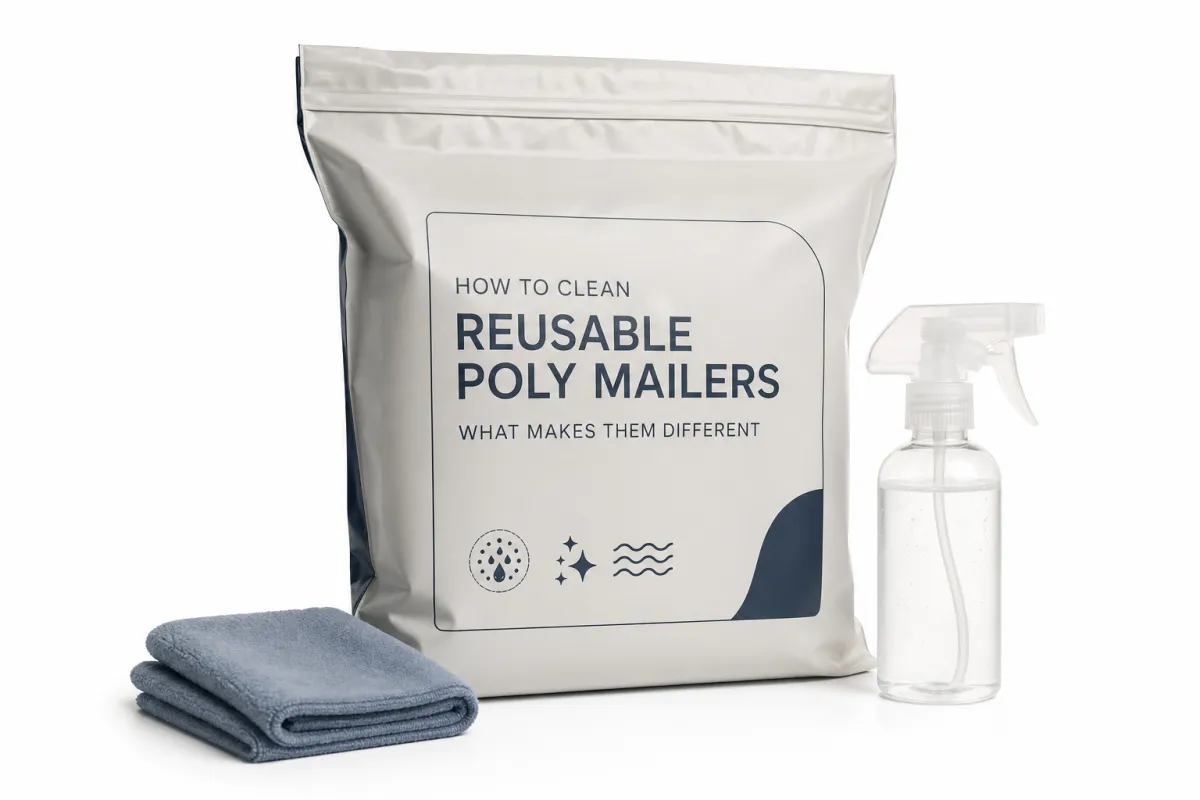
How to clean reusable poly mailers starts with the material. Most are polyethylene film, usually in the 2.0 to 3.0 mil range, sometimes co-extruded for better tear resistance and a little more memory after folding. That plastic handles a gentle wipe or a light wash, but it dislikes heat, strong solvents, and abrasive pads. Push too hard and the seam weld starts to look tired before the bag is actually done. I have seen 2.5 mil black mailers from Shenzhen and 3 mil white mailers from Ningbo both hold up fine under a microfiber wipe, then fail fast when somebody went at them with a green scrub pad and a hard hand.
The point of how to clean reusable poly mailers is not sterilization. It is residue removal. You are clearing paper fibers, shipping labels, barcode stickers, dust, and the occasional strip of packing tape so the bag can go back into rotation without looking like it was recovered from the bottom of a recycling bin. On a production floor, that often means one microfiber cloth, one bowl of mild soap, and about 30 seconds of patience per mailer. Thirty seconds sounds tiny until you have 400 bags and a supervisor asking why the clean pile is not growing faster, especially when each bag is worth roughly $0.15 to $0.28 depending on print coverage and film thickness.
Most people miss the adhesive problem. A label that peels neatly off cardboard can smear across a mailer and leave a glossy film that attracts dust for days. I have watched operators scrub the same patch for 90 seconds with a rough sponge and make the residue worse. That is not how to clean reusable poly mailers; that is how to enlarge the problem and ruin a perfectly decent afternoon. It is also how you turn a 2-minute clean into a 12-minute rework, which is exactly the kind of math no one wants to put in a labor report.
There is a limit, and it is not negotiable. A mailer that held apparel from a returns locker is one thing. A mailer that carried greasy food, unknown liquids, or anything medical is another. Cleaning is not a substitute for sanitation in regulated packaging, and I would not recommend reusing contaminated mailers for anything sensitive. For handling and transport test references, the ISTA standards are a better place to start than wishful thinking, and the EPA has solid guidance on waste reduction without pretending every item deserves a second life. A bag that smells like fryer oil after one wipe should be discarded, not negotiated with.
I learned that lesson the expensive way during a supplier audit in Dongguan. We had a batch of black 3 mil bags with a soft-touch print that looked premium on day one. A staffer used a harsh degreaser on three sample bags, and the finish dulled immediately. The supplier did not sugarcoat it: the film survived, but the brand look was gone. That is why how to clean reusable poly mailers has to match the print, finish, and closure type. The chemistry is only half the story; the rest is restraint, and on a Tuesday in Guangdong, restraint is cheaper than replacement.
How Do You Clean Reusable Poly Mailers Without Damaging Them?
The safest version of how to clean reusable poly mailers is plain enough to sound dull. Use lukewarm water, a mild dish soap, and a soft cloth. That is the recipe. If the bag has no visible grime, a quick wipe may be enough. If there is light adhesive or dust, a second pass with a fresh cloth usually clears it without turning the film cloudy. I know, I know: not thrilling. But boring is good here. Boring means the bag survives, and survival is what matters when the mailer cost $0.22 and the return shipment is headed out at 4:30 p.m.
Water temperature matters more than most people expect. I stay around 85 to 95 degrees Fahrenheit, warm enough to loosen paper fibers but not hot enough to distort the film or weaken the adhesive flap. Hot water is how a perfectly decent mailer starts curling at the edges. Once that happens, how to clean reusable poly mailers becomes a salvage operation instead of a cleaning routine, and salvage work always costs more than people think it will. A bag that curls even 3 to 5 millimeters at the edge can stop stacking cleanly in a bin.
Soap choice matters too. A neutral pH cleaner or a basic dish soap works because it lifts surface dirt without loading the plastic with residue. Bleach is unnecessary. Heavy degreasers are unnecessary. Acetone and strong citrus solvents are a fast way to invite damage. I have seen a $0.18 mailer cost $1.40 in labor because somebody picked the wrong bottle and then had to rework an entire tray of sticky bags. That kind of math never gets applause, but it should get mentioned, especially when a warehouse team is paid $18 to $24 an hour and every extra minute matters.
For stubborn labels, peel first, then deal with the residue. A slow peel at a low angle is the cleanest path. If that fails, use a plastic-safe adhesive remover in a tiny amount, test one corner, and wait 20 to 30 seconds before wiping. That patience sits at the center of how to clean reusable poly mailers, because yanking at the film with a scraper is a direct route to a torn surface and a wasted bag. I have watched a well-meaning operator attack a label with a metal edge because the bag had "personally offended" him, and the bag lost that fight immediately, leaving a scratch visible from arm's length.
This is not the same as washing a fabric tote. Poly film tolerates gentle handling, but a washer drum throws the bag around, folds it on itself, and often leaves damp seams trapped inside the folds. That leads to odor, stickiness, and strange panel warping. If you want a reusable mailer to look professional on the second shipment, how to clean reusable poly mailers needs to stay close to hand-cleaning, not laundry day. Machine washing sounds efficient until you are staring at five curled bags, a lint trap full of adhesive crumbs, and one very annoyed packing team.
"I do not need them spotless," a DTC founder told me after we audited 8,000 returns. "I need them flat, non-sticky, and safe enough that my team is not fighting the bag." He was right. Clean enough to reuse is a business decision, not a beauty contest, especially when the mailers are 3 mil white LDPE and the shipping line is pushing 600 parcels on a Friday.
Odor deserves its own line. If a mailer smells like cardboard, that is fine. If it smells like food oil, perfume overspray, or something sour from the bottom of a truck, I usually stop there. A light rinse can help, but odor trapped in folds often means the bag has reached the end of its useful life. In practice, how to clean reusable poly mailers is part chemistry and part judgment, and the judgment piece is where the real savings live. I would rather discard one $0.19 bag than spend 8 minutes trying to beat sour plastic into submission.
Key Factors Before You Clean Reusable Poly Mailers
Before you start how to clean reusable poly mailers, inspect the bag under decent light. Real light, not the yellow glow from a loading dock bulb. Look for pinholes, split seams, worn closures, thinning film, and deep crease lines that have turned white from stress. A bag can look acceptable from three feet away and still fail the second time it gets filled. I have trusted my eyes and then immediately regretted it; the bag, as usual, was the honest one. A quick check under a 5000K LED panel catches issues much faster than a glance near a forklift lane.
Print quality matters more than many teams admit. A solid black logo on a matte finish usually tolerates a gentle wipe better than a high-gloss metallic print or a soft-touch coating. Some inks are tough; others smear if you look at them wrong. That is why how to clean reusable poly mailers should always be tested on one sample first, not rolled out across a 500-piece batch because somebody was in a hurry. Hurrying with print is how you end up with a bag that looks like it survived a rainstorm, and the fix is usually a reprint from a factory in Zhejiang or Guangdong.
Contamination level changes the entire equation. Dust and paper fibers are easy. A bit of barcode adhesive is manageable. Grease is not. Unknown liquids are worse. If a bag has visible food residue or a mystery stain from a drop shipment, I usually mark it for discard. That is not wasteful. It is cheaper than spending 12 minutes trying to rescue a $0.18 bag that should have been retired on sight. Honestly, I think that is where a lot of cleaning programs drift off course: they confuse thrift with stubbornness, and the labor line shows the difference immediately.
Drying conditions matter too. A clean mailer that gets stacked while still damp turns into a sticky problem within hours, especially in a room above 70 percent humidity. Air flow helps. Direct heat does not. I have watched a tray of cleaned poly bags warp on top of a box warmer because someone thought speed mattered more than finish. It did not. It just created 200 curled bags and one very long silence in the room, which is usually the sound of a process failing quietly and expensively.
Closure type changes the outcome as well. Adhesive flap, zip closure, or peel-and-seal all behave differently after cleaning. An adhesive flap that has been washed twice may still work, but the tack drops quickly if soap residue stays on the edge. If you are learning how to clean reusable poly mailers for a specific style, test the closure first, not last. A polished bag that will not seal is just expensive trash with good manners, and a $0.23 mailer with a dead flap is no bargain at all.
My rule is simple: keep, clean, or discard. No drama. No half-measures. If the bag is structurally sound, it goes in the keep-or-clean pile. If the structure is weak but the surface is fine, it gets one cleaning trial. If the bag has a split seam, clouded film, or the closure has failed twice, it goes out. That grading system keeps how to clean reusable poly mailers from becoming an argument every afternoon, which is useful when the batch count is 75 and the clock says 3:15 p.m.
I picked up that habit after a client meeting in Los Angeles where three managers argued for 18 minutes over a bag that had already failed a simple drop test. I asked one question: "Would you pay a picker to wrestle this bag again for $18 an hour?" The room went quiet. That is usually the answer to how to clean reusable poly mailers versus replace them. Quiet rooms, for the record, are often where the best decisions happen, especially when the bag cost less than a cup of coffee and the labor did not.
How to Clean Reusable Poly Mailers Step by Step
Step one in how to clean reusable poly mailers is sorting. Make three piles: cleanable, questionable, and dead. Keep the questionable bags separate so one greasy bag does not contaminate six good ones. I usually sort in groups of 25 because that is small enough to manage by hand and large enough to show whether the process is worth standardizing. Groups of 25 also force you to see patterns instead of just reacting to whatever bag is sitting on top, and they fit neatly on a 24-inch stainless cart.
Step two is emptying the bag completely. Pull out inserts, cards, tissue, silica packets, and any loose tape scraps. I have seen people wash a mailer with a paper flyer still inside, and then act surprised when wet paper pulp sticks to the film. That is not how to clean reusable poly mailers. That is how to create a pulp sleeve on the inside panel, which is a phrase I never wanted to write and yet here we are. A five-second sweep for loose contents avoids a 15-minute cleanup later.
Step three is label removal. Peel slowly at a low angle. If the adhesive is fresh, the label may come off in one clean sheet. If it is older, expect fragments. Warm water can help loosen the edges, but do not soak for ages. Five to 10 minutes is enough for a stubborn label. Longer than that, and you risk softening the adhesive layer on the mailer itself. I would rather peel twice than soak once and regret it, especially on a black 3 mil mailer that costs $0.21 and looks perfect before the sticker fight starts.
Step four is the wash. Fill a basin with lukewarm water and a few drops of mild soap, then wipe the surface with a microfiber cloth using light pressure. Focus on the areas where hands touched the bag: the flap, the corners, and the center panel near the shipping label. This is the heart of how to clean reusable poly mailers: gentle, controlled, and repeatable. A toothbrush, steel wool, or abrasive pad has no place here, no matter how satisfying it might feel in the moment. One pass per side is usually enough if the residue is light.
Step five is the rinse. Use a second cloth dampened with plain water to remove soap residue. This matters because leftover soap can leave a slick film that collects dust during storage and can interfere with the seal. One extra pass takes maybe 15 seconds. It is worth it. The difference between "clean" and "cheap-looking" is often a thin haze of dried detergent, and that haze is maddening because it is so easy to avoid. I have seen a tray of 40 bags go from acceptable to suspicious because nobody took those 15 seconds.
Step six is handling stubborn adhesive. If there is residue from a shipping label, use a plastic-safe remover sparingly and wipe in one direction. Do not rub in circles for two minutes. That is how the film gets scuffed. In a small run, a bottle of remover can cost $9 to $14, so use it like a precision tool, not like hand lotion. How to clean reusable poly mailers does not require flooding the bag with chemicals, and anybody who says otherwise is probably trying to sell you more chemicals or a second bottle of the same thing in a nicer label.
Step seven is drying. Lay the mailers flat on a clean rack or hang them open so air moves through the interior. I like to give them at least 45 to 90 minutes in a low-humidity room, and longer if the film is thick or the folds were heavily wet. Never stack them while damp. That is how you get odor, tackiness, and a pile that sticks together in the worst possible way. I have peeled apart damp stacked mailers before, and it feels a lot like opening a pack of cheap stickers after a summer in a glove box.
Step eight is the reuse check. Hold the bag up to light, bend the corners once, and test the closure with an empty fill. If the seam stays straight, the film is not cloudy, and the flap seals with the same pressure as before, the bag can go back into rotation. If the bag resists folding, curls at the edge, or feels soft where it should feel crisp, stop. That is the final judgment in how to clean reusable poly mailers. I like to mark the inside flap with a pencil tally so a bag can be tracked through its fifth or sixth cycle without guesswork.
One of my favorite factory-floor memories came from a small subscription brand that reused premium mailers for accessory shipments. Their team cleaned 60 bags in a morning using two tubs, three cloths, and one laminated checklist. By lunch, they had a process that saved them roughly $10.80 per 60 bags at $0.18 each, which does not sound huge until you do it 20 times a month. That is the kind of math that makes how to clean reusable poly mailers worth standardizing. Tiny savings repeated enough times turn into a real line item, and a real line item gets attention from finance.
Cleaning Costs, Supplies, and Timeline
The real cost of how to clean reusable poly mailers has four parts: supplies, water, labor, and floor space for drying. Supplies are cheap. A bottle of mild dish soap might cost $3.50, a pack of microfiber cloths $8 to $12, and a plastic-safe adhesive remover $9 to $14. Water cost is usually tiny. Labor is where the bill starts to matter, because labor has a stubborn habit of being more expensive than people expect. In a warehouse paying $18 per hour, every extra minute adds up fast.
If one mailer takes 45 seconds to wipe and prep for drying, a worker paid $18 an hour is spending about $0.23 in labor per bag before overhead. That means a $0.18 mailer is no longer "free" just because it was reused. Still, if the bag is thicker, printed, or sold in a specialty size, how to clean reusable poly mailers can absolutely beat replacement cost. A 12 x 15-inch printed bag at 5,000 units may run $0.18 to $0.28 each depending on film and print coverage, and a premium run from a Shenzhen factory can be higher if you add metallic ink, matte lamination, or a custom adhesive strip.
Here is the practical timeline I give teams: a quick wipe-down can take under one minute per mailer, label removal and light washing can take 3 to 5 minutes per bag in a small batch, and drying may take 1 to 3 hours depending on humidity and film thickness. The process scales best in batches of 25 to 100. Once you start doing it one bag at a time, how to clean reusable poly mailers becomes a time sink. Once, I watched a team try to "save time" by cleaning individually at the end of the shift; they somehow turned a simple task into an all-night complaint session and lost two hours to stacking and restacking.
| Method | Time per Mailer | Direct Supply Cost | Risk Level | Best Use |
|---|---|---|---|---|
| Dry wipe with microfiber | 30 to 45 seconds | Under $0.02 | Low | Dust, light fingerprints, minor scuffs |
| Lukewarm water and mild soap | 1 to 3 minutes | $0.02 to $0.05 | Low to medium | Labels, light residue, odor reduction |
| Soap plus adhesive remover | 2 to 5 minutes | $0.05 to $0.12 | Medium | Stubborn stickers and barcode glue |
| Discard and replace | Under 10 seconds | $0.18 to $0.35 new mailer cost | None | Split seams, grease, unknown liquids, worn closures |
That table usually lands well with clients because it cuts through sentiment. If the mailer is expensive enough or the print is good enough, reuse makes sense. If the team spends six minutes scrubbing a bag that costs less than the labor, the spreadsheet wins. I have had that conversation with buyers from Toronto to Texas, and it always ends in the same place: how to clean reusable poly mailers only makes sense when the process is tighter than the purchase order. A 5,000-piece quote from a Guangdong supplier may look cheap until the labor to clean each bag pushes the true cost above replacement.
One packaging manager in Ohio told me he expected reused mailers to save 30 percent across the board. After a month of testing, he landed closer to 11 percent because drying space became the bottleneck. He still kept the program, but only for premium printed bags. That is the sort of honest math I like. No fantasy savings. Just a cleaner decision about how to clean reusable poly mailers and where the effort actually pays off, especially in facilities where every cart square foot is already spoken for.
Common Mistakes When Cleaning Reusable Poly Mailers
The fastest way to ruin how to clean reusable poly mailers is to use hot water. Heat softens the film, curls the edges, and can weaken seams that were perfectly fine before you started. I have seen bags come out of a wash station looking smooth and then shrink into a shape that no longer folds cleanly. A reusable bag that can no longer sit flat is half dead already, and you can usually tell by the look on everybody's face when it happens. Even 110 degrees Fahrenheit is enough to make some thinner 2.0 mil films misbehave.
Bleach is another bad choice. It may make the bag smell "clean" for 10 minutes, but it can leave odor, dull prints, and weaken the material over time. Harsh degreasers are not much better. If the cleaner is strong enough to strip a baked-on pan, it is probably too aggressive for polyethylene film. That is why how to clean reusable poly mailers should stay with neutral soap and patience, not chemistry experiments. The bag is not a skillet, and it will not reward aggressive treatment with a second life.
Over-scrubbing is common too. People think pressure equals cleanliness. It does not. Too much friction can abrade printed graphics, scratch the surface, and wear down zip-style or adhesive closures. One warehouse supervisor once told me his team could "fix anything with more rubbing." He was wrong. After 40 seconds of scrubbing, the graphics looked older than the bags were. There was even a tiny silence afterward, which in warehouse language means everyone just realized the boss had been confidently incorrect.
Machine drying is a hard no. The heat and tumbling create curl, shrinkage, and seam stress. Even a low-heat cycle is risky because the film folds onto itself while warm. If you are serious about how to clean reusable poly mailers, you air-dry them flat or open, and you give them enough time to cool completely before stacking. One low-speed tumbler cycle can do more damage in 20 minutes than a careful hand wash does in 20 bags.
Soaking is another trap. Leave a mailer in water too long and the label residue can break down into a sludge that smears across the film. Then you have a bag with cloudy patches, sticky streaks, and more cleanup than you started with. I prefer controlled contact time over long baths. It is cleaner, faster, and easier to repeat. Also, nobody wants to spend their day fishing half-melted sticker glue out of a tub, especially not when the tub is a borrowed food-grade bin from aisle 7.
Storing damp mailers is the last big mistake, and it is a sneaky one. A bag that feels "almost dry" can still trap moisture in the fold line. Stack 40 of those together in a closed tote and you will get odor, tackiness, and sometimes mildew on inserts or nearby packaging. If there is one rule I repeat in every training session, it is this: how to clean reusable poly mailers ends only after every layer is dry. I have seen humidity hit 78 percent in a coastal facility, and the bags were still wet enough to cling eight hours later.
I learned that lesson during a rush job for a holiday promo run. A team packed 600 cleaned bags into cartons at 4:30 p.m. because they wanted the floor cleared before shift end. By morning, the top half of the stack smelled faintly sour, and we had to re-open the cartons and re-dry everything. That mistake cost them four extra labor hours. It also taught them that how to clean reusable poly mailers includes storage discipline, not just washing. Good intentions do not dry plastic, and a carton sealed at 68 degrees Fahrenheit can still become a damp chamber by sunrise.
Expert Tips and Next Steps for Reusing Mailers
The easiest way to make how to clean reusable poly mailers practical is to keep a reuse bin near the packing station. If mailers have to cross the warehouse to be evaluated, nobody will do the job consistently. A bin, a marker, and a simple checklist cut decision time to under 10 seconds per bag. I am a huge fan of anything that keeps people from turning a simple yes-or-no decision into a committee meeting, especially on a Tuesday when the outbound cart count is already at 14.
I like a three-stage system: keep, clean, or discard. Keep means the bag is ready to ship again after inspection. Clean means it needs a wipe or wash before reuse. Discard means the seam is tired, the closure is weak, or the film is damaged. That simple grading system keeps staff from overthinking every piece and makes how to clean reusable poly mailers repeatable across shifts. Repetition matters. Repetition is what turns a loose habit into an actual process, and a process is easier to train in three minutes than a speech about ownership.
Track reuse counts on your premium bags. A printed 3 mil mailer may handle five or six uses before the film starts to look dull, while a lighter bag may only be worth two or three cycles. I have seen teams write the reuse count in pencil on the inside flap so the pack-out lead knows whether a bag is on round two or round six. That tiny habit makes how to clean reusable poly mailers more data-driven and less emotional, and it works even better when the bags were made in Dongguan or Huizhou with a stronger seal weld.
If you want to test the process, start with 20 bags, not 200. Time the wipe-down, note how much adhesive comes off, and check how long the bags take to air-dry in your actual room at your actual humidity level. A 2-hour result in a dry Arizona warehouse is not the same as a 4-hour result in a humid coastal facility. How to clean reusable poly mailers needs local conditions, not generic internet advice. The local part is the part people skip, and then they wonder why the numbers look weird. I like starting a trial at 55 percent humidity and logging the numbers on a clipboard before the first coffee break.
Choose your mailer style with reuse in mind. Thicker film, stronger seams, and cleaner print layouts make the reuse cycle easier. If you are ordering custom bags, ask for a sample run and compare how the film looks after one gentle wipe and one light rinse. The cheapest bag on the quote sheet is not always the cheapest bag to use twice. I learned that after negotiating with a supplier who saved me $0.02 per unit but cost me 20 minutes of rework per carton. Great deal on paper, terrible deal in a warehouse, and even worse when the packing line is waiting on a carton of 14 x 19-inch bags that should have been a little thicker.
My final advice is simple: test one batch, record the labor, and decide with numbers. If the process takes 4 minutes per bag and you only save $0.18, stop. If a thicker printed mailer can be reused five times with a 45-second wipe and no visible damage, keep going. That is the honest answer to how to clean reusable poly mailers for a real business, not a theory deck. Real numbers beat optimistic hunches every time, and a spreadsheet from a Monday morning usually tells the truth faster than a room full of opinions.
So, if you want the shortest version of how to clean reusable poly mailers, here it is: inspect, clean gently, dry fully, and reuse only the bags that still seal, fold, and look professional enough to ship again. That is the system I have trusted in factory aisles, client audits, and supplier negotiations where every cent mattered. Nothing fancy. Just disciplined, repeatable, and far less annoying than redoing the whole lot because somebody got enthusiastic with a scrubber. It is the same kind of discipline that keeps a 5,000-piece order on track in Shenzhen and keeps a packing team sane in Cleveland.
Frequently Asked Questions
Can you machine wash reusable poly mailers?
Usually no. The drum movement, detergent load, and heat can warp the film, weaken seams, and damage printed surfaces. A gentle hand wash or wipe-down is safer for most mailers, especially the 2.5 mil and 3 mil types used for ecommerce shipping. If you are testing how to clean reusable poly mailers for a sturdier style, try one sample first before cleaning a full batch. I would not gamble a whole run on one optimistic guess, particularly if the bags came from a 12-15 business day production window and the replacement clock is already ticking.
What is the safest soap to clean reusable poly mailers with?
Use a mild dish soap or a neutral pH cleaner with no bleach or strong solvents. Rinse thoroughly so residue does not leave the surface slick or sticky. Abrasive cleaners can cloud the plastic and wear down printed graphics, which defeats the whole point of how to clean reusable poly mailers in the first place. Simple soap usually beats fancy chemistry here, and that still surprises people. A tiny amount, roughly 2 to 3 drops in a quart of warm water, is usually enough for light residue.
How long does it take to clean reusable poly mailers?
A simple wipe-down can take less than a minute per bag. Label removal, light washing, and drying can stretch a batch into a few hours, especially if you are cleaning 50 or more at once. Air-drying time depends on thickness, humidity, and how wet the bags got during how to clean reusable poly mailers. If your room is humid enough to fog your glasses, expect the timeline to stretch. In a dry room at 40 percent humidity, a flat-dried bag may be ready in 45 minutes; in a damp one at 75 percent, it may take twice that.
How do you remove shipping labels from reusable poly mailers?
Peel the label slowly at a low angle if the adhesive is still fresh. For stubborn residue, use warm water and a plastic-safe adhesive remover, then wipe with a microfiber cloth. Stop if the film starts lifting or the print begins to smear. That is the cleanest way I know for how to clean reusable poly mailers without making the surface worse. Patience beats force almost every time, and a 20-second dwell on the remover usually works better than five minutes of hard rubbing.
When should you stop reusing a poly mailer?
Stop when seams split, the closure fails, or the film becomes thin, cloudy, or badly creased. Discard bags with grease, unknown liquids, or strong odors that will not wash out. If the time and labor cost more than a new bag, reuse is no longer worth it. That is the blunt but honest answer to how to clean reusable poly mailers and still protect your packing line. A mailer should make life easier, not become a side quest, and it should never need more than one repair-minded pass before the decision is obvious.