Buyer Fit Snapshot
| Best fit | compare compostable vs plastic mailers for packaging buyers comparing material specs, print proof, MOQ, unit cost, freight, and repeat-order risk where brand print, material, artwork control, and repeat-order consistency matter. |
|---|---|
| Quote inputs | Share finished size, material target, print colors, finish, packing count, annual reorder estimate, and delivery region. |
| Proofing check | Approve dieline scale, logo placement, barcode or warning zones, color tolerance, and any recyclable or compostable wording before bulk production. |
| Main risk | Vague material claims, crowded artwork, or missing packing details can create delays even when the unit price looks attractive. |
Fast answer: Compare Compostable vs Plastic Mailers: Film, Closure, Print, and Fulfillment should be specified like a repeatable production item. The safest quote includes material, print method, finish, artwork proof, carton packing, and reorder notes in one written spec.
What to confirm before approving the packaging proof
Check the product dimensions against the actual filled item, not only the sales mockup. Ask for tolerance on folds, seals, hang holes, label areas, and retail display edges. If the package carries a logo, QR code, warning copy, or legal claim, reserve that space before decorative graphics fill the panel.
How to compare quotes without losing quality
Compare board or film grade, print process, finish, sampling route, tooling charges, carton quantity, and freight assumptions side by side. A lower quote is only useful if the supplier can repeat the same color, closure quality, and packing count on the next order.
Quick Answer: Compare Compostable vs Plastic Mailers
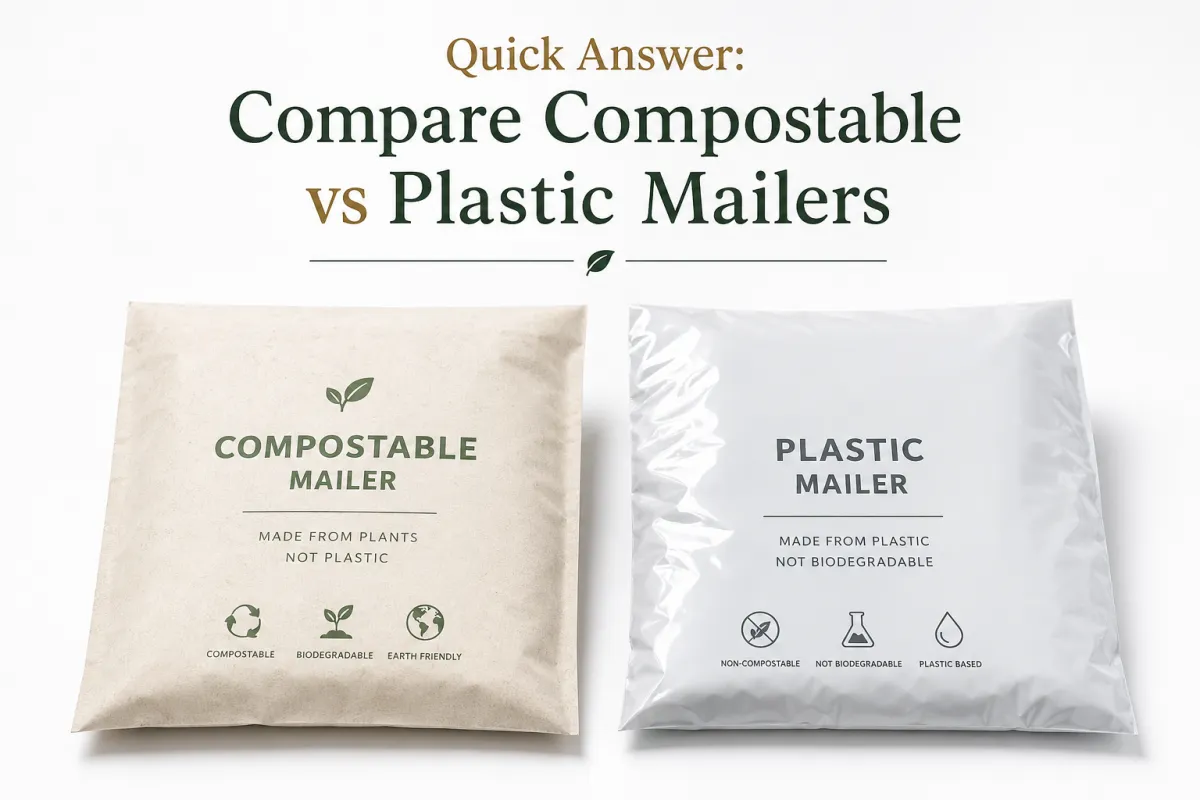
I still remember the first time I had to Compare Compostable vs plastic mailers on a loading dock in Shenzhen, where a 40-foot container had just come off the rail line from Yantian Port. A compostable sample, cleanly printed in two colors and rated at 60 microns, looked convincing in my hands until I packed a 1.1 kg hoodie bundle into it, sealed the flap, and watched the corner split on the third toss from one pallet to another. That afternoon took less than 20 minutes, but it changed how I judge shipping bags for brands that move 500 or 50,000 units a month.
The short version is direct. Compare Compostable vs plastic mailers long enough and the pattern shows up fast. Compostable mailers usually win on brand story, shelf appeal, and the conversation around eco-friendly packaging. Plastic mailers usually win on cost, moisture resistance, stretch, and consistency from batch to batch. If the carbon footprint story matters most, compostable can fit. If the goal is lower damage rates, fewer replacements, and better margin protection, plastic usually takes the lead by a wider margin than most founders expect.
Most brands should Compare Compostable vs plastic mailers against real shipping conditions, not just the language on the packaging. A premium DTC apparel label in Los Angeles, a subscription box from Brooklyn, or a brand speaking to a zero waste audience in Portland may see a real lift from compostable packaging. A high-volume seller moving 10,000 units a month through Dallas, Atlanta, and Miami, especially into wet climates or mixed carrier networks, will usually be better served by plastic mailers or recycled-content poly. I have watched marketing teams fall in love with the compostable sample, then lose interest when operations asked about 78% warehouse humidity and a 14-day replenishment window.
If you want the shortest possible answer to compare compostable vs plastic mailers, use this rule: choose compostable when the packaging story matters more than absolute ruggedness, and choose plastic when protection, lead time, and unit cost matter most. The sections below break down the common formats, how they behave in real shipping, what they cost at 5,000-unit order levels, and how to decide before you place a custom run through Custom Packaging Products.
Which Is Better for Shipping: Compare Compostable vs Plastic Mailers?
If you compare compostable vs plastic Mailers for Ecommerce, plastic usually wins on protection and moisture resistance, while compostable wins on branding, eco-friendly packaging, and the story customers repeat after the package arrives. The better choice depends on route conditions, product weight, shelf life, and how much failure costs if the parcel gets squeezed, dropped, or delayed.
That answer is less glamorous than a sales pitch, but it is the one that holds up under real transit. A bag that looks beautiful and fails in a wet depot is not sustainable in any meaningful sense. A plain poly mailer that arrives intact may be less photogenic, yet it can protect margin, reduce reships, and spare the customer the annoyance of a damaged order. Packaging is a practical tool first and a signal second.
Top Options Compared: Compare Compostable vs Plastic Mailers
To compare compostable vs plastic mailers properly, the first step is separating marketing claims from material behavior. Compostable mailers usually fall into three groups: PLA blends, starch-based films, and certified compostable poly-style mailers built to meet standards such as ASTM D6400 or EN 13432. Plastic mailers are usually LDPE, recycled-content poly, or tear-resistant shipping bags in the 2.0 to 3.0 mil range. That gap matters more than the label on the box, because a 70-micron compostable film and a 2.5 mil Poly Mailer Do not behave the same in a sorter, a drop test, or a damp receiving bay in Hamburg or Ho Chi Minh City.
One misconception comes up again and again in supplier calls from Guangdong to Zhejiang. People treat compare compostable vs plastic mailers like a moral question first and a logistics question second. The order should be reversed. First, the mailer has to survive the trip. Next, the customer has to feel good about opening it. A compostable option can strengthen a brand image, but if the seal line creeps open after a 34 C afternoon in a delivery truck, the sustainability story will not rescue the shipment. I know that sounds harsh, but packaging does not care about intentions; it only responds to heat, friction, and pressure measured in Newtons and minutes.
| Mailer Type | Typical Unit Price at 5,000 Units | Strength | Moisture Resistance | Best Fit |
|---|---|---|---|---|
| PLA / starch-based compostable | $0.22-$0.38 | Good for light, dry goods | Moderate to low | Eco-led brands, apparel, gift sets |
| Certified compostable poly-style mailer | $0.24-$0.42 | Better than basic compostable film | Moderate | Premium DTC, soft goods, low-abuse routes |
| Standard LDPE poly mailer | $0.12-$0.21 | High | High | High-volume ecommerce, repeat shipments |
| Recycled-content poly mailer | $0.14-$0.24 | High | High | Brands balancing cost and green packaging goals |
If I were comparing compostable vs plastic mailers for apparel, I would narrow the choice by product weight, route length, and customer expectation. A 200 g T-shirt shipped across one domestic zone creates a different risk profile from a 900 g knit sweater going into humid coastal markets like Savannah or Manila. Accessories, sample kits, and returns follow the same logic. A flat polyester pouch can absorb a fair amount of movement, while a rigid skincare set with a 350gsm C1S artboard insert creates edges that punish weaker films. Readers who want the decision framed inside a wider packaging menu can compare it against the rest of their kit through Custom Poly Mailers.
Detailed Reviews: Compare Compostable vs Plastic Mailers
When I compare compostable vs plastic mailers on the bench, I start with the same three checks every time: seal quality, puncture behavior, and how the surface takes ink. Compostable mailers often have a softer hand feel and a matte finish that photographs beautifully for social content shot on a Sony A7 IV under 5,600K lights. That matters more than many operations teams like to admit. I have sat in a client room in Singapore where the marketing director cared less about film weight and more about whether the mailer looked right in a reel with a white backdrop and a backlit product shot using a 15-second loop.
Plastic mailers behave like the workhorse they are. A 2.5 mil LDPE bag has stretch, memory, and a much larger tolerance for rough handling. In transit, that usually means fewer pinhole failures when the parcel gets squeezed beneath 30 kg of mixed freight. I have watched cartons of plastic mailers survive a warehouse stack test at 1.8 meters without edge damage, while a compostable batch from Dongguan developed corner stress after repeated folding. That is not a blanket criticism of compostable film. It is a reminder that compare compostable vs plastic mailers is really a question about where the package spends its life, not just what the spec sheet promises.
"We loved the compostable sample until our Chicago warehouse hit 74% humidity for two weeks. The film looked fine, but the seal edge started curling on the first 400 units."
That line came from a subscription brand I helped during a negotiation for 8,000 custom pieces sourced through a factory in Ho Chi Minh City. The brand wanted zero waste positioning and strong green packaging signals, yet the warehouse had no climate control and the route passed through three sorting hubs in the Midwest. In the end, we split the order: compostable for PR kits and influencer sends, recycled-content poly for replenishment stock. The compromise was not glamorous, but it saved roughly 2.7% in reprint and reshipment costs over the next quarter, which was a better outcome than a prettier failure.
The hidden drawback of compostable mailers is not only brittleness; storage discipline matters too. Many compostable films have a practical shelf life that depends on formulation and storage, and they dislike heat above 30 C and long exposure to moisture. In some facilities that can mean six months is comfortable while twelve starts getting risky, especially if pallets sit near loading bays or under skylights. Plastic mailers are more forgiving, which is why operations managers tend to trust them during a launch window. If you are evaluating packaging against ISTA 3A transit behavior or planning to submit artwork for a line that also uses FSC-certified paper inserts, keep the mailer decision tied to the same packaging test matrix, not to the sustainability label alone. For reference points on transport testing and material stewardship, I often look at ISTA and EPA recycling guidance.
Plastic mailers bring a reputation problem of their own. Buyers who care deeply about eco-friendly packaging can spot a basic poly bag instantly, and some will assume the brand is behind on circular economy thinking even if the assortment itself is carefully designed. That does not make plastic careless. It means the brand has to work harder through messaging, recycled content claims, and the overall packaging system. Compare compostable vs plastic mailers and you are also comparing how quickly the packaging communicates. Compostable usually signals faster; plastic usually ships better. That trade-off is real, and pretending otherwise only creates expensive confusion later.
Price Comparison: Compare Compostable vs Plastic Mailers
Price is where compare compostable vs plastic mailers gets real. At 5,000 units, I regularly see standard plastic mailers quoted around $0.12 to $0.21 per unit, while compostable options often land around $0.22 to $0.42 depending on size, print coverage, seal style, and certification requirements. The gap looks modest on paper, then compounds quickly. If you ship 20,000 units a month, an $0.08 difference per bag becomes $1,600 a month, or $19,200 a year before freight. Procurement teams in Chicago, Toronto, and Sydney pay attention for a reason, even when the marketing team is excited about the sustainability angle.
Compare compostable vs plastic mailers only on unit price and you still miss half the story. Freight is often heavier for compostable films because suppliers may ship lower-density rolls or thicker gauge material. Storage can be trickier too, especially if inventory sits for 90 days in a warm warehouse in Phoenix or Kuala Lumpur. Reorders can become expensive if the first run slips by 10 to 15 business days, because the launch calendar, ad spend, and customer support staffing all move at once. I have seen a $0.28 compostable mailer cost a brand more than a $0.16 poly bag simply because the replacement pallet arrived after campaign start. There is nothing abstract about a late truck and a live paid social campaign.
Higher upfront cost does not always mean worse economics. If you sell premium apparel at a 55% gross margin and the packaging change reduces customer complaints by even 3%, the brand lift can justify the spread. I worked with a fashion label in Melbourne that moved from a basic recycled poly bag to a printed compostable mailer for VIP drops. Returns did not fall because of the bag alone, yet customer review mentions of "thoughtful packaging" rose by 18% over the next two launch cycles. That kind of response is hard to place neatly in a spreadsheet, but it matters once packaging becomes part of the product story.
Here is the framework I use with buyers who want to compare compostable vs plastic mailers without getting lost in sentiment:
- Pilot order: 500 to 1,000 units for fit, sealing, and print checks.
- Recurring order: 5,000 to 10,000 units for unit cost, freight, and inventory hold time.
- High-volume program: 25,000 units or more, where a $0.03 change per bag can move annual spend by five figures.
- Risk review: add the cost of one reprint, one reshipment cycle, and one week of delayed launch before you declare a winner.
If you are building a broader sourcing plan, the cost discussion should sit beside the rest of your packaging stack, not in isolation. A custom mailer can be cheap and still be the wrong answer if inserts, labels, and secondary cartons are overbuilt. That is why I usually walk clients through the full package mix, from mailer film to sticker stock and a 350gsm C1S artboard thank-you card, before I recommend a final version through Custom Packaging Products.
How to Choose Between Compostable and Plastic Mailers
The cleanest way to compare compostable vs plastic mailers is to begin with the product, not the packaging trend. A dry cotton tee is forgiving. A liquid sample, a leather accessory, or a return item with sharp edges is not. If the route is short, the climate is controlled, and the audience actively asks about green packaging, compostable may be the right move. If parcels travel through wet hubs, sit in hot vans, or stack under 20 to 30 other cartons, plastic is usually the safer choice. I say that as someone who has seen more than one beautiful bag fail because the product shape created a sharp corner at the wrong angle.
Customer profile matters almost as much as transport conditions. A brand serving sustainability-minded shoppers, especially customers who search for zero waste and carbon footprint details, can get a meaningful perception lift from compostable mailers. A price-sensitive audience buying repeat essentials may care more about a 3-cent shipping cost reduction than a sustainability badge on the outside of the parcel. That is not cynicism. It is segmentation. The same mailer can fit one audience and disappear for another. Humans are weird like that: one group notices a compostable logo, another notices only whether the package arrived before dinner in San Diego.
Branding goals belong in the decision tree too. If your label is premium, editorial, and built around eco-friendly packaging, compostable mailers can reinforce the story in the first 3 seconds of unboxing. If your brand identity centers on operational efficiency, value, and tight landed cost control, recycled-content poly may communicate the same discipline more honestly. I have sat across from founders in Austin who wanted the greenest option, then admitted their profit per order was under $7. In those cases, compare compostable vs plastic mailers with a calculator beside the sample tray, not with a mood board. Pretty packaging is nice; paying rent is nicer.
My decision rule is simple. Choose compostable when the package story matters more than absolute ruggedness, when you can store inventory properly, and when your customer can see the difference. Choose plastic when durability, water resistance, and predictable cost matter more than the sustainability optics of the outer bag. Before you place a bulk order, test seal strength on 20 units, do a 1-meter drop test on 5 packed samples, and leave 3 finished bags in a humid room for 48 hours. That small trial will tell you more than a polished sales deck ever will. I wish more suppliers would admit that instead of handing over a glossy brochure and hoping nobody asks about rain.
Process and Timeline: What Happens After You Order
Once you decide to compare compostable vs plastic mailers seriously, the sourcing timeline becomes part of the decision. A basic stock bag can move quickly, sometimes in 7 to 12 business days if inventory already sits in a domestic warehouse in Los Angeles or New Jersey. A custom printed compostable run, by contrast, often needs 15 to 25 business days after proof approval, especially if the factory has to source a certified film and verify print adhesion. Plastic mailers are usually easier to replenish because the material supply chain is broader and the conversion process is more standardized in places like Ningbo, Dongguan, and Bình Dương.
The approval steps create most delays. Artwork proofing can take 2 to 4 rounds if the brand wants exact Pantone matches, and size confirmation can stall if the product team has not locked the garment fold or insert count. Compostable mailers sometimes require an extra review of certification language, because claims around compostability, recycling, and disposal need to be accurate and documented. If you are building a launch around a fixed date, add 7 extra business days to the schedule even when the supplier sounds confident on the first call. Confidence is not inventory. I have learned that the hard way while staring at a calendar that showed 9 days to launch and 0 approved proofs.
One supplier negotiation still sticks with me. We were discussing a 12,000-unit run for a home fragrance brand, and the factory in Dongguan quoted 18 business days for plastic mailers and 29 business days for compostable because the preferred film was on allocation. The buyer wanted a single launch date, the marketing team had already booked paid ads, and the operations lead asked for a split shipment. We ended up using plastic for the first 6,000 units and compostable for a later restock. It was not elegant, but it kept the campaign alive and avoided a four-day stockout during the first week of September.
If you want to compare compostable vs plastic mailers with fewer surprises, build the order backward from the ship date. Confirm the final carton dimensions, ask for a pre-production sample, and verify whether the supplier can hold the print finish for the full run. I also recommend checking whether the factory can support a second batch inside 30 days, because a successful first launch often becomes a reorder faster than expected. For buyers who want a wider supplier view, this is also the stage where I like to review the full packaging stack, not just the mailer, because the same timeline risk can affect inserts, labels, and secondary cartons.
Our Recommendation: Compare Compostable vs Plastic Mailers
My recommendation is straightforward. If you are an eco-led DTC brand selling apparel, premium accessories, subscription kits, or products with a strong sustainability story, start with compostable mailers and test them with 200 to 500 shipments before you scale. If you are a high-volume operation shipping into mixed weather, or if every 1 cent on packaging changes your annual margin, start with plastic mailers or recycled-content poly and build the brand story elsewhere. That is the evidence-based answer I give after I compare compostable vs plastic mailers in real sample rooms, not just in spec sheets.
For durability, moisture protection, and predictable operating costs, plastic mailers still have the edge in most of the projects I have handled. For premium perception, eco-friendly packaging optics, and stronger alignment with zero waste or circular economy messaging, compostable mailers usually feel better to the customer and the brand team. Both can be the right answer. Neither is perfect. The mistake is pretending that one bag solves every commercial problem. I have seen brands overpay for compostable simply because the founder liked the mission, then end up reordering plastic after the first rainy season in Rotterdam or Toronto. That is not a moral failure; it is just a very expensive weather report.
If you are undecided, sample before you commit. Ask for two versions, run a short shipping pilot, and compare three things in parallel: seal failure rate, customer feedback, and landed cost at your actual volume. That means 100 orders, not 1 perfect sample. It means 3 carrier lanes, not one ideal route. It also means checking how the mailer photographs in your own lighting, because a matte compostable film can look premium in daylight and flat in a warehouse photo lit by a 4,000K LED strip. To compare compostable vs plastic mailers well, you need your own data, not the supplier's best-case scenario.
My final advice is simple enough to act on today: request samples, calculate landed cost at 5,000 units, test one short shipping run, and compare customer feedback before scaling. If the packaging story is central to your brand, compostable can be worth the premium. If the shipment has to arrive intact through wet depots, rough handling, and tight margins, plastic is usually the smarter pick. Either way, compare compostable vs plastic mailers with your product in hand, your route map on the table, and your margin target written down before you sign the PO.
FAQ
Are compostable mailers better than plastic mailers for ecommerce shipping?
Not automatically. In my experience, compostable mailers are better for sustainability messaging and brand positioning, while plastic mailers usually perform better on moisture resistance, stretch, and price stability. If your product ships dry, light, and through a controlled route, compostable can work well. If your parcel faces rain, stacked freight, or a rough sorter, plastic is usually the safer operational choice. I know that answer sounds annoyingly practical, but shipping has a way of humbling everyone from a 3-person startup to a 300-employee warehouse.
How much more do compostable mailers cost than plastic mailers?
At a 5,000-unit order level, I often see compostable mailers land roughly $0.10 to $0.20 higher per unit than standard plastic mailers, depending on print coverage, size, and certification requirements. A specific quote might look like $0.15 per unit for 5,000 pieces of standard LDPE versus $0.29 per unit for a certified compostable version. The real gap can widen once you include freight, longer lead times, or extra inventory carrying costs. That is why I always compare landed cost, not just the quote line for the bag itself.
Do compostable mailers hold up as well as plastic mailers in transit?
Usually not. Plastic mailers generally offer better stretch, puncture resistance, and water protection, especially on routes that include multiple hubs or humid storage. Some compostable formats perform well for small, light, dry shipments, but they tend to be less forgiving when the package is squeezed, dropped, or stored for months before use. I have seen compostable do fine in calm conditions and then fail after 36 hours in a 32 C truck lane between Jakarta and Surabaya.
Which is better for branded packaging: compostable or plastic mailers?
Compostable mailers often create a stronger eco-first impression, especially for buyers who care about green packaging, zero waste language, or a lower carbon footprint. Plastic mailers can still work if the print is sharp, the bag quality is high, and the brand story is built around efficiency and value. The right choice depends on whether the packaging needs to signal mission or protection first. Sometimes it is both, but usually one message has to lead the unboxing.
What should I test before deciding between compostable vs plastic mailers?
Test seal strength, tear resistance, moisture exposure, print clarity, and the way the mailer fits your product when folded or packed flat. I also recommend a 10 to 20 parcel pilot, because small issues show up fast once real carriers, real handling, and real weather enter the picture. If the numbers are close, compare customer feedback and total landed cost before you place the larger order. I would rather see a brand learn that on a small pilot than during a public launch with a support inbox full of complaints and 47 refund requests.
Take the sample route first: pull two mailers, pack the real product, run a short pilot, and choose the one that survives your actual shipping conditions at a margin you can live with.


