Buyer Fit Snapshot
| Best fit | Compare Custom Rigid Versus Folding Cartons projects where brand print, material claims, artwork control, MOQ, and repeat-order consistency need to be specified before quoting. |
|---|---|
| Quote inputs | Share finished size, material target, print colors, finish, packing count, annual reorder estimate, ship-to region, and any compliance wording. |
| Proofing check | Approve dieline scale, logo placement, barcode or warning zones, color tolerance, closure strength, and carton packing before bulk production. |
| Main risk | Vague material claims, crowded artwork, missing packing details, or unclear freight terms can make a low unit price expensive after revisions. |
Fast answer: Compare Custom Rigid Versus Folding Cartons: Material, Print, Proofing, and Reorder Risk should be specified like a repeatable production item. The safest quote records material, print method, finish, artwork proof, packing count, and reorder notes in one written spec.
Production checks before approval
Compare the actual filled-product size with the drawing, then confirm tolerance on folds, seals, hang holes, label areas, and retail display edges. Reserve space for logos, QR codes, warning copy, and material claims before decorative graphics fill the panel.
Quote comparison points
Review material grade, print process, finish, sampling route, tooling charges, carton quantity, and freight assumptions side by side. A quote is only useful when the supplier can repeat the same color, closure quality, and packing count on the next order.
Quick Answer: Compare Custom Rigid Versus Folding Cartons
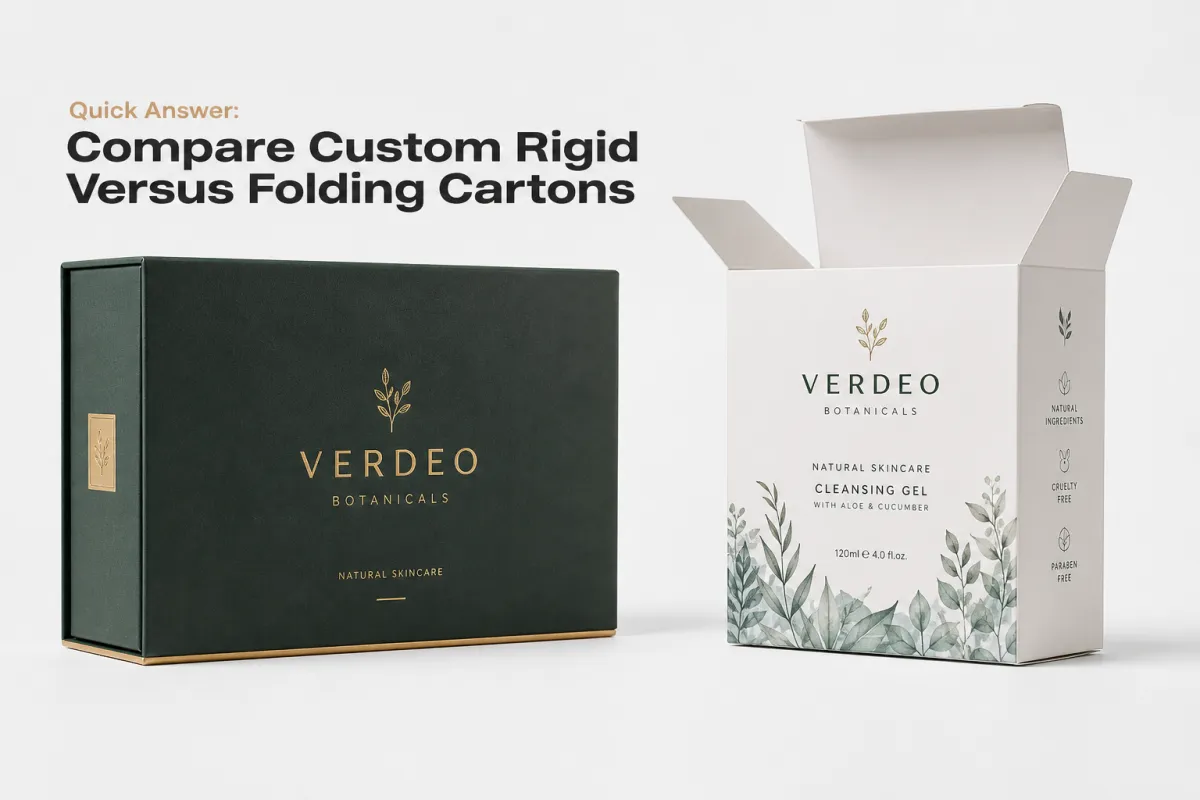
If you compare custom rigid versus folding cartons by feel alone, rigid usually comes out ahead. It has more weight in the hand, a cleaner sense of structure, and a presentation style that makes the product feel more deliberate before anyone even sees what is inside. The trouble starts when the packaging has to move through a real supply chain. Freight, storage, assembly, and damage risk can change the answer fast, and the most premium-looking option is not always the smartest one for the business.
The short version I give buyers is straightforward: rigid cartons tend to win on premium perception, structure, and presentation, while folding cartons usually win on cost control, speed, and shipping efficiency. Neither format is automatically better. The right choice depends on the product, the sales channel, and the job the carton has to do beyond simply holding the item.
Cosmetics, apparel, electronics accessories, gifts, and retail kits usually make the decision easier. If the carton itself needs to create a luxury moment, or the product needs more protection than a light paperboard structure can reasonably provide, compare custom rigid versus folding cartons with rigid near the top of the list. If the goal is practical retail packaging that ships flat, runs efficiently, and keeps unit cost under control, folding cartons usually make more sense.
Teams sometimes decide too early. They choose based on shelf appearance and only discover later that the “premium” package added hidden cost in handwork, larger carton dimensions, transit damage, or warehouse space. A better way to compare custom rigid versus folding cartons is to look at the whole system: fit, pack-out speed, freight, damage allowance, and the amount of branded packaging needed to support the price point.
A carton should earn its place in the program. If it looks beautiful but creates labor pain, higher freight, or avoidable damage, the packaging design is working against the business instead of supporting it.
That is the lens I use throughout this review. No hype. No sales pitch. Just a practical way to compare custom rigid versus folding cartons and choose the format that fits the work.
Top Options Compared: Custom Rigid Versus Folding Cartons
To compare custom rigid versus folding cartons with any real accuracy, it helps to separate them into three practical formats: a premium rigid setup, a standard folding carton, and a reinforced folding carton. They solve similar problems, but they do it in very different ways.
Premium rigid cartons are built from thick chipboard, often around 1.5 mm to 3 mm depending on the project, then wrapped with printed paper or specialty stocks. That construction gives the package real stiffness. You feel it before the lid lifts. Corners stay square, crush resistance is stronger than with lighter board, and the box carries the kind of visual weight people connect with premium packaging.
Standard folding cartons are usually made from paperboard such as SBS, C1S, or coated kraft in the approximate range of 14 pt to 28 pt, depending on the product and the strength needed. They are die-cut, scored, glued, and shipped flat. That flat-pack format is a major advantage for warehousing, freight, and assembly speed. For many custom printed boxes, that difference is what separates a tidy packaging program from one that keeps creating hidden handling costs.
Reinforced folding cartons sit between the two. They may use heavier board, insert trays, internal partitions, or a sleeve-and-tray structure to improve presentation and protection. They do not feel as substantial as rigid packaging, but they can get much closer than a basic tuck box. In real production work, this middle option deserves more attention than it usually gets.
Structure is only part of the story. Compare custom rigid versus folding cartons on locking styles and the gap becomes clearer. Folding cartons can use tuck ends, auto-lock bottoms, snap-lock bottoms, or crash-lock styles. Each one changes pack speed and load capacity. Rigid boxes do not depend on those same folds; instead, they rely on board thickness, wrapped corners, and inserted trays or magnets to keep their shape. That is why rigid cartons feel more architectural, while folding cartons feel more like precision-made retail packaging.
Brand perception follows structure very closely. A rigid box adds perceived value quickly because it slows the hand and creates a small moment of anticipation. Folding cartons can still look excellent, especially with good printing, foil, embossing, or matte lamination, but the hand feel is different. Buyers notice the difference even when they cannot put it into words. In branded packaging, those small cues matter.
Most common use cases stay fairly predictable:
- Rigid cartons: luxury cosmetics, jewelry, premium gift sets, electronics accessories, presentation kits, and seasonal gifting.
- Folding cartons: mass retail SKUs, ecommerce inserts, subscription items, pharma-adjacent consumer goods, and lightweight consumer products.
- Reinforced folding cartons: mid-market cosmetics, limited editions, and products that need better protection without the cost of a full rigid build.
If you compare custom rigid versus folding cartons at this level, the question stops being “which looks nicer?” and starts becoming “which structure supports the brand, the handling process, and the margin?” That is the better packaging design question.
Detailed Reviews: What We Look For in Rigid and Folding Cartons
When I compare custom rigid versus folding cartons in real production terms, I look at five things first: protection, print quality, assembly, customer experience, and disposal. Those details decide whether the carton actually works after the proof looks good on screen.
Protection and structural behavior
Rigid cartons are strong where they need to be strong. Corners resist crushing better, walls stay square, and the box keeps its shape even with heavier inserts or fragile contents. That matters for products like glass bottles, delicate accessories, small electronics, and gift sets with multiple components. A rigid carton also gives more confidence when the product is handled repeatedly in store or during fulfillment.
Folding cartons can protect well too, but only if the board choice, score pattern, and inserts are designed correctly. A 24 pt or 28 pt carton with a proper interior insert can do a solid job for lighter products. Once the item gets heavy, unevenly shaped, or likely to shift in transit, the box may need reinforcement. Otherwise, the customer can feel movement inside the package, and that undermines the experience very quickly.
For performance testing, I like seeing whether the package has been considered against real shipping conditions. ISTA testing methods are useful here, especially for ecommerce and distribution-heavy programs. If a box has not been checked against actual drop, vibration, and compression risks, you are guessing. The International Safe Transit Association explains those test frameworks clearly at ISTA, and that kind of reference is worth using before a run scales up.
Print, finish, and surface feel
This is where compare custom rigid versus folding cartons gets more nuanced, because both formats can look excellent if the finishing is done well. Folding cartons often deliver a very clean print surface and can take matte or gloss varnish, soft-touch coating, foil stamping, embossing, debossing, and spot UV without much trouble. For some cosmetic cartons, a well-made folding carton can look every bit as desirable as a rigid one from a short distance away.
Rigid cartons open the door to a different kind of finish strategy. Specialty wraps, deeper embossing, magnetic closures, ribbon pulls, and layered reveals are easier to use as part of the presentation. The package becomes part of the product story. That is why premium gift packaging and luxury launches often lean rigid: the finish options do not just decorate the box, they shape the unboxing ritual.
If sustainability messaging matters, finish choices deserve attention too. Heavy coatings and mixed materials can complicate recycling, so it makes sense to ask suppliers about substrate options and end-of-life guidance. The EPA has useful packaging and waste reduction resources at epa.gov/recycle. A responsible packaging program is not only about the first impression; it is also about what happens after the box is opened.
Assembly, labor, and pack line reality
This is the part that gets underestimated most often. Rigid cartons usually arrive pre-assembled or semi-assembled, but they still need more handwork, more careful inspection, and often more controlled packing. Folding cartons, by contrast, are designed for efficient shipment and fast conversion on the line. They ship flat, stack tightly, and are usually easier to store before use.
That labor difference matters. If a program needs thousands of units packed every day, a rigid structure can become a bottleneck unless the line is set up for it. If the packaging has to be assembled, loaded with inserts, closed, and handled by a small team, time adds up quickly. For many retail packaging programs, that is where folding cartons win quietly and decisively.
Customer experience and disposal
People remember how packaging feels to open. That is not marketing fluff; it is real buying behavior. A rigid box creates pause, anticipation, and a more deliberate opening process. Folding cartons create less ceremony, but they are lighter, easier to flatten, and usually less wasteful in the customer’s hands. For some buyers, that simplicity is exactly what they want.
Excess packaging can turn into a negative if it looks wasteful or overly engineered. A premium package should feel intentional, not bloated. Compare custom rigid versus folding cartons with that mindset, and the “best” option often becomes the one That Feels Honest for the product instead of overbuilt for the shelf.
For reference, FSC-certified paper and board can be a useful part of the conversation if your brand wants stronger sourcing signals. You can review the program at fsc.org. Certification is not a substitute for good design, but it does support the story when the materials are chosen carefully.
Price Comparison: Custom Rigid Versus Folding Cartons
Price is usually the deciding factor, so compare custom rigid versus folding cartons with full landed cost in mind, not just quoted unit price. The sticker number on the carton is only part of the equation. Board, print coverage, coatings, inserts, packing method, freight, and order quantity all affect what the program really costs.
Rigid cartons usually carry a higher unit cost because the structure uses more material and the conversion process takes more labor. Folding cartons are normally cheaper per unit, especially on longer runs, because they use less board, ship flat, and can be converted faster. Even so, a rigid carton can still make business sense if it increases perceived value enough to support a higher retail price or lower damage rate.
Here is a practical comparison that buyers can use as a starting point. The numbers are realistic ranges, not promises, because final pricing changes with size, print coverage, insert complexity, and region. Even with those variables, the ranges are close enough to help you compare custom rigid versus folding cartons in the right way.
| Format | Typical Unit Cost at 5,000 Units | Common Strength | Main Tradeoff |
|---|---|---|---|
| Premium rigid carton | $1.10-$3.50 | High perceived value, strong presentation, better corner stability | Higher labor, larger shipping volume, longer production cycle |
| Standard folding carton | $0.18-$0.65 | Low cost, flat shipping, fast assembly, scalable retail use | Less structural presence, may need inserts or heavier board |
| Reinforced folding carton | $0.35-$1.10 | Balanced cost and structure, better for mid-market presentation | Still less premium than rigid, finish options can be more limited |
Those numbers can move quickly with add-ons. A soft-touch lamination, foil stamp, embossing, or custom insert can push a folding carton up in price. A rigid box with specialty wrap, magnetic closure, or fabric pull can climb even faster. That is why a side-by-side price quote is not enough. You need to compare custom rigid versus folding cartons with the full spec sheet in hand.
The real savings in folding cartons often show up outside the box itself. Flat-pack freight is cheaper. Storage takes less space. Packing labor is simpler. On a high-volume program, those savings matter more than people expect. I have seen a carton that looked “cheaper” on paper end up costing more overall because the rigid version required more warehouse handling and more manual assembly than the team had planned for.
There is also a volume threshold to consider. Small runs can make rigid pricing look especially steep because setup and handwork are spread across fewer units. Folding cartons tend to scale more gracefully. For larger retail orders, the gap usually widens further in favor of folding cartons, unless the premium presentation is central to the product strategy.
If you are comparing custom rigid versus folding cartons for a launch, ask for more than a carton quote. Ask for tooling, insert costs, proofing charges, sample fees, and freight estimates to the warehouse or fulfillment center. Then compare landed cost per shipped unit. That is the number that actually affects your margin.
Process and Timeline: From Dieline to Delivery
Timeline is another place where compare custom rigid versus folding cartons can change the answer completely. A beautiful box is not very useful if it misses the launch window. In practice, folding cartons often move faster because the production flow is simpler, while rigid cartons usually need more time for assembly and finishing.
Folding carton workflow
A folding carton project typically starts with structural design and dieline approval, then moves to artwork, prepress, printing, die-cutting, gluing, and final packing. If the specs are straightforward, the timeline can be fairly efficient. Many folding carton jobs can land in roughly 10 to 20 business days after proof approval, though complexity, quantity, and finish choices can extend that.
Because folding cartons ship flat, they are easier to move in bulk. That often reduces freight cost and makes receiving simpler. If the project is tied to retail distribution or ecommerce fulfillment, those advantages are not minor. They often decide whether the box is operationally friendly or just visually attractive.
Rigid carton workflow
Rigid cartons usually involve a longer path. After the structure is finalized, there is printing, cutting, wrapping, board forming, corner folding, insert integration, and quality checking. Some programs also need more careful prototyping because the internal tolerances matter. If the lid is too loose or the tray is too tight, the whole feel of the carton changes.
That extra build time means rigid cartons often need a longer production window, frequently 15 to 30 business days or more depending on the style and the finishing package. Hand assembly and specialty wrapping are the main reasons. They are also the reason rigid cartons feel premium in the first place, so the extra time is not accidental; it is part of the format.
What affects the schedule most
Compare custom rigid versus folding cartons with these schedule drivers in mind:
- Custom inserts: Foam, molded pulp, or complex paperboard trays can add both design time and assembly time.
- Special finishes: Foil, embossing, spot UV, and specialty lamination often create extra proofing steps.
- Imported materials: Certain boards, wraps, and decorative stocks may need longer sourcing windows.
- Proofing cycles: The more revisions required, the more launch risk you carry.
- Testing: Compression, drop, and transit testing can save a program, but they also add calendar time before full production.
For packaging buyers, this is where patience pays off. A rushed rigid project can become frustrating if the sample stage is skipped. A rushed folding carton can also fail if the board is too light for the product. Good packaging design is often the result of one more proof, not one less.
How to Choose the Right Carton for Your Product
The best way to compare custom rigid versus folding cartons is to match the box to the product and the channel. There is no universal winner. A carton that works beautifully for a luxury serum may be a poor choice for a fast-moving apparel accessory, and the reverse can be true as well.
Start with product weight and fragility. If the item is heavy, breakable, or irregularly shaped, rigid structure or a reinforced folding carton may be the safer choice. For lightweight products, a standard folding carton can often do the job well with the right board and insert. A 12 oz product is not the same as a 3 lb product, and the carton should reflect that difference.
Next, look at the retail price point. Higher-price products usually have more room to absorb premium packaging, especially if the carton contributes to perceived value. Lower-price products often need tighter unit economics, so a folding carton tends to protect margin better. That does not mean the carton should look cheap. It means the design should spend money where it changes the outcome.
Channel matters too. In ecommerce, flat-shipping efficiency and pack-out speed can matter more than a dramatic opening moment. In retail, shelf impact and tactile feel may be more important. For gifting and launches, the package itself may be part of the purchase decision. Compare custom rigid versus folding cartons with that channel logic, and the answer usually becomes clearer.
Storage and sustainability should also sit in the decision. Folding cartons use less warehouse space and generally create less volume in transit. That can reduce freight emissions simply because more units fit in less space. Rigid cartons use more material and more cubic volume, which is not necessarily wrong, but it should be intentional. If your brand is working toward smarter packaging design, the format should support those goals instead of fighting them.
Here is a simple decision framework that helps most buyers:
- Define the product: weight, dimensions, fragility, and whether the item needs an insert.
- Set the target economics: unit cost, landed cost, and acceptable damage rate.
- Choose the channel: retail, ecommerce, subscription, gifting, or mixed distribution.
- Review the brand role: does the box need to sell the experience or just protect the product?
- Request samples: compare the physical feel before locking the run.
That last step saves many teams from bad assumptions. A rendered image can make a folding carton look almost as substantial as a rigid box. Real paper, real board, and real hand feel tell the truth quickly. I always trust the sample more than the spec sheet, because the sample shows how the carton behaves in human hands.
If you need a broader packaging menu while you compare custom rigid versus folding cartons, it is worth reviewing Custom Packaging Products to see what structures and finishing choices are available. Seeing the options side by side often makes the decision easier than staring at quotes alone.
Our Recommendation After You Compare Custom Rigid Versus Folding Cartons
After you compare custom rigid versus folding cartons across structure, cost, lead time, and customer experience, my recommendation is direct. Use rigid cartons when the package has to carry a premium signal, protect a delicate item, or create a memorable opening moment that supports a higher price point. Use folding cartons when budget discipline, faster production, flat-shipping efficiency, and easier scaling matter more than a luxury presentation.
That sounds simple, but the best programs make the decision with numbers, not instinct. A rigid carton can absolutely be the right move for premium cosmetics, jewelry, limited-edition gifts, and presentation-heavy kits. Folding cartons can be the smarter move for retail SKUs, subscription goods, and ecommerce products that need dependable, efficient product packaging without the weight and cost of a full rigid build.
If you are still undecided, compare custom rigid versus folding cartons with this short checklist:
- Measure the product and confirm whether it needs internal support.
- Decide how much the box must contribute to package branding.
- Set a target landed cost per unit, not just a carton price.
- Ask for structural mockups and printed samples.
- Check the timeline against your launch date before you approve the final spec.
There is no shame in choosing the simpler option if it does the job cleanly. In fact, some of the best retail packaging is the kind that disappears into the product experience and never creates operational friction. The opposite can be true as well: if a rigid box transforms the perceived value of the item, it may pay for itself in margin and customer response.
My honest take after years of watching packaging programs succeed or stumble is this: compare custom rigid versus folding cartons by looking beyond the mockup. Study the sample, the freight number, the assembly process, and the actual shelf or shipping context. Then choose the carton that fits the product, protects the margin, and tells the right story. If you do that, compare custom rigid versus folding cartons becomes less of a debate and more of a smart, confident packaging decision.
When should I compare custom rigid versus folding cartons for a new product launch?
Start the comparison before structural design is finalized, because board choice, insert style, and finish options can change both cost and lead time. If the launch depends on premium perception or fragile product protection, rigid cartons deserve early attention. If speed and cost control are the priority, folding cartons should stay on the shortlist from day one.
Are custom rigid cartons always better than folding cartons?
No. Rigid cartons usually look and feel more premium, but folding cartons often deliver better value for everyday retail, ecommerce, and high-volume programs. The better choice depends on product weight, sales price, shipping method, and how much brand impact the package needs to create.
Which option is cheaper when I compare custom rigid versus folding cartons?
Folding cartons are usually cheaper per unit, especially at larger quantities and when the design can ship flat. Rigid cartons can still be justified when the premium presentation supports higher margins, lowers damage costs, or improves the customer experience enough to influence repeat buying.
How do lead times differ between rigid and folding cartons?
Folding cartons are often faster because they require fewer assembly steps and can be packed flat for shipment. Rigid cartons usually take longer because they involve board construction, wrap application, and more finishing labor. Special inserts and decorative finishes can extend either format, but rigid usually has the longer path.
What product types fit rigid cartons better than folding cartons?
Rigid cartons are a strong fit for luxury cosmetics, gift sets, electronics accessories, jewelry, and presentation-heavy kits. They are especially useful when the box itself needs to feel substantial and elevate the perceived value of the product inside. If the structure has to contribute to the sale, rigid usually earns its place.

