Buyer Fit Snapshot
| Best fit | compare edible packaging vs reusable trays choice for packaging buyers comparing material specs, print proof, MOQ, unit cost, freight, and repeat-order risk where brand print, material, artwork control, and repeat-order consistency matter. |
|---|---|
| Quote inputs | Share finished size, material target, print colors, finish, packing count, annual reorder estimate, and delivery region. |
| Proofing check | Approve dieline scale, logo placement, barcode or warning zones, color tolerance, and any recyclable or compostable wording before bulk production. |
| Main risk | Vague material claims, crowded artwork, or missing packing details can create delays even when the unit price looks attractive. |
Fast answer: Compare Edible Packaging vs Reusable Trays Choice: Material, Print, MOQ, and Cost should be specified like a repeatable production item. The safest quote includes material, print method, finish, artwork proof, carton packing, and reorder notes in one written spec.
What to confirm before approving the packaging proof
Check the product dimensions against the actual filled item, not only the sales mockup. Ask for tolerance on folds, seals, hang holes, label areas, and retail display edges. If the package carries a logo, QR code, warning copy, or legal claim, reserve that space before decorative graphics fill the panel.
How to compare quotes without losing quality
Compare board or film grade, print process, finish, sampling route, tooling charges, carton quantity, and freight assumptions side by side. A lower quote is only useful if the supplier can repeat the same color, closure quality, and packing count on the next order.
Compare Edible Packaging vs Reusable Trays: Quick Answer
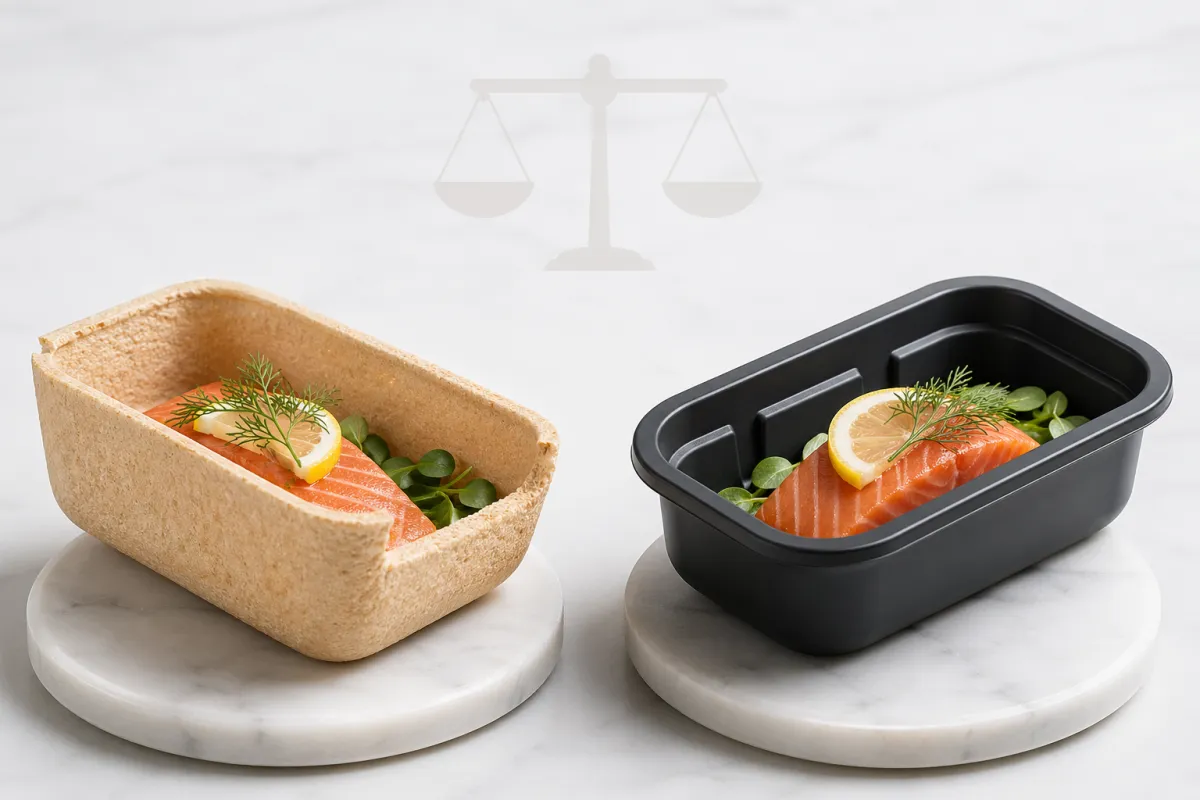
The blunt, practical answer
Most teams compare edible packaging vs reusable trays by staring at renders, not by running food through an actual shift. Pretty picture. Bad reality check. The kitchen usually wins. If you want a straight answer, reusable trays usually win on durability, food safety control, and cost per use. Edible formats can be sharp and memorable, but they are a narrow tool. They are not a clean substitute for reusable food containers or returnable trays across the board.
The part people skip is the failure pattern. Edible packaging can wreck the sustainability story if it cracks, softens, or gets tossed before anyone eats it. Then you get waste plus a weird marketing problem. In several pilots I reviewed, edible parts started failing once hold time crept past two hours. The reusable tray kept doing its job. Not glamorous. Very useful. That is the annoying truth.
When I compare edible packaging vs reusable trays, I start with the weak point, not the design board. Is the product hot, wet, greasy, or moving through a long line? Reusable trays usually make more sense. Is service tight, immediate, and built around a timed reveal? Edible may fit. That split separates clever branding from foodservice packaging that can survive service without falling apart halfway through lunch.
People also like to pretend reusable trays are endlessly expensive and edible packaging is magically cheap. Cute story. Not true. Reusable systems have upfront cost, yes, but they pay back when utilization is planned correctly. Edible packaging can look inexpensive at first and then get ugly once moisture failures, rework, and customer complaints show up. I have watched teams learn that lesson the expensive way.
The real compare edible packaging vs reusable trays question is control. Heat, moisture, stackability, breakage, washback, labor, and customer handling confidence matter more than the sales deck. If your distribution is one-way and there is no return loop, edible can be operationally safer. If you already run a managed return flow, reusable trays are usually the calmer choice.
Short version: edible packaging works best when the package is part of the experience and the timing is tight. Reusable trays work best when service repeats, handling is messy, and the operation needs fewer surprises. That is the split I trust.
Which Is Better for Hot, Wet, or Greasy Food?
If the food is hot, wet, oily, or likely to sit before it is eaten, reusable trays are usually the better choice. That is not a cute opinion. It is basic material behavior. Edible packaging tends to lose structure when moisture migrates into the contact surface, especially in real service conditions where staff are moving fast and nobody is timing the plate with a stopwatch.
For soups, saucy entrees, yogurt cups, and greasy snacks, compare edible packaging vs reusable trays by asking one question: how long does the product need to stay stable before consumption? If the answer is longer than a short service window, reusable trays are the safer call. If the answer is a tight, staged reveal with immediate consumption, edible packaging can still work.
Compare Edible Packaging vs Reusable Trays: Top Options
What people actually buy as edible packaging
"Edible packaging" sounds neat until you have to buy it. In practice, it comes in four formats: edible cups, snack shells, edible liners, and edible portion packs. Each behaves differently, and compare edible packaging vs reusable trays only makes sense if you compare the exact food behavior you expect. Otherwise you are just arguing about buzzwords.
Edible cups are usually used for sugar or dough-based wraps around frozen treats, dry snacks, and some dessert builds. They handle short heat exposure, then start losing shape once condensation shows up. I usually test edible cups at 65 C for 10-15 minutes if there is warm topping or sauce contact. After that, rim integrity drops fast. At room humidity above 60%, many samples soften in under an hour. That may be fine for a controlled tasting. It is a headache for a long service window.
Snack shells work well for short bites and sample formats. Dry centers are the sweet spot: nuts, chocolates, dry muesli, spice blends. They do fine in controlled tastings, but they hate oils above about 8-12% by weight near the contact surface. Greasy foods push them into failure faster than the brochure admits.
Edible liners are usually thin film layers for deli wrappers and small portion wraps. They are not flashy, which probably explains why sales decks love to ignore them. Still, they can be useful for tiny sealed bites. Moisture control matters a lot. Put one on a wet burger or sauce-heavy snack and you will get sogginess before service ends.
Edible portion packs are the most misunderstood option. They can be strong for tiny condiment packs, spice kits, and dry topping bundles. Storage is the problem. If your facility sits around 70% RH and products live in ambient storage longer than 90 minutes, a lot of these packs fail quietly. Quietly is the worst kind of failure because everyone argues about what happened after the fact.
Reusable tray materials you actually see in production
Reusable trays are not one material either. The meaningful options are polypropylene (PP), rPET, stainless steel, and molded fiber with return systems. Each has a different relationship with cycle life and line behavior. That is why compare edible packaging vs reusable trays has to start with material reality, not brand narrative.
Polypropylene (PP) is the workhorse. Foodservice teams choose it because it handles thermal shock better than many plastics, tolerates dishwashers, and survives light to medium stack loads. In real use, a good PP tray can run 100-300 cycles in moderate service; many teams push 400 if rotation and sanitation are disciplined. Its weak point is edge scratching when people treat it like a crate.
rPET (recycled PET) gets pulled into the conversation for clarity, presentation, and sustainability messaging. It feels more premium, and buyers often accept a higher unit Price for Recycled content claims. Check supplier paperwork carefully. If the recycled-content claim is fuzzy, ask for proof. Heavy impact loads can also dent rPET sooner than PP.
Stainless steel is the heavy-duty option. Hospitals, airlines, and high-acuity kitchens use it because hot holding and rough handling are routine. A well-managed stainless tray can exceed 1,000 cycles. It also takes high-temperature wash cycles and sanitizer exposure without much drama. The downside is weight and upfront spend. If your team is small, the labor hit is real because steel is slower to move.
Molded fiber with return systems fits premium hospitality and image-led retail packaging setups. The upside is lighter weight and a natural feel. The downside is moisture sensitivity and shorter clean/wipe loops. Repeated wet wash cycles can pull service life down to around 50-150 uses depending on coating and handling. In tightly controlled programs, it can still work, but I would not call it forgiving.
Now the picture is cleaner. Edible cups, shells, liners, and portion packs are not bad. They just need narrow use. PP, rPET, stainless, and molded fiber are not exciting. They are reliable because they behave predictably, and honestly, that is what most operators need.
Detailed Reviews: Compare Edible Packaging vs Reusable Trays by Use Case
1) Short-service moments where packaging is part of the experience
Edible packaging has a real case here. If service is short, visual, and controlled, the edible form makes the product feel playful and premium without needing much explanation. Product launches fit. Samples fit. Festival activations fit. One-bite portions fit because the container is consumed with the item. That matters. The package becomes part of the memory instead of a separate object to manage later.
Controlled launches with timed distribution and no cold-chain mess are where edible shells and liners feel natural. If the hold window is under 30 minutes and staff know how to hand off carefully, edible formats can work without turning the shift into a small disaster. If an event manager wants "wow factor," edible can deliver that faster than a tray swap and a brand story.
Airline-style premium service and theatrical retail activations can also use edible concepts if staff are briefed on portion sizing and every station follows the same script. Discipline matters. If 20 people are touching the same product in a rush, the learning curve gets steep, and edible components start collecting complaints. That is not a design failure. That is an operations failure wearing a design hat.
2) Where edible packaging falls apart fast
High-moisture foods are the trap. Wet sauce, broth, yogurt, and oil-heavy fillings make edible packaging risky quickly. If the contact area is large and the product sits against the edible surface for more than 20-30 minutes, the wrapper or liner can weaken, rupture, or transfer flavor. Nothing ruins a launch faster than guests tasting the package.
Greasy snacks with edible shells often turn dull or unstable after one service window. Outdoor pop-ups and air travel are even worse because temperature swings and humidity spikes do what they always do: they ignore your brand guidelines. In a photo, the package looks perfect. In actual service, it sags. I call that the hand test failure. If a courier cannot carry a portion in one hand without deformation, the format is not stable enough.
Long holding times are the silent killer. Teams often design an edible format for 45 minutes, then leave it on a line for 90 minutes because service got delayed. By then the package is stale, wet, or broken. In compare edible packaging vs reusable trays conversations, I keep asking one question: who controls holding time? If nobody can answer with a process gate and enforcement, edible is usually the wrong move.
3) Reusable trays in repeated service
If your menu runs every day, every shift, and the operation needs reliability, reusable trays are the backbone. Hospitals, schools, corporate cafeterias, meal subscriptions, and high-volume caterers all benefit from predictable cycle systems. A tray that returns, gets cleaned, dries, and re-enters service is not exciting. It is just useful. That counts for a lot.
Hospitals show this clearly. Meals are hot, mixed, and loaded on a strict rhythm. One tray failure means delay, not a branding moment. Stainless and heavy-duty PP give the control needed. I see fewer tray-related issues when facilities map wash stations, dry times, and return bins before service starts instead of after the first complaint.
Corporate cafeterias look similar. They need stackability, fast rehandling, and high throughput. A 4x daily turnover target is common in larger programs because breakage and shrinkage are part of the math. Reusable trays also help teams reduce contamination risk when sanitation is consistent and documented. That matters when IT systems track meal counts and allergen separation.
4) Operational tradeoff in plain terms
Reusable trays need discipline. Tracking, cleaning, storage. If you do not have space, staff, or process ownership, reusable can get messy even if the engineering is solid. Edible packaging asks for a narrower set of conditions and gives you less margin for error. That is often the opposite of how real operations behave.
Plain version: reusable trays are harder to run, but edible packaging is easier to fail. That is why this is a procurement question, not a creative one. A design brief cannot fix bad handling rules. You need the packaging choice to match the food, the labor model, and the timing.
Most brands do not fail on creativity. They fail on assumptions. Pick the wrong logic, and even a beautiful sample turns into a problem the minute service starts.
So if you are comparing edible packaging vs reusable trays, use one rule early: the best option is the one that still works at 6 p.m. The 10 a.m. photo shoot is not the business.
Price Comparison: Compare Edible Packaging vs Reusable Trays
| Option | Typical Unit Cost (USD) | Useful Service Life | What It Does Best | Main Cost Risk |
|---|---|---|---|---|
| Edible cup | $0.55 - $1.20 | One service (single use) | Short, controlled presentations | Moisture failure, food compatibility |
| Edible portion pack | $0.40 - $1.10 | One service (single use) | Dry portions, sampling bundles | Breakdown from heat, grease, humidity |
| Snack shell | $0.30 - $0.85 | One service (single use) | Tastings and novelty bites | Short shelf life, brittle edges |
| Stock polypropylene tray | $0.45 - $0.95 | 100-300 cycles | General food service, high rotation | Scratches, breakage, wash losses |
| Custom PP tray | $1.10 - $3.20 | 150-350 cycles | Branded fit and packaging consistency | Higher setup cost and lead time |
| Stainless tray | $3.50 - $12.00 | 500+ cycles | Heavy handling, hot-fill durability | Weight, higher handling labor |
| Molded fiber tray with coating | $0.60 - $1.80 | 50-150 cycles (cleaned) | Premium visual appeal and lighter unit feel | Moisture and chemical wash compatibility |
That table covers part of it, not all of it. Compare edible packaging vs reusable trays on total cost by looking past the sticker price. Edible formats often start above standard disposables because the package is doing functional work and marketing work at the same time. Reusable trays usually feel pricey upfront, then get cheaper as cycle counts rise.
Let’s do real math. Say you run 10,000 services per month and compare:
- Edible format at $0.90 average unit: $9,000/month direct material spend.
- Reusable PP custom tray at $2.20 each with 200-cycle performance: need 50 trays for 10,000 uses if fully rotated, plus 20% safety stock and spoilage allowance = 60 trays on hand.
Amortize those 60 trays across 200 cycles and the tray pool lands near $0.0066 per use before labor and utilities. Add washing labor, utilities, and losses, and reusable often lands around $0.14-$0.31 per use in mature systems. That is the part people forget when they pretend a tray is "expensive." The tray is not the whole system. The system is the whole system. Funny how that works.
Is edible suddenly cheaper? Not usually, unless holding time is tiny and volume is small. Some teams still choose edible because they are not building circulation infrastructure. In a 2,000-unit one-off launch, edible can cost exactly what they want because there is no return loop to fund and no tray storage plan to design. Once volume and frequency go up, reusable economics change fast.
Hidden costs buyers forget
For reusable trays, hidden costs are usually obvious only after the budget is already approved:
- Breakage and loss: if 2%-7% of trays never return, the cost shows up fast.
- Return logistics: staff time, collection bins, shuttle transport, and scanning.
- Sanitation: detergent, sanitizer, water heating, and water-softening in mineral-heavy sites.
- Drying and storage: floor space and queue control in kitchen operations.
- Replacement stock: emergency buffer for peak service and shrinkage.
For edible packaging, hidden costs are less visible and just as annoying:
- Product failure: soggy wraps and broken shells rejected by customers.
- Menu redesign: ingredients and portion formats changed to survive the package.
- Returns: unused edible materials expired or discarded.
- Inconsistent supplier quality: one ingredient shift can ruin batch stability.
That is why the real finance question is cost per usable service. If a reusable tray returns 20 times, one answer. If it returns 100 times, another. If it returns 1,000 times, the math gets even easier. Comparing edible packaging vs reusable trays through unit price alone is how people make expensive mistakes with confidence.
My quick rule: if estimated return and wash reliability is above 92%, reusable tends to win at volume; if reliability drops below 85%, the savings evaporate fast. That number comes from field work, not a glossy brochure with a recycled-paper cover.
Process and Timeline: Compare Edible Packaging vs Reusable Trays
Edible packaging timeline: validation is where margins live
Compare edible packaging vs reusable trays teams often get the timeline wrong. They assume edible launches faster because nothing gets washed. Not always. Edible projects can take longer because the validation work is real. A realistic timeline looks like this:
- Sample development: 10-14 days for concept mockups.
- Moisture and heat stability testing: 7-14 days, including 2-4 hour and 24-hour hold tests.
- Line trial and adjustment: 1-2 production runs.
- Regulatory review (contact compliance, allergen matrix): usually 1-2 weeks depending on complexity.
That puts many edible packages at 3-8 weeks before production confidence shows up. If the ingredient blend changes, say sugar ratio, binder, or fat content, the tests may need to run again. That is normal. If your team cannot tolerate that timeline, edible packaging can become a project trap.
You also need to measure behavior after the first two hours, not just when it leaves the mold. Moisture migration is delayed failure. I have seen products pass initial checks and fail before the event even starts. If shelf-life claims are real, test 4-hour, 8-hour, and 12-hour points under real line conditions. Packaging likes to behave until nobody is looking.
Reusable tray timeline: predictable, but setup still matters
For reusable trays, the timeline depends on stock size versus custom size. Stock reusable trays can move in as quickly as 5-12 business days at many suppliers, including basic cleaning and labeling setup. Custom tray systems usually run 4-8 weeks. Tooling, dimensional sign-off, and documentation add time. If you need custom stack geometry, plan for the longer lead from the start.
Typical setup includes:
- Material selection and load test: 3-5 days.
- Wash-cycle compatibility pilot: 1-2 weeks.
- Return logistics mapping: 3-7 days of internal implementation.
- Real breakage pilot: 1-2 weeks under actual handling conditions.
If your distribution touches multiple sites, add transit testing. Use ISTA-aligned drop and vibration checks if service sees rough handling. For recycled claims and packaging language, keep supplier documentation clean from day one. Missing cycle documentation can stall the schedule faster than a bad meeting.
Commercial reality check: what process mistakes cost
Both paths can fail. The difference is usually where. Edible fails in product science. Reusable fails in execution. Skip pilot testing and you are gambling. Skip tracking and staff instructions and you are gambling too. A compare edible packaging vs reusable trays decision is not done until the full team runs a pilot, not just QA in a conference room.
Operational errors cause most post-launch issues, not supplier defects. If your staff does not get clear handling SOPs, the best option fails. If they do, either path can work. I prefer process clarity before design novelty because packaging cannot fix missing instructions. It has enough trouble behaving on its own.
For compliance-minded buyers, bring standards in early. On the edible side, verify food-contact suitability and any compostable packaging or biodegradation claims with recognized documentation. For recycled reusable systems, align claims with chain-of-custody evidence and post-market controls. That keeps legal and reputational noise out of your week later.
Skipping pilot verification is like trusting a machine you have never run. It might work. It might not. And if it does not, you still pay for it.
How to Choose After You Compare Edible Packaging vs Reusable Trays
Decision filter you can actually use
Start with the filter, not the mood board. If the food is wet, hot, greasy, or handled multiple times, reusable trays usually make more sense. If the service window is short, controlled, and built around presentation, edible packaging can be the better tool. If your operation cannot control humidity, storage, or handoff time, edible gets expensive quickly.
Use these thresholds as a baseline:
- Service temperature: above 50 C for more than 15 minutes with edible contact lowers success probability a lot.
- Holding time: more than 30-45 minutes before consumption is a red flag for edible.
- Handling events per unit: if a unit changes hands more than twice, reusable trays usually reduce risk.
- Stacking density: if you need high stack loads for transport, edible packaging is often less safe.
- Return and wash capacity: if you cannot collect and clean reliably, reusable may not be ready.
The logic is not "green wins" or "reusable always wins." The logic is "failure cost is lower for your specific distribution profile." That is the bit that keeps procurement teams from making expensive choices with a straight face.
Check your own operation first
Before choosing, check your own house. Do you have washing capacity? Do you have return logistics? Is there floor space for staging wet trays? Can staff follow check-in and check-out discipline? If any answer is no, edible packaging may look tempting. Tempting is not a plan.
If you do have washing, storage, and returns, compare edible packaging vs reusable trays with the confidence of scale. A controlled system can absorb the labor and still stay cheaper per use. If you do not, edible can still work for very short-run programs, but do not force it into daily operations because the idea sounded nice in a meeting.
Separate brand goals from hype. If your goal is retail packaging consistency and scalable delivery, reusable trays support organized service much better. If your goal is package branding through a surprise moment, edible can hit harder. Both can work inside a branded packaging strategy. The trick is matching the business model to the format.
Custom print and materials architecture matter too. If your brand wants Custom Printed Boxes style finishes, tray embossing, or color matching for package branding, ask where the graphic complexity affects cleaning and reusability. Too many teams overdesign textures that trap residue. Cleanability comes before aesthetics. Every time.
Operational scoring model
Set up a 10-point score before procurement. Give points for heat resistance, moisture tolerance, cycle life, labor fit, sanitation burden, and claim risk. A format can score well in edible-specific tests and still lose in return-cost tests if the operation is chaotic. A reusable option with strong cycle life can still lose if staff do not follow return rules. That is why compare edible packaging vs reusable trays is a decision model, not a materials list.
In most teams I see, the best next move is a four-week pilot with 2-3 sample options and strict data capture: breakage, hold integrity, customer complaint rate, and labor minutes per service. Then apply the results to volume. Real data beats supplier deck claims every time. Every time means every time.
Our Recommendation: Compare Edible Packaging vs Reusable Trays Before You Buy
What I'd recommend for most ongoing food programs
For most ongoing food programs, reusable trays are the safer buy. That sounds plain because it is plain. They hold up under pressure, scale with volume, and give you control over repeat use. If the plan is daily service, repeat customers, and moderate-to-large throughput, reusable trays reduce total risk. In that setup, they usually beat edible packaging on reliability and per-service cost once volume settles.
For short, controlled events, product launches, and novelty moments, edible packaging can be the better attention grabber. That is especially true when you know exactly who gets the package, how long it sits, and who handles it. A good edible format can make a moment memorable without turning service into a mess.
Still, do not buy the format before validating the operation. Request samples in three variants, run real pilots, and measure:
- Hold time under load.
- Breakage and deformation rate.
- Wash effort and drying time, if reusable.
- Customer acceptance, including taste interference and texture complaints.
Also compare edible packaging vs reusable trays by invoice logic, not vibes: tray cycle count, replacement assumptions, and labor for collection and washing. If you only compare unit cost, you are missing the actual business decision.
Supplier checks I want before signing
Before placing an order, demand clear documentation. For reusable systems, ask for cycle test assumptions, wash compatibility, food-contact certifications, and a replacement policy for non-returns. If the supplier stays vague, walk away or renegotiate. Ask for explicit breakage handling steps, not just polished photos of a tray in perfect lighting.
For edible packaging, ask for shelf-life data, moisture and heat tolerances, and clear use-case notes for each SKU. I want to know where the package is approved to fail and where it should never be used. A good supplier should hand over handling limits and storage conditions, not just a marketing sheet with a nicer font.
If you are building a larger concept, connect the packaging system through Custom Packaging Products. Pairing packaging design with the right service format keeps sourcing from splintering into three separate headaches. For production planning, most teams should run Request a custom quote after pilot tests, not before. If you need a sanity check on fit and throughput, Talk to our team and map the pilot before you spend.
The final decision is not ideological. It is practical: compare edible packaging vs reusable trays against your actual volume, service temperature, cleaning capacity, and damage rate. If those numbers do not support the choice, do not force it. The most durable option is the one your team can actually execute.
Last paragraph: practical rule and closing
Here is the rule I keep coming back to: compare edible packaging vs reusable trays only after you measure your operating reality, because that is where cost, quality, and trust get decided. If your food is hot, moist, and handled more than once, reusable usually wins. If your event is short, curated, and controlled, edible packaging can be a strong experience lever. If you want one rule that cuts regret, pick the option that can run for six months without drama.
FAQ
Is edible packaging or reusable trays better for hot food?
Reusable trays usually win for hot food because they keep shape, tolerate repeated handling, and survive stacking. Edible packaging can work when heat exposure is brief and the filling is not moist or oily. Once serving temperatures and holding times rise, the risk shifts hard toward reusable trays.
How do I compare edible packaging vs reusable trays on cost?
Compare total cost per service, not the sticker price. Reusable costs spread across cycles, but wash, labor, returns, and loss all belong in the model. Edible costs are simple per unit, but product failure and reformulation costs can quietly erase the margin you thought you had.
Which option launches faster: edible packaging or reusable trays?
Stock reusable trays are often quicker if the dimensions already exist, because you avoid major tooling. Custom reusable systems usually need more time than stock trays, though they can still move quickly once specs are locked. Edible packaging often needs more testing for moisture, heat, and shelf stability, which can stretch the timeline.
Can edible packaging replace reusable trays for catering?
Only in tightly scripted, short-run formats where the container is consumed immediately, like tastings, single-bite flights, and novelty promotions. For plated meals, repeatable cafeteria service, or catering logistics with a handoff chain, reusable trays are the more dependable operational base.
What hidden costs matter most when comparing edible packaging vs reusable trays?
For reusable trays, the biggest hidden costs are labor, wash infrastructure, storage space, and unreturned tray loss. For edible packaging, hidden costs include failed runs, rejected portions, and menu changes needed to keep texture and integrity intact. If the supplier pitch sounds too clean, the hidden costs are hiding somewhere else.


