Buyer Fit Snapshot
| Best fit | To Seasonal Carton Illustrations More projects where brand print, material claims, artwork control, MOQ, and repeat-order consistency need to be specified before quoting. |
|---|---|
| Quote inputs | Share finished size, material target, print colors, finish, packing count, annual reorder estimate, ship-to region, and any compliance wording. |
| Proofing check | Approve dieline scale, logo placement, barcode or warning zones, color tolerance, closure strength, and carton packing before bulk production. |
| Main risk | Vague material claims, crowded artwork, missing packing details, or unclear freight terms can make a low unit price expensive after revisions. |
Fast answer: To Seasonal Carton Illustrations More: Board, Finish, Dieline, and Unit Cost should be specified like a repeatable production item. The safest quote records material, print method, finish, artwork proof, packing count, and reorder notes in one written spec.
Production checks before approval
Compare the actual filled-product size with the drawing, then confirm tolerance on folds, seals, hang holes, label areas, and retail display edges. Reserve space for logos, QR codes, warning copy, and material claims before decorative graphics fill the panel.
Quote comparison points
Review material grade, print process, finish, sampling route, tooling charges, carton quantity, and freight assumptions side by side. A quote is only useful when the supplier can repeat the same color, closure quality, and packing count on the next order.
I've spent enough time on factory floors in Shenzhen and Dongguan to know that a guide to seasonal carton illustrations is never just about pretty artwork. The carton has to read fast, survive die-cutting, folding, and gluing on a 350gsm C1S artboard, and still look like it belongs to the brand when it lands on a retail shelf in Osaka, Dallas, or Berlin. One holiday run I watched in Shenzhen used a single illustration, one accent color, and a plain kraft base; it outsold the more ornate version sitting beside it. That job was 8,000 units, the proof cycle took 4 business days, and the simpler box won because a shopper could understand it from 6 feet away without squinting. Honestly, that is the kind of result that makes the extra concept polish worth it.
Most teams think seasonal packaging means sprinkling snowflakes, stars, or hearts across a box and calling it strategy. That usually ends in a noisy carton and a tired production team in Guangzhou. A real guide to seasonal carton illustrations covers timing, board stock, print method, shelf distance, retailer expectations, and the margin math that turns elegant ideas into expensive mistakes. I've watched brands spend $12,000 on concept work and then forget the barcode quiet zone on the back panel, which can add a $900 reprint on a 10,000-piece run. That mistake hurts twice: once in rework, once in lost calendar time. And yes, someone always says, "Can we just move the barcode a little?" like the press in Dongguan has a sense of humor.
I have found the fastest way to waste money is to treat the seasonal version like decoration with no job to do. A smart guide to seasonal carton illustrations turns the box into a timed sales tool: giftable, limited, easy to spot, and still recognizable enough that regular customers do not think the brand changed personalities overnight. The artwork has to work with the carton structure, not fight the folds and seams on a six-panel sleeve or a tuck-end carton that will be packed 2,500 units per master case. I like boxes that behave themselves. Boxes with attitude? Not so much.
What Does a Guide to Seasonal Carton Illustrations Actually Mean?
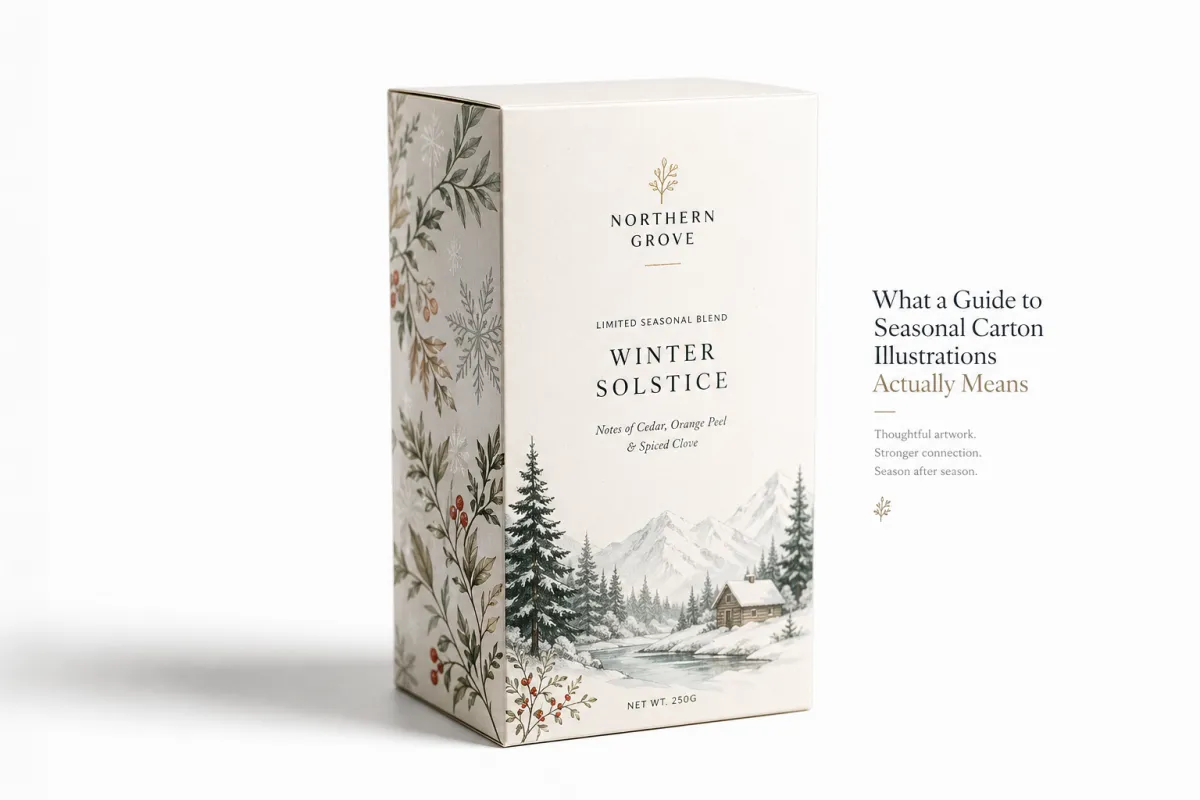
A guide to seasonal carton illustrations begins with a simple idea: artwork shaped around a holiday, season, event, or retail moment so the carton feels current without forcing a full structural redesign. The same container can carry Lunar New Year, Mother's Day, back-to-school, a winter gift set, or a football promotion in one production calendar from Suzhou to California. The form stays familiar. The visual layer changes, and that change does the selling.
Brands use a guide to seasonal carton illustrations because timing matters. A winter scene can add perceived value long before the customer opens the box, especially on a $14.50 skincare set or a $28.00 tea sampler. I've watched buyers in a trade meeting pick up a gift carton in Hong Kong simply because it looked ready to hand over at a dinner table, while a plain version at the same price sat there like it had been left behind in the inventory room. Shelf attention matters. Giftability matters. That sense of limited availability matters even more during peak retail windows like November through January.
There is a clear difference between an illustration, a repeating pattern, and a full packaging redesign. A pattern repeats across panels and can work nicely for background texture, but it can also drift into wallpaper if the motif is too small. A full redesign changes structure, hierarchy, and sometimes the carton size, which brings tool changes, extra prepress checks, and longer lead times from 12 business days to 18 or more. A guide to seasonal carton illustrations helps you Choose the Right degree of change. If the product already has strong brand recognition, a seasonal illustration layer is often enough. If the product is new and the shelf is crowded, the package may need a deeper rethink.
I learned that lesson the hard way in a cosmetics meeting in Guangzhou. The client wanted six holiday icons, two foil colors, and a pattern on every panel. The mockup looked expensive. The folded carton looked like a teenager packed a gift box after midnight. We cut it back to one illustrated ornament, one metallic red, and a 300gsm C1S board, then moved production to a plant near Foshan. The production sample cost dropped by $0.11 per unit at 10,000 pieces, and the final carton finally read as premium instead of noisy. Sometimes the best design move is the one that removes three ideas you were weirdly attached to.
"We thought the busiest design would sell more. The one with the clean illustration moved first." That was a buyer's line from a retail review in a 12-store test across Chicago, Austin, and Seattle, and I still hear versions of it whenever a project starts drifting toward visual clutter.
How Does a Guide to Seasonal Carton Illustrations Work From Brief to Box?
The guide to seasonal carton illustrations becomes useful once the idea leaves the mood board and enters production reality in places like Shenzhen, Ningbo, or Ho Chi Minh City. The process usually begins with a short brief: occasion, audience, SKU count, target unit price, print finish, and delivery date. From there, the illustrator or packaging designer develops concept sketches, the brand team reviews 2 to 3 directions, and the chosen concept gets mapped onto the dieline. Prepress, proofing, color control, and final approval follow. It looks orderly on paper. The shop floor has a way of making it more complicated, which is probably why I keep a coffee cup too close to the proofs.
Dieline discipline
Every guide to seasonal carton illustrations should include one rule that feels boring until it saves a project: respect the dieline. Fold lines, glue flaps, barcode zones, and regulatory copy all take up real estate on a carton that might be 145mm wide by 92mm deep. A pretty illustration that crosses a fold can turn into a broken face, and a decorative tree hidden behind the glue flap is just expensive theater. During a visit to a folding carton plant in Dongguan, I watched a clean illustrated garland vanish exactly where the side seam landed. The designer had approved a flat PDF, not the wrapped carton. Two days disappeared fixing what should have been caught in the first review.
Print method changes the art
A proper guide to seasonal carton illustrations also has to account for print method. Offset gives cleaner gradients and tighter detail, which is why I prefer it for premium illustration work on 5,000 to 20,000 piece runs. Flexo suits larger volume jobs in the 30,000 to 100,000 range, but line weight needs to be stronger and color transitions need to stay simpler. Digital printing works well for smaller seasonal runs or fast market tests, especially when the order only needs 800 to 2,000 cartons. I've seen elegant line art fail in flexo because the stroke was too thin by 0.25 pt. On press, that tiny choice decides whether a character face survives or turns into a smudge.
Proofing is not a formality. A guide to seasonal carton illustrations should treat proof approval like a gate with a lock on it. I want a hard copy proof, not only a screen render, because screens exaggerate brightness and hide the way ink sits on paper. In one supplier negotiation with a printer in Shenzhen and a foil vendor in Wenzhou, the team wanted to charge an extra $420 for a warmer silver underprint after the original proof looked cold on uncoated board. We tested two drawdowns and fixed the problem before production, which was cheaper than scrapping 3,000 cartons with the wrong temperature in the artwork. That kind of correction is boring on a spreadsheet and fantastic in real life.
Here is the timeline I usually budget for a seasonal carton job that needs original illustration and standard finishing: 3 to 5 business days for briefing and concept alignment, 5 to 7 days for the first illustration round, 2 to 4 days for revisions, 2 to 3 days for proofing and color sign-off, and 10 to 18 business days for production depending on the queue. That means a realistic guide to seasonal carton illustrations should begin at least 8 weeks before the cartons are due at your warehouse, or 10 weeks if the cartons need export packing and ocean freight from Yantian to Long Beach. If you are nervous about the schedule, good. A little fear keeps everyone from approving the wrong version too quickly.
Supplier communication is not glamorous, but it protects the budget. One wrong dieline revision can trigger a $1,200 reprint or a shipping delay that makes the season meaningless. I have seen a strong guide to seasonal carton illustrations get derailed by something as basic as a missing revision stamp on the art file, even after the carton spec had already been approved in Suzhou. The press operator does not care about mood boards. The press operator cares about the file version printed on the job ticket. So does finance, after the first invoice lands.
Cost Factors in a Guide to Seasonal Carton Illustrations
Anyone reading a guide to seasonal carton illustrations wants the money question answered early, so here it is: price depends on concept count, revision rounds, carton complexity, and how many SKUs need the artwork adapted. A single custom illustration for one carton can run from $350 to $1,500 depending on the artist, usage rights, and whether the work needs to be hand-rendered for a premium fragrance box or a mass-market chocolate sleeve. A multi-SKU system with interchangeable seasonal elements can land closer to $1,800 to $4,500 because the thinking work is heavier, even when the final art files are not dramatically larger. Those numbers are directional, not universal; a studio in Milan, a freelancer in Shanghai, and an in-house team in Chicago will quote differently.
Printing upgrades can move the budget fast. In a guide to seasonal carton illustrations, I always include finish cost because foil, embossing, spot UV, soft-touch lamination, metallic inks, and white ink underprints all add up. At 5,000 units, spot UV might add $0.03 to $0.08 per carton. Foil stamping can add $0.05 to $0.15 depending on coverage. Embossing usually lands in a similar band if the die is simple. A soft-touch laminate on a folding carton might add $0.06 to $0.12, and that number matters when your margin per unit is only $1.40 or $1.85. I have had more than one client stare at that line item like it had personally insulted them.
The cheapest path is not always the smartest path, and the priciest path does not always win the shelf. A guide to seasonal carton illustrations should help you see where money actually changes performance. I have watched a $0.18-unit carton with a smart 2-color illustration outperform a $0.31-unit carton with three finishes and cluttered art, because one looked intentional and the other looked like a holiday gift basket exploded. Strategic restraint usually costs less and sells better. My opinion? If the carton needs three sparkle effects just to feel alive, the design is probably overworked.
| Approach | Best For | Typical Art Cost | Typical Print Cost Impact at 5,000 pcs | Notes |
|---|---|---|---|---|
| Single illustration, no special finish | Fast seasonal test or one SKU | $350-$1,200 | $0.00-$0.04/unit | Works well on kraft or 350gsm C1S board with strong contrast |
| Illustration plus spot UV or foil | Gift sets and premium shelf placement | $900-$2,500 | $0.05-$0.18/unit | Good balance of perceived value and production control |
| Multi-SKU illustration system | Product families and retail programs | $1,800-$4,500 | $0.02-$0.10/unit | Higher upfront design work, lower long-term repeat cost |
| Full seasonal redesign | Major launches or repositioning | $3,500-$8,000+ | $0.08-$0.25/unit | Best when the old structure is not pulling its weight |
MOQ matters more than people admit. A guide to seasonal carton illustrations is incomplete if it ignores run length. At 1,000 units, setup costs take a bigger share of the total than at 20,000 units, which is why seasonal packaging often feels expensive at small quantities. The design fee does not shrink because the order is tiny. Neither does the plate cost, the proof charge, or the time spent on approvals. I usually tell clients to budget an extra 10% to 15% for revisions and proof handling so the project does not get cornered by a late-stage fix.
If you need a broader production benchmark, I usually cross-check packaging tests against industry references like ISTA for transit performance and FSC for board sourcing claims. A guide to seasonal carton illustrations does not replace those standards. It sits beside them and keeps the artwork, board, and shipping plan from fighting each other on a 1,200-carton pallet or a 40-foot container leaving Ningbo.
Step-by-Step: Building Seasonal Carton Illustrations That Work
A practical guide to seasonal carton illustrations starts with the audience, not the artwork. Ask who is buying, where the carton will sit, and what the item needs to feel like in 3 seconds at a shelf distance of 5 to 7 feet. A Holiday Gift Box for a 24-year-old skincare shopper should not look like a winter jam tin from a rural market in Hokkaido. That sounds obvious, yet I have sat in meetings where everyone nodded at a concept that was technically lovely and commercially dead. The shopper profile should decide whether the illustration feels premium, playful, nostalgic, or quiet.
After that, choose the seasonal story before the visual detail. A guide to seasonal carton illustrations works best when the theme is clear: first snow, spring bloom, lantern night, harvest table, festive ribbon, or warm cocoa. The icon set, palette, and mood all need to serve one idea. If the design includes a bird, a candle, a ribbon, and three snowflakes, the carton does not feel rich. It feels indecisive. One strong motif gives you memory. Five motifs give you clutter.
- Build the hierarchy. In a strong guide to seasonal carton illustrations, the logo leads, the seasonal cue supports, the product promise lands third, and the decorative detail stays in the background.
- Map the artwork early. Place the illustration on the dieline before final rendering so folds, seams, and flaps do not cut through the focal point on a 420mm x 280mm sheet.
- Test the shelf view. Print a rough mockup at actual size, then stand 6 feet away in a showroom or a warehouse aisle. If the seasonal cue disappears from that distance, it is too weak.
- Check finishes against the art. A guide to seasonal carton illustrations should match line weight, paper tone, and coating choice before anyone signs off.
I've been in a client room in Guangzhou where the team insisted the illustration would "feel fine" once the box was built. Then we wrapped the proof around the carton, and the main character landed across a side panel seam. That package needed 0.4 inches of art movement and a revised white border to stay readable, and the printer in Dongguan caught it just in time. Good guide to seasonal carton illustrations thinking happens before the print order, not after the sample comes back from the line. The sample is for confirming your decision, not discovering the problem.
Production checks close the loop. A guide to seasonal carton illustrations should always end with line thickness, color count, barcode placement, legal copy, and coating compatibility. If the artwork uses 7 colors but the budget only supports 4, you need to simplify before press day. If the illustration is built for gloss but the carton will be soft-touch, you need to adjust contrast. A carton that looks elegant in a render and illegible in a warehouse at 8:00 a.m. is just a waste of board.
Common Mistakes That Ruin Seasonal Carton Illustrations
The biggest mistake in a guide to seasonal carton illustrations is designing for the mockup instead of the real carton. A flat render can hide seam breaks, panel shifts, and bad scale. I've seen teams approve a gorgeous front-facing image that collapsed once it wrapped around a 6-panel folding carton measuring 180mm by 120mm. The lesson was not subtle: a box is a three-dimensional object, not a poster with corners. If you have ever watched a front panel slide half an inch off its intended center, you know the special feeling of disappointment that follows.
Another common miss is trying to use every holiday symbol in one design. A guide to seasonal carton illustrations should make it easy to say no to extra ornaments, extra branches, extra ribbons, and extra confetti. I once reviewed a winter carton with 14 separate visual elements for a client in Taipei. Fourteen. It looked like the design had been edited by committee with one cup of coffee and no deadline. The final cleaned-up version used one candle, one snowdrift, and a 2-color palette. That version sold better in the test store because the eye knew where to land.
Contrast problems can wreck an otherwise good guide to seasonal carton illustrations. Low-contrast copy on textured board can fade under retail lighting, especially when the carton sits on a lower shelf where overhead LEDs are unforgiving. Thin scripts, pale gray type, and pastel-on-kraft combinations need a press proof, not optimism. If you want a soft look, that is fine. Make sure the brand name is still readable from 1.5 meters away. I cannot tell you how many times somebody has said, "The vibe is very subtle," which is often code for "I hope the customer guesses our name."
People also forget that seasonal art should be repeatable. A guide to seasonal carton illustrations is not only for one box today; it should create a usable system for next season, next scent, or next flavor. If every holiday version starts from zero, the cost compounds and the team wastes time rebuilding the same decisions. I prefer a fixed grid, a consistent type system, and a flexible illustration frame, usually built around a 3-column layout and a 12mm safe margin. That way you can swap the motif without renegotiating the whole layout with the printer in Zhongshan.
One more thing: do not let finishing choices overpower the artwork. A guide to seasonal carton illustrations can fail if foil, embossing, and glossy coating all compete for attention. I have seen cartons where the embellishment cost more than the illustration logic on a $0.27 per unit box. The result looked busy, not premium. A better rule is simple: one hero effect, maybe two if the margin allows it. Anything more should earn its place. If the foil, emboss, and varnish each need their own applause, the package may be trying too hard.
Expert Tips for Better Seasonal Carton Illustration Decisions
If you want a stronger guide to seasonal carton illustrations, start with one visual anchor. That might be a character, a fruit, a candle, a ribbon, a snow globe, or a floral branch. One anchor is memorable. Ten weak motifs are noise. I learned this while negotiating a holiday refresh for a tea brand in Kuala Lumpur: we dropped six decorative elements and kept a single illustrated tin cup. The carton looked calmer, and the buyer called it "the one that feels giftable without trying too hard." That's the sweet spot, and it usually arrives after a few painful rounds of saying no.
Plan a reusable system. A smart guide to seasonal carton illustrations should let you swap colorways, icons, or border treatments without rebuilding every SKU. Keep the logo zone fixed, reserve a clean window for regulatory copy, and standardize the illustration frame. That way your winter pack, spring pack, and harvest pack feel related, not copied and pasted. I like to think of it as one engine with 3 body kits. Less drama, fewer mistakes, fewer last-minute calls from production asking if "the blossom version" is the same as "the one with the lanterns."
Ask for real samples, not only renders. A guide to seasonal carton illustrations gets stronger when you can touch the board, see the ink density, and judge the finish under warehouse lighting. Screen color lies. Paper fiber does not. If the project includes a premium finish, ask the printer for a press check or a hard proof before you approve the run. That extra 24 to 48 hours can save thousands on a 15,000-piece order. I would rather hear a little grumbling now than hear someone say later, "Well, the foil looked different on screen."
"We saved money by reducing the palette from 6 colors to 3 and putting the budget into foil on the logo." That line came from a buyer after a sampling round in Seoul, and it was exactly right. Good seasonal cartons usually win by focus, not by spending more everywhere.
Work backward from shipping windows. A guide to seasonal carton illustrations is only useful if the cartons land before the season does. If you're shipping by sea from Yantian to Los Angeles, give yourself more time than the calendar suggests, because freight delays love to appear right when the design is finally approved. For a boxed gift set, I like to see concept finalization 10 to 12 weeks ahead of in-hand date, especially if the run needs special finishes or retailer sign-off. A late carton is just a storage problem with a holiday print on it.
Keep an archive. A strong guide to seasonal carton illustrations includes approved dielines, source files, color references, finish notes, and press photos in one place. I have watched teams waste half a day searching Slack for "the version with the warmer red" because nobody saved the final swatch code. A folder named by SKU and finish code, like SKU-2401-Winter-SoftTouch, is boring. It is also worth money. The glamorous work is the illustration; the profitable work is the filing system.
If you want a stricter production lens, packaging standards such as ASTM-related transit guidance and packaging.org resources can help your team separate creative preference from practical performance. A guide to seasonal carton illustrations is better when it respects that the box has to survive a truck, a pallet, and a retail associate in a warehouse outside Atlanta or Rotterdam who is moving too fast to be delicate.
Next Steps: Turn the Seasonal Concept Into a Production Plan
The easiest way to use this guide to seasonal carton illustrations is to audit your current carton with a red pen and a spreadsheet. Mark what stays, what needs seasonal art, and what should be rebuilt. If the structure is sound, you may only need an illustration layer plus a finish tweak. If the structure is awkward, the seasonal art will not rescue it. I have seen brands spend $2,000 trying to decorate a box that needed a new layout more than it needed a holiday theme. That is a hard truth, but a useful one.
Write a brief that includes the season, the audience, the SKU count, the target unit price, the finish, the board spec, and the deadline. A useful guide to seasonal carton illustrations gets specific fast. Say "10,000 units, 350gsm SBS, matte aqueous, one foil hit, proof needed in 7 days" instead of "make it feel festive." Those numbers save time because nobody has to guess what festive means to accounting, purchasing, or the printer. And yes, "festive" means something different to every department, which is why it causes so much unnecessary yelling.
Then set the calendar with buffer. A serious guide to seasonal carton illustrations should include concept, revision, proof, approval, production, and freight time. Add 3 extra business days for surprise edits. Add another 2 if the artwork needs translation or retailer copy review. The season will not wait just because a designer wants one more snowflake. That is not how carton plants in Foshan work, and it is not how sell-through works either.
If you want the short version, here it is: use the guide to seasonal carton illustrations as a checklist before you brief a designer or release a print order. Keep the story tight, the hierarchy clear, the dieline respected, and the budget honest. Do that, and you get a carton that feels timely, prints cleanly on 350gsm C1S or 300gsm SBS, and actually helps sell the product instead of draining the margin for a few weeks of holiday cheer.
So the practical takeaway is simple: pick one seasonal story, map it onto the dieline early, confirm the print method and finish with a hard proof, then lock the freight window before you sign off the art. If you do those four things, the carton is far more likely to look intentional on shelf, hold up on press, and stay useful as a repeatable system for the next seasonal cycle. That is the real value of a guide to seasonal carton illustrations, and it is what keeps the work from turning into expensive holiday noise.
FAQ
How far in advance should I start a seasonal carton illustration project?
Start at least 8 to 12 weeks before you need the cartons in hand if the artwork is simple and the run is small. If you need custom die-lines, 3 or more SKUs, retailer approval, or premium finishes, I would push that to 12 to 16 weeks. In my experience, the biggest delay is rarely the drawing; it is revisions, proofing, and finding a production slot that does not already have 4 other urgent jobs on it in Shenzhen or Dongguan. I have seen beautiful concepts sit in limbo because someone in procurement waited a week to confirm the board spec.
What does a seasonal carton illustration usually cost?
A seasonal carton illustration can cost $350 for a basic single-SKU concept or $1,500+ for a more developed illustration system with multiple rounds and usage rights. The print side can add another $0.03 to $0.18 per unit depending on foil, embossing, spot UV, or special coatings, and a 5,000-piece order is often where those details first show up in the quote. A clean guide to seasonal carton illustrations often saves money because it avoids a full redesign that has no value once the season ends. The less glamorous answer is that time, not just art, is part of the bill.
Can I reuse one seasonal illustration across multiple carton sizes?
Yes, if you plan for it from the beginning. A flexible guide to seasonal carton illustrations uses safe zones, adaptable focal points, and a consistent grid so the same art can move across 2 or 3 carton sizes, such as 120mm, 180mm, and 240mm widths. You still need dieline-specific edits so important details do not fall on folds or glue seams, but reuse absolutely cuts cost when the system is built properly. I am a big fan of doing this once and then not reinventing the wheel every quarter.
What file format should I give my printer for seasonal carton artwork?
Most printers want layered vector files for logos, type, and key shapes, plus linked image files if the illustration includes raster art. Keep fonts outlined, colors labeled clearly, and the artwork placed inside the approved dieline. I always confirm the exact file specs with the printer before final export because one shop in Shenzhen may want PDF/X-4 while another in Qingdao wants editable AI files with embedded links and a 3mm bleed. A good guide to seasonal carton illustrations never assumes the press will guess the right setup. Guessing is how people end up with a very expensive headache.
How do I keep seasonal cartons on-brand without looking repetitive?
Hold the core brand pieces steady, then change the seasonal layer around them. A consistent illustration style, type system, or layout grid keeps the carton recognizable even when the theme changes from winter to spring or from gift set to limited flavor. The trick is variation in the motif, not chaos in the system. That balance is what makes a guide to seasonal carton illustrations useful instead of decorative fluff. My honest take: if the brand still feels like itself from across the aisle at 4 feet away, you probably got it right.