Buyer Fit Snapshot
| Best fit | compare kraft boxes vs rigid uses costs feel for packaging buyers comparing material specs, print proof, MOQ, unit cost, freight, and repeat-order risk where brand print, material, artwork control, and repeat-order consistency matter. |
|---|---|
| Quote inputs | Share finished size, material target, print colors, finish, packing count, annual reorder estimate, and delivery region. |
| Proofing check | Approve dieline scale, logo placement, barcode or warning zones, color tolerance, and any recyclable or compostable wording before bulk production. |
| Main risk | Vague material claims, crowded artwork, or missing packing details can create delays even when the unit price looks attractive. |
Fast answer: Compare Kraft Boxes vs Rigid Uses Costs Feel: Cost, MOQ, Proof, and Reorder Checks should be specified like a repeatable production item. The safest quote includes material, print method, finish, artwork proof, carton packing, and reorder notes in one written spec.
What to confirm before approving the packaging proof
Check the product dimensions against the actual filled item, not only the sales mockup. Ask for tolerance on folds, seals, hang holes, label areas, and retail display edges. If the package carries a logo, QR code, warning copy, or legal claim, reserve that space before decorative graphics fill the panel.
How to compare quotes without losing quality
Compare board or film grade, print process, finish, sampling route, tooling charges, carton quantity, and freight assumptions side by side. A lower quote is only useful if the supplier can repeat the same color, closure quality, and packing count on the next order.
Compare Kraft Boxes vs Rigid: if you are balancing cost, presentation, shipping durability, and the first feeling a customer gets when they lift the lid, you are looking at one of the most consequential packaging calls a brand can make. I have seen teams compare kraft boxes vs rigid after the artwork is already locked and the sample budget is running thin, and that usually turns a manageable choice into a scramble. Once the structure changes, everything changes with it: insert depth, freight weight, shelf stance, packing speed, and the way the box behaves after a few knocks in transit. For a brand like Custom Logo Things, the better answer usually comes from the product journey first and the render second.
The decision sounds easy until the actual product sits on the table. A kraft mailer, a kraft folding carton, and a rigid set-up box all solve different problems, and rigid packaging can be exactly right for premium gifting while still feeling like overkill for refill programs, subscription kits, or straightforward retail restocks. The most useful way to compare kraft boxes vs rigid is with the real item in hand, the shipping method already chosen, and a budget that includes print, inserts, and the labor needed to assemble the final package. If you want a clean place to review structures before you request samples, our Custom Packaging Products page gives you a practical starting point.
"The strongest box choice is rarely the fanciest one; it is the one that protects the product, supports the brand story, and keeps waste and rework out of the process."
Quick Answer: Compare Kraft Boxes vs Rigid
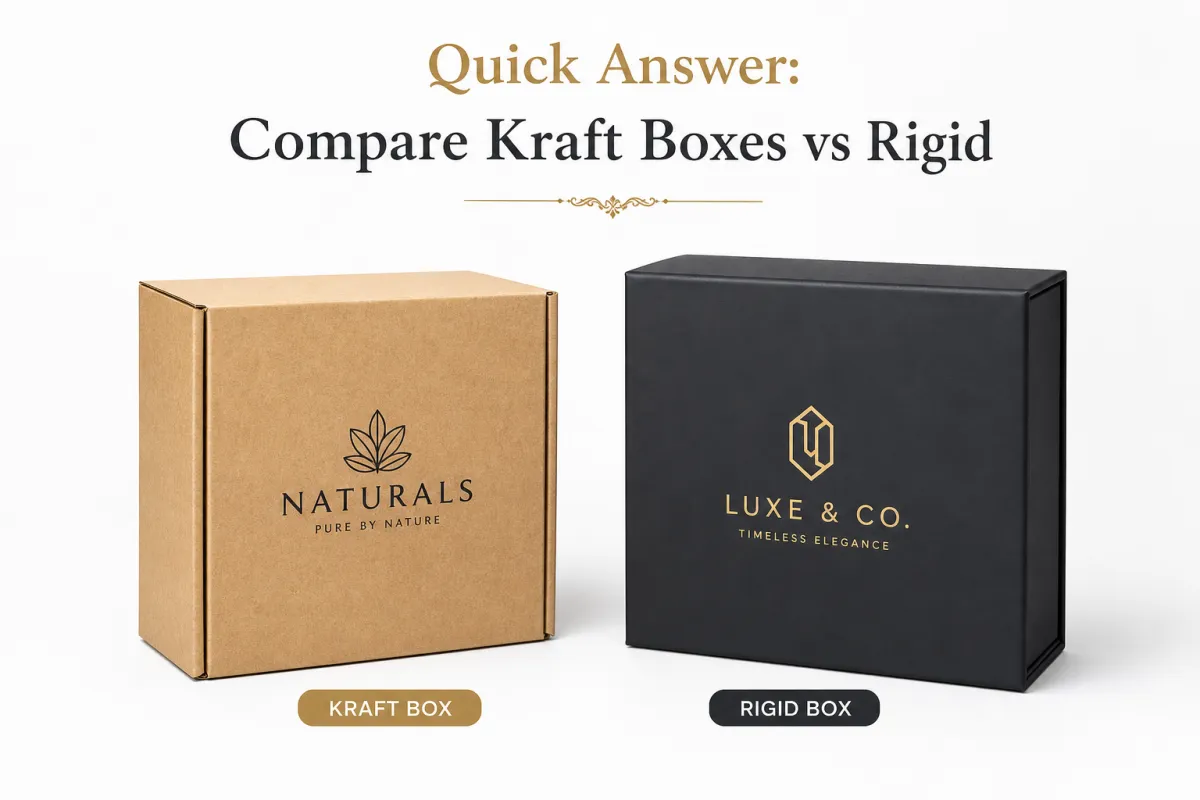
Most buyers compare kraft boxes vs rigid by appearance first, and that order can tilt the decision in the wrong direction. Weight, fragility, shipping path, and how the product sits inside the package matter more than a polished mockup. A modest-looking box can outperform a dramatic one if it survives a warehouse drop, stacks cleanly on a pallet, and keeps the insert from drifting during transit.
Kraft boxes usually make sense when the brand wants a natural look, lower package weight, easier recycling messaging, and a friendlier entry cost. I see them work especially well for apparel, subscription refills, accessories, candles, and practical retail goods where the package needs to look clean without acting precious. Good typography, a tight dieline, and a restrained print palette can make kraft feel considered instead of plain.
Rigid boxes usually fit better when the product needs a premium reveal, extra structure, stronger shelf presence, or a gift-worthy finish that feels substantial in hand. Magnetic closures, shoulder-and-neck builds, and lift-off lids create a deliberate opening sequence that many luxury buyers expect. If the package is part of the selling argument, compare kraft boxes vs rigid with the unboxing moment in mind, not just the carton cost.
The real answer lives in the full journey. Warehouse handling, carton fill, box weight, customer opening moment, and shelf presentation all push the decision in different directions. Durable products with modest margins often live comfortably in kraft. Premium products with a high perceived value may justify rigid even when the board cost is higher, because the packaging helps hold the price point up.
Use a simple rule if you need one: compare kraft boxes vs rigid by asking whether the box acts mainly as a shipping shell or as part of the brand theater. If it is mostly a carrier, kraft often wins. If it is part of the experience, rigid often earns its place. That answer can feel a little blunt, but honestly, it saves a lot of back-and-forth.
Top Options Compared When You Compare Kraft Boxes vs Rigid
There is more variety behind the words "kraft" and "rigid" than most buyers expect. When you compare kraft boxes vs rigid, you are not choosing between two neat categories; you are choosing among different structures, paper stocks, finish levels, and insert systems. A side-by-side sample shows those differences far better than a catalog description ever can.
Kraft packaging usually comes in corrugated mailers, Kraft Folding Cartons, sleeve-style cartons, tuck-end cartons, and kraft wraps over paperboard or chipboard. Rigid packaging usually shows up as two-piece set-up boxes, book-style boxes with a hinge, magnetic closure boxes, drawer boxes, and shoulder boxes with nested inner walls. Each build behaves differently under pressure, and each one changes the first touch a customer gets from the product.
Compare kraft boxes vs rigid according to the product you actually sell. Subscription kits often favor kraft mailers or folding cartons because they are light, easy to pack, and simple to brand. Cosmetics and fragrance can work in kraft when the line is natural, minimalist, or ingredient-led, while the same product often feels more giftable in rigid if the price point supports it. Electronics may need rigid inserts or a corrugated kraft shipper with a separate inner tray. Apparel usually lands in kraft unless the goal is a gift-first reveal.
The empty box is only the starting point. Load the real product, then add tissue, insert cards, foam, pulp, molded trays, or paper dividers if those pieces belong in the spec. A rigid box that looks perfect on a white table can become awkward once the product is loaded, while a kraft box that seems basic can feel surprisingly polished when the size, print, and closure are dialed in. I always tell buyers to compare kraft boxes vs rigid with the full stack-up in place, because movement inside the box is usually what causes disappointment later.
Here is a quick comparison that covers the common commercial tradeoffs:
| Feature | Kraft Boxes | Rigid Boxes | Practical Takeaway |
|---|---|---|---|
| Typical board build | 14pt-24pt paperboard, or corrugated kraft like E-flute/B-flute | 1.5mm-3mm chipboard wrapped with printed paper | Rigid feels heavier and more structured in hand |
| Best use | Shipping, retail basics, subscriptions, natural brands | Luxury gifts, launch kits, premium retail, display packaging | Match the structure to the product journey |
| Unit cost at mid-volume | About $0.30-$1.20 depending on size, print, and inserts | About $1.50-$5.00 depending on wrap, closure, and finishing | Rigid stays in the premium tier |
| Lead time | Often 10-15 business days after proof approval | Often 15-25 business days after sample approval | Rigid usually needs more manual work |
| Brand feel | Natural, practical, honest, understated | Premium, ceremonial, gift-ready, elevated | Both can be branded well, but the tone differs |
That table gives a useful frame, yet the small details often decide the project. Compare kraft boxes vs rigid on closure feel, edge crush, insert retention, and how much hand labor the team needs during packing. A box that takes twenty extra seconds to pack can change labor math faster than a modest print discount can fix it.
If you are still narrowing the field, browse Custom Packaging Products alongside your sample request. The more clearly you define the structure before ordering, the less time you spend correcting a beautiful box that is wrong for the product.
Detailed Reviews: Compare Kraft Boxes vs Rigid on Performance
Kraft packaging and rigid packaging are built on different engineering assumptions, and that difference shows up right away once you hold both in your hands. Kraft boxes usually rely on paperboard or corrugated-style structures that balance strength with practical packing, while rigid boxes use thicker chipboard wrapped in printed paper for a sturdier and more premium feel. When you compare kraft boxes vs rigid, those construction choices explain nearly everything else you notice: the weight in hand, the way the lid closes, the corners that stay crisp, and the way the box handles repeated touch.
Rigid packaging tends to win on presentation. Magnetic closures, lift-off lids, drawer styles, and shoulder boxes create a staged reveal that feels deliberate, and that matters for launches, gifting, influencer kits, collector sets, and any product that needs packaging to support a higher ticket price. The customer does not just receive an item; the customer moves through a sequence that slows the moment down and gives the product a little more gravity.
Kraft packaging often wins on visual tone for earthy, minimalist, industrial, or ingredient-led brands. A well-designed kraft box can look refined without feeling overworked, especially with black ink, white ink, a single bold spot color, or a restrained two-color layout. If your brand story leans natural, compare kraft boxes vs rigid with the finish choices in view, because a gloss-heavy rigid wrap can fight that story while an uncoated kraft stock supports it.
Three technical checks matter before you sign off. Corner crush resistance tells you whether the box can survive stacking or conveyor bumps. Lid fit tells you whether the closure stays secure without becoming annoying to open. Insert retention tells you whether the product stays centered after being shaken, turned, and reseated. Those details are what customers feel, and they separate a pretty sample from a dependable package.
It helps to separate the board from the wrap. A rigid box can be wrapped in uncoated paper, specialty stock, or printed kraft wrap, and each choice changes perceived value. Kraft boxes can receive aqueous coating, matte varnish, soft-touch lamination, or a plain uncoated finish depending on the use case. Sustainability also depends on the full spec, not just the headline material, because coatings and laminations affect recyclability more than many brand decks admit. For general recycling guidance, the EPA's materials page is a useful reference: EPA recycling guidance.
The insert system deserves equal attention. Foam, molded pulp, paperboard inserts, PET trays, and die-cut corrugated retainers all change how the package performs. A well-engineered kraft box with a proper insert can outperform a rigid box with weak internal support. Compare kraft boxes vs rigid with the actual contents inside, because the outer shell cannot fix sloppy internal engineering.
Packaging teams often look at ISTA methods when a product has to survive parcel networks, vibration, compression, and drop events. If you want a benchmark for testing language and transport thinking, the International Safe Transit Association has a useful reference library: ISTA testing standards. I would not use those standards as a slogan. I would use them as a check when the product is expensive, fragile, or hard to replace.
The practical question is simple: what fails first under pressure? If the outer shell fails, kraft may still work with a stronger board grade or a better shipper. If the presentation fails, rigid may justify the added cost. If both fail, the package system needs a redesign rather than a material swap.
Price Comparison: Compare Kraft Boxes vs Rigid for Real Orders
Cost is where a packaging project usually turns from aspirational into real. When you compare kraft boxes vs rigid, the price gap is not subtle, and it usually appears before artwork enters the conversation. Kraft construction uses simpler boards and fewer manual steps. Rigid construction uses thicker board, more wrapping, more alignment time, and more touch labor. That combination pushes the unit price up quickly.
For common custom orders, kraft boxes often land around $0.30-$1.20 per unit at mid-volume, depending on dimensions, print coverage, finishing, and whether inserts are included. Rigid boxes often land around $1.50-$5.00 per unit or more, especially if you add magnet closures, specialty wraps, foil stamping, or custom inserts. Those numbers can move with quantity, but the hierarchy usually stays the same: compare kraft boxes vs rigid, and rigid still sits in the premium tier.
Below a certain order size, the cost gap can feel sharp. At 500 or 1,000 units, setup fees and hand labor can dominate the quote, especially for rigid. At 5,000 or 10,000 units, the difference becomes easier to absorb, though it does not disappear. A packaging change that adds $1.50 per unit can erase a surprising amount of margin if the product is priced tightly.
The right way to compare is landed cost, not the sticker price alone. Freight, storage, assembly labor, damage risk, and packing speed all belong in the calculation. A rigid box may ship flat in some formats, yet many rigid structures still need more careful handling and more space. Kraft boxes usually pack more efficiently, which can reduce warehouse congestion and freight density. On a large run, those secondary costs can matter just as much as the base quote.
Here is a simple way to think about the budget:
- Kraft box base price: lower material cost, fewer assembly steps, faster scaling.
- Rigid box base price: higher board cost, more wrapping labor, more finishing complexity.
- Insert cost: can add $0.10-$1.50 for kraft and $0.25-$2.00+ for rigid depending on complexity.
- Freight and storage: affected by size, pack-out density, and whether the design ships flat or assembled.
- Packing labor: a hidden cost that becomes obvious only after the first production run.
Packaging buyers often compare kraft boxes vs rigid and stop at the per-unit quote. That habit creates surprises later. A lower-cost box can cost more overall if it takes longer to pack or damages product during transit. A premium rigid box can pay for itself if it supports a higher price point and cuts down on crushed presentations or returns. The quote matters, and the full line-item picture matters more.
If you are still gathering options, check Custom Packaging Products with your target size and target volume. A realistic quote only appears once the supplier knows whether the carton must hold a single item, a kit, an insert tray, or a nested set.
Process and Timeline: Compare Kraft Boxes vs Rigid from Proof to Delivery
Timeline is another place where the two structures behave very differently. Kraft box production is often faster because the construction is simpler, the finishing steps are fewer, and the boxes usually require less hand assembly. If the artwork is clean and the dieline is already proven, proofing and production tend to move with fewer surprises. When buyers compare kraft boxes vs rigid for a launch date, kraft often wins simply because there are fewer points where the job can drift out of spec.
Rigid box production usually takes longer because wrapped boards, inserts, specialty closures, and final fitting create more manual steps and more quality-control checkpoints. Fold lines, wrap tension, corner wrapping, and closure alignment all need to work together. Even when the box looks simple, the build itself is not. Compare kraft boxes vs rigid, and you will usually find that rigid needs more patience during sampling and more discipline at final approval.
Sampling matters on both, though the margin for error is tighter with rigid boxes. A millimeter of mismatch can affect lid feel, closure strength, or insert alignment. In a kraft box, a small tolerance issue may still be acceptable if the product is secure. In rigid, the same issue can make the package feel sloppy, which defeats the purpose of choosing the structure in the first place.
Plan extra time for print proofing, sample approval, production scheduling, and freight. The box itself is only one stage. A solid project timeline usually includes dieline sign-off, artwork preflight, physical sample review, revisions, production, inspection, and shipping. Seasonal launches and retail resets leave less room for mistakes, so compare kraft boxes vs rigid early enough to allow a revision if the first sample misses the fit.
Typical planning windows often look like this:
- Kraft boxes: roughly 10-15 business days after proof approval for many standard custom runs, longer if inserts or special finishes are added.
- Rigid boxes: roughly 15-25 business days after sample approval, sometimes longer for complex closures or premium wraps.
- First sample cycle: 5-10 business days is common, though complicated builds can take more time.
- Freight: can add a few days to a few weeks depending on lane, consolidation, and customs where applicable.
That schedule can stretch or shrink based on factory load, seasonal demand, and artwork revisions. The exact calendar matters less than the order of operations. Compare kraft boxes vs rigid with enough lead time to test the sample against the real product, because the best-looking box is still a problem if it arrives after the launch window.
For brands facing a tight release date, I usually recommend the simpler structure unless rigid truly adds measurable value. That is not a dismissal of premium packaging. It is a realistic read on what happens when an elegant box runs into assembly bottlenecks, late artwork changes, or freight delays. Compare kraft boxes vs rigid with the calendar open on your desk, not just the mood board.
How to Choose Between Kraft Boxes and Rigid Packaging
There is no universal winner. The right answer depends on what the package has to do, where it has to travel, and how the customer is supposed to feel before they even touch the product. Compare kraft boxes vs rigid by starting with the product, not the packaging trend.
Choose kraft when the product is durable, the shipment is cost-sensitive, the brand story is natural or functional, and the customer needs a box That Travels Well without excess weight. Kraft is especially comfortable for repeat purchases, refill items, accessory bundles, and ecommerce orders where the package must do its job without inflating the box budget. If the brand voice leans honest, earth-conscious, workshop-made, or practical, kraft usually fits the message without forcing it.
Choose rigid when the product is high-value, the unboxing moment supports the sale, or the packaging must signal luxury before the customer even sees the item. Jewelry, prestige cosmetics, gift sets, premium electronics, collector items, and launch kits often benefit from rigid because the package becomes part of the value story. Compare kraft boxes vs rigid on perceived value, because the box can raise the product's apparent worth, but only when the rest of the experience supports that promise.
Use the product itself as the deciding factor. Fragile, giftable, collectible, or high-margin products can justify rigid. Practical, replenishable, or subscription items often do not. If your item already has a strong visual impact, the box does not need to do all the heavy lifting. If the item is small, premium, and easy to overlook on a shelf, the box may need to carry more of the branding work.
Sustainability messaging deserves a careful look. Both structures can be paper-based, but the full spec matters: coatings, laminations, foils, magnets, foam inserts, and mixed-material trays all affect end-of-life handling. A kraft box is not automatically recyclable if it is heavily laminated or paired with the wrong insert. A rigid box is not automatically wasteful if it is built thoughtfully with paper-based wrap and a clear material plan. If sustainable sourcing sits at the center of the brief, consider the Forest Stewardship Council standards at FSC and make the material story match the actual construction.
From a packaging buyer's point of view, compare kraft boxes vs rigid using a simple scorecard:
- Cost: Does the box fit the target margin?
- Protection: Does it protect the product in the real shipping lane?
- Presentation: Does it match the price point and retail setting?
- Lead time: Can it arrive before the launch date?
- Customer feel: Does the opening experience support repeat purchase or gifting?
If one structure wins on only one point and falls behind on the others, the answer is usually clear. If the score stays close, compare kraft boxes vs rigid again using a physical sample, because tactile judgment often settles the debate faster than another round of quote emails.
Our Recommendation and Next Steps
For most commercial buyers, kraft boxes make the smarter first quote because they reveal the true size, print, and shipping requirements before money goes into premium construction. That does not make rigid a bad choice. It means rigid should usually be earned by the product, the margin, and the customer experience rather than chosen by default.
Move to rigid only when the sample proves that the extra structure improves conversion, protects the product better, or supports the price point in a measurable way. I like rigid packaging when it creates real value: a better opening sequence, stronger shelf presence, or a gift-ready format that makes the product feel complete. If those benefits are not obvious, compare kraft boxes vs rigid again after the first sample, because the answer may already be sitting in the physical evidence.
Next, request both styles in the same dimensions, pack the real product into each one, and compare the results on the same shipping lane, shelf display, and unboxing sequence. That last part matters more than people think. A box that looks excellent on a studio table can feel awkward in a fulfillment center, and a box that seems modest on paper can feel beautifully balanced once the product is inside.
If you are building a broader packaging program, use the same logic across the rest of the line. Many brands start with one hero product, then expand into matching cartons, mailers, inserts, and display sets. Our Custom Packaging Products catalog can help you see where a kraft structure makes sense and where a rigid build would genuinely improve the experience.
My honest recommendation is simple: compare kraft boxes vs rigid using a scorecard for cost, protection, presentation, lead time, and customer experience, then choose the higher total. That keeps the decision tied to the product, the budget, and the buyer's real expectations, which is exactly where packaging decisions belong.
When should I compare kraft boxes vs rigid for a new product launch?
Compare them before you finalize the dieline so the box size, insert depth, and shipping method are chosen around the right construction. If the launch depends on unboxing, gift appeal, or premium shelf presence, include rigid in the first sample round instead of treating it as a later upgrade.
Are kraft boxes strong enough for shipping compared with rigid boxes?
Yes, kraft boxes can be strong enough when the structure, board grade, and internal support match the product weight and shipping conditions. Rigid boxes feel stronger in hand, but shipping strength still depends on how well the product is immobilized inside the box and protected from crush.
Which is more affordable when I compare kraft boxes vs rigid for custom printing?
Kraft boxes are usually more affordable because the build is simpler and there is less manual assembly involved. Rigid boxes generally cost more even before decoration, so custom print, specialty wrap, and inserts usually widen the price gap.
How long does it usually take to produce kraft boxes versus rigid boxes?
Kraft boxes usually move faster through production because they require fewer finishing steps and less hand work. Rigid boxes typically need more time for wrapping, assembly, and inspection, so plan a longer timeline when the premium feel matters.
Can kraft boxes still look premium enough for retail packaging?
Yes, kraft can look premium when the print, structure, closure style, and insert design are intentional and the branding is clean. Kraft works especially well for modern, natural, craft, and minimalist brands where the product story benefits from an honest material feel.
If you want the short version, compare kraft boxes vs rigid by asking which structure protects the product, respects the budget, and supports the customer experience without adding unnecessary complexity. For many brands, kraft is the practical workhorse and rigid is the special-occasion finish, and the right choice is the one that matches the job.