Buyer Fit Snapshot
| Best fit | Order Custom Mailer Boxes Without The Guesswork projects where brand print, material claims, artwork control, MOQ, and repeat-order consistency need to be specified before quoting. |
|---|---|
| Quote inputs | Share finished size, material target, print colors, finish, packing count, annual reorder estimate, ship-to region, and any compliance wording. |
| Proofing check | Approve dieline scale, logo placement, barcode or warning zones, color tolerance, closure strength, and carton packing before bulk production. |
| Main risk | Vague material claims, crowded artwork, missing packing details, or unclear freight terms can make a low unit price expensive after revisions. |
Fast answer: Order Custom Mailer Boxes Without The Guesswork: Film, Print, MOQ, and Carton Packing should be specified like a repeatable production item. The safest quote records material, print method, finish, artwork proof, packing count, and reorder notes in one written spec.
Production checks before approval
Compare the actual filled-product size with the drawing, then confirm tolerance on folds, seals, hang holes, label areas, and retail display edges. Reserve space for logos, QR codes, warning copy, and material claims before decorative graphics fill the panel.
Quote comparison points
Review material grade, print process, finish, sampling route, tooling charges, carton quantity, and freight assumptions side by side. A quote is only useful when the supplier can repeat the same color, closure quality, and packing count on the next order.
How to Order Custom Mailer Boxes Without the Guesswork
Fragile, premium, and subscription products are ruthless about packaging. One bent bottle, warped tube, or crushed sample can wipe out a week of margin in a single shipment. If the box is designed after the fit, you already know the problem. The package becomes the weak link. If you are trying to figure out how to order Custom Mailer Boxes without chaos, start here. How to order custom mailer boxes at scale is simple on paper, but it needs discipline in practice. If your fulfillment workflow is fragile, your packaging should absorb that pressure, not pass it to your buyers.
Most brands treat packaging like a visual choice. That is backwards. Packaging is a fit, material, and shipping decision first, and a design decision second. How to order Custom Mailer Boxes correctly depends less on pretty mockups and more on real tolerances, board strength, and how the parcel behaves once it leaves your hands. We will cover what changes a quote, where delays usually show up, how to avoid return-triggering mistakes, and how to order custom mailer boxes from the first measurement to delivery without surprise charges or endless revisions. Clean boxes still look good. They just do their actual job too. If that sounds blunt, good. Buying custom packaging is not for vanity. It is for reliability.
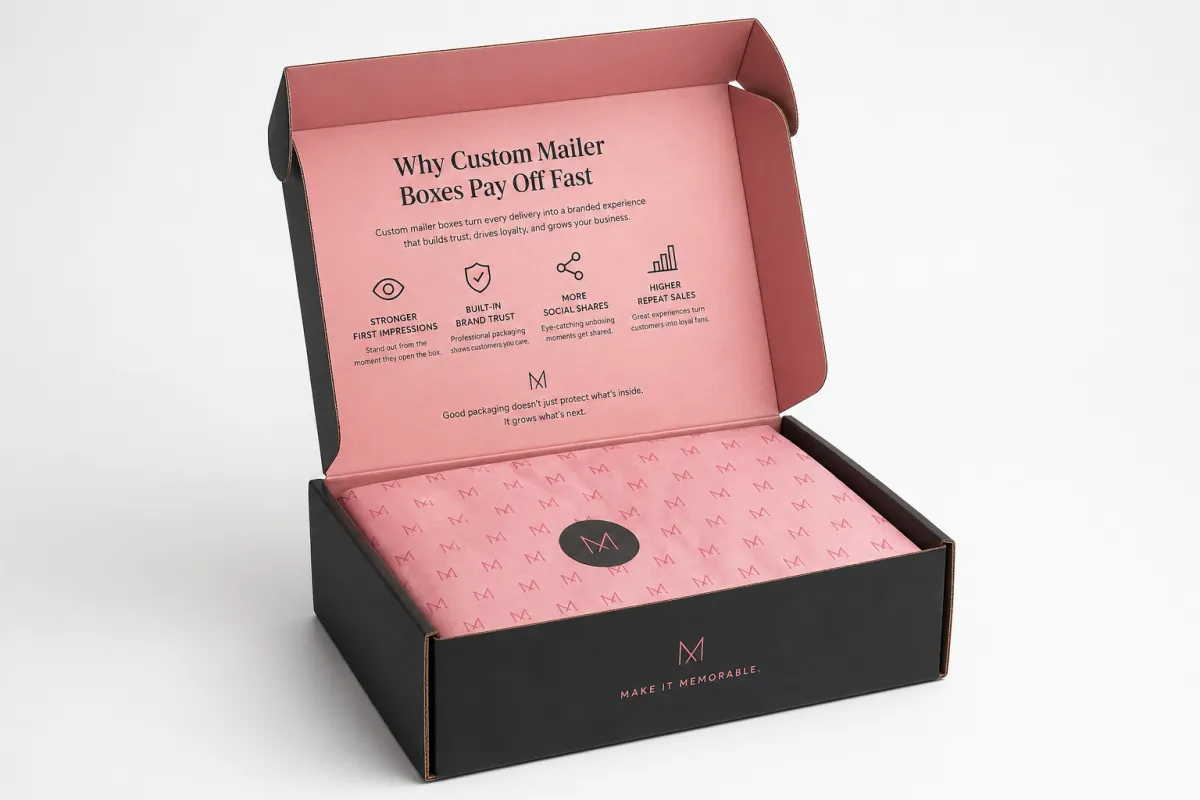
Why Custom Mailer Boxes Pay Off Fast
Here is the practical starting point: brands usually do not fail because the logo is wrong. They fail because the structure is wrong. I see teams approve gorgeous front panels, then ask for a quote that proves the box will not stock properly because the dimensions were guessed. If you do not understand how to order Custom Mailer Boxes from the inside out, design becomes a gamble. That is how budgets get wrecked. When people get this right, they stop treating packaging like a one-off graphic project and start treating it like a repeatable operations system.
That is why how to order Custom Mailer Boxes is mostly about risk control. You are deciding how much damage risk, dimensional-weight inflation, and production turbulence you can tolerate. A box that protects less than it promises creates silent cost. A box that overprotects with too much air adds freight waste, and both outcomes hurt the same thing: your margin.
Scenario check: premium, fragile, or recurring shipments
Picture a subscription tea brand shipping 5-ounce pouches plus a glass tasting set. A decorative mailer can look perfect in mockups and still fail after a few weeks in transit and a few rough touches in fulfillment. If the correct blank is 6.5 x 6 x 3 inches and your request says 6 x 6 x 2.5, the dieline will fight you. Miss the width by 3-5 mm and corner crush, slippage, and scuffing start showing up fast. That turns into complaints, replacements, and reviews nobody wants to read. This is also how many teams discover too late that knowing how to order Custom Mailer Boxes is not about templates. It is about controlled tolerances.
How to order Custom Mailer Boxes starts with the promise your customer sees at checkout: it arrives intact. If the offer is a luxury subscription, the box is part of the product. If the promise is speed and protection, the box is part of logistics. If the promise is sustainability, the material and finish matter. That is why custom mailer boxes are not just branding props.
Right-sized packaging reduces void fill. Give a box too much air and you will add 20-40% more filler before you know it. In medium-size parcels, a 1-inch gap around all sides can push dimensional weight higher on some carrier systems. In practice, that is freight pressure you pay for later. That extra cube can add real money per piece on domestic ground and more on express lanes. Any buyer team handling e-commerce parcels will tell you the same thing: tight fit protects margin.
Presentation plus performance, not one or the other
Buyers ask, "Can this look premium?" Fair question. The better question is, "Can it look premium and stay intact?" A custom mailer box with clean locking tabs and the right wall height can feel expensive even with a simple logo and matte print. Premium does not require overbuilding. It requires stable stack height, clean fold geometry, and die-cut seams that do not fight the packer. If you are learning how to order custom mailer boxes, do not pile on decorative extras until the base structure has survived real pack-outs.
Returns make the point quickly. A brand with 1,000 monthly orders and 2% avoidable damage can lose $400 to $1,200 depending on item value, freight, and re-ship costs. A sturdier 20pt structure can cut those incidents by half when crushing is the real issue. Spending more in the wrong place still loses money. Cheap and wrong is usually worse than expensive and wrong, which is not exactly a comforting category.
Returns can be lower than expected when the packing stack logic is right. If your shipping cartons are built around your actual fulfillment motion, damage drops in ways that are hard to explain but easy to measure on a week-over-week dashboard.
Unboxing is the other half of the experience. A secure lock tab, proper insert depth, and clean alignment make the first 10 seconds feel intentional. Once the customer notices quality before opening the inside, you have already improved the perception of the brand. That physical moment repeats with every shipment. It is one of the few brand decisions that gets paid for by the box itself.
"The box is not extra design; it is the first physical contact between your brand and a paying customer."
That line is blunt on purpose. If you are comparing options, treat how to order custom mailer boxes as a buying process with data, not a mood board exercise. You can still deliver a beautiful brand story with a controlled structure. You just stop outsourcing the logic.
How to Order Custom Mailer Boxes for the Right Fit
How to order custom mailer boxes correctly starts with a simple rule: do not begin with artwork. Begin with the product. Measure it, then map how it is packed: one piece, two-sided orientation, insert, cushioning, and carton orientation in the tote. Skip that step and you will discover late that how to order custom mailer boxes is mostly about math and tolerance, not color palettes. The goal is not to be exact to the millimeter for vanity; it is to be repeatable at volume.
1) Start with the product package dimensions
Measure your product and packed product three times: once raw, once with labels or pouches attached, and once as it leaves your current pack-out line. Add buffer for cushioning and movement on each axis. A practical formula is:
Inside box length = longest item length + 10 to 20 mm (for small inserts),
Inside width = item width + 10 to 20 mm,
Inside height = item height + cushioning + 3 to 8 mm tolerance.
That tolerance is not decoration. It gives room for tape thickness, manual packing variation, and barcode scanners hitting the box edge. Cut it too tightly and the packer slows down. Cut it too loose and the contents start wandering around inside the carton like they own the place. If you are asking how to order custom mailer boxes for high confidence, use consistent measuring stations and record dimensions per SKU, not per mood.
2) Map pack-out style to structure
People still guess here, and it shows. Decide whether this is a direct pack, padded-insert pack, or foam-reinforced pack. Direct pack is cheapest but highest risk for hard corners. Add a paper divider or foam insert and the inside dimension changes by 3-6 mm per wall. If you know the final packed shape before you order, you can order custom mailer boxes with fewer corrections. This decision is where how to order custom mailer boxes gets real, because one pack-out choice changes all the later numbers.
Shipping method changes structure too. Parcels that run through conveyor rollers or parcel sorting need a different level of crush resistance than boxes that go straight from a local shelf to a driver. One-week delivery lanes can be much rougher than same-route freight. Ask how the parcel is handled and how long it may sit in sort hubs. The right structure for local courier pickups is not always the right structure for cross-docking. That is how how to order custom mailer boxes for distribution starts turning into logistics strategy, not just packaging.
If you sell to B2B buyers and need clean unit handling, this is also where custom packaging dieline discipline matters. A good structure review can prevent reboxing and repacking losses.
3) Choose the right lock and style
Roll end tuck front is usually the quickest and budget-friendly entry point for many brands. It packs fast and tolerates small variations, though it is not always the stiffest option for long storage runs. Front lock improves opening consistency and works well for repeated manual opening in fulfillment because the closure behaves the same way every time. Tab lock gives stronger top-edge control in heavier applications and is common where the brand wants a cleaner outer profile without extra tape.
For custom printed boxes with simple profiles, front lock often wins in repeat-use fulfillment environments. If you are sending glass, rigid inserts, or high-value subscription kits, tab lock is usually the stronger move. If you are unsure, run one test of each. That is still part of how to order custom mailer boxes: compare, measure, prove. Every style has a place; no one style solves all products.
4) Standard size or fully custom dieline?
Standard templates are useful for low-risk runs. Use them when product dimensions are stable, inserts are minimal, and you can accept preset tolerances. A fully custom dieline is worth the setup when you need brand-specific fold behavior, unusual side dimensions, integrated branding windows, or tighter tolerances for heavier sets. A custom dieline also helps if your box needs machine-friendly edges for auto insert or if a narrow print panel must be placed precisely for compliance or scanning.
Common rule of thumb: if your shipping team is already using tape, foam, and ad-hoc adjustments every batch, you are probably paying for a poor initial size. Spend the up-front effort and lock the dieline. That is why so many teams ask how to order custom mailer boxes in multiple rounds; a proper fit cuts revision cycles down hard. It also saves the buyer calendar from the endless "tiny correction request" loop that steals time from fulfillment.
5) Fast-checklist before placing your order
- Product dimensions taken in packed form (length, width, height, weight)
- Pack-out style confirmed: direct, insert, foam, or rigid partition
- Shipping method and route class (local courier, parcel hubs, or freight-like handling)
- Box family selected: roll end tuck front, front lock, or tab lock
- Inside clearances set for print variation, scanner access, and closing margin
- Dieline decision: standard template or custom fold geometry
- Proof checkpoints scheduled before production release
- Dimensional-weight exposure estimate and maximum acceptable carton weight included in quote review
Use this list and the design-to-production ping-pong gets shorter. Most buyers who respect it stop guessing how to order custom mailer boxes and start making decisions with actual numbers. Your team gets fewer surprises, and your fulfillment floor gets a cleaner rhythm. If you are onboarding a new SKU, keep this checklist pinned to the intake form.
And yes, when teams ask how to order custom mailer boxes for recurring products, this list is where everything starts becoming predictable.
Custom Mailer Box Specifications That Actually Change the Quote
The phrase how to order custom mailer boxes gets messy at the quote stage because everybody loves variables. Strip it down and five specs carry most of the cost and quality risk: inside dimensions, board thickness, print coverage, finish choice, and insert strategy. Everything else matters too, but these are the levers you can control before artwork.
Inside dimensions and tolerance
Inside dimensions are your first and last line of defense. If the inside volume is too tight, the production line slows down and returns increase. Too loose and you add weight plus void fill. Measure to 0.5 mm consistency if your pack-out is manual. If automation is involved, tighten to 1.0-1.5 mm tolerance bands and test for edge interference.
For brittle products, add 5-10 mm extra height and side clearance compared to the item footprint. For powder or capsule items, allow movement but stop corner crush. If humidity shifts in your facility, account for paper expansion by leaving a little breathing room in flat regions. That part is boring. It is also where real teams separate themselves from people guessing at dimensions on a Friday afternoon.
If you are trying to order custom mailer boxes for a product line, this is where dimensional tolerance language becomes a shared standard. No one likes arguing about decimals. Put it in writing and move on.
Board thickness and crush behavior
Board is where lightweight meets strength economics. A 15 pt to 16 pt single-face board can look fine on screen and save cost at low weights, but if the product is over 600-700g or if drops happen during handling, you are asking for top panel collapse. Up to 5 mm of wall denting might be acceptable for letters, but not for rigid product protection.
Common production ranges for mailer-grade board are roughly 15 pt, 18 pt, and 20-22 pt equivalents depending on manufacturer and flute style. In practical terms:
- 15-16 pt: lowest baseline cost, best for light items, fewer handling layers
- 18 pt: balance tier for most e-commerce kits and apparel accessories
- 20-22 pt: better crush resistance, higher compression performance for repeated sorting, better for higher-value or heavier boxes
The tradeoff is simple. Heavier board increases freight from factory to you and usually increases unit price, but it lowers replacements and complaint pressure. If your monthly claim rate is above 1.5%, upgrade thickness before you start chasing finish upgrades. That is how to order custom mailer boxes for resilience, not just appearance.
Print coverage and color complexity
One-color and two-color jobs are still underrated for high-volume consistency. One-color can be sharp, modern, and faster to proof. Full color (CMYK) gives you more expression, but every added color increases plate and setup complexity. A common pricing spread is 20-40% higher from one-color to full-color for the same size and stock, not counting extra proof cycles. Add inside print and you are adding material control plus inspection time.
If there is no critical branding element on the inside, skip inside print on first test runs and ask for a quote split: outside-only versus outside-and-inside. A lot of teams assume inside print is mandatory for packaging brand work. It is not. It only matters for specific premium positioning or anti-counterfeit workflows.
For consistency in how to order custom mailer boxes, keep color specs narrow on first proof. You can always add complexity after the second batch. It is less risky.
Finish and feel
Finish changes both shelf impact and cost. Matte or unvarnished stock performs well for budget and readability. Gloss raises color pop but can show print marks. Soft-touch can justify premium positioning, but it needs additional coating and longer cure handling, and small-run pricing jumps more because of setup and minimum coating runs.
Spot UV adds selective gloss and strong branding accents, especially around logos. It is a high-value upgrade, but it can add $0.10-$0.35 per piece depending on footprint and whether you are combining it with foil, matte lamination, or high-shine varnish. Add a specialty coating under 1,000 pieces and expect longer proof checks. That is just how the schedule behaves.
If you are balancing presentation and cost, this is where knowing how to order custom mailer boxes can save money: choose finish based on handling conditions first, then luxury layer second.
Common pre-production mistakes
Most errors happen before press start, which is exactly why people who know how to order custom mailer boxes early demand clear proof standards. Three repeat offenders show up all the time:
- Artwork approved before bleed is locked (3 mm bleed in most cases is common; ask your supplier)
- Panel orientation not marked, causing logo rotation and label misalignment
- Barcode zone conflicts with fold lines, seams, or score lines
If the barcode sits across the fold radius, scanners can fail on a wet Tuesday at fulfillment, and that is not a theory problem. It is a real production failure mode. Ask for the panel map and fold map before production release.
For environmental claims, verify certification status. FSC sourcing and recycling claims should be checked before the final marketing language gets locked. Moisture and adhesive compatibility matter too, especially if your products sit in humid conditions or travel through different climates.
Reference standards and best-practice resources from Packaging and ISTA can help align test expectations for parcel handling. That is one less place for surprises after launch.
How to order custom mailer boxes right is not glamorous. It is just boringly specific work that compounds in your favor.
Pricing, MOQ, and What Drives the Real Cost
There is no perfect one-line price. Unit cost depends on size, board grade, print complexity, finish choices, quantity tier, and distance to destination. I do not want to sell you a myth: cheap-looking prices can hide tooling and freight penalties. Real understanding starts with a clean quote and visible assumptions.
If you want to compare how to order custom mailer boxes offers, force the vendor to separate setup from recurring cost. Most teams get trapped by the first "good headline" only to see total spend rise after changes. You are not buying a single job; you are buying a repeat mechanism.
Unit cost formula in plain language
If you want to compare offers, break every quote into five buckets:
- Setup (dieline creation, film/platemaking, prepress)
- Material (board, laminate, lining)
- Print (colors, plates, registration, run length)
- Finishing (coatings, UV, embossing, custom varnish)
- Post press (trimming, inspection, packaging of finished lots, freight)
Once setup costs are spread across a low count, unit prices look high. That is why MOQ exists and why smaller runs feel expensive even when the quote seems simple. You can also ask for a per-batch labor surcharge if your order includes complex hand packing. If your buyer team is new, this is the best way to understand how to order custom mailer boxes without pricing surprises.
| Quantity tier | Typical 4x6x3 structure | Print and finish assumption | Estimated unit range (USD) | Lead-time tendency |
|---|---|---|---|---|
| 250-300 pcs | 18 pt, standard roll-end lock | 2-color front, no inside print | $1.80 - $2.95 | Higher per-piece, normal proof cycles |
| 500-750 pcs | 18 pt, front-lock option | 3-color, optional matte varnish | $1.25 - $1.95 | Good balance for pilot launches |
| 1,000-2,500 pcs | 18-20 pt depending weight | Full color, one finish choice | $0.95 - $1.45 | Most stable production window |
| 5,000+ pcs | Custom dieline, optimized structure | Full color + light specialty option | $0.55 - $0.95 | Strongest unit economics and smoother scheduling |
These ranges are directional and vary by region, material source, and exact print coverage. They still show the core rule: quantity and complexity drive the real cost. If you are trying to order custom mailer boxes on a real budget, quantity breakpoints are your steering wheel, not your logo.
MOQ explained without fluff
MOQ is plain: fewer pieces mean higher unit cost. A 250-piece test run might be possible, but you pay for setup across fewer units. A larger run can reduce setup burden and lower per-piece cost significantly, especially when your Wholesale Programs plan supports planned replenishment. If you plan quarterly reorders, ask for a tiered quote at 300, 1,000, 3,000, and 5,000.
For custom printed boxes with difficult colors, many vendors push MOQ higher to keep ink waste acceptable. If your target is a market test at 100-200 pieces, lock fewer colors, skip specialty coatings, and keep the dieline simple. Fancy does not help if the first run burns cash. How to order custom mailer boxes cheaply does not mean cutting corners. It means sequencing complexity over time.
Hidden drivers that quietly increase cost
The sneakiest costs hide in what customers do not ask for up front:
- Inserts (custom partitions, foam blocks, die-cut dividers)
- Short delivery windows and rush options
- Color matching across multiple materials
- Very tight tolerances and small dimensional adjustment after first approval
- Overprints, die cut gates, and premium coating transitions
- Unplanned rework from shipping carton testing failures
An insert can add $0.18 to $0.60 per unit depending on complexity. A rush surcharge can run 10-25% in some cases. Specialty coatings add both cost and handling time, which affects total landed cost, not just the invoice number.
How to order custom mailer boxes for growth means building cost control into the timeline. Price should be visible before design gets locked.
How to request the right quote
Send everything in one request packet. Do that and you control the quality of the quote. For how to order custom mailer boxes correctly, include:
- Inside dimensions and weight
- Quantity and expected reorder cadence
- Print coverage (outside, inside, both, colors)
- Finish preference and any special coating
- Insert details or packing notes
- Destination and shipping mode
That is the whole game. Send less and the first quote is just a starting point. Send more and you cut revision cycles almost in half. If you are serious about how to order custom mailer boxes repeatedly, always include shipping lane details and dimensional limits. It is the line item nobody likes, but everyone pays when it is missing.
How to Order Custom Mailer Boxes Without Delays? Process and Timeline
Most delays do not come from production speed. They come from indecision. A good process is simple: quote, spec lock, dieline, proof, sample approval, then release. Miss those gates and how to order custom mailer boxes turns into another week of email ping-pong. In many teams, this is where budget, launch date, and customer trust drift apart.
If you are trying to order custom mailer boxes with less friction, make review windows explicit before approval starts. A clean schedule is more valuable than a loud vendor.
Step-by-step timeline you can actually use
- Request quote (same day to 1 business day): send dimensions, quantity, finish, and destination.
- Spec confirmation (1-2 business days): check size, lock style, and insert requirements.
- Dieline generation and technical review (1-3 business days): inspect panel placement and fold sequence.
- Proof review (usually 1-2 business days): lock colors, orientation, barcode position, text clarity.
- Sample approval if needed (2-4 business days): optional but recommended for first runs above 1,000 pieces.
- Production (6-12 business days standard; 4-6 for very simple jobs)
- Packing and shipment (transit separate: 2-3 days local, 5-10+ international)
Where delays usually happen
If the design is ready and the dieline is right, most batches move fast. Delays show up when artwork gets swapped repeatedly, bleed is wrong, barcode placement changes late, or print corrections arrive after proof approval. Even if production is 8 business days, one unresolved proof note can stretch it to 18 because the line sits waiting on your answer. A fast buyer response can save almost a full production week.
Simple jobs are faster than custom-heavy jobs. If you request one color and one finish, and skip complicated inserts, you can often move through production quickly. Add soft-touch, custom window, interior print, and exact color matching, and expect two to five more days for press stability and QA checks. If you are trying to order custom mailer boxes for a campaign window, your correction window should be locked before artwork goes live.
Production days vs transit days
Do not confuse factory output with final delivery. Production may finish in 8 business days, but carriers can still take 5-12 days depending on lane and weekend cutoffs. Confirm both numbers before you lock the launch date. If the ship date is fixed by a campaign, lock proof review dates first and share that target with your supplier before release.
For transactional buyers, the fastest path is simple: all design corrections done before artwork is approved, and sample decisions made immediately after proof. That is not glamorous. It is how to order custom mailer boxes with fewer mistakes and less operational stress.
How to order custom mailer boxes reliably gets easier when your team treats proof days like hard dates, not suggestions. That part is on the buyer as much as the vendor.
Why Choose Custom Logo Things for Mailer Boxes
Some suppliers sell a blank spec sheet. Others help you make decisions that save time later. The useful part of a partner is not just the printer; it is the guidance tied to real shipping scenarios. You want a team that can tell you when a cheaper option is smarter than a premium one, and when premium is the only sensible move.
Custom Logo Things positions itself on that practical side. The team-level advantage usually comes down to three points: sizing discipline, print setup help, and proof clarity. If you are trying to order custom mailer boxes and you already know your final dimensions, they can still help tighten panel math, check fold feasibility, and reduce expensive revisions.
They are useful if you need help understanding how to order custom mailer boxes in a way that supports your internal planning rhythm. They can flag weak structures before they become late changes, and they can tell you when a custom packaging dieline is worth the spend.
What to expect in the real process
- Clear quoting based on real variables, not one fixed template
- Direct communication before production, not after
- Specific advice on what matters for fulfillment, not just artwork
- Support for first-run tests and stable scale runs afterward
That is the difference between a one-off launch and a repeatable packaging line. Teams shipping small accessories often start with a test order of 300-500, then move to 2,000+ after they verify damage rates and pack-out speed. That is the point where Custom Logo Things can help scale without overbuying.
They can also support product packaging decisions across Custom Packaging Products so you compare similar structures, and they can help your finance team model how much to spend per order cycle.
No fake hype here: better fit, cleaner print acceptance, fewer surprises, and a cleaner handoff to fulfillment are the outcomes buyers usually care about. That is the kind of outcome that keeps a team profitable when repeat customers start expecting consistency. If you are trying to order custom mailer boxes for the long run, that consistency is the edge.
Next Steps to Place Your Order
Execution starts here. If you want a clear route to order custom mailer boxes and stop guessing, follow this sequence and save time, cost, and stress.
Final buyer checklist
- Measure every SKU in final pack-out state: length, width, height, and packed weight.
- Select your structure: roll end tuck front, front lock, or tab lock based on handling.
- Choose print coverage: outside only, or outside plus inside if needed.
- Decide finish level: matte, gloss, soft-touch, or local accent.
- Lock quantity tier and reorder cadence, then request a layered quote.
- Gather artwork files, barcode size, and shipping destination before request submission.
Compare three build paths for every order: budget, standard, and premium. Budget means lower board and simpler print. Standard means balanced board and stronger reliability. Premium means full color, finish, and controlled inserts. Do that before ordering and how to order custom mailer boxes becomes a decision, not a negotiation.
For the FAQ on common approval terms, read it before submission so everyone is aligned on proof rounds and accepted correction limits. Then lock the timeline: approval deadline, production start, and expected arrival date.
When you are ready, request a quote with dimensions, print colors, quantity, and destination in one message. If you are new to this, start with one size and one SKU only. The fastest path is easy to say and hard for people to follow: review proofs the same day, approve the sample quickly if required, and correct before production. Do not let approval drift into a calendar problem.
Last reminder: how to order custom mailer boxes without mistakes is not a trick. It is confirmation, proof, and timeline discipline. Confirm specs, approve the dieline, and lock the delivery date before the job goes live. Then the branded packaging does what it should: protect, present, and ship right.
And one final practical reminder for teams running campaigns: if you need to order custom mailer boxes on a short timeline, reduce variables first. The fewer assumptions, the fewer emergency revisions. That is the boring answer, and it is usually the right one.
FAQ
How do I order custom mailer boxes if I do not have a dieline?
Send your product dimensions, target quantity, and shipping method first. In most cases, a supplier can generate a starting dieline from those measurements and your pack-out method. Review the proof carefully, then confirm panel dimensions before production starts. If anything is off, lock the correction before proof approval; this is the moment to stop guessing and confirm.
What do I need to request a quote for custom mailer boxes?
Include inside dimensions, quantity, print colors, finish requirements, and insert needs in your request. Also specify whether you need inside print, outside print, or both. Add the delivery destination so freight or shipping lead time and cost can be estimated correctly. A complete request means fewer back-and-forth emails and cleaner commercial terms. If you are trying to order custom mailer boxes fast, this is where most delays are prevented.
What is the usual MOQ for custom mailer boxes?
MOQ depends on size, print complexity, and required tooling. Smaller runs are usually possible, but unit prices rise because setup costs are spread across fewer units. If you expect repeat orders, ask for tiered quotes at multiple breakpoints so you can compare cost shifts and avoid overpaying on the first run. This helps when you are planning how to order custom mailer boxes for next quarter, not just this month.
How long does it take to order custom mailer boxes and receive them?
Proofing is usually the fastest part if artwork is clean and complete. Production takes longer with specialty finishes, complex inserts, or strict tolerances. Shipping adds a separate lead-time layer, so confirm both production days and transit days before locking launch timing. Most delays come from late approval, not factory speed. If you need an exact answer for campaigns, ask for timeline milestones in writing when you ask how to order custom mailer boxes.
Can I add inserts or special finishes to custom mailer boxes?
Yes, and they can significantly improve protection and brand feel. Both inserts and special finishes increase unit cost and can lengthen manufacturing time. Cardboard inserts, foam, partitions, and custom slots all need dedicated specs. Ask for two quotes - basic and upgrade - so you can compare the real price impact before approving. If you are deciding how to order custom mailer boxes on a tight launch date, include those options in the same request so nobody has to guess later.