Buyer Fit Snapshot
| Best fit | Compare Matte vs Glossy Packaging Finish projects where brand print, material claims, artwork control, MOQ, and repeat-order consistency need to be specified before quoting. |
|---|---|
| Quote inputs | Share finished size, material target, print colors, finish, packing count, annual reorder estimate, ship-to region, and any compliance wording. |
| Proofing check | Approve dieline scale, logo placement, barcode or warning zones, color tolerance, closure strength, and carton packing before bulk production. |
| Main risk | Vague material claims, crowded artwork, missing packing details, or unclear freight terms can make a low unit price expensive after revisions. |
Fast answer: Compare Matte vs Glossy Packaging Finish: Pros and Costs should be specified like a repeatable production item. The safest quote records material, print method, finish, artwork proof, packing count, and reorder notes in one written spec.
Production checks before approval
Compare the actual filled-product size with the drawing, then confirm tolerance on folds, seals, hang holes, label areas, and retail display edges. Reserve space for logos, QR codes, warning copy, and material claims before decorative graphics fill the panel.
Quote comparison points
Review material grade, print process, finish, sampling route, tooling charges, carton quantity, and freight assumptions side by side. A quote is only useful when the supplier can repeat the same color, closure quality, and packing count on the next order.
Compare matte vs glossy packaging finish and the difference shows up fast. Put both under bright retail lights and glossy makes the artwork pop like it has something to prove. Matte does the opposite. It softens reflections, cuts glare, and gives typography a quieter stage. That is the real decision for most Custom Printed Boxes. Not trend. Not guesswork. A finish choice that changes how the package looks, feels, ships, and sits on a shelf.
If you are choosing finish for a carton, mailer, or rigid box, start with the brand story instead of the finish name. A calm wellness line, a luxury gift set, and a loud promo kit need different packaging behavior. Good product packaging supports the message. It does not fight it just to look shiny in a sample photo. If you want to look at structure and finish together, our Custom Packaging Products page is a solid starting point.
Compare Matte vs Glossy Packaging Finish: Quick Answer
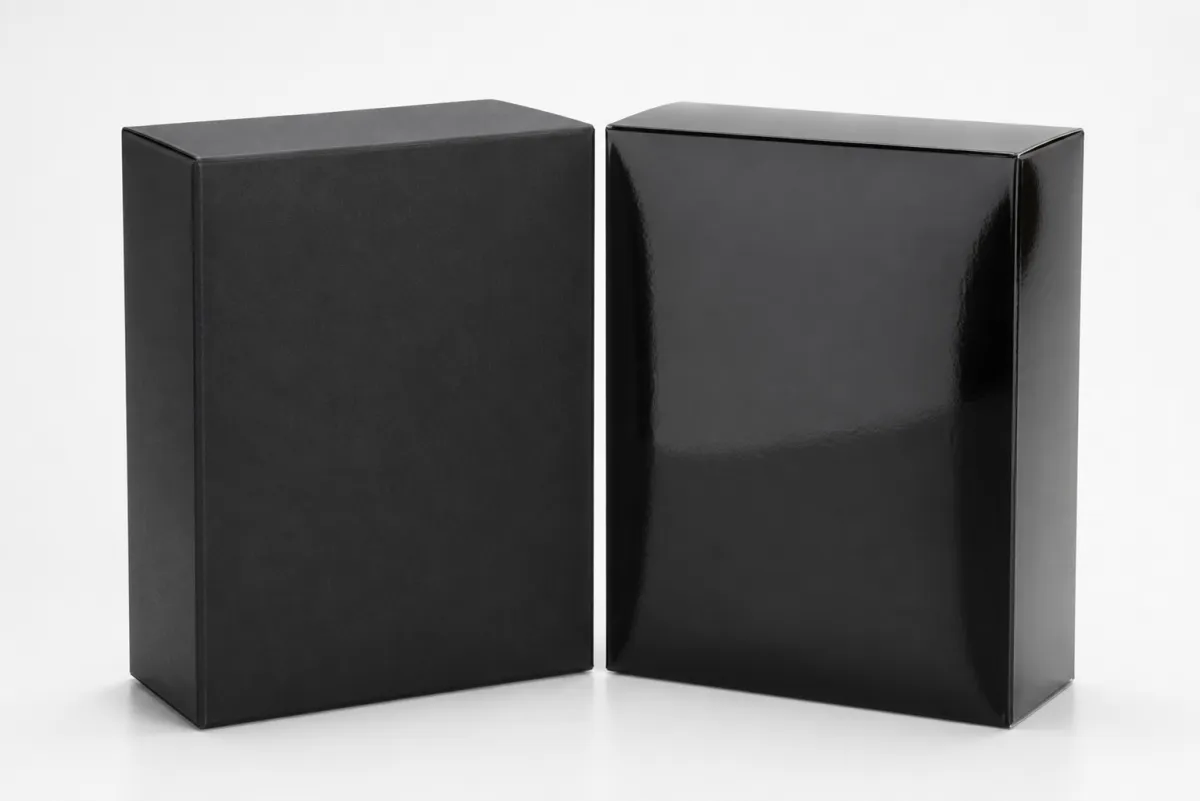
Compare matte vs glossy packaging finish in plain English and you are really choosing between restraint and shine. Matte reads soft, understated, and less reflective. Glossy reads bright, saturated, and harder to ignore from across the aisle. Matte usually feels more refined because it removes glare and lets text sit calmly on the surface. Glossy wins when the artwork needs punch, contrast, and a bit of attitude.
Here is the shortcut I use. Choose matte if the brand feels premium, minimal, natural, editorial, or text-heavy. Choose glossy if the package depends on photography, bold illustration, candy-bright color, or a loud shelf presence. Not a perfect rule. Still useful. Especially when somebody wants to compare matte vs glossy packaging finish three hours before a deadline and acts surprised that packaging has consequences.
Lighting changes the answer faster than most people expect. A box that looks elegant in an office sample room can behave very differently under LED retail fixtures, warm home lighting, or warehouse fluorescents. The same artwork can feel calmer in matte and more energetic in gloss before a customer even picks it up. That is why a screen mockup never settles the debate. Screens do not show glare, fingerprints, or surface texture. They show confidence. Then the sample arrives and reality gets a vote.
Think about the whole use case. Is the package opened once and kept, or handled repeatedly through fulfillment and store display? Is it meant to feel premium in hand, or to shout for attention on a crowded shelf? Those questions matter more than abstract preference. They usually decide whether matte or gloss belongs on the final box.
"If the package has to sell from a distance, gloss earns its keep. If it has to feel quiet and expensive in hand, matte usually wins."
That is the working logic behind compare matte vs glossy packaging finish. The rest comes down to substrate, print method, cost, and how much abuse the package will take before the customer opens it.
Top Options When You Compare Matte vs Glossy Packaging Finish
To compare matte vs glossy packaging finish properly, separate the surface treatment from the box itself. A basic aqueous coating behaves differently from film lamination. Spot UV behaves differently again. Buyers often use "matte" or "glossy" as if those are the only two choices. On a press floor, that oversimplifies things fast. These are several different finishing methods with different costs, different looks, and different levels of protection.
The common options are matte coating, gloss coating, matte lamination, gloss lamination, and hybrid finishes like matte with spot UV or spot gloss. That matters because the board, print coverage, and finishing pass all affect the final result. A matte laminate can feel smoother and more substantial than a coated matte carton. Gloss lamination can look richer than gloss coating, and it can also turn into a mirror if the lighting is unfriendly. Packaging likes to keep people humble.
| Finish type | Feel in hand | Visual effect | Best fit | Cost note |
|---|---|---|---|---|
| Matte coating | Soft, low glare, slightly muted | Reduces reflections and calms dark solids | Text-heavy retail packaging, wellness, apparel | Often near the lower end for coated runs |
| Gloss coating | Smoother, brighter, slicker | Boosts color saturation and contrast | Promo kits, candy, bold graphics | Usually inexpensive for larger runs |
| Matte lamination | More substantial, premium touch | Very controlled, elegant surface | Luxury gift boxes, branded packaging | Typically higher than coated matte |
| Gloss lamination | Firm, slick, highly reflective | Strong shelf shine and vivid image pop | Electronics, retail packaging, high-color artwork | Usually higher than gloss coating |
| Matte with spot UV | Matte base with bright visual emphasis | Contrast between quiet background and glossy highlights | Logos, premium marks, package branding | Extra pass and registration cost |
In hand, the difference matters just as much as the visual one. Matte feels more tactile and less slippery, which helps mailers and folding cartons stay presentable after handling. Glossy feels brighter and slicker. That can work beautifully for retail packaging that needs energy. It can also show fingerprints and micro-scratches faster. If you compare matte vs glossy packaging finish for a project that will move through fulfillment, that handling detail can matter more than the marketing photo does.
There is also print behavior to think about. Matte can soften very dark blacks and lower the apparent contrast of saturated colors, especially under softer light. Gloss can make the same CMYK build feel richer and sharper, particularly on large color fields and photographic artwork. If your design uses bold typography, matte may read more sophisticated. If the box depends on bright imagery, glossy usually gives a cleaner visual hit.
For brand owners who are still deciding between substrate and surface, look at structure at the same time. A lightweight mailer, a folded carton, and a rigid setup box all react differently to finish. If you are comparing the finish as part of a broader branded packaging decision, our custom printed boxes options make it easier to test board, coating, and construction together instead of treating the finish like an afterthought.
Detailed Reviews: Matte vs Glossy Packaging Finish by Use Case
Compare matte vs glossy packaging finish by use case and the answer gets much clearer. There is no universal winner. A box for cosmetics does not need the same surface behavior as a box for candy, and a subscription mailer does not handle like a rigid gift carton. Honest review work starts with the category, then moves to the finish. Reverse that and you end up buying based on vibes. Packaging does not care about vibes.
Matte works very well for premium categories such as cosmetics, wellness, apparel, stationery, luxury gifts, and subscription boxes. It makes the package feel more deliberate and less promotional. That is why so many buyers link matte with stronger package branding. The surface stays out of the way and lets typography do the talking. On product packaging where the label copy carries the brand story, that matters a lot. If the artwork is minimalist or ingredient-led, matte usually helps the layout instead of competing with it.
Glossy has a different strength. It gives color energy, especially on packaging that relies on bright photography, illustration, or heavy saturation. Candy, toys, promotional kits, consumer electronics, and seasonal retail packaging often look stronger in gloss because the finish amplifies the visual language. If the box uses high-contrast art, glossy can make the design feel sharper and more active. Some brands need exactly that. Quiet is not the only route to expensive.
Here is the part people skip because it is less glamorous. Matte hides handling wear better. It is more forgiving of fingerprints, light scuffs, and the rough edges that come from fulfillment, shelf stocking, and parcel transit. Glossy can look fantastic on day one, then reveal every tiny mark if someone opens the shipper in strong light. If you are trying to compare matte vs glossy packaging finish for a box that will be opened and inspected before purchase, matte often survives that process with more dignity.
There are category-specific tradeoffs that are easy to miss:
- Folding cartons: Matte is often better for text clarity, while gloss helps with vivid colors and retail shine.
- Mailer boxes: Matte tends to hide shipping wear, while gloss creates a sharper first impression.
- Rigid packaging: Matte often feels more luxury, while gloss works well for showpiece graphics and gift sets.
- Promotional packaging: Gloss usually pulls the eye faster, especially on crowded shelves or event tables.
For practical testing, I look at three things: how the finish photographs, how it feels under the fingertips, and how it behaves after a few minutes of handling. That last part gets skipped too often. A finish can look perfect in a proof and still feel wrong once it has been folded, stacked, and carried around. Compare matte vs glossy packaging finish with the actual product in mind, not just the mockup on screen.
The packaging industry tracks many of these material and handling concerns through groups such as packaging.org, while distribution testing guidance from ISTA matters if your boxes have to survive parcel systems, corner drops, and vibration. Those references are useful whenever finish is part of a larger durability plan. A beautiful surface still has to arrive intact. Pretty does not refund itself.
Buyers sometimes argue about matte versus gloss as if this were only a style choice. It is not. It is a packaging performance choice. That is why compare matte vs glossy packaging finish should always include the actual handling path, from print bench to warehouse to customer doorstep.
Price Comparison: Compare Matte vs Glossy Packaging Finish Costs
Cost is where compare matte vs glossy packaging finish becomes very real. People often assume matte is cheaper because it looks quieter, or assume glossy is pricier because it shines more. Both assumptions are shaky. The actual number depends on whether the finish is a coating or a film lamination, how much of the sheet is covered, how many colors are on press, and how many units you are ordering. Packaging pricing loves context.
For many mid-volume custom printed boxes, a basic aqueous gloss or matte coating can add only a small amount per unit. Film lamination, especially matte lamination, usually costs more because you are adding a separate film layer and another handling step. Spot UV or spot gloss adds still more because it needs registration and another pass. So the answer to compare matte vs glossy packaging finish is not "matte is always cheaper" or "gloss is always premium." The honest answer is "it depends on the method."
| Run size | Gloss coating | Matte coating | Gloss lamination | Matte lamination |
|---|---|---|---|---|
| 250-500 units | About $0.12-$0.28 added per box | About $0.13-$0.30 added per box | About $0.20-$0.45 added per box | About $0.22-$0.50 added per box |
| 1,000-2,500 units | About $0.05-$0.12 added per box | About $0.06-$0.14 added per box | About $0.10-$0.22 added per box | About $0.12-$0.25 added per box |
| 5,000+ units | About $0.03-$0.07 added per box | About $0.04-$0.08 added per box | About $0.08-$0.16 added per box | About $0.10-$0.18 added per box |
Those numbers are not a quote. They are a framework. Board weight, box size, total print coverage, and whether the finish is only on the exterior or on both sides all move the price. A simple gloss coating may come in below a matte laminate, but a specialty matte coating with extra scuff resistance can close that gap fast. If you compare matte vs glossy packaging finish only by headline price, you can end up choosing the wrong method and paying for it later in reprints or a weak presentation.
Hidden costs show up too. Matte and gloss finishes both can require proofing, but specialty finishes may need extra setup or a second approval cycle. Lamination can increase material weight slightly. That does not matter on one sample. It matters on large retail programs. A poor finish choice can also create rework if the artwork looks too dull or too reflective, and rework is where budgets go to die.
The smarter question is not "Which finish is cheapest?" It is "Which finish gives the best result for the least total risk?" If the box is tied to a launch date, a display program, or a seasonal campaign, the cheaper finish is not the better finish if it creates delays or forces a second run. Compare matte vs glossy packaging finish on total program value, not on one line item.
That matters even more for premium branded packaging, where the surface finish affects perceived value. A $0.08 difference in finish cost can be irrelevant if the package is retail-facing and the product price is much higher. For high-volume product packaging with thin margins, the same difference can change the economics of the whole program. No one should pretend otherwise.
If you want a broader view of sustainable substrate choices while you compare matte vs glossy packaging finish, the FSC system is worth asking about when paper sourcing matters. Finish and board selection are separate decisions, but in the real world they are often bought together.
Process and Timeline for Matte vs Glossy Finishes
Compare matte vs glossy packaging finish with the production schedule in mind, because timeline changes as soon as the finish is selected. The basic sequence is usually artwork review, proofing, press run, finish application, curing or drying, die-cutting, folding, and final inspection. The finish step sits in the middle of the manufacturing path and can change how quickly a job moves from press to pack-out. People tend to think of finish as decoration. It is also a process decision.
Gloss UV coatings often move quickly because they cure fast and can be handled sooner. That is one reason they show up so often on short-to-mid production schedules. Matte lamination adds film handling and another layer of inspection, so it can take longer. Specialty matte coatings can also need extra drying or testing if the surface needs scuff resistance or a specific tactile feel. If you compare matte vs glossy packaging finish for a launch schedule, that extra time is not abstract. It can decide whether the cartons arrive before the campaign starts or after the marketing team starts pretending they are fine.
Order of operations matters too. If the design includes foil stamping, embossing, debossing, or spot UV, the finish has to be coordinated with the rest of the sequence. Some effects work better before certain coatings, others after. Misreading that sequence creates delays, and delays are especially painful on custom printed boxes with retail ship dates already locked. Good finish planning is process planning with fewer excuses.
In a practical schedule, I would expect something like this for a standard run after proof approval:
- Basic coated cartons: often 7-12 business days, depending on quantity and complexity.
- Laminated boxes: often 10-15 business days, sometimes longer if artwork coverage is heavy.
- Spot UV or foil combinations: often 12-18 business days, because registration and finishing checks add time.
Those ranges can move in either direction based on workload and material availability, but they are a realistic starting point. The safest move is to request a physical sample, check it under office lighting and store lighting, and confirm the finish before the full run begins. A screen mockup cannot show sheen, glare, fingerprint behavior, or the way a matte surface softens the typography. If you compare matte vs glossy packaging finish only from a digital proof, you are guessing. Guessing is not a production strategy.
I also ask suppliers how the finish affects final inspection. Matte often hides tiny print flaws more easily, while gloss can reveal print structure and uneven coverage more clearly. That is not always a problem, but it is something a production manager should know before the order is released. Compare matte vs glossy packaging finish early, and the approval process usually stays calmer.
For project managers who want a clean approval path, a good rule is simple: order two physical samples, review them at the same time, and sign off only after you have checked them in the environment where the package will actually be seen. If the package is headed for a retail shelf, that means retail lighting. If it is for direct mail, that means the customer’s home or office. The finish has to work where it will live, not where it photographed well.
How to Choose the Right Finish for Your Brand
To compare matte vs glossy packaging finish in a way That Actually Helps a brand, start with identity. Clean, restrained, premium, natural, or editorial brands usually look better in matte because the finish supports quiet confidence. Bright, energetic, promotional, youth-focused, or photography-heavy brands usually benefit from gloss because it adds motion and shine. That is not a law. It is just the strongest starting point I know.
Think next about handling. If the package will be touched many times, stacked, shipped, and reshipped, matte tends to be more forgiving. It hides fingerprints and minor wear better, which is useful for subscription boxes and ecommerce product packaging. If the package is a hero object, such as a launch kit or a display box meant to stop people in their tracks, glossy may be the better tool because it catches light immediately. Compare matte vs glossy packaging finish based on how often the box changes hands, not only how it looks in a render.
Photography is another filter. Some brands need the box to look good in person and on a phone screen. Finish can change how the package photographs because glare and specular highlights can create distractions. Matte usually behaves better for clean social images, while gloss can look fantastic in controlled shots where color density matters. If your package branding depends heavily on digital content, ask how the finish will show up in user-generated photos and launch images. The internet is not known for flattering harsh reflections.
A simple testing method works better than long meetings. Line up matte and gloss samples side by side, use the actual artwork, and look at them under the same light. Then check four things: readability, fingerprints, color depth, and perceived quality. If the typography gets lost in gloss, or the colors feel flat in matte, the samples will tell you fast. That is the most practical way to compare matte vs glossy packaging finish without guessing from a specification sheet and hoping nobody notices the difference later.
For teams building a bigger packaging design system, think beyond a single box and consider the whole family of branded packaging. If the first run works, will the finish still make sense on shipper cartons, display trays, or future SKUs? That is where consistency matters. A package that looks great alone but awkward beside other products creates a merchandising problem later. Problems like that do not announce themselves politely.
Sometimes the best answer is a hybrid. Matte with spot gloss or spot UV can give you both restraint and emphasis, which is why many premium categories use it on logos, seals, and key artwork. This approach does cost more, but it can sharpen package branding in a way full-surface gloss or full-surface matte cannot. If you are evaluating a refresh, compare matte vs glossy packaging finish alongside a hybrid sample before you settle on one surface.
For teams that want a broader source of options, our branded packaging options can help you compare board, print, and finish in one place instead of piecing the order together later.
Our Recommendation: Next Steps After You Compare Matte vs Glossy Packaging Finish
Compare matte vs glossy packaging finish with a practical eye and the answer usually lands in one of three places. Matte for premium and forgiving presentation. Glossy for color energy and shelf shine. Hybrid if you want contrast without losing control. That is the simplest honest recommendation I can give after looking at enough packaging samples to know that "pretty" is not the same as "right."
If the brand leans quiet, natural, or luxury, I would start with matte. If the artwork is lively, graphic, or highly photographic, I would start with gloss. If you need both depth and emphasis, I would test matte with spot UV or spot gloss. Compare matte vs glossy packaging finish against your actual product, not against a mood board, because the real package has to live in the real world and survive whatever the warehouse, the carrier, and the customer decide to do with it.
My next step recommendation is simple: order two physical proofs, one matte and one glossy, then inspect them in the environment where the package will actually sit. If you are shipping a launch box, test how the finish looks after a little handling too, because the first person to touch the package may not be you. That is especially true for ecommerce and retail packaging, where the finish has to survive transport, stocking, and customer unboxing without falling apart emotionally or physically.
If you want one supplier path, ask for the substrate, coating method, and lead time in writing. Confirm whether you are comparing coating versus lamination, because those two choices affect cost and durability in very different ways. If you are still building the product line, our Custom Packaging Products can help you compare structures, finishes, and printed branding details together rather than piecing them together one at a time.
So, if you need the shortest possible answer to compare matte vs glossy packaging finish, here it is: choose the finish that supports the product, the budget, and the timeline, and do not approve it without a physical sample. That one step saves more headaches than most people expect, and it keeps the final packaging design aligned with the way the box will actually be seen and used.
When you compare matte vs glossy packaging finish, which looks more premium?
Matte usually reads as more premium when the goal is understated luxury, because it reduces glare and gives the package a calmer, more deliberate look. Glossy can still look premium if the design depends on rich color, strong contrast, or photography, but it usually feels more energetic than quiet.
Does matte or glossy packaging finish show fingerprints more easily?
Glossy surfaces usually show fingerprints, smudges, and micro-scratches more clearly, especially under direct lighting. Matte is generally more forgiving in handling and display, which is why it often performs better for packages that move through many hands.
Is matte packaging finish more expensive than glossy?
It can be, but not always; the price depends on whether the finish is a coating or a film lamination, plus the size and quantity of the order. A basic gloss coating may cost less than a matte laminate, while specialty matte finishes can move pricing higher because of material and process differences.
How does matte vs glossy packaging finish affect production time?
Gloss UV coatings often move faster because they cure quickly, while matte lamination or specialty matte coatings may add more handling and inspection time. If the project includes foil, embossing, or spot UV, the finish choice can affect the production sequence and the final approval schedule.
Can I use both matte and glossy on the same custom box?
Yes, and it is one of the most effective ways to create contrast, especially with matte backgrounds and spot gloss or spot UV on logos and key graphics. A mixed finish can make the packaging feel more dimensional, but it should still be tested in person so the contrast does not feel too subtle or too busy.


