Buyer Fit Snapshot
| Best fit | Compare Printed Labels vs Stickers projects where brand print, material claims, artwork control, MOQ, and repeat-order consistency need to be specified before quoting. |
|---|---|
| Quote inputs | Share finished size, material target, print colors, finish, packing count, annual reorder estimate, ship-to region, and any compliance wording. |
| Proofing check | Approve dieline scale, logo placement, barcode or warning zones, color tolerance, closure strength, and carton packing before bulk production. |
| Main risk | Vague material claims, crowded artwork, missing packing details, or unclear freight terms can make a low unit price expensive after revisions. |
Fast answer: Compare Printed Labels vs Stickers: Material, Adhesive, Artwork, and MOQ should be specified like a repeatable production item. The safest quote records material, print method, finish, artwork proof, packing count, and reorder notes in one written spec.
Production checks before approval
Compare the actual filled-product size with the drawing, then confirm tolerance on folds, seals, hang holes, label areas, and retail display edges. Reserve space for logos, QR codes, warning copy, and material claims before decorative graphics fill the panel.
Quote comparison points
Review material grade, print process, finish, sampling route, tooling charges, carton quantity, and freight assumptions side by side. A quote is only useful when the supplier can repeat the same color, closure quality, and packing count on the next order.
If you need to compare printed labels vs stickers, start with the thing people usually ignore: how the packaging actually gets used. A sample sitting on a desk can look great. A label sitting on a chilled bottle in a warehouse, not so much. The real difference shows up after the first few hundred units, once the line gets busy, the carton gets handled, and somebody is trying to hit a ship date without making a mess.
The short version is pretty simple. Printed labels usually make more sense for repeatable packaging, higher volumes, and jobs that need consistency across a run. Stickers usually make more sense for short runs, promo packs, seasonal drops, and artwork that changes all the time. A sticker can look inexpensive and still cost more once someone has to peel, align, and press every piece by hand. So if you want to compare printed labels vs stickers properly, look past the quote and into the workflow.
That means substrate, adhesive, finish, application method, and reorder pattern all belong in the conversation. I have seen teams choose the “cheaper” option and then spend a small fortune on labor, rework, and replacements. Not fun. If you are narrowing options for a product line, a mailer program, or a retail launch, our Custom Labels & Tags page is a good place to start. Material choice matters just as much as format.
Quick Answer: Compare Printed Labels vs Stickers
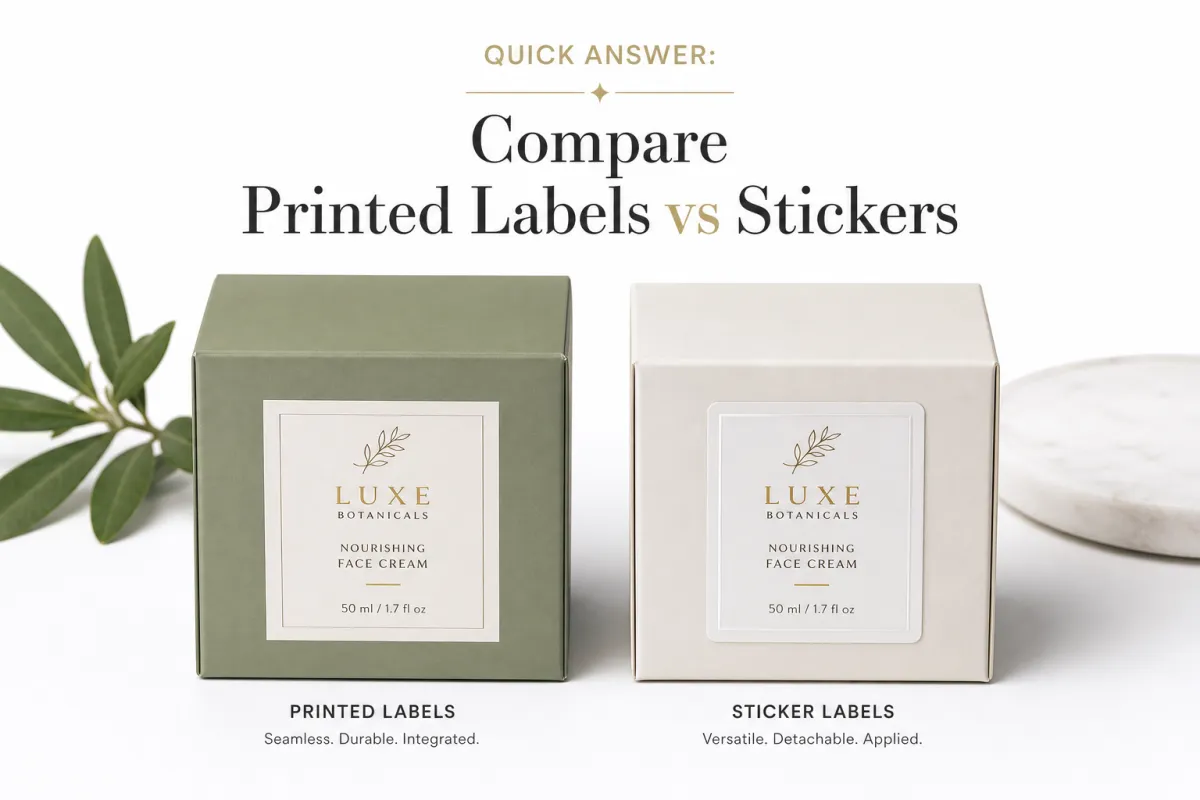
On the floor, the biggest difference between these two options is usually not the artwork. It is speed, waste, and how many chances the operator has to get it wrong. When you compare printed labels vs stickers in an actual production setting, the winner is often the one that reduces touch time and keeps placement consistent. A clean label that lays flat can save more money than a “cheaper” sticker that slows the whole line down. That's the bit people forget.
My rule of thumb is straightforward: printed labels suit higher-volume, branded, and compliance-heavy packaging, while stickers usually fit short runs, test markets, giveaways, and frequent artwork updates. If the pack is going onto a bottle, jar, carton, or mailer that needs to look identical across thousands of units, compare printed labels vs stickers with a bias toward the format that keeps registration, edges, and finish more uniform. If the job changes every few weeks, stickers are easier to live with because setup and revisions are less painful.
There is another detail buyers miss. A sticker can be cheaper per piece, but if it takes 6 to 10 extra seconds to place correctly, the labor cost climbs fast. Multiply that by 5,000 units and the “savings” can disappear in a hurry. I’ve watched this happen on beverage runs, bakery cartons, and cosmetics kits. That is why the real way to compare printed labels vs stickers is by landed cost: material, print, finishing, application labor, freight, and spoilage all need to sit in the same spreadsheet.
Good packaging rule: buy for the worst day, not the best day. If a label has to survive a warm truck, cold storage, and a few hands in fulfillment, compare printed labels vs stickers by durability and handling, not by a flat sample alone.
For the rest of this post, I break the decision into format options, materials, durability, pricing, timeline, and use case fit. That is the cleanest way to compare printed labels vs stickers without getting buried in marketing fluff. The goal is not to crown one format forever. The goal is to choose the one That Actually Works on your package, in your environment, and on your reorder schedule.
Top Options Compared: Compare Printed Labels vs Stickers
When buyers compare printed labels vs stickers, they are often comparing five or six things at once without realizing it. Roll labels, sheet stickers, die-cut stickers, clear labels, waterproof labels, and premium matte or gloss finishes all behave differently once they hit a real container. A roll label on a bottle line is a very different animal from a sheet sticker slapped onto a kraft mailer by hand. If you want a useful comparison, separate the format from the visual effect.
Roll labels are the workhorse for higher-volume packaging. They feed well through applicators, thermal transfer systems, and semi-automatic labelers, and they tend to give a cleaner, more repeatable look on curved bottles and jars. Sheet stickers are easier for smaller teams because they can be printed, trimmed, and used without special equipment. Die-cut stickers are the most flexible on shape, especially for logos, icons, and promotional art, but the final result depends heavily on how carefully they are applied. When you compare printed labels vs stickers across these formats, machine-readability and consistency usually favor labels, while flexibility and quick changes often favor stickers.
Clear labels can be excellent on glass or smooth plastic when the goal is a clean, low-clutter look. They can also be frustrating if the package artwork underneath is busy, because the clear film can disappear in the wrong way and kill contrast. Waterproof labels often use BOPP or other film stocks with moisture-resistant adhesives, which makes them a safer pick for cold-chain items, bath products, or anything that may see condensation. Compare printed labels vs stickers here by asking what the package will actually face: shipping, refrigeration, bathroom humidity, abrasion, or UV exposure. A nice design means very little if the corners curl after the first chilled pallet.
Matte and gloss finishes change brand perception more than a lot of buyers expect. Matte tends to read as calmer, more premium, and less reflective under store lighting. Gloss gives sharper color pop and can make saturated artwork feel more energetic. On jars, bottles, and cartons, finish choice can affect how integrated the label feels with the package. That is another reason to compare printed labels vs stickers on the actual container rather than on a design mockup. A matte label on a gloss carton can look intentional and refined; the same artwork in a mismatched finish can look like a last-minute patch.
| Format | Typical Best Use | Strengths | Watchouts | Typical Buyer Fit |
|---|---|---|---|---|
| Roll printed labels | Bottles, jars, cartons, mailers | Fast application, consistent placement, strong shelf look | Higher setup discipline, less flexible for changing artwork | Medium to high volume |
| Sheet stickers | Small batches, internal use, promos | Easy to order, easy to handle, good for short runs | Hand labor can be expensive, alignment varies | Low volume or frequent design changes |
| Die-cut stickers | Brand marks, giveaways, custom shapes | Strong visual appeal, flexible shape options | Manual application time, edge lift on curved surfaces | Marketing and promotional use |
| Clear labels | Glass, premium cosmetics, minimalist packs | Clean appearance, low visual clutter | Can disappear on busy graphics, needs good surface prep | Premium retail packaging |
| Waterproof labels | Cold-chain, bath, beverage, outdoor handling | Moisture resistance, better scuff resistance | Usually higher material cost | Durability-driven projects |
That table is the practical version of compare printed labels vs stickers. It shows where the real tradeoffs live: not in the logo artwork, but in throughput, adhesion, and how often the package gets touched before purchase. If a pack needs repeatable performance at scale, printed labels usually win. If the job needs agility, lower commitment, or frequent changes, stickers usually make more sense. That simple test clears up a lot.
Detailed Reviews: Printed Labels and Sticker Types
To compare printed labels vs stickers properly, you have to look past the names and into the material structure. Paper, film, adhesive, and finish each change how the piece behaves once it hits a line, a shipper, or a refrigerated shelf. A lot of “bad label” problems are really material mismatch problems. The label may have been printed correctly, but the stock was wrong for the environment, or the adhesive was chosen without thinking about the container surface. That is where experienced buyers save the most money.
Paper Printed Labels
Paper remains one of the most common label materials because it is easy to print, widely available, and cost-effective for dry goods, cartons, and indoor retail packaging. Standard uncoated or coated paper labels work nicely on jars, boxes, and bottles that are not exposed to moisture or heavy abrasion. In a price-sensitive job, paper often looks attractive. But when you compare printed labels vs stickers in the real world, paper has one weakness that matters: it can scuff, edge-damage, and absorb moisture faster than film. If the package gets handled a lot, paper may be the wrong place to save money.
My take is that paper is still worth paying for when the package is dry, the shelf life is short, or the brand wants a natural, recyclable look. FSC-certified paper can also support sourcing claims when the chain is documented properly, and that matters for buyers trying to align packaging with current sustainability goals. For more on responsible fiber sourcing, FSC is a solid reference point: fsc.org. If you compare printed labels vs stickers and the brand story depends on texture, a good paper label can be exactly right. Just do not expect it to behave like a film.
BOPP and Film Printed Labels
BOPP, or biaxially oriented polypropylene, is one of the most dependable film choices for moisture resistance and general durability. It is commonly used for beverage, personal care, and household product labels. A 1.6 mil or similar film construction can offer a cleaner wipe-down surface and better resistance to curling than many paper stocks. When you compare printed labels vs stickers for refrigeration, condensation, or abrasion, BOPP is often the safer bet. It also tends to hold color well, especially for bold branding and barcode readability.
Where BOPP can fall short is on very textured or highly curved surfaces if the adhesive is not matched correctly. The film itself might be fine, but the wrong adhesive can cause edge lift, especially on tight radii or low-energy plastics. That is why compare printed labels vs stickers by looking at both the film and the glue. The substrate matters, but so does the bond strength. If you are labeling PET bottles, HDPE containers, or glossy cartons, ask for a sample on the actual pack shape before you approve a full run.
Thermal Transfer and Variable Data Labels
Thermal transfer labels are common where lot codes, shipment data, and barcode readability matter more than decorative graphics. They can be a smart choice for logistics, warehouse labeling, and some compliance applications. They are not always the prettiest option, but they are dependable when the user needs variable data printed cleanly and quickly. If your buyer team compare printed labels vs stickers for inventory systems, thermal transfer should be on the list because it integrates well with process control.
The limitation is design flexibility. Thermal transfer usually serves function first and branding second. That makes it ideal for shipping cartons, master cases, and internal traceability, but less ideal for the front panel of a retail jar or bottle. Still, it deserves a place in the decision because it can reduce labor and rework on production lines that print lot information in-house.
Paper Stickers
Paper stickers are often the easiest entry point for small businesses and limited campaigns. They can be printed in short quantities, cut into custom shapes, and used without special application equipment. On kraft mailers, bakery boxes, and gift packaging, paper stickers can look charming and quick to produce. The problem is that they are still paper. If the surface sees friction, humidity, or cold storage, they can wrinkle or dull faster than expected. That is why compare printed labels vs stickers with paper-based stock only when the environment is controlled.
Paper stickers make sense for short promotions, internal branding, and packaging that will be opened quickly. They are not the material I would choose for shipping cartons that need to survive warehouse abuse or chilled distribution. If you need the brand to look clean after transit, move up to a film-based option. A sticker should support the pack, not become the fragile part of it.
Vinyl and Clear Stickers
Vinyl stickers are more durable and generally better for higher handling, outdoor exposure, and long wear. Clear stickers are popular for a modern, minimal look on glass and plastic. When done well, the logo seems to float on the container, which can be a strong premium effect. Compare printed labels vs stickers carefully here because a clear sticker can become visually weak if the background is busy, reflective, or uneven. The piece may technically be fine and still look underwhelming.
Vinyl usually handles abrasion better than paper, but it can still be the wrong choice on a curved or textured container if the adhesive is too aggressive or the film is too stiff. That is especially true on smaller diameter bottles and squeezed tubes. I would rather have a slightly less glamorous label that stays put than a perfect-looking sticker that lifts at the corners after a week in the field.
Removable and Permanent Adhesives
Adhesive choice often decides whether the project succeeds. A removable adhesive is useful when the sticker needs to come off cleanly from glass, boxes, or temporary promotion pieces. A permanent adhesive is the better bet for shipping, retail display, and product packaging where the label needs to survive the full use cycle. When people compare printed labels vs stickers, they sometimes blame the format when the real issue is adhesive selection. The wrong adhesive can leave residue, stain a carton, or fail under cold storage.
Ask how the piece will be applied, how long it needs to stay on, and what kind of surface it touches. Coated paper, matte carton, smooth PET, and textured corrugate all behave differently. If the pack is going through temperature changes, ask for a cold-temperature adhesive or a stock designed for that condition. A supplier who understands packaging should be able to talk through those details without guessing.
For packaging projects that need more than one format, it is often smart to compare printed labels vs stickers against the same artwork, the same adhesive target, and the same application method. That keeps the comparison honest. A glossy sticker on a promo box and a roll label on a bottle are not really competing on equal terms unless they are facing the same job.
Price Comparison and Timeline: Compare Printed Labels vs Stickers
Pricing gets distorted fast if you only compare quoted unit prices. To compare printed labels vs stickers the right way, break the quote into setup, material, print method, finishing, die cutting, application labor, shipping, and spoilage. On a small run, a sticker that looks inexpensive can become expensive once you include hand placement. On a larger run, a printed label can become the better value because the cost per piece drops as volume rises and application becomes more consistent.
For rough planning, paper stickers or simple digitally printed labels might sit around $0.08 to $0.25 per piece at low quantities, depending on size, artwork coverage, and finish. Film labels, clear stocks, or specialty adhesive constructions can move higher, sometimes into the $0.12 to $0.40 range or more if the order is small and the finish is elaborate. Those are planning ranges, not promises. Every supplier, region, and spec sheet changes the math a little. Still, they are useful enough to frame the discussion. The point is that when you compare printed labels vs stickers, the lowest unit price does not always produce the lowest total cost.
Labor is the hidden line item. If a person can apply one label in 2 seconds on a machine-assisted line, the economics are very different from a 10-second hand placement on a short batch. At 5,000 units, that difference adds up quickly. A manually applied sticker may seem friendly to the budget until the production team is slowed down for an entire afternoon. That is why compare printed labels vs stickers with labor and throughput in the same spreadsheet as print cost.
Lead time also shifts the decision. A simple digital sticker job may move in 5 to 8 business days after proof approval, while a more complex printed label run with special finishes can run 10 to 15 business days or more. Add embossing, foil, special varnish, or unusual die cutting, and the schedule may stretch to 2 to 4 weeks. If you need a rush order, the quote may rise because press time, finishing, and freight all tighten. So when you compare printed labels vs stickers, ask not only “What is the unit price?” but also “What happens if I need these earlier than expected?”
If you need distribution testing, especially for shippers, cartons, or retail packs moving through rough handling, it is smart to think about standards such as ISTA. That organization focuses on transport testing, and it is a useful reference when a package has to survive vibration, drops, compression, or temperature changes. A label that looks great on the bench can still fail during fulfillment if the adhesive or stock is mismatched to the distribution environment. Compare printed labels vs stickers with those realities in mind, because packaging is judged by the trip it survives, not just by the artwork file.
Here is a practical timeline breakdown many buyers can use:
- Proof and artwork review: 1 to 3 business days if the files are ready and the size spec is clear.
- Sampling and approval: 1 to 5 business days if a physical sample is requested on the actual substrate.
- Production: 3 to 10 business days for straightforward digital work, longer for specialty finishes.
- Finishing and packing: same day to 3 days, depending on lamination, die cutting, and roll conversion.
- Freight: 1 to 7 business days depending on destination and service level.
That timeline matters because many buyers compare printed labels vs stickers only after they have already committed to a launch date. A cheaper format can be the wrong answer if it misses the ship window and forces a production hold. The best quote is the one that lands on time and still behaves properly on the line.
One more cost point: spoilage. If 3% to 5% of pieces are damaged by curl, adhesive failure, miscuts, or scuffing, the true cost rises beyond the original quote. Good buyers compare printed labels vs stickers by asking about overage allowances, inspection, and replacement policy. A slightly higher unit price can be a bargain if the finished quality cuts rejects.
How to Choose Between Printed Labels vs Stickers
The cleanest way to compare printed labels vs stickers is to start with the package surface. Curved bottles, textured corrugate, cold-chain containers, coated cartons, and glossy plastic all behave differently. A label that lays flat on a folding carton may lift on a small-diameter bottle. A sticker that looks fine on a smooth mailer may fail on a textured kraft surface because the adhesive cannot make full contact. In practice, the package surface often decides the winner before the artwork even gets a vote.
Environment comes next. Moisture, refrigeration, abrasion, UV exposure, and frequent handling all point toward durability instead of the lowest quote. For bath products, refrigerated food, shipping cartons, or items handled by warehouse teams, compare printed labels vs stickers with a bias toward the option that can take wear. If the product is a seasonal promo, a gift box, or a limited test, flexibility may matter more than long wear. That is why this decision is situational, not universal.
Brand goal matters too. A premium bottle line, a polished cosmetic jar, or a high-end retail carton usually benefits from the integrated look of a well-chosen printed label. A sticker can still look premium if the stock and finish are right, but the project has to be handled carefully. Promotional items, giveaways, and short-run bundles often benefit from stickers because they are fast to update and easy to deploy. If you compare printed labels vs stickers for a brand refresh, ask whether the goal is shelf authority, speed, or experimentation.
Order pattern is another important filter. If you reorder the same SKU every month or every quarter, printed labels tend to reward discipline with less operational friction. If the artwork changes every few weeks, stickers can reduce waste and make it easier to test new designs. That is especially true for small brands still dialing in their visual identity. Compare printed labels vs stickers with your forecast in mind, not only with your current order.
Here is a fast yes/no path that usually gets buyers close to the right answer in under two minutes:
- Will the package see moisture, condensation, or abrasion? If yes, lean toward a more durable printed label or film sticker.
- Will the label be applied by machine or on a controlled line? If yes, printed labels usually make more sense.
- Will the artwork change often? If yes, stickers or short-run digital labels are often the better fit.
- Is premium shelf presentation more important than low setup cost? If yes, compare printed labels vs stickers with finish quality in mind.
- Do you need quick reorders and small quantities? If yes, stickers may be the most practical starting point.
If you answer “yes” to durability and repeatability, choose printed labels. If you answer “yes” to speed and changeability, choose stickers. That is the simplest useful rule I can give a buyer. It is not fancy, but it works. And if you are still undecided, compare printed labels vs stickers on actual samples rather than rendered artwork. The package will tell you the truth faster than a design proof will.
For buyers who are also thinking about compliance or sustainability messaging, the material choice should be checked against current packaging claims. Paper sourcing, recyclability language, and substrate performance all need to match the package reality. A well-chosen label can support a brand story, but a weak one can create confusion in the supply chain and the checkout aisle. That is another reason to compare printed labels vs stickers with a production mindset instead of a purely graphic one.
If you want a broader packaging reference point while you compare printed labels vs stickers, packaging industry resources such as packaging.org can be useful for materials and sustainability context. The important part is to match the material to the use case first, then polish the graphics second. That order saves money and frustration.
Our Recommendation: Next Steps After Compare Printed Labels vs Stickers
Here is the recommendation I would give most buyers after they compare printed labels vs stickers carefully: choose printed labels for repeatable, branded packaging that needs to look the same across many units, and choose stickers for promos, small batches, testing, or campaigns where artwork changes often. That is the practical split. It is not about which one is better in theory; it is about which one supports the actual work without creating extra handling and waste.
The next step should be a real sample test. Order one version of each option, then apply them to the actual package surface, not a flat desk sample. Check adhesion after 24 hours, after a temperature change, and after a bit of handling. If the item will ship, place a few samples in a carton and move them through the same rough handling the finished product will see. If you want a quick internal check, compare printed labels vs stickers on the exact container geometry, because even a few degrees of curvature can change the outcome.
Before approving anything, use a short checklist:
- Artwork size: confirm bleed, safe area, and final trim dimensions.
- Substrate: paper, BOPP, clear film, vinyl, or another stock.
- Adhesive: removable, permanent, cold-temp, or specialty bond.
- Finish: matte, gloss, soft-touch, or no coating.
- Application method: hand-applied, semi-automatic, or machine-applied.
- Turnaround: proof timing, production timing, and freight timing.
- Reorder quantity: the amount you will likely need on the next cycle.
That checklist keeps a packaging order from drifting into guesswork. It also helps the supplier quote the job correctly, because a good quote depends on more than artwork size. When buyers compare printed labels vs stickers with complete details, the supplier can steer them toward a material that will actually hold up in the field. That is a lot better than discovering the problem after the first shipment is already gone.
Honestly, I think many packaging teams spend too much time debating label versus sticker as if one is “premium” and the other is “cheap.” That framing misses the point. A well-made sticker can be exactly the right tool for a launch box, a limited run, or a temporary promotion. A well-made printed label can carry a product line for months without complaint. The smart move is to compare printed labels vs stickers using the same budget, the same container, and the same timeline, then judge by performance rather than habit.
If you want help narrowing the options further, browse our Custom Labels & Tags and request samples built for your actual package. That is usually the fastest way to compare printed labels vs stickers without wasting time on formats that do not fit your surface or production flow. Once you see the material on the real pack, the decision gets a lot clearer.
And one last practical thought: compare printed labels vs stickers the way a production manager would. Ask what happens during application, what happens in shipping, what happens in storage, and what happens when you need to reorder. That is the full picture. That is the one that saves money.
Are printed labels cheaper than stickers for small orders?
Not always. For small orders, the cheaper option is usually the one with the lower setup burden and the faster handling time, even if the unit print price is a little higher. If the job is hand-applied, labor can matter more than the print price itself, which is why many buyers compare printed labels vs stickers by total job cost rather than piece cost alone. If the same design will be reordered often, printed labels can become the better value once the process is stable.
Which lasts longer: printed labels or stickers on shipping packaging?
Durability depends more on the material and adhesive than on the words printed labels or stickers. For shipping cartons, choose a stock that can handle scuffing, warehouse handling, and temperature changes. If the package may see moisture or abrasion, ask for a film label or a sticker built for that environment instead of a basic paper option. That is the most reliable way to compare printed labels vs stickers for transit use.
Do printed labels or stickers work better on curved bottles?
Printed labels usually perform better when they are designed for the container shape and applied consistently. Stickers can work well for short runs, but thick facestocks or stiff adhesives may lift at the edges on tighter curves. The safest approach is to test the actual bottle or jar before approving the full order. In curved-pack projects, compare printed labels vs stickers with the surface radius in mind, because that detail changes the outcome fast.
How fast can I get labels or stickers made?
Turnaround depends on artwork approval, material availability, finishing, and whether the order is digital or conventional print. Simple sticker jobs can move quickly, but custom printed labels with specialty finishes usually take longer. A proof and sample test can save time later by catching sizing or adhesion problems early. If speed is critical, compare printed labels vs stickers with the full schedule, not just the press time.
What should I ask a supplier before I order printed labels vs stickers?
Ask about material, adhesive, finish, lead time, minimum order quantity, and whether the product will be hand-applied or machine-applied. Request a sample on the real package surface, not just a flat proof, and confirm whether the quote includes setup, finishing, and freight. If you compare printed labels vs stickers with those details in hand, you will usually get a cleaner quote and a better final result.

