Buyer Fit Snapshot
| Best fit | Compare rigid boxes vs corrugated projects where brand print, material claims, artwork control, MOQ, and repeat-order consistency need to be specified before quoting. |
|---|---|
| Quote inputs | Share finished size, material target, print colors, finish, packing count, annual reorder estimate, ship-to region, and any compliance wording. |
| Proofing check | Approve dieline scale, logo placement, barcode or warning zones, color tolerance, closure strength, and carton packing before bulk production. |
| Main risk | Vague material claims, crowded artwork, missing packing details, or unclear freight terms can make a low unit price expensive after revisions. |
Fast answer: Compare rigid boxes vs corrugated: cost, strength, fit should be specified like a repeatable production item. The safest quote records material, print method, finish, artwork proof, packing count, and reorder notes in one written spec.
Production checks before approval
Compare the actual filled-product size with the drawing, then confirm tolerance on folds, seals, hang holes, label areas, and retail display edges. Reserve space for logos, QR codes, warning copy, and material claims before decorative graphics fill the panel.
Quote comparison points
Review material grade, print process, finish, sampling route, tooling charges, carton quantity, and freight assumptions side by side. A quote is only useful when the supplier can repeat the same color, closure quality, and packing count on the next order.
Compare rigid boxes vs corrugated and you are not really comparing two boxes. You are comparing two jobs, two failure modes, and two very different customer experiences. One package is built to impress before anyone lifts the lid. The other is built to survive the carrier network without turning your margin into confetti. That split shows up fast in ecommerce, retail replenishment, subscription shipping, and gift packaging.
The short version is blunt. Rigid boxes win when the opening moment matters, when the package needs to feel expensive, and when the box itself is part of the product story. Corrugated wins when protection, stacking strength, and shipping efficiency matter more. If the package is opened once and remembered, rigid deserves a look. If it gets stacked, tossed, or reshipped, corrugated usually has the upper hand. That is the lens I use to compare rigid boxes vs corrugated for actual programs, not just pretty samples on a table.
There is a catch people miss. The same SKU can need different packaging depending on whether it ships direct-to-consumer, wholesale, or as a retail-ready unit. I have seen elegant rigid boxes approved for launch, then turn into expensive headaches once volume scaled and the fulfillment team had to touch every order twice. I have also seen plain corrugated mailers outperform premium cartons because they protected the product better and cut damage claims. Fancy does not win by default. Shocking, I know.
Packaging is a system. Box style, insert design, product weight, route length, and warehouse workflow all pull on the final result. That is why compare rigid boxes vs corrugated is not just a style debate. It is a shipping decision, a brand decision, and a margin decision packed into one line item. Miss one part of the system and the whole thing gets kinda stupid, fast.
The box that wins in a pitch deck does not always win on a parcel scale.
One more practical point: the best answer is not always one box type for every SKU. A cosmetics launch kit may deserve a rigid setup for the hero item, while refill packs and replacement units are better inside corrugated. That mixed approach makes sense because the economics are different. Good packaging buyers compare rigid boxes vs corrugated SKU by SKU, not as a religious war.
Quick answer: compare rigid boxes vs corrugated when the shipment has to do two jobs
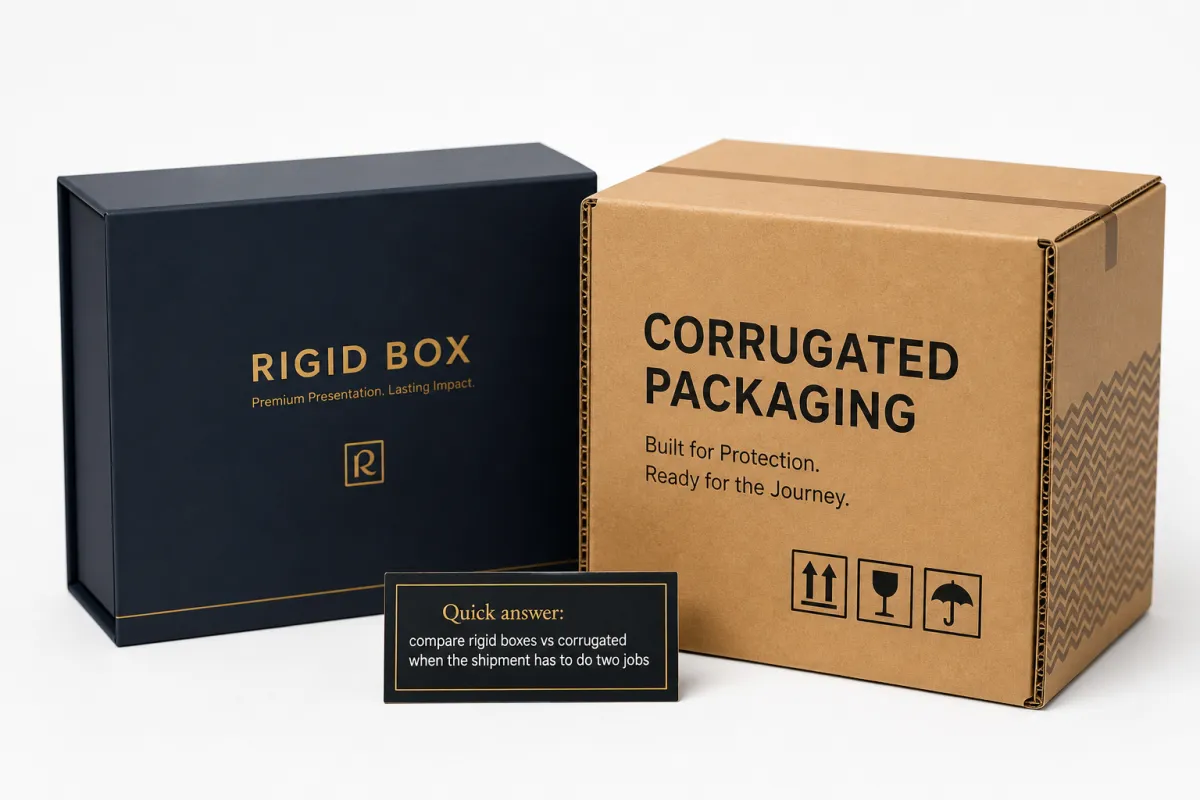
If you need the fast answer, here it is: compare rigid boxes vs corrugated based on what the package must do after it leaves your hands. Rigid boxes are better for display, gifting, launches, and luxury perception. Corrugated is better for transit protection, stacking, and cost control. That sounds obvious. It still gets ignored all the time.
A rigid box usually uses 1.5 to 3 mm chipboard wrapped in printed paper, specialty texture stock, or soft-touch laminate. It feels substantial because it is substantial. A corrugated box uses fluted board that creates a spring-like buffer between the product and the outside world. That flute structure matters more than many buyers realize, especially on long carrier routes where packages get dropped, corner-loaded, and stacked until somebody’s bad day lands on your doorstep.
Here is the rule I would give a packaging buyer: if the product is opened once and the opening moment is part of the sale, lean rigid. If the package needs to survive repeated handling, stacking, or reshipment, lean corrugated. Compare rigid boxes vs corrugated with the whole trip in mind, not just the first impression.
That matters even more in ecommerce. A rigid carton can elevate an unboxing, but if it needs a large outer shipper anyway, you may end up paying twice: once for the presentation box and again for the shipping box that protects it. Corrugated is often the smarter single-layer answer because it can be both the brand surface and the transit shell. When I compare rigid boxes vs corrugated for online orders, I ask one question first: will this package earn its keep during transport, or only at opening?
There is no shame in choosing corrugated for a premium product. Some of the strongest packaging programs I have seen use well-printed corrugated with precise inserts, because the structure does the hard work and the graphics do the selling. A rigid box can still be the right move for a practical product if the brand promise depends on perceived quality. That is the honest center of compare rigid boxes vs corrugated.
Top options compared: compare rigid boxes vs corrugated on protection, branding, and freight
This is where compare rigid boxes vs corrugated gets clearer. The table below is not a classroom scorecard. It reflects how these boxes behave in real programs where freight bills, warehouse labor, and damage rates show up on the P&L. Reality is rude like that.
| Category | Rigid boxes | Corrugated boxes | Best fit |
|---|---|---|---|
| Protection | Strong shell feel, but often needs an outer shipper for transit | Excellent impact absorption and better stacking behavior | Corrugated for shipping; rigid for presentation |
| Branding | Very high tactile and visual impact with wraps, foils, embossing | Strong if print quality and structure are well executed | Rigid for luxury; corrugated for branded shipping |
| Freight efficiency | Heavier and bulkier; more likely to raise dimensional charges | Usually lighter and easier to cube efficiently | Corrugated for recurring shipments |
| Storage space | Consumes more warehouse cube, especially with fitted lids and inserts | Flatter storage profile, better for pallet density | Corrugated in most operations |
| Assembly speed | Can involve more handwork, magnets, sleeves, or insert fitting | Often faster to erect, tape, or auto-bottom | Corrugated in high-volume pack lines |
| Lead time | Often longer because of finishing and hand assembly | Usually faster for simpler structures and common board grades | Corrugated for speed-sensitive launches |
| Customer perception | Feels premium immediately | Can feel premium with the right print and insert design | Rigid for giftable, keep-worthy items |
| Typical channel | Retail, influencer kits, launch boxes, gifts | DTC shipping, wholesale replenishment, subscription logistics | Depends on channel mix |
That table hides one important truth: channel drives the outcome. A box that works beautifully in a retail tray may be wasteful for ecommerce. A mailer that ships cleanly may not deliver enough theater for a premium launch. So when you compare rigid boxes vs corrugated, ask where the box lives first. On a shelf? In a truck? On a front porch? Inside another mailer? The answer changes the economics.
For cosmetics, gifts, and launch kits, rigid boxes often win because the package is part of the brand story. For electronics, replacement parts, and subscription programs, corrugated usually wins because the package has to protect the product at scale. For mixed programs, many brands use a rigid inner box with a corrugated outer shipper. That hybrid approach is popular for a reason. It keeps the reveal and respects freight.
If you are comparing rigid boxes vs corrugated for a product that crosses borders or gets handled multiple times, look harder at compression and corner damage. The box that feels stronger in hand is not always the box that survives stacked trailer loads and distribution centers. Corrugated board can be engineered for the load. Rigid packaging usually needs help to get there.
There is also a brand nuance people skip past. Corrugated does not have to look cheap. With precise print registration, clean die cuts, a fitted insert, and a closure that makes sense, a corrugated package can look deliberate and modern. It will not feel identical to rigid, but it can look sharp. That distinction matters in compare rigid boxes vs corrugated because “premium” and “expensive-looking” are not the same thing.
Detailed review: rigid boxes for premium unboxing and retail
Rigid boxes earn their keep where touch matters. They are the packaging version of a heavy door closing with confidence. The board is thick, the corners are crisp, and the whole unit signals value before the product is even visible. That is why compare rigid boxes vs corrugated often starts with luxury, cosmetics, jewelry, premium accessories, gift sets, and launch kits.
A proper rigid box usually uses chipboard around 1.5 to 3 mm thick, wrapped in printed paper, textured stock, or specialty finish film. Closure styles can include magnetic lids, shoulder-neck constructions, drawer styles, hinged lids, or telescoping two-piece setups. Each one changes the unboxing rhythm. A drawer pull gives you one kind of drama. A magnetic flip lid gives you another. Neither is shy.
What rigid boxes do well
They create perceived value quickly. Customers judge weight, resistance, and fit within seconds. A rigid box almost always scores well there. They hold shape, which keeps shelf display cleaner and product photography sharper. They also support premium finishing: foil stamping, embossing, debossing, soft-touch coating, spot UV, and specialty wraps. Those details matter because the first touch is often the brand’s first proof point.
From a packaging buyer’s point of view, rigid boxes are useful when the product itself cannot carry the full emotional load. A $180 serum, a limited-edition watch, or a gift box for a seasonal promotion benefits from packaging that signals care. The box becomes part of the price justification. That is not fluff. It is part of the purchase psychology.
I also like rigid packaging for controlled environments. Retail display, influencer sends, press kits, and VIP gifts are often handled fewer times and opened intentionally. In those cases, the structural feel pays off. The box is not getting punished by a parcel network, so its strengths stay visible.
Compare rigid boxes vs corrugated here and the rigid side wins on presentation almost every time. The real question is whether that presentation justifies the extra cube, cost, and handling time. Sometimes it does. Sometimes it is pure vanity with a nicer finish, which is a fancy way of saying the math is bad.
Where rigid boxes fall short
The obvious weakness is shipping efficiency. Rigid boxes add weight and bulk. A tightly specified product may end up with a larger outer dimension than expected, which can trigger dimensional charges or reduce pallet density. On a busy distribution program, that difference compounds quickly. A box that looks small in a design file can become expensive once stacked, warehoused, and shipped by the thousands.
Rigid boxes are also more sensitive to system design. They often need an outer mailer or shipper if they are traveling by parcel. That means one more layer, more touch points, and more cost. If the outer shipper is weak, the beautiful inner rigid box can still arrive scuffed, crushed at the corners, or loose in transit. So compare rigid boxes vs corrugated with the whole pack-out in view, not just the fancy box itself.
Storage is another issue. Most rigid boxes are set-up cartons, not true fold-flat shippers. Some collapsible versions exist, but many standard rigid constructions still take up more warehouse cube than a comparable corrugated solution. That matters for seasonal programs where inventory sits longer than planned and every pallet foot starts looking expensive.
Honestly, this is where buyers get misled. They compare the unit quote, see a polished rigid sample, and stop there. The real cost lives in labor, outer packaging, and freight. Compare rigid boxes vs corrugated properly and the rigid option often needs a second financial test before approval.
Still, rigid boxes remain hard to beat when the package itself is the event. If your product should feel giftable before the customer even sees it, rigid packaging has a very clear job to do.
If your team is building a broader packaging line, it can help to review Custom Packaging Products for related components such as inserts, sleeves, and branded support pieces. That way, you can see how the box fits into the rest of the pack system rather than treating it as a stand-alone item.
Detailed review: corrugated boxes for transit protection and repeat shipping
Corrugated is the workhorse. It handles the bulk of shipping volume because it solves the hard problem: getting product from one place to another without turning every move into a damage claim. If compare rigid boxes vs corrugated is a shipping efficiency debate, corrugated usually wins it.
The structure comes from the flute, the wavy inner layer that creates air pockets and gives the board cushioning behavior. That is why a corrugated box can be both light and surprisingly strong. Depending on the job, you may see E-flute for a tighter retail look, B-flute for general shipping, C-flute for thicker protection, or double-wall constructions when the load gets serious. The right flute is not a cosmetic choice. It is a load-bearing decision.
Why corrugated is the default for transit
Corrugated absorbs impact better than most rigid-style presentation cartons because the fluted structure compresses and spreads force. It stacks more predictably. It also makes warehouse operations easier. Auto-bottom mailers, RSC shipper boxes, and die-cut mailers can be erected fast, taped consistently, and packed in high volume. For teams that count every second at the pack line, that difference is huge.
Compare rigid boxes vs corrugated and you will notice another benefit: corrugated is easier to standardize across SKUs. One base shipper size can often support several product variations with only insert changes. That is a real advantage when the catalog is broad and inventory planning needs to stay simple. Fewer bespoke structures usually mean fewer headaches, which is the kind of luxury operations actually care about.
Print quality has improved too. Digital print, flexographic print, and litho-lam options let corrugated boxes carry strong branding without losing structural value. If the design is clean and the structure is well thought out, corrugated can look more premium than buyers expect. Add a custom insert, a branded sleeve, or a neat closure, and the package starts to feel intentional rather than plain.
For many ecommerce boxes, corrugated is the right compromise. It protects the product, ships efficiently, and still leaves room for good design. That is why compare rigid boxes vs corrugated often ends with corrugated for practical channels like refill packs, subscriptions, and wholesale replenishment.
Where corrugated falls short
Corrugated usually cannot match rigid on first-touch luxury. The board is functional, but the emotional signal is different. Even with excellent print, there is less of that dense, keep-it-on-the-shelf feeling. If the product is meant to impress at opening, corrugated has to work harder for the same effect.
Edge denting can also show up if the board grade is too light or the closure design is weak. Humidity matters too. Corrugated performs well in normal shipping conditions, but prolonged exposure to moisture can soften the board and reduce compression strength. That is one reason why shipping environment and storage conditions belong in the same conversation when you compare rigid boxes vs corrugated.
Another limitation is presentation consistency. Corrugated can look excellent, but the finish is more dependent on print registration, board quality, and manufacturing discipline. A sloppy run looks sloppy fast. A well-run program looks crisp. There is less forgiveness than some buyers expect.
That said, corrugated remains the smarter solution for most repeated shipping programs. The reason is not glamour. It is math. Lower unit cost, better stackability, easier fulfillment, and fewer freight surprises can outweigh the lower tactile drama every time.
If your packaging program includes shipping-specific structures, take a look at Custom Shipping Boxes to see how corrugated formats can be tailored for product size, inserts, and brand graphics without giving up transit performance.
Price comparison: compare rigid boxes vs corrugated by unit cost and total landed cost
Unit price is where packaging decisions go sideways. It is the first number people see, and it is almost never the full number. If you compare rigid boxes vs corrugated honestly, you have to include inbound freight, storage cube, assembly, pack-out labor, and damage replacement. Otherwise the “cheap” option turns into the expensive one wearing a fake mustache.
As a rough planning range, Custom Rigid Boxes in moderate quantities often land around $1.20 to $3.50 per unit depending on size, wrap, inserts, magnets, foil, and hand assembly. Corrugated boxes commonly fall around $0.35 to $1.10 per unit for similar-volume custom work, though print coverage, board grade, and die complexity can move that higher. Those are not promises. They are budgeting ranges, not final quotes. And no, a glossy sample does not change the math.
| Cost component | Rigid boxes | Corrugated boxes | What to watch |
|---|---|---|---|
| Unit manufacturing cost | Usually higher due to board, wrap, and assembly | Usually lower for standard shipping structures | Print coverage and insert complexity |
| Inbound freight | Higher because of bulk and lower pallet density | Lower because of flatter storage and better cube | Pallet count and stack height |
| Storage cost | More warehouse space per piece | Less warehouse space per piece | Seasonal inventory carrying cost |
| Pack-out labor | Can be slower if lids, wraps, or inserts need manual fit | Often faster to erect and fill | Seconds per order add up fast |
| Outbound shipping impact | Can increase dimensional weight and carton size | Usually more shipping-efficient | Carrier pricing tier |
| Damage replacement | High if the rigid box needs an outer shipper and that shipper is weak | Usually lower when designed for transit correctly | Drop performance and corner crush |
That table is why compare rigid boxes vs corrugated should never stop at the invoice. A rigid box may look cost-effective if you only compare the package itself. Add the outer shipper, the higher freight cube, and the manual handling time, and the true landed cost can jump sharply. Corrugated usually benefits from the opposite effect: one integrated structure, fewer touches, and better shipping density.
Think about a 5,000-piece launch. If a rigid box saves brand team approval time because it looks luxurious, but it adds 20 seconds of pack-out labor per order and bumps parcel cost by even a small amount, the total can move by thousands of dollars. That is not melodrama. That is math. At scale, a few cents per piece become meaningful. A few extra inches of cubic space do the same thing.
Compare rigid boxes vs corrugated again through a total landed cost lens:
- Unit cost - what the box costs at the plant.
- Inbound freight - what it costs to bring cartons into your warehouse.
- Storage - how much cube the boxes occupy before use.
- Assembly - how many labor seconds each unit needs.
- Outbound freight - the parcel or pallet impact after packing.
- Damage rate - replacement product, reshipment, and support time.
This is also where custom inserts matter. A carefully cut insert can reduce movement, which lowers damage, but it adds material and assembly cost. If the insert is inside a rigid box, the total can climb quickly. If the same insert sits in corrugated and removes a separate outer layer, the math can improve. Compare rigid boxes vs corrugated with the insert in mind, not after the fact.
One more practical note: minimum order quantities can change the picture. Rigid programs often need more setup and sometimes higher MOQs, while corrugated can be more flexible depending on print method and structure. That flexibility is valuable for test launches, seasonal runs, and smaller SKU families. The cheapest quote is not the best quote if it locks cash into inventory that sits for months.
How to choose: process, timeline, and production trade-offs
The right choice gets clearer once you map the process. Compare rigid boxes vs corrugated from concept to delivery, and the time cost often separates them as much as the material cost does. A good packaging project does not start with artwork. It starts with the product, the channel, and the shipping method.
Most projects move through the same sequence: size confirmation, dieline review, sample build, visual proofing, production approval, and final shipment. The part that slows teams down is rarely the artwork alone. It is the fit decision, the insert decision, and the finish decision. A magnetic closure or specialty wrap can add time. A simple corrugated die-cut mailer can move much faster.
A practical timeline
For a straightforward corrugated program, a good timeline is often 12 to 18 business days after proof approval, depending on complexity and line load. A more detailed rigid box program can run longer because of wrapping, hand assembly, and specialty finishing. It is not unusual for rigid to take several additional days, especially if the run uses foil, embossing, or complex inserts.
That difference matters when a launch date is fixed. If the package is tied to seasonal demand, influencer timing, or retail reset windows, buffer time is not optional. I have seen otherwise solid programs get squeezed because the packaging schedule was built around the ideal case rather than the real one. Compare rigid boxes vs corrugated early enough and you can avoid that mess.
Testing should happen before final release, not after a complaint. For shipping programs, use practical stress checks based on the route. ISTA test methods are a sensible benchmark, and the organization documents common distribution test approaches at ISTA test methods. You do not need to overcomplicate the process, but you do need to simulate the real journey. A package that passes a desk review and fails a drop test is still a failed package.
Another useful standard reference is FSC, especially if your team cares about responsible sourcing or retailer requirements. Paper and board choices can align with FSC certification standards when the supply chain supports it. That does not make a package automatically better, but it can matter to brands that need documented sourcing.
Here is the checklist I would use before final sign-off:
- Confirm product dimensions with the actual packed SKU, not just the item alone.
- Decide whether the package is a presentation box, a shipper, or both.
- Test closure strength, corner crush, and insert movement.
- Check warehouse assembly time on a small production sample.
- Compare freight impact using the real outer dimensions.
- Review the launch quantity against storage space and cash flow.
From a planning point of view, compare rigid boxes vs corrugated SKU by SKU. Do not assume one style fits the entire catalog. A premium serum, a refill pouch, and a gift set may each need a different structure. That is normal. It usually means someone is paying attention to the actual use case instead of forcing a one-size-fits-all plan because spreadsheets are lazy.
And yes, sample the box before you commit. Physical samples reveal things a CAD drawing will not. Lid tension, insert friction, print sheen, and handling speed only become clear in hand. That is true for rigid and corrugated alike, but especially true when the decision is close.
Our recommendation and next steps for shipping, samples, and order planning
If I had to make the call in one sentence, I would say this: choose rigid boxes for high-touch brand moments, choose corrugated for protection-first shipping programs, and use a hybrid when both matter. That is the cleanest way to compare rigid boxes vs corrugated without pretending every shipment has the same job.
For luxury retail, press kits, wedding or gift programs, and launch boxes that are opened in a controlled setting, rigid usually deserves the budget. For ecommerce fulfillment, repeat replenishment, wholesale cartons, and any program that faces stacking, rough handling, or higher shipping volume, corrugated is usually the smarter investment. If the box must do both jobs, then a rigid inner with a corrugated outer shipper often gives the best balance.
The next three actions are practical and fast:
- Request samples of both styles for the same SKU and same fill weight.
- Run a short ship test, ideally using the same pack-out method your warehouse will use.
- Compare true landed cost, not just the quote, using unit price, freight, storage, assembly, and damage risk.
That is the point where the discussion gets real. Compare rigid boxes vs corrugated on paper first, then compare them in motion. A box that looks right but ships badly is still the wrong box. A box that feels plain but protects the product and keeps margins intact can be the better business decision. Honest packaging work is rarely glamorous. It is usually measured, specific, and a little less romantic than the mockup suggests.
If you are building a broader packaging rollout, review the supporting options in Custom Packaging Products and match the box style to the channel rather than forcing one structure across the board. That keeps the system cleaner and usually improves both cost and customer experience.
For most brands, the real answer is not “rigid or corrugated forever.” It is “which one solves this shipment best?” Once you ask that, compare rigid boxes vs corrugated becomes a much easier decision, and a much more profitable one.
My practical rule: start with the route, then the product, then the unboxing. If the package is mostly a shipping problem, choose corrugated and build the brand feel into the print and insert. If the package is mostly a brand moment, choose rigid and protect it with an outer shipper where needed. That keeps you honest, and it keeps the warehouse from quietly hating your guts.
FAQ
How do I compare rigid boxes vs corrugated for fragile products?
Judge the whole shipping path, not just the box wall strength. Fragile items often need corrugated for impact absorption plus inserts to keep the product from moving. Use rigid boxes only if the product also needs a premium reveal and the package will travel inside a protective outer shipper. A drop test and compression check on the actual packed SKU is the safest way to compare rigid boxes vs corrugated for fragile goods.
Which is cheaper when I compare rigid boxes vs corrugated for ecommerce shipping?
Corrugated is usually cheaper once you include inbound freight, storage space, and outbound shipping efficiency. Rigid boxes can make sense only when the branding value justifies the extra cube, labor, and material cost. The best comparison is total landed cost per shipped order, not the unit quote alone. That is the number that tells the truth.
Are rigid boxes or corrugated better for luxury unboxing?
Rigid boxes usually win on tactile feel, structure, and the first impression customers remember. Corrugated can still feel premium if the graphics are strong, the structure is clean, and the insert design is thoughtful. For high-end launches, many brands use a rigid box inside a corrugated outer shipper. That gives you the reveal and the shipping protection.
What lead times should I expect when I compare rigid boxes vs corrugated?
Rigid boxes often take longer because they may need more finishing, wrapping, and assembly steps. Corrugated can move faster when the structure is simple and the print requirements are standard. Ask for sample, proof, and production timelines separately so launch planning stays realistic. A single date usually hides too much.
Can corrugated boxes look premium enough for retail programs?
Yes, especially with strong print, clean structure, and inserts or sleeves that elevate the reveal. Corrugated is a strong fit when the product needs both retail presence and efficient shipping. If the box must signal luxury at first touch, rigid usually still has the edge. That is why compare rigid boxes vs corrugated should always be tied to the channel and the customer expectation.

