Buyer Fit Snapshot
| Best fit | compare seasonal packaging inventory options for packaging buyers comparing material specs, print proof, MOQ, unit cost, freight, and repeat-order risk where brand print, material, artwork control, and repeat-order consistency matter. |
|---|---|
| Quote inputs | Share finished size, material target, print colors, finish, packing count, annual reorder estimate, and delivery region. |
| Proofing check | Approve dieline scale, logo placement, barcode or warning zones, color tolerance, and any recyclable or compostable wording before bulk production. |
| Main risk | Vague material claims, crowded artwork, or missing packing details can create delays even when the unit price looks attractive. |
Fast answer: Compare Seasonal Packaging Inventory Options: Material, Print, MOQ, and Cost should be specified like a repeatable production item. The safest quote includes material, print method, finish, artwork proof, carton packing, and reorder notes in one written spec.
What to confirm before approving the packaging proof
Check the product dimensions against the actual filled item, not only the sales mockup. Ask for tolerance on folds, seals, hang holes, label areas, and retail display edges. If the package carries a logo, QR code, warning copy, or legal claim, reserve that space before decorative graphics fill the panel.
How to compare quotes without losing quality
Compare board or film grade, print process, finish, sampling route, tooling charges, carton quantity, and freight assumptions side by side. A lower quote is only useful if the supplier can repeat the same color, closure quality, and packing count on the next order.
Compare Seasonal Packaging Inventory: Best Options starts with a blunt fact. The cheapest quote is often the most expensive mistake. I have seen a holiday campaign look profitable on a spreadsheet, then wobble because cartons arrived late, artwork approvals dragged, or the warehouse filled up with stock nobody wanted once the season passed. To compare seasonal packaging inventory properly, start with unit cost, lead time, storage burden, and demand risk. Save the glossy mockup for later.
I have watched this same pattern show up in gift sets, subscription programs, and retail packaging launches. Teams compare seasonal packaging inventory by unit price only, then pay for it in rush freight, extra handling, or markdowns on leftovers. That approach looks tidy on paper and messy in real life. A better method is less pretty and a lot more useful: compare seasonal packaging inventory as part of the whole operation, not as a showpiece in a deck.
For brands building branded packaging or Custom Printed Boxes, the real question is not, "What looks nicest?" It is, "What can move through production, receiving, storage, and fulfillment without chewing up margin later?" That is where package branding and product packaging collide with operations. If you need a place to start on format ideas, review Custom Packaging Products and match each option to the season you actually have, not the one you wish you had. Seasonal inventory planning works best when the box, the calendar, and the warehouse all agree for once.
One caveat before we get practical: the cost ranges and workflows below are directional, not a quote sheet. Paper grade, print coverage, finishing, geography, and freight distance can swing numbers hard. If your program is unusual, use the framework here and then pressure-test it with supplier data. That is the honest way to do it.
How Do You Compare Seasonal Packaging Inventory Fast?
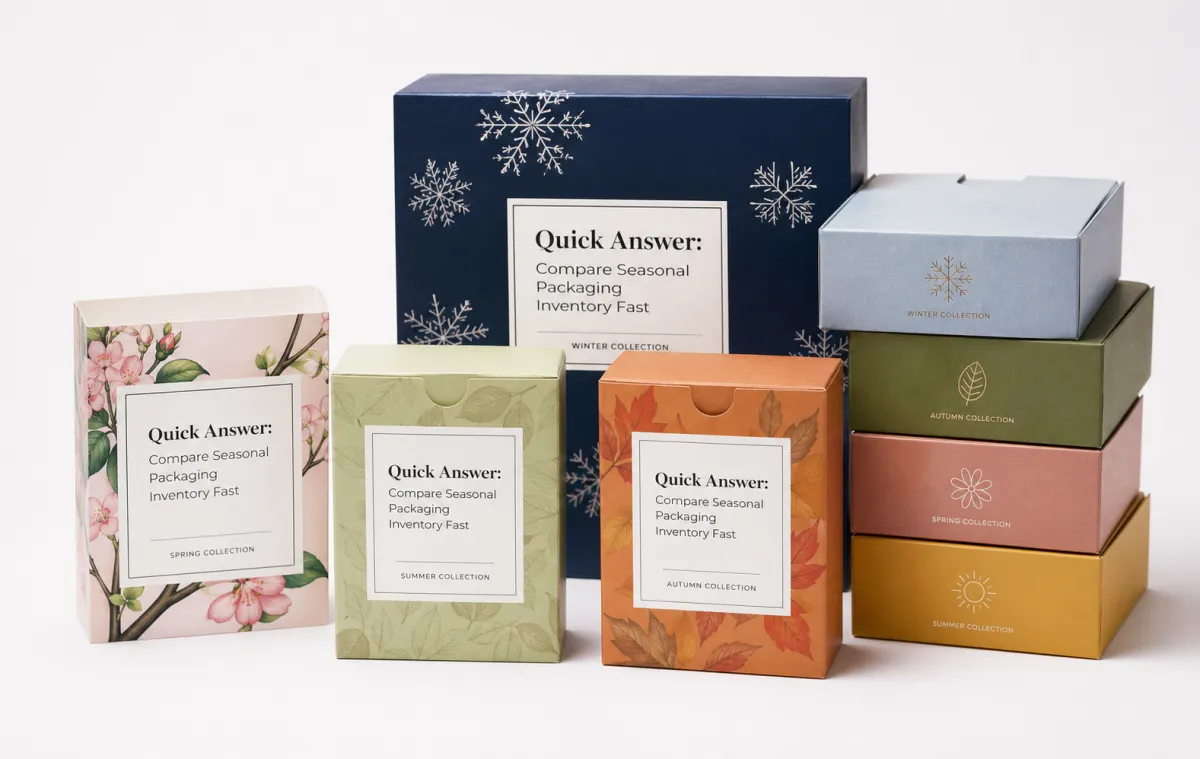
A strong holiday forecast makes it tempting to order deep and early. Then the forecast shifts. The promo sells slower than expected, the art team revises the design twice, or inbound freight gets jammed by peak-season congestion. The fastest way to compare seasonal packaging inventory is to put four numbers on the table first: unit cost, lead time, storage burden, and demand risk. Put those side by side and the answer gets a lot less foggy.
Here is the short version. If demand is predictable and the package can carry across several product lines, a larger prebuild usually makes sense. If demand is shaky, or if the seasonal artwork has a short shelf life, smaller batches and flexible reorders are safer. Compare seasonal packaging inventory against the sales window, not just against the purchase order. A short seasonal cycle turns small delays into expensive problems fast.
That matters because seasonal packaging has a market life, even if the board itself can sit around for months. A Valentine mailer may still be physically usable after February, but commercially it is dead weight. A winter pattern may survive storage just fine, then feel awkward once the season passes. Compare seasonal packaging inventory with that reality in mind, and the best choice is usually the one that protects sell-through instead of the one that saves a few cents on paper.
From a packaging buyer's point of view, the rule is simple. If the product line has steady demand, hold more inventory and use the volume to improve price. If demand swings hard, keep the run smaller, reserve production capacity, and compare seasonal packaging inventory again once early sales data arrives. Shipping on time with a slightly higher unit cost beats missing the window entirely. Every time.
A practical shortcut helps here: give each option a score from one to five for cost, speed, storage, and flexibility. That makes it easier to compare Seasonal Packaging Inventory Without getting hypnotized by one impressive sample or one suspiciously low quote. The best plan is usually the one that scores well across all four categories, not the one that wins a single round and loses the match.
The wrong packaging plan rarely blows up all at once. It leaks money in pieces: extra storage, duplicate SKUs, one late shipment, then a season that ends before the inventory is fully used.
That is the lens I use here: compare seasonal packaging inventory on operating risk, not just on the face value of the quote. The next sections break down the common models, the real cost drivers, and the timeline choices that separate a manageable season from a sloppy one.
Top Options When You Compare Seasonal Packaging Inventory
Four models show up again and again in seasonal packaging programs. Each one works. None of them works for every business. The trick is to compare seasonal packaging inventory with the same assumptions so the tradeoffs are visible instead of buried in supplier language and optimistic forecasts.
Fully stocked seasonal runs are the easiest to understand. The team orders enough packaging to cover the season, receives it before launch, and fulfills from stock. This fits gift sets, retail displays, and launches with a high sell-through rate. The downside is storage pressure. Once the pallets arrive, the clock starts. If the campaign slows, the inventory can sit around long after the promotion is gone.
Hybrid base-pack plus seasonal add-ons is usually the smartest middle ground. The base box stays standard, while the seasonal change happens through a sleeve, insert, label, or belly band. That lets the brand reuse the main structure while swapping graphics for each campaign. Compare seasonal packaging inventory this way and the waste picture usually looks better, because only part of the package is season-specific.
Just-in-time replenishment keeps less inventory sitting in the warehouse. It can work well for disciplined teams with solid forecasts and fast supplier communication. The weakness is obvious. A delayed proof, a crowded production queue, or a freight snag can empty the shelf at the worst time. Compare seasonal packaging inventory with just-in-time planning only if everyone involved can respond quickly and accurately.
Limited-edition short runs are the loudest visually. They fit campaign packaging, influencer kits, and seasonal product packaging where the look itself is part of the sale. Short runs help when the visual concept carries the demand, but they usually cost more per unit. If the design cannot be reused, the risk is simple: you pay for novelty, then pay again if the forecast misses.
Teams often overbuy graphic-heavy packaging because the sample looks too good to cut back. Classic mistake. A holiday print with metallic ink, soft-touch lamination, and a custom insert can look great in review and still become a headache if sell-through slows. Compare seasonal packaging inventory with enough skepticism to ask the uncomfortable question: will this box still help the business after the season ends?
For brands that need a broader mix of formats, retail packaging options can be matched to a campaign by volume, artwork complexity, and storage life. That is usually smarter than forcing one structure to do every job.
Detailed Reviews of Seasonal Packaging Inventory Models
Testing each model in practice tells a clearer story than any supplier brochure. To compare seasonal packaging inventory well, I look at setup speed, storage demand, reorder flexibility, and what happens if the season performs better than expected. That is where the real mess, or the real efficiency, shows up.
Prebuilt inventory is the strongest on availability. Once the boxes are on hand, fulfillment can move fast, which matters for retail launches and time-sensitive promotions. The weakness is easy to spot: more pallets, more capital tied up, and more exposure if the season underperforms. Compare seasonal packaging inventory in this format and the biggest risk is obsolete stock. A strong box can still be a bad asset if it misses its selling window.
Hybrid packaging deserves more attention than it usually gets. A standard structural box can live across multiple seasons while the outer artwork changes. That cuts the amount that becomes useless after the campaign ends. It also fits subscriptions nicely, where the box structure can stay stable while seasonal printed materials inside carry the theme. Compare seasonal packaging inventory this way and the waste profile often looks much cleaner than a fully custom seasonal run.
Short-run custom packaging is the right answer when visual impact is the main event. Limited-edition cosmetics, holiday beverage cartons, and premium gift packaging often need a design that feels special. The economics change, though. Smaller runs usually cost more per unit, and the design timeline becomes more sensitive to revision cycles. Compare seasonal packaging inventory in this format only if the campaign value justifies the premium.
Just-in-time planning can be efficient, but it is not forgiving. Artwork approvals need to happen on schedule. Freight needs to be predictable. The supplier needs room in its production calendar. If any one of those pieces slips, the whole season starts to strain. On a good day, it is operationally clean. On a bad day, it breaks faster than people expect.
There is also a quality-control angle. If the packaging has to survive parcel handling, especially for ecommerce, transit testing matters. The ISTA transport testing standards are useful because they force the team to think about actual shipping conditions, not just shelf appeal. For custom printed boxes that travel through distribution centers, that is basic risk control, not a nice-to-have.
Another practical point: compare seasonal packaging inventory with finishing specs in mind. A paperboard carton with aqueous coating is easier to store than one with specialty film and heavy embellishment. A matte laminate may look sharp, but it can also change scrap rates and cost. Teams that ignore those details usually overestimate how much the season can absorb.
My honest read is simple. The best model is not the one with the prettiest render or the lowest unit price. It is the one that keeps the campaign moving without forcing ugly discounting later. Compare seasonal packaging inventory with that standard and the answer gets less emotional, which is usually an improvement.
For teams comparing structure, print, and finishing choices across packaging design options, custom printed boxes can be matched to the season without building a pointless pile of one-off stock.
Compare Seasonal Packaging Inventory Costs
Price is where many teams stop. That is exactly where they should not stop. To compare seasonal packaging inventory accurately, total the landed cost, not just the quoted unit price. The real bill usually includes tooling, plate or setup fees, freight, receiving, storage, picking and packing, spoilage, and the cost of leftovers. That list gets long quickly.
Small-batch pricing looks expensive because the per-unit number is higher. The whole picture changes if the season is short and storage costs are steep. A larger run may trim unit cost by a decent margin, then give some of that savings back in warehousing and markdown risk. Compare seasonal packaging inventory with a full-cost lens and the cheapest quote often stops being the cheapest decision.
Here is a practical comparison table I would use in a buyer review. The ranges are not fixed rules; they are working numbers that shift with size, print coverage, board grade, and finishing. Still, they help because they force the discussion onto real tradeoffs instead of hopeful assumptions.
| Inventory Model | Typical MOQ | Unit Cost Range | Storage Burden | Best Fit | Main Risk |
|---|---|---|---|---|---|
| Fully stocked seasonal run | 5,000-10,000 units | $0.18-$0.42 | High | Predictable holiday volume, retail displays, gift sets | Leftover inventory after the season |
| Hybrid base-pack plus add-ons | 2,000-5,000 base units; 1,000-3,000 seasonal components | $0.22-$0.55 | Medium | Multi-season brands, ecommerce, subscription packaging | Component mismatch if planning gets sloppy |
| Just-in-time replenishment | 500-2,000 units per release | $0.30-$0.70 | Low | Uncertain demand, limited storage, fast-moving assortments | Stockouts if approvals or freight slip |
| Short-run limited edition | 250-1,500 units | $0.45-$1.10 | Low to medium | Premium seasonal launches, campaign packaging, press kits | High per-unit cost if sell-through is weak |
Those numbers help because they show the hidden shape of the decision. A buyer might prefer a fully stocked run at $0.22 per unit, then discover that the storage bill, surplus handling, and markdowns erase the savings. Another team might choose a higher per-unit cost for a short-run box and still come out ahead because the inventory stays tight and the season clears quickly. Compare seasonal packaging inventory both ways before locking the order.
The cost of a stockout deserves its own line item. If the packaging runs out, the brand can lose sales, pay rush production premiums, or ship product in fallback packaging that hurts presentation. For premium retail packaging, that damage can linger long after the season is over. Compare seasonal packaging inventory with stockout risk included, and the economics become a lot more honest.
Material choice changes the picture too. FSC-certified paperboard often costs a bit more than basic stock, but it can support a sustainability claim that matters to buyers. Check the FSC certification framework if your customer expects chain-of-custody documentation. On the other side, complex finishes like foil, embossing, and specialty laminates can raise setup and scrap rates. Package branding should be judged alongside production efficiency, not apart from it.
The EPA's waste reduction guidance points in the same direction: avoid making waste you will later have to move, sort, or dispose of. That sounds simple. In seasonal packaging, it turns into a financial decision. Every extra pallet has a carrying cost, and every leftover carton has a disposal or rework question attached to it.
A good comparison sheet should include these columns: MOQ, landed cost, storage months, sell-through expectation, and reorder option. Add one more column for reuse potential if the art can carry into another campaign. Compare seasonal packaging inventory with those fields in front of you and the conversation gets more useful very quickly.
Process and Timeline: How Seasonal Packaging Inventory Moves
Even a strong inventory plan can fail if the schedule is loose. To compare seasonal packaging inventory properly, the team has to understand the path from forecast to final delivery. That path usually runs through demand estimate, artwork approval, sample sign-off, production slot booking, freight, and warehouse intake. Miss one step, and the calendar starts slipping.
The most common delay points are not mysterious. Proof revisions take longer than expected. Supplier queues fill up. Freight gets caught in a peak window. Warehouse receiving slows because too many inbound boxes arrive at once. Compare seasonal packaging inventory with those timing pressures in mind and the decision shifts from "What do we want?" to "What can actually land before launch?"
Working backward from the in-store launch or campaign go-live date is the cleanest method. Start with the date the product must be live. Subtract receiving time. Subtract transit time. Subtract production time. Then subtract a cushion for artwork approval and sampling. That cushion is not decoration. It is where the plan survives reality.
A useful pre-season checklist looks like this:
- Lock the quantity by SKU and by channel.
- Confirm every dieline and carton dimension.
- Approve print files and finishes before the production slot is reserved.
- Verify warehouse space, pallet count, and receiving hours.
- Decide in advance whether a partial shipment is acceptable.
- Set a reorder trigger before the first pallet ships.
That checklist is not glamorous, but it saves money. Compare seasonal packaging inventory after the checklist is complete and the forecast is no longer a guess on a slide. It becomes an operational plan.
Timelines also shape the packaging design itself. A very detailed package with multiple inks, special coatings, and inserts can take longer to approve and produce. A simpler structure may cut enough calendar risk to be worth more than a small visual upgrade. That is why product packaging should be judged on production fit, not appearance alone.
Here is the hard truth. A small scheduling cushion often matters more than a tiny unit-cost saving. If the season lasts six weeks, losing three days to a delay can hurt more than paying two extra cents per unit. Compare seasonal packaging inventory with that kind of math and the lead-time conversation stops being abstract.
For teams that want more consistency in seasonal rollouts, compare the packaging run against branded packaging solutions that already fit common dimensions and finishing needs. Standardization shortens the calendar, and shorter calendars usually mean fewer mistakes.
How to Choose the Right Seasonal Packaging Inventory Mix
The right answer is almost never one answer. Most brands need a mix. To compare seasonal packaging inventory intelligently, start with three questions: how predictable is demand, how expensive is storage, and how reusable is the packaging after the season ends? Those three questions expose most of the hidden risk.
If demand is steady and the item sells through quickly, deeper stock is usually acceptable. High-volume retail packaging often fits this model because the seasonal window is narrow and the benefit of being fully ready matters more than a few cents of holding cost. Compare seasonal packaging inventory in that setting and a prebuild often wins.
If demand is uncertain, the mix should tilt toward flexibility. That may mean a smaller first run, reserve capacity for a second order, and seasonal graphics that live on sleeves or inserts instead of full structural boxes. Compare seasonal packaging inventory this way and the business avoids getting stuck with a mountain of material nobody wants in January.
Risk tolerance is not a soft idea. It affects profit. A missed shipment can damage launch momentum, and leftover stock can require heavy discounting or disposal. The more expensive the item, the more painful the miss. Compare seasonal packaging inventory with the cost of failure visible, and the preferred option often changes.
Operational fit matters too. A team that tracks SKUs cleanly, keeps lead times tight, and confirms artwork fast can handle a more complex mix. A team that still runs on email chains and manual spreadsheet updates needs a simpler structure. Compare seasonal packaging inventory against the actual internal process, not against the process you wish you had.
There is also an aesthetic filter. If seasonal packaging is a key sales driver, the design may justify a higher cost because it helps conversion. That is especially true for premium gift packaging, launch kits, and campaign packaging where the box is part of the product story. In those cases, package branding carries real commercial value.
I think too many teams split packaging design from inventory planning. They should be the same conversation. A strong visual concept with poor inventory control gets expensive fast. A plain but reusable structure with smart seasonal components often performs better over time. Compare seasonal packaging inventory through that combined lens and the better mix usually shows itself.
One more practical note: for paper-based seasonal programs, ask whether the base structure can be reused across quarters. If the answer is yes, a hybrid model deserves serious attention. If the answer is no, then a short-run custom approach may be justified, but only if the forecast is strong enough to absorb the premium.
Our Recommendation and Next Steps for Seasonal Packaging Inventory
My recommendation is straightforward. Start with a hybrid model unless demand is unusually stable. That approach balances cost control with seasonal flexibility, and it avoids the worst outcome in both directions. Compare seasonal packaging inventory against that baseline and you usually end up with a plan that is easier to finance, easier to store, and easier to adjust if the season shifts.
Build the decision around a comparison sheet, not a hunch. Gather at least two quote structures: one for a deeper prebuild and one for a smaller first run with reorder capacity. Compare seasonal packaging inventory using the same inputs for both quotes: quantity, material, print coverage, dimension, finish, lead time, and target delivery date. If the numbers are not normalized, the comparison is fake.
Then review the last season honestly. How much stock was left over? Which SKUs sold out too early? How many rush orders were needed? Were any cartons damaged in transit? Compare seasonal packaging inventory against those answers and the next buy gets smarter immediately. History is not perfect, but it beats guessing.
After launch, set a review checkpoint while the data is still fresh. Measure stockouts, damage, storage leftovers, and any reprint issues. That review is where the next forecast improves. Teams that do this consistently tend to make cleaner packaging decisions over time because they stop repeating the same mistakes.
If you are mapping the next promo calendar now, compare seasonal packaging inventory against the real timeline, not the ideal one. Orders should match the production window, the freight window, and the warehouse window. If those pieces do not align, the campaign will pay for it later. For teams that want to move from guesswork to a cleaner buying process, custom printed boxes and other Custom Packaging Products can be lined up with the season before the first deadline slips.
The practical takeaway is simple: choose the option that protects sell-through, preserves storage space, and leaves room for one more order if the season outperforms. That is the cleanest way to compare seasonal packaging inventory, and usually the least expensive one once the season is over.
FAQ
How do I compare seasonal packaging inventory from different suppliers?
Use the same input set for every quote: quantity, material, print coverage, dimensions, and target delivery date. Compare landed cost, not just the quoted unit price, because freight and storage can change the final number sharply. Ask each supplier how they handle rush changes, reprints, and partial shipments. If the answers are vague, compare seasonal packaging inventory with caution because the risk is probably being hidden rather than removed.
What costs matter most when I compare seasonal packaging inventory?
Start with unit cost, then add setup fees, freight, storage, and the cost of leftover stock. Include the hidden cost of delays, because late packaging can slow fulfillment and hurt seasonal sales. Use a simple per-sale cost estimate so the numbers reflect your actual sell-through rate. That is the cleanest way to compare seasonal packaging inventory without underestimating the true bill.
How far ahead should I plan seasonal packaging inventory?
Work backward from the launch date and leave time for artwork approval, production, freight, and receiving. Build extra time into the plan if your packaging uses special finishes, custom inserts, or multiple SKUs. Start earlier than you think if the season overlaps with peak factory or shipping demand. In practice, compare seasonal packaging inventory early enough that you still have a second option if the first schedule slips.
Is it better to hold more inventory or reorder during the season?
Hold more inventory when demand is stable and the packaging can be reused or sold through quickly. Reorder during the season when demand is uncertain or when storage space is limited. Choose the method that lowers the combined risk of stockouts and leftover packaging. That is the simplest way to compare seasonal packaging inventory without getting trapped by one metric.
What should I do if my seasonal packaging forecast is uncertain?
Use a smaller first run, then reserve supplier capacity for a second order if sales accelerate. Keep the seasonal design flexible so you can reuse the base packaging with inserts or labels. Review last season's data by SKU, not just by total volume, before you commit to the next order. When the forecast is shaky, compare seasonal packaging inventory with a bias toward flexibility rather than volume.


