Buyer Fit Snapshot
| Best fit | Compare Sugarcane vs Kraft Boxes projects where brand print, material claims, artwork control, MOQ, and repeat-order consistency need to be specified before quoting. |
|---|---|
| Quote inputs | Share finished size, material target, print colors, finish, packing count, annual reorder estimate, ship-to region, and any compliance wording. |
| Proofing check | Approve dieline scale, logo placement, barcode or warning zones, color tolerance, closure strength, and carton packing before bulk production. |
| Main risk | Vague material claims, crowded artwork, missing packing details, or unclear freight terms can make a low unit price expensive after revisions. |
Fast answer: Compare Sugarcane vs Kraft Boxes: Quote Scope, Sample Proof, MOQ, and Lead Time should be specified like a repeatable production item. The safest quote records material, print method, finish, artwork proof, packing count, and reorder notes in one written spec.
Production checks before approval
Compare the actual filled-product size with the drawing, then confirm tolerance on folds, seals, hang holes, label areas, and retail display edges. Reserve space for logos, QR codes, warning copy, and material claims before decorative graphics fill the panel.
Quote comparison points
Review material grade, print process, finish, sampling route, tooling charges, carton quantity, and freight assumptions side by side. A quote is only useful when the supplier can repeat the same color, closure quality, and packing count on the next order.
If you need to compare sugarcane vs kraft boxes for food, retail, or takeout, start with the part that really decides whether the package works: how it behaves after filling, not how it looks in a clean sample photo. A box can feel sturdy on a table and still go limp once steam builds inside it or sauce reaches a seam. That is the point where compare sugarcane vs kraft boxes stops being a materials label exercise and becomes a practical check of structure, barrier performance, and handling.
I have watched thin kraft builds hold together in a mockup and then sag after a short delivery, especially with greasy food or anything that traps moisture. I have also seen molded sugarcane boxes surprise people by staying rigid under heat and condensation, even without much help from coatings or print treatment. The gap between a pretty sample and a working package can be wide. If you compare sugarcane vs kraft boxes with the actual menu item in mind, you reduce the chance of expensive trial runs and avoid discovering the weak spot after launch.
Quick Answer: Compare Sugarcane vs Kraft Boxes
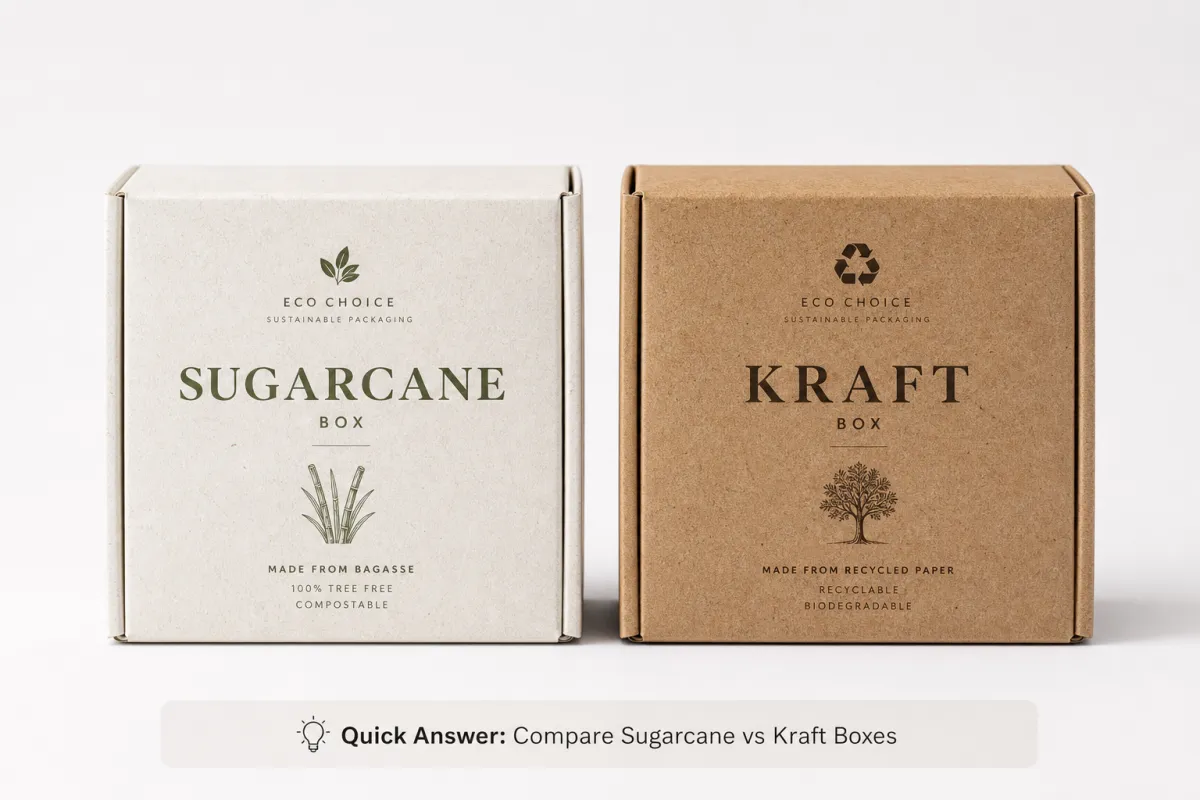
The short answer is pretty straightforward. For hot, greasy takeout, sugarcane usually feels sturdier than thin kraft unless the kraft version has the right liner or coating. Sugarcane is molded fiber, so the walls and base tend to act like one rigid piece rather than a set of scored panels. Kraft is a paper-based board that folds into many box styles, prints beautifully, and ships flat with excellent storage efficiency. The better choice depends on what the box carries, how long it sits before the customer opens it, and what happens after use. If you compare sugarcane vs kraft boxes from a buyer's point of view, sugarcane often wins on heat and moisture, while kraft usually wins on presentation and warehouse efficiency.
My rule is simple. Reach for sugarcane first if the package will face steam, sauce, condensation, or short-term cold storage. Reach for kraft first if the contents are mostly dry, the branding needs to carry a lot of visual weight, or the package doubles as part of the retail display. That keeps the decision grounded and makes it easier to compare sugarcane vs kraft boxes without turning the project into a materials seminar.
There is a basic construction difference worth spelling out. Sugarcane fiber is molded into a rigid form with a matte, fibrous surface. Kraft is board stock that gets die cut, scored, printed, and folded into the final shape. Both can be sustainable choices, but the raw fiber is only one piece of the story. The liner, coating, seam style, and closure all affect performance. If you have ever seen a box fail because oil found a path through the bottom panel, you already know why compare sugarcane vs kraft boxes should always include a real product and not just a spec sheet.
Fast buying rule: pick sugarcane first for wet, oily, or heat-heavy service; pick kraft first for dry, branded, or retail-facing packaging. If you need to compare sugarcane vs kraft boxes for a mixed menu or a broad product line, test both with the worst-case item, not the easiest one.
Top Options Compared: Sugarcane Trays, Kraft Boxes, and Lined Variants
The comparison gets a lot more useful once you stop talking about the material names in the abstract and look at the formats people actually buy. A molded sugarcane clamshell does not behave the same way as a sugarcane tray with a separate lid. A plain kraft tuck-top box is not the same as a kraft food box with a grease-resistant liner. If you compare sugarcane vs kraft boxes at the format level, the differences show up in stiffness, closure feel, and how much abuse the package can take before the customer notices.
From a packaging buyer's perspective, the common choices usually look like this:
- Molded sugarcane clamshells: strong top-load feel, useful for hot meals, and easy to stack in kitchen prep.
- Sugarcane trays with lids: practical for meal kits, sides, and trays that need a cleaner presentation.
- Unlined kraft tuck-top boxes: a solid choice for dry bakery, retail, and gift packaging where print matters.
- Kraft boxes with grease-resistant liners: better for food, though the liner changes both the cost and the disposal story.
- Coated kraft food boxes: helpful for moisture resistance, while the coating type can affect recyclability and compostability claims.
The biggest tradeoff is barrier performance. Sugarcane usually handles moisture and short-term heat well because the molded structure is forgiving. Kraft often needs a liner, coating, or internal insert to match that performance on wet or oily food. That added layer can improve function, but it also means the end-of-life claim needs a closer look. If you compare sugarcane vs kraft boxes only by the base fiber name, you can miss the part that shapes the customer experience: the liner, the seal, the edge treatment, and the closure.
Another thing I look at is the first ten seconds after filling. Sugarcane often has a uniform molded body that feels right for food service and nests neatly in prep areas. Kraft gives you more flexibility in structure, sharper print surfaces, and more closure styles, which explains why it shows up so often in branded retail programs. For many buyers, compare sugarcane vs kraft boxes really means deciding whether the package needs to behave like a food-service vessel or a presentation piece.
The table below gives a practical side-by-side view based on the formats I see most often in custom packaging programs.
| Feature | Sugarcane Trays / Clamshells | Kraft Boxes / Lined Kraft |
|---|---|---|
| Moisture resistance | Strong for hot, moist, or steamed food | Plain kraft is weaker; lined kraft improves performance |
| Print quality | Limited compared with board print surfaces | Excellent, especially for retail branding |
| Stacking and prep | Rigid and easy to handle in food-service settings | Very good when flat packed; depends on box style |
| Grease resistance | Generally better without extra treatment | Often needs coating or liner |
| Storage footprint | Bulkier in storage and shipping | Usually better because it ships flat |
| Best use case | Hot meals, takeout, steam-heavy deliveries | Dry goods, bakery, retail, premium presentation |
Packaging.org has useful general guidance on material choices and fiber packaging trends, and the EPA's recycling information is worth checking if your disposal claim matters to your customers. For source fiber questions, FSC's certification guidance is also a solid reference. If you want transit performance context, ISTA's testing standards are worth a look at ISTA and general material stewardship resources are available through the EPA recycling page. Those resources do not replace a real product test, but they do help you compare sugarcane vs kraft boxes with a more disciplined eye.
Detailed Reviews: What Each Material Gets Right and Wrong
Sugarcane, in practice, gets a lot right. It gives you a strong first impression, especially for hot and saucy meals that need a container with real body. The molded shape resists collapse better than a lot of plain kraft structures, and the tactile feel can read as premium in a food-service setting even without glossy print. Sugarcane also works well for items that need predictable geometry during transit. When a driver stacks three orders on top of each other, the box either holds its form or it does not, and sugarcane usually performs well there. If you compare sugarcane vs kraft boxes for takeout reliability, sugarcane often wins the simple abuse test.
There are drawbacks, and buyers should hear them plainly. Sugarcane can be bulkier to store and ship because the molded shapes do not nest as tightly as flat cartons. It is also not the strongest canvas for high-resolution branding. You can emboss, print, or label it in different ways, but you will not get the same crisp graphic surface you get from a well-printed kraft board. Consistency matters too. Some suppliers deliver very even edges and smooth forming, while others produce a more variable finish. That is one reason I always tell buyers to inspect a sample with the actual lid closed and the actual food inside before they compare sugarcane vs kraft boxes based on appearance alone.
Kraft is strong in a different way. It prints beautifully, converts into a wide range of shapes, and ships flat, which makes warehouse math easier. For dry goods, pastries, small gifts, and retail packaging, kraft often gives you the better brand story because it offers sharper graphics and stronger shelf presence. There is also a reason so many custom box programs are built around kraft board: it is familiar to converters, it cuts and scores cleanly, and it scales well when the order size changes. If your package is mostly about presentation, you will probably compare sugarcane vs kraft boxes and find kraft easier to brand.
Kraft has weak points that are easy to underestimate. Plain kraft can soften, warp, or show oil faster than many buyers expect. A sauce-heavy meal will expose that weakness quickly, especially if the box sits under heat or in a warm car for more than a few minutes. Once coatings or laminations enter the build, the disposal question gets more complicated. That does not make coated kraft a bad choice. It just means the full construction matters. If you compare sugarcane vs kraft boxes on function alone, plain kraft is often less forgiving unless the design accounts for grease, vapor, and hold time.
"I trust a packaging sample only after it has been filled, stacked, and left alone long enough to show me what the customer will actually see."
That is still the best test. I like to judge packaging after fill, after 15 minutes, after stacking, and after delivery. A box that looks perfect on a desk can fail the moment the lid meets condensation or the bottom panel absorbs oil. In a real program, compare sugarcane vs kraft boxes using the same product, the same portion size, and the same delivery window. Anything less invites false confidence.
For buyers who want more control over structure and customization, it can help to look at options beyond the two base materials and compare them with other Custom Packaging Products that support inserts, sleeves, or branded outer wraps. Sometimes the best result is not a single perfect box. Sometimes it is a package system built around the right material in the right place.
Price Comparison: Compare Sugarcane vs Kraft Boxes by Cost
Price deserves a careful look because the headline unit price rarely tells the full story. Raw material, tooling, print coverage, barrier layers, freight, storage volume, and damage rates all affect the final number. If you compare sugarcane vs kraft boxes using only the quoted per-unit price, you can easily miss the freight and warehousing savings that flat-packed kraft provides, or the barrier savings that sugarcane sometimes brings on messy food programs.
In many programs, kraft appears cheaper at first glance because it is widely converted and easy to print in volume. A simple kraft tuck-top or food tray can often land in a lower price band than a custom molded sugarcane item, especially on small or mid-size runs. For a 5,000-piece order, I would expect rough pricing ranges like these, depending on style and print coverage:
- Unlined kraft box: about $0.12-$0.24 per unit
- Printed kraft box with modest coating: about $0.18-$0.35 per unit
- Basic molded sugarcane tray or clamshell: about $0.16-$0.30 per unit
- Custom sugarcane format with tighter spec control: about $0.22-$0.42 per unit
Those are not universal numbers, and they should not be treated like a quote. They are planning ranges based on common custom packaging conditions. The real number depends on size, mold complexity, print area, local supply, and the amount of barrier treatment needed. A plain kraft box may look cheaper than sugarcane, but if you have to add a grease-resistant liner, a sleeve, or an insert, the total landed cost can move closer than expected. That is why experienced buyers compare sugarcane vs kraft boxes on total cost per usable packed unit, not the bare carton price.
Sugarcane can also be competitive on total cost in a food program because it may reduce the need for extra barrier layers. If you are trying to keep fries crisp, sauces contained, and steam from collapsing the container, that functional advantage can offset a slightly higher molded unit price. The savings show up in fewer complaints, fewer replacements, and less secondary packaging. A box is never just a box. It is also the failure rate it avoids. That is hard to capture in a spreadsheet, but it matters every time you compare sugarcane vs kraft boxes.
MOQ and setup costs matter too. Custom sugarcane projects may involve more tooling and longer sample coordination, especially if the form is not standard. Printed kraft often scales more easily for shorter or mid-size runs because the workflow is familiar and the print process is well established. Here is the purchasing shortcut I use: compare the quotes at the same quantity, same closure type, same print coverage, and same barrier level. If one sample has an inner liner and the other does not, the comparison is already tilted. To compare sugarcane vs kraft boxes honestly, you need the same assumptions on both sides.
| Cost Factor | Sugarcane | Kraft |
|---|---|---|
| Base unit price | Often mid-range, sometimes higher for custom molds | Often lower on simple styles |
| Freight efficiency | Less efficient due to molded bulk | Stronger because it ships flat |
| Extra barrier needs | Usually fewer extras for hot food | Often needs liner or coating for greasy items |
| Setup and tooling | Can be higher on custom shapes | Usually easier on standard folds and print runs |
| Total landed cost | Can be very competitive for food service | Can be very competitive for dry retail packs |
If your order volume is small, freight can swing the economics more than the box itself. A flat kraft carton may save on storage, but it may need more build complexity to survive moisture. A sugarcane tray may cost a bit more per unit, but it could reduce the need for extra packaging steps. That is the sort of tradeoff I want buyers to see before they compare sugarcane vs kraft boxes and lock themselves into the cheapest-looking quote.
Process and Timeline: From Sample to Production
The ordering process usually starts with the basics: product dimensions, fill weight, closure style, print needs, and disposal expectations. Then the supplier matches the format to the material, reviews the dieline or mold needs, and sends samples. After that comes approval, production, packing, and freight. Simple enough. Still, every step has a place where time can slip, and that matters if you are trying to launch a menu or retail line on a fixed schedule. If you compare sugarcane vs kraft boxes early, you can usually avoid the biggest timeline surprises.
Sugarcane can take longer when the project is highly customized. Molded fiber products may require more coordination on tooling, sample matching, and production tolerances. If the shape, compartment count, or lid fit is unique, expect more back-and-forth before final approval. I would rather see a buyer spend a few extra days on the sample than discover a fit issue after production starts. In practical terms, custom molded sugarcane can often need 15-25 business days from proof approval, and more if tooling changes are required. That is not a warning to avoid sugarcane. It is simply part of how you compare sugarcane vs kraft boxes intelligently.
Kraft often moves faster on standard folds and common food-box structures because the tooling is more familiar and the conversion process is straightforward. A simple printed kraft project can sometimes move through sampling and production faster than a molded item, especially when artwork is ready and the spec is not unusual. But that speed advantage fades if you add special coatings, windows, inserts, or complicated board combinations. Then the timeline can stretch enough to rival a custom molded job. So yes, kraft is often quicker, but not always. If you compare sugarcane vs kraft boxes only by material name, you might misread the production path.
I also recommend building in time for actual product testing. Do not approve a box just because it looks right. Fill it. Close it. Stack it. Shake it a little. Let it sit for 10 to 20 minutes. If you can, test a sample through the same delivery path your customer will experience. That might mean warm food in a bag, a cold item in a refrigerated truck, or a retail product under display lighting. A good supplier should support this process and should be willing to adjust details before the full run begins. That is the point where compare sugarcane vs kraft boxes becomes a useful project instead of a guessing exercise.
A practical delay-prevention checklist looks like this:
- Confirm exact box dimensions and product fill before sampling.
- Approve artwork early, especially if print coverage is heavy.
- Ask for food-contact, barrier, and disposal details in writing.
- Run a test with the real product, not an empty sample.
- Leave time for one revision round if fit or structure needs adjustment.
If you follow that sequence, the ordering process stays cleaner. It also helps you compare sugarcane vs kraft boxes on a fair timeline basis instead of comparing one material's ideal lead time with the other's complicated production path.
How to Choose Between Sugarcane vs Kraft Boxes
The easiest way to choose is to begin with the product, not the packaging trend. Choose sugarcane for hot meals, greasy items, steam-heavy delivery, and anything that needs real structure during transport. Choose kraft for dry goods, bakery items, premium retail packaging, gift boxes, and programs where the printed brand experience matters as much as the container itself. That is the practical way to compare sugarcane vs kraft boxes without drifting into theory.
Another important check is the actual disposal path in your market. Recycling and composting rules vary, and the marketing language on a box does not override local acceptance. A coated kraft box may not be as simple to recycle as the sales sheet suggests. A sugarcane tray may be marketed as compostable, but the local facility may not accept it. That is not a packaging failure; it is a systems issue. Still, from a buyer's point of view, it belongs in the decision. If you compare sugarcane vs kraft boxes honestly, disposal claims must be tested against the region where the product will be used.
Operational fit matters just as much as material choice. Think about packing speed, storage footprint, stacking stability, and how the box behaves in a busy kitchen or on a retail line. Sugarcane often feels better in a food-service workflow because it is rigid and easy to handle, but it can take up more storage room. Kraft is usually easier to stage because it ships flat, but it may need more steps if barrier performance is a concern. I would also ask how the box feels after a second handoff. Will the driver carry it? Will the customer place it in a bag? Will the lid stay clean? Those small details are where you really compare sugarcane vs kraft boxes with confidence.
A short decision list helps:
- Product condition: hot, wet, greasy, dry, fragile, or premium.
- Branding goal: natural, minimal, bold print, or retail showcase.
- Cost ceiling: unit cost, freight, storage, and any secondary packaging.
- Lead time: standard print job or custom molded build.
- Disposal claim: recyclable, compostable, or locally accepted fiber recovery.
If those five points all point to the same answer, you are in good shape. If they point in different directions, slow down and sample both materials. That is usually the smartest place to compare sugarcane vs kraft boxes, because the right package often emerges only after you see how it behaves with your actual product.
For a buyer who needs a broader view of custom packaging choices, the strongest programs often combine the right outer box with the right insert, sleeve, or branded accessory. That is where a packaging partner can help you think through the full pack system instead of treating the box as a stand-alone item. The goal is not only to pick a material. The goal is to build a package that works in the hand, in transit, and at the Point of Sale.
Our Recommendation: Compare Sugarcane vs Kraft Boxes in a Real Pilot
My practical recommendation is clear. If the box must survive heat, moisture, or greasy food, lead with sugarcane. If the box is dry, branded, and budget-sensitive, lead with kraft. That is the cleanest starting point, and it holds up well in real production. I would not stop there, though. The best answer usually comes from a pilot, not a guess. Order samples of both, pack the same product, and compare appearance, failure points, and customer handling. If you compare sugarcane vs kraft boxes in a controlled pilot, you will learn more in one afternoon than you will from a stack of spec sheets.
Here is the testing checklist I trust most:
- Fill test: pack the box with the actual item and standard portion size.
- Stack test: place realistic load on top and check top-load stability.
- Transit test: move it through the same delivery path or shipping method.
- Hold test: wait 10 to 20 minutes and inspect for oil, steam, or warp.
Ask for two or three quote tiers as well: low volume, mid volume, and target scale. That gives you a clearer view of where the economics shift between the materials. Sometimes sugarcane wins on small food-service runs because it avoids barrier add-ons. Sometimes kraft pulls ahead once print volume rises and shipping efficiency becomes more valuable. The only honest way to compare sugarcane vs kraft boxes is to look at the numbers alongside the actual performance.
If I had to reduce the decision to one line, it would be this: choose the package that protects the product first, supports the brand second, and fits the disposal reality third. That order matters. Too many buyers reverse it and then spend months fixing complaints, replacements, or cost overruns. Compare sugarcane vs kraft boxes with your real item, your real lead time, and your real end user, then pick the structure that holds up in the field.
Which performs better for greasy food when you compare sugarcane vs kraft boxes?
Sugarcane usually holds up better because the molded fiber structure resists softening and gives the food more support during delivery. Kraft can work well if it has the right grease-resistant liner or coating, but that adds cost and can complicate recycling or composting claims. For saucy, hot, or steam-heavy meals, test the box with the actual menu item before deciding. If you compare sugarcane vs kraft boxes for fried foods or saucy entrees, sugarcane is often the safer first sample.
Are sugarcane boxes more compostable than kraft boxes?
Not automatically. Both depend on the full construction, including inks, coatings, adhesives, and any laminated layer. Sugarcane fiber is often marketed as compostable, but local acceptance varies and contamination from food can affect disposal options. Kraft boxes may be recyclable or compostable if they are plain enough, but barrier treatments can change the end-of-life path. Before you compare sugarcane vs kraft boxes on compostability, check local rules and the exact material build.
Which is cheaper for small orders: sugarcane or kraft boxes?
Kraft is often cheaper for small runs because it is widely converted and easier to print or fold without custom tooling. Sugarcane can carry higher upfront setup costs, especially for molded or custom-shaped formats. The best small-run comparison should include shipping, storage, and any extra liners or inserts needed for performance. If you compare sugarcane vs kraft boxes on a small order, do not stop at the quote line that shows unit price only.
How do lead times compare for sugarcane vs kraft boxes?
Kraft usually moves faster when the design uses standard folding and printing methods. Sugarcane can take longer if tooling, mold approval, or sample matching is involved. Complex kraft projects with coatings or special inserts can still take substantial time, so confirm the full production path early. When buyers compare sugarcane vs kraft boxes on timing, the biggest variable is usually customization, not the base material by itself.
Which looks better for branding when you compare sugarcane vs kraft boxes?
Kraft usually offers stronger print clarity, sharper graphics, and more premium visual control. Sugarcane often looks more natural and functional, which can support an eco-forward story but may not deliver the same print detail. If brand presentation is critical, ask for printed samples on both materials before locking the order. The visual answer can shift a lot once you compare sugarcane vs kraft boxes with the actual logo, ink coverage, and finish in hand.
If you compare sugarcane vs kraft boxes using your actual product, a real hold test, and a disposal claim that matches your market, the choice becomes much easier. That is the method I trust: sample both, test both, price both honestly, and choose the one that works for the package, the customer, and the operating conditions. Compare sugarcane vs kraft boxes that way, and you are far less likely to end up with a box that looks good in theory but falls short where it counts.
The clearest takeaway is simple: sugarcane is usually the better fit for hot, wet, or greasy food, while kraft is usually the better fit for dry, branded, and storage-efficient packaging. Start with those assumptions, then verify them with a real sample run so the final choice matches the product instead of the pitch.