Buyer Fit Snapshot
| Best fit | compostable courier bags manufacturer for packaging buyers comparing material specs, print proof, MOQ, unit cost, freight, and repeat-order risk where brand print, material, artwork control, and repeat-order consistency matter. |
|---|---|
| Quote inputs | Share finished size, material target, print colors, finish, packing count, annual reorder estimate, and delivery region. |
| Proofing check | Approve dieline scale, logo placement, barcode or warning zones, color tolerance, and any recyclable or compostable wording before bulk production. |
| Main risk | Vague material claims, crowded artwork, or missing packing details can create delays even when the unit price looks attractive. |
Fast answer: Compostable Courier Bags Manufacturer: Key Things to Know should be specified like a repeatable production item. The safest quote includes material, print method, finish, artwork proof, carton packing, and reorder notes in one written spec.
What to confirm before approving the packaging proof
Check the product dimensions against the actual filled item, not only the sales mockup. Ask for tolerance on folds, seals, hang holes, label areas, and retail display edges. If the package carries a logo, QR code, warning copy, or legal claim, reserve that space before decorative graphics fill the panel.
How to compare quotes without losing quality
Compare board or film grade, print process, finish, sampling route, tooling charges, carton quantity, and freight assumptions side by side. A lower quote is only useful if the supplier can repeat the same color, closure quality, and packing count on the next order.
Compostable Courier Bags Manufacturer: Key Things to Know
A bag can carry the right logo and still fail on the line. A corner tears, the seal pops, the adhesive strip lifts after a hot van ride, and the customer is left with crushed contents and a claim to file. That is why selecting a compostable courier bags manufacturer is not a sticker exercise; it is a test of material specs, seal behavior, print compatibility, and disposal claims that have to survive real handling after the parcel leaves your warehouse. For e-commerce brands, subscription boxes, and retail shipments, the difference between a capable supplier and a weak one shows up quickly: split seams, scuffed graphics, and support tickets that swallow the savings you thought you gained from greener packaging.
Brands trying to cut packaging waste often turn to compostable mailers as part of a broader eco-friendly packaging plan. The detail that gets missed is simple and costly. Not every bag labeled compostable belongs in the same disposal stream, and not every compostable courier bags manufacturer can prove the claim with documents that stand up to scrutiny. That makes the buying process less glamorous than a marketing brief would suggest. Evidence matters more than slogans, and a supplier worth your time should be comfortable living with that fact.
What a compostable courier bags manufacturer actually makes
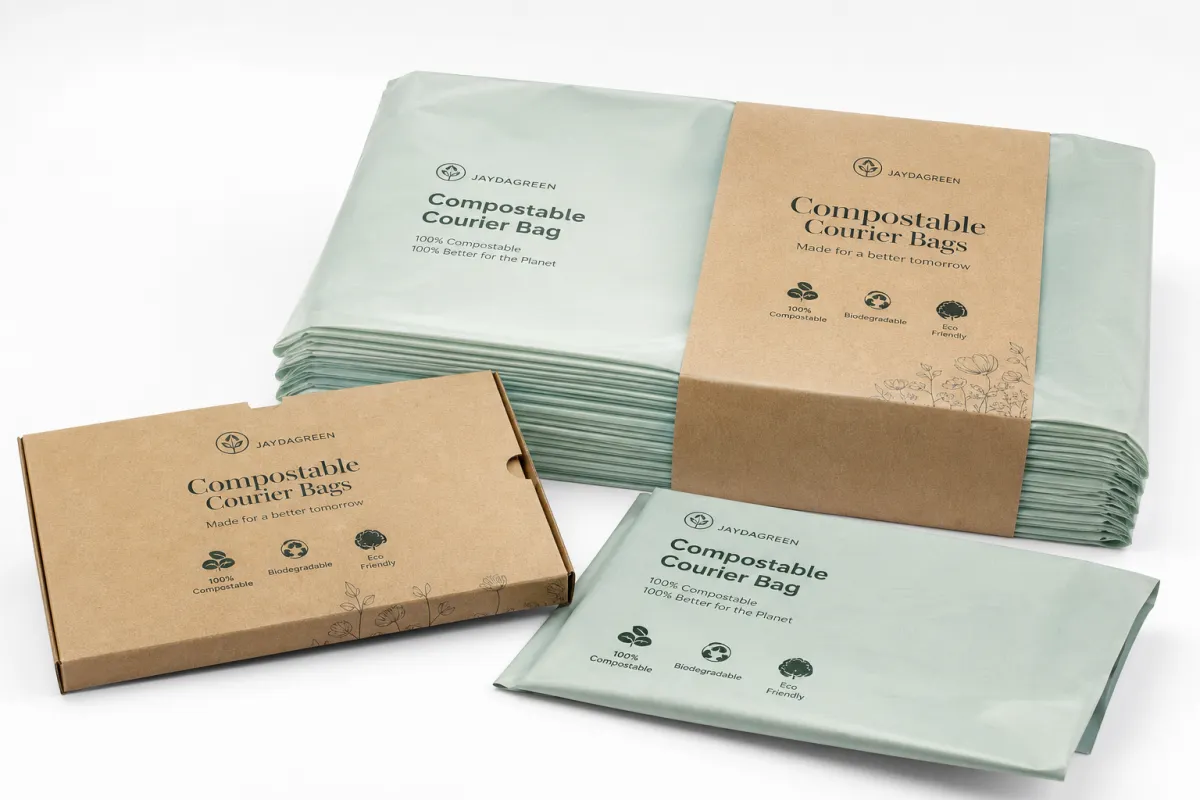
Start with the obvious problem: a courier bag can look environmentally responsible and still fail in transit. The seal may split, the film may stretch too far, or the print layer can turn brittle after a week in a warm warehouse. A good compostable courier bags manufacturer is not simply producing a bag with a leaf graphic. They are balancing film formulation, bag structure, adhesive behavior, print method, and shipment durability so the bag survives courier handling first and breaks down later under the right conditions.
In plain English, compostable courier bags are mailer bags designed to break down into natural components under specific composting conditions. That usually means industrial composting, not a fantasy where a bag disappears in a backyard after two rain showers and a hopeful caption. The distinction matters because buyers often mix up compostable, biodegradable, recycled, and conventional plastic mailers. Those words are not interchangeable, even when the packaging copy makes them sound close enough to pass.
Here is the short version:
- Compostable means the material is designed to break down within a defined composting standard and timeframe.
- Biodegradable is broader and looser; it does not always tell you where, how fast, or under what conditions the item breaks down.
- Recycled mailers reduce virgin material use, but they do not automatically break down in composting.
- Conventional plastic mailers are durable and cheap, but they are not the right fit for brands chasing zero-waste goals.
A serious compostable courier bags manufacturer should be able to explain the bag structure and what each layer does. A film might use a plant-based blend, yet the final bag still depends on gusset width, seal profile, tear resistance, opacity, and whether the adhesive strip holds under dust and humidity. That is part material science and part packaging engineering. It is also where weak suppliers are exposed, usually by the third sample rather than the first.
From a buyer's point of view, the manufacturer controls five things that matter most: film formulation, bag construction, sealing quality, printing method, and certification support. If one of those slips, the whole order gets expensive. A clean-looking sample means very little if the bag creases, peels, or fails after a courier scan-and-drop cycle. That is the trap: packaging can look polished in a photo and behave badly in a depot.
A green label is cheap. A failed shipment is not.
If you want a practical benchmark, ask whether the supplier can support standards such as ASTM D6400 or EN 13432, and whether they can speak clearly about disposal conditions in the markets you sell into. For composting guidance in the United States, the EPA composting guidance is a useful place to start. A real compostable courier bags manufacturer should treat that conversation as part of the job, not as a nuisance.
How compostable courier bags work from resin to shipment
The production flow looks straightforward on paper and less charming in a factory. A compostable courier bags manufacturer usually starts with raw resin or a compostable blend, then moves through film extrusion, bag converting, sealing, printing, inspection, and packing. Each step changes how the bag performs later. If the blend is off, the film can become brittle. If extrusion is inconsistent, thickness wanders. If sealing temperature drifts, weak seams show up where you least want them.
The hard part is balance. Compostable courier bags need enough strength to survive shipping, but they also need to break down under the correct composting conditions. Too weak, and the bag fails before it reaches the customer. Too stiff or overbuilt, and the bag may travel well while losing efficiency in the very sustainability story that justified it. A good compostable courier bags manufacturer understands that the goal is not “feels tough in the hand.” The goal is “holds up in transit and still meets the disposal standard.” Those are not the same thing.
Composting is not magic. Industrial composting usually depends on heat, moisture, oxygen, and microbial activity. That is why disposal route matters so much. A bag that meets a compostability standard in a controlled facility may behave very differently in a backyard pile, in a landfill, or in a recycling bin where it never belonged. Buyers who ignore that nuance often end up buying trouble with a nicer label.
From a performance standpoint, you want to ask a compostable courier bags manufacturer about four basic tests:
- Drop resistance so parcels survive ordinary handling and short falls.
- Seal strength so the adhesive or heat seal does not peel open in storage or transit.
- Puncture resistance so box corners, edges, and sharp inserts do not punch through.
- Storage stability so the bags remain usable after sitting in a warehouse for weeks.
Storage is where many buyers get surprised. Heat, humidity, and direct sunlight can age compostable films faster than people expect. A bag that sits near a loading bay window or in a hot stockroom can become less forgiving over time. That does not mean compostable mailers are fragile by default. It means they need the same common-sense storage discipline you would give any serious packaging spec. If a supplier shrugs at that question, keep looking.
For broader packaging context, industry resources such as ISTA testing standards matter because courier bags do not live in a lab. They live in trucks, depots, shelves, and on doorsteps. A compostable courier bags manufacturer worth paying attention to should talk like they know that. Packaging that ignores the route is just a theory in film form.
How do you choose a compostable courier bags manufacturer?
Most buyers begin with price. Fair enough. Price without specs is just a number attached to a guess, though, and packaging guesses are expensive in the wrong places. A better way to compare a compostable courier bags manufacturer is to look at the material, proof, construction, branding, and scale together. That gives you a realistic read on whether the supplier can support your business without turning reorders into a slow-motion headache.
Material composition comes first. Ask what the bag is made from, what percentage is compostable, and what disposal claim the material actually supports. If the supplier cannot explain the blend in plain language, that is a warning sign. If they can, ask for a spec sheet, not a slogan. A bag that is “plant-based” is not automatically a bag that performs well. A bag that is “compostable” still needs proof tied to a standard, a test method, and a real-world use case.
Certifications and standards matter because they separate verified claims from marketing gloss. Good suppliers can provide copies of certifications, test reports, or standard references without making the process feel like a hostage negotiation. A reliable compostable courier bags manufacturer should be ready to discuss recognized standards, the region where the bag will be sold, and whether the claim is suitable for industrial composting only. If the answer sounds fuzzy, that fuzziness usually shows up later in legal review or customer complaints.
Sizing and construction need real attention. A mailer that is technically compostable but the wrong size is still the wrong bag. Compare gusset width, seal type, opacity, and available print area against the products you actually ship. A fashion brand shipping lightweight apparel has different needs from a beauty brand shipping bottles, and both are different again from a subscription kit with sharp inserts and mixed materials. A one-size-fits-all spec rarely fits anything well for long.
Branding and print compatibility are another practical filter. A compostable courier bags manufacturer should tell you whether your logo, one-color line art, or full-coverage print will hold up without harming the bag's compostability claim. Not every ink system behaves the same way. Not every artwork layout looks good on a soft film. A bad print job can make an otherwise decent package look cheap in the one place customers notice most: the doorstep.
Production scale is where a lot of buyers get caught. A manufacturer may be excellent at samples and uneven at repeat orders. Ask about minimum order quantity, reorder consistency, and whether custom sizes trigger a new setup every time. The best suppliers reduce drama on the second, third, and fourth order. That is the real test. A supplier who cannot handle scale is not really a long-term compostable courier bags manufacturer; they are a sample shop with a good sales deck.
Here is a quick comparison matrix for what buyers usually see:
| Supplier Type | Typical Strength | Common Weak Spot | Best For |
|---|---|---|---|
| Low-volume custom shop | Flexible artwork and small runs | Higher unit cost and slower repeat consistency | Testing a new market |
| Mid-size compostable courier bags manufacturer | Balanced pricing and stable production | May limit unusual specs | Brands scaling from pilot to regular orders |
| Large-volume producer | Better unit economics at scale | Higher minimums and less flexibility | Established e-commerce programs |
The point is not to find the “best” supplier in a vacuum. It is to find the compostable courier bags manufacturer whose strengths match your order size, disposal claim, and shipping profile. That is the part buyers often skip because they are chasing a lower quote. Then the samples look beautiful and the warehouse team complains as soon as the first full pallet arrives. Packaging has a way of humiliating shortcuts.
Compostable courier bags manufacturer pricing: what drives cost
Pricing is where theory gets hit by reality. A compostable courier bags manufacturer usually charges more than a basic PE mailer supplier because the resin, testing, compliance work, and process control are more demanding. That does not mean the bag is overpriced. It means the inputs are different. Buyers who compare compostable mailers against the cheapest plastic bag on the market are not comparing the same product category. That is how people end up disappointed and oddly offended by chemistry.
The main price drivers are easy to list and annoying to ignore. Material cost is the largest one, followed by bag thickness, size, print complexity, certification requirements, and order volume. If you want a simple rule, bigger bags cost more, thicker bags cost more, and more print colors cost more. A custom compostable courier bags manufacturer also has to account for testing, setup, and quality control. Those costs do not disappear just because the order is small.
Small runs hurt per-unit pricing. That is normal. At low volume, the setup cost gets spread across fewer pieces, so unit prices feel painfully high. A run of 3,000 custom bags may cost materially more per unit than 20,000 or 50,000 pieces, even if the bag itself is identical. That is not a scam. It is math. A supplier who promises bulk pricing on a tiny order is either taking a loss or hiding something in the spec.
Custom features add cost faster than many buyers expect. Examples include:
- Extra print colors or full-coverage graphics
- Stronger adhesive strips
- Tear strips or zipper-style closures
- Hang holes or retail-ready perforations
- Special barrier layers for odor control or moisture resistance
There are also hidden costs. Freight can change the landed price more than the quote itself, especially on bulky bags. Tooling and plates may be charged separately. Sampling usually has a cost if the design is custom. If the spec is vague, testing can become an expensive guessing game. A careful compostable courier bags manufacturer should flag these early instead of burying them in fine print after you have already approved the artwork.
For practical expectations, buyers should assume compostable bags cost more than standard poly mailers, especially at low volume. Rough ranges for custom production often look something like this, depending on size, thickness, and print coverage:
| Order Size | Typical Unit Range | What Affects It Most | Lead Time Pressure |
|---|---|---|---|
| 3,000-5,000 pieces | $0.18-$0.35 each | Setup, sampling, artwork | Higher, because small changes are expensive |
| 10,000-20,000 pieces | $0.11-$0.24 each | Material grade, print complexity | Moderate, if specs stay stable |
| 50,000+ pieces | $0.07-$0.16 each | Material efficiency, production speed | Lower per unit, but planning matters more |
Those numbers are not a promise. They are a practical buying range. A premium print finish, a special size, or a stricter certification package can move the price up quickly. So can freight, especially if you are importing. A sensible compostable courier bags manufacturer will walk you through the total landed cost instead of pretending the bag price is the whole story. That is a more honest conversation, which is probably why it shows up less often than it should.
Step-by-step process and timeline for ordering compostable courier bags
Ordering custom mailers is never just “send artwork, get boxes.” A serious compostable courier bags manufacturer will guide you through a sequence that usually includes the brief, quote, sample, revision, approval, production, and shipment. If the supplier claims you can skip most of that, they are either very fast or very careless. Usually it is the second one, dressed up in a quick reply.
Start with a buyer brief. Be specific. List dimensions, target load weight, whether the bag needs a glossy or matte finish, how much print coverage you want, what market the bags will ship into, and what disposal claim you plan to make. If you are vague at the start, the sample will be vague too. And vague samples waste time because everyone has to reinterpret them later. A good compostable courier bags manufacturer can work from a clear brief much faster than from a mood board and a sentence like “make it feel premium.”
After quoting, request physical samples. Do not inspect them like art objects. Test them like shipping tools. Put in your actual products, tape the flap, drop the parcel from a sensible height, and see what happens. If you ship liquids, powders, sharp boxes, or mixed SKUs, test those exact items. A desk sample that looks great in your hand means little if the bag bursts after a courier sortation belt does its usual rude little dance.
A realistic timeline often looks like this:
- Quote and spec alignment: 2-5 business days if the brief is complete.
- Sampling and artwork proofing: 5-10 business days, sometimes longer for custom sizes.
- Revision and final approval: 2-7 business days, depending on how many people need to sign off.
- Production: often 12-20 business days for standard custom runs, longer for complex print or large volumes.
- Shipping: add local transit time or international freight time, plus customs if the order crosses borders.
The biggest delay points are almost always artwork changes and certification questions. If marketing keeps changing the logo size every three days, production slows down. If compliance wants clearer documentation, the supplier has to pause and gather proof. That is why an experienced compostable courier bags manufacturer asks for a locked spec before production starts. They are not being difficult. They are trying to prevent the classic “we made 50,000 bags and now the logo is wrong” disaster.
One practical move saves a lot of pain: use the first order as a pilot. Start with one product line, one region, or one shipment channel. Validate how the bag handles warehouse storage, courier handling, and customer feedback. Then scale. That approach reduces risk and gives you real data instead of optimistic guesswork. For eco-friendly packaging programs, this is usually the fastest way to improve your carbon footprint without setting your operations team on fire.
From a sourcing angle, I would rather see a buyer launch a smaller, well-tested order with a reliable compostable courier bags manufacturer than rush a large run built on assumptions. The small order teaches you what the real shipping conditions are, how your print holds up, and whether the disposal story makes sense for your audience. That is much cheaper than learning it after a warehouse full of bags has already been delivered.
Common mistakes buyers make with compostable courier bags
The biggest mistake is simple: buying on the word compostable alone. That word is not a full specification. It does not tell you the standard, the test method, the composting environment, or whether the claim is relevant in your market. A good compostable courier bags manufacturer should be able to support the claim with documents. If they cannot, the label is doing too much work.
Another common error is choosing a bag that looks sturdy but fails after packing. People touch a sample, like the hand feel, and assume the thickness is enough. Then the product weighs more than expected, the box corners are sharper than expected, or the route has more handling than expected. Transit does not care about first impressions. It cares about seal integrity and puncture resistance. A supplier who knows this will ask for product weight, dimensions, and filling method instead of guessing.
Print and adhesive compatibility also get ignored. That is a costly oversight. A logo that peels, a flap that loses tack in cool storage, or a seal that lifts after dust contamination can make the whole package look cheap. This is where a technically competent compostable courier bags manufacturer earns their keep. They understand that branding is part of package performance, not a separate art project handed off at the end.
Storage is another quiet failure point. Compostable films can age if they sit too long in heat, humidity, or direct sunlight. A buyer who stores bags near dock doors or in poorly controlled stockrooms may see changes in flexibility and performance before the order is even used. That is not the supplier's fault every time. Sometimes it is just weak warehouse discipline. Still, a good supplier should give storage guidance, shelf-life expectations, and temperature warnings in writing.
Finally, people forget the disposal story. If your customer cannot access industrial composting, the sustainability claim becomes muddy fast. That does not mean the bag is worthless. It means the claim has to be honest and local. A compostable courier bags manufacturer that treats disposal as an afterthought is selling half a story. Half a story is usually enough to create awkward customer-service emails and compliance headaches.
A useful way to avoid mistakes is to slow down and ask for three things before you place the order:
- Proof: certification copies, test reports, and a clear material spec.
- Performance: sample bags tested with your actual product and shipping stress.
- Clarity: storage guidance, disposal guidance, and honest lead times.
That checklist does not eliminate every risk, but it cuts out the most expensive surprises. In sourcing, boring is good. Boring means predictable. Predictable means fewer replacements, fewer complaints, and less waste. That is the sort of circular economy progress buyers usually want, even if they do not phrase it that way during the first supplier call.
Expert tips and next steps for smarter sourcing
If you want a cleaner buying process, ask for the paperwork before you compare quotes. A serious compostable courier bags manufacturer should be able to provide a technical spec sheet, certification copies, and test summaries without making you chase them for a week. If those documents are missing, then the quote is just a guess with a price tag attached. I have seen too many buyers compare incomplete offers and call it sourcing. That is not sourcing. That is collecting problems in a spreadsheet.
Run a pilot with real parcels. Not desk samples. Real parcels. Use your actual product, your actual tape, your actual packing line, and your actual courier route. If a bag survives in the lab but fails on a wet Monday in your warehouse, the lab result does not matter much. A practical compostable courier bags manufacturer will respect that testing mindset because they know the bag lives in the real world, not on a spec sheet.
Build a simple vendor scorecard. It does not need to be fancy. Score each compostable courier bags manufacturer on five things: material proof, print quality, lead time, consistency, and after-sales support. Give each category a rating from 1 to 5. If the scorecard feels too basic, that is probably because basic tools are often the most useful. People love complicated procurement systems right up until they need a clear answer.
Also, pressure-test the supplier conversation. Ask how they handle custom sizes, how they manage reorders, what happens if a batch has a sealing issue, and how they store or ship finished bags to prevent degradation. Ask whether they can support longer-term planning if your order volume grows. A dependable compostable courier bags manufacturer will answer directly. A weak one will hide behind generalities and promise to “check with the team.” That phrase has ended more useful conversations than I can count.
If your brand is serious about green packaging, the next step is not to chase the cheapest quote. It is to find the supplier who can prove the bag, support the claim, and repeat the result. That is how compostable packaging fits into a broader carbon footprint strategy without turning into green theater. The right supplier can help with the practical side of eco-friendly packaging while still keeping the numbers honest.
For buyers who want to learn more about the team behind the packaging work, the About Custom Logo Things page is a useful place to start. If you need a broader sense of how the company thinks about custom print and packaging support, take a look at Custom Logo Things and compare it against the questions you plan to ask any compostable courier bags manufacturer. The best supplier conversations are the ones where you already know what good looks like.
If you are still narrowing vendors, the smartest move is to order a pilot, test the bag with your real shipping flow, and then scale only after you know the seal strength, print durability, and disposal claim all hold together. That is the real job of a compostable courier bags manufacturer, and it is the standard buyers should demand before they commit to a long run.
For more context on packaging standards and sustainability claims, the FSC website is useful when paper-based packaging enters the mix, especially if your broader program includes recyclable cartons or inserts. A compostable courier bags manufacturer should be able to explain where the mailer fits inside a larger packaging strategy instead of pretending one bag solves everything.
The right compostable courier bags manufacturer helps you buy less guesswork and more proof. That is the whole point. If the bags fit your products, survive transit, and match the disposal conditions in your market, then the higher unit cost can make sense. If they do not, you are paying extra for a nice story. That is waste in a cleaner font.
What should I ask a compostable courier bags manufacturer before placing an order?
Ask what material blend is used, what compostability standard it meets, and whether the claim is for industrial composting only. Request spec sheets, certification documents, and real sample bags. Also confirm minimum order quantity, lead time, print options, and storage guidance so you know what happens after approval.
Are compostable courier bags strong enough for e-commerce shipping?
Yes, if the thickness, seal design, and bag size match the product weight and transit stress. Test with your actual items, not just empty bags. Check puncture resistance, adhesive strength, and drop performance before you scale up, because courier handling is where weak packaging usually gets exposed.
How much does a compostable courier bags manufacturer usually charge?
Pricing depends on size, thickness, print complexity, certification requirements, and order volume. Small runs cost more per unit than bulk orders, and custom features can push the price up quickly. Freight, tooling, and sampling also move the total cost more than many buyers expect.
How long does it take to make custom compostable courier bags?
A typical order includes quoting, sampling, approval, production, and shipping. Simple runs can move faster, while artwork changes and certification checks usually slow things down. A pilot order is often the safest way to avoid delays and catch issues before a larger production run.
What is the biggest mistake people make when buying from a compostable courier bags manufacturer?
They treat compostable like the finish line instead of a claim that needs proof. They also skip real-world testing with their own products and shipping lanes. The third mistake is forgetting to verify how customers are supposed to dispose of the bags after use.

